Secretary of Education Speaks
 At the Department’s Education Stakeholders Forum Thursday, Secretary Duncan delivered a speech that can be summarized as “ESEA Reauthorization: Why We Can’t Wait.” After visiting approximately 30 states, dozens of schools and meeting with thousands of stakeholders on his Listening & Learning Tour, the Secretary has concluded that the time to move forward, together, on reauthorization is upon us. He believes strongly that we cannot waste a minute of this unprecedented opportunity to improve education in the United States, not just by turning around schools that are poorly serving their students, but by also making America’s many excellent schools even better and more globally competitive.
ON THE ARTS
“Let’s build a law that discourages a narrowing of curriculum and promotes a well-rounded education that draws children into the arts and sciences and history in order to build a society distinguished by both intellectual and economic prowess.”
ON THE PROPER ROLE OF THE FEDERAL GOVERNMENT IN EDUCATION
· “People want support from Washington but not interference. They want accountability but not oversight. They want national leadership but not at the expense of local control.”
· “The best solutions begin with parents, teachers and principals working together in the home and the classroom. Our role in Washington is to support reform by encouraging bold, creative approaches to addressing underperforming schools, closing the achievement gap, strengthening the field of education, reducing the dropout rate and boosting college access.”
ON CRITICISMS AND MERITS OF NCLB/ESEA THAT HE HAS HEARD
· “Teachers complain bitterly about NCLB’s emphasis on testing. Principals hate being labeled as failures. Superintendents say it wasn’t adequately funded. And many parents just view it as a toxic brand that isn’t helping children learn.”
· “Some people accuse NCLB of over-reaching while others say that it doesn’t go far enough in holding people accountable for results. I always give NCLB credit for exposing achievement gaps, and for requiring that we measure our efforts to improve education by looking at outcomes, rather than inputs.”
· “I also agree with some NCLB critics: the law was underfunded — it unfairly labeled many schools as failures even when they were making progress — it places too much emphasis on raw test scores rather than student growth — and it is overly prescriptive.”
· “The biggest problem with NCLB is that it doesn’t encourage high learning standards. In fact, it inadvertently encourages states to lower them. The net effect is that we are lying to children and parents by telling kids they are succeeding when they are not.”
HIS VISION FOR A NEW ESEA
· “In my view, we should be tighter on the goals – with clear standards set by states that truly prepare young people for college and careers – but we should be looser on the means for meeting those goals.”
· “We must be flexible and accommodating as states and districts – working with parents and non-profits — develop educational solutions. We should be open to new ideas and we should build on what we know works.”
· “We don’t believe that local educators need a prescription for success. But they do need a common definition of success — focused on student achievement, high school graduation and college. We need to agree on what’s important and how to measure it or we will continue to have the same old adult arguments – while ignoring children.”
WHY REAUTHORIZING ESEA IS URGENT
· “We want to be first in the world again and to get there we cannot waste a minute. Every year counts. Every class counts. Every child counts.”
· “We’ve had five decades of reforms, countless studies and repeated affirmations and commitments from the body politic to finally make education a national priority. And yet we are still waiting for the day when every child in America has a high quality education that prepares him or her for the future. We’re still waiting to get great teachers and principals into underperforming schools We’re still waiting for a testing and accountability system that accurately and fairly measures student growth and uses data to drive instruction and teacher evaluation. We’re still waiting for America to replace an agrarian 19th century school calendar with an information age calendar that increases learning time on par with other countries. We’re still waiting – and we can’t wait any longer.”
· “More than any other issue, education is the civil rights issue of our generation and it can’t wait — because tomorrow won’t wait – the world won’t wait – and our children won’t wait.”
CALLING YOUR ORGANIZATIONS AND MEMBERS TO ACTION
· “This is our responsibility and our opportunity and we cannot allow it to slip away….Education is everyone’s responsibility – and you who represent millions of people across this country with a direct stake in the outcome of reauthorization – have a responsibility as well – to step up and do more.”
· “Our task is to unite education stakeholders behind a national school reform movement that reaches into every town and city – and we need your help to do it.”
· “To those who say that we can’t do this right now – we need more time to prepare and study the problem – or the timing and the politics isn’t right – I say that our kids can’t wait and our future won’t wait.”
· “Let’s build a law that restores the honored status of educators – who should be valued as skilled professionals rather than mere practitioners and compensated accordingly. Let us end the culture of blame, self-interest and disrespect that has demeaned the field of education by recognizing the nobility of teaching and rewarding excellence.”
· “Let’s build a law that provides real accountability tied to growth and gain in the classroom – rather than arbitrary goals and harsh rhetoric – a law that encourages educators to work with children at every level – and not just the ones near the middle who can be lifted over the bar of proficiency with the least effort.”

 Each morning around 5:30AM my husband and I go for a walk. It is a tradition we started several years ago to get us away from the details of everyday. About 10 minutes into our walk yesterday morning I heard a tapping above our heads. We searched the trees and spotted a pileated woodpecker. Even with the fall leaf colors surrounding it, the brilliant red head jumped out. We stood there for several minutes watching it use it’s beak as a drill. My husband wondered aloud if we could go back to get the camera and return to take a picture before he moved on to another task.
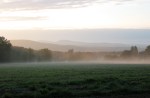
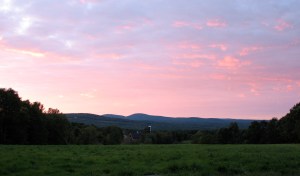 I am also conscious of my time and conversations with people. Life is to short not to smell the flowers, take in the landscape and reach out to others. During September I have taken a photo each day from the same spot looking at the same landscape at about the same time. What a collection I have! I have noticed the colors and how they change the field, sky, trees, mountain and farmland in my view.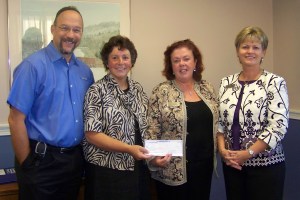

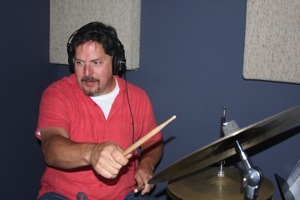 Please join me in CONGRATULATING BRAD for his accomplishments! Please

 Turning onto the Haystack road brings a smile to my face. Unloading the car, walking up onto the deck, looking down towards the flag pole with the water beyond is so special. Hellos and hugs follow rather quickly and before we know it we’re at work in a weekend studio. Much to fast the weekend is ending with the tour of studios and being amazed at the work that was accomplished in such a short time.
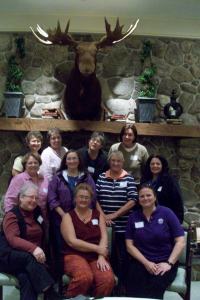
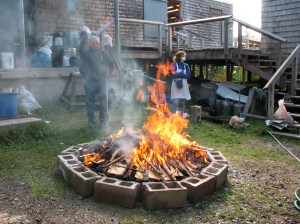 The 16 participants jumped in enthusiastically, previous experiences varying widely. We learned not only from Kathy and Mia but each other. We started our Friday afternoon session learning the possibilities for pit and barrel firings with an overview of the history and looking at several examples. We quickly went to work creating new work and working on surfaces of bisqueware.
 We also learned how to burnish or alter the surface with a thousands of year old idea called Terra sigillata that was used on the early Greek pottery.
 Saturday evening we fired our barrel’s continuing the learning, exchanging of ideas and experimenting to enhance our knowledge. These took about 2 hours to burn down a fair amount in our trashcans.
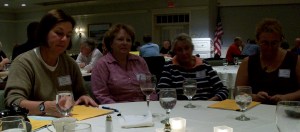
 The opportunities to talk about art education were endless. I can’t think of a better way to spend a beautiful weekend talking about teaching and learning than with a group of art educators who are passionate and dedicated to education!

 me arts ed