Archive for October, 2009

h1

“The Arts Connect” Conference Continues:Part XXIIII – Andrea Peterson

October 26, 2009

Keynote Speaker Andrea Peterson by Carol Trimble
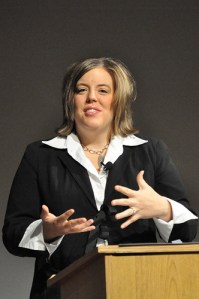
Andrea Peterson

Andrea Peterson

Oh, what a great celebration we had at The Arts Connect. Now, 2 weeks later, I’m still thinking of the connections I made with so many participants–seeing people I hadn’t seen in a while; viewing artwork on cell phones; hearing about ideas, students, and programs, and meeting new people.

I’m also still thinking about keynote by Andrea Peterson (2007 National Teacher of the Year), especially the stories she told about her students. I keep thinking about the boy who fixed the pencil sharpener (reminding me to notice and respect everyone’s individual way of contributing to our world) and the child who felt “like the National Student of the Year” (reminding me of the enormous impact teachers can have on a student’s view of his/her own life). All of us who teach have favorite–and equally moving–stories about our students.

Andrea Peterson’s keynote reminded me how powerful it can be to share those stories—amongst ourselves so we can acknowledge to each other the importance of the work that educators do—but also how important it is to share those stories with others who may not yet know the many ways that arts education can have a critical and transformative effect on students’ lives. I’m interested in hearing YOUR stories about YOUR students. Please send them to me at ctrimble@maineartsed.org .
h1

“The Arts Connect” Conference Continues: Part XXIII – Susan Potters

October 25, 2009

Workshop: Community Connections: Nuts, Bolts And Freebies – by Brooke Holland

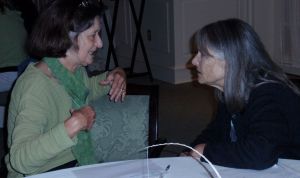
Gail Scott, conference evaluator and Susan Potters, workshop facilitator

Gail Scott, conference evaluator and Susan Potters, workshop facilitator

Art enriches our lives and helps us better understand the world we live in.  The question is: How do we bring more art to our schools, especially in this economy? Getting art in our schools without paying or with paying little might be easier than we think. The school’s focus should be on connections. Our connections from school can be initiated by teachers, parents or volunteers. They, in turn need to connect with people in our community such as artists, PTO, art organizations, grants and business sponsors.

First the school needs to rally their art advocates, and the best people to reach are the parents. They play a vital role and can help organize meetings, research and design grant proposals, find artists and check on their quality, raise money, advertise and document the event. Parents are important and can make arts in the school take priority.

Who should you contact to get the arts in our schools? Try the artists themselves. As a start, speak to the universities and ask them if they have some young artists who can share their work; parents or grandparents who are artists and local artists might be willing to come in and talk with classes. This gets the artist’s work and name out and you can further help the artist by taking a picture and sending a press release to the paper. You may also try an exchange of services by providing a place to show their art work or  providing a facility where the artist can do their work.

High School students can be inspiring to the younger students with their talents and often they can come at the end of their school day to share their work, performance or gift with the elementary schools.

Art organizations such as museums, non-profits, theaters, symphonies and bands are often supported by grants and are looking to partner up with schools in order to fill their community responsibility. We just need to let them know that we are here and would love to work with them.

There are many creative, low cost ways to bring arts to the schools. We need to build a strong community of art advocates, define the need of art in the school and seek out those opportunities.


h1

“The Arts Connect” Conference Continues: Part XXII – David Patterson

October 25, 2009

Workshop: Want to Blog? – by Cathy Adelman

With David Paterson’s knowledgeable guidance and good humor (despite intermittent internet connectivity!), some participants were able to accomplish setting up a blog.

Other’s, myself included, got started.  I have chosen this route instead of a website to represent the K-4 Art Program in MSAD #55.  Most of the participants viewed the blog format as a flexible and manageable tool to communicate to parents and the school community about their Art programs.

David has a blog called Stories From Home which includes his outstanding photographs.

Danette Kerrigan, who teaches visual arts at Sacopee Valley Middle School, attended the session and has her own blog called The Fabulous Art Room that is just getting underway.

Rush Brown, who teaches visual arts in Sanford, attended the session and has a blog he has just started called Rush Brown.

David Patterson assisting a blogger

David Patterson assisting a Barbara blogger

h1

MLTI Webinars

October 24, 2009

Professional Development Online Activity

Picture 1Almost every Thursday, the MLTI is hosting a webinar for teachers. These webinars are focused on different strategies teachers can employ in their classrooms to help them better leverage the MLTI devices in their schools.

Webinars are hosted twice each Thursday, at 3:15 pm and again at 7:15 pm. To participate, you’ll need an Internet connection and a phone.

You can learn more, see the schedule of upcoming topics that are being offered and register by clicking here.

h1

M.Ed. Integrated Teaching Through the Arts

October 22, 2009

Lesley University

Picture 1On Wednesday I received an email from Tracy Davis at Lesley University. I’ve always been interested in their Integrated Teaching Through the Arts Masters program. My curiosity is partially due to believing all educators should look at a “connected” approach to teaching. It puts me on tilt when any content teacher believes that one subject is more important than anything else. All content areas are important if we want young people to have the opportunity to reach their potential. And why cut up the pie of learning and give out the pieces separately and expect young people to make the connections on their own? During most of my 30 years as an art teacher I connected art about 90% of the time, sometimes on my own, but most of the time with other teachers.We did interdisciplinary, multidisciplinary, and integrated units. It certainly was more fun to teach in this manner and I know it was more meaningful and a deeper level of learning happened.
My other interest in the Lesley program is because I’ve met so many teachers who have gone through the program (not just all arts educators) and have positive comments about their learning. Their outlook on teaching and learning has changed.

Briefly… here is what is happening…. a cohort of this program is starting in Western Maine, specifically Oxford Hills, and they are seeking individuals who are interested in taking the plunge. This is a good time as any to check out the integrated program that Lesley offers. Here is the description:

The Creative Arts in Learning Programs have earned a far-reaching reputation for their innovative perspectives in the arts and in education. Educators and other professionals seeking to integrate the arts into different areas of learning–from classrooms to museums to community settings–value the division’s highly creative and spirited atmosphere.
Through stimulating courses and numerous hands-on experiences, students discover the power and potential of the arts to reach children and adults in new and effective ways. Students also engage in exciting personal explorations of their own creativity, uncovering in the process their innate talents and strengths. The division’s strength rests in its underlying philosophy that the arts are central to human learning, and can serve as a foundation for education in many different settings.
The program, offered at a number of off-campus sites (Oxford Hills, Maine), is delivered in an intensive weekend format, where a cohort group moves together through a sequential program of study. This format allows working professionals to continue to teach or work in a related setting, while using their classrooms as learning laboratories to test, evaluate, and implement the theory and practice of arts-integrated curriculum.

To learn more about this what could be a life changing program, please click here or contact Tracy at tdavis@lesley.edu.

h1

“The Arts Connect” Conference Continues: Part XXI – Jennifer Bourgeault

October 22, 2009

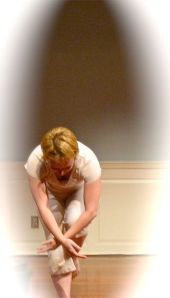
Artists Showcase: Friday – Eco by Jennifer Bourgeault

Jennifer Bourgeault - photo by Frank Chin

Jennifer Bourgeault - photo by Frank Chin

Choreography: Jennifer Bourgeault and Jenny Letendre
Performance: Jennifer Bourgeault
Music: Andrew Bird

Eco is an excerpt from Collective Motion’s evening length work to be debuted Spring 2010. This is an abstract work about humanity’s impact on the environment.

Jennifer Bourgeault graduated DeSales University in 2005 with a BA. in Dance. Returning to Maine upon graduation, Jennifer established Collective Motion a modern, innovative company of artistic dance which embraces and furthers the spirit of the collaborative arts through the promotion of area dancers in roles of both performer and choreographer.

With Collective Motion, Jennifer has taught technique classes, set company repertory and performed for high school dancers in Southern Maine.

As an individual teaching artist, Jennifer is a guest choreographer for Thornton Academy and Portland Arts and Technology’s dance department. Currently, Jennifer is expanding her focus to include dance instruction at the pre-school level. To learn more about Collective Motion please click here.

h1

“The Arts Connect” Conference Continues: Part XX – Rachel Spatz

October 22, 2009

Workshop: The Inclusive Visual Arts Classroom – by Corda Kinzie

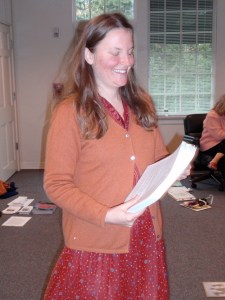
Rachel Spatz

Rachel Spatz

While at the Arts Connect Conference I,  and about 20 arts educators had a chance too attend a session with Rachel Spatz.

Those of us who attended her session had a great opportunity to see how to use materials that make it easy to join in an art lesson whether you have a broken hand, a sprained wrist, a physical, motor, learning, communication, or any other  disability.

Rachel led us in a hands-on experience of many ways to adapt materials for our students. If you are looking for ideas on how to include every student in your art classes or ways support students who want to join in art projects in general classes, Contact: Rachel Spatz (rspatz@vsartsmaine.org)  the Education and Program Director for VSA arts of Maine. She has some great handouts on adaptations for students.

h1

“The Arts Connect” Conference Continues: Part XIX – Jeri Pitcher

October 21, 2009

Workshop: Bringing Shakespeare’s Language to Life – by Jason Bannister

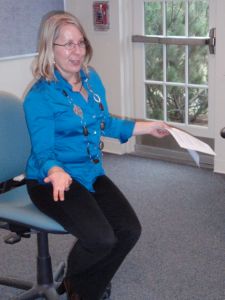
Jeri Pitcher

Jeri Pitcher

I attended the Bringing Shakespeare’s Language to Life session. It was facilitated by Jeri Pitcher, the Associate Artistic Director of the Theater at Monmouth.

She showed our small group different exercises you can do with your class if you are teaching a unit on Shakespeare. One of the exercises was Shakespearean Insults. This showed a fun way to introduce students to the language of Shakespeare. Another exercise, called Creating Shakespeare’s World, compared and contrasted a theater experience now to Elizabethan times. There were other exercises as well, all leading up to scene work on a Shakespeare text. Part of the session focused on a discussion of how to specifically implement these exercises into our classrooms.

I will be teaching a unit on A Midsummer Night’s Dream in the next few months and this session gave me some great ideas to include. I would recommend this session for anyone interested in teaching Shakespeare.

h1

“The Arts Connect” Conference Continues: Part XVIII – Alan Kaschub

October 21, 2009

Workshop: Filmscoring Basics – by Charlie Johnson

Alan Kaschub

Alan Kaschub

The workshop with Alan Kaschub married in a simple and functional way the arts disciplines of music and video production. GarageBand is a relatively simple program to get to know and with which to produce working products that reflect and embrace a student’s creative approach to problem solving. Whether taken as an individual assignment or part of a group project, the iMovie interaction with GarageBand allows students the opportunity to create their own musical accompaniment to whatever video visuals they might have in working process.
Most videographers will tell you that the most important part of a video is the soundtrack, and that without a well recorded and appropriately “synched” audio track, video loses the biggest part of itself.

Dan and Charlie (up to no good?)

Dan and Charlie (up to no good?)

We (Charlie and music colleague Dan Granholm at Mount Desert Island High School) are in hopes that we may get the opportunity to share with a group of students the techniques for shooting an exciting video sequence and then building a well matched and appropriate musical scoring for a particular visual sequence.

h1

Call for Student Artwork

October 21, 2009

National Art Education Association Electronic Gallery

Picture 1NAEA invites you to participate in creating  a one-of-a-kind electronic gallery of student artwork in celebration of the 2010 NAEA National Convention theme, “Art Education and Social Justice.” This unique collection of artwork will be showcased during the 2010 NAEA National Convention, as well as online at Artsonia.com, the official provider of NAEA Classroom Galleries.

Their goal is to collect over 5,000 pieces!

Deadline

Submissions will be accepted through February 28, 2010.

How to  Submit

Participating teachers must be registered members of Artsonia (a free NAEA member benefit) . Visit http://www.artsonia.com/naea2010 to register and begin submitting digital photos of  your students’ work.

Thank you in advance from NAEA for contributing to this important student gallery that depicts our country and the world through the eyes of our students. One note: You have to be a member of Artsonia.com (or register to be a member) to submit artwork, but registration is free if you are an NAEA member.