
Thursday evening: Artists Showcase- Karen Montanaro
If you are familiar with the “fish philosophy” than you are aware of the 4 components: 1) play, 2) make their day 3) be there and 4) choose your attitude. And if you know Karen Montanaro you are aware that she is the epitome of that philosophy. At the Arts Content! conference “Celebration” on Thursday evening Karen ‘WOWED’ the participants with her performance drawing everyone in to enjoy themselves thoroughly!
An interview with Karen Montanaro: dancer/performer/wonderful all around person!
1. What was your most rewarding experience as a teaching artist?
 Each workshop is a barrage of rewarding moments. Before every class, I feel like a race horse, chomping at the bit to get started. I really can’t wait to dive into the thrills and challenges of mime and dance. I bypass words and explanations and go right into the actual experience of moving, knowing that the kids will learn so much from the experience itself. It is rewarding for me to watch them struggle and accomplish the intricate movements of dance and the magical movements of the mime illusions. Teachers often express their delight and pride at the attempts and gains of their students. So often the teachers have shared how this workshop has given them a new perspective on a child in their class. I look forward to watching the children’s expressions when I tell them that the skills they use in mime and dance may be applied to math or science or basketball or anything requiring focus, timing, precision and follow-through. There have been countless rewarding experiences as a teaching artist, and I look forward to more.
2. How did you find yourself in this profession?

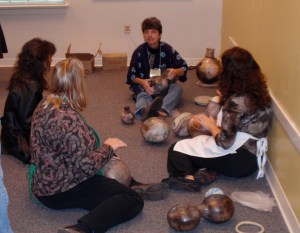
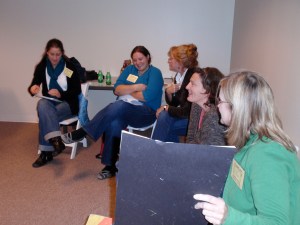
Participants join in the fun
I am motivated by a deep desire to inspire young people to do their best at all times. I do this using the vehicles of mime and dance because these movement-disciplines have taught me so much about myself and my connection to other people and the world around me. Mime and dance are natural ways for me to communicate with students. They are also natural ways for me to share the joy of self-discovery, self-mastery, and self-expression.
3. What are some of the primary goals in your res idencies?
To use mime, dance and movement in engaging ways to : –Get young people energized and excited about doing their best and learning new things, –Give young people a sense of accomplishment and effervescent joy, –Sharpen the students’ focus, –Access the students’ energy, –Provide a creative outlet for the students’ –And activate their imaginations all at the same time!
4. Who are you available for (schools, camps, private engagements, etc) and when are you available?
 I am happy to consider all venues with the appropriate physical requirements. Please feel free to contact me by clicking here to discuss any teaching/performing possibility. I am available year-round.
5. What do you hope to achieve as an artist?
As a performing artist, I strive to keep learning, exploring, creating and trying new things. I strive to expand my solo-repertoire as well as my collaborations with other performing and visual artists. As a teaching artist, I strive to be the very best teacher I can be. One day, I hope to design a movement curriculum that will be part of every child’s school experience, from kindergarten through high-school and beyond. I intend to direct a performing troupe of school children and teenagers who create their own stage material and tour the world inspiring other children and teenagers to explore their creativity too.
 At the urging of a college friend, I took my first mime class in 1976 at a dance studio in a Kansas City suburb. I was immediately hooked. My first teacher was Steve Harris. Steve had trained with Claude Kipnis and had been in Claude’s company at the University of Illinois. Steve invited me to be one of the founding members of Mimewock, a Kansas City based mime company. Through my association with the company, I received training in mime, dance, t’ai chi, improvisation, juggling, magic, and mask work. The company became a clearing house for mimes in the midwest. It was also a stopover for many of the great movement artists of the time. I met and participated in workshops with Claude Kipnis, Bari Rolfe, Ken Feit, and many others who passed through our doors.
 After starting my career by performing on the streets, at shopping malls, and birthday parties, I soon had enough of a show to start doing school assembly programs. In 1979, I went on the road for my first solo tour, doing fifteen weeks in Georgia and Kentucky, averaging thirteen shows each week, never in a town larger than about 10,000 people. Two weeks of wearing whiteface make-up and trying to find my way around rural Georgia, combined with the fact that I was interested in many other aspects of performance besides the silent, illusionary pantomime I was concentrating on, made me decide to stop wearing the whiteface, and include in my show every type of skill that I possessed – juggling, magic, improvisation, and storytelling – while learning from the school audiences themselves what actually worked.
 Since then, I have had the good fortune to make a living as a performing artist by touring around the world. I have given over 3500 school assembly performances in addition to doing shows in theaters, universities, festivals, fairs, television, circuses, and cruise ships.
 From these two powerful influences, and from my study of the French movement theorist Francois Delsarte, I have developed my current school performance and workshop, BODYTALK. In these programs, I give students and teachers clear, usable tools for understanding and using body language. Our bodies speak. Every facial expression, every gesture, every little movement is a statement. BODYTALK teaches you how to understand what you and other people are saying without words. Besides the obvious application of this information to the performing arts, the benefits of exploration into this not-so-secret language include: Improved communication skills; Physical fitness; Improved gross- and fine-motor skills; Improving personal and social interactions; Self-confidence; Public speaking improvement; Improved empathy/awareness of others’ feelings and thoughts.
 Something else that I have to offer to audiences that I feel is every bit as important as the educational and informative aspects of my work is laughter and fun. When ideas are presented in a way that engages and entertains, the information presented will be retained far longer. The laughter that my audiences experience is by far the greatest gift that I can give to them, or that they can in turn give to me.
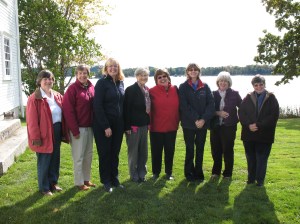
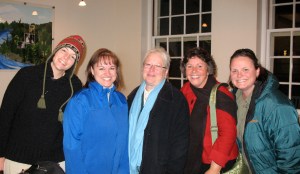 I attended the Art in the Heart meeting at the University of Maine. A great faculty exhibit is happening at Lord Hall. Afterwards I met with a few colleagues.
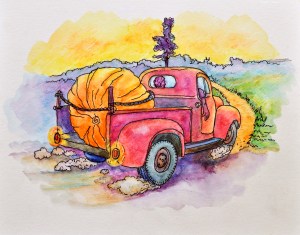 Veteran art teacher, Tom Block from Wiscasset High School has just published a children’s book called “Little Buzzy and the Giant Pumpkin”. He kindly donated a copy for the conference raffle. Below you can read a review of the book.
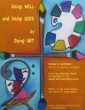 This book sounds very interesting, here is a short review on the book. I found it on Amazon for $19.00.
 Half day seminar to introduce you to Apple’s two music applications, Garageband and Logic Studio. These are complimentary tools that can be used to teach music to students of all ages and abilities. You will learn the strengths of both programs and where they fit best for the music classes you teach.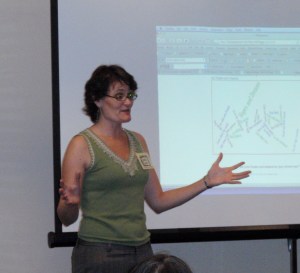
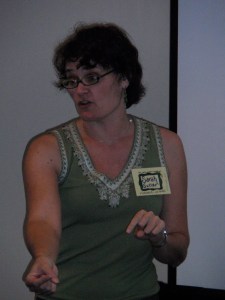 Sarah’s gallery posting suggestions ranged from a simple download to flicker to a snazzy voice thread of students talking about their work that is embedded in a blog or wiki. All of this becomes interactive with people being able to record voice comments and identify elements within the image using pointing and writing tools. The gallery is now a critique platform! Technology allows quiet kids a chance to reflect publicly in a private setting. The voice thread teaches critical thinking, thoughtful criticism and internet etiquette.
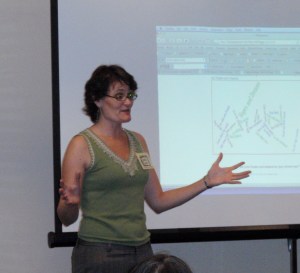 Sarah Sutter’s workshop “Exhibit and Critique: Visual Arts and Web 2.0” was a dynamic, in-depth tour of web-based tools available to allow teachers and students to post work and discuss their work through technology: blogs, Voicethread, Flickr, wordle, animoto, classblogmeister, googledocs, and digital drop boxes were all demonstrated by this energetic presenter, who is both a high school (and college) art educator as well as a technology integrator — the best of both worlds.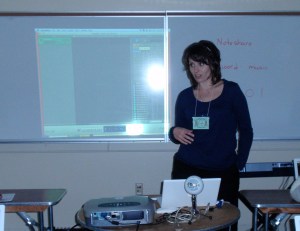
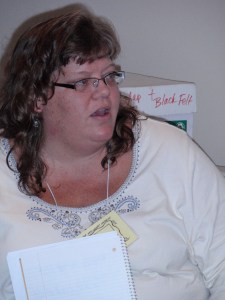
 Two other visual arts teachers shared some of their favorite lessons. Karen Wolfe shared a bunch of helpful tips and creative ideas for working with paper mache in the classroom, and Lynne Nickerson provided us with some great handouts for use in improving students’ drawing skills. Both educators also shared some beautiful samples of student work which made evident their success in the art classroom!
 me arts ed