Archive for October, 2009

h1

“The Arts Connect” Conference Continues: Part X – Ellyn Whitten Smith & Lynn Whitten Bustard

October 18, 2009

Workshop – Times Five – by Anne Kofler

Lynn Bustard

Lynn Bustard

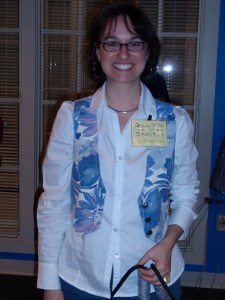
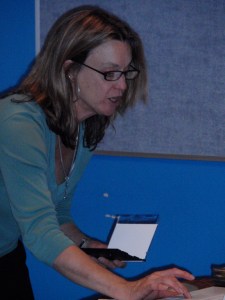
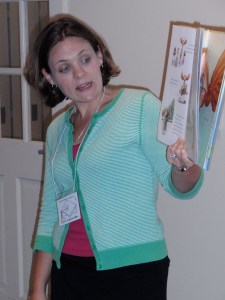
Two times the fun,  TIMES FIVE the size.  A lively presentation was given by sisters Ellyn Whitten Smith and Lynn Whitten Bustard on the Pop Art  Sculpture of Claes Oldenburg and Coosje van Bruggen.

Super size examples of a paint bottle, a can of Play Dough, a  Crayola Marker, a watch, an Etch-A-Sketch, a Katrina bracelet  and more greeted us as we entered  the workshop session.

Completing each others thoughts as sisters do, Lynn and Ellyn went on to explain their art plus math lesson.  Students are asked to select an ordinary object from everyday life, measure it from every angle and multiply those measurements by five in preparation for a larger than life sculpture.

Careful notes are taken and sketches made before the hands on part begins. Recycled materials provide the base for sculptures, paper mache smooths the surface and paint provides the finishing touches.

Ellyn Smith

Ellyn Smith

Useful handouts included background information on Claes Oldenburg and Coosje van Bruggen, an introductory materials list, a drawing and measurement example, vocabulary for the lesson,  a student evaluation sheet and a 3 photograph page in color of TIMES FIVE from start to finish showing a super size box of Crayola crayons.

h1

“The Arts Connect” Conference Continues: Part IX – Erma Colvin

October 18, 2009

Workshop: Dances of the Decades – by Karen Hartnagle

Erma Colvin photo by Shalimar Poulin

Erma Colvin photo by Shalimar Poulin

Dances of the Decades was a great example of what can be done with an innovative teacher and a dance artist! Jim Morse is a social studies and math teacher at Camden-Rockport Middle School and he uses the arts to teach social studies.

Jim divides his social studies class into units based on different decades, for example, the 50’s, 60’s etc. He gives the students lists of important people, events, etc for each decade and the students research it along with fashions, music and fads of that decade. They develop a slide show that connects all the elements they have studied.

Jim partners with Erma to develop dances for individual decades. Erma has the students for a week to teach them different dances. Parents donate “costumes”, along with treasures found at Goodwill and it culminates in a performance for the parents/community!

PA080386One of the many positive things about this project is that every child participates in some way on an equal basis. So, in the workshop we got to experience some of this energy! Erma taught us one of the dances and brought the costumes so we did our dance with costumes! She and Jim showed us the slide show the students created and a video of the students doing some of the dances.

This is an outstanding example of what an involved, innovative teacher and a dance artist can create to bring a subject to life. The strength and depth of the arts is so apparent here, I am sure these students will never forget what they learned from this total experience. With this kind of program in all schools we would never have to worry about getting high test scores!

h1

“The Arts Connect” Conference Continues: Part VIII – Michael Trautman

October 18, 2009

Workshop: Physical Character and Physical Comedy – by Kim Murphy
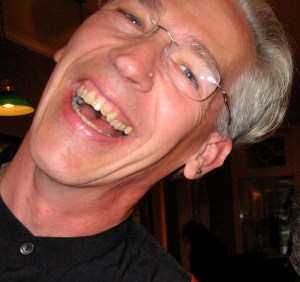
Michael Trautman

Michael Trautman

Intellectual, Emotional, and Physical are the three divisions of the body as identified by Delsarte.  This is the simple overview of the workshop on physical character and comedy as presented by Michael Trautman in a pack-filled hour.

We, the workshop participants, first did some simple warm-ups and then progressed to moving around the room while leading with different parts of our body.  This isolation of parts was later explained by Michael as how characters are presented on stage physically and how our interpretation of the character’s intellect, emotions or physicality should also be portrayed in the body.

I discovered ideas to bring back to the drama program here at Camden Hills Regional High School – and thoughts of how we could use these ideas in our duck-like movements of our current production of Honk! Michael Trautman’s session was more than a workshop on body language.  Through the following of Delsarte’s philosophy of the various qualities of the parts of the body – one becomes aware of how characters do portray those aspects….even if you’ve never understood why.   For instance, Michael explained that Fonzi is a strong, physical character – and so he leads with his hips when he enters the room; and Romeo is a character full of emotion, and so he leads with his chest when crossing the stage.
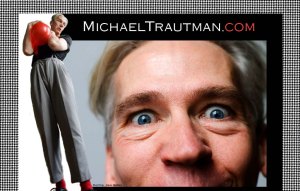
MLTsplashfinal_01The most valuable part of the workshop was watching Michael portray different characters and talk about how he puts their qualities into his body.  He is very flexible  – I would liken him to the father character in The Incredibles! We asked about the qualities of certain characters.  Then watched as these aspects were acted out by Michael.  Watching Michael’s demonstrations was the proof in the pudding; plus,  it was very entertaining and educational for all of the workshop participants.

I must say – during our little romp around the room – leading with the nose, or the hip, or the thigh….we all seemed a bit stiff and silly.  But that’s because the majority of us have been walking with distinct patterns for almost a half-century…and unlearning those habits in a matter of minutes was nigh on impossible.  Yet – take this same workshop and do it with kids? – Yes!  The (more flexible) youngsters would pick it up in seconds and really fly with it.

4004956284_0737fc74c3_sMy personal goal is to see if I can have Michael come to our school to do a workshop session with our students.  He would be perfect for our current play….but we may not have the time right now.  However, it would be a valuable workshop for students at any time of the year.  If there is another school(s) in the MidCoast area who would like to partner with me in bringing him to our area, please contact me at kim_murphy@fivetowns.net

Thanks to the conference organizers for bringing Michael to our conference – I only wish I could have been there on Thursday night to see that performance too.

h1

“The Arts Connect” Conference Continues: Part VII – Erica Troy

October 18, 2009

Workshop: Of Stories and Songs: Promoting Musical and Verbal Literacies in the Classroom – by Michael R. Davis

Erica Troy photo by Argy

Erica Troy photo by Argy

I was fortunate enough to attend this fantastic session led by Maine’s own Erica Troy who teaches K-1 music in Yarmouth.  In a day where teaching verbal literacy has become a priority to most schools, doing “whatever it takes” often involves the music teacher whether they realize it or not.

In this session Erica pointed out that by using books in her music class she supports the literacy department and its objectives.  She states that she is not teaching the literacy curriculum but supporting literacy through the creative use of books in the music classroom.

Erica helped guide teachers in this workshop on the three level process she uses to incorporate music.  Level 1 is where students create sounds to accompany actions or words in the story.  Level 2 is where students will upon a second read of the story use instruments and sounds to re-create the story with little or no text involved.  Level 3 is where students have ultimate control of the sounds and often re-creating the story in whatever order they wish.

Teachers in the workshop were given the opportunity to hear stories they’d never heard of before.  Starting with simple animal sounds to accompany a book, teachers ended with improvisation and create a soundscape to accompany the story with the use of musical instruments.

I personally work in a district where EVERY teacher’s annual appraisal goals have been aligned to the district goal of improving literacy for ALL students. Students LOVE a great story and being able to turn that story into a musical masterpiece is without a doubt going to support my district’s mission! Besides it is GREAT FUN!  Thank you ERICA for a great session!  If you’d like to see her powerpoint presentation from the session please click here to find Erica’s school webpage.

h1

“The Arts Connect” Conference Continues: Part VI – Paul Janeczko

October 18, 2009

Workshop: Say It Out Loud! by Karen Montanaro

Paul Janeczko photo by Shalimar Poulin

Paul Janeczko photo by Shalimar Poulin

It was a joy to attend Paul B. Janeczko’s presentation, SAY IT OUT LOUD!  I went in there hoping to get ideas about how I might use the spoken word in my own workshops (mime/dance/movement workshops) and in collaboration with English classes.  I certainly got that and more out of Paul’s workshop.

He gave us all printed copies of several delightful poems.  We read each poem silently to ourselves.  After each reading, he asked questions . . . great questions that opened our eyes to how the poem might be read aloud.  Suddenly we saw how many different “voices” there were in the poem.  We identified shifts of mood and tempo and energy.

Finally, we divided into groups and each group chose a poem to read or “treat” out loud, in performance.  It was amazing we could accomplish so much in so little time.  I think this is proof of Paul’s energy and expertise.  He guided us through all the stages of creativity from reading to listening, from observing to discovering, from leaping to flying.  A thrilling workshop!

h1

Harvest of Ideas

October 14, 2009

Professional Development Opportunities for Over 300 Educators

The Washington County Consortium, under the leadership of Betty Jordan, planned and implemented the Harvest of Ideas workshop day for many of the educators in Washington County.

I arrived in the early morning yesterday in the pouring rain and was quite surprised to have 20 participants attend my session. I had the pleasure of presenting a session on “The Arts and Technology” and had 20 educators attend. Many were arts educators and other educators including elementary, middle school, physical education/health, and Title 1 teachers attended.

Washington County arts teachers

Washington County arts teachers

I shared with them information from The Arts Connect conference for those who could not attend.

In the afternoon we had a content specific forum facilitated by art teacher Lisa Marin, where 12 arts teachers met to discuss topics including the high school graduation requirements and the Maine Learning Results. The teachers discussed the positive aspects of their programs as well as the challenges.

h1

“The Arts Connect” Conference Continues: Part V

October 13, 2009

Census Report Released

Dennie Wolf sharing the reports findings

Dennie Wolf sharing the reports findings

Two years ago at the “At the Creative Center Statewide Arts Education Conference” the work was started on conducting a statewide arts education census. The Maine Alliance for Arts Education collaborated with the Maine Department of Education and a Design Team under the direction of researcher Dennie Wolf to create a survey that many of you completed.

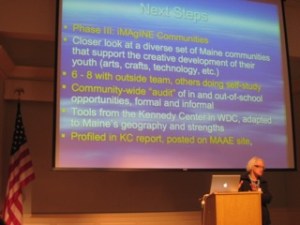
The promise two years ago was to create a report that arts educators could access to influence the work done at the local level in arts education. At The Arts Connect! conference during a general session participants heard some of the results. The statewide census looked at arts education opportunities and conditions.

Funding was provided by The Betterment Fund, the John F. Kennedy Center, and the Maine Arts Commission. Over a third of the arts teachers in Maine, 44% of the schools, responded to a survey about their programs and their working lives as educators.

The Executive Summary and the full 287 page report are posted on the Department of Education website and can be accessed by clicking here (as of 10-13). Please read the summary to learn more.

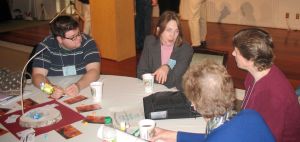
IMG_2341At the conference on October 9th, participants worked in their regions to create maps that show the opportunities to learn in the arts in schools, and the school communities, and the connections between the opportunities. The next step in the process is to identify “imagination-intensive” communities and profiles will be created of them.
It is important that arts educators share the major results with policy makers, funders, and leaders in the field. It is up to each of us to disseminate this information.

h1

Obamas’ Borrow Art for the White House

October 12, 2009

45 Pieces of Artwork were Borrowed from the National Gallery of Art

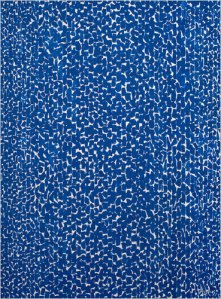
"Sky Light" 1973, Alma Thomas

"Sky Light" 1973, Alma Thomas

The Obamas selected a wide range of artwork for the White House from the Smithsonian American Art Museum, the National Gallery of Art and the Hirshhorn Museum and Sculpture Garden collection.

Michelle Obama and the White House curator, William Allman, made choices for the White House after looking at the artwork on the websites. They visited with Harry Cooper, curator of modern and contemporary art at the National Gallery.

Their selection included these artists and several others: Mark Rothko, Jasper Johns, Edgar Degas, and Louise Nevelson. You can read the entire article by clicking here.

Imagine being able to select art for your home from these collections?

h1

“The Arts Connect” Conference: Part IV

October 12, 2009

Centerpieces that Keep on Centerpiecing

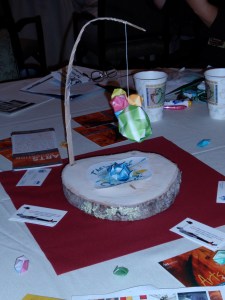
PA080052Veteran art educator Suzanne Goulet and first year teacher Crystal Douglas (student of Trudy Wilson at USM and student of mine from middle school) from Waterville High School teamed up to create the conference centerpieces. Sadly, neither one could join us due to other traditional commitments they had but none the less they wanted to contribute to the conference.

Instead of creating something quick and easy they masterminded a meaningful work of art. The 3″ thick bases were sliced out of a log that measured about 10 inches across. A thin branch like piece came up from the base that gently bent over the wood, dipping towards it. Off of the branch tied to string hung three origami lanterns. A flat paper shaped like a lily pad with the conference logo sat on the base.

Suzanne had created a small origami lantern for each participant. In her own words:

“For, though, “the Arts Connect”, it is the educator that gives them life. It is the educator that transcends the 2 dimensions into the 3 dimensions. Each educator creates more than what we start with. The centerpiece represents the following:

*Dance: Kinetic  *Music: Arrangement *Theatre: Stage *Visual Arts: Colors and Shape

Each educator could blow into the flat form and make it 3 dimensional. Those who found a yellow stickie on the bottom of their chair got to take a centerpiece home with them.

The centerpieces complimented the blue and gold balloons that were recycled from the Celebration the night before. THANK YOU Suzanne and Crystal for your creative work to help the conference with one of the little touches that make the two days unique.

cent table


h1

Understanding Sound and Music

October 12, 2009

Free Podcasts on iTunes

imagesWe know there many connections between the arts and other content and topics. There are many free resources on iTunes that you may want to take a closer look at. Many are published on iTunes by higher education institutes and are taken from specific course syllabi. According to “Understanding Sound and Music” “your favorite song may have memorable lyrics and rhythms you can dance to, but sound and music are a mix of science, math, art, physics, history and psychology. Learn about the science of sound waves, the impact of musical vibrations on behavior, and music as a universal language.”

If you are interested in listening to some of these podcasts and/or songs, I suggest you go to iTunes, podcasts and type in any of the titles below in the search bar. Some of them are actually free movies. Please note I have not looked and/or listened to all of these.

  • Music and the Brain (Library of Congress)
  • Sounds Harmonious
  • The Language of Music (Missouri State University)
  • Smithsonian Folklife Festival
  • History of Jazz
  • Infrequency
  • Vibration and Waves Physics III

These are great resources for your classrooms as well.

On another note…

I heard a segment on public radio this morning about using software to make it more possible to create hit songs. Hit Songs Silence software Company has done research on what songs are soothing to the ears and will attract listeners to a song/music. Once they “field test” it they can go back and remix the song and try again. The software actually gives an artist the information to figure out which songs listeners will want. Using technology and agorithms to predict hit songs. Another connection between art and math.