
Wondering about copyright?
Periodically I hear questions and discussion around “copyright” in the arts. So, I’ve asked Barbara Greenstone to write a post on the topic. Barbara is a Statewide Integration Educator for MLTI. Her son Andrew graduated with a BFA in Sequential Art last spring from Savannah College of Art. One of Andrew’s drawings is embedded in the post. Barbara’s husband is a music educator at Lake Region High School.
Thank you Barbara for this great post…
Mark Twain said, “Only one thing is impossible for God: To find any sense in any copyright law on the planet.” If Mark Twain had difficulty understanding copyright at the turn of the last century, how would he fare now in the information age? Copyright laws are even more complex now and, as arts educators, you probably find yourself worrying about protecting your own intellectual property as well as being respectful of that of others. In school, we run into copyright conundrums daily as we try to set a good example for our students while giving them as many rich, creative, and innovative learning opportunities as possible.
Just figuring out who owns what, let alone whether it can be used and reused, is a daunting task. I am not an intellectual property lawyer, and I know I make mistakes, but I’ve developed some practices and strategies that help me make decisions about what is right. Here are the four basic principles I think about when I’m creating new products:
- If I didn’t make up that text, draw that picture, take that photo or video, or write and perform that music, it isn’t mine.
- If it isn’t mine, I always have to say whose it is and often I have to get permission before I can use it.
- I should try making my own things before I decide to use someone else’s property.
- I must decide how much I want other people to be able to use the things I make.
They may seem overly simple but I think those four principles cover most situations and get to the heart of what copyright is all about. I also think we should start teaching those principles in the elementary grades.
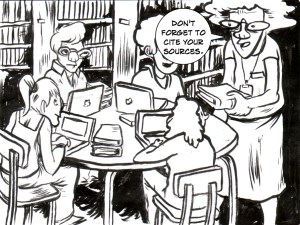
By Andrew Greenstone - Creative Commons Attribution-Noncommercial-Share Alike 3.0 United States license
Principles 1 and 2 are fairly obvious and teachers can consult their school’s Library Media Specialist for help with determining whether permission is needed and how to attribute or cite someone else’s work. Principle 3 is one that I think arts educators can really help the rest of us with. Often, students will want to simply find a picture on the internet or use some music from their CD collection in their multimedia projects, but I’ve found that if you challenge them to make their own, they come up with some amazing things. Art teachers can help students draw or paint their own images or use a camera to take pictures. Music teachers can help them find music that is in the public domain (no permission required) and find a student who can perform it and donate that performance to the project. Drama and dance teachers can help students make their own video footage.
When students create original products, they will need some guidance in how to protect that work (Principle 4) if they decide to publish it on the internet. They may decide to give it a Creative Commons license that will allow others to use it without first asking for permission, as long as they attribute it to its original creator. There are also privacy issues for teachers to consider when posting student work and teachers should consult their district’s policies. Usually permission from both the student and the student’s parent is required and students’ full names cannot be used.
Most teachers’ copyright questions arise around confusion about whether they have to get permission to use someone else’s property in their classroom teaching. The Fair Use Guidelines are just that – guidelines. They are open to interpretation and have many gray areas. Usually you can use a part of a work in your classroom if you don’t lose control of who sees it (by posting it on your web site, for example) and if your using it does no financial harm to the owner. There are many more potential pitfalls for music teachers but MENC has a useful and informative web site that teachers can consult.
The web has many good resources for teachers who want to learn more about copyright, public domain, fair use, and Creative Commons licensing. I’ve collecting many of these resources in a NoteShare notebook that I created for a session at the recent ACTEM MAINEd Conference. If you are a NoteShare user, you can download it from the Barbara Greenstone collection on the ACTEM NoteShare server. Once you’ve downloaded it, feel free to change it and redistribute it (Creative Commons License). If you are not a NoteShare user, or you would just like to browse it on the web, you can find it by clicking here.
 Since it first opened its doors in 1985, Artist and Craftsman Supply has outfitted the creative culture in Portland, Maine with art material and spirit. Though the company has grown to embrace 14 retail locations and web-site commerce, the basic principles of operation have remained true. The flagship store is still located on Deering Avenue under the guidance of the company’s founder and president Larry Adlerstein.
 As one who always saw herself as a band director, I jumped at the chance to attend Lynn Brinckmeyer’s session “Help! I am Music K-12 and I Thought I was a Band Director” as well as her session on “User Friendly Essentials for Teaching General Music” at the Arts Conference in Northport on October 9. I’ve only been doing the “K-8 everything” routine since 1986. There’s still lots to be learned!
 The best part was trying out the ideas at school the following week. I tried them at a variety of levels, K-6. My students loved the songs, chants (quite an upgrade from our usual 1971 Exploring Music books!) and the rhythm exercises. All I have to do is pantomime holding that ball and start the t-t-t-t-t-t-t-t, ch-ch-ch-ch, ssss-ssss, shhhhhhhh, and they’re all with me. Funwa Alafia has become a favorite of my students from grades 1-5! I’m not sure the West African words were intended this way but we do have FUN and LAUGH with FUNwa a-LAUGH-ia!
 me arts ed