Archive for February, 2010

h1

RSU 20 Art Exhibit: Hutchinson Center, Belfast

February 21, 2010

RSU 20 art educators initiative

"Fish" by Jay Hoagland

The towns of Belfast, Belmont, Frankfort, Morrill, Northport, Searsmont, Searsport, Stockton Springs, and Swanville have reorganized to become RSU 20 and the ten art teachers there are leading a consolidation initiative. UMaine Hutchinson Center in Belfast are hosting an art teachers exhibit, March 1 – the end of April.

"Cog" by Laurie Brooks

The idea is a positive way to endorse the consolidation effort! The opening reception will be on March 4th, 6:00-7:00 PM. in the beautiful new Walsh wing, Fernald Art Gallery at the Hutchinson Center which is located on route 3 in Belfast.

The following art teachers/artists will have their work on display. Congratulations to all of them!

  • Ron Bisbee
  • Laurie Brooks
  • Nancy Desmond
  • Ginney Hallowell
  • Charles Hamm
  • Jay Hoagland
  • Samantha Maheu
  • Heidi O’Donnell
  • Jessica Porter
  • Lynnette Sproch
h1

NASA Life and Work on the Moon Art and Design Contest

February 20, 2010

Example of the Arts and the connection to Science, Technology, Engineering and Math (STEM)

NASA is inviting high school and college students from all areas of study, including the arts, industrial design, architecture, and computer design, to submit their work on the theme “Life and Work on the Moon.” Artists are encouraged to collaborate with science and engineering students. Such collaboration is not required but would help to ensure that the work’s subject is valid for the moon’s harsh environment.

Entries will be accepted in three categories: two-dimensional, three-dimensional, and digital, including video. For the first time, entries in literature (poetry and short stories) will also be accepted. Judges will evaluate entries not only on their artistic qualities, but also on whether they depict a valid scenario. Prizes include awards and exhibit opportunities. International students are encouraged to participate, but they are not eligible for cash prizes. Entries are due no later than April 15, 2010. For more information about the contest and to register online, please click here.


h1

The Night I Met Einstein by Jerome Weidman

February 18, 2010

This story is from Jerome Weidman, with no known copyright info. Thanks to Derek Sivers for reposting.

When I was a very young man, just beginning to make my way, I was invited to dine at the home of a distinguished New York philanthropist. After dinner our hostess led us to an enormous drawing room. Other guests were pouring in, and my eyes beheld two unnerving sights: servants were arranging small gilt chairs in long, neat rows; and up front, leaning against the wall, were musical instruments. Apparently I was in for an evening of Chamber music.

I use the phrase “in for” because music meant nothing to me. I am almost tone deaf. Only with great effort can I carry the simplest tune, and serious music was to me no more than an arrangement of noises. So I did what I always did when trapped: I sat down and when the music started I fixed my face in what I hoped was an expression of intelligent appreciation, closed my ears from the inside and submerged myself in my own completely irrelevant thoughts.

After a while, becoming aware that the people around me were applauding, I concluded it was safe to unplug my ears. At once I heard a gentle but surprisingly penetrating voice on my right.

“You are fond of Bach?” the voice said.

I knew as much about Bach as I know about nuclear fission. But I did know one of the most famous faces in the world, with the renowned shock of untidy white hair and the ever-present pipe between the teeth. I was sitting next to Albert Einstein.

“Well,” I said uncomfortably, and hesitated. I had been asked a casual question. All I had to do was be equally casual in my reply. But I could see from the look in my neighbor’s extraordinary eyes that their owner was not merely going through the perfunctory duties of elementary politeness. Regardless of what value I placed on my part in the verbal exchange, to this man his part in it mattered very much. Above all, I could feel that this was a man to whom you did not tell a lie, however small.

“I don’t know anything about Bach,” I said awkwardly. “I’ve never heard any of his music.”

A look of perplexed astonishment washed across Einstein’s mobile face.

“You have never heard Bach?”

He made it sound as though I had said I’d never taken a bath.

“It isn’t that I don’t want to like Bach,” I replied hastily. “It’s just that I’m tone deaf, or almost tone deaf, and I’ve never really heard anybody’s music.”

A look of concern came into the old man’s face. “Please,” he said abruptly, “You will come with me?”

He stood up and took my arm. I stood up. As he led me across that crowded room I kept my embarrassed glance fixed on the carpet. A rising murmur of puzzled speculation followed us out into the hall. Einstein paid no attention to it.

Resolutely he led me upstairs. He obviously knew the house well. On the floor above he opened the door into a book-lined study, drew me in and shut the door.

“Now,” he said with a small, troubled smile. “You will tell me, please, how long you have felt this way about music?”

“All my life,” I said, feeling awful. “I wish you would go back downstairs and listen, Dr. Einstein. The fact that I don’t enjoy it doesn’t matter.”

He shook his head and scowled, as though I had introduced an irrelevance.

“Tell me, please,” he said. “Is there any kind of music that you do like?”

“Well,” I answered, “I like songs that have words, and the kind of music where I can follow the tune.”

He smiled and nodded, obviously pleased. “You can give me an example, perhaps?”

“Well,” I ventured, “almost anything by Bing Crosby.”

He nodded again, briskly. “Good!”

He went to a corner of the room, opened a phonograph and started pulling out records. I watched him uneasily. At last he beamed. “Ah!” he said.

He put the record on and in a moment the study was filled with the relaxed, lilting strains of Bing Crosby’s “When the Blue of the Night Meets the Gold of the Day.” Einstein beamed at me and kept time with the stem of his pipe. After three or four phrases he stopped the phonograph.

“Now,” he said. “Will you tell me, please, what you have just heard?”

The simplest answer seemed to be to sing the lines. I did just that, trying desperately to stay on tune and keep my voice from cracking. The expression on Einstein’s face was like the sunrise.

“You see!” he cried with delight when I finished. “You do have an ear!”

I mumbled something about this being one of my favorite songs, something I had heard hundreds of times, so that it didn’t really prove anything.

“Nonsense!” said Einstein. “It proves everything! Do you remember your first arithmetic lesson in school? Suppose, at your very first contact with numbers, your teacher had ordered you to work out a problem in, say, long division or fractions. Could you have done so?”

“No, of course not.”

“Precisely!” Einstein made a triumphant wave with his pipestem. “It would have been impossible and you would have reacted in panic. You would have closed your mind to long division and fractions. As a result, because of that one small mistake by your teacher, it is possible your whole life you would be denied the beauty of long division and fractions.”

The pipestem went up and out in another wave.

“But on your first day no teacher would be so foolish. He would start you with elementary things – then, when you had acquired skill with the simplest problems, he would lead you up to long division and to fractions.”

“So it is with music.” Einstein picked up the Bing Crosby record. “This simple, charming little song is like simple addition or subtraction. You have mastered it. Now we go on to something more complicated.”

He found another record and set it going. The golden voice of John McCormack singing “The Trumpeter” filled the room. After a few lines Einstein stopped the record.

“So!” he said. “You will sing that back to me, please?”

I did – with a good deal of self-consciousness but with, for me, a surprising degree of accuracy. Einstein stared at me with a look on his face that I had seen only once before in my life: on the face of my father as he listened to me deliver the valedictory address at my high school graduation.

“Excellent!” Einstein remarked when I finished. “Wonderful! Now this!”

“This” proved to be Caruso in what was to me a completely unrecognizable fragment from “Cavalleria Rusticana.” Nevertheless, I managed to reproduce an approximation of the sounds the famous tenor had made. Einstein beamed his approval.

Caruso was followed by at least a dozen others. I could not shake my feeling of awe over the way this great man, into whose company I had been thrown by chance, was completely preoccupied by what we were doing, as though I were his sole concern.

We came at last to recordings of music without words, which I was instructed to reproduce by humming. When I reached for a high note, Einstein’s mouth opened and his head went back as if to help me attain what seemed unattainable. Evidently I came close enough, for he suddenly turned off the phonograph.

“Now, young man,” he said, putting his arm through mine. “We are ready for Bach!”

As we returned to our seats in the drawing room, the players were tuning up for a new selection. Einstein smiled and gave me a reassuring pat on the knee.

“Just allow yourself to listen,” he whispered. “That is all.”

It wasn’t really all, of course. Without the effort he had just poured out for a total stranger I would never have heard, as I did that night for the first time in my life, Bach’s “Sheep May Safely Graze.” I have heard it many times since. I don’t think I shall ever tire of it. Because I never listen to it alone. I am sitting beside a small, round man with a shock of untidy white hair, a dead pipe clamped between his teeth, and eyes that contain in their extraordinary warmth all the wonder of the world.

When the concert was finished I added my genuine applause to that of the others.

Suddenly our hostess confronted us. “I’m so sorry, Dr. Einstein,” she said with an icy glare at me, “that you missed so much of the performance.”

Einstein and I came hastily to our feet. “I am sorry, too,” he said. “My young friend here and I, however, were engaged in the greatest activity of which man is capable.”

She looked puzzled. “Really?” she said. “And what is that?”

Einstein smiled and put his arm across my shoulders. And he uttered ten words that – for at least one person who is in his endless debt – are his epitaph:

“Opening up yet another fragment of the frontier of beauty.”

— story by Jerome Weidman

h1

Proposed Educational Cuts

February 16, 2010

Email from Sandra Sharood – music educator, Scarborough Middle School

I am writing this email to share my concern over the proposed educational cuts in Scarborough. It is time for the people of Scarborough to renew their support for education in the 21st century. This is a critical time for our youth who are facing challenges that previous generations have never before seen. Our students need to be fluent in their uses of technology and learn to become life long learners so as to keep up with rapid changes that are demanded of them.

Research shows us the importance of creativity, innovation and critical thinking skills and how art and music increase these skills. As a music teacher, I am aware of the role that music plays in promoting these characteristics along with increased math skills and spatial reasoning. Music has directly been linked to higher SAT scores. Not only is it linked to scholastic aptitude but research has shown it to improve student behavior and attitude. I believe cutting music programs in Scarborough will have an immediate negative impact on the learning outcomes of our students.

Our general music curriculum at the middle school is heavily invested in its use of technology. Students learn music theory and performance in our keyboard lab. They use “Garageband” on their laptops to compose and edit music. They also use this application to creating music history teaching podcasts and projects. Middle school general music is part of a spiral curriculum that is continued in the music lab at the high school.

Further information about the benefits of music education can be found on the MENC and AMC websites. Please feel free to contact me with any questions.

Sincerely,
Sandra Sharood
Band/Music Teacher
Scarborough Middle School

h1

Maine Arts Census: Next Steps

February 11, 2010

Search for Maine’s Top Imagination Intensive Communities!

Imagination is our greatest natural resource – but one that we need to grow.

Introduction
A recent two-year study of arts education in Maine shows:

  • The state can be proud of a group of communities that support the creativity of children and youth. These communities can be found in rural, town, and city settings. Whatever their size, location, or resources, these communities use what they have and what they value to ensure that young people have regular learning experiences about how to create and innovate.
  • But many Maine students lack regular access to imaginative learning. Currently, a strong — and inequitable — link exists between the size, location, and wealth of communities and the opportunities provided for students to learn to create.

To act on these findings, the Maine Alliance for Arts Education (MAAE), the Maine Department of Education and the Maine Arts Commission  have formed a partnership to identify, acknowledge, and spread the word about how a wide range of Maine communities invest in the imaginative development of children and youth. Through an open application and juried selection process, six communities that vary in size, location, and resources will be selected as “imagination-intensive” communities.

The purpose of this initiative is to:

•    Acknowledge a set of Maine communities that value and invest in the creative interests of young people
•    Learn about the creative opportunities they offer children and youth
•    Find out how these communities sustain and grow these opportunities
•    Figure out how more Maine communities could do the same.

Through this initiative, Maine educators and youth advocates will gain:

•    A website describing Maine’s top Imagination-Intensive Communities, including contact information for visits by other communities
•    A process and community survey tool for on-going identification of new imagination-intensive communities
•    A network to incubate ideas for future innovations.

If Selected, What Are the Benefits to My Community?

•    An award of $750
•    An Imagination Day Community Visit idea exchange: a full-day visit and conversations between community members and  statewide panelists to exchange ideas and share strategies about arts- and creativity-rich education and celebrate the community’s selection
•    A community survey tool with support to prepare for the Imagination Day Community Visit
•    A web-based profile of your community
•    An invitation to participate in and present at a statewide forum on supporting imagination development
•    An invitation to an award ceremony acknowledging the Imagination Intensive Communities
•    A citation that can be used in advocacy, fundraising, and promotion.

How Can My Community Apply?
Interested consortia of school and community-based organizations can apply by submitting an on-line application describing the range of creative opportunities they provide for young people. A statewide panel of educators, artists, innovators and entrepreneurs will review applications to select six Imagination Intensive Communities.

1) Forming a Community Consortium: Applicants should be consortia of schools and youth-serving organizations that collectively provide sustained and high-quality opportunities for young people to develop their imaginations. These consortia may bring together many sectors that support young people’s creativity in a variety of ways; for example, the arts, science, design, technology, agriculture, construction, business and social entrepreneurship.

Consortia could be located in communities such as:
•    A rural region
•    A small town
•    A city
•    A network of communities
•    A Regional School Union (RSU)
•    A regional or state-wide digital community

Consortia must include at least 1 public school, and at least 1 community organization, such as a library, parks and recreation facility, cooperative extension program, college or university, cultural organization (for example, museum, historical society, performing arts organization), or other youth-serving organization.

2) Making an Application: Consortia should complete the on-line application available on the Maine Alliance for Arts Education website at http://www.maineartsed.org after February 15.  Applications should be submitted no later than March 15.  A member of the panel may follow-up on the application to collect additional information.

3) Questions about your application? Email your questions to Gail Scott, Project Coordinator, at gail.scott@maine.rr.com

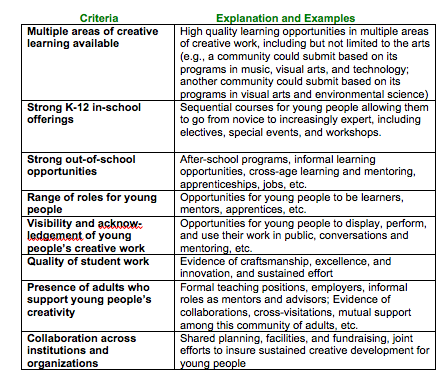
What Criteria Will be Used to Select the Communities?


What Happens After the Communities are Selected?

Hosting the Imagination Day Community Visit
Maine’s Top 6 Imagination-Intensive Communities will be notified of their selection, and each community will be offered an award of $750, a community survey tool, and support to help in planning the Imagination Day Community Visit.

During the Imagination Day Community Visit, panelists will observe, interview, and document the stories of participants in a variety of roles including:
•    Teachers and administrators
•    Mentors and role-models
•    Young people
•    Supporters in local government
•    Program designers and implementers

Each Imagination Day Community Visit will also include:
•    Site visits to in- and out-of-school programs
•    Interviews with key persons who help to create that particular imagination-intensive community
•    Interviews and focus groups with young people who are engaged in creative work (in school or on their own)
•    A brainstorming session about the challenges that Maine communities face in helping their young people to become the innovators and creators of tomorrow. The session will focus on inventing powerful and feasible solutions to these challenges.

What’s the Timeline for this Initiative?

Date                       Event
February 15:           Application up on MAAE website on or after this date
March 15:               Applications due
April 1:                   Selections announced; planning for community visits begins
April 15-May 15:    Community visits
May 30:                  Community visits and documentation concluded
June:                      Award Ceremony
September:            Imagination Intensive Communities Website: Live
•    Community Profiles with Award Citations
•    Interactive Map with Contacts for Visits

Who are the Project Partners and Funders?

MAINE ALLIANCE FOR ARTS EDUCATION

MAINE DEPARTMENT OF EDUCATION

This project is supported in part with a grants from the JOHN F. KENNEDY CENTER FOR THE PERFORMING ARTS, THE BETTERMENT FUND, and the MAINE ARTS COMMISSION.

h1

Empty Bowl Supper

February 9, 2010

Southern Maine Clay Guild and York High School Art Students

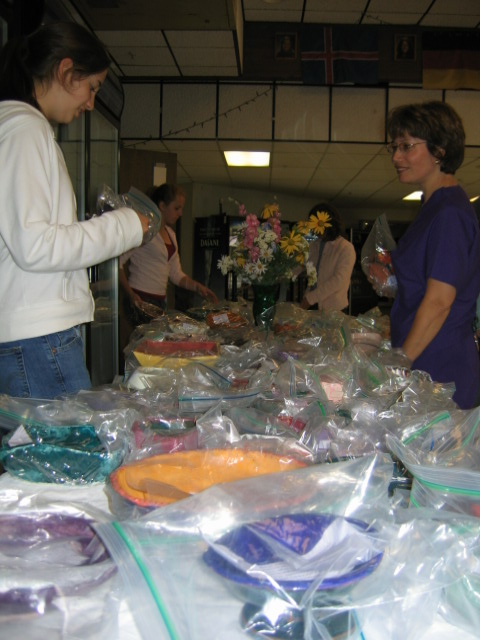
Empty Bowl SupperThe Southern Maine Clay Guild and York High School art classes (Beth Nowers, teacher) are collaborating on the Empty Bowl supper, March 5th, 5-7. Over 200 bowls have been created by the SMCG and students. The public is invited to sample delicious soups and breads from local restaurants who have donated their products. The bowls are to be taken home as a reminder that someone’s bowl is always empty. Proceeds from donations ($15 minimum per bowl, $10 Kids’ bowl) will benefit the York Food Pantry.

On February 12th, 5-7 the gala opening for the annual Clay Show and Sale will take place. The show will be held at the York Art Association on 394 York Street (Route 1A) in York on February 12-March 14, Fridays, Saturdays, and Sundays, 11-4. If you have questions please call 207-363-4049.

Hundreds of unique pottery pieces both decorative and functional will be exhibited by SMCG featured artists Al Pelletier, Cathie Cantara, Kathleen King, Elaine Fuller, Lisa Torraca, Hara Harding, Sue Berman, Mary Sweeney and more.

Along with the Empty Bowl supper another community event for children will be held by the guild members. On Saturday, February 27th there will be a “kids clay day” from 1-3PM.  Activities planned include: hand building coil pots, clay animals, and stamping. Cost is $5.00 per child.

The Empty Bowls mission is to raise money to help organizations fight hunger, to raise awareness about the issues of hunger and food security, and to help bring about an attitude that will not allow hunger to exist.

“From its humble beginnings as a meal for the staff of one high school, Empty Bowls has spread across the United States and beyond and has raised tens of millions of dollars for anti-hunger organizations.”

If you are having an Empty Bowl supper at your school please let us know on the comments below.

h1

Japanese Addressing System and Other Opposites

February 9, 2010

Derek Sivers from sivers.org

Thinking differently, hmmmmm…. a video to help you think about that….

A saying from India “whatever true thing you can say about India, the opposite is also true.”

h1

Harley Motorcycles

February 9, 2010

Real life opportunity

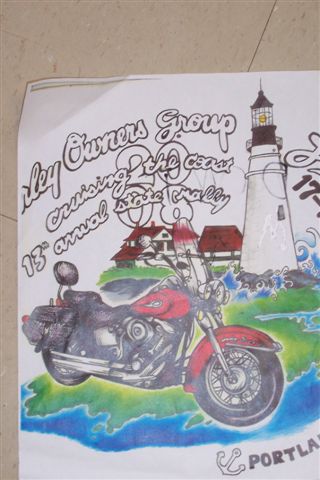
Last years design by Amy Mizner

Every year the Commercial Art class at the Portland Arts and Technology High School designs the idea for the annual Harley Davidson state rally tee shirt. This years winner is Eva Andrade, a student from Wells.

Students learn many techniques when designing the t-shirt including lay out, design, color and  how to draw a Harley motorcycle. The winning idea goes to the Harley headquarters in Detroit and there the design is put on to a t-shirt and distributed to Harley owners at the summer state rally.

The winning student receives a t-shirt as a momento, which is an honor since Harley owners are the only ones to receive a t-shirt!

h1

Boosting Creativity

February 8, 2010

Brandon Schauer vimeo and message

Mr. Schauer tweeted that it’s been discovered you can boost creativity with side-to-side eye movement. He claims that “people who watch a target moving side-to-side for 30 seconds have been tested as producing significantly more ideas when immediately given a creative task”. He goes on to say that this technique is, “thought to increase the cross-talk between the hemispheres. Perhaps you’d like to try this and see if it impacts your creativity…. Please click here.

This reminds me to go back and read some of the information on Arts and the brain like this article in a mesartsed blog post from June 19, 2009 written by Liz Bowie, printed from the Baltimore Sun. Using our whole brain and developing both sides so we are more integrative in our thinking is an important part of what arts educators do with students. In fact, I believe, it is our responsibility as arts educators to present articles and research to school decision makers so they understand the importance from this angle. It is another piece of the puzzle.

And another article you might want to read from “Power States” blog of Joseph Bennette with an entry entitled “Using Your Whole Brain”.

h1

Unlocking the Digital Door

February 7, 2010

MLTI Winter/Spring 2010 Regional Workshops

Overview:  To fully communicate, collaborate, participate, teach, and learn, we must be able and willing to open the “digital doors” that are today’s gateways. Each digital door opens opportunities, but it can be difficult to navigate among them. For some of us, the process of opening, entering, and experimenting comes naturally. For others, the doors are more mysterious than inviting.

Regardless of which side of the digital door you are, this regional MLTI workshop is designed to support you in improving the existing effectiveness of technology in your curriculum. Whether you are ready to take a first step, such as using technology as a substitute for traditional instruction, or are moving on to redefine your curriculum, such as experimenting with virtual environments, this meeting is for you. For those taking the first step, the MLTI staff will provide introductions to appropriate options that are available, both on the MLTI MacBooks and on the Web. For those who are more experienced, we’ll give you the freedom to explore the latest innovations as they relate to your curriculum. For everyone, the goal of the day will be to leave with a meaningful plan that results in improved engagement for student learning and continuing professional development for you.

Outcomes:  Participants will…

  • Know how to access live and recorded online professional development opportunities such as MLTI webinars, webcast recordings, and podcasts;
  • Begin to create a personal learning network using social networking tools like LearnCentral and Twitter;
  • Plan and create a virtual learning environment for students using a combination of tools that may include class web sites, blogs, wikis, Nings, Studywiz, etc.

Activities: The format for the workshop will be a combination of direct instruction and facilitated, independent work time. We will begin by helping participants unlock the digital door for their own learning and then continue to support participants as they make a plan for unlocking the door for students and inviting them into a virtual learning environment. We will look at Adobe Connect, LearnCentral, and Twitter as ways for teachers to access online professional development and create personal learning networks. We will brainstorm a list of possible ways teachers can build virtual learning environments for students and help each participant plan and begin to construct one.

Follow up: The MLTI staff will offer continued online support for participants and schedule follow-up face-to-face workshops as needed.

To register: Please visit our Events Page at http://www.maine.gov/mlti/events/ to find a link to online registration. Please note, each session can accommodate 20 participants.

Audience: Grades 7 – 12 Teachers who want to learn more about entering and working in virtual environments for teaching and learning. No prior knowledge or experience is required, and participants will be shown many options from which they can choose.

To Bring: MLTI Device, charger, snacks/lunch/beverages

Times: 8:00am – 3:00pm

Dates/Locations:
February 23: Noble HS
February 24: Biddeford MS
February 25: Bonny Eagle MS
February 26: Mt Ararat Central Office
March 1: Wiscasset HS
March 2: Auburn MS
March 3: Skowhegan HS
March 4: Winslow HS
March 5th Piscataquis HS
March 8th Ellsworth Central Office
March 10th Washington Academy
March 12th Fort Fairfield MS/HS