
What Do the Arts Teach?
October 13, 2010Shanna Wheelock blog post
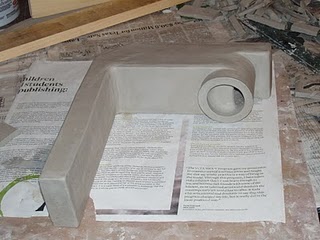 I look forward to reading Shanna’s blog posts and I was especially moved by her description recently on creating a work out of clay. The struggles and thought process involved clearly pointed out to me that it is not just about taking a lump of clay and envisioning it into “something”. My concentration in my undergraduate program was clay so I could relate to her story. I just loved how at the end of her story she brought it back to the importance of arts education. Not about the making but about the many components of learning that one learns and uses. At the end of her vividly explained post I almost felt like I was there. Here is an excerpt of the piece:
The task of creating the top structure took nearly seven hours, leaving me quite exhausted, but feeling like I accomplished what needed to be done. As I worked through various solutions on the sculpture I thought of my students and how important the arts are to their education. One of the Maine State Learning Results’ Guiding Principles is to be a “creative and practical problem solver”. The arts are a perfect venue for building those skills, and those skills can be applied in all parts of life and work. In fact, I recently read that the number one characteristic that employers desire in an employee is the ability to think creatively.
Maybe next time someone suggests that the arts are not important in school, that just the basics such as reading, writing and math are necessary, I think I will refer them this blog entry.
You can read the entire post and see great pictures by going to her blog The Easternmost Potter in the United States called Arts Hone Creative Problem-Solving Skills, October 3rd.

 me arts ed
Shanna, I am struck by the exhaustive problem solving – the jumping up and down with your friend, and trying multiple ways to try to extricate the clay from the tube – the invisible supports needed to keep the structure sound – all things that tie in science (physical properties, chemistry) and math, common sense, creativity, spatial understanding, purpose — all to create a form according to the artist’s intent. I see all sorts of neurons and synapses lighting up on a brain scan!
Catherine
Shanna’s observations are ‘spot-on’ in music, as well. Her web-site is also well worth a visit (or 2— or 3). Thanks for the post!
Iris