Archive for December, 2010

h1

How to Crank up Your Creativity

December 11, 2010

Creativity, Imagination, Innovation
I have received many emails recently that include at least one of these words: creativity, imagination, innovation. They are being used in articles, the titles and themes for conferences, and researchers are looking closely at the benefits and importance of them. I wonder if these are part of the present buzz words only or if they are here to stay?! Are others learning what many arts educators have known for years? CEO’s and university leaders are toting that creative and critical thinkers are absolutely necessary in selecting employees and students. The revised Bloom’s taxonomy (2001) has create at the top of the pyramid.

Jim Small has been teaching creativity at Madison Area Memorial High School in Madision, ME for many years. Creativity is a major portion of the curriculum for his Intro to Visual Arts course and he measures the learning of it effectively. He has written articles, given presentations and you can hear him reading one of his articles on iTunesU podcasts under Visual and Performing Arts at the Maine Department of Education segment. In the podcast he states: “verbally and visually everyone can become a more creative thinker – children start out that way…”. His advance classes reach inventiveness and innovation.

The Maine Learning Results Parameters for Essential Instruction Visual and Performing Arts Standard 3 is Creative Problem Solving. I have looked at several other state arts standards and haven’t seen Creativity stated separately.

Ken Robinson has addressed creativity and has even gone as far to say that the present school system kills creativity and recently in a podcast talks about the assessment of creativity.

Recently a friend sent me an article called How to Crank up Your Creativity published on wikiHow. The article includes exactly what the title says. Not sure why they refer to the 11 steps as a method, seems a bit odd when referring to creativity. However I can understand why many adults would look closely at this, especially those who don’t think of themselves as creative.

The “steps” are listed below and I urge you to go to the link and read the  3 or more sentences under each step that expands on the title. There is a short video called How to Stimulate the Creative Process which talks about basic ideas on healthy living including sleep. Yup, the writer refers to how sleep  helps to boost creativity and problem solving abilities.

Anyway, the “steps” below are the content of the article that you will find in detail in the article. It would be great to hear what YOU have to say by clicking on “comment” below the post.

  1. Accept that you are creative.
  2. Change your perspective.
  3. Shift your mental landscape.
  4. Embrace your imagination.
  5. Play with abandon.
  6. Engross yourself in the artistic process.
  7. Find your comfort spot.
  8. Allot time.
  9. Soak up solitude.
  10. Revel in connection.
  11. Keep it simple.

Thank you to Carol for sending me the link to the article.

h1

“The Fringe Benefits of Failure, and the Importance of Imagination”

December 9, 2010

JK Rowling gives Commencement Address at Harvard- June 2008

Please click here to listen to JK Rowling delivering the keynote.JK RowlingPublished in the Harvard Magazine.


h1

Australia Educational Testing

December 8, 2010

Weight and the PISA

Dr. Kevin Connelly

While this article is about the testing situation in Australia and the PISA (Programme for International Student Assessment) I found myself reading to the end feeling like there was hope in this article. And sure enough this was the last paragraph in the piece:

The focus on improved productivity and international competiveness by raising test scores should not ignore the reality that education in its fullest sense deals with emotional, spiritual and moral issues that define us as humans and determine the nature of the society in which we live.

The article, A Test for Educational Assessment, Dec. 8, 2010, was written by Dr. Kevin Donnelly who is the director of the Education Standards Institute and author of Australia’s Education Revolution. You can read the article by clicking here and please make a comment below.

h1

It Takes a Child to Raise a Whole Village

December 5, 2010

Interesting article

I took advantage of the day after Thanksgiving, a vacation day, to do some cleaning out. Boxes of “stuff” are starting to back up on me. Maybe it was that trip this summer, packing up my 92 year old mother’s home, and moving 20 boxes of her photographs and scrapbooks to my home that have given me a little push to clean out.

While sifting I came across articles that I had saved, one that I am referencing is from a 1995 report from the Johnson Foundation, Racine, Wisconsin called Wingspread “It Takes a Child to Raise a Whole Village” written by John P. Kretzmann and Paul H. Schmitz. It is a different twist on the topic “It Takes a Village” which many of you probably know of the saying with the African origin. I am going to be using segments of this article (which I couldn’t find online) since the authors encourage readers to share it with others. Even though this article is a bit older it still makes me think.

Certainly since 95 the cliche is not heard as much and more and more people have been rethinking what education is about and the importance of “relationships” for the success of each student. The authors make clear that they believe the cliche is incomplete. In the cliche, adults in the village act to “raise” young people. Young folks are the objects of the action, never the subjects. Hmmmmm…. They go on to say that young people are passive and useless. They are defined as deficient – of knowledge, of skills, of any useful capacities – and relegated with their cohorts to the filling stations we call schools. The assumption is that, magically, at age 18 or 21, young people will emerge from their years of being filled, and re-enter the community as full and useful contributors.

I am not sure I agree that the cliche was interpreted like that by all. However I do agree with them when they discuss the village raising and what it could be. And I think since 95 we have moved towards that but there are still adults who view students in the same manner. Some adults still believe that it is their job to open up the brains of young people and poor knowledge in.  The authors want our young people to be valued by contributing their gifts our communities. In places where young people are active members of the community, those who are engaged in community service and service learning projects, they are anything but passive.

The authors believe that we have lowered our expectations for our young people, that we do to much for them and don’t involve them in the decision making segment of the work. So, if the problem is that there is a disconnect between what adults perceive young people need and what young people really want, no wonder adults have low expectations. In fact, how can any adults know and understand teenagers if they aren’t sitting at the table asking them, involving them in the conversation, listening to what they have to say?

What I ask myself is how far have we moved since 95, that’s 15 years ago? When a teacher sits down to talk to a parent about their son or daughters progress, is the student at the table? Does a teacher punish a student before asking them to discuss the situation? Are teenagers given responsibilities that are realistic to their abilities with a little stretch mixed in?

Below are the “ten commandments” for involving young people in community building shared by the authors:

  1. Always start with the gifts, talents, knowledge, and skills of young people – never with their needs and problems.
  2. Always life up the unique, never the category to which the young person belongs. It is “Frank who sings so well” or “Maria, the great soccer player”, never the at “at-risk youth” or the “pregnant teen.”
  3. Share the conviction that: (a) Every community is filled with useful opportunities for young people to contribute to the community; and (b)There is no community institution or association that can’t find a useful role for young people.
  4. Try to distinguish between real community building work, and games or fakes-because young people know the difference.
  5. Fight-in every way you can-age segregation. Work to overcome the isolation of young people.
  6. Start to get away from the principle of aggregation of people by their emptiness. Don’t put everyone who can’t read together in the same room. It makes no sense.
  7. Move as quickly as possible beyond youth “advisory boards” or councils, especially those boards with only one young person on them.
  8. Cultivate many opportunities for young people to teach and to lead.
  9. Reward and celebrate every creative effort, every contribution made by young people. young people can help take the lead here.
  10. In every way possible, amplify this message to young people: We need you! Our community cannot be strong and complete without you.

Hopefully this gives you something to think about. Do you encourage your students to take on leadership roles in your classrooms? Do you reach out to all your students or just a segment? All students deserve the opportunity to reach their potential!

h1

Articles

December 5, 2010

Reading on a snowy day

It was so wonderful to wake up to see it snowing yesterday morning and again today with snow on the ground. Not much snow, but enough to put a smile on my face. I thought I’d curl up by the woodstove with the newspaper and a cup of tea but the newspaper hasn’t arrived yet so I promise myself only to take a short time and catch up on email and write a blog post.

Realizing I haven’t posted in two days, oh my gosh, the holiday preparation has taken priority. And oh my gosh again, I found several emails and drafts for blog posts that contain articles that I’ve wanted to share…. this gives me the chance to delete some of the mail AND write a post. Below are articles (and blogs) that you might find interesting….

I hope there is snow where you are this morning! Whether you’re working on grades, budget preparation, baking cookies, making gifts, listening or making music or wherever this morning finds you, that you enjoy the day!

h1

The Whole Child

December 2, 2010

ASCD and their whole child initiative

Most teachers are familiar with ASCD, formerly the Association for Supervision and Curriculum Development. Founded in 1943, they are an “educational leadership organization dedicated to advancing best practices and policies for the success of each learner.” 

Their blog called Whole Child Blog is intended to raise awareness about the need to ensure each child is healthy, safe, engaged, and challenged. If you go to their site you can learn more about each of these topics and resources are provided.

Recently my colleague from Vermont, Gail Kilkelly shared information with me on the Whole Child blog. During October they were focusing on the critical role the arts have on a child’s growth and development. I suggest you go and check out the site and in the blog archive box, top right of the page, click on October 2o10. If you are short on time just click here and it will take you directly to October 2010 page which provides links to several pieces on arts education.

Also, if you click on “PODCAST” located in the bar across the top it will take you to the podcasts. Scroll down to the one called “The Critical Role of the Arts Throughout a Whole Child Education”. The podcast has Peter Yarrow of Peter, Paul and Mary, and Operation Respect and United Voices for Education, and Mike Blakeslee, senior deputy executive director and chief operating officer of MENC, (The National Association for Music Education), and Vanessa Lopez, art educator from Roland Park Elementary/Middle School in Baltimore, MD.

Pieces of interesting information on 21st century including how the arts can increase students’ college, career and citizenship readiness. Take a few minutes to listen and learn.
Thanks Gail for sending the link and information!

h1

In Today’s News

December 1, 2010

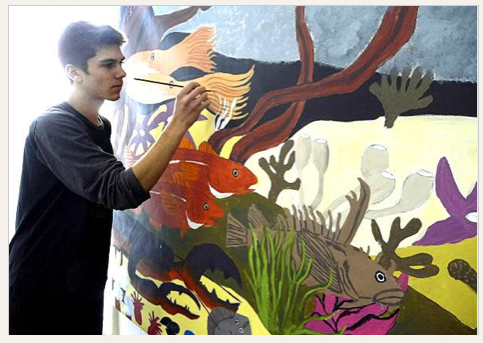
“Local artists step up at Eastport to educate students”

Please click here for the article in the Bangor Daily News written by and photograph by Sharon Kiley Mack, 11/29/10.

Senior, Cecil Cates, at Shead High School, Eastport


Plus an article about Alyssa Anderson’s middle school students who recorded the holiday CD. In the Bangor Daily News, 11/22, written by Kevin Miller. This article was picked up by the AP wire as well.