
Interview with Carol Dilley, Associate Professor of Dance and Director of Dance, Bates College
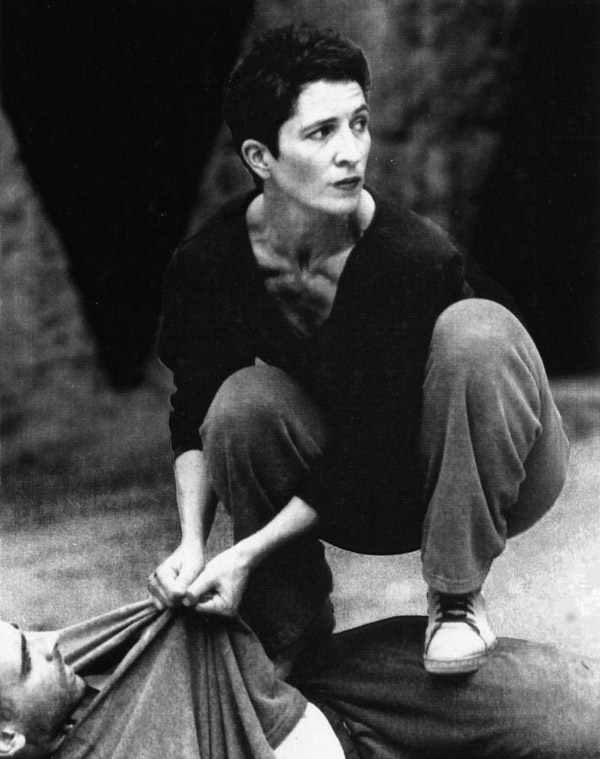
Carol Dilley with Barcelona choreographer Carles Sales, photo by Manel Socias
I learned recently from my friend and long time dance educator and arts education advocate Nancy Salmon that Bates College had approved their dance major. I could hear the excitement in her email! Nancy has worked with the Bates Dance Festival among many other projects to further dance education for Maine students so I called to speak with her. She let me know that Carol Dilley had worked for several years on obtaining the major and passed on her contact information. I had a delightful conversation with Carol who was in New York at the time and on sabbatical this year. I learned more about the dance program at Bates and below is some of the information.
CONGRATULATIONS to all those who worked on this and now we have one more reason to encourage young people to go into the dance field.
How long have you been working on obtaining a Dance major at Bates College and what has it entailed? I understand this is (might be) a first for Maine.
I have been working on this major since I was hired in 2003. Before my position was created, Marcy Plavin, who was the heart and soul of Dance at Bates since 1965, officially had a ¾ time position. The first step was to stabilize the full time position and the curriculum and then we had to sit and wait for three years until the College was ready to step up and support a new major. This is the first new major at Bates since 1998. It also required a commitment to a second faculty position in dance and in this current environment that is a big commitment.
Why do you suppose in a state so rich with the arts that there hasn’t been a dance program before now?
Bates is the first in the state to have a freestanding major specifically in dance to my knowledge. Colby College has had a major in Theater and Dance on the books for years but it tilts towards theater and there are dance programs of some kind at most of the colleges and universities. With even a presence of dance education in the K-12 schools, Maine is by no means at the back of the line as far as dance in its educational institutions. In addition to Bates initiating its major and a second full time faculty position, Colby and Bowdoin have both recently also hired new tenure track dance faculty, which is a definite sign of commitment from all three schools. Both University of Maine at Oreno and University of Southern Maine have had active dance programs as well.
In the case of Bates, the lack of a major has frankly been baffling given the presence of the Bates Dance Festival. Most people in the profession simply have assumed that it does and I regularly get puzzled emails from parents and prospective students looking for the major on the website. Each institution, however, has its own story that has to do both with the arts in general and with theater and dance more specifically. Given the national crisis in arts education and funding for the arts, however, the fact that Maine actually does appreciate its arts is a great starting place.
Tell me what approval of this Dance major means for Bates College
Having a major in dance is an acknowledgement of the academic value of what we teach and a validation of the form as a whole. It is not unusual for dance to be the last of the arts to be brought into a curriculum but at a time when Bates is prioritizing the arts, having a brand new major in one of its very active art forms can only be good for the institution. Most importantly, the major is a much needed curricular bridge to the internationally heralded Bates Dance Festival in the summers which I will discuss in more detail below.
And, what does this mean for the state of Maine?
This increased energy in the college dance programs can only be good for the state of Maine in general. Stronger programs bring more dancers, both through the teachers who are active in the community and the students. At Bates at least, we have always had students who are interested in teaching and who volunteer or intern in schools and various educational dance programs either as part of their studies or on their own. We very much look forward to having the capacity to develop this aspect of our dance program now that we are over the hurdle of creating the major. On a very different level, the faculty at the colleges are all active dancers and participate locally in dance performances and with workshops in public studios. Since I arrived in 2003 a few new initiatives have developed and there is definitely a sense that dance is blossoming in the state.
How many dance courses are offered at Bates presently? What will change due to this news?
There are currently over 30 courses offered in dance at the moment including theory, creative process, technique and courses cross listed in education and music. Most are on a rotating schedule of course with only the technique courses being offered both semesters every year. The change in the curriculum is actually minimal because in the years we were waiting we built the curriculum up to the level of a major. Students were already graduating with more credits in their dance minor than they had in their major subject.
What impact might this Dance major have on the Bates Dance Festival?
How closely do you work with them? While we have always had a vibrant dance program with dedicated dancers, without the major we did not attract enough serious contemporary dancers to be able to take full advantage of the presence of the festival. Those students majored in dance elsewhere and then came to the festival in the summers. The students are actually the most important link between the festival and the curriculum and we look forward to much active engagement through the combined summer and school year programs.
What do you think is the attitude of Bates College towards the arts and specifically towards Dance?
At the moment Bates arts are enjoying a moment in the sun largely due to a group of dedicated faculty and staff making a heroic and sustained effort over the last three years to raise the visibility of the arts at Bates. As a result the arts were named as one of three top priorities for the college along with a science building and a teaching and learning center. This has made a world of difference because since being publicly prioritized we are much harder to ignore. Dance has always enjoyed a sense of being appreciated at the college even if it’s potential has not been fully recognized. I never have the sense that anyone is against dance, just that they are a bit baffled by what we do. This is often the case in the arts and more so because of its general lack of cultural status. But that is a long discussion better left for another time.

 me arts ed