Very beautiful!

MetLife Survey of the American Teacher
Ed Week reporter Erik Robelen reports on how schools are doing in these poor economic times and applying budget cuts. Erik’s information is taken from a teacher survey conducted by MetLife in their 28th annual MetLife Survey of the American Teacher.
The areas of arts, world languages, physical education were reported on and Erik’s blog post is dated March 9th. You can read the entire post by clicking here.
Carol Trimble honored at the Youth Art Month opening, Portland Museum of Art
Carol Trimble, former director of the Maine Alliance for Arts Education, received the Maine Art Education Association (MAEA) advocacy award on March 10th at the opening for the state Youth Art Month opening at the Portland Museum of Art and shared these words. The award was presented by Sandy Brennan, president of the MAEA. Below is the message she shared with students, families, and educators that evening.
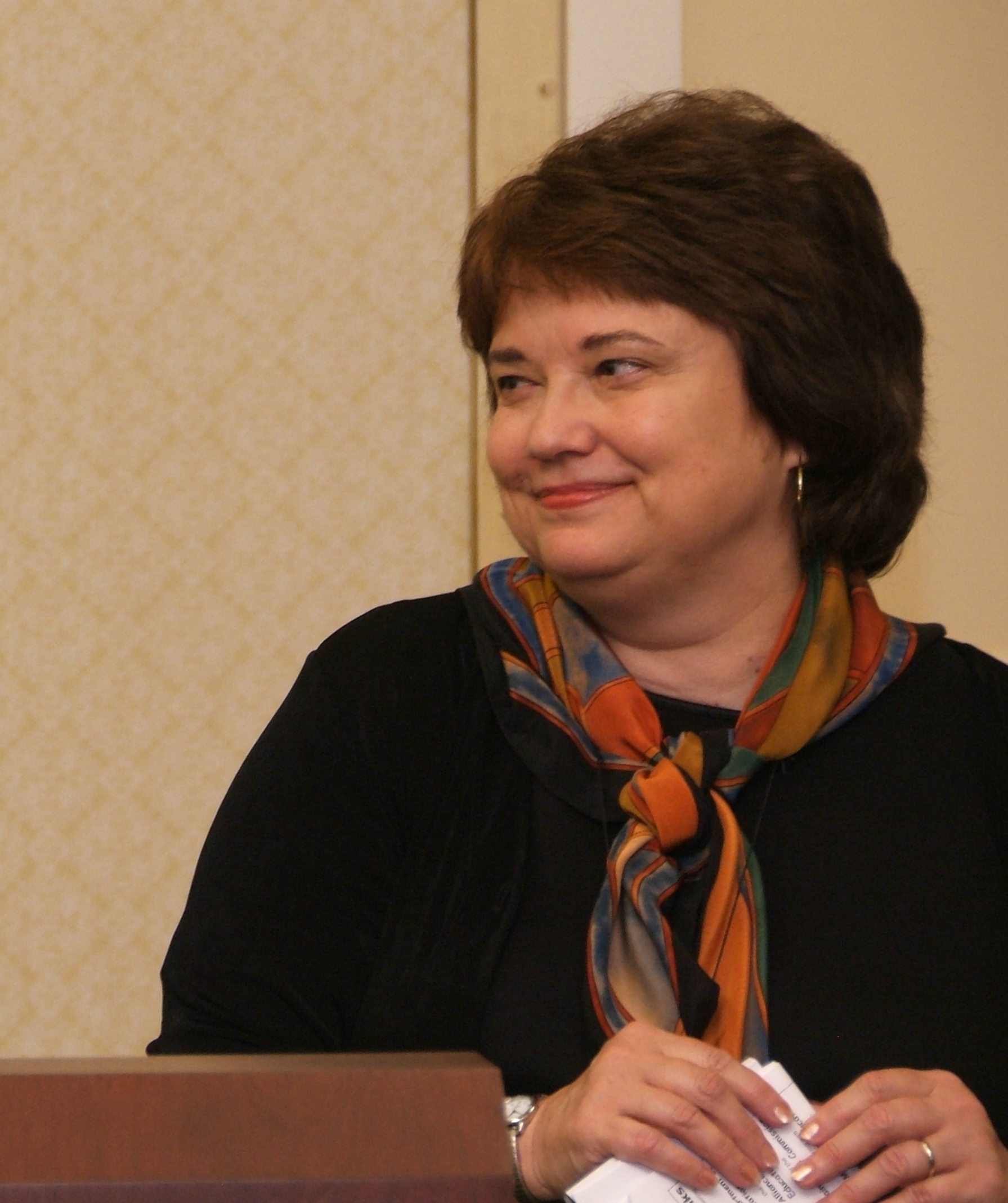 I am so pleased to participate in this celebration of inspiration and imagination and pleased to be here with teachers, administrators, parents, and representatives of organizations, like the Portland Museum of Art, all of whom actively support arts education for these wonderful students.
I’m grateful to be honored by the Maine Art Education Association.
I have such a deep respect for Maine’s arts teachers who are talented, inspired, hard-working and very dedicated.
I have worked closely with MAEA’s former president Trudy Wilson and current president Sandy Brennan on several successful advocacy campaigns to strengthen arts education for Maine students.
One of the lessons we learned is that parents are the very best advocates. So I’d say to the parents here today: use your power to ensure that your children receive the best education to continue the development of their imaginations. Take a picture at the event today and share it by email or in person with someone on your school board. Let them know what important work our art teachers and their students are doing. And along with that, support your local cultural organizations, especially those, like the Portland Museum of Art, that find effective ways of working with and supporting local schools, teachers, and students.
To the student artists whose work we are celebrating today, I’d like to say: keep using your imagination! We want to see what your imagination comes up with next! Take advantage of all the opportunities you have to develop your imagination and your skills for expressing yourself. Your imagination will help to build your future.
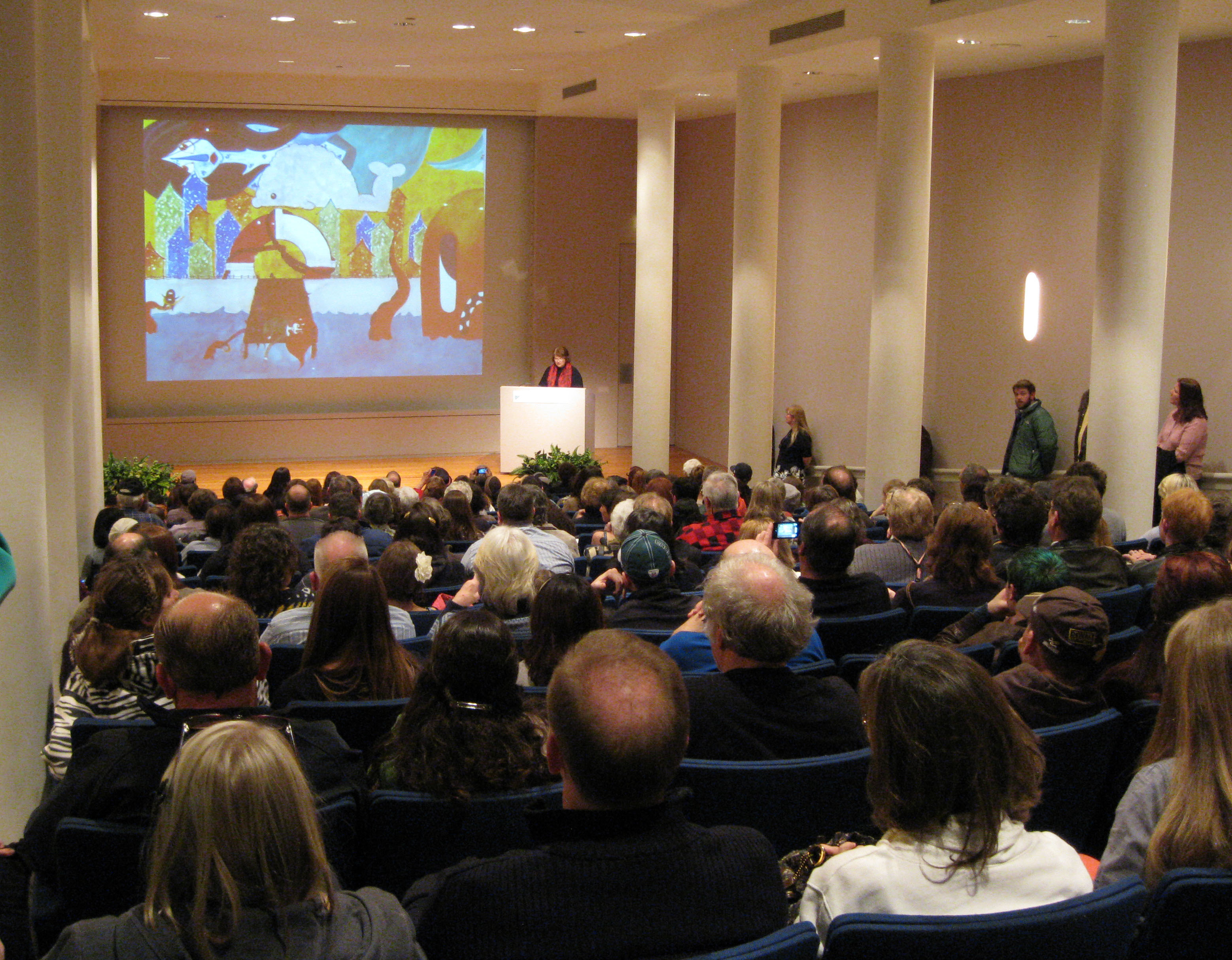
Carol speaking at the opening, Portland Museum of Art
Musician Michael Burd teaching ukulele to adult ed students
The Sun Journal published article written by Ann Bryant on March 7th about Michael Burd teaching ukulele to adult ed classes at Mt. Blue Middle School in Farmington. Not only can you find the article by clicking here but also at the link is a video clip of Michael and the students in action.
The article starts like this:
Four strings, three chords and the agile fingers of 10 students in Ukulele 101 resounded in a rendition of “Happy Birthday” at Mt. Blue Middle School.
After showing students where to place their fingers for each chord, instructor Michael Burd asked the students if they knew the meaning of muscle memory. It’s doing it until it comes naturally, he said. He urged the students to “practice, practice, practice” the simple song before the next class.
Michael is a professional musician who plays bass with David Mallett, Noel Paul Stukey and others. He bought himself a ukulele last year at a yard sale for $2 and started playing. He is an instructor with the adult ed program in the Mt. Blue Regional District where he is teaching others to play the ukulele.
Burd attended the Maine Learning Technology Initiative workshop with Steve Garton in January. You might remember his picture from the blog post.
Anyone else teaching arts in an adult ed program? Please let me know!
Bowen lauds Ed Committee vote on teacher effectiveness
FOR IMMEDIATE RELEASE – Wednesday, March 21, 2012
Contact: David Connerty-Marin, 207-624-6880/831-3313
The Legislature’s Education Committee voted unanimously Wednesday afternoon in favor of LD 1858, a bill that would require schools to adopt teacher and principal evaluation systems.
“Of all the education bills this session, this one has the potential to positively impact education more than any other,” Bowen said. “The bill goes to the very heart of what we know has the greatest impact on learning: the effectiveness of teachers and school leaders. The best curriculum and learning materials in the world are of no use to us unless we have effective educators in our schools. Supporting great teaching and school leadership is what this bill is all about.”
The Education Committee has supported efforts to promote improved standards for students and now follows suit with clearer standards for teachers. The Maine Department of Education will work with many groups to develop guidelines and standards for evaluation systems, but the systems themselves will be developed or adopted at the local level.
“I appreciate the give and take with the Maine Education Association and legislators,” Bowen said. “It made this bill better by underscoring its true purpose – to improve the ways in which we prepare, support, and evaluate teachers.”
The committee approved LD 1865, which enhances career and technical education, by a 10-1 vote earlier this week. Both bills are part of Gov. Paul LePage’s education agenda and will likely go before the full Legislature in the next week or two.
Two more bills are part of the Administration’s agenda. One deals with public and private school choice options, the other with allowing funding for religious schools. Those measures will be discussed by the committee on Thursday.
Information about all four bills, including links to the bill language and the commissioner’s testimony, can be found online at http://www.maine.gov/doe/first.
So many good days to be surprised and grateful for
The weather has been tricking us lately, that is for sure! I keep remembering that it is only March 20th, the first day of Spring, and then I check the calendar! This is Maine and the weather is very unusual for this time of year. Seventy degrees today, the flower bed is raked, the shorts are out, canoe in the water, and it looks like it will continue for a couple more days anyway. We heard woodcock last night on our walk and the air seemed perfectly still! Almost like a July warm evening. I don’t remember a first day of Spring like this!
While canoeing over the weekend the ice was still in the pond, the water very calm so the reflections were intense, and sign of beaver along the bank. It was a delightful morning. I hope you’ve had a chance to get outside and enjoy this unusual weather!


Featuring one teacher’s journey as an arts educator
This is the first in a series of blog posts telling arts teachers’ stories. This series contains a set of questions to provide the opportunity for you to read their stories and to learn from others. The first one is featuring Rob Westerberg who is one of the recipients of the first presented Carol Trimble Award for outstanding contributions to arts education. If you have questions please don’t hesitate to contact Rob at rwesterberg@yorkschools.org and/or put your comments at the bottom of the post. Please let me know if this series “Another Arts teachers’ story” will be helpful to you by emailing me at argy.nestor@maine.gov.

All-State conference, UMaine, 2010
Rob Westerberg is a High School Choral & General Music teacher who has taught for 24 years, the last 12 at York High School. He averages between 175 and 250 students per year covering several choirs, Vocal Auditions Class, Music History & Music Theory I and II. He is well respected by colleagues in New England for his enthusiasm and commitment to excellence in arts education! He has been a member of the Leadership Team for the Maine Arts Assesment Initiative and a member of the three person team who created the plan for the initiative.
What do you like best about being a music educator?
Waking up every day and being excited about going to work. Really!
Tell me what you think are three keys to ANY successful arts ed program?
1) getting the school and community to “unlearn the irrelevant” about the arts, 2) establishing the arts as “essential” ACADEMIC instruction, 3) building connections with other arts educators outside of your district to invigorate and reinforce your work.
What specific way(s) do your assessment practices tie into the success of your program?
They show the concrete parallels to assessment in other academic areas (reinforcing and demonstrating our academic status), they focus and enhance student achievement, and they help me to continuously evaluate and revise my curriculum and instructional practices.
What have been the benefits in becoming involved in the arts assessment initiative?
I have grown more in the last two years as a professional than the previous ten combined. Every interaction I’ve had with others as a component of the Initiative has driven me to want to be better at what I do, and has provided a foundation on which to build my assessment practices in ways I always wanted to but could never fully wrap my arms around.
What are you most proud of in your career?
Establishing a graduation requirement specifically for music (performing arts) and specifically for art (visual arts) at two of the three schools I have taught at. 100% of our graduates display genuine proficiency in the fundamental MLR standards of both subject areas through rigorous coursework, truly fulfilling a global vision of arts education for all.
What gets in the way of being a better teacher or doing a better job as a teacher?
“Getting SO wrapped up in working through, over or under the various brick walls that always seem to be standing in front of me (in front of ALL of us!!!) that I easily forget how much I love teaching to begin with… and not drawing from that reservoir of passion and excitement more often.”
Apple or PC?
Apple
What have you accomplished through hard work and determination that might otherwise appear at first glance to be due to “luck” or circumstances?
The music resources that we have access to at YHS can often be perceived as being due to being in a “wealthy” community. 75% of those resources (which does not include a functional auditorium) were not around 12 years ago and had to be fought for tooth and nail. We can empathize with anyone’s battle of having to fight for more resources in the arts.
Look into your crystal ball: what advice would you give to teachers?
Connect with other arts educators CONSTANTLY… in your 1st year or 41st year, all the best ideas for building and developing your program are already out there, and it’s your colleagues who have those ideas ready to share with you! Go get them!!!!
If you were given a $500,000.00 to do with whatever you please, what would it be?
I’d pay off my mortgage and then live off of the rest so I could just spend every single day of every single school year visiting arts educators across northern New England and working with them on curriculum and assessment development for their own programs I’d also buy an awful lot of Terra Cotta Butternut Squash Pasta…
York High School music programs webpage: www.yorkschools.org/yhs/music
Harlow Gallery working with visual art educators
Nancy Barron, Program Director at the Harlow Gallery in Hallowell has helped to create a connection with local visual art educators to form a group called Art Educators’ Initiative. Recently Nancy answered questions for meartsed readers. Since this is a great model for other communities please share this post with your local galleries so they can think of possibilities for communities throughout Maine.
 Mission Statement: “The Harlow Education Committee mission is to promote the arts through educational partnerships with the community.”
Vision Statement: “The goal of the Harlow Education Committee is to foster creativity by supporting programs and activities that encourage public awareness of, participation in, and appreciation of the arts.”
Tell me about the purpose of the Art Educators’ Initiative group.
The purpose of the Art Educators’ Initiative group is to give art educators a network of peers to problem solve, generate ideas, share professional development opportunities-in short, a support system.
Sounds like a PLC (Professional Learning Community) to me. How and when did this idea form?

Website for classroom workshop, Shalimar Poulin instructing
The idea was an “ah-ha” moment at the Harlow. We have hosted Higher Forms of Art for several years; a show celebrating some of the area’s high school students art work. It is unique because the students not only display their work, but select the work for the show (curate), hang and promote the show. A hands on experience in a real gallery. We always want to engage this high school demographic and brain stormed about how to do just that. We decided to have a young artists celebratory pizza party. We had a sponsor who provided the pizza and requested that the teachers invite up to 6 students and to attend themselves. (60 students were invited). Disappointedly only 3 students came to the party, however; nearly all of their instructors came. With art from these various schools on the walls, introductions were made and the event instantly morphed into a very upbeat networking session for the instructors. The teachers were inspired by their colleague’s lessons and curious about their techniques. Needless to say, the event, though not for reasons intended, was a complete success. I floated the idea to host an “Art Teachers Retreat” to our relatively new, but very eager Art Education committee. They, (some of whom are retired art educators) loved the idea. In May of 2011 we held a focus group compiled of about 15 area art educators, Art Ed committee members and the Harlow staff. We asked the group:
They liked the idea, were realistic about what kind of commitment they could make (4 times per year), and they came up with a list of focus items which included: website development, clay workshops, behavior in the classroom, and more.
What does your work include?
So far, nearly a year later, the group has met for a website for classroom workshop taught by Art teacher Shalimar Poulin-10 educators signed up for this workshop in August of 2011. We have had two meetings since in which a good chunk of time was spent talking about assessments. This piece was a real eye opener for me. This one topic is clearly something nearly every teacher seems to struggle with. Teachers were also encouraged to bring examples of “tried and true” lessons.
Tell me about the teachers who are participating.

Website for classroom workshop
The group varies from meeting to meeting with between 9 and 12 teachers attending. Our list has grown from 20 to over 30 teachers now. Many of the teachers on our list have participated in our yearly Young at Art month in March. But we are not limiting the group to school aged children. We have an adult ed instructor and two instructors of adults with mental illness. Instructors are finding us through email blasts to statewide groups. The areas represented are: Bath (adult ed instructor),Wiscassett, Richmond, Gardiner (and all the schools they serve-Randolf, Pittston, Chelsea), Chelsea, Hallowell, Augusta, Manchester, Readfield, Winthrop, Monmouth, Wayne (Kent’s Hill), and Waterville.
What activities, forums, and/or gatherings have you provided for the teachers?
So far, we have done one off site workshop at Capitol Area Computers and three meetings at the Harlow. We provide snacks… a small gesture with a large impact.
What is your philosophy around the idea of connecting the Harlow Gallery with art teachers? Value to the community, teachers, students, and others?

Chantel Wellman, "Blue Rock' Gouche on Paper Cony High School, from this years Higher Forms of Art show at the Harlow Gallery
The philosophy behind the group is: Art teachers are a somewhat under supported group. Every year facing budget cuts-one of our instructors jobs was cut in half last year! They are very often the only art teacher in their schools-there are not “teams” for them to bounce ideas off from. The Art Educators’ Initiative Group was meant to provide support-for teachers from teachers.
The value to the community will be teachers that, even with the unique challenges they face, will continue to provide the best arts education to students.
The value to teachers will be a support network, for example someone to call during the struggles of trying to understand how to assess a student that doesn’t fit the criteria for a passing grade in art. Professional development: something so important, to keep current with new trends in art education. The importance of this group for students will be art teachers that are fresh and focused.
What do your future plans include for the Art Educators’ Initiative group?
We are currently writing a grant to help support this group both by providing funds for a laptop and LCD for educators to present to one another, and for a series of clay summer workshops. This was one of the original requests from the focus group.
A great big THANK YOU to Nancy for taking the time to answer these questions. If you have others please post them below in the comment section of the blog post or email Nancy Barron directly at kvaa@harlowgallery.org.
Wednesday, March 14, 2012
Contact: David Connerty-Marin, 207-624-6880/831-3313
Bowen testifies for educator effectiveness bill
AUGUSTA – Education Commissioner Stephen Bowen made the case today before the Legislature’s Education Committee for legislation to improve and support teacher development and evaluation.
LD 1858, An Act To Ensure Effective Teaching and School Leadership, focuses on teacher and principal evaluation and professional development. It would set standards for evaluation systems that would then be developed locally. It also allows the Department to collect and report data about teacher and principal preparation programs, as well as provide alternative pathways for experienced professionals to become teachers.
The legislation is the second of four bills that are part of Gov. Paul R. LePage’s education agenda to be heard by the committee. The first, heard Tuesday, addressed enhancements to career and technical education. The remaining two will be heard Thursday and include proposals to increase school choice options for families and students. The package of legislation was first announced in early February.
“No other bill you’ve heard has the potential to effectively impact education in Maine in the way that this bill does,” Bowen told committee members. “I say this because this bill goes to the very heart of what we know has the greatest impact on learning: the effectiveness of teachers and school leaders.”
Consistent with the ESEA flexibility package put forward by the U.S. Department of Education, the bill would require school districts to develop or adopt and then implement teacher and principal evaluation systems consistent with criteria to be established by the Department through rulemaking.
The Department would begin working with stakeholders to develop guidelines this year, with the goal of having final rules adopted a year from now. Districts would develop or adopt evaluation systems during the 2013-2014 school year, pilot them during the 2014-2015 school year, and fully implement them during the 2015-2016 school year at the latest.
These systems would require: use of multiple measures of effectiveness, including student achievement and growth as a significant factor; that evaluations be conducted regularly; and that evaluations provide specific, timely and relevant feedback to teachers and principals that would be used to direct and support professional growth.
Bowen addressed directly concerns about the bill, saying that while some portray the legislation as a way to remove teachers, its real purpose is to help all teachers and principals improve.
“As someone who was evaluated a number of times over the course of my teaching career, I can tell you that the vast majority of those evaluations, though generally well-intended, did very little to help me get better,” Bowen said.
He noted that in meetings with the Maine Education Association, officials there told him that the teachers they represent sometimes go years without any kind of evaluation, and are sometimes subject to perfunctory evaluations.
“Teachers and school leaders want to be evaluated and want to be given feedback that helps them improve their practice,” he said. “This legislation requires that.”
Bowen said the legislation is in line with the strategic plan he unveiled in January, which “puts the student at the center of all our efforts…It is the teaching and learning that goes on in our classrooms, we argued, that should be our core area of focus. None of that teaching and learning happens, though, unless we also pay attention to the second focus area, great teachers and leaders. The best curriculum and learning materials in the world are of no use to us unless we have effective educators in our schools. Supporting great teaching and school leadership is what this bill is all about.”
National Coalition for Core Arts Standards (NCCAS)
FOR IMMEDIATE RELEASE
Contact: Cory Wilkerson, 800-587-6814
NCCAS adds media arts writing team to Next Generation Arts Standards Project
 The National Coalition for Core Arts Standards has agreed to support the writing of national, voluntary media arts standards as part of the Next Generation Arts Standards Project. Recognizing the growing interest and diversity of media arts as a new mode of expression within public education, NCCAS has formed a team of media arts writers and leadership to lead the work. NCCAS is committed to creating re-envisioned voluntary, web-based arts standards that will build on the 1994 National Arts Standards (and the 2005 Standards for Learning and Teaching Dance in the Arts), that have helped guide curriculum designers, pre-professional training programs, funders, and federal and state policy makers in their PreK-12 decision making. NCCAS leadership is relying on the media arts writing team to create a set of standards that will be equal in rigor, breadth, and depth as those of those of dance, music, theatre and visual arts, while simultaneously recognizing that media arts will be embedded within each of the traditional forms as a pathway for knowing and understanding. Currently, media arts standards are included in the state standards of Minnesota, South Carolina, and in the district standards of New York City and Los Angeles. The writing team will use the research report, A Review of Selected State Arts Standards, to help guide them in their work. The report, one of five created in support of the project by NCCAS member the College Board, is available as a PDF at http://nccas.wikispaces.com/State+and+Media+Arts+Standards.
“Our goal is to write media arts standards that will fully describe expectations for student learning in an art form that has the ability to serve as the nexus between the arts and other subjects in the curriculum,” said Pamela Paulson, senior director of policy at the Perpich Center for Arts Education in Minnesota and one of two new NCCAS leadership members chosen to represent the area of media arts in the coalition of eight arts and education organizations. Richard Burrows, retired director of Los Angeles Unified School District’s nationally recognized arts education effort, and now an independent strategist, will serve as the other media arts leadership member. He commented, “Media Arts plays a pivotal role in putting a strong, versatile and creative culture at the heart of contemporary learning in today’s education for young minds, and is beautifully positioned to make artistic meaning in bold new ways on behalf of the arts.”
Randy Nelson, the head of the education department of cutting-edge film maker DreamWorks Animation, and John Hughes, president and founder of Rhythm & Hues Studios (a leading producer of computer-generated animation and visual effects) praised the inclusion of media arts as its own subject area within arts education. “This is a visionary and forward thinking path for arts education,” said Nelson. “Artists who get technology, technologists who get art, managers who are creative and creatives who can manage are our future. Fail to include the full spectrum of skills, fail to treat media arts education as anything but a full partner, and get ready to find an explanation even a child can understand about why the rainbow is missing half its colors, and one for business people about why we are losing jobs to more colorful competitors.”
Said Hughes: “Media arts is relevant to today’s students because it reflects our contemporary, global culture. It provides vehicles for all students to find success and enjoyment in learning and promotes critical thinking processes while engaging, real world activities that make the content more meaningful.”
The Media Arts Writing Team Members are:
NCCAS Leadership and the team chairs met most recently in Reston, Virginia, in the offices of the College Board to finalize work on a learning framework that will guide all five writing teams and to refine the project’s timeline. Writing teams are currently in the first stages of creating drafts. In the coming months, NCCAS will issue a new call for reviewers who will take the first pass over the new standards. For more information about NCCAS and the Next Generation Arts Standards Project, go to http://nccas.wikispaces.com.
You are currently browsing the me arts ed blog archives for March, 2012.
