Archive for April, 2012

h1

TED Talk: Shawn Achor

April 16, 2012

The Secret of Happiness

Pyschologist Shawn Achor presents his ideas on how happiness inspires productivity. Using your brain at positive will impact your life positively. You don’t want to miss this 12 minute video. It is fast paced and confronts so many topics from a very practical level. Don’t miss it!

Thank you to Assessment Teacher Leader and Deer Isle Stonington Elementary School art teacher, Shannon Campell sent me this link and in her words:

“If we raise our standards we will also raise our results.  I think this is so true and important to remember in all of this forward movement of education.  This TED Talk pushes those ideas and is just funny and great!”

h1

The Art of Storytelling

April 15, 2012

Lothar Meggendorfer, pop-up books

In this TED talk iPad storyteller Joe Sabia takes us through history starting with cave walls to show how technology has helped us to tell stories. Lothar Meggendorfer, the creator of the pop-up book, is included and has a greater impact than you might imagine. It is VERY engaging; I recommend to that you share it with your students and have a discussion.

Thank you to my friend and veteran high school art teacher from Phoenix, AZ, Joanie Share, for sharing this link.

h1

Portland Refugee Connects with Falmouth Art Students

April 14, 2012

Illuminating the Beauty and Tragedy of Darfur

Twenty eight year old El-Fadel Arbab fled his village in Darfur at age 12. His story has been shared with many including students at Falmouth High School in art teacher Nancy Durst’s class. The artwork students have created continues to tell Arabab’s story. This past week the work was on display. You can read about how this came together in the Forecaster from April 6th by clicking here.

h1

Musical Scores Made from Tree Rings

April 13, 2012

German artist Bartholomaus Traubeck

A record player (the kind we used when I was growing up) was modified to be able to read the growth rings of a tree to create music. Bartholomaus Traubeck created what he calls Years to analyze the rings for their strength, thickness, and rate of growth. It transform this data and outputs it as music. You can read more, see photos, and hear music by clicking here.

h1

COLLABORATION

April 12, 2012

The importance and value of collaborating whenever possible

The Maine Arts Assessment Initiative that got off the ground one year ago has been successful for many reasons and due to the contributions of many people. If I had to identify one, most important reason for the success it would be due to the collaborative efforts of several. I have watched and lived COLLABORATION  for years and years. USM professor Jeff Beaudry and I frequently talk about the “C” word and the importance and value of it. I gravitate towards people who enjoy collaborating.

The season of budgets is upon us and tough conversations and decisions are being had and made by administrators and school boards. I am getting phone calls and emails on the topic.

I believe that collaboration is a foundation for all the work we do as arts educators. Let’s face it the power of the orchestra, band, choral group, dance or theatre performance lies in the collaboration of the collective voices, instruments, and/or bodies.

  • We need to collaborate with our colleagues who are other visual and performing arts educators. We do what we do for the success of all students! We should not be competing for funds or slots in the schedule or work spaces or all those other “things” we need for the success of arts education programs.
  • We also need to be collaborating with educators of other content areas. Three times in my career as an art teacher VPA positions were in proposals for eliminations. Every time the positions were re-instated. The third time it was my colleagues of other content areas who provided their voices. In fact, they collaborated to create the presentation for the school board meeting. You might wonder why… they understood the value and importance of the collaborative curriculum work we did educating all kids. It wasn’t the icing on the cake but an essential part of all kids learning. It was the collective voices and meaningful message that made the difference.
  • Collaborating with administrators. The once every four year arts celebration that we put in my place where I taught brought 4000 people to school. Every administrator attended the event and you can be sure they had smiles on their faces! It was the single event in the districts history that brought people from all backgrounds into the school since all kids participated by exhibiting artwork and performing in the music and theatre groups.
  • Collaborating with community members is ongoing. Inviting them to your classroom to volunteer provides the opportunity for them to be involved and they “feel good” about helping. And, OMG, the opportunities for them to see and understand what happens in an arts classroom is first hand. If they didn’t undersand before that the arts are essential to all kids learning they most likely will after they spend some time in your classroom or on the field trip bus to the art museum or at the music festival or another opportunity. Engaging them in conversation about “what” you are doing and “why” you are doing it brings them to a new level of understand about arts education.

So, how does collaboration get started? In a variety of ways, perhaps one smile, one “hello”, and/or one conversation with one other person. Share ideas, ask questions, listen. My most memorable experiences teaching are when my middle school team designed interdisciplinary units. It was sooooooooo much fun to teach. We had such a good time that the enthusiasm spread to the students and by the way, the learning that took place was incredible. It was pure magic! I couldn’t wait to get to school each day to continue the collaboration.

York High School Music Educator Rob Westerberg has written a blog post called “chopped”. He takes a thorough look and position on the components of what takes place in some school districts during this time of year. If you know Rob you are well aware of how articulate he is. You won’t want to miss reading his latest post on the blog that he and Jarika Olberg collaborate on called Goober Music Teachers.

One of my favorite sayings is an African one: A single bracelet does not jingle. If you don’t already, please find the other bracelets that are all around you and start the beautiful, strong sound that only happens when you collaborate!

h1

Common Core State Standards: ELA and Math

April 12, 2012

Catch up on what’s happening

National work

I get a ton of email and at least once a week this question: “when are the Common Core coming for the Arts?” If you’ve been following the blog posts you probably know that the Common Core State Standards (CCSS) include ELA and Math. However, the work is underway on the rewriting of the national arts standards which will not be called common core but National Core Arts Standards. The Coalition for Core Arts Standards is the leadership team for the work and is made up of the national organizations for each discipline of the arts plus The College Board and my professional organization State Education Agency Directors of Arts Education (SEADAE).

There are five disciplines being developed as part of the document: dance, media arts, music, theatre, and visual arts. The writing teams are comprised of teachers in PK-higher ed and also include members from SEADAE. You can follow the development of this work and learn what has taken place to date by going to http://nccas.wikispaces.com/.

I have been reading information about the connections of the arts to the CCSS and have provided some resources at the Maine Department of Education arts pages for you. My colleague from Kansas facilitated a webinar called The Arts, Common Core, and 21st Century Connections. Please take a few minutes to view it by clicking here.

With the heavy focus on reading and math with the CCSS I know there are some concerns that the arts will be marginalized. I understand David Coleman who was a leader write for the CCSS, ELA said: “The new requirements do not exclude the arts. There is no such thing as doing the nuts and bolts of reading in kindergarten through 5th grade without coherently developing knowledge in science and history and the arts. Period. It is false. It is a fiction.” Education Week/Curriculum Matters blog (3/21)

Condoleezza Rice and the Arts

Condoleezza Rice Makes the Case for Arts as Vital Part of Education at http://www.pbs.org/newshour/rundown/2012/03/condoleeza-rice-makes-the-case-for-arts-as-vital-part-of-education.html

Teaching Math Through the Visual Arts

Caren Holtzman and Lynn Susholtz have written a book called Teaching Math Through the Visual Arts, K-5. You can preview the book online at http://www.stenhouse.com/shop/pc/viewprd.asp?idProduct=9334&r=eu11024&pos=sponstop1&adv=stenhouse

h1

Laura, Romy, Beth, and Karen Go To Boston

April 11, 2012

Art and Music Teachers travel to Boston for fabulous learning opportunity

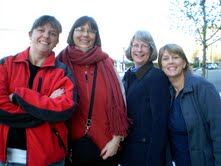
Romy Polizotto, Laura Devin, Beth Whitney, Karen Wolfe outside Boston Museum of Fine Arts.

Romy Polizotto, Laura Devin, Beth Whitney, Karen Wolfe outside Boston Museum of Fine Arts

Laura Devin, K-8 Art, Woolwich Central School and co-art teacher at Fisher Mitchell School, Romy Polizotto, K-5 Art, Phippsburg Elementary School and St. John’s School, Beth Whitney, K-8 Music, Woolwich Central School, and  Karen Wolfe, Pre-K-5 Art, West Bath School and Georgetown School applied and were accepted to an Expeditionary Learning Conference at Wheelock College in Boston put on by the Conservatory Lab Charter School. The conference title was Interdisciplinary Teaching in the Elementary Classroom, Art and Music as Tools for Learning – A Picturing America Conference.

In Laura’s words:

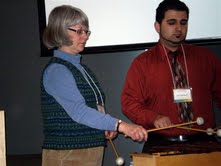
Audience Participation...Beth Whitney style!!

The next morning, as we checked in to the conference, we were handed a great tote bag with a full notebook of resources- you gotta love swag from conferences. (Most of my grocery bags are conference bags.)

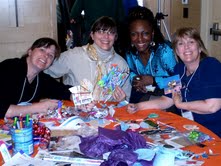
Romy Polizotto, Laura Devin, Ekua Holmes, Karen Wolfeparticipating in a hands-on workshop with Artist in Residence, Ekua Holmes

The guiding question of the conference was “How do art and music shape the ways we picture the past?” We came away with many ideas that we are all anxious to implement in our schools. We will be developing an interdisciplinary lesson plan to be submitted for inclusion in a website of resources.

In the afternoon, we had the great pleasure of going to Boston’s Museum of Fine Arts to hear keynote speakers, Elliot Bostwick Davis and Barbara T. Martin. We toured the new Art of the America’s Wing and now want to bring all of our students back to such an amazing display of wonderful art with many interactive pieces included.

We also got to browse in Dick Blick’s Art Supply store…even Beth, the music teacher, bought something!

A great day and lots of ideas to go forward with.

Thank you to Laura Devin, one of our Maine Arts Assessment Initiative Teacher Leaders, for writing this blog post.

h1

Another Arts Teachers’ Story: William Buzza

April 10, 2012

Featuring one teacher’s journey as an arts educator

This is the fourth in a series of blog posts telling arts teachers’ stories. This series contains a set of questions to provide the opportunity for you to read educators stories and to learn from others.

William Buzza is the featured teacher this week; he goes by Bill because as he says “it’s less pretentious sounding :-)”. Bill started his career as a music educator 19 years ago in Turner at Tripp Middle School; for the last 14  he has been at Leavitt Area High School, RSU 52. He serves in the leadership position as visual and performing arts coordinator for his school district in which he gets to process lots of paperwork and fulfill other tasks that come up and for arts activities. His classes consist of concert band, percussion ensemble, piano 1 & 2, guitar 1 & 2 and electronic music for a total of 41 students. His school also has a marching band that participates in the regional band shows. Bill is one of the Maine Arts Assessment Initiative’s Teacher Leaders, Phase I.

What do you like best about being an arts educator?

I enjoy sharing those “aha” moments with students when they achieve new levels of success and they recognize the progress they’ve made in learning the concepts and skills we’ve been studying in class.

Tell me what you think are three keys to ANY successful arts ed program?

I think a successful arts ed program revolves around relationship building. I came to this realization a number of years ago when reading Stephen Covey’s well known book, “Seven Habits of Highly Effective People” which really affected me as a teacher. I’ve come to realize the importance of the following three sets of relationship building:

  1. You need to have a positive and respectful relationship with your students. The arts are about sharing: the students sharing their artwork with you, you sharing the creative process with the students; especially when you and your students experience that special moment in a performance when everything you’ve been working on comes together and the goose bumps happen. Without an atmosphere of trust, openness and acceptance, that special sharing will not happen.
  2. Arts educators need to have positive relations with colleagues and administrators. There are many times when the success of our program depends on those people, whether it’s budget time, time for the guidance department to do the scheduling, or the occasion when your students need to miss another class for a special rehearsal or field trip. The time to work on your professional relationships is not when you need something.
  3. Arts educators depend on good relations with the parents. Those are the people that will encourage the child to practice at home, help out with fundraisers, chaperone field trips, assist in the marching band pit crew, etc., etc. Without the support of my students’ parents, I don’t know how I would have accomplished some of the things we have over the years.

What specific way(s) do your assessment practices tie into the success of your program?

I try to make all my assessments formative in nature by finding ways to make these experiences instructional moments for the students.  Sometimes I will have the students reflect on the successes or struggles they’ve experienced, while at other times I will use rubrics and narrative feedback to instruct them on what they need to do to improve. My goal is for my students to become independent musicians and thinkers. I believe that formative assessments supports this goal and promotes a sense of ownership of common goals. I tell my students that I know I will have done my job if by the time they graduate, they don’t me anymore.

What have been the benefits in becoming involved in the arts assessment initiative?

The initiative has provided a great opportunity to network with some amazing teachers. It is difficult to describe the synergy that is created when a group of arts educators get together to work on educational issues that transcend boundaries otherwise imposed by considering oneself a “music teacher” or a “visual arts teacher”. It has been very fulfilling to talk about effective teaching and learning practices and have a network of colleagues to bounce ideas off of.

What are you most proud of in your career?

There are two things I am very proud of. One is the creation of a guitar program at our school. This addition to our music department has brought a new group of students into the music room that I and my colleague, Penny Appleby would not otherwise get to meet. These students bring a different energy to the music department that enhances the department’s relevancy to the general student body.

On a personal level, I am very proud to have been recognized as a finalist for the 2011 Maine Teacher of the Year. As arts educators, I think we often teach in a bubble where very few of our colleagues and administrators understand what we’re doing. I suspect we all have occasions when we may doubt our effectiveness as a teacher. The Teacher of the Year program was a challenging process that involved much outside assessment of my teaching practices and beliefs and was truly a validation of my work as a teacher. I encourage the readers to consider nominating a deserving teacher for this recognition.

What gets in the way of being a better teacher or doing a better job as a teacher?

Time – there never seems to be enough of it.

Apple or PC?

Both. I use a Mac at school and a PC at home. I also have the “pleasure?” of working at a school where our students’ 1-to-1 devices are running on Linux.  So that probably makes me sufficiently qualified (or confused) in the digital age. I’m learning the significance of “open source”.

What have you accomplished through hard work and determination that might otherwise appear at first glance to be due to “luck” or circumstances?

Our administration is very supportive of all the arts in our district. This has occurred from years of regular internal advocacy. The advocacy piece always seems necessary due to the regular turnover of administrators.

Look into your crystal ball: what advice would you give to teachers?

When considering your own professional development, try to take a course or workshop not related to the arts / your content, but to teaching in general. I found this experience to give me a whole different outlook on my teaching. The list of possible teaching strategies / methods is endless.

If you were given a $500,000.00 to do with whatever you please, what would it be?

The first thing I would do is pay off the mortgage! Growing up in Presque Isle, I always said if I ever got rich that I would buy a motor coach for the Presque Isle High School music program so the band wouldn’t have to ride a school bus to the basketball tournament or the state jazz festivals. Then I would take my two boys for an extended road trip down the eastern seaboard before they hit college – then we all know where the money would go.

Thank you Bill for taking the time to tell your story!

h1

Show Choir Performances

April 9, 2012

Saturday, March 31, 2012

The excitement was intense and impressive at the annual Maine State Vocal Jazz Festival held at Ellsworth High School.

Connie Carter attended and said the following:

“What an amazing showcase of talent, energy, commitment, collaboration, and just plain incredible entertainment!  It was so exciting to see Ellsworth High School overflowing with people who suipport the arts.  There was enough creative energy there
on Saturday to meet Maine’s energy needs for a year! Clearly the arts have a voice in Maine!”

And Ed Brazee’s observations:

“I loved every minute of the state competition for Show Choirs and Jazz Choirs last Saturday at Ellsworth High School. It was particularly gratifying to see high school students from across Maine collaborating and enjoying each others’
presentations. Were they competive? Of course, but they were also appreciative and supportive of each other’s efforts. Very impressive!”

The Ellsworth High School Show Choir won the Division I State Championship at the event for the sixth time in the choir’s history and the third year in a row. They also received a “Gold Award” rating of 1 and received the “Outstanding Choreography” Award for the third year running as well. Special recognition for 1 rating performances in the solo category went to Tyler Small, Tyler Beardsley, Kassidy Jordan, Tim Follette, Blake Pattengale, Marissa Boynton, Lauren Barkhouse, Savannah Jackson, and show-stopping Melissa Wells. The choir presented “I Know Where I’ve Been: Twenty Years of EHS Show Choir” . The evening final performance may be found on You Tube. On Tuesday, April 10th, the Show Choir leaves for Orlando, Florida where they will be competing in Disney Festival and performing on the Waterside Stage in Downtown Disney. Congratulations and Good Luck!

Ellsworth High School Show Choir

h1

Kennedy Center on Arts Integration

April 8, 2012

Kennedy Center

Some of you may be aware of the work that the Kennedy Center has done on Arts Integration. If not, please click here to learn about it and to access their arts education information. They have a very clear definition which they use in their education programs. Recently they’ve added a just over 6 minute video on their site that I recommend to you found on the Kennedy Center ArtsEdge site. It is called Public Education in the United States, Setting a Context for Arts Integration, and includes ideas from many educators (Dewey, Vygotsky, Piaget) through time and people from today (Robinson, Pink) who are promoting and supporting what the arts have to offer in the development for our 21st century learners. Please take 10 minutes to take a look!