Archive for November, 2013

Dance, Gymnastics
November 10, 2013How do they do that?
As I watched this video I kept asking myself, how do they do that??? It is amazing – the strength, agility, concentration, balance, focus, seriousness of these two dancers, athletes, amazing people. Here is the link to the YouTube…
As a follow-up to watching the video I emailed colleague and friend Karen Montanaro and she sent me the following information for further thinking and viewing.
To me, it proves how little force is actually necessary when you can read the subtle shifts of weight and follow the lines of force that way. The Asians are masters at this. If you have a chance, I highly recommend watching these videos that illustrate the miracle and the horrible down-side of this rigorous investigation:
Horrifying:
http://www.hulu.com/watch/69775 (if you don’t have time to watch all 53 minutes of this documentary, fast forward to 15 minutes in and watch only one minute.)
Miraculous:
http://www.youtube.com/watch?v=4sMc-p19FIk
Miraculous:
http://www.youtube.com/watch?v=-KVPA-9hofw
This is almost 8 minutes long. If you don’t have time to watch the whole thing, capture the gist in the beginning and then watch to the very end. It’s not over until AFTER she bows! She’ll make one last, totally stupendous gesture 🙂
Art Brings People Together
November 9, 2013A blog called MUSEUM
A colleague sent a link to a blog post this morning called Art Brings People Together: Measuring the Power of Social Bridging. It is from a blog called MUSEUM and is located at http://museumtwo.blogspot.com/2013/10/art-brings-people-together-measuring.html?utm_source=feedburner&utm_medium=email&utm_campaign=Feed%3A+museumtwo+%28Museum+2.0%29. I know you might be thinking what a LONGGGGGGG link. Thank goodness for ‘links’, huh?
Anyway, I found the post (and blog) interesting, providing ‘food for thought’ about the power of the Arts. The post starts out with info on research conducted by Stanford professors and provide links to their study called Enacting Cultural Interests
How Intergroup Contact Reduces Prejudice by Sparking Interest in an Out-Group’s Culture. Of course, when I read blogs, reports, and/or research I immediately jump to the questions: What can I learn from this information? and, How do I apply this to the work we are doing in Maine Arts education?
I think about our diverse population in Maine and the learning environments that exist in each school and community partially because of the make-up of our student population. I suggest that you read the post and see what you think about the information and how it applies to your classroom learning environment.

Tap Dancer
November 7, 2013What stage presence
You have got to take 2 minutes and 51 seconds to see this post from the Huffington Post.
http://www.huffingtonpost.com/2013/10/22/little-girl-tap-dance-broadway-baby_n_4143124.html

Maine Youth Excellence in Art
November 5, 2013Call for Student Art

Presented by the First Lady of Maine
Ann LePage
In partnership with the Maine Arts Commission
CALL FOR STUDENT ART
Scope:
The Maine Arts Commission, in partnership with the First Lady of Maine Ann LePage, is issuing a call for student art for inclusion in the Spring 2014 Maine Youth Excellence in Art exhibition at the State Capitol Complex in Augusta. Art teachers from public, private and parochial schools in Maine are invited to submit one piece of two-dimensional artwork that represents artistic excellence from a K-12 student. Selected works will hang in various locations including the State House, Cross Office Building (second floor), the Blaine House and the office of the Maine Arts Commission for approximately four months. Selected artists, their families and submitting teachers will be invited to an opening reception at the Blaine House hosted by the First Lady Ann LePage where they will receive recognition for their artistic achievements.
Process:
One piece of 2-D art work may be submitted per school. Each school should have one designated teacher to submit the chosen artwork for that school. The program will exhibit approximately forty-five student works. Selection will be made on a first come, first served basis per Superintendent Region. Five pieces of work will be accepted from each of the nine Superintendent Regions. The regions are as follows:
- Aroostook
- Cumberland County
- Hancock County
- Kennebec County
- Mid Coast
- Penquis
- Washington County
- Western Maine
- York County
If you are unsure of which region your school is located in, please refer to the directory on the Maine Department of Education website or at this link: https://www.medms.maine.gov/medms_public/ReportPortal/ShowReport.aspx?CurrentLocation=%2fPublic+Reports%2fDirectory+of+Maine+Schools%2fPublic+Schools+By+Superintendent+Region
As an added element to this year’s showing we would like to collect a statement from each artist. If the child’s work is selected, we will ask the submitting teacher to provide a brief (one sentence) statement/quote from the student about their thoughts either toward making art in general, or about the specific piece that they are entering. These statements will be printed on each artwork’s label for the public to read. We believe this added element will assist in enlightening the audience about the essential need for art making in providing children with a comprehensive learning experience.
Teachers interested in submitting should e-mail Julie Horn at the Maine Arts Commission with any questions and/or a request to participate in the program. Please use the subject heading “SPRING 2014 MYEA” in your e-mail to Julie at julie.horn@maine.gov. Your confirmation e-mail will include further instructions and all necessary paperwork. Information is posted on the Maine Arts Commission site at https://mainearts.maine.gov/Pages/Education/MYEA#.
Important:
Only two-dimensional artwork will be accepted. Submitted art work must fit the maximum dimension of 18” x 24.” When submitting smaller artwork it has to be mounted on an 18” x 24” mat or poster board. There is a combined maximum thickness of 3/16’’ for artwork and mat together. The artwork can be exhibited vertically or horizontally (please indicate) and will be placed in pre-existing frames. Artwork submitted that does not fulfill these size requirements will be considered ineligible. All artwork must be labeled on the back with the student’s name, school, and grade. Please do not send artwork in cylinders or mailing tubes.
Deadline:
Artwork and paperwork must be received by Friday, December 6, 2013 for consideration in the exhibition.
The Maine Arts Commission assumes no responsibility for lost or damaged artwork.
The Maine Arts Commission reserves the right of final selection and display of all works for this exhibition.
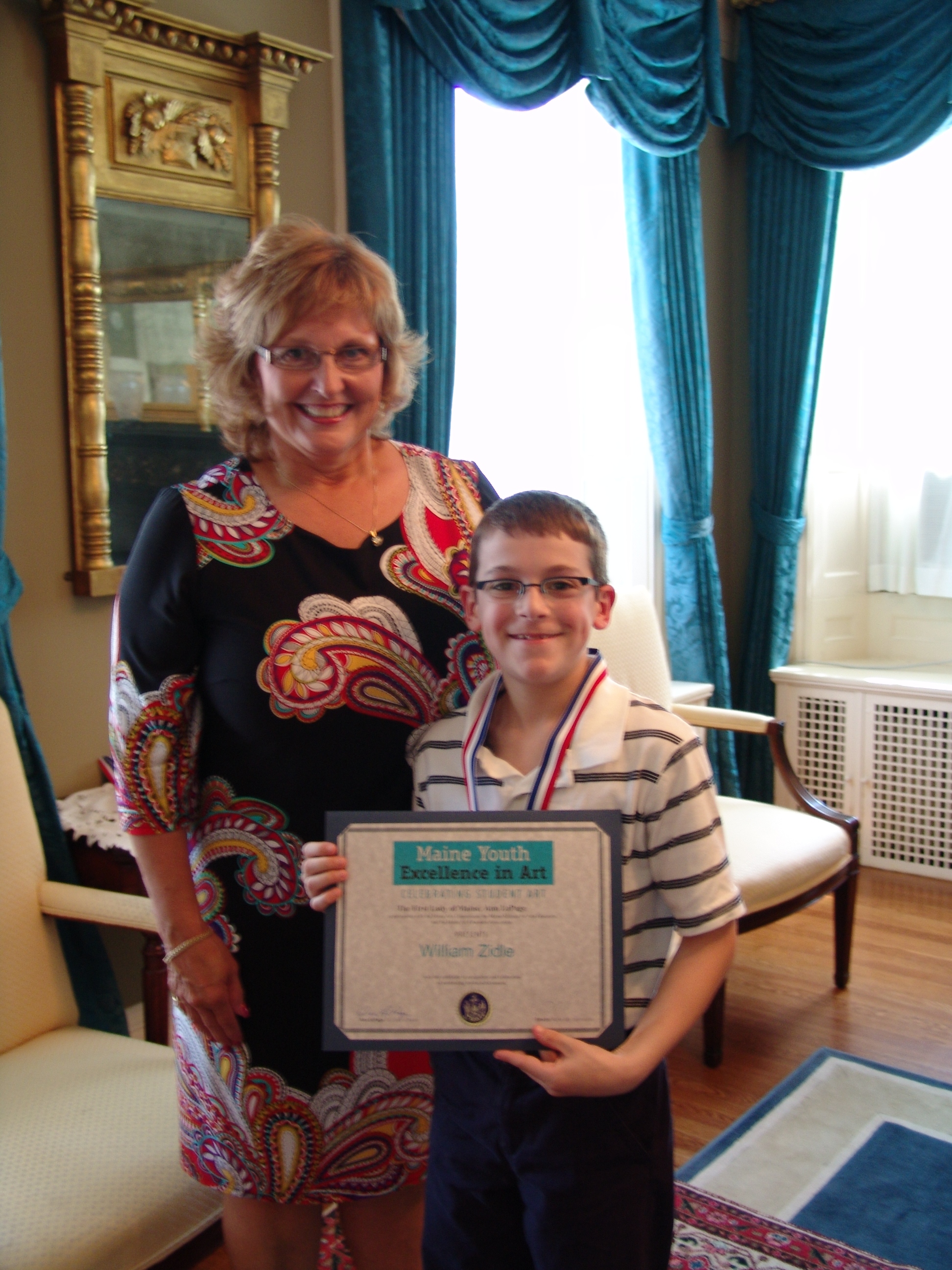
First Lady Ann LePage with 2011 recipient William Zidle from Village Elementary School in Gorham, Maine
Kevin Honeycutt
November 4, 2013Recently at the ACTEM conference
If you didn’t attend the October Association of Computer Technology Educators of Maine you’re in luck because the keynote session given by art educator Kevin Honeycutt was recorded and worth watching. Thanks to Kern Kelley and his student video team for the recording located at https://sites.google.com/site/nokomiswarriorbroadcasting/Conferences/actem.
And thank you to Bob Sprankle recorded all of Kevin Honeycutt’s Friday sessions at ACTEM along with Dan Russell’s session. The audio only versions are available at http://bobsprankle.com/bitbybit_wordpress/?cat=506.
If you are not a member of ACTEM I suggest you take advantage of what ACTEM has to offer! Check them out at http://www.edline.net/pages/actem.

The Next Edison
November 3, 2013Research linking arts and STEM
Artsy Kids More Likely to be the Next Edison published in Laboratory Equipment by Michigan State University, October 24, 2013. Research at Michigan State University links “childhood participation in arts and crafts activities to patents generated and businesses launched as adults”. You might be thinking as I did, that the research referred to pre-school or elementary age children. In fact, the researchers defined childhood as up to 14 years old. The students included in the study were honors graduates who had majored in science, technology, engineering, or math. You can read the entire article by clicking here.
Carrabec High School Presents….
November 2, 2013
 Carrabec High School is located at 160 N Main St North Anson, Maine.

 me arts ed