Archive for July, 2014

h1

In Today’s News

July 20, 2014

Aaron Robinson

So cool to see Aaron Robinson in the Maine Sunday Telegram Audience section today. Aaron is a former student of mine and one of those students who had a great deal of spirit, energy, and a smile on his face. Now many years later (Aaron is 43) he has been busy writing music. This week at the Parker B. Poe Theater at Lincoln Academy in Newcastle “The Legend of Jim Cullen” opens. When he started composing it,  Aaron didn’t know much about the lynching of Jim Cullen. The true story is about a “Canadian immigrant lynched in 1873 by a mob in northern Maine”.

Aaron was the music director for many shows at the Good Theater in Portland and the music director for Immanuel Baptist Church, where he created “Black Nativity – In Concert: A Gospel Celebration”. He has several CDs and was presented a regional Award nomination for his work on MPBN’s “Maine Arts!” series.

The article ends with this paragraph:

HIS TRAINING: Brian Allen, co-founder and artistic director at Good Theater, Braley and Robinson all graduated from Medomak Valley High School in Waldoboro. “In the 80s, that was a wonderful place. We had a slew of teachers and an administration who were art-oriented, big time. They instilled strong values in so many kids. It was a magical place. To know how much art and theater came out of there is really amazing.”

It is great to read about Aaron and hope you will take the time to read the entire article which written by Bob Keyes and located at http://www.pressherald.com/2014/07/20/work-of-art-aaron-robinson/.


h1

Embrace the Shake!

July 19, 2014

Ya gotta see this!

Recently I had a lovely conversation with the Maine Art Teacher of the Year, Allison Price. We brainstormed about a collaboration on altering books, how our memories from childhood come alive with smells and sites, how as we grow older the importance of family in what we do is evident, how fortunate we are to watch the art work of young students grow and change as they mature and many, many other topics.

We mentioned how great it is to have the internet to inform our thinking and  provide educational experiences that didn’t exist during our younger learning days. She reminded me of this TED Talk done by artist Phil Hansen. It is a GOT TO SEE talk. And, also worth going to Phil’s website.

This is part of Phil’s bio:

As an art student, Phil Hansen’s intense style of pointillism led to a tremor in his hand and a diagnosis of nerve damage. Devastated, he dropped out and lost his way … until a neurologist suggested he “embrace the shake.” That piece of advice tweaked Hansen’s point of view and sent him on a quest to invent different approaches to making art by embracing personal and universal limitations.

On this beautiful Saturday morning in Maine, I share them both with you. TED Talk below and CLICK HERE for Phil’s website. (Hint: listen to the talk first and be sure you have time to meander when you go to the site). My apology I can’t find the embed code so you can just watch it in the blog – please click on the link below for the talk.

http://www.ted.com/talks/phil_hansen_embrace_the_shake


Thanks to Allison Price, art educator and the 2014 Maine Art Teacher of the Year, for sharing this link.

h1

What 4 Teachers Told President Obama Over Lunch

July 17, 2014

Lunch in the Blue Room at the White House

This is the text from Justin Minkel’s blog. He writes two blogs: Teaching for Triumph and Career Teacher.

President Obama sat down this week for lunch at the White House with Education Secretary Arne Duncan and four teachers to talk about education, teaching and school reform. What the teachers said to Obama is explained in the following post by Justin Minkel, the 2007 Arkansas Teacher of the Year, a board member of the National Network of State Teachers of the Year, and a member of the Center for Teaching Quality’s Collaboratory. He writes two blogs, Teaching for Triumph and Career Teacher. Follow him on Twitter:  @JustinMinkel

By Justin Minkel

President Obama has often been described as an eloquent speaker. I learned this week that he is an eloquent listener, too.

The table in the West Wing was set for six: the president, Secretary of Education Arne Duncan, and four teachers. The hour-long conversation was serious but relaxed. The four of us have each been teaching in high-poverty schools for over a decade, and the president asked us to respond to a few questions that were on his mind.

The president wanted to know: Why had we stayed in our schools? What could he and the secretary do to support teachers in high-need schools? What policies could ensure that students who need the strongest teachers receive them?

This is what we told him:

1. There’s nothing wrong with the kids.

I asked Dwight Davis, an African-American fifth grade teacher born and raised in Washington, D.C., why he has stayed with teaching. He didn’t hesitate: “The kids and the families.”

We told our students’ stories to the president. I talked about Cesar, a second grader who won $10 in a writing contest. When I asked what he planned to do with his winnings, he said, “I’m going to give it to my mom to help her buy food for our family.”

I told the president about Melissa, a second grader who became the only literate person in her family through a home library project and plenty of school-wide support. When we were reading together one day, Melissa told me, “Now when my mom and little sister and I are watching TV, they tell me, ‘Melissa, turn off the TV and read to us,’ so I do.”

Students like Melissa and Cesar, who walk into the classroom with greater challenges than more affluent students, are not the obstacle to attracting skilled teachers to high-poverty schools. They’re the motivation.

2. “Responsibility and delight can co-exist.”
The No Child Left Behind era still taints the system at every level. The creativity, curiosity, and sense of wonder that make students such a joy to teach have been stripped from students’ experience at school, particularly in low-income schools desperate to raise test scores.

In place of literature, science experiments, and engineering design challenges, students in these schools often receive scripted curricula, test prep booklets, and worksheets. Drudgery has been substituted for rigor.

The teachers I know are willing to work harder on behalf of kids like Cesar and Melissa. But they are unwilling to teach in sterile classrooms stripped of literature, the arts, and critical thinking in order to drill students on which one of four bubbles to pick. Given the low quality of many of those tests, it doesn’t matter what bubble they pick. Passing poorly designed tests will not give them greater knowledge, skills to succeed in college and careers, or the opportunity to lead a meaningful life.

The writer Philip Pullman said, “Responsibility and delight can co-exist.” If we want students to excel—and if we want skilled teachers to seek positions in high-poverty schools—we have to restore some of that delight.

3. It’s not about good and bad teachers. It’s about good and bad teaching.

The teachers at my school are dramatically better than we were five or ten years ago. The reason is simple: we’ve worked with our principal to design a culture of collaboration, innovation, and peer observation, with time built into the school day for purposeful professional development to take place.

You never hear teachers say of a student, “She’s a bad learner—we need to get rid of her.” Yet that is often the go-to solution for reformers outside the system when it comes to “bad teachers.”

There are a handful of teachers who can’t or won’t get better—but they are a scant sliver of the profession. If we provide mentoring, collaboration time, and job-embedded professional development, the vast majority of teachers will continue to improve. Most people want to be effective at what they do. That is particularly true of professionals who have chosen to work with children.

I wasn’t good at teaching when I started, and I’m not where I want to be five years from now. I’ve gotten better the same way that everyone—from doctors to pilots to presidents—gets better at their job: through reflection, collaboration, and mentoring.

Yes, we want to recruit talented new teachers who walk in the door with high potential for perseverance, intelligence, and compassion. But we don’t need to swap out all the bad and mediocre teachers for better teachers, anymore than we should swap out our struggling students for more advanced students. We need to build systems that support every teacher willing to put in the work it takes to move from novice to competent, competent to excellent, and beyond.

4. If we want students to innovate, collaborate, and solve real-world problems, we need to make it possible for teachers to do those same things.

The systems we create for teachers have a profound impact on the classrooms we design for students. Teachers have long been seen as consumers of policy, professional development, curriculum, and research, when we should be partners in creating it.

The working conditions that matter most to teachers in Generation X and Y have to do with intangibles like autonomy, collaboration time, and the potential for innovation. Scripted curricula, test prep, and micro-management are anathema to that kind of school culture, and they have a devastating effect on both teacher recruitment and retention.

The hopeful news is that we can create the conditions for excellence in lower-income schools. They exist where I teach: Jones Elementary, a school with 99% poverty and virtually 0 percent teacher turnover.

Every year, we receive students who come in angry, disrespectful, and ashamed of their struggle to learn. These same students become thoughtful scholars and compassionate human beings once their needs are met and their trust in teachers has been earned.

There’s nothing wrong with the kids. There is plenty wrong with the system—but none of it is inevitable. An invitation to classroom teachers from the holder of the highest office in the land won’t cure all that ails that system. But it’s a damn good place to start.

The last thing the president said to us was, “You all make me feel hopeful.” President Obama, you left us hopeful, too.

h1

Arts Organizations Invited

July 17, 2014

You’re Invited!

MAAI Logo_Color_TxtCtr3L

The Maine Arts Education Summit taking place at USM, Portland July 29-31 invites organizations who include arts education programs to join us on Wednesday, July 30, 8:00 – 12:30, to strut your stuff. The Summit is shaping up to be a wonderful opportunity not only for arts educators to come together and learn but also others. We have teaching artists joining us and now I am happy to extend this invitation to you. Where else can you go in Maine and share arts education opportunities with Maine arts teachers? Contact me ASAP to reserve a 4 foot or 8 foot table space. We will include your information in the participant packets and a blurb about your organization and your logo in the wiki space with all the Summit information.

If you are interested or wish to learn more please email me at argy.nestor@maine.gov TODAY!

h1

ZOOM Planning

July 15, 2014

Getting ready

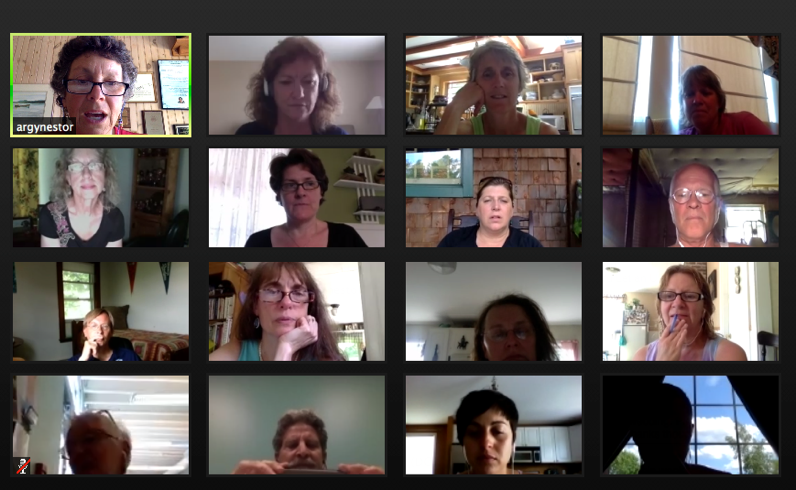
Screen Shot 2014-07-15 at 11.23.53 PMMany of the Maine Arts Assessment Initiative (MAAI) Teacher Leaders and Leadership Team have been working (almost) around the clock getting ready for the Arts Education Summit happening on July 29-31 at USM, Portland campus. The Summit is chock full of sessions facilitated by educators with years of experience in teaching and assessment practices. To learn more please click here.

During the last three summers the MAAI has provided a summer institute for teachers interested in being Teacher Leaders. The feedback we received from many teachers included requests to provide summer extended professional development for everyone, not just those who wish to be MAAI Teacher Leaders.

Recently several of the Teacher Leaders planning the Summit came together for a planning meeting using Zoom.us which provides video conferencing. MAAI has been using it for meetings recently and found it very simple and reliable! Above is an image that I took (screen shot) during the meeting attended by 16 educators. Direct registration to the Summit can be accessed by clicking here.

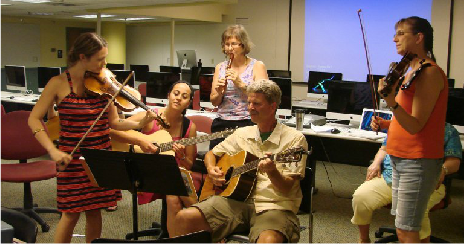
MAAI is continually breaking new territory to meet the needs of arts educators across the state which we know ultimately impacts arts education and all students. It is not to late to register for the Summit! Don’t miss this fabulous opportunity! Please contact me by email if you have any questions at argy.nestor@maine.gov. The image below is arts educators (plus 1) jamming last year at the MAAI summer institute.

Screen Shot 2014-07-15 at 11.29.38 PM


h1

Kandinsky On A Plate

July 14, 2014

Paintings and food

Who says art doesn’t impact our day to day world? Wonder about how art; color, movement, and composition impact our food interests? Read this interesting article how food creators and researchers are thinking what to prepare to attract diners. A salad created like ‘s Painting No. 201. “Charles Michel, who is the chef in residence at the Oxford Crossmodal Research Lab and the lead author of the study, tells The Salt he chose Kandinsky’s work for “the specific association of colors and movement. His chef’s mind saw a salad, particularly the mushroom shape in the top left corner, and the experiment took shape.” Click here for the article.

Thank you to Anne Kofler for sending this link.

h1

Resources

July 13, 2014

Art degree programs

Screen Shot 2014-07-11 at 3.07.25 PMLooking for information on accredited college art degree programs for you or your students? During the last couple of years a team has been researching, cataloging, and publishing databases of every online art degree program offered by an accredited college in the US. The in-depth information includes specific accreditations of each institution.

This information is located at http://www.accreditedonlinecolleges.org/. There is no cost for this resource and it is updated yearly. If you have questions please contact Arianna Long ariannalong22@gmail.com.

h1

So Long David Patterson

July 12, 2014

A friend to Maine Arts Education

Some of you knew David Patterson as the “AP for All” guy or perhaps you met him at an MLTI workshop. Not many of you knew that he was the person who suggested that I use a blog for communicating with all of you. And, then he helped create it, encouraging me every step of the way. I called on David when I had a technical question or wanted to bounce an idea off of him. He was one of three people who helped select the MLTI screen saver images each year. He presented workshops at the Statewide Arts Ed conferences in 2007 and 2009 and helped set up the site for the 2011 conference. I learned a ton from David on a variety of topics. Sadly, David passed away on Thursday. His absence will leave a huge hole but I know everyone he touched will carry on a bit of David’s kindness, knowledge, and cheerfulness! I am grateful for having known him.

BANGOR – David Patterson, 50, passed away peacefully on Thursday, July 10, 2014, surrounded by his wife and two sons, at a Bangor hospital.

IMG_0211Known for his love of coaching soccer, stunning photography, and award-winning blog, David dedicated his life to his family, friends, and youth soccer players.

David was born to Miriam and Jack Patterson in Lurgan, Northern Ireland on January 27, 1964. David received his B.A. in Sports Studies from the University of Ulster in 1986, and his Master’s in Education from Lenoir-Rhyne University in Hickory, North Carolina in 1994. From an early age, David was a gifted soccer player. One of his proudest accomplishments was when he captained the Northern Ireland Schoolboys soccer team to victory in the 1979 European Championship. At age 16, David left home to apprentice in England with Luton Town F.C. He channeled his love of playing soccer into his coaching — training young women players at Lenoir-Rhyne College and the University of Maine, and young men at Maine Maritime Academy. He also loved coaching the Bangor High School boy’s team. While coaching Bangor, David was named Maine Soccer Coaches’ Coach of the year twice, and was awarded New England Coach of the Year in 2010. David loved few things more than watching his teams play under the lights on crisp fall evenings at Bangor High School. David was most recently employed with the Maine Department of Education as an Education Specialist working closely on the distance education program, AP For All.

David met his wife, Lori, at a YMCA camp in Sandwich, Massachusetts, where they were both camp counselors. They fell in love the summer of 1986, and were married July 2, 1988 in Locust Valley, NY. Their first son, Sam, was born on May 15, 1992, in Hickory, NC; their second son, Jack, was born on April 1, 2004, in Bangor. When he wasn’t coaching soccer or snapping photos, David was blogging on Stories from Home, cooking, and walking with his family and their beloved dog, Oliver.

David was predeceased by his parents, Miriam and Jack Patterson of Lurgan, Northern Ireland. David leaves his wife, Lori, of 26 years; his sons, Sam and Jack; his brothers, Ronald and John; his sister, Joan, all of Northern Ireland; and many friends near and far. The Patterson family extends its heartfelt thanks to the greater Bangor community for its breathtaking support. They also extend their gratitude to the nurses and physicians of Grant 6 at EMMC and CancerCare of Eastern Maine, and to the nurses and volunteers of Hospice of Eastern Maine.

A service celebrating David’s life will be held 3 p.m. Saturday, July 12, 2014, at Brookings-Smith, 133 Center St., Bangor. The family invites relatives and friends to share conversation and refreshments at the Family Reception Center of Brookings-Smith, 163 Center St., Bangor, following the service. Those who wish to remember David, the family welcomes contributions to David’s most treasured cause, Friends of Acadia, P.O. Box 45, Bar Harbor, ME 04609. Condolences to the family may be expressed at http://www.BrookingsSmith.com.

h1

College Students

July 11, 2014

Invitation for college students studying arts education

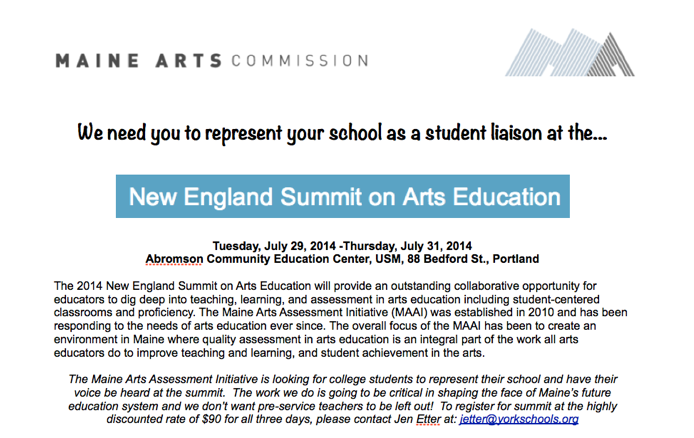
The Maine Arts Assessment Initiative is inviting pre-service teachers to attend the Summit on Arts Education at USM, July 29-31. Please read the details below and if you have any questions contact York Middle School Music Educator Jen Etter at jetter@yorkschools.org or Marshwood Middle School Art Educator Melanie Crowe at melanie.crowe@rsu35.org.

Screen Shot 2014-07-10 at 9.56.22 AM