Sharing her presentation – Carolyn Brown
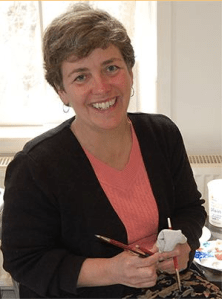 Carolyn teaches Visual Arts at Camden Hills Regional High School and is the Maine Art Educator of the Year for 2016. The award is presented by the Maine Art Education Association. Below is the presentation she gave at the fall conference at Haystack Mountain School of Crafts.
Ripple Effects
I made about a hundred versions of this presentation. Should I use the latest research on the relationship between the arts and cognitive development? Should I give a play-by-play history of my long teaching career, the ups, the downs, the crying in the storage closets? Or tell you how important it is for each of you to be strong advocates for arts education, so we can prevent losing ground in the face of budget cuts and pressure to conform to standards? Should I explain, with a diagram and the latest educational lingo, how to write a compelling…. assessment rubric? Instead, I decided to just let this write itself.
I’m going to start with a poem. I spent most of my childhood and teenage years hunched over my desk writing for hours on end, and making little paintings and drawings. Finally, in high school, I had my first real art class, and my teacher, Bruce Elfast, changed everything. He held the orange for me, as the character in the poem does.
Ego
By Denise Duhamel
I just didn’t get it—
even with the teacher holding an orange (the earth) in one hand
and a lemon (the moon) in the other,
her favorite student (the sun) standing behind her with a flashlight.
I just couldn’t grasp it—
this whole citrus universe, these bumpy planets revolving so slowly
no one could even see themselves moving.
I used to think if I could only concentrate hard enough
I could be the one person to feel what no one else could,
sense a small tug from the ground, a sky shift, the earth changing gears.
Even though I was only one mini-speck on a speck,
even though I was merely a pinprick in one goosebump on the orange,
I was sure then I was the most specially perceptive, perceptively sensitive.
I was sure then my mother was the only mother to snap,
“The world doesn’t revolve around you!”
The earth was fragile and mostly water,
just the way the orange was mostly water if you peeled it,
just the way I was mostly water if you peeled me.
Looking back on that third grade science demonstration,
I can understand why some people gave up on fame or religion or cures—
especially people who have an understanding
of the excruciating crawl of the world,
who have a well-developed sense of spatial reasoning
and the tininess that it is to be one of us.
But not me—even now I wouldn’t mind being god, the force
who spins the planets the way I spin a globe, a basketball, a yoyo.
I wouldn’t mind being that teacher who chooses the fruit,
or that favorite kid who gives the moon its glow.
———-
When I started teaching, in 1984, I was the “first ever” art teacher in the whole district of Lisbon and Lisbon Falls. No art room. No sinks in the classrooms. I unfolded tables at 6 a.m. in the mornings when I taught in the cafeteria, and folded them back up before gym class. I carried buckets of water to the classrooms for cleaning paintbrushes. In one of the five buildings I taught in, this was up two flights of stairs. I was about a thousand years younger then.
Fortunately, I had something- some people- who made it possible to continue. The first grader who asked for “mascara” to put on the eyelashes of his mask. (I handed him a black marker.) The fifth grader who said he wanted to be an artist because he now knew it was okay for a boy to like drawing.
I also had a teacher mentor. She was a classroom teacher-turned G/T teacher, who was assigned to be my mentor in a pilot program that year. Because of her, I stayed in teaching.
Because of some of you acting as mentors, others have stayed in teaching. Because of you, some of your students found their voices by learning about art, and using their minds and hearts to make things that matter. Those are little ripples you make in the world. The edges of those ripples are too distant for you to see, because the effects are endless.
Looking back through my teaching career, at Mt. Ararat School in Topsham, at an International School in Tokyo, in the new schools in Poland, Maine, and Rockport, a few things come to mind. One is that teaching, really teaching, is exhausting. With the younger grades, there are questions to answer, runny noses to wipe, displays to organize, sinks to scrub, not to mention lessons to plan, assessments to write, and so on.
With older students, there are still questions to answer, of course, and big questions to ask of them; sometimes I think that half of the task of teaching high school students is to get them to take risks like kindergarteners do every day.
Any of this is a big task. The most important job in the universe is teaching. To be able to do this, you have to have something deep, and sensitive, and joyful, and knowledgeable, and persistent, and brave, and amazing inside of you. I am convinced that to be a good art teacher, you have to be humble, as well as somewhat confident, but humble enough to be open to new learning. You have to be quiet, as well as “breathing from the diaphragm” when you speak to your class. You have to be able to listen with sensitivity, as well as talk. You have to keep changing, and growing.
If you teach the same lesson, the same way, to every class, year after year, you might have successes: the carefully but imperfectly shaded portrait of Jimi Hendrix, Rest in Peace; the painting of a lighthouse a thousand miles away, from some 1990’s calendar, that Grandma can put on her fridge; but you won’t have any surprises. To be an excellent teacher, you have to take risks. Put yourself in the position of your students: try something new. Hold onto the bungee cord, hold tight, but jump, look at the magnificent rushing river underneath your dangling feet, and look back up at your colleagues at the top of the bridge- whoo hoo!
One of the weirdest and most exciting teaching experiences I ever had was at Mt. Ararat. One of my classes was a 3D Design class. I was really into installation art at the time, and we had a huge entryway to the school that I found all sorts of ways to mess up. One year, I invited the sculptor Michael Shaughnessy to work with the class. We brainstormed together ourselves, and then with the students, to come up with some ideas for installation sculptures based around themes of the students’ choice. The largest and most exciting piece was conceived by all of us collaboratively. The students decided to use the theme of the interactive process of teaching and learning. We gathered all the extra desks and chairs from a storage room, and arranged them in a giant spiral in the main lobby, about 20 feet across. We lined the top of each desk with potting soil, and planted seeds in the dirt. We suspended lights from the ceiling to represent the light of knowledge, and teaching. Slowly, over a couple of weeks, the seeds sprouted and grew lush green grass. The remarkable thing about this was that this weird sculpture, in the main lobby of the school, was not damaged or vandalized. This was before security cameras were routinely installed in hallways. In fact, at the end of the two weeks, students wanted to keep it there. They loved how it changed every day, how they understood the metaphors we tried to communicate, and that they grew to find more meaning in it, from their own experiences. It was a sad day when we had to dismantle it.
That project was one of the most memorable and exciting because it was a risk. We had to plan extensively, we had to negotiate with the principal, communicate with the Fire Marshal; we had to be willing to accept that for some students and parents, this might just be too bizarre and conceptual to accept. Because the students were integral to every part of the process, however, it was valid for them. It was their project. That was crucial, and I think it’s important to remember that, as we work at creating lessons tailored to meet specific district and state standards. It has to be their projects, their ideas, their learning.
We are among the luckiest art teachers in the world, I think, in that we have so many amazing opportunities in Maine. We have a beautiful natural world to observe. Immersing oneself in nature is a critical aspect of being a sensitive human steward of the world. Nature teaches by example, if you take time to be still and watch, and listen.
We also have a strong tradition of the arts, and arts organizations. When we gather here at Haystack, we have the energy of many hands, many minds, many voices coming together. Some of us find we grow much more in the single weekend here at Haystack than we can in a month on our own at home. The challenge is to hold onto that energy, keep it vibrating, keep it rippling, keep it flowing when we return to our classrooms, and ordinary lives next week. How do we take this sacred creative time, in this sacred special place, and transport it back to share with our students, and our colleagues, while keeping it fresh and whole for ourselves?
The next bunch of slides are some of my own artwork- done during the past few years- I have been fortunate to take workshops and classes at Haystack, Waterfall Arts, and Maine College of Art, and have been influenced by my time working in Tokyo)
Studies demonstrate that practice in the arts stimulates cognitive growth- the prolonged concentration needed for in-depth problem solving and creating with our hands actually makes new neural connections in our brains. It is this paying attention, in the real world, in real time, that is crucial to our jobs as teachers, as creative artists, and as caretakers of our planet.
I will close with a short poem by Wendell Berry, titled
The Vacation http://www.poetryfoundation.org/poem/245686
By Wendell Berry
Once there was a man who filmed his vacation.
He went flying down the river in his boat
with his video camera to his eye, making
a moving picture of the moving river
upon which his sleek boat moved swiftly
toward the end of his vacation. He showed
his vacation to his camera, which pictured it,
preserving it forever: the river, the trees,
the sky, the light, the bow of his rushing boat
behind which he stood with his camera
preserving his vacation even as he was having it
so that after he had had it he would still
have it. It would be there. With a flick
of a switch, there it would be. But he
would not be in it. He would never be in it.
—————————
I ask you all to go out, back into the night, back into your studios here at Haystack, and be in it. Absorb the positive ripples sent out in your workshop. And back in your real lives, back in your classrooms, spread the ripple, and be in it. Hold the orange, the world, in your hand, and be in it.


 Congratulations to everyone who contributed to the days success. There will be other posts and photos in the next couple of weeks. In the mean time, I am going on vacation!




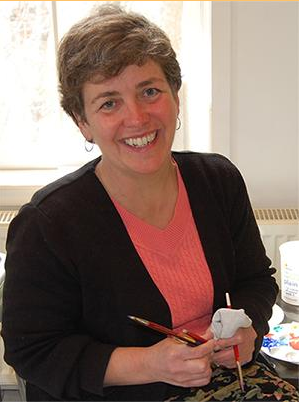

 me arts ed