Archive for March, 2016

h1

Arts Education Advocacy Day

March 23, 2016

Join the excitement in Augusta – tomorrow!

Maine Alliance for Arts Education (MAAE) has planned a wonderful day in Augusta at the State House for Arts Education Advocacy Day. Thanks to Executive Director, Susan Potters, MAAE for the preparation work. Students will be meeting with legislators, SLAM from MSAD #33 will be interviewing Commissioner of Education William Beardsley, Maine Arts Leadership Initiative Teacher Leader Andrea Wollstadt will be leading the Biddeford Intermediate School Chorus in a performance. Maine Arts Commission Executive Director Julie Richard will speak and Jeff Poulin, Arts Education Program Manager from Americans for the Arts will join us and much much more! I hope to see you there!

Screen Shot 2016-03-23 at 7.52.26 AM Screen Shot 2016-03-23 at 7.52.39 AM

h1

Another Arts Teacher’s Story: Virgil Bozeman

March 21, 2016

MALI Teacher Leader series

MALI_V1_Color_100ppi

This is the third blog post of the Maine Arts Leadership Initiative (MALI) Phase 5  Teacher Leader stories. This series contains a set of questions so you can learn a little bit about the work they are doing as Maine arts educators. CLICK HERE for more information on MALI. CLICK HERE for more information on the 73 of the MALI Teacher Leaders. CLICK HERE for Arts education resources. Search in the “search archives” box on the bottom right side of this post for past stories. There have been 62 posted to date.

Screen Shot 2016-03-21 at 5.23.50 PMVirgil Bozeman IV has been teaching at Richmond Middle/High School for 17 years. He teaches 150 students in grades 6-12 Choral and Classroom Music, the total population grades 6-12 is 270. Virgil has four choruses, grades 6, 7/8, and two high school. In addition he teaches grade 6 and 8 General Music and AP Music Theory.

What do you like best about being an arts educator?

I believe that music educators are in the enviable position of being able to leverage naturally intense student interest to promote critical thinking, demand strong work ethic and introduce students to the incredible depth and breadth of our tradition. It is easier to get students to sing Rachmaninoff than to read Tolstoy.

What do you believe are three keys to ANY successful visual and performing arts education?

  1. Quality repertoire
  2. Individualized assessment
  3. Quality repertoire

I know this is pithy, but I firmly believe that great music is the best teacher my students will have.

How have you found assessment to be helpful to you in your classroom?

Simply put, the better I have become at assessing individual student growth, the more my individual students have grown. I used to think that changing the way I assessed would necessitate a drastic change in my teaching methods. Nothing could be further from the truth.

What have been the benefits in becoming involved in the arts assessment initiative?

Across the state our music/art/dance/drama colleagues are doing innovative work in the area of student assessment. Many are already involved in MALI, as are a ever-growing number of teaching-artists. It is a tremendously fertile collaborative environment. I can always count on the fact that solutions are already being developed and tested for assessment challenges that I am experiencing in my classroom and ensembles.

What are you most proud of in your career?

I am most proud when graduates from Richmond High School continue be active music makers in college and beyond.

What gets in the way of being a better teacher or doing a better job as a teacher?
IMG_1911

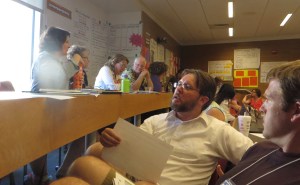
Virgil, center, in deep discussion with colleagues at the MALI summer institute, August 2015.

I am lucky to teach in a supportive small school with a terrific student/teacher ratio that allows me to focus more easily on the individual needs of students. That being said, our small size can sometimes be a barrier, both in limiting the repertoire I can introduce to our students, and working within a schedule that can prevent interested high-school students from being able to enroll in music classes/ensembles throughout their careers.

What have you accomplished through hard work and determination that might otherwise appear at first glance to be due to “luck” or circumstances?

Creating the culture and expectation that our students will have to approach music from styles/cultures/languages that lie far outside their immediate experiences and interests. I used to think it was just “something in the water” in Richmond, but now recognize how important it was to remain true to this vision, even when students occasionally exhibited frustration at not being able to sing enough of “their music”.

Look into your crystal ball: what advice would you give to teachers?

When I first arrived in Richmond, the school had just cycled through four teachers in a five year span. That turnover had sapped the continuity and morale of the music program. Don’t think that the grass is necessarily greener somewhere else. Most arts educators encounter barriers where they work, be they schedule, budgetary, cultural, or facilities-based. If it feels as though there are too many barriers to building and maintaining a quality program at your school, it just means that there is important work that needs doing, and nobody is better suited to this work than you.

Also, keep searching for opportunities to improve your musical chops. We need to model life-long learning to our students, and they need to see us doing it.

If you were given a $500,000.00 to do with whatever you please, what would it be?

Make a lead gift for the construction of a suitable performance space at my school, sock away living expenses to take a sabbatical to finally pursue a DMA in choral conducting.

Imagine you are 94 years old. You’re looking back. Do you have any regrets?

Aside from not knowing how they kept my corpse animated for 20+ years, I will regret knowing that there were students who could have learned so much about themselves through learning how to use their voices, and either they never walked through my classroom door, or I failed to reach them when they did. IMG_0087
h1

Resource Conversation

March 21, 2016

R.S.V.P ME

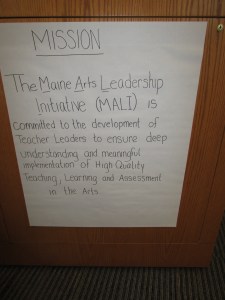
Screen Shot 2016-03-20 at 2.26.22 PMTomorrow, Tuesday, March 22, R.S.V.P. ME has scheduled a virtual meeting. Maine Arts Leadership Initiative (MALI) Teacher Leader and Facilitator Lisa Ingraham will explore your favorite online resources. Recently she attended the MALI Winter Retreat at Bowdoin College. During the day she realized that many of the resources arts teachers are clamoring for are already available on the Maine Arts Assessment Resource website. She will share a tour of this site during the Tuesday Zoom online conference for R.S.V.P. ME. There is time also for you to share your favorite sites (but not required).
You’re invited, 3:30 to 5:00! To participate in this Zoom Online Video Conference email Lisa at lisa.ingraham@msad59.org. R.S.V.P. is a program of the Maine Art Education Association.

Is there something that you are passionate or knowledgeable about? Consider sharing your expertise with other Maine Art educators during future meetings. Please contact Lisa anytime with questions, comments, or to suggest a future topic. Future R.S.V.P. ME Dates and Tentative Topics:

  • April 12th – Teaching Artists
  • May 10th – Proficiency-Based Education
h1

Sculpture Opportunity

March 20, 2016

Teaching Artist Anne Alexander

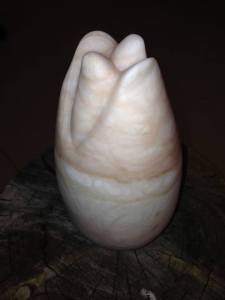
Alabaster-3Anne Alexander is a sculptor on the Maine Arts Commission Teaching Artist roster. She has a dream for all Maine middle and high school teachers – to be able to teach soft stone carving to their students. She’s moving to making that dream a reality by offering a weekend alabaster carving workshop at Waterfall Arts in Belfast on April 15 – 17. Friday 6 to 9 pm, Saturday 10 to 1 & 2 to 5, Sunday 10 to 1. $130 + $15 materials
WORKSHOP DETAILS

Students will carve a small pieces of alabaster stone into an organic forms. We will look at examples of nature from the surrounding ecosytem (shells, lichen, plant pods) for inspiration for the forms of our work. Methods of carving including hammering with chisels, filing, sawing, and drilling will be taught. The various methods of finishing the stone from wet sanding to oiling and waxing will be the final part of the workshop.

ABOUT ANNE

Anne Alexander at the Viles Arboretum Sculpture Symposium, September 2015

Anne Alexander at the Viles Arboretum Sculpture Symposium, September 2015

Anne Alexander received a BA in sculpture from Bard College, NY and an MFA in sculpture from Alfred University, NY. She has been living in Maine teaching and sculpting since 1989. She has received two Pollack-Krasner Foundation Grants and a Fulbright Senior Scholar Grant to study the Art and Artifacts of The Taino Indian in The Dominican Republic during the 1998/99 school year. Anne primarily carves her work in wood and stone. She makes pieces that range in size from small hand held pieces to human size exterior installations. Her work is organic in form and are abstractions of small life forms from the natural world, (marine life, plant pods, insects etc.). Her work also refers to the human body and expresses themes of life stages, germination, growth, regeneration, sexuality, and cyclic changes. Please refer to her website- Annealexandersculptor.com to see examples of her work.

Workshop information at http://waterfallarts.org/event/alabaster-carving-workshop-weekend/.

If you have questions please contact Anne at annealexander@me.com.

h1

Vox Nova and Daponte String Quartet

March 19, 2016

Combine concerts

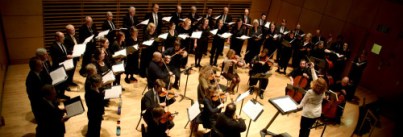
Vox Nova Chamber Choir, under the direction of Shannon Chase, will join artistic forces with the DaPonte String Quartet to present, “With Strings Attached,” a concert program of music for chamber choir and string quartet. Concerts will take place at the Unitarian Universalist Church, 15 Pleasant Street in Brunswick, Maine on Saturday, April 9th at 3:00pm & 7:30pm and on Sunday, April 10th at 3:00pm.

This exhilarating concert features the song cycle, The Golden Harp, by American composer Gwyneth Walker and the poetry of Rabindranath Tagore. Rose Horowitz, Poetry Out Loud Maine State Champion of 2015, will perform the readings. Also on the program, Eric Whitacre’s Five Hebrew Love Songs set to poems by Hila Plitmann.

Concert sponsor is HM Payson.

Vox Nova Chamber Choir 2

Tickets will be available and for sale online starting April 1, 2016. $20 general admission at the door or online at www.voxnovachamberchoir.com. $10 general admission for current college students with an ID card, cash or check accepted at the door. Payment method include Visa, Master Card, Discover or American Express. Make checks payable to: Vox Nova Chamber Choir. Tickets for children 18 and under and accompanied by an adult, are free and available at the door only.

Vox Nova Chamber Choir, founded in 2009, features members of the Maine Midcoast musical community including Bowdoin College faculty and alumni. The group champions the expansive body of modern and contemporary choral music an seeks to engage audiences in a fresh musical experience through exposure to new music by living composers. Although the choir typically performs an entirely a cappella repertory, Vox Nova has become known for inventive programming and has sought in recent years to engage soloists and instrumentalists in meaningful collaborations to bring its audiences a well-rounded listening experience.

Please contact Dr. Shannon M. Chase, Director at smchase207@gmail.com, 200-3995.

h1

Thinking Creative Spaces

March 18, 2016

Trip to South Portland

IMG_1925

The Dyer School entrance

I’ve been on a quest lately to find STEAM types of teaching and learning in Maine. The responses to my “call” have been wide and varied. Recently I traveled to South Portland, specifically to the beautiful and welcoming Dyer Elementary School where the Library Media Integrator, Megan Blakemore is at home (and very excited) in the Maker Space. I’ve read about Maker Spaces and even a book about the concept but they don’t compare with the engagement of student learning that I observed. The school has 250 students, grades K-5.

The space is set up in stations where students are naturally challenging themselves to creatively problem solve through a variety of avenues. The teacher is the guide on the side, allowing the students to own their learning and learn from each other. Getting messy is part of the learning. The room looks similar to an art room with boxes of colorful parts, wooden pieces, and stuff stacked in corners standing ready when needed. Principal Elizabeth Fowler explained how the school is addressing the developmental needs in the student-centered environment and leveraging the maker space as part of that learning tool. The ideas extend into the classrooms and in some cases becoming woven into curriculum content. It is a philosophical shift that includes process versus product and failing forward; these take shape slowly.

IMG_1923

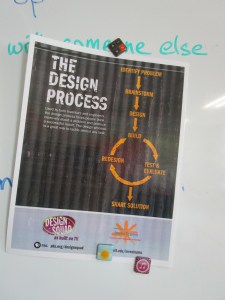
PBS The Design Process

In the beginning 5th grade students were asked what they wanted the learning space to look like and include. They made drawings labeling their ideas. Many of them have been incorporated into the space, like an area with legos (lots of them in all colors) in the Fab Lab area. They are using the PBS Design Process; Identify Problem, Brainstorm, Design – Build, Redesign, Test & Evaluate – Share Solution as the overarching concept in the Maker Space. I visited during Tinker Time where students have choices of Challenges.

The greater community members are invited in as Visitor Makers; sharing their knowledge in multiple ways. A group of students approached the principal wanting to be Visitor Makers and put their idea in writing to be considered. The kids are really beginning to own the space and idea. Learning buddies between grade levels encourages the idea that we are all learners and teachers.

Plans are underway for a Creation Station which is a Maker Space on wheels so when the space is not available teachers can still have access to the materials including 2 carts of iPad minis. Megan has collaborated with teachers to connect their learning through literacy; reading, writing, and making books.

IMG_1924

Megan Blakemore

IMG_1919

Principal Elizabeth Fowler plays an integral role in the Maker Space

Dyer School is filled with permanent and temporary student artwork in the halls.

Dyer School is filled with permanent and temporary student artwork in the halls.

I want to visit again when the art teacher, Margaret Burman, will be melting down scraps of crayons with 5th graders to make into hearts to sell and raise money for a foundation that is making 3D printing hands http://www.limitlesschildinternational.org. If you have a Maker Space or something similar in your school please let me know, I’d love to visit others.

Thank you Megan for inviting me! If you have any questions about the Maker Space at Dyer School please contact Megan at megan.frazer@gmail.com.

h1

Master Musician Visits Waterville

March 17, 2016

Waterville students benefit

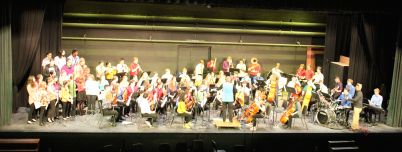
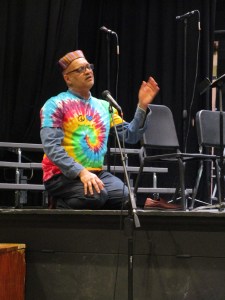
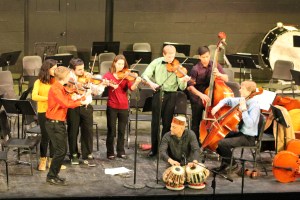
IMG_2924Waterville schools had the privilege of hosting Srinivas Krishnan, an Indian Musician, for a week-long residency. The educational experience impacted the 80 members of the high school band, the 40 member chorus and 50 member orchestra. In addition, Srini worked with the 38, grades 4-8 elementary and middle school gifted and talented students from AOS 92 (Waterville, Winslow, and Vassalboro).

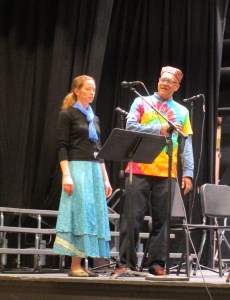
Singing WedWhile in Waterville Krishnan, taught the students about music from other cultures, cooked and treated them to Indian food and told stories. As often happens when providing unique learning opportunities for students, he enlightened the students about life and humanity. Scrini’s goal is to work in small towns to share his culture with students who would not otherwise be able to have access.
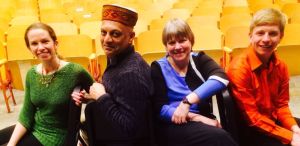
Not only was this a learning opportunity for students but when teaching artists spend time in schools, teachers benefit as well. It was an initial contact that Scrini had with Sam Lyons while he was at USM that lead to this residency. It was evident that Scrini impacted Sam and music educators Sue Barre and Ciara Hargrove as well.

With HS teachers

Ciara, Scrini, Sue, Sam

I joined Maine DOE visual and performing arts specialist Beth Lambert for the culminating performance at Waterville Senior High School and it was evident that the impact Scrini had on the music program and students during the week was enormous. In addition to the performance that I attended the community packed the auditorium on one evening that a day school was canceled.

Playing Tablas with HS Students

Playing Tablas with high school students

Srinivas Krishnan who goes by Scrini, is a Master Percussionist from India and has been trained under four master musicians in India. He gave his first solo recital at the age of 16 and was featured as a percussionist at the University of North Texas at the age of 21. Srinivas performs on the tabla, the ghatam, the Middle Eastern dumbek, the Irish Bodhran, and the mridangam. He has degrees in areas of the science, engineering and management from Miami University. You can read his entire biography at THIS LINK.

IMG_1764

Ciara and Scrini singing

The English department chair, Katie Dunn sent the following note to the members of the music department Sue Barre, Ciara Hargrove, and Sam Lyons:
Thank you for such a heartwarming cultural experience on Friday. I was overwhelmed to see so many of our students singing and playing music with Scrini Krishnan. Over a quarter of the school was on that stage! And they had embraced this Indian rhythm and sound that is so different than what I imagine they usually hear and play. It was awesome to see and hear the results.

Check out a segment of the performance Scrini directed with the audience by CLICKING HERE.

Amy Calder from the Kennebec Journal attended the Friday concert and she describes the experience very well in the article at THIS LINK.

IMG_1768I think the experience was best summed up by accomplished sophomore musician Soren Nyhus, 15, a cellist in the school orchestra. “We all work to make the music better with the notes, the rhythms and all that stuff. Working with Scrini taught me that music is more than working on the notes. Music has the ability to speak to all of us through the heart, music is our common language.”
CLICK HERE for a glimpse at a rehearsal with Scrini that lead up to the performances.

CLICK HERE for video footage of the afternoon at Waterville High School.

Sue Barre, department chair, hopes that Scrini will return and involved more learners as part of a Global Rhythms Concert. If you’d like more information please contact Sue at sbarre@aos92.org.

h1

POL State Champ

March 16, 2016

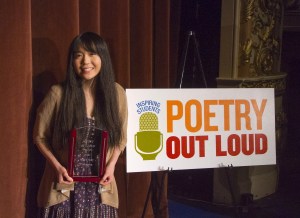
Rose Horowitz is the Poetry Out Loud Maine State Champion

2016_POL Champ_RoseHorowitzAugusta – Rose Horowitz of Mt. Ararat High School won the 2016 Poetry Out Loud competition on March 15 at the Waterville Opera House. Owen Sinclair from Rangeley Lakes Regional School was the runner-up. Both students will receive cash awards and their schools will receive prize money to purchase poetry books for their libraries.
Poetry Out Loud was established in 2006 and is sponsored annually at the state level by the Maine Arts Commission. This year’s competition included almost 10,000 students in 46 public and private Maine high schools. After participating in classroom, school-wide and regional level competitions, 10 state finalists gathered at the Waterville Opera House to recite three rounds of poetry from memory in the Maine State Final. Horowitz recited three poems: “In the Basement of the Goodwill Store” by Ted Kooser, “Mrs. Caldera’s House of Things” by Gregory Djanikian, and “On An Unsociable Family” by Elizabeth Hands.

As the Maine State Champion, Horowitz will represent Maine at the National Poetry Out Loud Finals to be held May 2–4 in Washington, D.C. where students from all 50 states, the District of Columbia, the U.S. Virgin Islands, and Puerto Rico will compete for the national title and a total of $50,000 in awards, including a grand prize of $20,000, and school stipends for the purchase of poetry. All prizes, as well as all materials for running this popular program in high schools across the nation, come from the National Endowment for the Arts and their partner in Poetry Out Loud, the Poetry Foundation.

In addition to Horowitz and Sinclair, other state finalists were: Lydia Caron, Bangor High School; Morgan Steward, Carrabec High School; Shiloh Munsen, Freeport High School; Charlotte Benoit, Greely High School; Danielle Barrett, Hampden Academy; Sylvia Holland, Maine Coast Waldorf School; Anna Bucklin, Searsport District High School; and Ben Millspaugh, Waynflete School.

Thornton Academy Jazz Combo, under the direction of music educator Dave Stebbins, provided musical interludes.

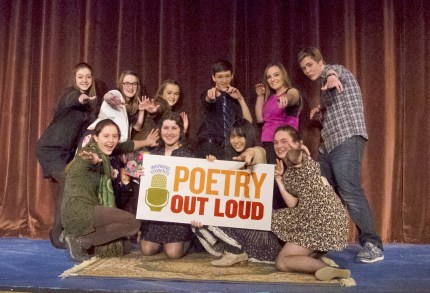
2016_POL Finalists

Back Row (l to r): Lydia Caron, Shiloh Munsen, Morgan Steward, Owen Sinclair, Anna Bucklin, Ben Millspaugh Front Row (l to r): Sylvia Holland, Charlotte Benoit, Rose Horowitz, Danielle Barrett

For more information about Poetry Out Loud, http://mainearts.maine.gov/Pages/Education/POL-Home or contact Argy Nestor, Director of Arts Education, Maine Arts Commission at argy.nestor@maine.gov

The Maine Arts Commission shall encourage and stimulate public interest and participation in the cultural heritage and cultural programs of our state; shall expand the state’s cultural resources; and shall encourage and assist freedom of artistic expression for the well being of the arts, to meet the needs and aspirations of persons in all parts of the state.


h1

Another Arts Teacher’s Story: Samantha Armstrong

March 15, 2016

MALI Teacher Leaders series

MALI_V1_Color_100ppi

This is the second blog post of the Maine Arts Leadership Initiative (MALI) Phase 5  Teacher Leader stories. This series contains a set of questions so you can learn a little bit about the work they are doing as Maine arts educators. CLICK HERE for more information on MALI. CLICK HERE for more information on the 73 of the MALI Teacher Leaders. CLICK HERE for Arts education resources. Search in the “search archives” box on the bottom right side of this post for past stories. There have been 61 posted to date.

Screen Shot 2016-03-13 at 11.02.05 AM

Samantha Armstrong teaches K-6 visual arts at Paris Elementary and the Hebron Station School. This is her ninth year teaching and second year in the Oxford Hills School District. She currently teaches a little over 500 students each week. Her students have art class once a week for 40 minutes and I teach either 5 or 6 classes a day. Samantha is a team member from the Oxford Hills School District that are creating integration ideas as part of the Maine Arts Education Resource Project – Integration formed by the Maine Department of Education under the direction of VPA Specialist Beth Lambert.

What do you like best about being an arts educator?

One of the things I like about teaching art is getting to see how unique each student is and how they all approach projects differently. I enjoy teaching students new concepts and techniques, exposing them to new artists, making connections between the arts, other subject areas and the world around them. It’s exciting when students can reflect and make connections between what they are learning in my classroom and the world around them.

What do you believe are three keys to ANY successful visual and performing arts education?

  • Teachers that are passionate and excited about what they are teaching.
  • School districts that support the arts and arts education.
  • Community outreach, getting student performances and artwork out into the community and getting local artists into the schools.

How have you found assessment to be helpful to you in your classroom?

I find assessment to be very helpful in my classroom. When students finish an assignment they each complete a reflection paper. This helps them bring together what they have learned in the lesson and how the concepts and techniques work in connection with each other. Assessment also helps  guide my teaching, the effectiveness of the lesson and my approach to teaching. Currently I have developed a checklist for students, a type of formative assessment, so that they can monitor their learning and progress and help them meet their goals.

What have been the benefits in becoming involved in the arts assessment initiative?

I have met many wonderful arts educators from all over the state of Maine and many others dedicated to the ongoing success of arts education. Through collaboration I have learned a great deal of information that has helped me in the classroom. I have become more involved in advocating for arts education and am currently working as a Teacher Leader Ambassador on the census and the arts integration resource project.

What are you most proud of in your career?

I am most proud of my students and all their progress and learning that happens throughout the year. Seeing my students being successful and enjoying their learning is the best!

What gets in the way of being a better teacher or doing a better job as a teacher?

Time and not having enough of it. I am fortunate to work in two great schools with very supportive administrators and teachers. Many teachers are interested and open to collaborating but with schedules and time constraints it is often difficult to have planning time. Planning is often a quick conversation in the hall or an email, which  works, but obviously with more planning time it could be even better.

What have you accomplished through hard work and determination that might otherwise appear at first glance to be due to “luck” or circumstances?

I feel very lucky to be an art teacher in the community in which I live. It definitely took a lot of time and patience to finally be fortunate enough to be hired as an art teacher in my community. As everyone in the field knows art teaching positions are often few and far between. I have a Bachelor of Fine Arts degree so I did not have an education background. I had several years of catching up on classes while working. My path was winding as I first taught Special Education, then moved to a small independent school as a classroom teacher.  At the same time I taught a metalsmithing class at Lesley University and at summer arts program for kids. My teaching experience has been all over the place but I have enjoyed all of it and have learned so much from it.

Look into your crystal ball: what advice would you give to teachers?

My advice would be to be patient. Unfortunately I see many new teachers overwhelmed by behaviors. It is something that an education in teaching really can’t prepare you for. We all come to school everyday from a different place and for some the act of simply getting to school takes a lot of effort. Acknowledging the diversity in our schools and the struggles many students face academically, socially and physically is essential to creating helpful working relationships with our students. Being aware of students needs, being patient, and working with them to meet their goals is essential in helping students be successful.

If you were given a $500,000.00 to do with whatever you please, what would it be?

Add more art programs and help provide teachers with more opportunities for collaboration. I would love to see more drama and dance programs at the elementary level and more access to affordable instruments for all students. The time I have had to work with other teachers this year through MALI has been great and I have learned so much. It would be great if there was more funding for this and other programs that bring teachers together. 

Imagine you are 94 years old. You’re looking back. Do you have any regrets?

That is hard to imagine! Hopefully I still have my wonderful, crazy family around me, that I am still making art and enjoying lots of good food and wine. I’m sure I’ll have some regrets but for the most parts I love my life and how I’ve gotten where I am now. I have a simple life but that is perfect for me. I live in a great town, I have a loving family, wonderful friends, a warm home, good food to eat and I enjoy getting up everyday and going to work doing what I love with great teachers and students.

IMG_0087

h1

STEAM Camp in Poland

March 14, 2016

STEAM Camp

IMG_1751What happens when you bring together the ARTS and STEM (Science, Technology, Engineering, and Math)? Well, if you ask Jonathan Graffius, Poland Community School PK-6 art teacher, Scott Segal, Director of Poland Rec Department, and Jason Farson, Maine College of Art MAT student, the answer is educational, fun, and engaging for all involved.
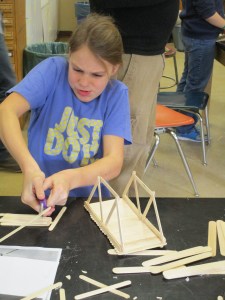
IMG_1739During winter break Jon and Jason designed an opportunity for students called STEAM Camp. According to Jon, “The desired outcome for STEAM camp was that students would develop and apply both critical and creative thinking processes. The objectives were to use instructional practices that were trans-disciplinary, project-based, and highly engaging to young, developing minds.”

I had the chance to visit for a half day and it was all of those things wrapped up in one. The fun learning opportunity was offered to students in grades 2-6 and yes, those age levels are very different, but all students were engaged, taking in what they were able to do and to stretch them in multiple ways.

IMG_1729Jon: “I have offered a lot of visual art camps in the past, however this time around, I wanted to integrate art with other content areas. I have many interests beyond visual art and the STEAM concept allowed me, and the students, to experience the world in a broader way. Conducting this camp through Poland Parks and Recreation expanded outreach into the community; we ended up having students from four different towns spanning five grade levels. Both parents and students thoroughly enjoyed the camp and are eagerly awaiting the next camp.”
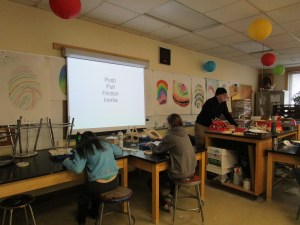
DESCRIPTION
The morning sessions will test students’ skills through exciting team challenges where students will investigate force, momentum, gravity and inertia.  Students will research, plan, build and test their designs through a series of experiments that will expand their understanding of the natural world. These experiments will involve catapults, pendulums, marble runs, chain reactions, paper airplanes, bridges, clay creations, and large paintings. The afternoon sessions will focus on the history, science and art of fingerprints. These individual activates will both challenge the students’ mind and expand their creativity.

IMG_1722It was so fun to see their large finger prints, talk with them about their catapults and bridges, and see the problem-solving and creativity in action!
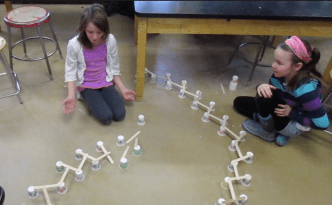
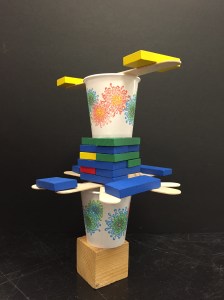
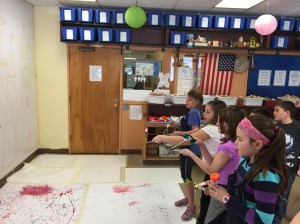
There were two sessions, 8:00 – 12:00 AM and 12:30 – 4:30 PM. Students could attend morning, afternoon or both. And guess what? All but one of the 12 participants attended both.

If you have questions or wish to learn more please contact Jon at jgraffius@rsu16.org.

Screen Shot 2016-03-11 at 8.44.26 PM

Cup Challenge

CatapultWar

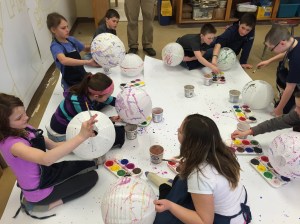
Lantern Painting

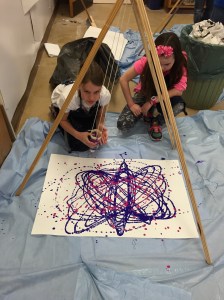
Pendulum Painting

Thanks to Jon for providing some of the photographs and the information for this post! And for creating such a fabulous opportunity for students. Congrats on a job well done!