US DOE
 The U.S. Department of Education today released non-regulatory guidance to help states, districts and schools provide students with a more well-rounded education under Title IV, Part A, Student Support and Academic Enrichment Grants (SSAE). The new grant program in the Every Student Succeeds Act (ESSA) focuses on safe and healthy students, and how technology can be integrated into schools to improve teaching and learning in addition to emphasizing access to a well-rounded education that includes a wide variety of disciplines – such as music, the arts, social studies, environmental education, computer science and civics.
“As a social studies teacher, I know the value of a well-rounded education for students,” said “For me and for so many students, a wide range of possible subjects in school, powerfully and creatively taught, can be exactly what it takes to make the difference between disengagement and a lifelong passion for learning. Literacy and math skills are necessary but not sufficient for success in college, careers, and life. The world our children will be working, leading and succeeding in will be one of constant innovation and connection from across the globe. In order to fully maximize the potential of this world of ideas and cultures, it’s vital that we redefine a well-rounded education for all students that includes access to learning new languages, in addition to science, social studies and the arts. Under the Every Student Succeeds Act, we have an opportunity to broaden the definition of an excellent education to strike the right balance in our nation’s classrooms and expand opportunities to learn for all students to build a strong foundation for college and career.”
The guidance – which serves as a resource to help support effective implementation of the new grant program – provides examples of allowable uses of funds, discusses the role of state education agencies, details fiscal responsibilities, and identifies local application requirements.
Under the new program, states, districts and schools have the flexibility to tailor investments based on the needs of their unique student populations.
As, King said earlier this year, while strong literacy and math skills are essential for success in college, career and life, they are not sufficient. King told the audience at Las Vegas Academy of the Arts that varied disciplines – including music and the arts, social studies and civics, science and technology – “aren’t luxuries that are just nice to have. They’re what it means to be ready for today’s world.”
One recent survey found, though, that elementary school students spend just 21 minutes a day on social studies, and just a little bit more on science. With the passage of ESSA, states, districts and schools can refocus on the characteristics of a comprehensive, well-rounded education—and do so in ways that and ensure access and equity for all students.
Too often, students from low-income families and students of color do not have access to arts, science, social studies or advanced coursework. Likewise, gender gaps persist in many disciplines. Science achievement gaps can show up as early as kindergarten. Further, there is evidence that students get better at math when they take classes that make the connection between STEM and the arts. Students can also grow in self-confidence, in linguistic skills, and in creativity when they have certain courses in the arts.
Through this guidance, the Department provides resources, tools and examples of innovative strategies to support the effective implementation of the SSAE grant program. Areas of focus include:
- Strategies to leverage federal, state, and local funds as well as develop partnerships to maximize the impact of the programs and services;
- Steps to guide districts in examining their needs and investing in areas that will have the greatest impact on their communities;
- Tactics to improve school conditions for student learning so students are healthy and feel safe and supported;
- Effective practices to carefully design and thoughtfully apply technology to accelerate, amplify, and support student learning;
- Approaches to engage students in educational opportunities across multiple subjects and domains.
Importantly, the guidance highlights that SSAE funds may not be sufficient to independently fund many of these innovative activities. This guidance discusses leveraging other state and local resources in combination with the SSAE grant funds to achieve the goals of SSAE programs and activities. For the full guidance released today, click here.
http://www.ed.gov/news/press-releases/us-department-education-releases-guidance-encouraging-well-rounded-education

 School districts and schools with exemplary commitment to music education are encouraged to apply for a national distinction as a Best Communities for Music Education. Presented by The NAMM Foundation, the Best Communities for Music Education Award (BCME) for school districts and its counterpart, the SupportMusic Merit Award (SMMA) for individual schools, recognize outstanding efforts by teachers, administrators, students and community leaders to ensure access to music as part of the curriculum and available to all students. Celebrate your music program with this national recognition! Deadline to apply is January 31, 2017. CLICK HERE for more information.
 Researchers are learning about the brain these days at a fast clip. And, some of the stuff that is being learned is surprising. by Scott Barry Kaufman and Carolyn Gregoire provides some of the latest findings on creative thinking.
 High School Artwork receiving Silver Key and Gold Key recognition will then be considered for the 2017 Congressional Art Competition.
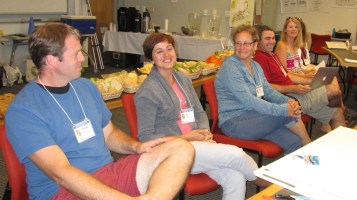 Ellsworth High School, USM Portland, and UMaine Orono, and Hebron Station School Hebron, Easton Schools
 Dates and Locations
 Sessions for Ellsworth Mega

 me arts ed