Archive for March, 2018

h1

Americans for the Arts Blog

March 11, 2018

Jeff Poulin – repost

The Americans for the Arts Education Program Manager Jeff Poulin provided a blog post called Shooting Survivors Turn to the Arts in Wake of Tragedy on February 27. Below is the opening of the post.

On February 14, 2018, seventeen people, including students and adults, were killed in a shooting at Marjory Stoneman Douglas High School in Parkland, Florida. Since this tragedy, the voices of young people from the community have been lifted through their dynamic advocacy to call for reform to national, state, and local gun- and mental health-related policies. Many of the strong skills that they are using for their advocacy came from their immersion and studies in arts education.

Jeff Poulin

The movement that the young people have started—Never Again—utilizes myriad skills that the students have honed from their artistic learning experiences. As reporting from the New Yorker noted, “…it’s not a coincidence that a disproportionate number of the Never Again leaders are dedicated members of the drama club.” Some members of the group were in rehearsal at the time of the shooting, while others referenced their participation in arts courses during town hall meetings. One of the group’s leaders, Emma González (who was in the school’s auditorium at the time of the shooting), has received much praise from numerous artists for her impassioned speech at Broward County Federal Courthouse in Fort Lauderdale a few days following the incident.

READ THE ENTIRE POST.

h1

The Arts and the Economy

March 10, 2018

$760 Billion contributed to the US Economy

Washington, DCNew data released March 6 by the U.S. Bureau of Economic Analysis (BEA) and the National Endowment for the Arts (NEA) offers an insightful picture of the impact the arts have on the nation’s economy. The arts contribute $763.6 billion to the U.S. economy, more than agriculture, transportation, or warehousing.  The arts employ 4.9 million workers across the country with earnings of over $370 billion. Furthermore, the arts exported $20 billion more than imported, providing a positive trade balance.

Produced by the BEA and NEA, the Arts and Cultural Production Satellite Account (ACSPA) tracks the annual economic impact of arts and cultural production from 35 industries, both commercial and non-profit. The ACPSA reports on economic measures—value-added to gross domestic product (GDP) as well as employment and compensation. For the first time, the report also includes the arts impact on state economies as contributions to gross state product (GSP). The numbers in this report are from 2015, the most recent reporting year.

“The robust data present in the Arts and Cultural Production Satellite Account show through hard evidence how and where arts and culture contribute value to the economies of communities throughout the nation,” said NEA Chairman Jane Chu. “The data confirm that the arts play a meaningful role in our daily lives, including through the jobs we have, the products we purchase, and the experiences we share.”

KEY FINDINGS 

National

  • For all national findings, see this arts data profile.
  • The arts contributed $763.6 billion to the U.S. economy in 2015, 4.2 percent of GDP and counted 4.9 million workers, who earned $372 billion in total compensation.
  • The arts added four times more to the U.S. economy than the agricultural sector and $200 billion more than transportation or warehousing.
  • The arts saw a $20 billion trade surplus, leading with movies and TV programs and jewelry.
  • The arts trended positively between 2012 and 2015 with an average growth rate of 2.6 percent, slightly higher than 2.4 percent for the nation’s overall economy. Between 2014 and 2015, the growth rate was 4.9 percent in inflation-adjusted dollars.

By Industry

  • Among the fastest-growing industries within the ACPSA are web-streaming and web-publishing, performing arts presenting, design, and architectural services.
  • Tax-exempt performing arts organizations (those producing art and those presenting the art of others) contributed $9 billion to the U.S. economy and employed 90,000 workers, who earned $5.6 billion in total compensation.
  • Consumers spent $31.6 billion on admissions to performing arts events, $1 billion more than projected.
  • The value added by performing arts presenting (tax-exempt and for-profit) rose by 9.5 percent during the recent three-year period.

By State

The value-added to a state’s economy defined as contributions to the GSP is noted for individual ACPSA industries and the states in which that industry ranked above the national average. For example, as a percentage of GSP, Nevada is at the top for performing arts companies and Louisiana follows only California and New York as the premiere state for movie production. For all state findings, see this arts data profile. Other leading states are:

  • Graphic design in Illinois contributed $589.5 billion to GSP, 69 percent above the national rate.
  • Architectural services in Massachusetts added $804.6 million, 73% greater than the national rate.
  • Industrial design in Michigan added $429 million, 9 times the national rate.
  • Jewelry manufacturing in Rhode Island is $224 million, 33 times the national rate
    Art‐related printing in Wisconsin contributed $530.9 million to the state’s economy, four times greater than the national rate.

In a research brief looking at rural states, North Carolina and Tennessee had the largest rural arts economies with value-added from rural areas in both states totaling more than $13 billion.

In a research brief about the fastest-growing arts economies, Washington State and Utah topped the list with average annual growth rates over five percent between 2012 and 2015.

More state examples are on the State Highlights Fact Sheet.

RESOURCES

The NEA, BEA, and the National Assembly of State Arts Agencies have developed resources to help users navigate the data.

  • A Key to Industries describes the 35 ACPSA industries and the percentage and amount of economic value ascribed to each.
  • The NEA created five research briefs featuring national and state overviews, plus special topic areas:

o   The Economic Contributions of Tax-Exempt Performing Arts Organizations 

o   Rural State Arts Economies

o   Three Years of Fast-Growing Arts Industries at the State-Level

  • Through an award from the NEA, the National Assembly of State Arts Agencies produced an interactive dashboard that allows users to explore key information for individual states.
  • The Bureau of Economic Analysis’s state fact sheets feature ACPSA value-added, employment, compensation, top industries, trends, and rankings for 50 states and the District of Columbia.
  • Two interactive infographics produced by the NEA offer a quick and fun look at national and state data.

About the National Endowment for the Arts

Established by Congress in 1965, the NEA is the independent federal agency whose funding and support gives Americans the opportunity to participate in the arts, exercise their imaginations, and develop their creative capacities. Through partnerships with state arts agencies, local leaders, other federal agencies, and the philanthropic sector, the NEA supports arts learning, affirms and celebrates America’s rich and diverse cultural heritage, and extends its work to promote equal access to the arts in every community across America. Please visit arts.gov

h1

AFTA Awards

March 9, 2018

Americans for the Arts nominations deadline: March 12

At the Americans for the Arts annual convention each year several awards are presented. The following may be applicable to the arts education field.

  • The Arts Education Leadership Award
  • The Alene Valkanas State Arts Advocacy Award
  • The Robert E. Gard Awarrd

Information on these awards are located on the Awards webpages. Thanks to Jeff Poulin, Americans for the Arts Education Program Manager for summarizing the three awards below.

The Arts Education Leadership Award is given annually to honor transformational leadership in arts education. The award brings visibility and national recognition to our field’s highest caliber leaders and the organizations and communities they serve.

Presented each year in conjunction with Americans for the Arts Annual Convention, the Alene Valkanas State Arts Advocacy Award honors an individual at the state level whose arts advocacy efforts have dramatically affected the political landscape.

The Gard Award aims to raise up projects completed in the last year led by individuals or organizations working to cross the arts into other aspects of community life in meaningful, measurable ways. In previous years, after a public voting process, Americans for the Arts awarded the ArtsMemphis Community Engagement Fellowship, an innovative program connecting the arts and civic activation in Memphis, TN, and the Red Can Graffiti Jam, an annual celebration of traditional Lakota arts and culture melded with a hip hop festival and graffiti jam in Eagle Butte, SD.

The nominations are open for two more weeks (closing March 12, 2018 at midnight Eastern time).  Consider nominating someone.

Please note: to nominate a person or project, you must be a member of Americans for the Arts – when you click the above link, if you see a notice that says, “You do not have permission to view this form,” please click the “Login” link toward the top right of the page, login, and revisit the link and the nomination form should appear. You do not have to be a member of Americans for the Arts to be nominated, only to nominate.

h1

Who Are They? Oxford Hills Region Part 2

March 8, 2018

Cafe Nomad Community Gallery

This blog post is the second in a series that aims to bring awareness to you about the many visual and performing art venues and educational opportunities in the Oxford Hills. The Oxford Hills Region of Maine is a perfect setting for the arts as it is centrally located where the rolling foothills of the White Mountains and beautiful lakes regions intersect. Located 45 miles north of Portland, 35 miles east of New Hampshire, and 20 miles west of Lewiston-Auburn, the region hosts multiple year-round opportunities for learners of all ages and a thriving arts community. The Oxford Hills School District (SAD17) is Maine’s largest school district in geographic area, with nine community schools, a regional middle school, a comprehensive high school and the Streaked Mountain School, an alternative school for high school students. The Oxford Hills include the towns of Buckfield, Harrison, Hartford, Hebron, Mechanic Falls, Norway, Otisfield, Oxford, Paris, Poland, Sumner, Waterford and West Paris. A great big THANKS to Diana Arcadipone for writing this series of posts.
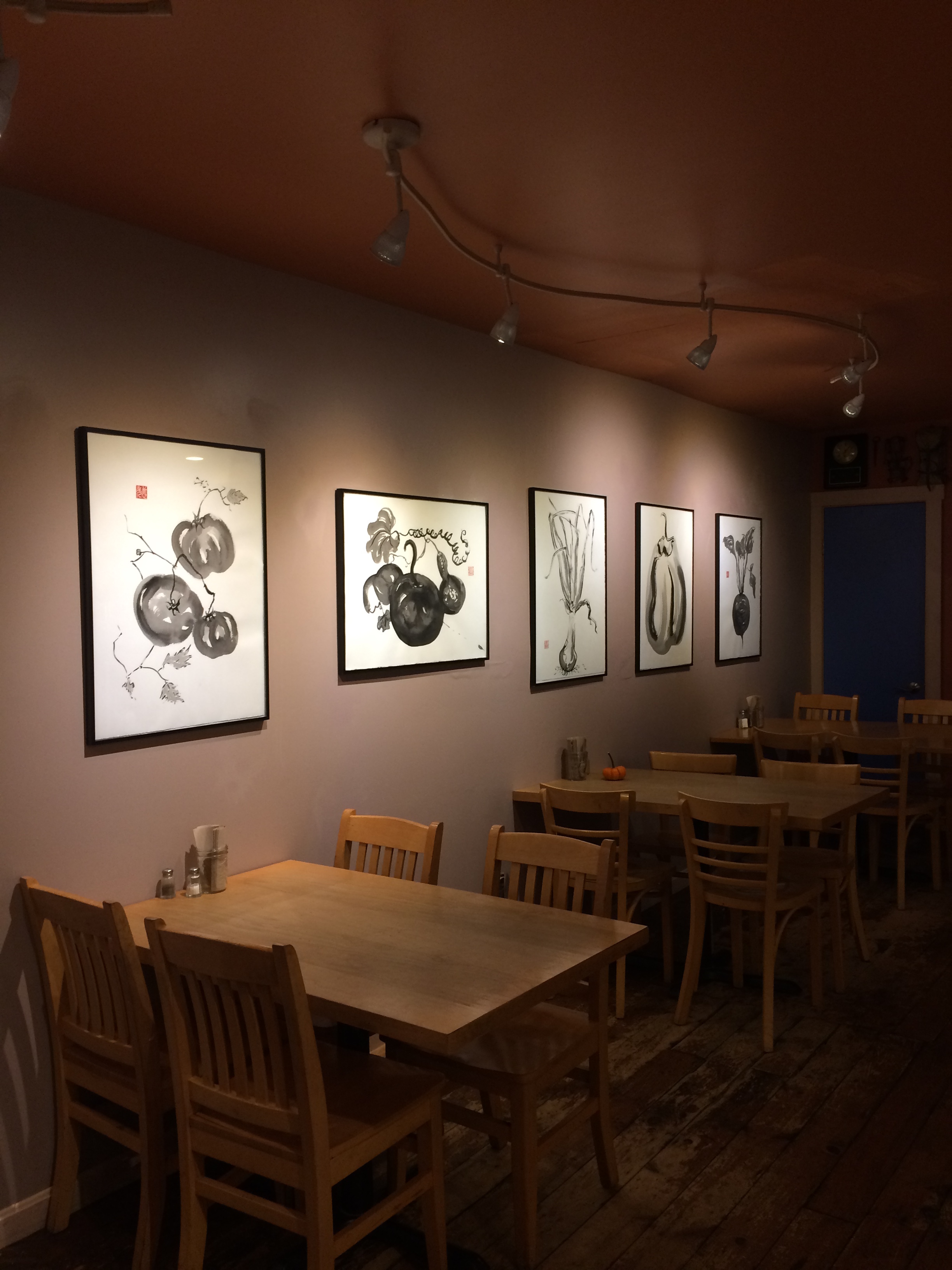
Located at the intersection of 450 Main Street and Pikes Hill in Norway, Maine, Cafe Nomad is a cornerstone of the community. Upon entering the cafe, patrons are immediately greeted with the Community Gallery wall.  Here monthly exhibitions host a variety of two-dimensional works from artists all over the USA, but primarily Maine. It is the policy of the cafe owner, Scott Berk, to foster inclusivity, highlight the work of local practitioners and also introduce artists “from away” to the cafe community. It is very important to Berk that learning be emphasized with the work that graces his walls and that the local community be introduced to work that they might not be familiar with. “It’s for artists to learn from each other and inform our customers of what is happening in contemporary art”.
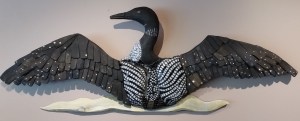
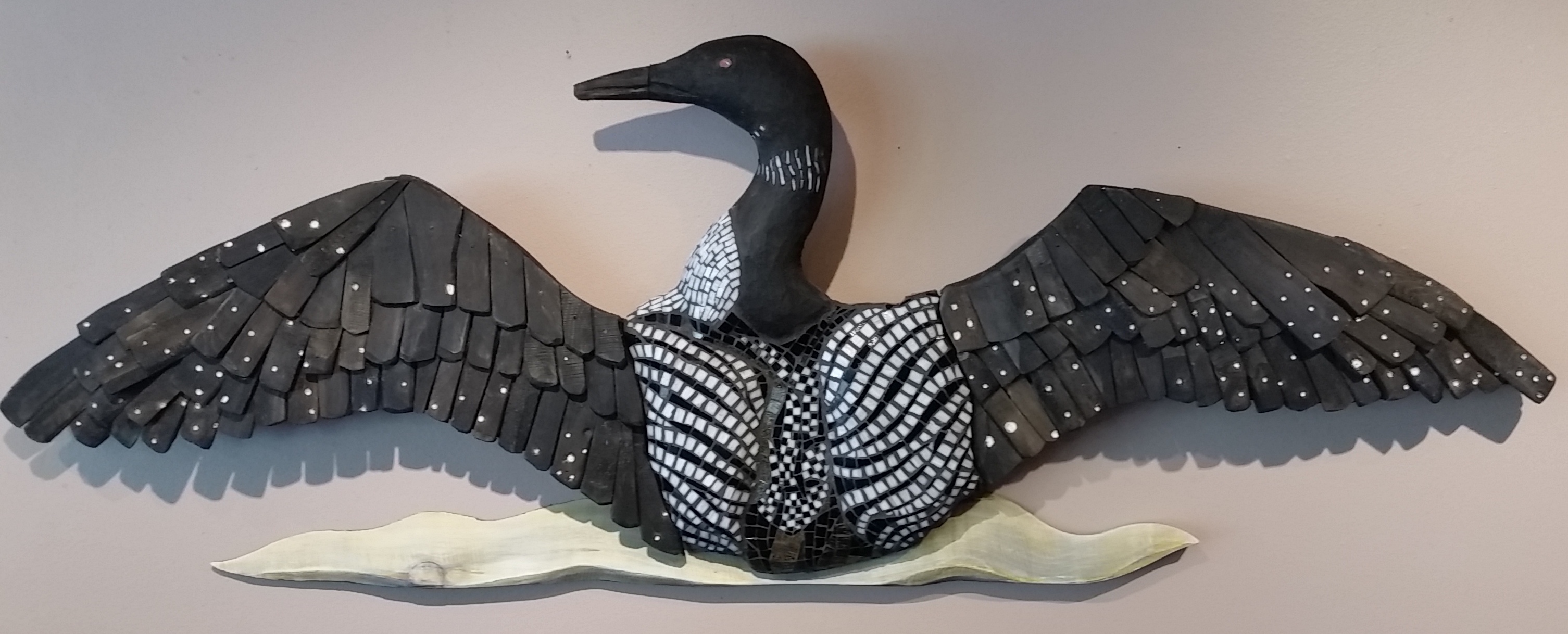
Don Best “Loon”

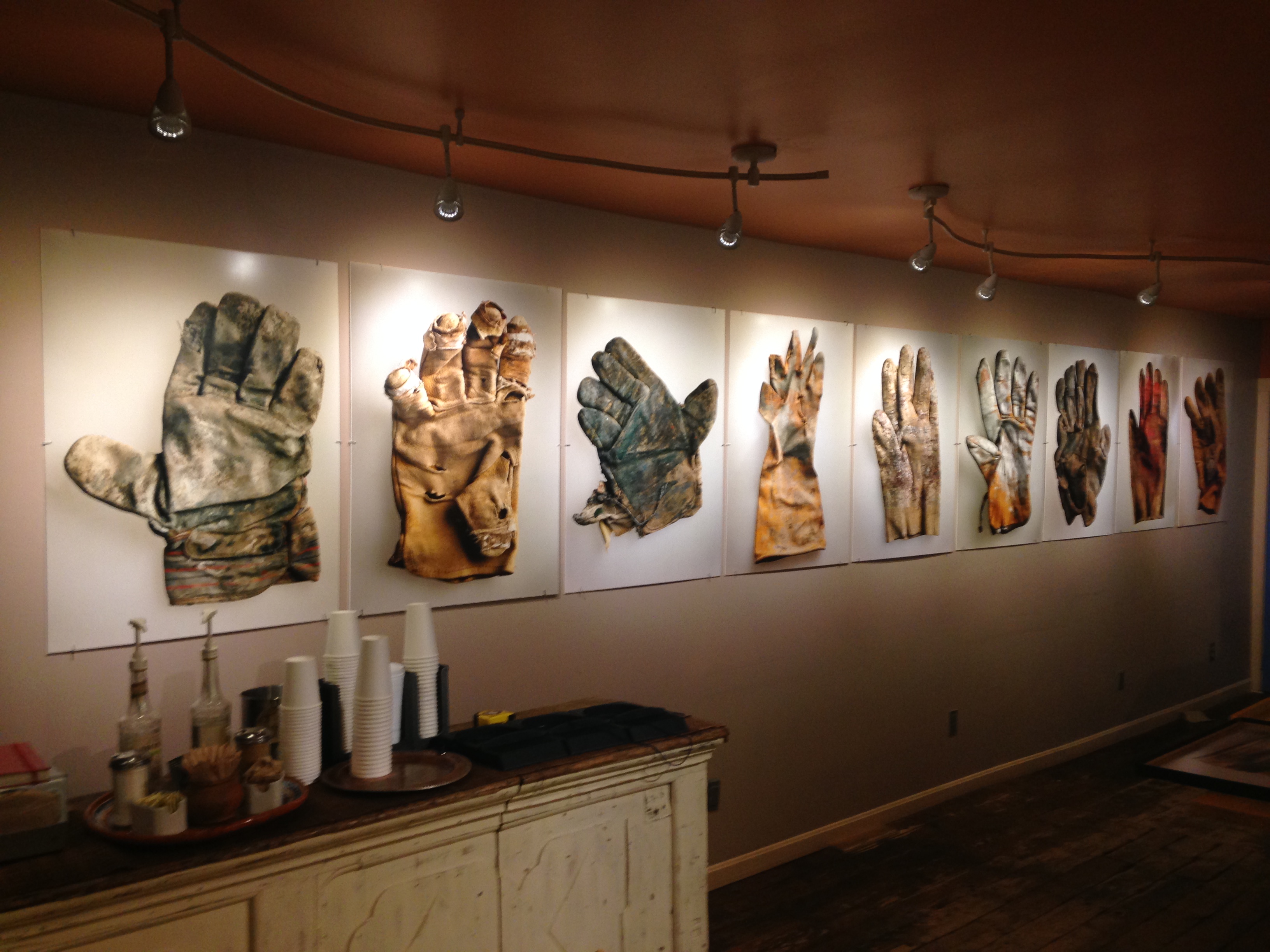
The Community Gallery hosts artists who work in paint, paper, textiles, collage, mosaic, stained glass, encaustic, carved wood relief, photography, printmaking and whatever else can hang on a two-dimensional wall. All are welcome! In addition to the changing exhibitions of the community gallery wall, the back room of the cafe is dedicated to the owners’ permanent collection and works for sale. Celebrated artist Norman Laliberte is included as well as graphic designers Nathan Felde, Luba Lukova, local wood carver Matt Burke and stained glass artist and art teacher Susan Moccia.
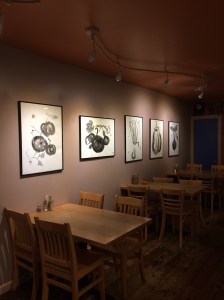
Om Devi’s Show

Every year, the cafe hosts a “Mothers Day” show where local artists are invited to show one piece of artwork. This group show hangs for the month of May and it celebrates our mother’s and daughters all over the world. The Mother’s Day show is planned to coincide with the one Sunday of the year that the cafe is open!

For the remainder of 2018, the following exhibitions are scheduled: April; Virginia Virginia Valdes’ Graphic Design Students, Oxford Hills Technical School, May; Mother’s Day Show, June; Lourdes Rubio Quilts, July; Don Best Wood Sculpture, August; Scott Vlaun Photographs,  September; Group Printmaking Show, October; Pam Chodosh Fabric Collages, November; William Janelle Wood Reliefs, December; Kenneth Schweizer Paintings and Drawings.
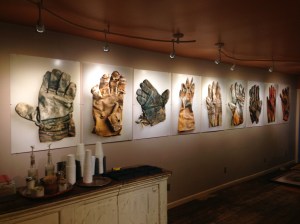
Scott Vlaun “Big Gloves”

Exhibitions are coordinated on a monthly basis and scheduled up to one year in advance. Artists are invited to send one or two photos of their work and a request to be put on the exhibition calendar to cafenomad@gmail.com. And/or if you are interested in curating a small group exhibition, we invite group proposals too. The amount of wall space is about 20 linear feet. Cafe Nomad is open Mondays through Thursdays from 7 am – 4 pm, Fridays from 7 am – 9 pm and Saturdays from 8 am – 3 pm. Closed Sundays cafenomad@gmail.com or cafenomad.com or facebook: https://www.facebook.com/cafenomad/

h1

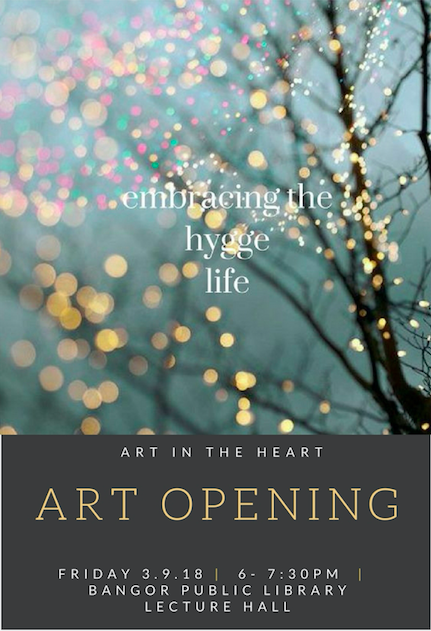
Art in the Heart Exhibit

March 7, 2018

Friday opening, Bangor Public Library

h1

MALI Teacher Leader Story: Cindi Kugell

March 6, 2018

Visual Art Educator

This is the first of several blog posts in 2018 that include stories of the Maine Arts Leadership Initiative (MALI) Phase 7 Teacher Leaders and Teaching Artist Leaders. This series includes a set of questions so you can learn a little bit about each leader. CLICK HERE  for more information on MALI. CLICK HERE  for more information on the 93 Teacher Leaders and 8 Teaching Artist Leaders.  CLICK HERE  for Arts education resources. CLICK HERE  for the MALI Resource Bank. Search in the “search archives” box on the bottom right side of this post for past teacher leader stories.  Thank you Cindi for sharing your story!

Cindi Kugell is currently teaching High School Visual arts. She was fortunate to find an open teaching position just after graduating from the University of Maine Orono and has been happily teaching art for the past 28 years. Cindi’s first teaching assignment was in SAD#58 teaching at 2 K8 schools. In 1998 my husband, 2 young children and I moved to Oxford and started teaching in SAD#17 in the Oxford Hills K6. In 2000 we added a third child to our tribe and our family was complete. Fast forward to 2010 and a position opened at our high school. I made another move to Oxford Hills Comprehensive High School to teach darkroom photography and introductory Art 1 courses. Over the past 8 years I’ve added Adaptive Arts, Drama, Yearbook, Advanced Photography, and Studio Art History to my teaching load and have taken on the roll of K12 Visual Art department chair. I am also the Yearbook advisor and Lead teacher for our Project Graduation group. I like to stay busy!

What do you like best about being an art educator?

What are the positives of having the best job EVAH!? At the K-8 level one of the “bests” was getting to see EVERY student in the school and building lasting relations with them over time – year after year after year! Most teachers don’t get the opportunity to really know their students (and their families) as they grow up. My first year teaching at the high school level I had the unique opportunity to have Seniors in my classes that I had first 13 years previous as Kindergarten students, nothing is cooler than that! I love my job, there isn’t anything that I’d rather be doing. Who wouldn’t love the celebrity status that comes with knowing so many students, building positive relationships with them and their families, building skills in talented children and getting to play with art materials all day while teaching a subject that you love?!

What do you believe are three keys to ANY successful visual and performing arts education?

I think that one of the biggest ways that arts educators can offer their students success in the arts is in the way or the “how” that they present problems to their students. If students feel confident and non-threatened in by the process of creating and realize that there are multiple solutions to problems they feel free to flourish. Releasing students from the fear of being wrong is a great part of a successful program. Another way that

Teachers can foster success in their programs is by letting their students know that skill in the arts can be increased just as math, English or any other core subject can be build upon. By letting them know that it’s your job (and your pleasure!) to help them get better and grow as an art student, you can relieve some of the pressure they may feel while in your classroom. Meeting student where they are and moving them forward is the job of all educators, some of us just get to have more fun with the supplies that they use to get students to their best! A well rounded education is important to student success. So are the skills of creative problem solving and critical thinking. The arts are a fantastic, hands on way of fostering those skills in students. I’m fortunate in my district to be very well supported in what I do and how I teach. Teachers and administration see the value of a well rounded education and the roll that the arts play in student success.

How have you found assessment to be helpful to you in your classroom?

My current jam in the world of assessment and reporting is a single point universal project rubric. This style of rubric has only the descriptors for the proficient level of achievement listed down the center. To the left is a box that I can write descriptive feedback to my students on what needs improvement or isn’t going well and to the right there is an area that I can write things that were amazing or outstanding in their project. Kids love the comments and the opportunity to go back and make adjustments to their work. It takes a long time to assess this way, but as it’s a universal rubric for all projects there is a clarity for students as they navigate through work in the art room.

What have been the benefits in becoming involved in the Maine Arts Leadership initiative? I think the biggest benefit for me is the networking with other teachers. It’s easy to become comfortable on your own little teaching Island and get stuck in a pattern or “the same old”. Learning new things, meeting others that share your discipline and making those colleague connections helps to keep things fresh and inspiring in teaching for me and for my students.

What are you most proud of in your career? The first thing that comes to mind is the fact that I had my own 3 children in my classroom K12. When they were in Elementary I taught at their schools and when I made the transition to the High School level I had them there as well. It’s a unique opportunity to see your own children as learners and know that they are great people! They also have given me great feedback on my lessons, organization and classroom routines that have been very reaffirming. Nobody is more critical than your own children on the crazy things you do to inspire students! I’m proud of my 28 years in art education and proud of the great students (and children!) that I’ve raised during my career.

What gets in the way of being a better teacher or doing a better job as a teacher? I think the age old comment of “time” is the biggest obstacle in becoming a better teacher. It takes a huge amount of the stuff to do your job well. Staying current with educational practices in this ever changing landscape can be exhausting. Pair that with extra curricular activities, leadership roles, teaching, parenting and family life and you’ve got a full 24 hours in each day – oh, and try to rest up in there as well!

What have you accomplished through hard work and determination that might otherwise appear at first glance to be due to “luck” or circumstances? Starting in this district as a part time elementary art teacher, moving to full time elementary then stepping up to the High School level and finally ending up as the leader of our K12 art department has taken a fair amount of hard work and determination. I wouldn’t change a thing and can’t thank my colleagues enough for their support and hard work this year. It’s amazing to work with such a great team of educators and I’m thankful for that everyday!

Look into your crystal ball: what advice would you give to teachers? Get your masters while you are young and never stop taking courses or PD to improve your teaching skills. As educators we need to keep learning just as we expect our students to learn from us. Stay current, advocate for yourself and your program and LOVE what you do.

If you were given a $500,000.00 to do with whatever you please, what would it be? Education is so grossly underfunded that I can think of a plethora of activities, programs and equipment that would be amazing to add to our district. I think the most pressing issue that I’d apply the funds to would be to increase the base pay of our new young teachers to entice them into the profession. I know teaching isn’t all about the money and has it’s own rewards, but we need new qualified educators in our field and we need to validate the importance of the profession and celebrate it accordingly.

Imagine you are 94 years old. You’re looking back. Do you have any regrets? I have truly enjoyed my career. My only regret is in not continuing my education by getting my masters. I’m working on it now, but do wish that I’d taken that step earlier. I can remember starting out as a new teacher and thinking to myself “I’ll do this for 5 years or so then change to something else”. Well, 28 years later I’m still here and loving every minute of it! Every day is a great day to learn something new and my students teach me something new every day.

h1

Poetry Out Loud Finalists

March 5, 2018

Yahoooo for high school students and poetry

State Final, Free and Open to Public, at Waterville Opera House March 14

AUGUSTA, ME–The art of performance and spoken word is alive and well in Maine high schools, as 39 individual students competed in two Poetry Out Loud Regional Finals last month.  The Maine Arts Commission, which administers the poetry competition at the state level, is pleased to announce the top 10 finalists who will compete in state finals at the Waterville Opera House on March 14 at 3:00 p.m.

Congratulations to the following finalists:

Northern Maine Regional Champions: The northern regional poetry recitation contest final was hosted by Hampden Academy.

  • Lydia Caron, Grade 12, Bangor High School
  • Katherine Kemper, Grade 12, Camden Hills Regional High School
  • Lauren Dodge, Grade 12, Lee Academy
  • Hannah Lavenson, Grade 12, Messalonskee High School
  • Lauren Farmer, Grade 10, Rangeley Lakes Regional Schools

Southern Maine Regional Champions: The southern regional final was hosted by Westbrook Middle School.

  • Allan Monga, Grade 11, Deering High School
  • Abbie vanLuling, Grade 12, Gorham High School
  • Richard Hilscher , Grade 12, North Yarmouth Academy
  • Emma Lombardo, Grade 11, Westbrook High School
  • Wyatt Bates, Grade 11, Yarmouth High School

After three rounds of competition, one state finalist will be named the overall winner and advance to the national competition, where s/he will compete for a total of $50,000 in awards and school stipends, as well as a $20,000 scholarship.

The Maine Poetry Out Loud state finals are March 14 at the Waterville Opera House. The doors will open at 2:30 p.m. for a 3 p.m. performance start. The event is free and open to the public, who are encouraged to attend. It will also be broadcast and streamed live throughout Maine in collaboration with Boothbay Region Television on the BRTV station and through Facebook Live.

For more information about the state and national finals, please visit Maine Arts Commission: Poetry Out Loud 2017 or contact Argy Nestor, Maine Arts Commission Director of Arts Education at argy.nestor@maine.gov or 207-287-2713.


h1

In Today’s News

March 4, 2018

Maine rethinks giving diplomas only to students who demonstrate proficiency in key subjects

Portland Press Herald written by Noel K. Gallagher, March 4, 2018.

h1

ABLE Assembly: Arts Better the Lives of Everyone

March 4, 2018

Berklee College of Music

After five years of very successful Teaching Music to Students on the Autism Spectrum conferences, the Berklee Institute for Arts Education and Special Needs (BIAESN) is delighted to announce its new conference, ABLE Assembly: Arts Better the Lives of Everyone.

The ABLE Assembly promises to be an exceptional professional development opportunity in the field of arts education and special needs, bringing together educators, artists, researchers, policymakers, school administrators, program administrators, and students to share best practices, engage in hands-on experiences, explore new research, and learn from each other.

The event will feature presentations and workshops on teaching the arts to students with special needs. Keynote presenters include Sheila Scott, Ph.D.; Stephen Shore, Ed.D.; and Jenna Gabriel, Ed.M. Hands-on workshops will include opportunities to experience teaching strategies and approaches in music, dance, and theater. BIAESN is currently accepting proposals for presentations.
The conference is open to the public.
REGISTER
Registration fee is $100 and includes admission to all conference sessions and events plus lunch on Saturday and Sunday.
SCHEDULE
Friday, April 6, 5:00 p.m.-9:00 p.m.
Saturday, April 7, 9:00 a.m.-4:30 p.m.
Sunday, April 8, 9:00 a.m.-4:30 p.m.
LOCATION
Berklee College of Music
921 Boylston Street, Boston
h1

Ticket to Ride

March 3, 2018

Research supporting Field Trips

The Brookings Brown Center Chalkboard posted information on research that is underway about the positive impact of arts-centered field trips. Part of the piece is below and you can access the entire article at THIS LINK.

No reason like the present for planning trips with your students to arts venues in Maine. We are fortunate to have so many learning opportunities that take place across the state that are focused learning in and through the arts. In addition, the Maine Arts Commission (MAC) has funding to help defray the cost of transportation to these venues.

Learn more about the Ticket to Ride program at THIS LINK and apply for the funding to hop on the bus with your students! It’s a fairly simple process – please let me know if you have any questions by emailing me at argy.nestor@maine.gov.

In a new experiment, we are conducting on the effects of arts-focused field trips—and we have a positive result that we totally did not expect. The study is funded by the National Endowment for the Artsand examines long-term effects of students receiving multiple field trips to the Woodruff Arts Center in Atlanta. The Woodruff Arts Center houses the High Art Museum, Alliance Theater, and Atlanta Symphony, all on one campus. We randomly assigned 4th and 5th grade school groups to get three field trips per year–one to each of Woodruff’s arts organizations–or to a control condition in which students received a single field trip. We administered surveys to collect a variety of outcomes from students at the beginning and end of the school year, and also collected administrative data from the participating school district. We are currently examining the results after a single year, but some students will get a second treatment of three field trips, and we will continue tracking students over time.

READ MORE!