Archive for April, 2019

h1

Ventriloquist

April 20, 2019

Nina Conti

Nina Conti and her monkey Monk are quite the duo. He is simply created but has a large personality that I was instantly drawn into. She passes control to him as he hypnotizes her and puts on quite the show. And, the voice he/she has ain’t bad either. Take 4 minutes and check out the video. Consider sharing with your students!

h1

Flowers are Red

April 19, 2019

Harry Chapin

The little boy went first day of school

He got some crayons and he started to draw

He put colors all over the paper

For colors was what he saw

And the teacher said, “What you doin’ young man?”

“I’m paintin’ flowers” he said

She said, “It’s not the time for art young man

And anyway flowers are green and red”

“There’s a time for everything young saw

And a way it should be done

You’ve got to show concern for everyone else

For you’re not the only one”

And she said, “Flowers are red young man

And green leaves are green

There’s no need to see flowers any other way

Than they way they always have been seen”

But the little boy said

“There are so many colors in the rainbow

So many colors in the morning sun

So many colors in the flower and I see every one”

Well the teacher said, “You’re sassy

There’s ways that things should be

And you’ll paint flowers the way they are

So repeat after me”

And she said, “Flowers are red, young man

And green leaves are green

There’s no need to see flowers any other way

Than they way they always have been seen”

But the little boy said

“There are so many colors in the rainbow

So many colors in the morning sun

So many colors in the flower and I see every one”

The teacher put him in a corner

She said, “It’s for your own good

And you won’t come out ’til you get it right

And are responding like you should”

Well finally he got lonely

Frightened thoughts filled his head

And he went up to the teacher

And this is what he said

And he said

“Flowers are red, and green leaves are green

There’s no need to see flowers any other way

Than the way they always have been seen”

Time went by like it always does

And they moved to another town

And the little boy went to another school

And this is what he found

The teacher there was smilin’

She said, “Painting should be fun

And there are so many colors in a flower

So let’s use every one”

But that little boy painted flowers

In neat rows of green and red

And when the teacher asked him why

This is what he said

And he said

“Flowers are red, and green leaves are green

There’s no need to see flowers any other way

Than the way they always have been seen”

h1

Arts Education Program Manager

April 18, 2019

Americans for the Arts

Americans for the Arts believes that every American should have access to high-quality arts education.  The principal tasks of this position are to create the tools of advocacy, research, and professional development to strengthen the network of arts education supporters and particularly local arts agency membership of Americans for the Arts who can then affect change in arts education programs and policies at the local, state and federal levels through work with Americans for the Arts’ members and the field at large.

The Arts Education Program Manager is a member of the Government & Public Affairs Department, which is responsible for promoting public policies that advance the arts and arts education. The Program Manager will oversee the professional programs and services for Americans for the Arts’ members including arts education networks and their elected Arts Education Advisory Council. The Program Manager will also work cross-departmentally at Americans for the Arts to ensure connectivity of arts education through shared programming with all departments and will assist the Vice President in identifying funding sources and earned income opportunities on an ongoing basis. The Program Manager will implement field education programming and communications directed to empower arts education supporters to become effective advocates. The Program Manager will build and maintain strategic partnerships to implement initiatives to bring public awareness to the impact of arts education for the field.

The Program Manager is aware of key arts education programs and initiatives at the local, state, and federal levels, and is knowledgeable about broader arts, cultural, and education policy, research, and practice. The Program Manager will understand how to articulate the benefits of arts education to diverse audiences and be able to demonstrate how arts education relates to critical issues in education reform valued by diverse stakeholders.

The Program Manager will oversee the professional programs and services for Americans for the Arts’ members including arts education networks and their elected Arts Education Advisory Council. The Program Manager will also work cross-departmentally at Americans for the Arts to ensure connectivity of arts education through shared programming with all departments and will assist the Vice President in identifying funding sources and earned income opportunities on an ongoing basis.

The Program Manager will implement field education programming and communications directed to empower arts education supporters to become effective advocates. The Program Manager will build and maintain strategic partnerships to implement initiatives to bring public awareness to the impact of arts education for the field.

To learn the key responsibilities and responsibilities and the qualifications please CLICK HERE.


h1

Student Conference

April 17, 2019

MLTI


16th Annual Student Conference 

Thursday, May 23rd, 2019 

University of Maine Orono 

Join 1000 Maine students, 250 Maine educators, and numerous staff and volunteers for a day of learning and creating with technology! 

This year’s theme will be #Create4ME. 

We are celebrating the power of students to create innovative solutions to challenges in Maine and the spirit of entrepreneurism that is found in some many Maine communities. 

Schedule 

8:00 AM – 8:45 AM – Registration and Light Refreshments (Collins Center) 

8:50 AM – 9:20 AM – Welcome and Opening Keynote (Collins Center) 

9:30 AM – 10:30 AM – Block 1 Workshops (various classrooms) 

10:45 AM – 11:45 AM – Block 2 Workshops (various classrooms) 

11:45 AM – 12:50 PM – Lunch (University dining halls) 

1:00 PM – 2:10 PM – Block 3 Uber Session (Collins Center) 

2:10 PM – 2:40 PM – Closing (Collins Center) 

Registration Information 

Cost: $15 per person 

Session descriptions and locations will be included in the registration form so that students can pick their ses-sions ahead of time. Even students in non-MLTI grades can attend (though chaperones should check the de-vice requirements for each session to make sure students will be able to participate). 

Registration open: April 1, 2019 Last day to register: April 23, 2019 

MORE INFORMATION  For answers to questions, please contact Amanda Nguyen at Amanda.Nguyen@maine.gov.

h1

Assessment for Learning & Leading

April 16, 2019

Brain-Based Strategies to Cultivate Positive Learning Environments

USM and Southern Maine Partnership present their annual Assessment for Learning & Leading Conference, May 6-7, Portland campus in Abromson Hall. This year’s theme is Brain-Based Strategies to Cultivate Positive Learning Environments.  Featured keynoter and presenter is the brilliant and exuberant Dr. Marcia Tate

REGISTRATION

In addition to daily keynotes and breakout sessions by best-selling author Dr. Tate,  dozens of Maine educators will be presenting!
 

Dr. Marcia Tate

These educators come from a variety of schools, districts,  higher ed institutions,  and  statewide educational  organizations and represent a host of roles (e.g., k-12 teachers, instructional coaches, school administrators, central office administrators, higher ed faculty from undergraduate and graduate programs, professional development specialists, content specialists from the DOE, researchers, etc.) from a variety of content areas (e.g., social studies, literacy, math, visual and performing arts, science, leadership, teacher education, etc.). 

 
Please see the Conference Draft Program for specific session information. 
 
Session Topics include:
  • Worksheets Don’t Grow Dendrites: 20 Instructional Strategies that Engage the Brain
  • Formative Assessment in the Brain-Compatible Classroom: How Do We Really Know They’re Learning
  • Leading the Change Process
  • Characteristics of a Brain-Compatible Classroom
  • Brain-based Strategies – Gateways to Creativity, Growth and Recovery
  • Pulling Tricks from Your Hattie
  • Making Meaning in History Using Primary Sources
  • Sit & Get Won’t Grow Dendrites: 20 Professional Learning Strategies that Engage the Adult Brain
  • Storytelling and Innovation – An Exploration in Arts Integration
  • All Aboard!! Experience The Power of Field Trips at the Osher Map Library
  • Student Involvement & Student Voice
  • Authentic Assessment:  Products and Performances for Student Success
  • Assessment Literacy Leadership & Processes for Successful Implementation
  • Sketchnoting & Visual Learning Strategies
  • Develop Surveys To Get The Data You Want
  • Escape This! Breakout Challenges in the STEM Classroom
  • Shouting Won’t Grow Dendrites: 5 Ways to Detour Around the Danger Zones
  • What Questions Do You Have? Inquiry in the Social Studies Classroom
  • Using Visualization and Infographics to Tell Your Story
  • Balancing Formative and Summative Assessment in High School Math Classroom – The Synergy of Feedback, Self-assessment and Goal Setting
This is going to be an incredible two days of learning! You and your team do not want to miss this unique learning opportunity in beautiful Portland, ME! 
Register at:

https://conferences.usm.maine.edu/attendeeonline/AutoLogin.aspx?page=new&event=2856&password=event

Jeff Beaudry & Anita Stewart McCafferty

Cost: $225 for full conference, including materials, lunches, and snacks; $125 for 1 day; $200/person for full conference for teams of 5+

Co-directors of the Southern Maine Partnership and responsible for the conference are Drs. Anita Stewart McCafferty, Assistant Professor, Department Chair and Jeff Beaudry, Associate Professor, both in the School of Education and Human Development, Educational Leadership Program.

h1

Tides Institute

April 15, 2019

Visual Thinking Strategies workshop

The Tides Institute & Museum of Art (TIMA) in Eastport, Maine is delighted to announce a free professional development opportunity for visual art teachers and other educators on Saturday, April 27 from 9 am to 3 p.m. Sara Egan, School and Youth Programs Manager from the Isabella Stewart Gardner Museum in Boston, will be leading the workshop at the Tides Institute & Museum of Art in Eastport.

Thanks to generous support from three private foundations, this workshop is free of charge to participating educators. Contact hours will be provided. The workshop will cover the basics of Visual Thinking Strategies (VTS), which will be an introduction or quick review for those familiar with the educational approach.

Siri Beckman, “Machias Cod”, wood engraving, 2010. From the collection of the Tides Institute & Museum of Art, Eastport.

Teachers will discuss and share ideas about ways to use the recently-published TIMA poster set in classroom settings, including using VTS. Teachers will also learn about ways to partner with the Tides Institute to extend classroom studies on the region’s art and culture, both historical and contemporary, and support student centered learning. Teachers will also learn about outreach opportunities available through the StudioWorks Artist-in-Residence Program.

Lunch will be provided, and limited lodging is available for the night before the workshop for those traveling more than 60 miles (one-way) to Eastport. We have workshop space to accommodate up to 25 educators from Washington County for this workshop, but will consider registrations from other counties in Maine and New Brunswick if space allows.

To register, or for more information, please contact Kristin McKinlay, Director of Exhibitions & Education, kmckinlay@tidesinstitute.org, or call (207) 853-4047.

h1

PumpkinFest 2019

April 14, 2019

Damariscotta

PUMPKINFEST 2019 volunteers are at work and efforts are underway to host another great festival for Damariscotta, the State of Maine, and all of New England. You’re invited to participate in the annual t-shirt design contest – with a $500 prize.   This year marks the 13th anniversary of the festival to celebrate The Pumpkin. In 2018 the festival recruited many new artists for the t-shirt design contest and artist volunteers who paint, decorate, and carve the giant pumpkins. Maine artists are a major contributor to the huge success of the festival. Tens of thousands of photographs of our artists’ pumpkin street art are taken each year. These photos are saved, shared and circulated worldwide. Also, there are photographs posted around the world of the visitors who are wearing PUMPKINEST apparel manufactured with the festival design created by the contest’s winning artist.

Listed below are important schedule dates for the 2019 Artist Events.

  • MONDAY – 17 JUNE 2019:  T- Shirt Design Contest Submission Deadline
  • FRIDAY – 11 OCTOBER 2019:  Artists at Work – Pumpkin painting, decorating and carving
  • THURSDAY – 24 OCTOBER THROUGH WEDNESDAY – 30 OCTOBER 2019:  Street art pumpkins will be removed and disposed.

If you have any questions, please do not hesitate to contact John Bristol at estancia@gvtc.com. If you’re going to participate in the t-shirt design please email John.

h1

Halcyon Quartet

April 13, 2019

Belfast United Farmer’s Market

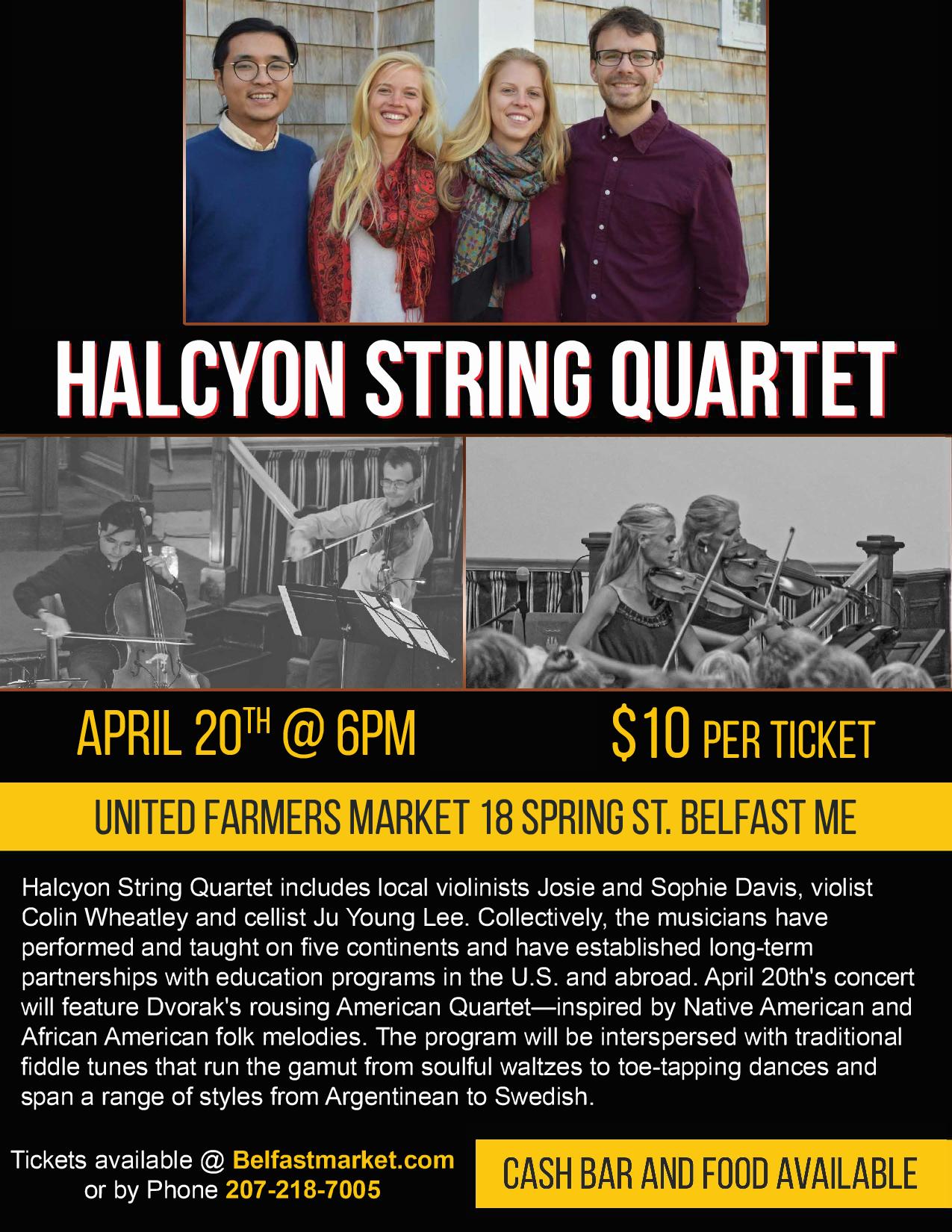
Sophie and Josie Davis and friends Colin Wheatley and JY Lee will be performing April 20, 6:00 p.m., Belfast United Farmer’s Market. Tickets $10. It promises to be a fun evening with food, drinks, and lots of music. They’ll be playing Dvorak’s “American,” Quartet and a slew of folk tunes from around the world. You can find tickets and more information HERE!

h1

LEAPS

April 12, 2019

Art program in schools and community

Jonathan Frost speaking with the 5th graders at his gallery. Their portraits are displayed on the left and bark drawings behind him.

Several years ago Nancy Harris Frohlich created LEAPS of IMAGINATION where artists work with students in connecting the environment and history to making art. Much of the work is done through literacy. Recently I visited the Jonathan Frost Gallery in Rockland during a celebration of art created by 5th graders from South School in Rockland.

The students worked with teaching artist Susan Bebee and after studying bark created drawings. The drawings were amazing and it was clear that the students will not look at a piece of bark the same way again. I remember when I learned to make rock baskets (forming a basket around a rock, whatever size), I never look at rocks the same way again. Always wondering what shape the basket might be if I used it for a form.

The bark drawings were followed by portraits created with a combination of prints and drawings. Students were invited to speak about their artwork and I so enjoyed how articulate they were – they learned so much and were so proud. Thank you Nancy and those who work with LEAPS to provide such rich learning environments for learning in visual arts.

Below are some student responses.

Tell us Why Art is Important for Kids?

  • Because if you have a job, you need to have IMAGINATION.
  • Art helps kids feel INSPIRED.
  • Art is a great way for kids to EXPRESS THEMSELVES.
  • Art is FUN!
  • Art lets kids show their FEELINGS.
  • Art helps kids be CREATIVE.
  • Art makes it possible for kids to be ARTISTIC.
  • Art is so important and helps kids CONNECT to NATURE in so many ways.
  • Kids can get BETTER at drawing.
  • Art helps kids TAKE their MINDS off the REAL WORLD.
h1

Maranacook Middle School

April 11, 2019

Dance Education grant

During the 2018-19 two schools in two different districts were the recipients of the Dance Education grant awarded by the Maine Arts Commission (MAC). Freeport High School and Maranacook Middle School created amazing units that impacted hundreds of students in Grades K-12. Freeport High School was highlighted in yesterday’s blog post with a description of the dance education opportunity that was provided during this school year.

G/T teacher Pat Godin, Teaching Artist Nancy Salmon, Visual Art Teacher Hope Lord

This blog post describes the dance education program that took place at Maranacook Middle School this school year. It is wonderful to see what occurred when teaching artist Nancy Salmon, art educator Hope Lord, and gifted and talented teacher Pat Godin collaborated! This is a great example of learning in STEAM (Science, Technology, Engineering, Art, Math).

Thank you to Hope and Pat for providing the plethora of information for this post – the story and resources!

DESCRIPTION FROM HOPE

My original idea was to have students create masks and then have them add lights with Little Bits electronics. However, after collaborating with Pat, we decided to teach the students about light circuits and how to soldier their own circuits. This allowed us to integrate science with the electricity and engineering with the design process. For math we introduced proportions as we discuss the features of the face and how to construct the masks and giving students the choice to increase the proportions of the face to make their mask more visible to the audience. We also provided students a variety of mask making materials, including a new medium called Thibra.  This is a thermoplastic sculptable material that costume designers and special affect artists use in designing masks and costumes. The students used the heat gun to soften the material and then molded it around sculptural pieces that were added to their masks.  

Students performing at the Arts Night Celebration

We showed the students examples of dance groups who performed in the dark with lights and the students wanted to incorporate black lights and glow in the dark paints in their masks and dance. As our dance choreography progressed, the students and Nancy determined which segment of the dance would be performed with lights on and which segment would be performed in the dark with black lights. 

The students started planning their masks with a group brainstorming activity called “brainwriting” where they all charted ideas of how they could represent themselves and their role in our school community. Students could add to other students’ ideas or write new ideas. Then students charted 12-15 ideas to help them plan their mask theme. 

The individual and small group dances came about through the students exploration of dance movement as a means of communication. Nancy helped the students experiment with movement and determine which movements could help them express their role and what their mask was communicating. For example, one student had a camera on her mask because she spends a lot of time taking photographs. She incorporated gestures that communicated someone taking photos. Next, the students worked in small groups and collaborated to create a dance routine that incorporated each of the students individual dance movements.

Nancy, Pat, and I also wanted to have the students end the dance as a community with the group dance. Our goal was for the dance to communicate that even though we all have individual interests and perceived roles, we are one school community.

Nancy introduced the dance collaboration project before we performed our dance since Pat and I were back stage with the students waiting to dance. We did not provide an audience handout because our dance was part of our Arts Night Celebration and listed in the program given to parents. The focus of the entire night was to advocate, educate, support, and celebrate the arts. That is why we chose this event to have the students perform their collaborative mask/dance performance. We feel our project communicated the value of teacher collaboration across content areas, including the Arts.

DANCE, VISUAL ARTS, SCIENCE STANDARDS

MLR Dance standards: A.Dance Literacy, B.Creation/Performance/Expression, and E.Visual and Performing Arts

NCAS:CR2: Organize and develop artistic ideas and work.

CR3: Refine and complete artistic work.

Pr5:Develop and refine artistic techniques and work for presentation.

Next Gen Science Stds. ETS:1, 2, 3, & 4 Engineering and Design

IMPACT OF SCHOOLING ON CREATIVITY

Research on this phenomenon is confirmed by Kyung Hee Kim. Kyung is a professor of Innovation & Creativity at the College of William & Mary.

In the last 20 years, children have become less emotionally expressive, less energetic, less talkative and verbally expressive, less humorous, less imaginative, less unconventional, less lively and passionate, less perceptive, less apt to connect seemingly irrelevant things, less synthesizing, and less likely to see things from a different angle (Kim, 2011).

BIBLIOGRAPHY SOURCES

Located at THIS LINK.

RESOURCES

Gem Activity

Thinking Matrix

Design Plan Sheet 

VIDEOS

Learning to solder – I DID IT!

Dance Practice Take II

The Dance Education grant is the only MAC grant that is a grass-roots effort grant. Several dance studios and two high school dance programs have a fund raiser each November. The money raised is what funds the dance education grant at the Commission. Without the dedication and commitment of many educators, dancers, parents, and community members this grant would not be possible. Special thank you to Thornton Academy Dance Educator Emma Arenstam Campbell for her contributions to being instrumental in making the Dance Education grant possible.