Archive for December, 2020

h1

Getting There, Part III

December 11, 2020

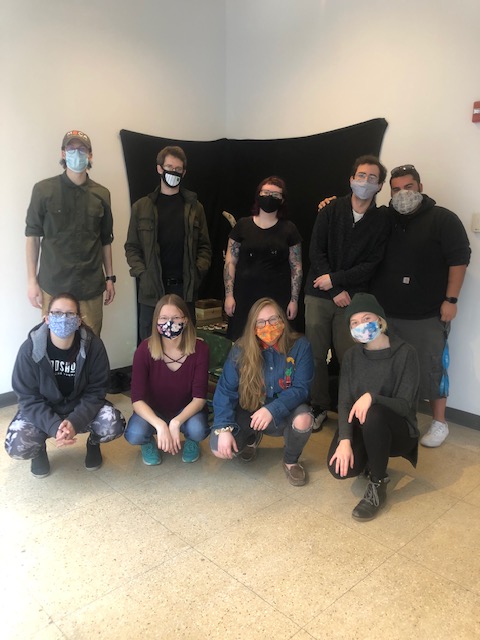
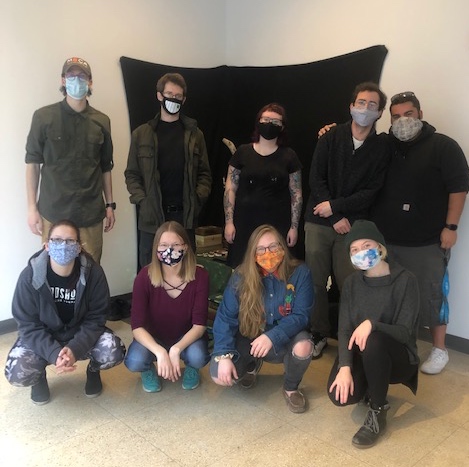
MECA MAT students

This is Part III of a blog post about the Masters in Arts and Teaching (MAT) students at Maine College of Art (MECA). Together with Part I and Part II you can get a snapshot of their program this fall. Students presented their work in an exhibit called “Getting There“, November 28 – December 7 at the college in Portland. The last two days of Maine Arts Ed blog posts include images from the show, their thoughts on visual art education, and their role as artists and future teachers. It also includes their successes and challenges, and their hopes for the future, post pandemic. I hope I am able to have a more personal conversation with this group of people in the near future. They have so much to offer, are is very articulate and thoughtful, and are bright lights during this dark time.
These MAT voices are strong and I’m sure you’ll agree with me that the future is in good hands. I’ve mentioned over the years how important our role is as educators to mentor, encourage and seek out the future teachers to insure that arts education continues moving forward to provide an excellent education for all students. Here is an opportunity for veteran teachers – read and listen carefully and if you’re inclined, reach out to these students.

In the Part I post there are examples of each students work. In Part II you can hear their voices and below are the responses to questions that I asked the students.

What do you see going on or what are you doing right now (in the midst of Covid) that is so dynamic and creative and alive that you hope doesn’t go away once Covid does?

  • Even though so much of education and the world is in a precarious state, the pandemic is helping me realize how important grounding learning with an arts education is for kids. I’m happy that there’s new energy being channeled into making education more accessible for everyone, and it’s amazing to be in a cohort of teacher candidates as we are all so eager to bring fresh perspectives to classrooms. ~ Philippa Grace, Massachusetts College of Art and Design, Sculpture, 2016
  • Education and healthcare seem to be never quite completely accessible. During the pandemic, when everything moved online, we evolved in creating tools of still allowing these things to happen and even flourish virtually. Though an end to the pandemic seems to be in the foreseeable future, I hope to see a continued mix of virtual and in person experience. It allows for more voice and choice. School and doctors are more accessible to those without cars through virtual platforms and if we made decent internet connection a necessity, we could be a lot more productive and connected from within our homes where we are most comfortable. ~ Audrey Robidoux, Maine College of Art
  • Oh gosh great question! I have caught myself noticing the present SO much more- the color of a meadow this fall after a recent rainfall, how this random lady sitting on a bench laughed exactly the same way that my roommate does, the soul settling experience of paddling in a canoe on a lake. I hope to maintain this awe of the moment, (and teach others to do the same!) once quarantining ends. ~Sophie Olmsted, Bates College, Lewison, Studio Art (ceramics), 2018
  • I don’t think I’m doing anything in my personal life that I hope continues after Covid. I do see a silver lining when it comes to my teaching practice. I was blessed enough to get a teaching job that both supplements my student teaching requirements and my wallet during this time. This type of experience would not have happened if it was not for the circumstances that we are in. ~Cooper Binette, Maine College of Art, Portland ME, BFA in painting 2020
  • Refining skills as an artist and a teacher is my life’s work. I am grateful for the time and opportunity to study at Maine College of Art even if we work remote. Allowing me to continue to create an enriching environment for Maine’s youth. It is during the epidemic that I am able to work harder than I ever have to make this a career. ~Seth Baron, Maine College of Art, BFA in Illustration 2020
  • I unfortunately don’t feel that I have achieved anything so dynamic or exciting that it is going to stick around post Covid. I have found myself feeling trapped inside, and uninspired/overwhelmed due to the stressful climate of my surroundings. One positive thing that has come  out of the situation is that I have had a lot of time to sit and work inside of my sketchbook, something I usually do despite Covid times but it feels very accomplished to be able to sit and just draw for hours while being stuck inside. These sketchbooks will be reminders of this unexpected situation, and bring a sense of accomplishment to these hard times. I will then be able to share this experience with my future students, so I guess you could say there’s a small sliver of a silver lining there. ~Lauren Ashlee Anderson, Maine College of Art, BFA in Ceramics 2020
  • I am feeling so inspired by food right now and have been pouring all of my creative energy into cooking and baking. Since the pandemic began, my partner and I have started growing our own vegetables and herbs and have had a lot more time to experiment with new recipes. I never would have guessed I would be so excited about street corn or heirloom tomatoes! ~Madison Mahoney, University of Vermont, Burlington, VT, BA in Studio Art, 2019
  • Unfortunately as of right now, I don’t have any creative and dynamic practices that will stay with me post Covid. My ceramics practice was cut short due to Covid and I do not have the means to continue it right now. In all honesty, I hope for things to go back to a seminormal if/when Covid is gone. The silver lining for me is that I’m thankful to be in the Master’s of Art in Teaching program to become an art educator. I will be able to share my passion for art to students and hope to inspire them to achieve their dreams. ~Shelby Pyrzyk, Maine College of Art, BFA in Ceramics 2020 
  • When Covid first hit back in March, I didn’t make any art for 4 months. I was newly unemployed, broke, and depressed. However, about a month before I moved to Maine from Kentucky, I started doing all these paintings of retro video game covers for my friends, and it helped me rejuvenate my creative confidence. Throughout the MAT program I have been able to keep doing these video game commissions for friends, on top of many other creative endeavors, and so I have been able to sustain that motivation to create, but it wasn’t easy. I think that being an artist during a pandemic has reminded me that there are always ups and downs, but art will always be there for me when I’m ready. ~Trent Redmon, Transylvania University, Lexington, KY, BA in Studio Art 2016
  • Storytelling is very important to my life and work as an artist. Traditionally, I tell my stories through comics and graphic novels. Since Covid, however, I’ve invested myself more in the creation of artifacts and life size set pieces from out of my fictional worlds. I’m hoping in the coming years I continue to expand on the idea of bringing the fictional into the real world. ~Sean Dillon, Eastern University 08-12, Exercise Science

What has it been like jumping from student to teacher while continue to nourish your own creative practices?

  • I audited a porcelain class taught by Cathy Hammond at MECA this fall. When I was a few years younger, I was so afraid of failure, but now that I’m learning about mindfulness and bringing our whole selves to the classroom, I was so eager to show Cathy my failures and ask her “what do I do now?!” I learned so much about the materials just by being in a classroom (albeit masked and distanced!) with BFA students at all levels, and Cathy was always willing to share her decades of ceramics teaching experience with us. It was so powerful to be able to fail in front of her and have that be an empowering experience of growth. ~Philippa Grace (favorite color: orange)
  • The journey from artist to teacher has expanded my perspective on the world. As a working artist, I often felt isolated, deeply buried in late studio nights and internal thought. I love to create but it wasn’t enough. I couldn’t invest every piece of myself into it. I felt as though it wasn’t a sustainable practice for myself or my well being. As much as I loved it, I needed something different, a different purpose. After four years of focusing on the art world, I felt the pull to come to the teaching program. Despite the pandemic, and the upheaval of the world around me, I knew that it was the right decision. ~Audrey Robidoux (favorite color: red)
  •  I see the role of teacher and student as interchangeable hats- in one moment, I may have the teacher hat on, but I’m wearing the student one in the next. Flipping back and forth informs both experiences. I feel so lucky to be a student in my 800 studio class because it reminds me of the student experience- what it is like to not know what’s next, how uncomfortable it can be to not know, how to navigate teacher expectations and social interactions. The MAT program (so far) has been the perfect bridge between feeling mostly student to feeling mostly teacher (I plan to identify as a partial student for the rest of my life). ~Sophie Olmsted (favorite color: lavender)
  • Jumping straight from student to Teacher has been a crazy experience. I’ve had to strengthen my time management skills along with prioritizing my school and teaching over my personal practice without allowing it to fizzle out completely. ~Cooper Binette (favorite color: pastel purple)
  • Starting my practice of teaching has been an incredible new experience. New experiences such as meeting a group of students for the first time will continue to inspire my digital paintings. ~Seth Baron (favorite color: cyan)
  • Jumping from student to teacher while continuing to nourish my creative practices has been a big challenge for me. Coming out of quarantine to this program has to be the biggest challenge. My semester in undergrad was cut short due to Covid so all of my studio privileges unfortunately disappeared. I found myself in a creative slump with a lack of inspiring materials. I have worked my way out of the slump by creating awesome lesson plans for future students, and being able to create art while making lesson plans is exciting. I haven’t made much art for myself, but no matter what I still continue to doodle, work in my sketchbook, and pull from the world around me to inspire me. ~Lauren Ashlee Anderson (favorite color: terra cotta)
  • It has been a transition for sure. Some parts of teaching have come easy to me, while others have been harder to grasp. Jumping into teaching after months of uncertainty and quarantine felt like a huge change of pace. But luckily this cohort has been able to offer me amazing support. I’ll admit, at the start of this program I found myself neglecting my creative practice. That quickly shifted when we were given the opportunity to join a BFA class to continue our making. It felt amazing to be back in the studio and since I have gained back more of my creative energy that had been lost in quarantine. ~Madison Mahoney (favorite color: slate blue)
  • It has been interesting but I like the transition because I am able to apply my knowledge from when I was a student to what I am doing while teaching. It also has been helpful when creating lesson plans to have experience with some of the media. ~Shelby Pyrzyk (favorite color: teal or pink)
  • It has been challenging to say the least. It requires so much discipline and drive to be able to change gears from academic work, to studio work, and back and forth. It’s taken lots of perseverance. ~Trent Redmon (favorite color: red)
  • Teaching has gradually become a part of my practice as I’ve become closer with my audience.  I started doing art tutorials and live streams for my following a few years ago and educating others has become just another hat I wear. ~Sean Dillon (favorite color: green)

Was there evidence of the teacher as artist or artist as teacher in the show?

  • Getting There is a time capsule of our cohort on the verge of student teaching with our mentors this winter, in the midst of this pandemic. We are all in different stages of discovering the balance of being a teacher and an artist (for me and some other peers, we have been out of school for a few years and are falling back in love with art and school–others are fresh out of their BFA programs). As we have grown together since August learning about art education, I am so grateful to be able to share this space as artists in our field as well. It is a potent reminder for me to never stop making–even as my creative practice shifts and changes, being an artist is what guides my teaching and grounds me. ~Philippa Grace (pronouns: she/they)
  • For my exhibit I created a sketchbook and a curriculum map, tying in all of the sketchbook prompts. It’s designed for high school students, based off a curriculum map that I dreamt up. High school education is a difficult experience in the current society, and art can teach the lifelong lessons of creative and critical thinking. Giving a young adult a sketchbook can awake a childhood passion that seemed lost and change their perspective on life. The sense of individuality that is born within a sketchbook can inspire. Art and creativity is what every student needs in this current world, where we have no idea what the next few years looks like, let alone the rest of our lives. I want to equip my students with skills that will stay with them no matter what path they take. And it takes an artist to teach these concepts. There really is an art to teaching. And I’m getting there. ~Audrey Robidoux (pronouns: she/hers)
  • Yes, absolutely. I made some jars using a technique on the wheel that I had never tried before (or even heard of!). I absolutely plan to make jars in this way again and to teach others to give it a try. The process served as a reminder that you can always learn new ways to do things and you can always teach students to keep looking for those ways of making that spark energy and intrigue. I plan to hold this experience of discovery with me as I step into my role as a teacher. ~Sophie Olmsted (pronouns: she/her)
  • I think there is evidence about the importance of the teacher as an artist in every piece in the shell. The artwork helps bridge the gap between what we are learning in class and what we are practicing in our studios. This information will only benefit our teaching practice. It will make all of our learnings more accessible to both the audience and the artist. ~Cooper Binette (pronouns: he/him)
  • The show contains an array of illustrations, paintings, ceramics and sculptures. All of which are created by some incredibly diverse perspectives inspired by pedagogy based readings and studies. I highly recommend everyone follow meca.mat on instagram to see all of the pieces from the show. ~Seth Baron (pronouns: he/him/his)
  • Getting There is a show depicting each of our individual journeys as artists and future educators. There is both evidence of teacher as artist, and artist as teacher. In my work specifically I have honed in on the idea of “Embracing being a novice”. My work displayed is a variety of new techniques I learned in my BFA class this semester called “The Sculptural Imagination”. As I am learning to be a teacher, I am still continuing to add new tools into my personal tool box that I will carry with me for the rest of my life. These new techniques are now some that I can share with my future students! Embracing being a novice not only means learning new things, but also means that I am learning things I can teach my students in the future.  ~Lauren Ashlee Anderson (pronouns: she/hers)
  • Absolutely. In my work there is evidence of teacher as artist in the way I approach a new material; in this case, porcelain. For this exhibition I focused on play and embracing possibility in a medium that was brand new to me. As a painter, I primarily work 2D, but I wanted to get a feel for how my students might experience a 3D material. I was the only handbuilder in a class of wheel throwers and I wanted my pieces to reflect that. All of my pieces in this show are my firsts and many experiment with balance as well as glazes. ~Madison Mahoney (pronouns: she/her)
  • Our show Getting There is centered around us as both artists and future teachers. We were tasked with continuing or learning a form of art while being able to tie it back to what we are learning in our program. Many of us have highlighted that in the pieces of our work in the show. I feel this show is important to the program to show us that we can continue our art practices while still being teachers. ~Shelby Pyrzyk (pronouns: she/hers)
  • There is definitely evidence of that in our show. Just going around reading everyone’s artist statements is evidence that everyone put a ton of thought into what they made. Everyone’s perspective is so different, but all the work is still unified by our dual perspectives as both artists and teachers. ~Trent Redmon (pronouns: he/him/his)
  • It’s a subtle message, you really have to look into the details of my piece to decode the artist-teacher relationship.  For me the piece is more of a physical waypoint in a mostly spiritual journey to become a teacher. ~Sean Dillon (pronouns: he/him)
h1

Getting There, Part II

December 10, 2020

MECA MAT students

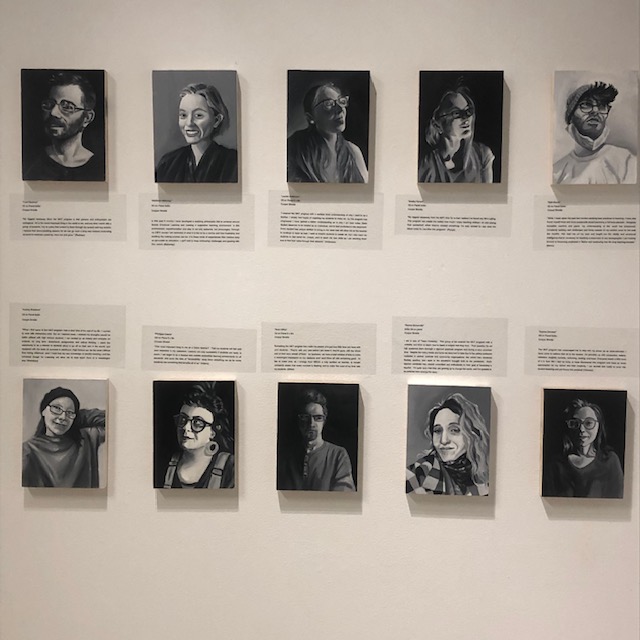
This is Part II of a blog post about the Masters in Arts and Teaching (MAT) students and along with Part I a snapshot of their program this fall at Maine College of Art (MECA). Students presented their work in an exhibit called Getting There, November 28 – December 7 at the college in Portland. Included in the exhibit was a piece that connects each artist and future teacher together. Called Team Awesome, artist Cooper Binette created ten 6×8 inch portraits, oil on panel, of each student. Included in the piece are statements from each of the ten. Their words, below, say it best.

Cooper Binette

Team Awesome 

Cooper Binette

10 6 x 8in Oil on Panel 

I’m getting there…

The journey from artist to teacher has changed my outlook on everything I thought I knew about the subjects. Through readings, guest speakers, field work, and our amazing community of teachers and students, we are all bettering ourselves and deepening our knowledge of the practice. The education system is designed to condition students out of their creativity and to discourage mistakes. The only way to combat this is for teachers to encourage exploration while fostering a safe environment where students can not only make a mistake, but learn from it and discover something new. 

Through this MAT program, I have developed a completely new outlook on art as a whole. My art has always been inspired by a deep interest in the traditional academic style of painting. I was enveloped in the ideas of “mastery” and obsessed with learning different techniques to accomplish what I was trying to convey. These ideas and techniques work for some people, but I have found that each and every student learns differently. There are so many different tastes, styles, and students. The teacher has to have a wide variety of skills and knowledge to help foster an inclusive environment where all students can learn.    

The teacher candidates I work alongside at Maine College of Art have such diverse and creative backgrounds. To capture this I painted each teacher candidate and had them concoct a paragraph describing where each individual is at in their studies. The Masters of Art for Teaching program has introduced me to many incredible new people and ideas. It is my hope that through our study of inclusivity and best practice we can reform not only the future of teaching, but the future of all of our students.

Trent Redmon

“My biggest takeaway from the MAT program is that passion and enthusiasm are contagious. Art is the most important thing in the world to me, and any time I work with a group of students, I try to make that evident to them through my speech and my actions. I believe that demonstrating passion for art can go such a long way towards motivating students to embrace creativity, have fun and grow.”  

Seth Baron

“While I have spent the past few months studying best practices in teaching. I have also found myself more and more passionate about becoming a full time educator. Alongside incredible mentors and peers, my understanding of the world has broadened. Constantly tackling new challenges and living outside of my comfort zone for the past few months. Has kept me on my toes and taught me the vitality and emotional intelligence that is necessary for teaching a classroom of any demographic. I am looking forward to becoming employed in Maine and continuing this life long learning process.”

Lauren Anderson

“I entered the MAT program with a surface level understanding of why I want to be a teacher. I simply had hopes of inspiring my students to make art. As this program has progressed I have gained a better understanding as to why I am here today. Each student deserves to be treated as an individual, and to feel comforted in the classroom. Every student has unique abilities to bring to the table that will allow me as the teacher to continue to learn as well. I want to inspire students to create art, but I also want my students to feel cared for, unique, and to teach me new skills as I am teaching them how to find their voice through their artwork.”

Philippa Adams

“The most important thing to me as a future teacher?  That my students will feel safe and respected in my classroom. Lessons are only successful if students are ready to learn. I am eager to be a teacher who creates accessible learning environments for all students, and turns the idea of “accessibility” away from something we do for some students into something that benefits all of us.”

Sean Dillon 

“Something the MAT program has made me aware of is just how little time you have with your students.  They’re with you, and before you know it, they’re gone, with the whole rest of their story ahead of them.  As teachers, we have a brief window of time to make a meaningful impression on our students and send them off with something good.  I’d like to make sure, as I emerge from MECA a fully certified art teacher, to remain constantly aware that every moment is fleeting and to make the most of my time with my students.”

Audrey Robidoux

“When I first came to the MAT program I had a clear idea of the rest of my life. I wanted to work with elementary kids. But as I learned more, I realized my strengths would be better utilized with high school students. I am excited by art history and complex art projects, by long term sketchbook assignments and critical thinking. I want the opportunity to be a mentor to students about to go off on their own in the world, and equipped with the tools to succeed in adulthood. High School can be the most difficult time during childhood, and I hope that my new knowledge of mindful teaching and the Universal Design for Learning will allow me to best teach them in a meaningful way.”

Shelby Pyrzyk

“My biggest takeaway from the MAT thus far is that I believe I’ve found my life’s calling. This program has made me realize how much I enjoy teaching children art and seeing their excitement when they’ve created something. I’m truly excited to see what the future holds for me after this program!” 

Sophie Olmsted

“The MAT program has encouraged me to step into my power as an artist-educator. I have come to believe that art is the answer. Art provides us with connection, beauty, reflection, laughter, honesty, reckoning, healing, and hope. Everyone needs a little more of it in their life! I feel so lucky to have discovered this program and have so much appreciation for my cohort and their creativity. I am excited and ready to jump into student teaching and put theory into practice!”

Madison Mahoney

“In the past 5 months I have developed a teaching philosophy that is centered around Social Emotional Learning and creating a supportive learning environment. In this environment, experimentation and play is not only welcome, but encouraged. Through my BFA course I am reminded of what it is like to be a novice and how frustrating and exciting the making process can be. It is these kinds of experiences that I believe keep us grounded as educators. I can’t wait to keep embracing challenges and growing with this cohort.”

Rachel Somerville

Dr. Rachel Somerville is the Interim Program Chair of Art Education, Assistant Professor at MECA and works directly with each of the ten MAT students.

“I am in awe of ‘Team Amazing.’ This group of ten entered the MAT program with a curiosity and drive to learn how to teach a subject that they love. Their passion for art has sustained them through a rigorous graduate program and during a very uncertain time. Despite the many twists and turns we have had to take due to the safety protocols instituted in partner schools and community organizations; the cohort has remained flexible, positive, and open to the conditions brought forth by the pandemic.  Each teacher candidate has remained committed and enthusiastic to their goal of becoming a teacher.  I’m quite sure that they are gearing up to change the world, and I’m grateful to be pictured here among the stars. ” 

h1

Getting There

December 9, 2020

Maine College of Art – Student Journeys

Maine College of Art (MECA) Masters in Arts and Teaching (MAT) students presented their work in an exhibit called “Getting There”, November 28 – December 7. Due to the pandemic it was only accessible by MECA. Thanks to the efforts of many this blog post provides background information, an overview and photographs of the work displayed. The content was coordinated by the efforts of students Philippa Grace and includes contributions from 10 students presently enrolled in the program.

During past work of the Maine Arts Leadership Initiative (MALI-now MAEPL), ‘Teacher as Artist’, ‘Artist as Teacher’ has been researched and explored so I’m pleased to see attention being given to this topic at MECA. You will read the thoughts of some of the MAT students below on the topic.

After reading their Artists’ Statements and responses to a group of questions I am confident that the future of visual art education in Maine is in good hands. Thank you to everyone who contributed to this blog post.

BACKGROUND

The exhibit “Getting There” is a reflection of our individual and collective experiences as students learning to be teachers, while also nurturing our creative practice. In addition to our coursework, observations, and field work, all ten of us have been auditing BFA classes at Maine College of Art this fall. Due to limited class sizes because of the pandemic, we weren’t all able to be in our top choice – but we all learned so much. Although our initial prompt was to tie our experience of learning to teach while being an artist to our BFA class, we all expressed ourselves in different ways – from portraits of each other, to new skills we learned, to creating artifacts for future lesson plans. The show is a time stamp of our cohort on the cusp of student teaching this winter. Though this is an unusual year, we are all eager to join the field of art education! 

COURSE DESCRIPTION

Throughout the summer and fall, candidates explore the tools they will need to keep their artistry alive. They also learn how to digitize evidence of artistic and teaching performance. During the summer, candidates explore key personal dispositions of the artist-educator and learn how these qualities shape their lives as artists and future educators. Candidates reflect on their identity and articulate how their personal qualities contribute to their development as creative educators. During the fall, candidates register for an art studio course and continue to explore the artist/educator theme. By examining personal learning goals, they select an art form to study that either supplements or expands their existing repertoire. Candidates create a group art exhibition and prepare a final reflection that examines the strengths and challenges of maintaining high-quality teaching while continuing to work as practicing artists.

EXHIBIT STATEMENT 

Getting There 

November 28 – December 6, 2020

Masters of Art in Teaching Exhibition

Getting There encapsulates our Master of Arts in Teaching program experience. As we develop into artist-educators, we wish to share our individual reflections on various art education theories meaningful to the ten of us as we balance our creative and teaching practices.

Throughout the summer and fall, we have been developing the tools we need to keep our artistry alive in this emerging hybrid and remote learning culture. In between fieldwork assignments and coursework, we explored key personal dispositions of the artist-educator role, and learned how these qualities shape our lives as future teachers. We respond to the prompt of how we are individually ‘getting there’ within our own paths. We reflect on our identity and articulate how our personal qualities contribute to our development as creative educators, which culminates in our exhibit, Getting There

ARTISTS STATEMENTS  

LAUREN ANDERSON

Getting There: While Embracing Being a Novice

Metal, fabric, casted aluminum, wood

As my brain is reaching information overload, I am excited by all the new tools I am adding to my personal tool box. While I am learning how to be a teacher, I am also learning how to work with wood and metal in my Sculptural Imagination class. I have had the opportunity to learn how to cut wood on various saws; bandsaw, miter saw, and the table saw. I also learned how to weld and bend metal, as well as pour aluminum into sand casted resin molds. I am learning to be a teacher, but I am also learning how to continue being a diverse maker. I will soon be an expert teacher, but I will never stop enjoying  learning new mediums and embracing being a novice.

Lauren Anderson

In this exhibition I have shared a piece of each of my sculpture adventures. I created necklace wearables for my body extension project based on the idea of huge chunky necklaces. These necklaces were created from textile materials as well as metal. I also included my aluminum casting composed of intuitive shapes, and my final project titled “I miss you”, a piece created with metal, wood, and crocheted yarn. In this piece I depicted my mom, my sister and I as circles and focused on displaying our personalities through different materials. My mom, the metal circle, is tough as metal and never fails to make me feel safe. My sister, the wood circle, is older than me and very tough to get through to which is why she is depicted as solid wood. I, the crocheted yarn circle, am very soft, gentle, and easy to open up to. In this study of materials I stepped out of my comfort zone and gained many new tools to add to my personal tool box. 

SETH BARON

The Courage To Teach

Digital painting

Studying best practices in teaching is the most important thing to me at this point in my life. Best practice pedagogy has been formally defined as a program’s procedure that continuously and regularly produces superior results when compared with other strategies. With the right intentions, teachers can be some of the most valuable people in this society. This painting is my visual interpretation of the book The Courage To Teach by Parker Palmer. In this book Palmer writes “To correct our excessive regard for the powers of intellect, I stress the power of emotions to freeze, or free, the mind.” Now more than ever, we as educators need to better focus our efforts towards getting students excited about learning. 

Teachers are doing this. By working overtime every week to make sure that remote learning is successful, whether the gym teacher is doing backflips to start a zoom meeting or the English teacher starts class by playing piano. Teachers show up to class with the positive energy that the students need to feel safe in an environment that feels so dangerous. This is important as schools can very well be safer than home for many students. With the face of the school being the teachers it is vital that they are cool, calm and collected. 

Seth Baron

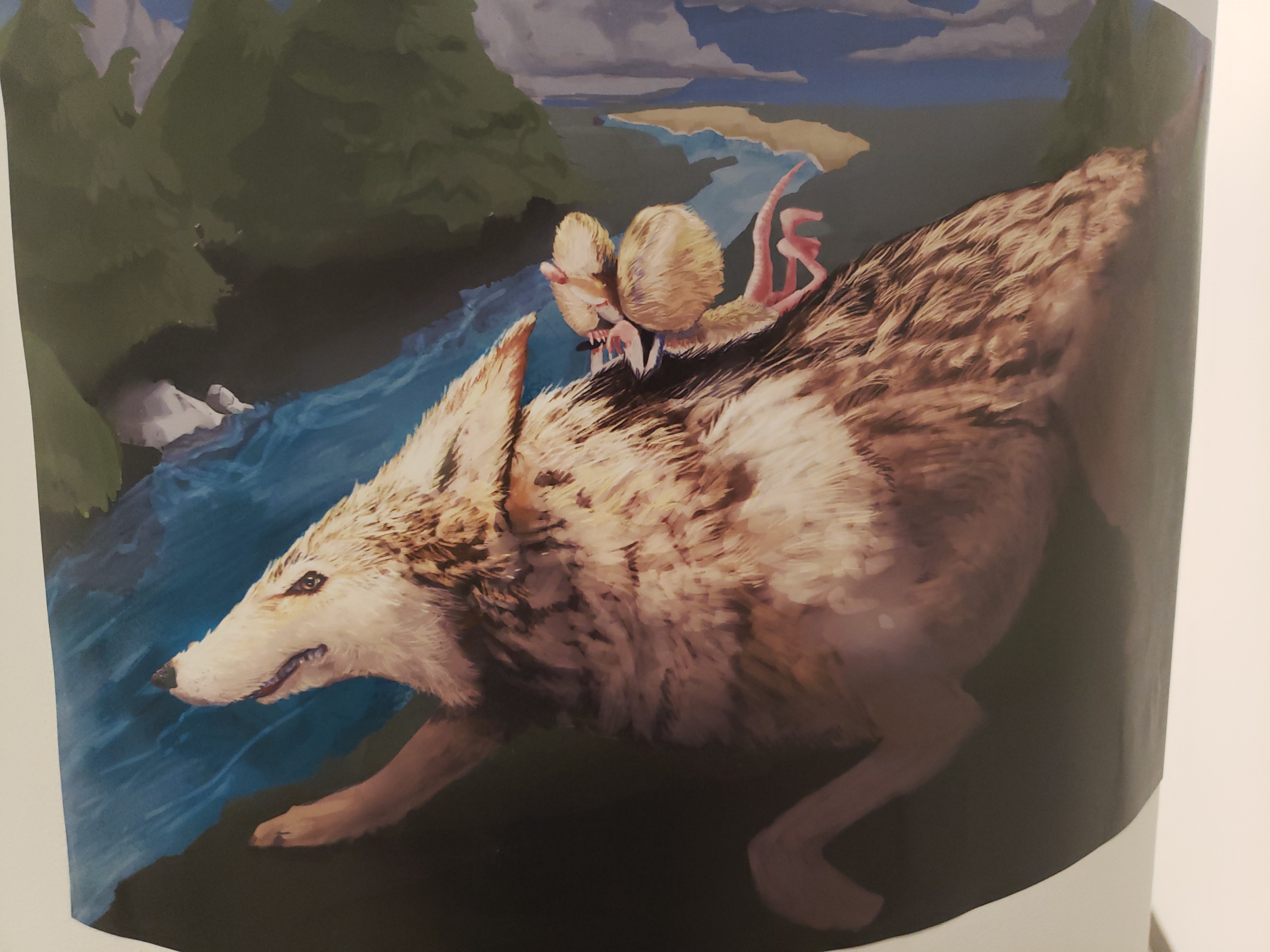
As an art educator, students should be able to come to my classroom knowing that their voices are heard and respected. Whether their voice is in the form of talking or visual communication. When going outside feels dangerous, art can comfort and make one feel as if they are safe even if they are a mouse riding on the back of a wolf. 

In this painting animals symbolize how I perceive educators are reacting to the CoronaVirus epidemic. As the epidemic is making schools a terrifying place to be, Teachers continue to show up everyday for their students with a big smile on their face. Educators show up to school cool, calm and collected. 

SEAN DILLON

Getting There: The Traveling Shrine 

Storyteller, tomb of travelers, driftwood, cotton sheets, stones, glass vials, story books, assorted found objects

Behind every art piece in Getting There, is an artist, and behind every artist, there is a story.  The Traveling Shrine is a sacred place, a crossroad where my path as an artist intersects with those of my fellow art teachers in training. Together, we are travelers navigating the path from artist to art educator by way of MECA’s Masters of Art in Teaching program (MAT).  The Shrine also serves as a place of rest, and a vantage point for those passing through to observe the present.  Cherish these small moments, for who knows if or when we’ll cross paths again.  It is this feeling of nostalgia and reflection that inspired me to build this shrine that embodies my journey up until now.  Comprised of and adorned with relics, artwork, and trinkets from my past and present, the Traveling Shrine is a reminder to myself and my cohort that we are all indeed getting there.

Sean Dillon

My entry for Getting There is unlike anything I’ve drawn or crafted previously.  In the spirit of using innovation and divergent processes to make art, which is one of our seven MAT dispositions, I chose to bring my spiritual space into the tangible world in full life-size form.  The Traveling Shrine is fully immersive and welcomes visitors on all paths of life.

Visitors of the Shrine are encouraged to sit, observe, and reflect on the surrounding artwork and their own journey that brought them here. They may also inscribe their own story into the Tome of Travelers, a living book that remembers all who visit the shrine and grants them good luck on their own journey.  Time and again, the spirit of the shrine will appear to tell tales, share fortunes, and barter strange magic for the stories of others. 

PHILIPPA GRACE

Failing Fearlessly

Porcelain clay

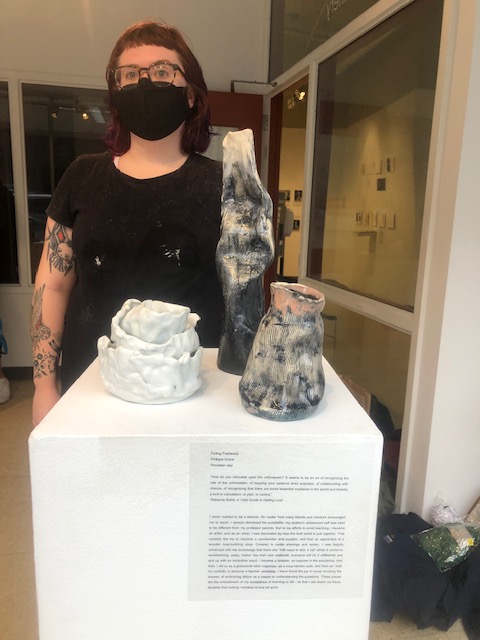
“How do you calculate upon the unforeseen? It seems to be an art of recognizing the role of the unforeseen, of keeping your balance amid surprises, of collaborating with chance, of recognizing that there are some essential mysteries in the world and thereby a limit to calculation, to plan, to control.

Rebecca Solnit, A Field Guide to Getting Lost

Philippa Grace

I never wanted to be a teacher. No matter how many friends and mentors encouraged me to teach, I always dismissed the possibility; my stubborn adolescent self was keen to be different from my professor parents. But in my efforts to avoid teaching, I became an artist; and as an artist, I was fascinated by how the built world is put together. That curiosity led me to become a woodworker and sculptor, and then an apprentice at a wooden boat-building shop. Covered in cedar shavings and epoxy, I was happily entranced with the knowledge that there are “100 ways to skin a cat” when it comes to woodworking: every maker has their own methods; everyone will try it differently and end up with an incredible result. I became a tinkerer, an explorer in the woodshop. And then, I did so as a grassroots labor organizer, as a soup kitchen cook, and then as I built my portfolio to become a teacher candidate. I have found the joy in never knowing the answer, of embracing failure as a means to understanding the questions. These pieces are the embodiment of my acceptance of learning to fail – so that I can teach my future students that making mistakes is how we grow. 

SHELBY PYRZYK

My Teacher’s Journey

Getting There: Continuing to Learn 

Illustration – ink and watercolor

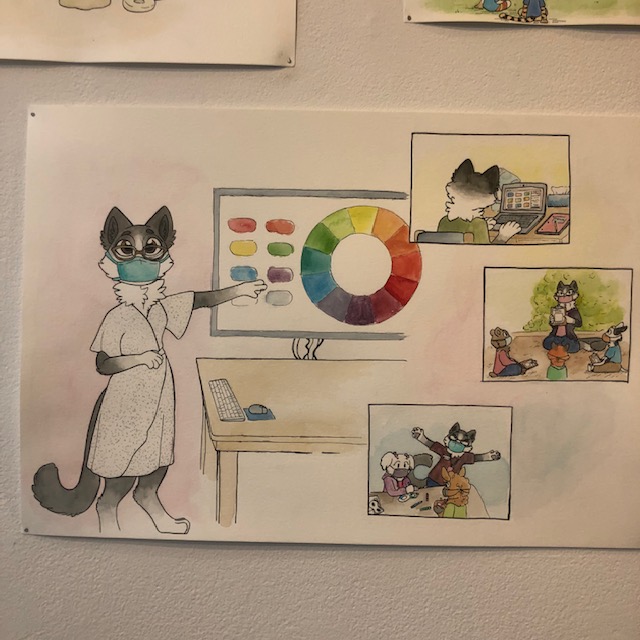
Throughout my compulsory education I looked forward to art class and looked up to my art teachers. They always encouraged me to strive big and pursue my passion for art. These teachers led me to further my art education through college. 

My prior experiences with children, from babysitting in my early teens to working as summer camp counselor during college, allowed me to realize I enjoyed working with children. The biggest contributor to my decision to become an art teacher was when I volunteered at my local art museum for their summer art camp. This opportunity opened my eyes to children’s learning capabilities and excitement for art. The Master’s of Art in Teaching program at MECA was a perfect path for me to travel on and has expanded my understanding of pedagogy and problem solving any challenges that a teacher may face in these uncertain times. I feel I have found my true calling and I aspire to be like the teachers that encouraged me and to spread my passion for art to children as an art educator. 

Shelby Pyrzyk

My art practice revolves around my playful, childlike personality so creating children’s book illustrations is a perfect way to depict snippets of my past experiences that have led up to the MAT program. The smaller panels depict experiences that inspired me to work with children. The medium panels depict major factors that played a key role in planting the seed of going in art education. And lastly the largest panel is of the MAT program, focusing around teaching with small snapshots of different moments, from online observation and working with students from Waynflete and Portland Rec Center. I’m continuing to learn and I’m getting there.

MADISON MAHONEY

Back to Basics

Collection of handbuilt glazed porcelain vessels

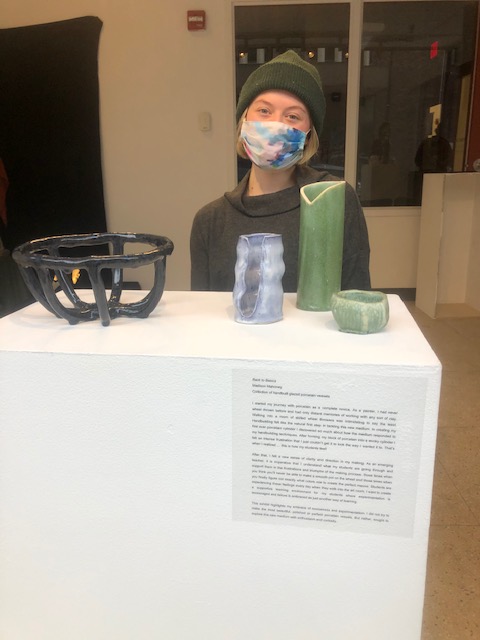
I started my journey with porcelain as a complete novice. As a painter, I had never wheel thrown before and had only distant memories of working with any sort of clay. Walking into a room of skilled wheel throwers was intimidating to say the least. Handbuilding felt like the natural first step in tackling this new medium. In creating my first ever porcelain cylinder I discovered so much about how the medium responded to my handbuilding techniques. After forming my block of porcelain into a wonky cylinder I felt an intense frustration that I just couldn’t get it to look the way I wanted it to. That’s when I realized … this is how my students feel!

Madison Mahoney

After that, I felt a new sense of clarity and direction in my making. As an emerging teacher, it is imperative that I understand what my students are going through and support them in the frustrations and triumphs of the making process: those times when you think you’ll never be able to make a smooth pot on the wheel and those times when you finally figure out exactly what colors mix to create the perfect mauve. Students are experiencing these feelings every day when they walk into the art room. I want to create a supportive learning environment for my students where experimentation is encouraged and failure is embraced as just another way of learning. 

This exhibit highlights my embrace of noviceness and experimentation. I did not try to make the most beautiful, polished or perfect porcelain vessels. But rather, sought to explore this new medium with enthusiasm and curiosity.

SOPHIE OLMSTED

Getting There

Glazed Porcelain 

I crave connection. I revel in feeling connection to myself and to others. I notice connection in my visual world, especially in nature. In the Masters of Art in Teaching program at the Maine College of Art, I connected theory to practice, in both fieldwork placements and in my Introduction to Porcelain class with Cathy Hammond.

The bases and lids of these jars used to be connected; they were originally thrown in one piece, a cylinder connected at the top. Each time you use the jar, you lift and replace the lid, disconnecting the form and then leaving it reconnected. To me, the theme of “Getting There” celebrates the connections I’ve made in the learning process. Each jar is an example of my progress and reflection, a step on my way to becoming a teacher. 

Sophie Olmsted

This porcelain class also reminded me of how special it is to be a student. I’ve missed being in a class and so I relished in the demonstrations and assignments, successes and failures, redundancy and discovery. It was inspiring to be surrounded by creative and enthusiastic artists. I hadn’t worked with clay since college and I didn’t use the wheel at all for my senior thesis, so this class was a time of personal and artistic reconnection. The class ended just as I was getting comfortable with the clay body and glazes, which was a timely reminder of the iterative nature of the learning process. Making these jars fuels my excitement to teach students how to see connection. I am in the early stages of getting there; I’m observing and collecting ways teachers can facilitate opportunities of learning and connection for their students. 

AUDREY ROBIDOUX

Finding My Way

Handcrafted book ~ Watercolor, collage, graphite, pen, colored pencil

I’m getting there…

The journey from artist to teacher has expanded my perspective on the world. As a working artist, I often felt isolated, deeply buried in late studio nights and internal thought. I love to create but it wasn’t enough. I couldn’t invest every piece of myself into it. I felt as though it wasn’t a sustainable practice for myself or my well being. As much as I loved it, I needed something different, a different purpose. After four years of focusing on the art world, I felt the pull to come to the teaching program. Despite the pandemic, and the upheaval of the world around me, I knew that it was the right decision. 

And now I have learned why. It has brought out and amplified parts of me that hadn’t made sense to me before. My love for leadership and advocacy, my tendencies towards organization and planning. It allows me to see the grand big picture, while honing in on all the small details. But most importantly it has brought my passion for art into a new light, and given it a new meaning. As a teacher I can create, without the boundaries of being a working artist. I can play with all the different mediums, in endless ways. I can create for just me, I can create for an audience, and I can create for my students.

Audrey Robidoux

This book is an encapsulation of these ideas. It’s formatted as a sketchbook of prompts that is designed for high school students, based off a curriculum map that I dreamt up. High school education is a difficult experience in the current society, and art can teach the lifelong lessons of creative and critical thinking. Giving a young adult a sketchbook can awake a childhood passion that seemed lost and change their perspective on life. The sense of individuality that is born within a sketchbook can inspire. Art and creativity is what every student needs in this current world, where we have no idea what the next few years looks like, let alone the rest of our lives. I want to equip my students with skills that will stay with them no matter what path they take. And it takes an artist to teach these concepts. There really is an art to teaching. And I’m getting there.

TRENT REDMON and COOPER BINETTE

Gateway Triptych

Acrylic paint and oil-based paint marker on panel

Trent’s statement:

 “…it is from popular culture that most people weave their identities and establish their relationships with others and the environment. Mass media images saturate our lives, structuring much of what we know beyond personal experience. We live through visual images as much as we do language” – Paul Duncum 

To us, the phrase “getting there” refers to our journey from artists to art educators, but it also takes us back to our own childhood, before we ever considered ourselves to be artists. As children of the 90’s, the visual culture that we were exposed to via television, internet and video games had a major impact on us. Our admiration for these colorful and imaginative characters ultimately transitioned into a desire to create, thus shepherding us into our respective artistic practices. For us, this series of colorful paintings is a love letter to visual culture. It is our way of paying homage to the classic characters that inspired us, but it also represents the artistic merits of VCAE as a potential gateway into creative expression for kids. The painterly execution of these works further emphasizes the overlap between visual culture and fine art.

Collaboration was also an important concept for these pieces, as Cooper and I worked side by side to create the series in a single day. As future art teachers, we realize the importance of fostering collaboration among students in the classroom, as it requires students to think flexibly and to cooperate with others. With these works, we wanted to highlight the importance of working with people who have different aesthetics and ideas, while ultimately being able to reach the same goal. Cooper’s vibrant underpainting provided a great backdrop for my bold, line-based character renderings, as we successfully harmonized our two distinct artistic voices into one unified series. Cooper was one of the first friends I made at MECA, and to be able to work with him on this project was a joy. Making art with friends can be incredibly fun and rewarding, and we want to encourage our students to experience that.

COOPER BINETTE

Team Awesome 

Ten 6 x 8in Oil on Panel 

Cooper’s statement:

I’m getting there…

The journey from artist to teacher has changed my outlook on everything I thought I knew about the subjects. Through readings, guest speakers, field work, and our amazing community of teachers and students, we are all bettering ourselves and deepening our knowledge of the practice. The education system is designed to condition students out of their creativity and to discourage mistakes. The only way to combat this is for teachers to encourage exploration while fostering a safe environment where students can not only make a mistake, but learn from it and discover something new. 

Through this MAT program, I have developed a completely new outlook on art as a whole. My art has always been inspired by a deep interest in the traditional academic style of painting. I was enveloped in the ideas of “mastery” and obsessed with learning different techniques to accomplish what I was trying to convey. These ideas and techniques work for some people, but I have found that each and every student learns differently. There are so many different tastes, styles, and students. The teacher has to have a wide variety of skills and knowledge to help foster an inclusive environment where all students can learn.    

The teacher candidates I work alongside at Maine College of Art have such diverse and creative backgrounds. To capture this I painted each teacher candidate and had them concoct a paragraph describing where each individual is at in their studies. The Masters of Art for Teaching program has introduced me to many incredible new people and ideas. It is my hope that through our study of inclusivity and best practice we can reform not only the future of teaching, but the future of all of our students.

Part II of this post will appear tomorrow. Included in the post will be the 10 photographs created by Cooper and much more! Photos are contributed by Rachel Somerville and Seth Baron.

h1

MALI Becomes MAEPL

December 8, 2020

Teacher Network Rebrands its Commitment to Arts Education

The Teacher Leader network known as MALI, or Maine Arts Leadership Initiative, has taken on the new mantle of MAEPL, Maine Arts Education Partners in Leadership, with the revised mission to develop and promote high quality arts education for all.” Leaders of MAEPL say the new name and mission statement better encapsulates what this community of arts educators has been and will continue to be. The process evolved as a result of bringing in new staff and expanding the organization’s leadership structure. Jake Sturtevant, music educator at Falmouth High School, longtime MALI member and Chair of the MAEPL Vision Team, said, “We are still committed to partnering with each other to be resilient, compassionate, and curious Teacher Leaders for our students and in our communities.”

2014 Summer MALI Institute

MALI, now MAEPL, a program of the Maine Arts Commission, is a unique teacher leader development program specifically for preK-12 visual and performing arts (VPA) educators from across the state, one of the very few in the country.  Led by active educators, they focus on the emerging needs of the field.  Components of the year-long program for both classroom teachers and teaching artists in all arts disciplines include community-building, an annual Individualized Professional Development Plan, structured mutual accountability, and leadership development. Over 120 Maine VPA teachers, as well as teaching artists, have participated in the last ten years.  

Even before the pandemic, teachers of the arts often felt isolated.  School district-level trainings are often geared towards general or “core” subject teachers.  “I’m only one of two in my district teaching elementary music.  We are in our little islands, far from anyone else doing what we do,” said Kate Smith, 2014 York County Teacher of the Year and MAEPL Program Team Leader.  “MALI changed all that.” 

Pamela Kinsey, Lori Spruce, Kate Smith, Pam Chernesky, Julie Richard, Winter Retreat 2020

This past year the group took a deep dive into their own organizational structure, assessing and clarifying their policies and processes. Even through the pandemic, the Leadership Teams met and solicited input from the entire membership, and determined a new name, a refined mission, and a new logo. “We chose the whirling maple seed pod as our new symbol because we felt it reflected the best of what we do – taking new ideas, learning and sharing together, then planting them throughout our school communities,” said Jennie Driscoll, visual art educator at Brunswick High School and Vision Team member. “It’s got our energy.”  

In 2020 they also delivered a virtual Summer Institute to 50 VPA educators, addressing the social and emotional resiliency needed this year. In addition, many members led efforts to support and connect with other teachers quickly adjusting to online instruction, leading virtual seminars through the Maine Department of Education and the Maine Arts Commission.

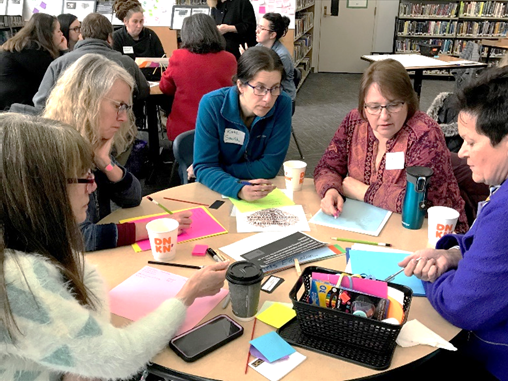
Group exercise at Winter Retreat, 2020

 “MALI grew a wealth of resources and committed members over the years,” said the current Director of Arts Education for the Maine Arts Commission, Martha Piscuskas, referring to the online Resource Bank and Arts Assessment Resources website, available free to all teachers. “We wanted to build on those strengths.” In addition to the professional development programs, next steps include creating an advisory council, streamlining their web presence, and continued advocacy for the sector. 

The group formed in 2010 to focus on student assessments, an emerging need for visual and performing arts teachers at that time. After learning from other states, a small group of educators led by Argy Nestor, the former Director of Arts Education at the Commission, Rob Westerberg, Choral Director at York High School, and Catherine Ring, former school administrator and art teacher, created the Maine Arts Assessment Initiative. They established the multi-day Summer Institute, sharing a framework and best practices for successful arts assessment in the classroom. “We quickly became the assessment experts in our schools,” said Sturtevant. 

Hope Lord and Adele Drake, MALI Summer Institute 2017

In 2015 the group added “teacher voice” and advocacy to their mission, becoming the Maine Arts Leadership Initiative (MALI), again addressing emerging needs of the sector. “I never would have thought to seek out leadership positions, continue my graduate studies, or have presented at conferences without the support and influence of MALI,” said Iva Damon, visual art teacher and Humanities Department Head at Leavitt Area High School.    

For more information about MAEPL, and to learn about how to get involved, contact Director of Arts Education for the Maine Arts Commission, Martha Piscuskas at martha.piscuskas@maine.gov. Arts education resources developed over the years are accessible through the Maine Arts Commission’s website, https://mainearts.maine.gov/pages/programs/maai.

The Maine Arts Commission is a state agency supporting artists, arts organizations, educators, policy makers, and community developers to advance the arts in Maine since 1966.  www.Mainearts.com


h1

The Poetry Place

December 7, 2020

Teaching Artist Brian Evans-Jones

Maine is fortunate to have Brian Evans-Jones as a poet and writer. He has established a unique website called The Poetry Place. What’s so interesting about it is that he offers The Poetry Parlor to offer support and an online learning environment for participants to write poetry. If you’re interested in writing poetry or perhaps you write poetry but want to learn more about writing poetry, I recommend Brian and The Poetry Place. Here are some questions (from Brian’s site) that can help you get a better idea:

  • Do you want to write better poems?
  • Do you wish you knew more about the techniques of poetry?
  • Do you need help with ideas and getting poems written?
  • Would you love to connect with like-minded poets?

There are many free resources on the site including a 30 page .pdf that you can download. It is called 8 Steps to Better Poems and is filled with a plethora of ideas and information to guide you to writing better poems. The document is broken into 3 segments: Poetry Techniques, Mastering Drafting and Your Next Steps. You can’t go wrong since the document is free! I suggest that you check it out and recommend that your colleagues and students do the same. You can also sign up for his newsletter which is filled with inspiring ideas.

LOOKING FOR INSPIRATION?

Poetry Parlor took me on a positive journey from using an existing poem as an idea to developing the first draft of my poem. The chosen poem and the discussions were inspirational in my own poetry writing.

Then, there were excellent tips on editing that helped to produce a published poem.”

— Sue B.

Brian is a teacher who is providing the motivation and guidance on an individual basis as well as providing time with others who write poetry. You can become a member of the parlor and benefit from following:

  • Getting authentic feedback and support from Brian and others
  • Learning techniques
  • Reading great poetry
  • Writing every month
  • Meeting other poets

Poetry Parlor can work for you if…

  • You have written poetry before, maybe for years, and you would like to broaden your knowledge and skills
  • You would like to learn more about the techniques and forms of poetry
  • You are looking for regular inspiration to help you create poems
  • You want to get feedback on your poems to help you improve
  • You want to know more about poetry being published now
  • You’re just starting poetry and would like some structure and guidance to help you
  • You’d like to get to know other poets in similar positions to yourself, for support, friendship, and encouragement.

ABOUT BRIAN

I was Poet Laureate of Hampshire in the UK (where I used to live) in 2012‑13, and in America I won the Maureen Egen Award from Poets & Writers in 2017. I’ve had poems published in magazines, competitions, and art events on both sides of the Atlantic. And I’ve taught at three colleges/universities, visited dozens of schools as a visiting Teaching Artist, and worked with hundreds of adult students through my own workshops and courses.

Brian coached the Maine State Poetry Out Loud (POL) champion Joao Victor before he traveled to the national competition where he finished in the top 10. Brian served as a judge for POL during 206-2018. POL is open to all Maine high school students and administered by the Maine Arts Commission (MAC). Brian is a member of the MAC Teaching Artist roster and a Teaching Artist Leader with the Maine Arts Leadership Initiative (MALI) established in 2011.

If you want to learn more check out the site and contact Brian at brian@brianevansjones.com and please let him know I sent you.

h1

Teaching Online

December 5, 2020

“Teaching an Effective Virtual Lesson” will be presented on Wednesday, December 9, 7:00 – 8:00 pm. Sarah Hoad from Saco Public Schools will be leading the session with tips and strategies for teaching online. Included will be a roundtable discussion on this suddenly-extremely-important topic.

This session is free, and is sponsored by the Maine Chapter of the American String Teachers’ Association (ASTA).
The session will be presented over Zoom. You can access the session by scanning the QR code below or email maineasta02@gmail.com for the Zoom link.

h1

Transmission Times

December 4, 2020

3 Maine artists sharing

Since mid-March Katie Semro has been making the podcast Transmission Times using audio diaries from people around the world about life during the pandemic. She’s done a special episode on Artists. There are 14 artists in all, 3 from Maine, and it’s filled with their pandemic stories as well as clips of their art. The episode is wonderful as are all of the episodes. Voices from around the world reminds me ‘we are not alone’. They share their struggles and their surprises. Many of the artists mention ‘the silver lining’ and art they’ve created that they would never have during a non-pandemic time. You can listen at THIS LINK.

You can tell your stories as well by recording on your smartphone and email them to Katie at ksemro@gmail.com, or call 847-354-4163 and leave your answers as a voicemail.

h1

Artists’ Residencies

December 3, 2020

FREE Webinar

School Arts Residencies During COVID?  Yes We Can! 

Monday, December 14 @ 4 pm.  

As you know all too well, school visual and performing arts teachers are experiencing diminished programming options; many music rooms have been repurposed for regular instruction due to their size and height, offering more room for social distancing; and some VPA teachers have even been re-assigned. Many schools are completely remote now. So how can residencies possibly occur?? The Maine Arts Commission presents a panel of Maine teaching artists who will share tips for successful school residencies happening right now, and some of the obstacles they’ve addressed. Bring questions and if time allows, we’ll hold small group brainstorm sessions on personal next steps. 

Panelists 

  • Tim Christensen, Clay Artist, Roque Bluffs bio
  • Dana Legawiec, Theater Artist, Bowdoinham bio
  • Bridget Matros,  Visual and Performing Artist, Belfast bio
  • Alicia Phelps, Piano and Voice Artist, Director of Community Partnerships and Special Programs, 317 Main.  bio

REGISTER HERE for the free webinar.

You will then be sent the link to attend the webinar.  

h1

Arts Advocacy Week

December 2, 2020

If there was ever a year for Arts Education Advocacy Day, this is it!… so mark your calendars for February 17 – 28th!  This year’s Virtual Advocacy “Day” will be a full week-and-a-half of important events and meetings. Our plenary session on Wednesday, February 17th will feature reports from the field by the leaders of each of the four professional arts educators’ associations that partner with MAAE in the Arts are Basic Coalition (ABC), representing visual art, music, theatre and dance. They’ll be sharing how the pandemic has impacted their discipline, and showing us how they’ve been responding to the challenges, including students’ voices as well.

The week and a half will also be an opportunity for Maine arts students to advocate directly with their legislators in small groups, a tradition we started in 2016 that brought students to Augusta from all around the state. This year zoom meetings will make that trip a lot easier! And the student delegations will also have other advocacy opportunities this year. Our new ABC Student Leadership Group (SLG – see below) has been hard at work on an initiative to form the teams of students who will be representing their schools on Advocacy Day first as advocacy teams at their school who can support arts education locally, as well as connect with the other school teams around the state via our student-managed Instagram account!

Organizing the teams will start this week with a message to the arts teachers from the ABC and Student Leadership Group asking the teachers to encourage one or two enthusiastic arts students at their school to attend a zoom meeting with the SLG about forming a team. The meeting will take place on December 6 at 7 pm

You can help!  If you’re a high school or middle school arts educator but not a member of your ABC arts organization, you can contact Melissa Birkhold, MAAE Advocacy Coordinator, at melissa.birkhold.maae@gmail.com to start the process. If you’re not an arts educator, please forward this email to your local arts educators so they can follow up.

Our SLG students below are looking forward to connecting with other students who share their arts enthusiasm. Their goal is creating a broad network of student arts advocacy teams for Advocacy Day and beyond!  This is the year when those teams are needed more than ever. We thank you for your help, and we’ll keep you posted as we make progress!

If you have any questions please contact Susan Potters, Executive Director
Maine Alliance for Arts Education at maaebangor@aol.com.

ABC Student Leadership Group

h1

I Am Grateful for Dance

December 1, 2020

Thornton Academy Dance program

The dance education program at Thornton Academy is well established and meeting the needs of all learners who are deeply engaged in their learning. Thornton Dance educator and Maine Arts Leadership Initiative Teacher Leader Emma Campbell has high expectations and understands how to connect with all students.

Every year Emma has students respond to the question – What am I grateful for? In a non-Covid year student responses write their gratitude notes on giant cut out leaves and tape them to the mirror in the dance studio.

This year the assignment was adapted to replicate while students are at home this year. They use the Google app called jam board to draft the notes. So everyone contributes a sticky note and then they get to pick from that as groups of that makes sense. Students use this format so there was no need to learn a new concept for the project.

Emma splits the group into breakout rooms to brainstorm thoughts and ideas and recorded one voice from each group and sent Emma the recording. She screen recorded them saying the phrase. Emma takes the footage and voices and does the editing and uploaded it to YouTube. The results are below. A wonderful way to incorporate dance into student thoughts and the outcome is amazing! Thank you Emma and Thornton Academy dancers for sharing your love for dancing and your gratefulness during this season.