Jazz band and State Festival
Falmouth High School
Messalonskee Middle School Beginning Band Concert

Jazz band and State Festival
Falmouth High School
Messalonskee Middle School Beginning Band Concert
Portland Museum of Art and Portland High School
Collaboration comes in many forms and can make a huge difference in the education of students. I’ve observed collaborations that start with a small idea and grow into a long-term meaningful learning opportunity. Quite often, not only are students learning but the adults, who are behind the details, are expanding their knowledge as well.
One such opportunity is presently underway at Portland High School (PHS) in collaboration with the Portland Museum of Art (PMA). The PMA Learning & Teaching Specialist Meghan Quigley Graham has been working with the Portland Public Schools (PPS) Partnerships since 2019. The PPS/PMA Partnerships was established as a way to connect with educators and students in the district on a deeper level. The partnerships work with individual educators to collaboratively build opportunities for free-choice, student-driven learning. Through these partnerships, they learn more about access barriers and opportunities for the PMA to be a better resource for educators throughout Maine. These partnerships within the PPS district help to inform ways that the museum can expand capacity for more direct collaboration with educators in other districts.
Meghan has been working with art teacher Louis Pierre Lachapelle as part of the PPS/PMA Partnerships. Louis taught at Lincoln Middle School before taking the position at Portland High School two years ago. This school year, Meghan and Louis wanted to connect students with artists featured in the Untitled 2020: Art from Maine in a ____ Time exhibition at the PMA. It was important that the youth voice be a part of this exhibition in some way, as young people have a lot to express about the year that 2020 was, just as the artists featured in the exhibition do. The PMA’s main role in this partnership was to connect Louis and the Artists’ Rapid Response Team (ARRT)! They will also be reflecting on the experience and sharing that out with wider audiences once the collaboration is complete. They hope to find a way to display some of the artwork that students create.
Each week the artists of ARRT! connect with Louis’ advanced students and provide them feedback and comments on the art they have underway. Students are inspired by the conversations and are very engaged in the opportunity. Louis acknowledged that not only do the artists’ have so much to offer students but PMA does as well. It’s a win-win for everyone.
For those who don’t know ARRT! they create banners and props to promote the work of progressive non-profits across Maine. You can learn more at THIS LINK. ARRT! artists’ are also members of the Union of Maine Visual Artists (UMVA). ARRT! collaborates with 60+ non-profit, progressive groups to promote social change in Maine. ARRT artists’ are pleased to be working with the PHS students in Louis’ classes. They are concerned about the future so being able to work with high schoolers provides a wonderful opportunity to address their concern. With the pandemic ARRT! has shifted how they perform their mission. Maine artist Natasha Mayers who established ARRT! says: “One of the best things to come out of this work with the PHS class is to work as a team, an expert panel, seeing how much we have to offer the students. I’m overwhelmed by the skill and kindness and generosity and insight that the other ARRTists bring to the discussion. The students get feedback from at least 3 or 4 of us. Lucky students.” In addition, this opportunity opens up a new window for ARRT. “We have worked together for years, but not in this way, so it is a new appreciation of each other and of ARRT! collaboration.”
ARRT! was selected to participate in the juried exhibition Untitled, 2020: Art From Maine In A _______ Time, which runs until May 31, 2021. The PMA is now open to the public by advance time ticketed only.
Meghan said: “PMA is always looking for more ways to collaborate and partner with Maine educators! If anyone is interested in discussing potential collaborations and partnerships with the PMA.” Please contact Meghan at mquigley@portlandmuseum.org.
RSVP

The Lewis Prize for Music is thrilled to invite you to our virtual Open House for Music CYD Rural Leadership on Thursday, April 22 from 5pm – 7pm ET. We are hosting an informal conversation with rural and tribal creative youth development practitioners and youth participants, members of state arts agencies, rurally based community centers, advocates and supporters for rural and indigenous communities.
Creative Youth Development is a recent term for a longstanding practice that integrates creative skill-building, inquiry, and expression with positive youth development principles, including holistic wellbeing. The Lewis Prize for Music team is eager to learn about rural communities and the experiences of working and getting funding for out of school music programming.
We will share information about our annual Accelerator Awards application and how to apply beginning in May 2021, as well as how to share about the award opportunity with other rural CYD music organizations that qualify for this opportunity.
Please note, we are capping attendees to the first 100 people to sign up. Honorariums will be provided for attendees that qualify as being a part of CYD Music Organizations.
Maine Art Education Partners in Leadership
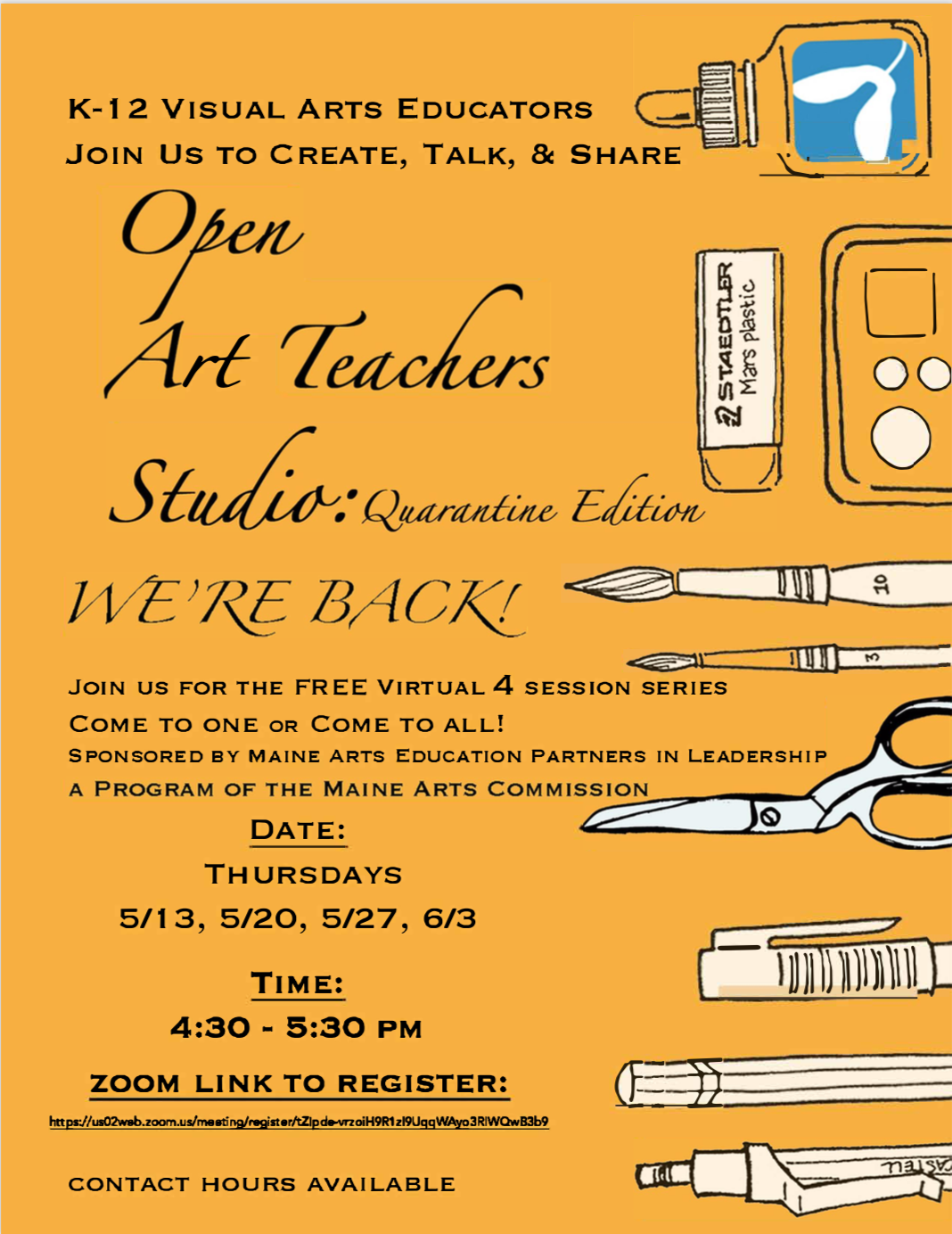
The Virtual Open Art Teachers Studio is back, starting May 13! For and by Maine teachers. Open to anyone involved or interested in arts education – visual, literary and performing arts educators, teaching artists, administrators, community folks. This is a time to set aside and activate your own creativity. In this long year, we have learned that self-care is critical for those supporting others, such as arts educators. Please give yourself one hour a week to dive into your own imagination with us! Four sessions, free. To register click here. Article about past sessions can be read in the winter edition of the Maine Arts Journal here.
For more information: martha.piscuskas@maine.gov
A HUGE SUCCESS
Congratulations to the Maine Art Education Association for a successful virtual conference held this past Saturday. Iva Damon was the chair who waited an entire year to complete her task. Last year the conference was canceled thanks to the pandemic. Every aspect of the conference entitled Perceptions 2021 went really well. If you’re working on the planning of a virtual conference or workshop I suggest you reach out to Iva who is an art teacher at Leavitt Area High School. Conference planner Extraordinaire!
The conference opened with a keynote provided by Natasha Mayers and Rob Shetterly. She often explores themes of peace and social justice. Recently the film on Natasha’s life as an artist was released called Natasha Mayers: an Un-Still Life. Natasha founded ARRT! (the Artists’ Rapid Response Team) in 2012, an artists’ collective that meets monthly, creating over 400 banners, props and yard signs for most of the progressive organizations in Maine. She co-founded and is editor-in-chief of The Maine Arts Journal: Union of Maine Visual Artists Quarterly. Learn more about how Natasha has contributed to so many meaningful projects and made a difference in Maine practicing her art in a collaborative way. You can read about her contributions since 1976 at THIS LINK. Conference participants had a chance to view the film before the conference.
Artist Rob Shetterly founded Americans Who Tell the Truth (AWTT) and has painted over 250 portraits of ‘truth tellers’. The Samantha Smith Project is part of the AWTT work where middle and high school students use art to build a bridge between the classroom and the world to create curious, courageous, and engaged citizens. SSC projects teach students that, no matter what age, they can be part of solving the challenges and problems they see around them.
One of the portraits that Rob has created is of Natasha so it was a delight to have them both share their stories and inspire art educators to make a difference in their classrooms.
Participants had a chance to attend three workshops throughout the day and meet with colleagues informally. The workshops were:
The day ended with a gathering and door prizes presented. It was very clear that teachers missed seeing colleagues from other parts of the state and making art together. Comments around the challenges of the year and that the value of the art classroom became more clear to educators. Participants said what a great conference it was. More people attended the spring conference than has been the case in the last several years. The comment that placed clarity on our important roles as art educators this year was stated by Rangeley Lakes Regional School Art Teacher Sonja Johnson:

Casco Bay High School
The Music and Mental Health website was created by Gridley Abercrombie, a student at Casco Bay High School in Portland. The Casco Bay curriculum is organized around Learning Expeditions which are long-term, in-depth studies of a single topic that explore vital guiding questions. They incorporate standards and involve fieldwork, service and research, culminating in a project, product or performance. Expeditions require strong habits of work and quality thinking that come through the daily rituals of reading, writing, research, problem solving, and discussion. Individual and group projects are designed to unify and ignite student learning by calling for concrete products or actions that address authentic problems, typically with a component of social or environmental justice.

Casco Bay High School principal Derek Pierce said that the expeditions encourage students to take on a project that is an intersection of their personal passion and a need in the world. They are an example of educators allowing students to pursue their interests to do something that will make a difference. He said that Gridley’s expedition is a great example of that.
When Gridley started the project he knew from his past musical experiences and learning over the years that the arts were good for the overall well being of individuals and for parts of the brain. His research helped him go deeper in his understanding of the science in the brain chemistry and the impact on the neurotransmitters. Music effects the mental health on the brain and body.
Along with learning the science Gridley learned how to create a website and he effectively uses it to include information that is useful for young people, parents and educators. Gridley researched the following topics in relationship to music and mental health: The Problem, Music’s Effect, Musical Opportunities, Who to Contact if You Need Help and Resources.
Some of the statistics that Gridley includes in the website are helpful to have a better understanding. For example, in 2017, “An estimated 3.2 million adolescents aged 12 to 17 in the United States had at least one major depressive episode. This number represented 13.3% of the U.S. population aged 12 to 17.” The potential of music and its impact on mental health is enormous.
Especially during the last year we know that we have students who are facing challenges that didn’t exist earlier. I suggest that you check out the website Music and Mental Health and share with your own school community. Thank you Gridley for your research and sharing it with the world through the creation of the website.

New York Philharmonic
Aaron Copland composed “Fanfare for the Common Man” in 1942 during WWII as part of the war effort. He settled on this title because, as he put it, “It was the common man, after all, who was doing all the dirty work in the war and the army.” He later added, “He deserved a fanfare.” Today, the title could just as easily apply to the healthcare workers and other essential frontline workers who have helped us through the COVID-19 pandemic. This newly recorded performance was conducted by David Robertson in January 2021 at St. Bartholomew’s Church.
New homework
This idea is from a school in Ireland where they ditched the regular homework for a month and instead assigned ‘acts of kindness’. Some research supports the ineffectiveness of homework and suggests that time spent with family and doing acts of kindness can positively impact a family and their community. What do you think? In this time of the pandemic it is a bit challenging to carry on with ‘normal’ volunteering but after a year of confinement consider how to ease your students out to participate in community kindnesses. Read the entire article.

Rob Shetterly and Jim Carrey
As another month comes to an end today I’m sharing this post that might help you close another chapter in a wondering state of mind. In Elizabeth Gilbert’s book “Big Magic” she talks about ideas that come into our thinking and how if we don’t act on them they fly out and keep circulating out there until they land somewhere else. Not sure if this has happened to you but it has to me multiple times, some small topics, others very monumental.
Recently Rob Shetterly from Americans Who Tell the Truth (AWTT) was sharing with my students his story about becoming the painter of the Truth Tellers. Rob has painted over 250 portraits of truth tellers and if you’re not familiar with them please take the time to view the AWTT site – there are many teaching and learning resources and opportunities for your learners.
Anyway, Rob said something that hit me upside my head. It went something like this: A few days later Ellsworth High School art teacher Leah Olson shared a video about Jim Carrey. First, I was surprised that the video had a similar message to Rob’s and that it was coming to me not long after I heard Rob say it. Needless to say it was my “big magic” moment and I knew that I had to act on it. So, I followed up with Rob, shared Jim Carrey’s video, and asked him to repond. Rob’s response pushed on my thinking and the importance of Rob’s paintings became more clear. I am so grateful for his work and wisdom.
Rob’s thinking on The Searcher
Jim’s video
When I went back to view Jim’s video what I found, along with “the searcher”, was how meaningful this video is for students and adults alike. I have been reminded over and over in the last month how serious some parents and educators are about “preparing kids for the future”. Sadly, not about the importance of living each day to the fullest. The video has many messages along with the important one “what you do in life chooses you”. It’s about how important color is (I equate this with the lack of sun during Maine winters), relationships, engagement in learning, observation, love and so much more. I urge you to take the 6 minutes and 18 seconds to watch it and encourage you to share with a friend and/or colleague and of course, if appropriate with your students.
Happy new month
We can, and many educators do, use poetry and creative writing in their classrooms whether they teach English Language Arts or another subject. Many arts educators use poetry to enhance, dove-tail, and/or integrate into their arts subject. When Amanda Gorman recited her poem at the Presidential Inauguration in January it made a huge impression on citizens of all ages. If you’re not incorporating poetry into your arts classroom I can’t think of a better time to do so.
In recognition of National Poetry Month this post is about resources and opportunities about learning more about poetry. You may find it useful for yourself and for your students. If you have any resources please feel free to share at the bottom of this post or email me at meartsed@gmail.com and I can include them in a blog post for others to learn from.
POETRY RESOURCES
Amanda Gorman
Just after the presidential inauguration Amanda told “CBS This Morning” co-host Anthony Mason: “Poetry is a weapon. It is an instrument of social change…and poetry is one of the most political arts out there because it demands that you rupture and destabilize the language in which you’re working with. Inherently, you are pushing against the status quo. And so for me, it’s always existed in that tradition of truth-telling.”

You are currently browsing the me arts ed blog archives for April, 2021.

 me arts ed