This is a wonderful tribute to music teachers, Kevin and Pam Rhein. They have dedicated the last 42 years to teaching. The have impacted hundreds of students in Messalonskee Schools. This is a wonderful tribute to both of them – teachers, community members, parents, friends, and colleagues. Wishing you only the very best Pam and Kevin and thank you for your commitment to education!
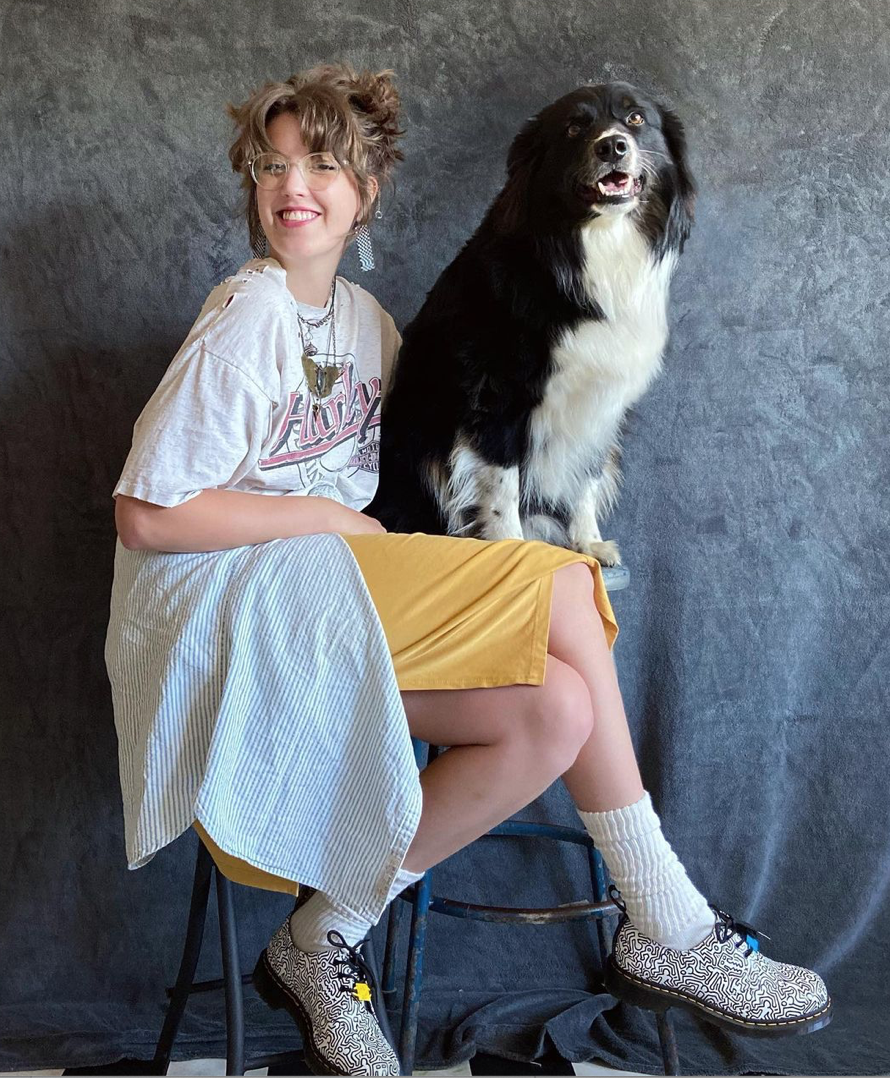
Yes, Finn is a dog who is dressed up or dresses up and helps his owner re-create paintings. Fun and funny, Finn is an Australian Shepherd who is quite obviously patient and tolerant and his artist friend and owner Artist Eliza Reinhardt must have a great sense of humor. She started creating these works of art at the beginning of the pandemic and has not stopped. You can follow her and her 3-year old Finn on Instagram. Need a smile I highly recommend checking out these photos and by all means share them with your students (of all ages). I intend to next week with my learners. Check out the rest of the story at THIS LINK. I do wonder if Eliza has met William Wegman?! Hmmm…
Join us next Tuesday, June 8th for a dynamic panel discussion that will interrogate the systems of Eurocentric educational spaces and their impact on the liberation of BIPOC students, from both a historical and multicultural frame of reference. The panel will be moderated by Dr. Durell Cooper, Co-Founder and CEO, Cultural Innovation Group and the panelists include:
Phil Chan, Co-Founder, Final Bow for Yellow Face Quanice Floyd, Executive Director, Arts Education in Maryland Schools Alliance Ashley Lipscomb, CEO, The Institute for Anti-Racist Education, Inc.
Registration is required and this event is free to attend.
Each of us holds meaning about pieces of history in different ways and for different reasons. My mother’s birthday was yesterday, she would have been 103 years old. She died at age 97. She and my dad had an amazing story which included D-Day. My parents were very patriotic, perhaps it was because my father landed at Omaha Beach after fighting in Africa and Sicily as part of the Army’s Big Red One. His story continued on from the beach for several months. My mother was proud that she shared her birthday with D-Day having volunteered in WWII helping with the wounded soldiers when they returned to the states.
We talk about performances and the meaning behind the stories. When I saw this performance by Sam Elliott I knew that I had to share it on the blog. It’s Ray Lambert’s story but its also everyone’s story who fought in the war. The performance of Sam Elliott sharing Ray Lambert’s story is the finest kind of performance, in my opinion.
In remembrance of D-Day Actor Sam Elliott shares the story of 98-year-old D-Day survivor Ray Lambert who landed on Omaha Beach. Sgt. Ray Lambert is a highly-decorated combat medic who landed on Omaha Beach on D-Day in 1944. He survived along with his brother who also landed on the Normandy beaches on D-Day. This talk was given at the 30th National Memorial Day Concert in Washington D.C. in 2019.
I usually include on this blog a summer reading list so I was excited to receive this email recently from Edutopia with a list that was compiled by Marissa King, Chief of Staff, Teaching and Leading Initiative of Oklahoma. Some of these resources are in response to the past year that we all know has been a challenge. Perhaps you’ll put some of these on your summer reading list.
THE TEACHING PROFESSION
If you’re looking for a hopeful peek into the ways that immense public and administrative trust can lead to excellent schools, reach for In Teachers We Trust: The Finnish Way to World-Class Schools (2021). The book combines the perspectives of Finnish education expert Pasi Sahlberg and Timothy Walker, an American educator who moved to Finland with his family to live and teach.
Many of Sahlberg and Walker’s suggestions for building trust and making improvements are policy related, but the authors also offer insights into smaller, more practical ways. Pragmatic suggestions range from systems for transparent decision-making, to prioritizing schedule changes that give teachers shared work time, to purposeful mentorships for those new to the profession.
TAKING CARE OF OURSELVES
If the pandemic-induced changes of this school year left you battered, breathless, or teetering toward burnout, add Wintering: The Power of Rest and Retreat in Difficult Times (2020) to your bookshelf. Katherine May writes about personal winters—those periods in our lives when we feel cut off, out of sorts, or unable to productively contribute to our communities. May gently guides readers to look at personal winters as a time to care for ourselves, “actively embrace sadness,” and find new practices for recovery.
Although May is a former writing teacher, she doesn’t address schools or educators directly. In fact, she acknowledges that slowing down can seem especially hard in the packed daily schedules of traditional school days. Using personal stories, May turns the traditionally gloomy topic into a hopeful handbook for self-care and recovery.
TACKLING TOUGH CLASSROOM ISSUES
If you need an inspirational reminder that educators are invaluable first responders, reach for Lisa Delpit’s latest edited collection of short essays. Each chapter of Teaching When the World Is on Fire (2019) tackles a moment of crisis or pain in which educators have had to make thoughtful choices to influence the students in their school.
This book makes the profession feel less lonely as each chapter dives into how successful educators are addressing topics ranging from hate speech to climate change to Confederate statues.
If you want to zoom out to the policy level this summer, read A Search for Common Ground: Conversations About the Toughest Questions in K–12 Education (2021). The book is a long-running series of letters between the two authors, Frederick Hess and Pedro Noguera. While the two often find themselves on opposite sides of the political spectrum, they offer a rare, compelling example of dialogue. They skillfully frame controversial issues, seek out areas of agreement, respectfully discuss disagreements, and intertwine the exchanges with bits of personal updates about managing life and children during the Covid-19 pandemic.
The chapters are labeled by issue, making it easy to cut straight to a particular topic.
THE PROMISE OF TECHNOLOGY AND THE INTERNET
If you’re ready to take a clear-eyed look at the impact of technology in your school this year, check out Justin Reich’s Failure to Disrupt: Why Technology Alone Can’t Transform Education (2020). Reich, a professor at MIT, offers a careful analysis of what schools can reasonably expect from technology, why it won’t fix inequalities, and how we should think about the technology we’re bringing into schools.
Reich’s skepticism about big, transformational claims will feel familiar to veteran educators who have taught through multiple iterations of internet-based instructional programs. Reich offers clear lists of questions to ask when new technology comes to your school, such as “What’s actually new here?”
If you’re more interested in the way that increased time on the internet shaped students (or politics) this year, pick up a copy of Mind Over Media: Propaganda Education for a Digital Age (2020). Author Renee Hobbs is on a mission to help schools tackle modern propaganda education head-on.
Mind Over Media details how propaganda influences everyday life from social media to advertising to education (and it’s not just the internet). Hobbs offers accessible explanations of the ways that propaganda wriggles into our daily consumption, why it’s especially profitable in the digital age, and how it can be used for good or evil.
For educators, Hobbs includes clear propaganda learning activities with guiding questions that range from finding fake Instagram accounts to analyzing the subtle influence of public opinion polls. Student resources (labeled as “learning activities”) aren’t course specific, which makes it easy to adapt them across the curriculum.
LEADING FOR EQUITY
If you’re ready to dive into the messy, complicated world of district decision-making, set aside some time to read Erica Turner’s Suddenly Diverse: How School Districts Manage Race and Inequality (2020). Through interviews with mostly white district officials, Turner examines how two Wisconsin school districts with different political and economic contexts responded to similar demographic changes.
Both districts relied on “color-blind managerialism” with policies like data monitoring and marketing—practices that Turner cautions against for their potential harm. At every turn, she reminds the reader why it’s important to learn from our mistakes, examine the messes we’ve made, and figure out “How do we live the reality well?”
Kristen Mosca shares “Dill Pickles Rag” by the great Charles L Johnson. Kristen has played the piano since she was 9 years old and fell in love with Ragtime as a teenager. This song was a hit in 1906 and it was the second rag song to sell over a million copies after Scott Joplin’s “Maple Leaf Rag”.
Re-stART: MAEA 2021 Fall Conference- September 17-18, 2021
The Maine Art Education Association (MAEA) Fall Conference is being planned after a year without it and after the struggles we have all faced with the pandemic. This will NOT be held at Haystack Mountain School of Crafts as they are still working on a reopening plan. MAEA is planning a full return for 2022. Instead, this fall MAEA is offering an in-person “satellite” conference at several venues, studios, and locations throughout the state. This will be a two-day event, in small groups, with 18 studio offerings! The conference will run from 8am-5pm during those two days. Room and Board will not be offered for most studios, however with so many locations, you may be able to find one close, or experience some of the great hospitality Maine has to offer. This does cut down on the conference cost significantly though as well!
The theme of the fall conference is Re-stART. With the worst of the covid crisis hopefully behind us and the acknowledgment of many social disparities, we are looking forward, using the silver linings and new understandings we have learned to continually improve our practice, our wellbeing, and our social interaction. We see this as something of a new beginning, a chance to make systemic changes and to highlight the best of mankind and of ourselves. This is an opportunity for us to make the changes we know can improve the structures we have found ourselves in. A chance to “Re-stART”. While not all workshops will focus on this theme, we hope it is something we can all reflect on as we begin a new school year this fall. Join MAEA this fall to learn a new craft, refine an old one, and/or develop art making skills with fellow arts educators!
Registration opens July 1st at 7:00 AM. Make sure to read the descriptions thoroughly for locations, recommendations, and other applicable fees (specifically for those that offer room and board). If you’re not a member of MAEA now is the time to become one so you can participate in the conference.
Thoughtful, meaningful, figuring it out, asking questions, listening to students, high standards. When it comes to teaching all of these represent Rob Westerberg. He acts in a very serious way and approaches most actions with a humorous twist. Recently he posted a piece called “Off the Grid” on his blog “Goober Music Teachers”. He describes what he’s learned during the pandemic, how he’s embraced the situation and a caution on the importance of not comparing what you do as a teacher with what the next teacher is doing. I’m certain that this year has revealed much to us individually. My greatest hope is that the shifts we’ve been forced to make and have chosen to make have been an opportunity to learn about ourselves, like no other time in our teaching careers. No matter if your career is at the beginning, middle or end there is something for everyone to ponder in Rob’s pandemic story. I’m always grateful when Rob takes on a subject and blogs about it. His posts give me a chance to pause and reflect. The next two paragraphs are the first two paragraphs of his post. You’ll find the link to Rob’s blog post at the end so you can continue reading.
IN ROB’S OWN WORDS…
Would you believe me if I told you this has been one of the most satisfying, rewarding and happy years of my career? The phrase, “going off the grid” is a spot on reflection of what every music teacher in the country has gone through the past 14 months. Nothing has been “normal”, and a lot has been taken from us and our students since March of last year. How that has individually impacted us is dependent on many factors including whether we’ve been allowed to be in person or not, what grade level we teach, general choral or instrumental, single teacher in a school district or one of many. In any given year prior to this one, each music teacher’s journey is incredibly unique. That’s never been more true than this one.
But a funny thing happened to me right around the middle of November, and it carried through to this very week: my kids and I were learning and growing, and realizing that we were learning and growing. We started enjoying this journey together.
Rob is the 2020 Maine York County Teacher of the Year. He is co-creator of the Maine Arts Assessment Initiative (MAAI) turned Maine Arts Leadership Initiative (MALI) and presently MAEPL, Maine Arts Education Partners in Leadership, with the revised mission to “develop and promote high quality arts education for all.”
I invite you to read Rob’s FULL POST – Off the Grid, May 15, 2021. Rob can be reached at THIS LINK.
Join us for a great opportunity! The Maine Arts Commission invites arts educators and teaching artists to be a part of the Maine Arts Education Partners (MAEPL) in Leadership Summer Institute on July 27 and 28, held this year at beautiful Pilgrim Lodge on Cobbosseecontee Lake in West Gardiner. Arts Educators and Teaching Artists from across the state will come together to reflect, collaborate, address emerging needs in Arts Education and leave with an individualized plan tailored to the needs in their programs, schools, communities or regions. MAEPL teaching artists and educators:
Share ideas
Collaborate
Advocate
Amplify student and teacher voice
Commit to life-long learning
Inspire and become inspired
Educate through high quality effective teaching and learning
Make connections
Enrich lives through the Arts
Feel isolated or overwhelmed? Long for like-minded people with whom you can share your passion for the Arts and Arts Education? Wish you could have more impact within your school, community or state? We can help. Become a part of the MAEPL family today, now over 120 people strong.
Argy Nestor
Arts Educator, Blogger, Artist, Connector meartsed@gmail.com
https://sites.google.com/view/anestor/
Argy’s Blog
The purpose of this blog is to share stories about people and places; and to celebrate the amazing work (and play) that students, educators, and organizations are doing in and for arts education. In addition, the blog has a plethora of resources and innovative ideas. This forum gives blog readers the opportunity to learn from each other. It is essential that we listen, learn, and collaborate in order to build on teaching practices for the benefit of every learner in Maine and beyond.








 me arts ed