The leaves had just started to turn their brilliant colors as I followed the windy road west to Rangeley from my home in the mid-coast. It was a warmish and beautiful day. I haven’t traveled to western Maine in a few years and surprisingly during my 13 years working for the state (Maine Department of Education, 7 years and Maine Arts Commission, 6 years), I didn’t visit the Rangeley Lakes School. (I say surprisingly because during those 13 years I visited about 450 schools.)
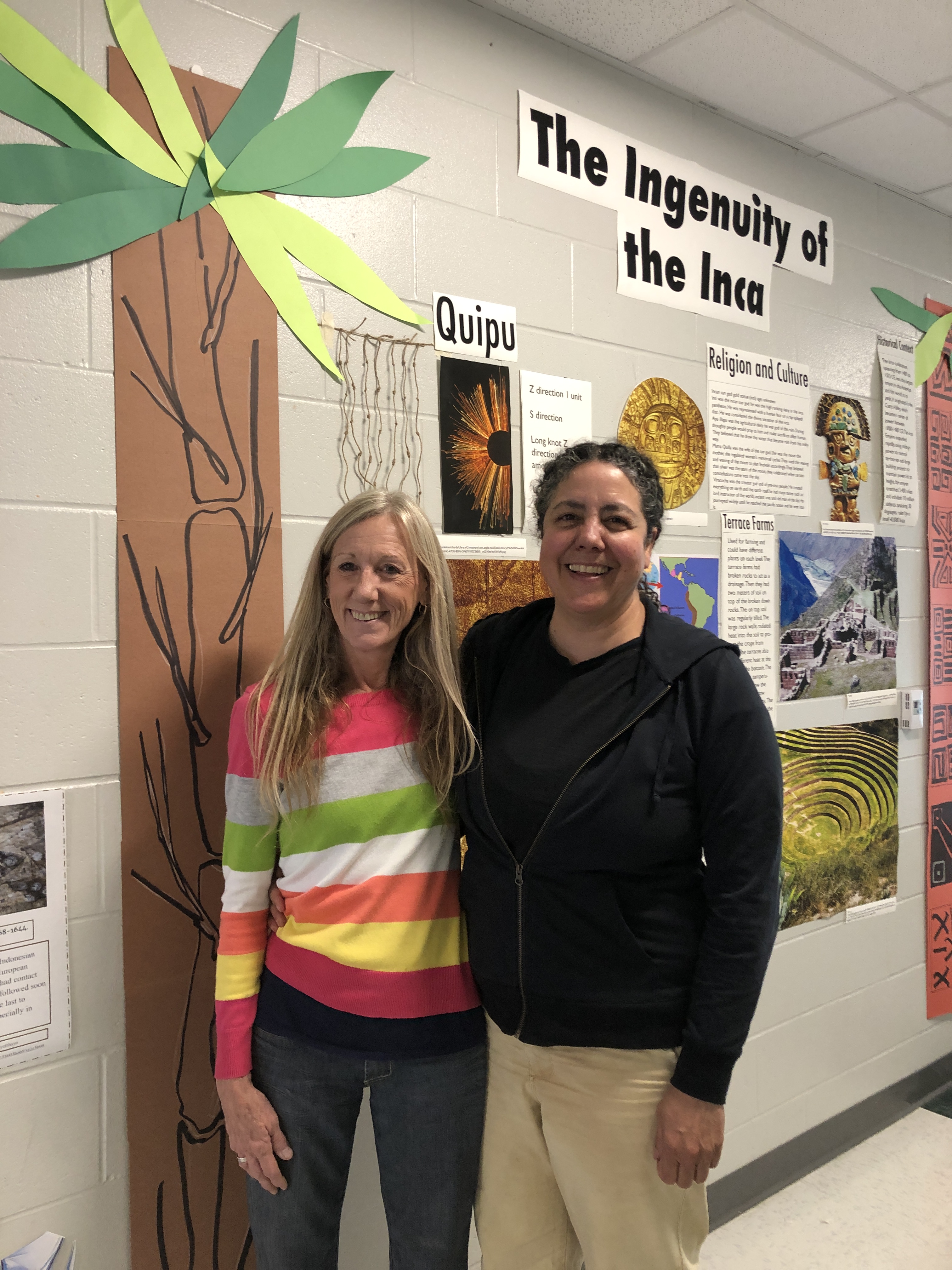
Sonja Johnson and Maryam Emami
I’ve know Rangeley art teacher Sonja Johnson and English teacher Timothy Straub for many years. More recently, I met Maryam Emami, graphic arts and history teacher and the 2023 Franklin County Teacher of the Year. I was excited to visit the Rangeley Lakes School and to learn more about Maryam and Sonja’s collaborative project. I shared my recently published book, Catching Fireflies, that I’ve co-authored with poet Jean Feldeisen. I learned about the community project that Sonja and Maryam have had underway for almost 10 years called Words of Wisdom. Students have made beautiful black and white photographs and collected stories from almost 100 community members. We discussed ideas on how they can move forward to complete this comprehensive historical and artistic project this school year. The lessons learned in creating Catching Fireflies have been many and I was happy to share them.
Along with the collaborative project I had a chance to learn about some of the recent engaging curriculum work Maryam had underway with students. You’ll find descriptions below of two units plus Words of Wisdom. It was fun for me to talk with students as they worked in the classroom space and the hall gallery they were creating with the completed work.
Graphics Arts
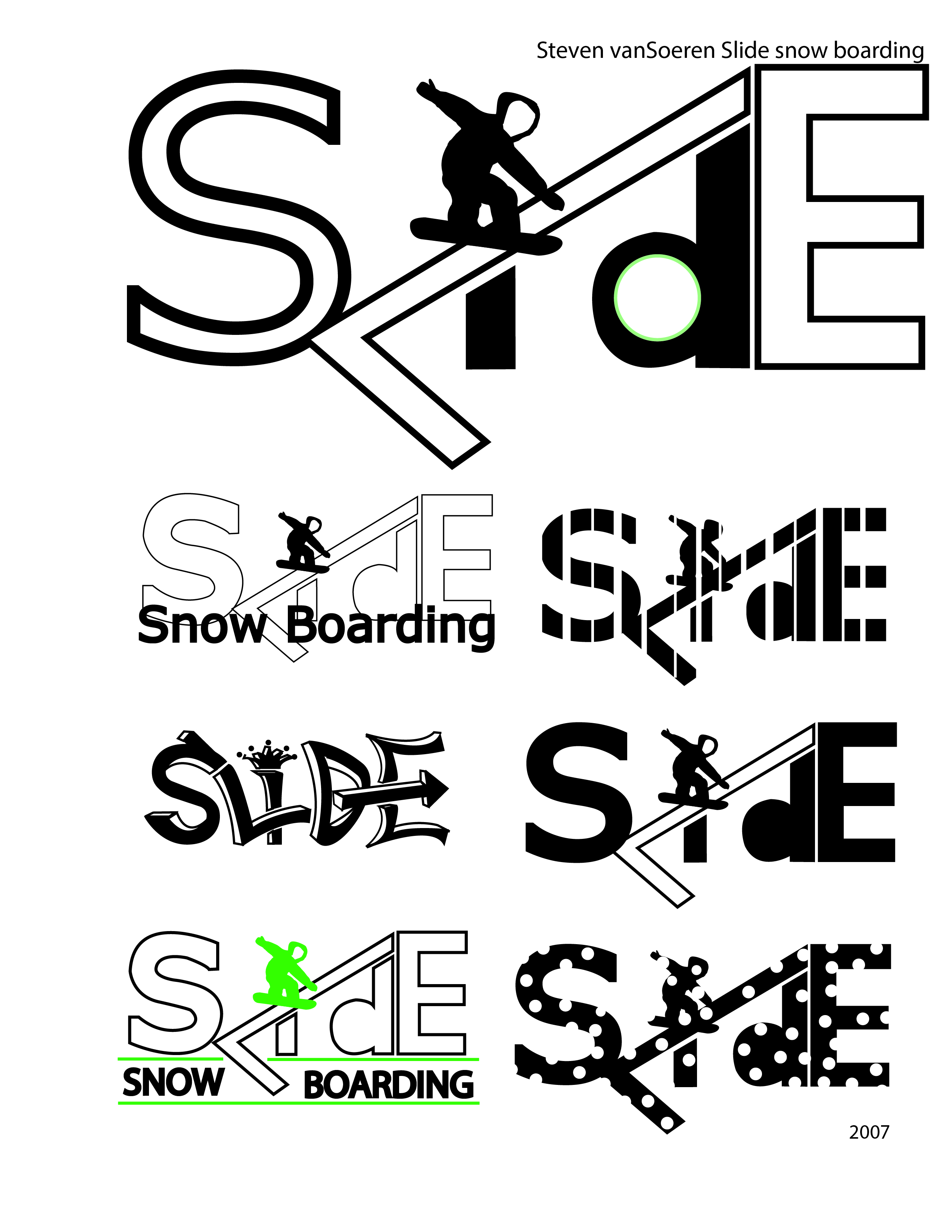
Retail Design: Part 1. The Logo-Create a fictitious company. Begin by naming it. Once the name has been selected everything else falls into place. Think of who your audience is and the company’s personality. The logo design will be most effective when the spirit of the store is clearly thought through. Keep in mind that you will be using the logo for a broad range of applications. The typographic symbol is usually, but not always, the expression of a unified design for advertising and manufacture. It must be original and simple in form, have a very high degree of memorability, and be easily recognized and noticeable. A symbol either brings letters together to make a new form, or illustrates the product or does both. A symbol is something completely different and of higher importance than a monogram (a sign of identity usually formed by the combined initials of a name). A faulty symbol is far worse than none at all, and a bad symbol can be disastrous to a product.
Humanities II
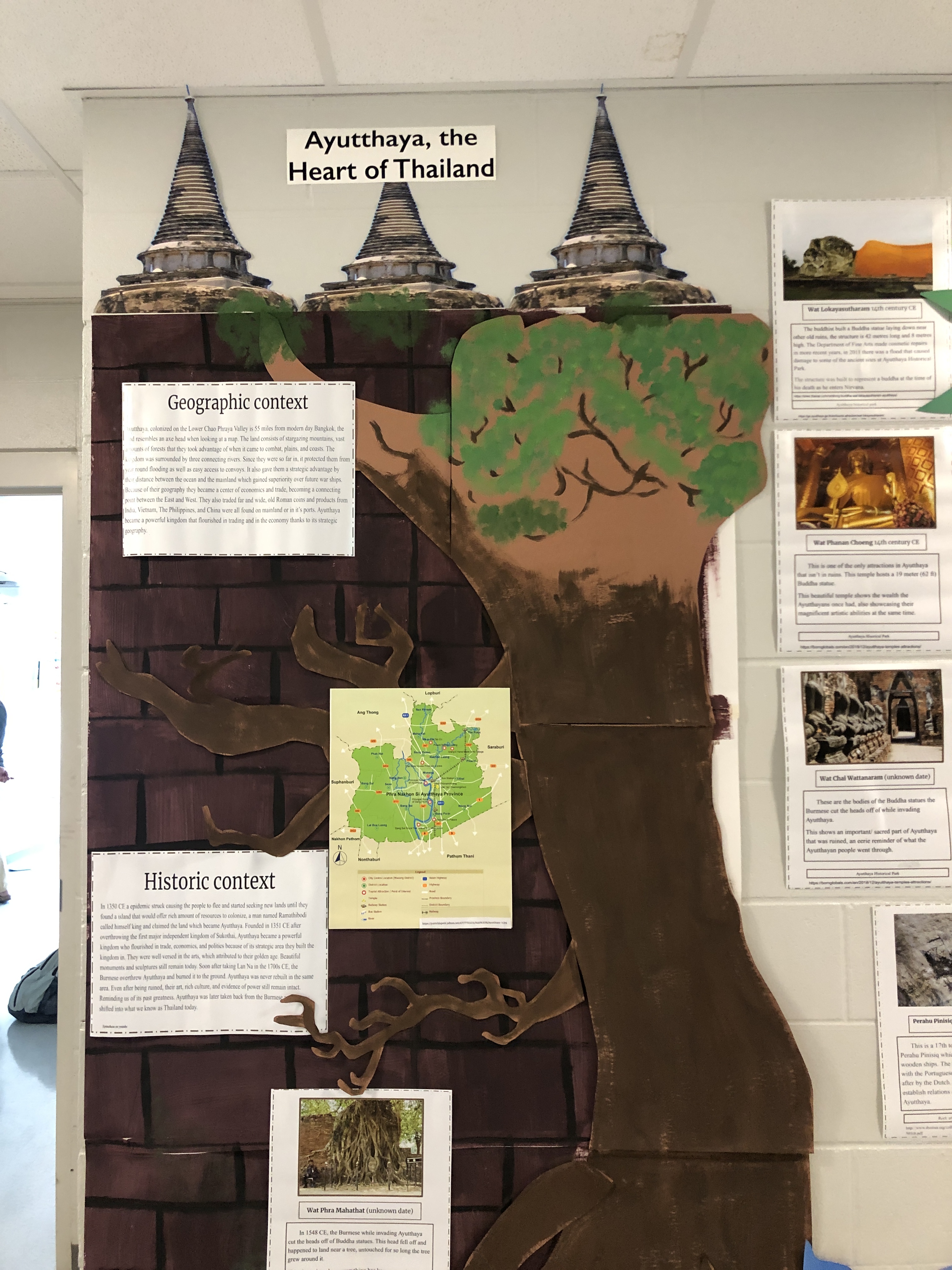
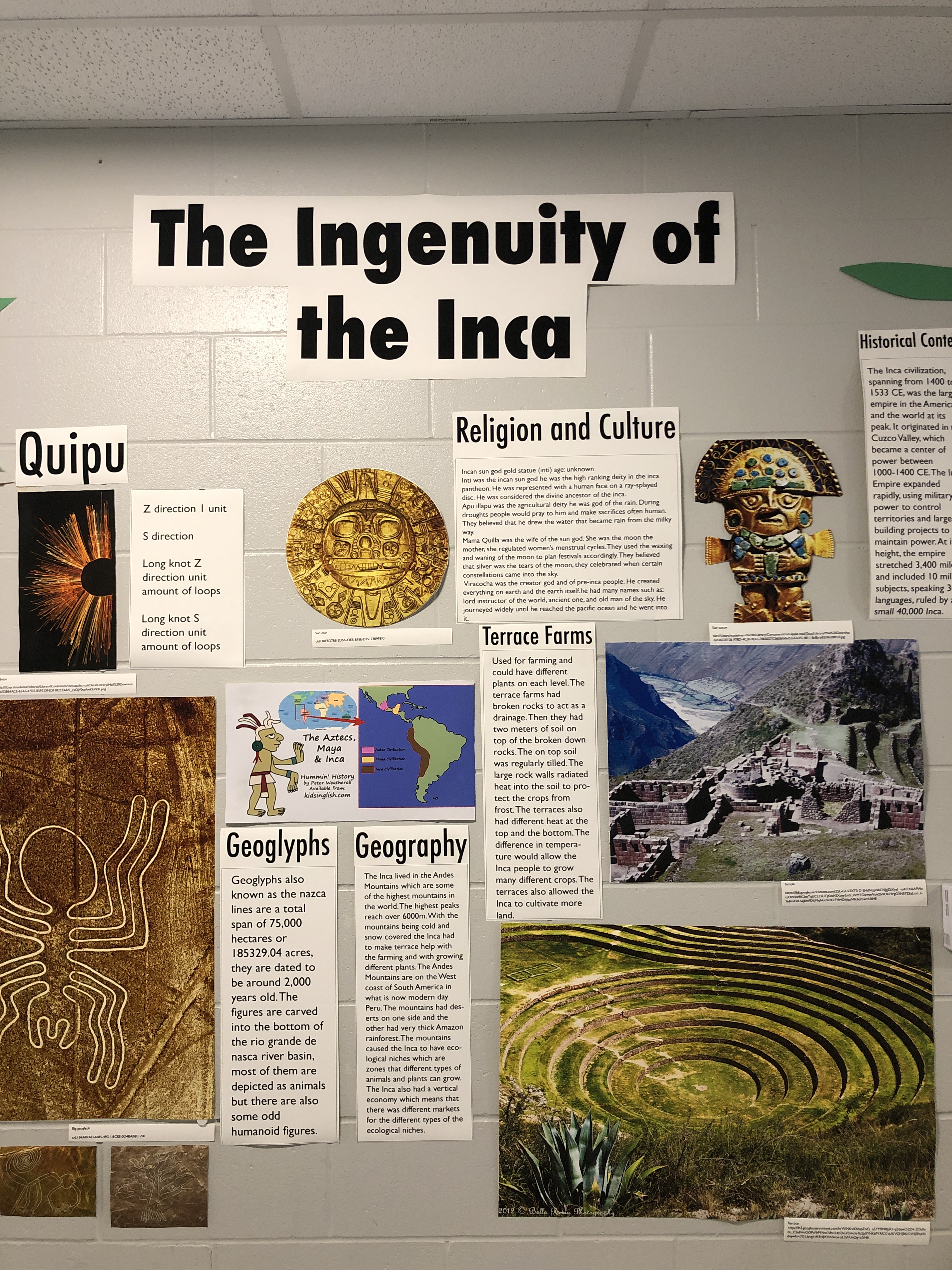
Historical Exhibit: Students curate artifacts which can include music, visual art, videos, digital media, information about important individuals from the time/culture, and cultural/historical items in their exhibit. Artifacts should be cataloged and given museum tags. And, students should be able to act as a docent to visitors to the classroom exhibit. When designing your exhibit, consider incorporating a mix of artifacts, documents, interactive displays, and multimedia presentations to engage visitors and provide a comprehensive view of your Empire’s history and cultural heritage. The Empires are the Inca, Songhai, Ayuttyha, and the Ottomans.
Words of Wisdom
Sonja and Maryam plan to publish a book with the information below that students have collected from almost 10 years of community members. The information supports the beautiful black and white photos students took and developed. These are older community members, at this point some of them have passed away. One student is the child of a student from 10 years ago when the project first got underway.
what is your full name including nickname
how old or young are you
where do you live in rangeley
what is your connection to rangeley how did you get here how long have you lived here
what was/is your occupation
what do you enjoy doing now
describe your family background
what are some of your interests/hobbies
Last piece: please share with us any additional details about your life or anything else you would like to share with future generations.
There is nothing more wonderful than learning about teachers collaborating in an impactful way. The information is of course, authentic and somewhat raw. I spent a few minutes reading through the answers, looking into the eyes of the portraits. I couldn’t help but wish this project could be carried out in every school in the state. This is a gift to the students who participated in so many ways. They’ve had a chance to learn about the individuals (in some cases relatives), to learn the history through the lives of community members, and to reflect on who they are as young people because of the people who live in their own community. Very, very powerful work! I look forward to holding the book in my hands in the future.
I’ll let you know when the project is complete. Good luck to Maryam and Sonja and to the students as they move to complete this gift to the community!
If you’d like to purchase my book Catching Fireflies it is available at THIS LINK.
Periodically I have learning opportunities that are so pleasurable! I am grateful that I have more flexibility in my schedule at this point in my life to consider options. Last fall I participated in a Book Arts class that took place at a beautiful location, a stones throw from Mussel Ridge Channel, in the mid-coast called 26 Split Rock Cove located in S. Thomaston. 26 Split Rock Cove is owned by artist and poet Sandy Weisman who moved to Maine in 2010 after working at Massachusetts College of Art as the director of museum education.
It was fun to take the class alongside retired Bangor High School art teacher Kal Elmore. It was like a mini-Haystack workshop with a variety of people (artists, educators, and creatives) attending. A pleasant surprise was meeting Gardiner Area High School (GAHS) science teacher Sharon Gallant.
This wasn’t the first book making class that Sharon had taken. In fact, in the summer of 2021 she had taken a week-long bookmaking summer class at the University of Southern Maine. At the conclusion of the class Sharon was so excited that she wrote a grant to Oak Grove for funds to support a school wide book making project. Her goal for the 2021-22 school year was simple but enormous – transition the school/subjects/teachers and students from paper and pencil to creating books. Sharon provided book art training to staff. We all know the value of professional development for teachers and when a staff come together to learn, community is created and expanded upon. In this case Sharon noticed that the staff confidence grew, classrooms opened to possibilities for projects, and conversation was stimulated among staff implementing projects as curriculum options were considered.
“Participants discussed ways they might use the book art samples in their classes in the varying content areas in the upcoming year. Participants were informed of the grant and the opportunities for supplies to be checked out from the library, prep of supplies by students doing community service, and support from us. In November (2021) and in March (2022), 21 staff members across all content areas participated in learning book art creation techniques.”
You might be asking WHAT? and wondering WHY! This is an example of one teacher getting excited about something learned, trying it in her classroom and understanding the potential of student learning all because of making books!
Librarian Debra Butterfield has been incredibly supportive and added so much to the project. A room off of the library was set up to store the materials and provides access for students to check out the materials, the same as library books. The school has a community service component as part of high school graduation. Debra worked with three trained student volunteers and as other students saw volunteers using professional cutting machines and a variety of tools provided by the grant, other students offered to volunteer. The student volunteers have grown to twenty who are not involved in sports or other clubs. The preparation of materials before, during, and after school has connected them to GAHS in a meaningful way. One student stated, “ I love preparing book art materials because I see in classes how much teachers and students appreciate that the supplies are prepped for them.” Volunteers have learned the importance of quality control, deadlines, and school service.
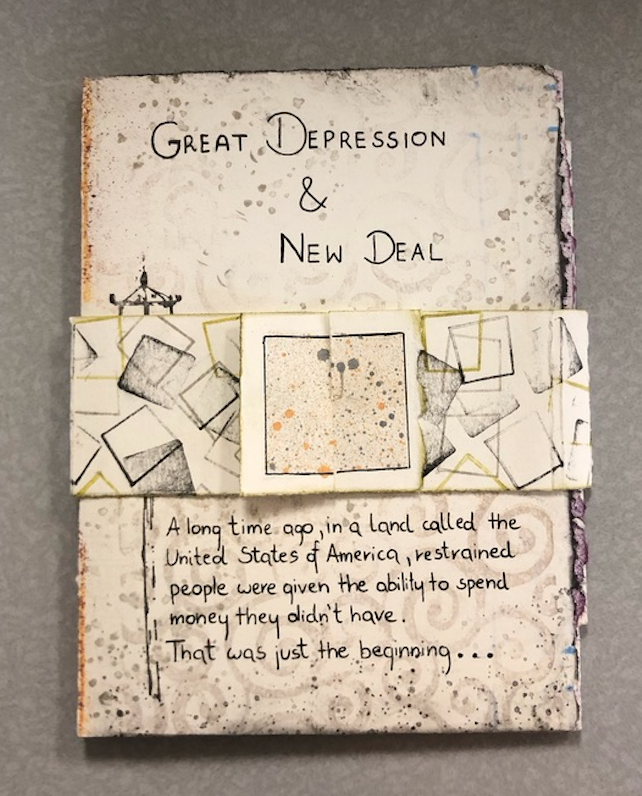
After I met Sharon at the Book Arts workshop we arranged a day for me to visit GAHS. I spent time with students in the social studies class with teacher Susan LeClair. Students were totally engaged in creating accordion books on The Great Depression and New Deal. The approach was structured but flexible, the materials plentiful, the atmosphere was supportive, relaxed and creative. The classroom was set up similarly to a ‘workshop model’. Students are introduced to history material, art materials and techniques at different intervals in the book making process. They work independently understanding their goals using a rubric based on a total of 100 points.
Causes of the Great Depression – 50 points
New Deal Programs – 50 points
Illustration – 25 points
Organization – 25 points
Susan is a veteran teacher having seen many changes during her teaching career. She shared that students had become passive, going through the motions of learning, memorizing for the test and to obtain a good grade. Many immediately forgetting material as soon as information was spit out for the paper and pencil test. Making books provided the opportunity for students to demonstrate learning in an engaging way. Understanding and retention of the material was evident as they created the story using illustrations. Not to mention students were proud of their creations.
As the school year, 2021-22 continued the ideas morphed and grew. Sharon’s description of what followed, thanks to the enthusiasm of teachers and the grant funding:
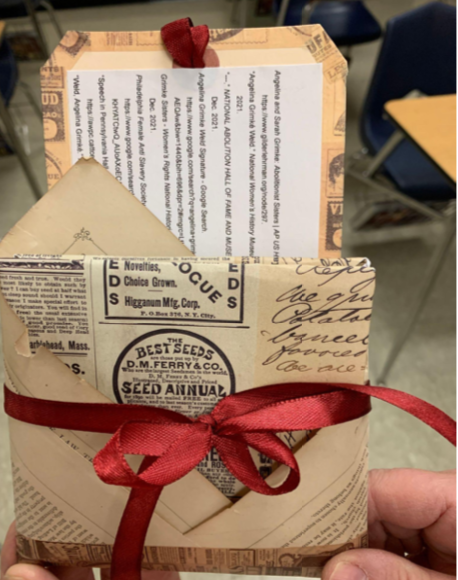
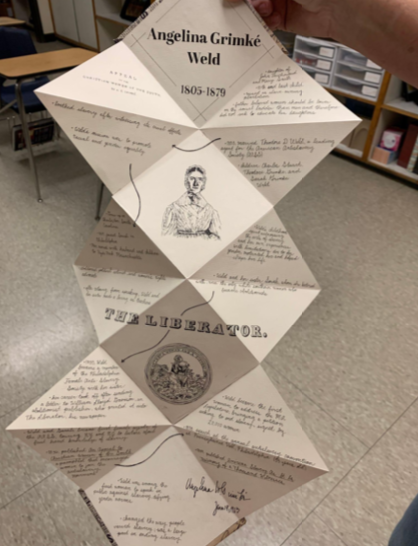
We have supported a range of projects this year with our support with instruction in classes. Following is a sample of some of the projects implemented this year that replace traditional paper and pencil assessment. A biology teacher created nature journals with compartments for collecting samples. A foreign language teacher had year four students create illustrated children’s literature books and then hosted a student lead reading to other foreign language levels. Social studies teachers have created a variety of projects as they have learned about the founding of our country, abolitionists, immigration, and world cultures. English teachers are currently having students create illustrated poetry selections for National Poetry Month, a showcase for learning from a variety of texts read this school year, and another focused on the exploration of fairy tales. Our library is physically in the center of our school with an English/social studies wing on one side and a science/math wing on the other. Historically students have rarely shared about their assessments for learning from one side of the building to another. Book art, however, has changed the culture. It has been a connecting force with students talking with each other across classes and disciplines. Through these projects, we have had a focus on developing templates as rough drafts and this repeated experience has fostered ahabit of mind focused on quality, planning, and revision that we see transferring to research, the writing process, and scientific inquiry. This has been an unexpected benefit of the grant. Students have been more present in their learning and deepened their own personal expectations for quality. One student stated, “Thank you so much for letting me make a book to show what I know. I don’t test well, and I’ve never felt the teacher knows what I know.”
Beyond projects in the classrooms, we have offered opportunities for students and staff to come together for after school sessions to learn advanced book art making techniques with holiday card making in December and Valentine card making in February. The sessions were intended from 2:00 to 3:30, but because students and staff were in the flow of creating together, the events lasted closer to 5:00 pm. Several students reflected on how amazing it was to be a learner along with their teachers. These experiences, which created amazing positive school energy, showed students the role that book art can play beyond the classroom for personal pleasure and engagement.
Due to such a positive response from students, we quickly realized that students needed a venue to showcase their impressive book art. We approached the art teacher, who has an annual K-12 art show, to feature book art as an added feature to expand the show to an art extravaganza. We have invited all students who have made a book to participate in the show. One student, who struggles academically, exclaimed in shock and delight, “You seriously want to show my book. No one has ever asked to have my work displayed!” This reaction alone exemplifies our belief that students need an alternative form of assessment. Book art fills that space.
No doubt about it, the excitement and impact that one person has made, the collaborative spirit and flexibility of staff and the support from administration has all come together to make a huge difference in teaching and learning at GAHS. Evaluating the program helped determine the next steps for Year 2. And, funding helped again. Sharon’s words describe it best:
During our tremendous success with book art as an alternative form of assessment, we quickly realized that there was still work to be done. We have a large population of students without access to materials at home, a space at school to complete book art projects, and the need for additional after school enrichment experiences.
The first year of Turn the Page funding allowed us to introduce a new form of assessment and purchase materials for multiple classes to simultaneously work on these projects. While several class periods are devoted to time in class for these projects, to ensure the quality of work required to complete a book, students are asking to work on the books at home. With the additional funding, we created supply kits, issued through the school library catalog, with all necessary materials for students to bring home to further work on their books. Not only does this assist students who need more time, but it also makes it easier for those who are economically challenged to have access to all materials not available at home. Through all of the amazing success of year one, we did note the disparity between students who had home access to additional embellishment and those who struggled with the basics. These kits eliminate any barrier for success.
Book art has truly made a significant shift in our attempt to establish learning environments and experiences that feature collaborative relationships, rigorous and meaningful curriculum, and shared instruction. It also addresses various forms of inequity and empowers young adults to thrive at school.
GAHS’s commitment to responding to and making needed changes are exemplary. What an outstanding example filled with possibilities. I am grateful that I had the opportunity to meet Sharon and visit the school to see the project in action! Are they proud of their accomplishments? You betcha; again in Sharon’s words:
We are very proud and grateful for what this grant has allowed us to do for professional development, student engagement, and expanded community connections. We have presented to the Plymouth State art class, at Viles for a pre-service teacher training , and a Saturday Maine Association of School Libraries conference session scheduled. Students have told us that they want to create with their hands, do meaningful projects, and have deep engagement with their learning.
Susan LeClair, Social Studies teacher – Sharon Gallant, Science teacher
This resource came across in my email recently. Even though the source is not specifically an organization focused on education I think it might be useful in planning lessons/units for teachers/students.
The World Alliance for Arts Education (WAAE) 2021 Virtual World Summit will take place from October 11-15, 2021. The summit is titled Arts Impact 2021: Context Matters, and focuses on Arts Assessment and Evaluation. The purpose of the summit is to bring together arts education professionals worldwide to share the latest research, thought, and practice in arts education assessment and evaluation. We invite primary and secondary school arts educators, higher education professionals, arts education researchers and policymakers, national, state and local education officials from across the world to come together virtually at this international event.
The WAAE 2021 summit will host one pre-summit event, the Young & Emerging Leaders Forum (YELF). This event provides a space for young scholars, emerging leaders, and new colleagues to the field of arts education to share work and develop a community of learning for expanding the pipeline of leaders in the global field of arts and cultural education. The Forum will be coordinated by Jeff M. Poulin, the managing director of Creative Generation.
Proposals are now being accepted for the Virtual World Summit and YELF.
Registration will open on July 6, 2021. If you are interested in registration information, please enter your contact information here.
Please help us spread the word. At the close of this email, please find pre-written blurbs to include on social media or in organizational newsletters.
Sincerely,
The Summit Co-Chairs
Dr. Timothy Brophy, University of Florida
Marcia McCaffrey, State Education Agency Directors of Arts Education (SEADAE); New Hampshire Department of Education
Jeff M. Poulin, Creative Generation
SAMPLE NEWSLETTER, FACEBOOK, OR LINKEDIN BLURB:
Call for Proposals: World Alliance for Arts Education Virtual Global Summit
The World Alliance for Arts Education is partnering with the University of Florida and SEADAE to host a virtual World Summit from October 11-15, 2021. This event invites out-of-school time, primary and secondary school arts educators, higher education professionals, arts education researchers and policymakers, national, state and local education officials from across the world to submit proposals and attend the summit to network; share research; and examine quality structures, processes and practices. Ahead of the summit, there will be a Young & Emerging Leaders Forum on October 11. Deadline to submit a proposal is July 19, 2021, with decisions by August 30, 2021. More info: http://bit.ly/WAAE2021
SAMPLE SOCIAL MEDIA POST:
Submit a proposal now for the World Alliance for Arts Education Virtual Global Summit focused on examining quality structures, processes and practices of assessment and evaluation in #ArtsEd. The Summit will be held virtually from October 11-15, 2021. More info: http://bit.ly/WAAE2021 — Jeff M. Poulin (he/him/his)Managing Director Creative Generation www.Creative-Generation.org@Campaign4GenC on Twitter, Instagram, and FacebookFind us on LinkedIn
Curious about the Maine Arts Commission (MAC) program, Maine Arts Education Partners in Leadership (MAEPL)? Wonder why you should consider applying? Listen to arts educator and veteran MAEPL Teacher Leader Charlie Johnson at THIS LINK explain his reasons and the benefits that he’s experienced during his ten years of participation!
DEADLINE TO APPLY IS TOMORROW, JUNE 22, 2021! DON’T DELAY!
Interested in getting together with other Maine Arts Educators and Teaching Artists? Learn more about Maine Arts Education Partners in Leadership (MAEPL) and consider applying to attend the summer institute and become a Teacher Leader or Teaching Artist Leader for the 2021-22 school year.
At the Summer Institute new Teacher Leaders and Teaching Artist Leaders will learn foundational practices in instructional design and leadership skills. Participants will take part in a variety of workshops focused on emerging needs in Arts Education professional development.
Collaboration, networking, and the sharing of resources are an expectation as a member of the MAEPL community. During the Institute participants will develop an individualized growth plan that will be shared with others for feedback and suggestions.
Throughout the school year, participants will continue to share how their individualized growth plan is developed and implemented, and they will have the opportunity to share at a Critical Friends Day, and with a thought partner.
There is a Winter Retreat with participants to review and reflect on the work done, and allow for time to get feedback to plan for the next Summer Institute.
JOIN US! Become a Teacher Leader and Change Lives.
APPLY TODAY — CLICK HEREJune 22, 2021 deadline for new and returning applicants
IMPORTANT THINGS TO KNOW:
SUMMER INSTITUTE
Pilgrim Lodge is a camp run by the United Church of Christ of Maine on Lake Cobbosseecontee in West Gardiner, with cabins with electricity and plumbing, large indoor and outdoor meeting spaces, modern dining facilities, wifi in main buildings and good general cell reception, and recreation options, including swimming, human-powered boating, and trails.
APPLICATION
Administrator Name/contact information
Paragraph of Interest — Selected individuals will be expected to be active leaders in helping to develop and support excellence in teaching and learning in Maine. A full commitment to the Institute timeline is expected as seen in the online information sheet. Please attach a brief overview of your interest and current/past experience (if any) in Leadership. Include your experience collaborating with other arts educators and experiences relevant to the initiative. (Please no more than ~ 500 words, about 1 page.)
Resume/CV — If you are a Teaching Artist, please also include websites or documentation of your teaching work.
Letter of Reference – TEACHERS: This should be from your administrator. TEACHING ARTISTS: This should be from a school or community organization with whom you have worked. Please attach a Letter of Recommendation in which the person includes comments and/or examples reflecting your leadership potential and your ability to work collaboratively. Selected individuals will be responsible for sharing their newly developed expertise and related classroom experiences with other arts educators.
Questions? Contact Maine Arts Commission Director of Education, Martha Piscuskas at Martha.Piscuskas@maine.gov.
The Art of SEL is a limited-run podcast about connecting social-emotional learning to what we already do every day in our teaching. Throughout eight episodes, Jonathan Juravich and his guests will explore how we can help ourselves and our students understand emotions, thoughts, feelings, and behaviors and why that understanding is crucial right now.
Each episode is based on one of the core competencies of SEL, self-awareness, self-management, social awareness, relationship skills, and responsible decision-making, with practical applications at every turn for you and your students. The first episode was released on Monday, May 17th.
Find The Art of SELpodcast and get started listening to the informative content that the Art of Education University is providing.
SUMMER CONFERENCE
Art teachers world-wide are invited to attend the summer conference provided by The Art of Education University on July 29. Enjoy a day full of artmaking, creativity, and discovery with thousands of art teachers from around the world—all without leaving your home! You’ll walk away with loads of inspired ideas, resources, and downloads you can immediately implement into your art room.
Highlights include:
Highly-engaging, fast-paced TED Talk-style presentations full of real-world, practical art room strategies.
Connect with over 2,000 art teachers from around the world!
Over 20 highly-practical and relevant art ed presentations, handpicked and expertly curated by AOEU.
Useful downloads ensure you can actually put the tips and strategies you learn to use right away in your real-world art room.
Maine College of Art’s (MECA) Office of Continuing and Professional Studies in collaboration with the college’s Master of Arts in Teaching program are pleased to offer two fully online courses for this May term. These Graduate-level courses offer 3 credits each at a discounted, non-matriculated rate. The two art education classes are certification requirements for folks seeking a Visual Art teaching endorsement. If you know any community artists or educational technicians that may be interested in becoming an art teacher, this would be a perfect opportunity for them to move closer to that endorsement.
May Term at MECA is five weeks, from May 15 to June 20. May Term 2021 offers: MAT 806: Teaching Exceptionality in the Art Classroom with Heather Nunez-Olmstead. MAT 815: Methods of Teaching Art in the K-12 Classroom with MAT Program Chair, Dr. Rachel Somerville, Ed.D.
Below is a video that provides information on the two courses being offered.
If you have questions please contact Rachel E. Somerville, Ed.D. Interim Chair & Director of Art Education Outreach at rsomerville@meca.edu. For more information about May Term classes, visit: https://cs.meca.edu/ or call us at 207.699.5061.
As the nation explores the future of education and embraces opportunities for new and innovative approaches to student instruction and assessment, the Maine Department Of Education (DOE) is excited to develop a more meaningful approach to assessment.
The federally-mandated State summative assessment is an essential component of an equitable instructional cycle. The assessment serves multiple purposes for educators, students, parents, policy makers, and community members, all with the shared goal of supporting student growth for lifelong learning.
The COVID-19 global pandemic has afforded educators the opportunity to meaningfully reflect on instructional practice, outcomes and student learning. As educators continue to explore opportunities for authentic learning, we are observing an increase in interdisciplinary/integrated instruction and the ability of students to apply their learning in a real-world context. With this in mind, and to ensure we are assessing student learning in a similar and authentic manner, the redesign of state assessment is underway.
The Maine DOE is seeking individuals interested in being involved in role specific assessment redesign focus groups. These focus groups will serve as collaborative thought partners as Maine’s approach to assessment and accountability is redefined, reframed and redesigned.
From these role alike focus groups, an ESSA Advisory/Maine TAC will be established. The ESSA Advisory/Maine TAC will represent the geographic and demographic diversity across the state and will be responsible for assisting the Department in synthesizing focus group feedback, suggestions, and best practice approaches to develop a cohesive assessment and accountability plan that addresses and supports the needs of Maine students while assisting Maine in meeting ESEA Federal assessment and accountability requirements
In the coming months, role specific focus groups will meet for a half day on a bi-monthly basis. Additionally, those nominated from within focus groups to serve on the ESSA Advisory/Maine TAC will meet for ninety (90) minutes once per month for an extended period of time. If you are interested in being a part of this work, please complete the intent to participate form by February 26.
Teacher Network Rebrands its Commitment to Arts Education
The Teacher Leader network known as MALI, or Maine Arts Leadership Initiative, has taken on the new mantle of MAEPL, Maine Arts Education Partners in Leadership, with the revised mission to “develop and promote high quality arts education for all.” Leaders of MAEPL say the new name and mission statement better encapsulates what this community of arts educators has been and will continue to be. The process evolved as a result of bringing in new staff and expanding the organization’s leadership structure. Jake Sturtevant, music educator at Falmouth High School, longtime MALI member and Chair of the MAEPL Vision Team, said, “We are still committed to partnering with each other to be resilient, compassionate, and curious Teacher Leaders for our students and in our communities.”
2014 Summer MALI Institute
MALI, now MAEPL, a program of the Maine Arts Commission, is a unique teacher leader development program specifically for preK-12 visual and performing arts (VPA) educators from across the state, one of the very few in the country. Led by active educators, they focus on the emerging needs of the field. Components of the year-long program for both classroom teachers and teaching artists in all arts disciplines include community-building, an annual Individualized Professional Development Plan, structured mutual accountability, and leadership development. Over 120 Maine VPA teachers, as well as teaching artists, have participated in the last ten years.
Even before the pandemic, teachers of the arts often felt isolated. School district-level trainings are often geared towards general or “core” subject teachers. “I’m only one of two in my district teaching elementary music. We are in our little islands, far from anyone else doing what we do,” said Kate Smith, 2014 York County Teacher of the Year and MAEPL Program Team Leader. “MALI changed all that.”
Pamela Kinsey, Lori Spruce, Kate Smith, Pam Chernesky, Julie Richard, Winter Retreat 2020
This past year the group took a deep dive into their own organizational structure, assessing and clarifying their policies and processes. Even through the pandemic, the Leadership Teams met and solicited input from the entire membership, and determined a new name, a refined mission, and a new logo. “We chose the whirling maple seed pod as our new symbol because we felt it reflected the best of what we do – taking new ideas, learning and sharing together, then planting them throughout our school communities,” said Jennie Driscoll, visual art educator at Brunswick High School and Vision Team member. “It’s got our energy.”
In 2020 they also delivered a virtual Summer Institute to 50 VPA educators, addressing the social and emotional resiliency needed this year. In addition, many members led efforts to support and connect with other teachers quickly adjusting to online instruction, leading virtual seminars through the Maine Department of Education and the Maine Arts Commission.
Group exercise at Winter Retreat, 2020
“MALI grew a wealth of resources and committed members over the years,” said the current Director of Arts Education for the Maine Arts Commission, Martha Piscuskas, referring to the online Resource Bank and Arts Assessment Resources website, available free to all teachers. “We wanted to build on those strengths.” In addition to the professional development programs, next steps include creating an advisory council, streamlining their web presence, and continued advocacy for the sector.
The group formed in 2010 to focus on student assessments, an emerging need for visual and performing arts teachers at that time. After learning from other states, a small group of educators led by Argy Nestor, the former Director of Arts Education at the Commission, Rob Westerberg, Choral Director at York High School, and Catherine Ring, former school administrator and art teacher, created the Maine Arts Assessment Initiative. They established the multi-day Summer Institute, sharing a framework and best practices for successful arts assessment in the classroom. “We quickly became the assessment experts in our schools,” said Sturtevant.
Hope Lord and Adele Drake, MALI Summer Institute 2017
In 2015 the group added “teacher voice” and advocacy to their mission, becoming the Maine Arts Leadership Initiative (MALI), again addressing emerging needs of the sector. “I never would have thought to seek out leadership positions, continue my graduate studies, or have presented at conferences without the support and influence of MALI,” said Iva Damon, visual art teacher and Humanities Department Head at Leavitt Area High School.
For more information about MAEPL, and to learn about how to get involved, contact Director of Arts Education for the Maine Arts Commission, Martha Piscuskas at martha.piscuskas@maine.gov. Arts education resources developed over the years are accessible through the Maine Arts Commission’s website, https://mainearts.maine.gov/pages/programs/maai.
The Maine Arts Commission is a state agency supporting artists, arts organizations, educators, policy makers, and community developers to advance the arts in Maine since 1966. www.Mainearts.com
Argy Nestor
Arts Educator, Blogger, Artist, Connector meartsed@gmail.com
https://sites.google.com/view/anestor/
Argy’s Blog
The purpose of this blog is to share stories about people and places; and to celebrate the amazing work (and play) that students, educators, and organizations are doing in and for arts education. In addition, the blog has a plethora of resources and innovative ideas. This forum gives blog readers the opportunity to learn from each other. It is essential that we listen, learn, and collaborate in order to build on teaching practices for the benefit of every learner in Maine and beyond.













 me arts ed