Archive for the ‘assessment’ Category

h1

R.S.V.P. ME

April 24, 2016

April 26

Screen Shot 2016-03-20 at 2.26.22 PMPlease join Maine educators on Tuesday, April 26th, 3:30 to 5:00 for the last R.S.V.P. ME meeting of the 2015-2016 school year.

This virtual meeting will be a roundtable discussion about how teachers are creating paths to Proficiency-Based Education. Across the state teachers are developing programs to help students adjust to the new demands of Proficiency-Based Education as independent and self-directed learners. This zoom meeting is to provide you with strategies to adjust to the teaching and learning environment. Sign up to share them on Tuesday, April 26th!

To participate in this Zoom Online Video Conference – and earn 1.5 contact hours as a Maine Art Education Association member – email lisa.ingraham@msad59.org. You can also contact me anytime with questions and comments.

*The April R.S.V.P. ME meeting has been moved from April 12th to April 26th.

h1

Calling All Teacher Leaders

April 14, 2016

Regional VPA Teacher Leader Search

Maine Arts Leadership Initiative (MALI) – Phase VI

IMG_1835

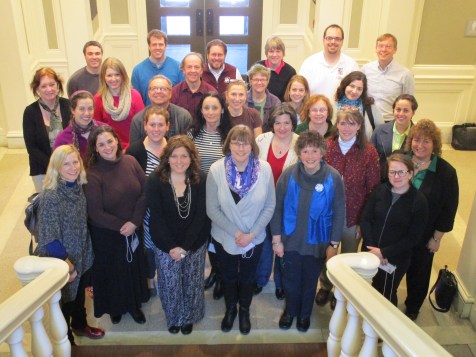
MALI winter retreat, March 2016, Bowdoin College

Join us for a GREAT opportunity! The Maine Arts Leadership Initiative invites YOU to be part of Phase VI. We are looking for teachers interested in leading and in taking a close look at assessment in the arts. If you are selected, you will be required to attend the summer institute, August 10, 11, and 12, 2016. We will provide professional development and ask that you take what you’ve learned and share it with other educators in your region and beyond.

IMG_1813If interested, please send a completed application by the Friday, May 6, 2016, 11:59PM deadline to Argy Nestor at argy.nestor@maine.gov ASAP. Details are below. TEACHER LEADER APPLICATIONS ARE AVAILABLE AT http://mainearts.maine.gov/Pages/Education/MAAI#

Selected teacher leader responsibilities for the 2016-17 school year include:

  • Communicate by wiki
  • Attend the three-day Summer Institute, August 10-12, 2016, USM, Portland
  • Present workshop to critical friends, all-day, date and location to be determined
  • Present a workshop in your region, planned by you
  • Present a workshop at the mega-regional workshop site that will be coordinated by the MALI leadership team
  • Attend a retreat to reflect on the work of phase VI with teacher leaders and the leadership team to be held winter/spring 2017

Maine Arts Leadership Initiative Background Information

OVERALL DESCRIPTION

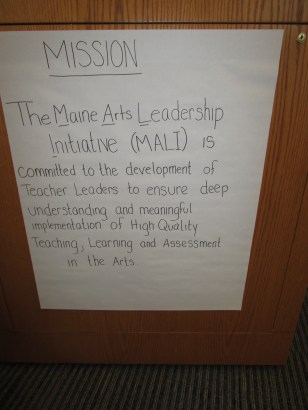
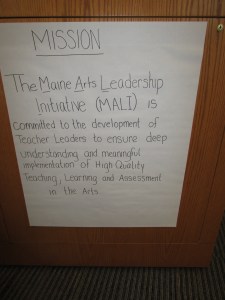
IMG_1814Committed to the development of Teacher Leaders to ensure deep understanding and meaningful implementation of high quality teaching, learning and assessment in the Arts for all students.

Since 2011 the initiative has been building capacity by training arts educators on the “what” and “how” of arts assessment so they can provide the leadership in Maine through professional development opportunities. The details of the initiative are at http://mainearts.maine.gov/Pages/Education/MAAI#.

MALI’s OVERALL OBJECTIVES

IMG_1808Create and implement a statewide plan for teacher leadership in arts education. This includes professional development opportunities, regionally and statewide, which will expand on the knowledge and skills of teachers to better prepare them to teach in a proficiency-based learning environment.

  • Develop and implement standards-based high quality teaching and learning statewide for Visual and Performing Arts
  • Continue to build an expanding team of arts educators and teaching artists representing all regions of Maine
  • Provide workshops and other professional development opportunities for educators

HISTORY – Phase I, II, III, IV, V – Summer 2011 to present

  • IMG_1818Seventy – three teacher leaders attended summer institutes on assessment,
    leadership, technology, creativity, proficiency-based standards-based and student-centered teaching and learning
  • Teacher leaders presented workshops at two statewide arts education conference, USM, Portland, UMaine, Orono, and Point Lookout Conference Center with over 600 educators attending
  • Teacher leaders facilitated regional workshops across Maine
  • Teacher leaders facilitated workshops at 12 mega-regional sites across Maine
  • Another Arts Teacher’s Story series (72) on the Maine Arts Ed blog
  • Arts assessment graduate courses offered by New England Institute for
    Teacher Education
  • Nine arts education assessment webinars for Maine educators facilitated by Rob Westerberg and Catherine Ring – archived
  • Video stories of seven teacher leaders that demonstrate a standards-based arts education classroom
  • Teacher Leader Resource Team ongoing development of items for resource bank
  • Maine Arts Assessment Resources website that contains a plethora of information

Phase VI components

  • IMG_1811August 3,4,5, 2015: Summer Institute, Portland
  • Regional and mega-regional workshops throughout Maine
  • Continuation of Another Teachers Stories on the Maine Arts Ed blog
  • Continuation of the Resource Bank
  • Professional development for teaching artists

For More Information

The Initiative is a partnership with MAC, MDOE, USM, MAEA, MMEA, MLTI, University of Maine Performing Arts, and New England Institute for Teacher Education

h1

Another Arts Teacher’s Story: Iva Damon

April 13, 2016

Teacher Leader series

MALI_V1_Color_100ppi

This is the sixth blog post of the Maine Arts Leadership Initiative (MALI) Phase 5  Teacher Leader stories. This series contains a set of questions so you can learn a little bit about the work they are doing as Maine arts educators. CLICK HERE for more information on MALI. CLICK HERE for more information on the 73 of the MALI Teacher Leaders. CLICK HERE for Arts education resources. Search in the “search archives” box on the bottom right side of this post for past stories. There have been 65 posted to date.

Iva Damon, 2Iva Damon is the 9-12 high school level in visual arts at Leavitt Area High School. She teaches art 1, art 2, natural arts, painting, and two dual enrollment classes through UMFK. This is her fifth year teaching at Leavitt and seventh year teaching in general. In my six classes, Iva has just under 100 students total. She is also the co-advisor to the Class of 2019.

What do you like best about being an arts educator?

It’s a unique experience to see students challenge themselves to be creative and try new things. The best part is having the opportunity to see how students grow throughout their high school experience.

What do you believe are three keys to ANY successful visual and performing arts education?

A sense of humor, patience, and continuing to be an active artist in one’s own discipline. We all are working with kids and a sense of humor and patience go a long way in making connections with students in a meaningful human way. Far too often there are so many items as teachers we are juggling to keep up with. We are all busy, but I personally need to take the time and just create art. It keeps my passion for what I am teaching alive when I can share what I do and why I find it important with my own students.

How have you found assessment to be helpful to you in your classroom?

Assessments in my classroom are essential to understanding how well my students are learning. Formative assessments are the best way to check for understanding and influence how long and and in-depth lessons need to be within a unit. Personally, formative assessments should guide instruction to fit the needs of the students.

What have been the benefits in becoming involved in the arts assessment initiative?

The Arts Assessment Initiative validates that there are other art teachers throughout the state who have a similar passion to become connected, advocate for our profession, and want to become better educators. It has given me the opportunity to work with individuals outside my district to share with and learn from.

What are you most proud of in your career?

The relationships I have been able to develop both professionally with peers and students. It’s an amazing thing to have shiny new faces in introductory classes, and continue to have those students come back for one to three more years because in some way I was able to capture and inspire their interest in the arts. Having students become passionate about a subject that I love so much is such a powerful experience.

What gets in the way of being a better teacher or doing a better job as a teacher?

All of the other things that occur that take us away from teaching or working with kids. There are so many tasks, duties, and assignments that are given to teachers, and I feel like the quantity increases every year. There is a need to reflect on one’s practice within the classroom and how well students are receptive to information, updating and changing curriculum, but there are so many other items that have found their way into my normal day.

What have you accomplished through hard work and determination that might otherwise appear at first glance to be due to “luck” or circumstances?

Every year Leavitt holds their Art’s Gala celebration in March. It is the annual art show that occurs Thursday night after a week of having 5-8 visiting artists come into the building to work with all the arts teachers as well as other content area teachers. The entire first floor of Leavitt becomes transformed with displays and installations that students are responsible for creating. It may appear that everything runs smoothly but a great deal of hard work and determination goes into the event. Though not alone in this endeavor, teaching students how to mat, create artist statements, tags, and create their own installation is exhausting but the final product of walking through the halls on the night of Arts Gala continues to be an amazing and proud experience.

Look into your crystal ball: what advice would you give to teachers?

Have fun in what you do. Students are so receptive to whether their teachers are passionate about what they teach. It is important that the passion we have for the arts comes through on a normal basis. When they see how passionate and excited we as teachers are for the arts, that enthusiasm will spill over to them too.

If you were given a $500,000.00 to do with whatever you please, what would it be?

If I were to be given $5000,000 I would probably spend half of it to pay off all of my existing debt and take time to travel with my family. The remaining amount of money, I would really like to see set in a trust to be given out to students so they can have opportunities for art experiences outside a school classroom like camps, college classes, or intense studies.

Imagine you are 94 years old. You’re looking back. Do you have any regrets?

By 94, I hope that I have few regrets. Like many things, time is my issue. I hope to travel more but I know that I need to take the time to do so. I want to see more masters work in person and be able to see more of the world, and to do so I need to travel. It is something I love to do, and I need to make the time for it to happen.

IMG_0087

h1

Another Arts Teacher’s Story: Dianne Fenlason

April 5, 2016

MALI Teacher Leader series

MALI_V1_Color_100ppi

This is the fifth blog post of the Maine Arts Leadership Initiative (MALI) Phase 5  Teacher Leader stories. This series contains a set of questions so you can learn a little bit about the work they are doing as Maine arts educators. CLICK HERE for more information on MALI. CLICK HERE for more information on the 73 of the MALI Teacher Leaders. CLICK HERE for Arts education resources. Search in the “search archives” box on the bottom right side of this post for past stories. There have been 64 posted to date.

20160324_142730Dianne Fenlason currently teaches middle school bands, grades 6-8, at Spruce Mountain Middle School. In addition, she teaches the following at Spruce Mountain High School: piano, guitar classes, contemporary vocal ensemble, a rock history perspective and performance class called Rock of Ages. She has taught a variety of other music electives over her 28 year career. Dianne has been at Spruce Mountain, formerly Jay Public Schools, since 1995.

What do you like best about being a music educator?

The best part of my job is working with my students and seeing them progress through the years that I work with them. I used to work with grades 4-12 students and to see the transformation of these students is awesome.

What do you believe are three keys to ANY successful visual and performing arts education?

For me the keys to a successful arts education include providing an opportunity to any student, creating a challenge for all students and establishing a rapport with each student. I also believe working with students beyond the classroom can greatly impact the success of your program within your school. Seeing students in another setting outside my class and them seeing me as well has benefits to building respect for one another and in a word, is fun.

How have you found assessment to be helpful to you in your classroom?

I have always felt assessment has been crucial for student progress and I had been doing instrumental performance assessment since I began in 1988. At first I used assessment simply to have an opportunity to hear high school students individually and try to provide them with feedback. Today I use assessment similarly but also incorporate a specific scaffolding of expected skill outcomes as well as a tool for students to self assess and track their own progress.

What have been the benefits in becoming involved in the arts assessment initiative?

My involvement with the arts assessment initiative has provided validation that what I had been doing was on point and it has made me focus my instruction on the specific outcomes I feel are important for all students.

What are you most proud of in your career?

The proudest moments in my career all revolve around student success. I once had a senior trumpet player perform the National Anthem standing on the pitcher’s mound at a state baseball playoff game. Whether taking students to adjudicated festivals, or instituting new and different ensembles or performing music that students may perceive as unattainable and having them realize group and individual success, is something that keeps me teaching year after year. Also seeing students pursue or participate in music beyond high school provides an undeniable sense of pride knowing that what you do and have done has made a lasting impact on their lives.

IMG_0173What gets in the way of being a better teacher or doing a better job as a teacher?

All professions have hurdles but I have never felt I couldn’t improve or do a better job. There is always someone who does it better and if I can learn from them and it helps my instruction with students than I am willing to do that. The educational field has undoubtedly become more difficult since I began and it has meant doing things differently and working harder to maintain the same expectations I have always had. Social and economic changes as well have greatly impacted students lives but I will always stand by the adage that students will meet whatever bar you set, so why not keep the bar high.

What have you accomplished through hard work and determination that might otherwise appear at first glance to be due to “luck” or circumstances?

I would have to say that my “luck” is that I continue to enjoy what I do. There is a quote that describes what we do that says something like “art is hard work masked by fun.” As visual and performing arts educators we not only teach students but also administrators and communities that the arts are not a frill but a necessity. This agenda never happens by luck but only from hard work, commitment and a belief that arts truly enrich our lives. I have told myself that when what I do is no longer fun, then I am done.

Look into your crystal ball: what advice would you give to teachers?

If I were to give advice to any teacher I would say make sure you love what you do and be willing to sacrifice for others while maintaining a balance for yourself at the same time. Teaching can often times commandeer much of our energy but it is important that we find a sense of accomplishment in what we do and find ways that refill our tank when we feel we have given everything we have.

If you were given a $500,000.00 to do with whatever you please, what would it be?

If I were given $500, 000 I would build a performance venue and become the house manager. There are not nearly enough large theaters or concert halls in the state of Maine. Augusta, our state capital, does not have a performance hall to draw people to the area. I would try to use the hall to provide performances for local schools and community groups to attend shows as well as perform in the local facility. If we can encourage performance attendance early in young people than I believe they will be patrons of the arts later in their lives.

Imagine you are 94 years old. You’re looking back. Do you have any regrets?

At age 10 I knew I was going to be a music teacher. I never wavered in that decision, so if I live to be 94, I will look back with no regrets. I don’t believe in “if only.” I was once asked why I continued to teach at my school and I replied by saying, “it is where I am supposed to be for now.” I am blessed to have worked with many wonderful students and excellent educators and colleagues over my career. In the end, I will have given all that I was capable of and if I made a positive impact on one student or colleague than my time was not wasted. I feel confident that I have made an impact on some and to me that is most rewarding.

IMG_0087

h1

Another Arts Teacher’s Story: Virgil Bozeman

March 21, 2016

MALI Teacher Leader series

MALI_V1_Color_100ppi

This is the third blog post of the Maine Arts Leadership Initiative (MALI) Phase 5  Teacher Leader stories. This series contains a set of questions so you can learn a little bit about the work they are doing as Maine arts educators. CLICK HERE for more information on MALI. CLICK HERE for more information on the 73 of the MALI Teacher Leaders. CLICK HERE for Arts education resources. Search in the “search archives” box on the bottom right side of this post for past stories. There have been 62 posted to date.

Screen Shot 2016-03-21 at 5.23.50 PMVirgil Bozeman IV has been teaching at Richmond Middle/High School for 17 years. He teaches 150 students in grades 6-12 Choral and Classroom Music, the total population grades 6-12 is 270. Virgil has four choruses, grades 6, 7/8, and two high school. In addition he teaches grade 6 and 8 General Music and AP Music Theory.

What do you like best about being an arts educator?

I believe that music educators are in the enviable position of being able to leverage naturally intense student interest to promote critical thinking, demand strong work ethic and introduce students to the incredible depth and breadth of our tradition. It is easier to get students to sing Rachmaninoff than to read Tolstoy.

What do you believe are three keys to ANY successful visual and performing arts education?

  1. Quality repertoire
  2. Individualized assessment
  3. Quality repertoire

I know this is pithy, but I firmly believe that great music is the best teacher my students will have.

How have you found assessment to be helpful to you in your classroom?

Simply put, the better I have become at assessing individual student growth, the more my individual students have grown. I used to think that changing the way I assessed would necessitate a drastic change in my teaching methods. Nothing could be further from the truth.

What have been the benefits in becoming involved in the arts assessment initiative?

Across the state our music/art/dance/drama colleagues are doing innovative work in the area of student assessment. Many are already involved in MALI, as are a ever-growing number of teaching-artists. It is a tremendously fertile collaborative environment. I can always count on the fact that solutions are already being developed and tested for assessment challenges that I am experiencing in my classroom and ensembles.

What are you most proud of in your career?

I am most proud when graduates from Richmond High School continue be active music makers in college and beyond.

What gets in the way of being a better teacher or doing a better job as a teacher?
IMG_1911

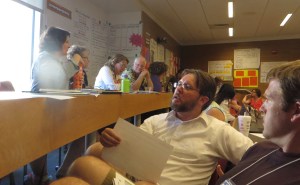
Virgil, center, in deep discussion with colleagues at the MALI summer institute, August 2015.

I am lucky to teach in a supportive small school with a terrific student/teacher ratio that allows me to focus more easily on the individual needs of students. That being said, our small size can sometimes be a barrier, both in limiting the repertoire I can introduce to our students, and working within a schedule that can prevent interested high-school students from being able to enroll in music classes/ensembles throughout their careers.

What have you accomplished through hard work and determination that might otherwise appear at first glance to be due to “luck” or circumstances?

Creating the culture and expectation that our students will have to approach music from styles/cultures/languages that lie far outside their immediate experiences and interests. I used to think it was just “something in the water” in Richmond, but now recognize how important it was to remain true to this vision, even when students occasionally exhibited frustration at not being able to sing enough of “their music”.

Look into your crystal ball: what advice would you give to teachers?

When I first arrived in Richmond, the school had just cycled through four teachers in a five year span. That turnover had sapped the continuity and morale of the music program. Don’t think that the grass is necessarily greener somewhere else. Most arts educators encounter barriers where they work, be they schedule, budgetary, cultural, or facilities-based. If it feels as though there are too many barriers to building and maintaining a quality program at your school, it just means that there is important work that needs doing, and nobody is better suited to this work than you.

Also, keep searching for opportunities to improve your musical chops. We need to model life-long learning to our students, and they need to see us doing it.

If you were given a $500,000.00 to do with whatever you please, what would it be?

Make a lead gift for the construction of a suitable performance space at my school, sock away living expenses to take a sabbatical to finally pursue a DMA in choral conducting.

Imagine you are 94 years old. You’re looking back. Do you have any regrets?

Aside from not knowing how they kept my corpse animated for 20+ years, I will regret knowing that there were students who could have learned so much about themselves through learning how to use their voices, and either they never walked through my classroom door, or I failed to reach them when they did. IMG_0087
h1

Resource Conversation

March 21, 2016

R.S.V.P ME

Screen Shot 2016-03-20 at 2.26.22 PMTomorrow, Tuesday, March 22, R.S.V.P. ME has scheduled a virtual meeting. Maine Arts Leadership Initiative (MALI) Teacher Leader and Facilitator Lisa Ingraham will explore your favorite online resources. Recently she attended the MALI Winter Retreat at Bowdoin College. During the day she realized that many of the resources arts teachers are clamoring for are already available on the Maine Arts Assessment Resource website. She will share a tour of this site during the Tuesday Zoom online conference for R.S.V.P. ME. There is time also for you to share your favorite sites (but not required).

You’re invited, 3:30 to 5:00! To participate in this Zoom Online Video Conference email Lisa at lisa.ingraham@msad59.org. R.S.V.P. is a program of the Maine Art Education Association.

Is there something that you are passionate or knowledgeable about? Consider sharing your expertise with other Maine Art educators during future meetings. Please contact Lisa anytime with questions, comments, or to suggest a future topic. Future R.S.V.P. ME Dates and Tentative Topics:

  • April 12th – Teaching Artists
  • May 10th – Proficiency-Based Education
h1

Another Arts Teacher’s Story: Samantha Armstrong

March 15, 2016

MALI Teacher Leaders series

MALI_V1_Color_100ppi

This is the second blog post of the Maine Arts Leadership Initiative (MALI) Phase 5  Teacher Leader stories. This series contains a set of questions so you can learn a little bit about the work they are doing as Maine arts educators. CLICK HERE for more information on MALI. CLICK HERE for more information on the 73 of the MALI Teacher Leaders. CLICK HERE for Arts education resources. Search in the “search archives” box on the bottom right side of this post for past stories. There have been 61 posted to date.

Screen Shot 2016-03-13 at 11.02.05 AM

Samantha Armstrong teaches K-6 visual arts at Paris Elementary and the Hebron Station School. This is her ninth year teaching and second year in the Oxford Hills School District. She currently teaches a little over 500 students each week. Her students have art class once a week for 40 minutes and I teach either 5 or 6 classes a day. Samantha is a team member from the Oxford Hills School District that are creating integration ideas as part of the Maine Arts Education Resource Project – Integration formed by the Maine Department of Education under the direction of VPA Specialist Beth Lambert.

What do you like best about being an arts educator?

One of the things I like about teaching art is getting to see how unique each student is and how they all approach projects differently. I enjoy teaching students new concepts and techniques, exposing them to new artists, making connections between the arts, other subject areas and the world around them. It’s exciting when students can reflect and make connections between what they are learning in my classroom and the world around them.

What do you believe are three keys to ANY successful visual and performing arts education?

  • Teachers that are passionate and excited about what they are teaching.
  • School districts that support the arts and arts education.
  • Community outreach, getting student performances and artwork out into the community and getting local artists into the schools.

How have you found assessment to be helpful to you in your classroom?

I find assessment to be very helpful in my classroom. When students finish an assignment they each complete a reflection paper. This helps them bring together what they have learned in the lesson and how the concepts and techniques work in connection with each other. Assessment also helps  guide my teaching, the effectiveness of the lesson and my approach to teaching. Currently I have developed a checklist for students, a type of formative assessment, so that they can monitor their learning and progress and help them meet their goals.

What have been the benefits in becoming involved in the arts assessment initiative?

I have met many wonderful arts educators from all over the state of Maine and many others dedicated to the ongoing success of arts education. Through collaboration I have learned a great deal of information that has helped me in the classroom. I have become more involved in advocating for arts education and am currently working as a Teacher Leader Ambassador on the census and the arts integration resource project.

What are you most proud of in your career?

I am most proud of my students and all their progress and learning that happens throughout the year. Seeing my students being successful and enjoying their learning is the best!

What gets in the way of being a better teacher or doing a better job as a teacher?

Time and not having enough of it. I am fortunate to work in two great schools with very supportive administrators and teachers. Many teachers are interested and open to collaborating but with schedules and time constraints it is often difficult to have planning time. Planning is often a quick conversation in the hall or an email, which  works, but obviously with more planning time it could be even better.

What have you accomplished through hard work and determination that might otherwise appear at first glance to be due to “luck” or circumstances?

I feel very lucky to be an art teacher in the community in which I live. It definitely took a lot of time and patience to finally be fortunate enough to be hired as an art teacher in my community. As everyone in the field knows art teaching positions are often few and far between. I have a Bachelor of Fine Arts degree so I did not have an education background. I had several years of catching up on classes while working. My path was winding as I first taught Special Education, then moved to a small independent school as a classroom teacher.  At the same time I taught a metalsmithing class at Lesley University and at summer arts program for kids. My teaching experience has been all over the place but I have enjoyed all of it and have learned so much from it.

Look into your crystal ball: what advice would you give to teachers?

My advice would be to be patient. Unfortunately I see many new teachers overwhelmed by behaviors. It is something that an education in teaching really can’t prepare you for. We all come to school everyday from a different place and for some the act of simply getting to school takes a lot of effort. Acknowledging the diversity in our schools and the struggles many students face academically, socially and physically is essential to creating helpful working relationships with our students. Being aware of students needs, being patient, and working with them to meet their goals is essential in helping students be successful.

If you were given a $500,000.00 to do with whatever you please, what would it be?

Add more art programs and help provide teachers with more opportunities for collaboration. I would love to see more drama and dance programs at the elementary level and more access to affordable instruments for all students. The time I have had to work with other teachers this year through MALI has been great and I have learned so much. It would be great if there was more funding for this and other programs that bring teachers together. 

Imagine you are 94 years old. You’re looking back. Do you have any regrets?

That is hard to imagine! Hopefully I still have my wonderful, crazy family around me, that I am still making art and enjoying lots of good food and wine. I’m sure I’ll have some regrets but for the most parts I love my life and how I’ve gotten where I am now. I have a simple life but that is perfect for me. I live in a great town, I have a loving family, wonderful friends, a warm home, good food to eat and I enjoy getting up everyday and going to work doing what I love with great teachers and students.

IMG_0087

h1

Another Arts Teacher’s Story: Josh Bosse

March 8, 2016

MALI Teacher Leader series

MALI_V1_Color_100ppiThis is the first blog post of the Maine Arts Leadership Initiative (MALI) Phase 5  Teacher Leader stories. This series contains a set of questions so you can learn a little bit about the work they are doing as Maine arts educators. CLICK HERE for more information on MALI. CLICK HERE for more information on the 73 of the MALI Teacher Leaders. CLICK HERE for Arts education resources. Search in the “search archives” box on the bottom right side of this post for past stories. There have been 60 posted to date.

Screen Shot 2016-03-08 at 5.41.55 AMJoshua Bosse currently teaches music, grades K-12 at the Madawaska School Department (MSD). He graduated from the University of Maine, Orono in 2011, and has been teaching at MSD since. Josh teaches almost 500 students throughout the week and am responsible in teaching them general music (EC-8), band (elementary, middle & high school), marching and pep band (7-12), guitar ensemble, and chorus (elementary). His true passion, however, lies with the high school band, because to hear the students express their feelings through music is truly amazing! “I get so excited when we learn a new piece, then as we work on it, I can see the growth and beauty coming from the students, and to have a concert at the end of the semester to show the audience how much we have grown and developed as musicians; it’s what I live for!

What do you believe are three keys to ANY successful visual and performing arts educator?

1) Passion, 2) Communication, and 3) Drive. The reason that you need passion is because if you are not passionate about what you teach, how can you instill passion into the heart and souls of these students who you are molding to become well rounded adults. Communication with other arts educators has been a saving grace for me this year! Getting different ideas, getting help with understanding of certain topics, and much more has helped me so much this year. Drive is also a must, because there are those days where it seems that everything you do is either not heard or respected, and some days you are completely stressed out! Most, if not all, of us have had those days, but what gets us through it is our passion for the arts and communication with other arts teachers in order to “vent” out frustrations and get different ideas to use for our classrooms. Having both passion and communication, definitely drives me to be a better educator.

How have you found assessment to be helpful to you in your classroom?

Since joining MALI, I have been able to come up with my standards which I have also been able to implement in my high school band class. Since I have started using my standards, I have been more focused on the growth aspect of each student rather than the “final product.” I have also been having students keep track of their learning, and I know that they are seeing a growth in their musicality, which in turn helps for a better “end product.”

What have been the benefits in becoming involved in the arts assessment initiative?

I have become a bigger advocate for the arts, by leading workshops, connecting with other arts teachers, and much more.

What gets in the way of being a better teacher or doing a better job as a teacher?

The biggest thing that gets in my way of teaching is having all the laws/rules and all the paperwork that we have to fill out in order to make sure that we are “effective” teachers. I feel as though there is so much happening outside the classroom, that it actually effects the inside of our classroom. I also feel that time is a huge factor in becoming a better teacher. Sometimes there is just not enough time to get to the things that you want to, which may change the outcome of a certain product.

What are you most proud of in your career?

The thing that I am most proud of and worked hard at in my career would have to be being part of MALI. The reason that I say this is because I have become a better music educator and a better advocate for the arts. Looking at myself in regards to these two things, I am seeing growth in myself and in my students. They are actually learning the material that I am presenting to them, and in turn, it makes me feel more accomplished as an educator, because I know that they are receiving a wonderful music education.

Look into your crystal: What advice would you give to teachers?

The best advice that I can give to other teachers would be to COMMUNICATE!!! You don’t know how many times I have had to talk to other teachers and/or professionals who actually “get” what I am going through. The good, the bad and the ugly are great things to share with fellow colleagues. I don’t know where I would be without the communication aspect of my job!

If you were given a $500,000.00 to do with whatever you please, what would it be?

If I was given $500,000, the first thing I would do is pay off mine and my wife’s student loans and other bills. They have been such a hassle to deal with since starting my “real life” in the “real world.” My life would be much simpler without them, and that way, I can actually save up and do the things that I want. With a quarter of the money gone, I would definitely donate to my church, purchase some new(er) instruments and fix some of our other instruments for my school, take a nice vacation to Europe with my lovely wife, and actually start a family without financial worries. Whatever I have left, I would save up and continue working to the point of retirement.

Imagine you are 94 years old. You’re looking back. Do you have any regrets?

I do what I love on a daily basis, and not everyone can say that. Looking over my short (but sweet) career, there is nothing that I regret doing. I look forward to being able to continue instilling my love of music into the children that I teach; there is nothing to regret about that!

IMG_0087


h1

MALI

March 6, 2016

Sooooo proud!

IMG_1836

MALI at Bowdoin for Winter Retreat

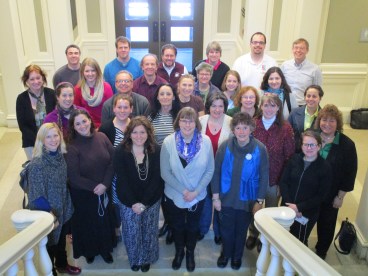
I am continually amazed and proud of the commitment and passion of Maine’s visual and performing Arts educators. Yesterday I had the opportunity to spend all day at Bowdoin College with the Maine Arts Leadership Initiative’s (MALI) for the Phase 5 winter retreat. Twenty five MALI members were able to join us. Thank you to the Bowdoin College Art Museum for hosting. The beauty of the room and the delicious food added to the energy, thoughtfulness, and incredible knowledge of the MALI Teacher Leaders.

IMG_1799

Teaching Artist and Teacher Leader John Morris

The topics of the day included overarching questions that are helping us to formulate the details of MALI’s Phase 6. The ideas are created based on the needs of teachers to meet the needs of Maine’s PK-12 students in the Arts. Who better to know about the needs of Arts education than Maine Arts educators?!

MALI’s Mission

MALI is committed to the development of Teacher Leaders to ensure deep understanding and meaningful implementation of high quality teaching, learning and assessment in the Arts for all students.

Teaching Artist/Teacher Leader – John Morris

During phase 5 John put together Creativity resources for the Resource Bank located at http://www.maineartsedresources.org/. The description of the Creativity resource: This discussion group model will help participants make connections with creativity research, while promoting inquiry and dialogue about the nature of creativity, as well as the role of creativity in K-12 teaching, learning and assessment. John facilitated the use of the model yesterday and the conversation was one that I wish every educator in the state could engage in. Contact John if you have questions about the resource at JohnMorris08@gmail.com.

IMG_1805MALI and Teaching Artists

We spent some time yesterday considering the role of the Teaching Artist and brainstormed ideas on possibilities for Phase 6. The Maine Arts Commission is committed to continue to develop opportunities. The Teaching Artist roster located at https://mainearts.maine.gov/Pages/Education/Teaching-Artist-Roster will continue to grow and be available for those interested in contracting with a Teaching Artist to provide learning opportunities for students.

MALI focus

IMG_1824

Deep in thought, Rob Westerberg, Mari-Jo Hedman, Jake Sturtevant

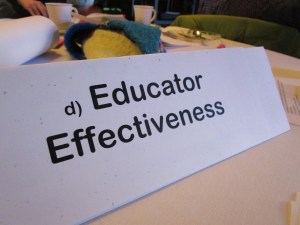
The bulk of our day was spent on looking at and discussing the MALI topics that have become essential components of our work. Using the MALI Logic Model we asked two questions: 1) What is the role of the Teacher Leader working with the MALI mission? and 2) What activity or output could be created or included to implement the essential topics? The topics include: Arts Integration, Creativity and 21st Century Skills, Proficiency-Based Learning and Reporting, Educator Effectiveness, Advocacy, Assessment Literacy, Effective Teaching and Learning/Best Practices, Funding, Legislative Policy, and Guiding Principles.

It was a great day and I am so grateful to know and be part of a group that is so positive about the work they do educating PK-12 student in Arts education. It is a pleasure to LISTEN to what each Teacher Leader is doing and has to offer! If you are considering applying to be a Teacher Leader for Phase 6 please watch for the “call” and email me at argy.nestor@maine.gov.

IMG_1833

Gorham School district Art teachers Elise Bothel and Allie Rimkunas

IMG_1842

Beth Lambert, DOE VPA specialist and St. Agatha art educator Theresa Cerceo

IMG_1846

Dance teacher MaryEllen Schaper and Music teacher Jen Nash

h1

In Today’s News

March 5, 2016

Americans for the Arts – Economic Impact Study

PrintThe Maine Arts Commission announced today that for the first time in the agency’s history it is facilitating statewide participation in Americans for the Arts’ national study Arts & Economic Prosperity® 5 (AEP5). AEP5 is the largest national study measuring the economic impact of spending by nonprofit arts and culture organizations and their audiences ever conducted. Surveys will be collected throughout calendar year 2016; results will be released in June of 2017. AEP5 is the fifth national study over the past 20 years to measure the impact of arts spending on local jobs, income paid to local residents, and revenue generated to local and state governments. More than 300 U.S. communities, including five study regions plus independent venues throughout Maine, will be part of this newest study.
Regions participating as study partners in Maine are Bangor, Belfast, Portland, Waterville, and the Western Mountain Regions. Only Portland has participated previously. In addition, the Arts Commission is reaching out to organizations in communities ranging from Ogunquit to Eastport and Lewiston to Presque Isle.
“The economic impact of the cultural sector in Maine is larger and more important than most people realize,” said Julie Richard, Executive Director of the Maine Arts Commission. “By collecting this data and making it available to communities and regions we are better able to demonstrate this impact, helping policy makers at all levels make better informed decisions throughout Maine.”

The study’s participating communities represent all 50 states plus the District of Columbia. For Maine’s five study regions, a partner organization representing each community will collect detailed financial information from its local nonprofit arts and culture organizations such as local theater and dance companies, museums and galleries, and arts education organizations. Study partners will also collect audience-intercept surveys from attendees at arts events using a short, anonymous questionnaire that asks how much they spent on items such as meals, parking and transportation, souvenirs and retail shopping, and overnight lodging as a direct result of attending the event. Outside of the five Maine study regions, the Arts Commission will work directly with independent organizations. Additional analyses will gauge the important role that the nonprofit arts industry plays in attracting tourists to communities.

Screen Shot 2016-03-03 at 9.27.46 AM“Our Arts & Economic Prosperity series demonstrates that the arts are an economic and employment powerhouse both locally and across the nation,” said Robert L. Lynch, president and CEO of Americans for the Arts. Americans for the Arts is the nation’s leading nonprofit organization for advancing the arts and arts education. “Leaders who care about community and economic vitality can feel good about choosing to invest in the arts. Nationally as well as locally, the arts mean business.”

According to AEP4, based on FY2010 data, the nonprofit arts industry generated $135.2 billion in economic activity and supported 4.1 million full-time equivalent jobs during 2010, resulting in $22.3 billion in federal, state, and local government revenues. The $135.2 billion total included $61.1 billion in spending by arts and culture organizations and an additional $74.1 billion in event-related spending by their audiences. A statistic that captured the attention of business and government leaders was that the typical attendee to a nonprofit arts event spends $24.60 per person, per event, beyond the cost of admission on meals, transportation, babysitting, and other event-related spending. Additionally, 32 percent of all arts attendees live outside of the county in which the arts event took place—a finding based on a survey sample of 152,000 arts attendees.

Americans for the Arts’ Arts & Economic Prosperity 5 study is supported by The Ruth Lilly Fund of Americans for the Arts. In addition, Americans for the Arts’ local and statewide study partners are contributing both time and a cost-sharing fee to support to the study. Financial information from organizations will be collected in partnership with DataArts™, formerly The Cultural Data Project, using a new online survey interface. For a full list of the communities participating in the Arts & Economic Prosperity 5 study, visit www.AmericansForTheArts.org/AEP5Partners.

For Maine arts organizations who have not yet been contacted by a study partner or the Arts Commission, please contact Linda Nelson, Assistant Director, at linda.l.nelson@maine.gov.

Americans for the Arts is the leading nonprofit organization for advancing the arts and arts education in America. With offices in Washington, D.C. and New York City, it has a record of more than 50 years of service. Americans for the Arts is dedicated to representing and serving local communities and creating opportunities for every American to participate in and appreciate all forms of the arts. Additional information is available at www.AmericansForTheArts.org.

The Maine Arts Commission encourages and stimulates public interest and participation in the cultural heritage and cultural programs of our state; expands the state’s cultural resources; and encourages and assists freedom of artistic expression for the well-being of the arts, to meet the needs and aspirations of persons in all parts of the state. Additional information is available at www.mainearts.com.