Archive for the ‘assessment’ Category

h1

Institute for Arts Integration and STEAM

October 28, 2020

13 Strategies for Making Thinking Visible in the Classroom

For many educators focusing on the process and not the product has been a gradual change. The pandemic has forced this shift rapidly and educators are gracefully embracing it in many cases. This requires a growth mindset and ideas and suggestions from supportive colleagues. Susan Riley’s Institute for Arts Integration and STEAM has put together a comprehensive list of strategies that you can apply (in person and/or remotely) in your classroom environment that will make your students thinking visible.

Why make learning more visible you may wonder? Critical and creative thinking skills are an integral part of teaching and learning, always have been part of arts education. I’m glad that other educators have gotten on board with this in this 21st century. One key for developing and assessing critical and creating thinking skills is to making thinking more visible. If we can see the process students are using to analyze problems, make predictions and draw conclusions, teaching and guiding students thinking becomes easier.

I encourage you to take a look at the ideas Susan Riley suggestions below to support your teaching and students learning.

  1. Use Artful Thinking Routines
  2. Try Close Reading of an Art Composition
  3. Connect with Cooperative Poetry
  4. Explore Ekphrasis Poetry for Vivid Language
  5. Generate One Word Focal Points
  6. Develop Collaborative Narrative
  7. Sketch to Write
  8. Create an Art Recipe
  9. Design Haibun Poems
  10. Perform a Human Slideshow
  11. Build Summarizing Skills
  12. Composing a Soundtrack
  13. Produce Curriculum-Based Reader’s Theatre
h1

Call for MALI Teacher Leaders

May 21, 2020

You’re invited!

Visual, Performing and Literary Arts Teacher/

Teaching Artist Leader SEARCH: MALI – Phase 20-21

APPLICATION DEADLINE: MONDAY, JUNE 1Join us for a GREAT opportunity! The Maine Arts Leadership Initiative invites YOU, with other selected Maine teachers and teaching artists, to be part of a year-long exploration in leading your school communities and the profession in effective teaching and learning in the arts.  If you are selected, you will be expected to attend the 2020 Summer Institute, taking place virtually June 15, July 24, and in-person August 5, pending state policy.   

This year’s Institute will explore Leading with Resilience; Embedding Social and Emotional Learning in our Teaching, Ourselves, and Our Communities; and Arts Advocacy.  

If you are selected, there is no cost to attend the Institute; however the expectation is that you integrate your learnings in your classroom, your school community, and share with other educators in your region of Maine and beyond.  Full participants will receive documentation of up to 35 contact hours.   

If interested, please complete the online application form, linked here and below, by June 1.

Questions? Contact Martha Piscuskas, Director of Arts Education at the Maine Arts Commission, Martha.Piscuskas@maine.gov  207-287-2750

Year-long Expectations for Teaching Artist/Teacher leaders (TA/TAL):

  • Attend New Teacher/TA introduction cohort zoom on Monday June 15
  • Complete pre-reading/viewing and participate in online discussion (on google classroom) 
  • Attend and participate in 2 virtual discussion meetings on Wednesdays – June 24 & July 15 – (w/mixed cohorts and breakout rooms)
  • Attend August 5, Wednesday in-person day in Waterville (tbd) if possible
  • Commit to two reflection sessions as a MALI TA/TAL one with cohort, one with “thought partner”
  • Develop a personalized Growth Plan for the coming year, and practice/learn ways to share it with others
  • Engage in Fall “thought partner” one-on-one check in 
  • Attend winter retreat – tentatively February 28, 2021.  Will include update on personal goal and/or action plan 
  • Author a guest blog post on the Maine Arts Ed daily blog

JOIN US!  Become a Teacher Leader and Change Lives 

APPLY TODAY!

Questions on the Application:

Name/contact information

Administrator Name/contact information (if classroom teacher)

Paragraph of Interest — Selected individuals will be expected to be active leaders in helping to develop and support excellence in teaching and learning in Maine. A full commitment to the Institute timeline is expected as seen in the online information sheet.  Please attach a brief overview of your interest and current/past experience (if any) in Leadership. Include your experience collaborating with other arts educators and experiences relevant to the initiative.  (Please no more than ~ 500 words, about 1 page.) 

Resume/CV —  If you are a Teaching Artist, please also include websites or documentation of your teaching work.  

Letter of Reference – CLASSROOM TEACHERS: This should be from your administrator.  TEACHING ARTISTS: This should be from a school or community  organization with whom you have worked.   Please attach a Letter of Recommendation in which the person includes comments and/or examples reflecting your leadership potential and your ability to work collaboratively.  Selected individuals will be responsible for sharing their newly developed expertise and related classroom experiences with other arts educators.

Maine Arts Leadership Initiative 

Background Information

MALI MISSION

MALI’s OVERALL OBJECTIVES 

  • Create and implement a statewide plan for teacher leadership in arts education. This includes professional development opportunities, locally, regionally and statewide, which will expand on the knowledge and skills of teachers to better prepare them to teach in a student-centered and proficiency-based learning environment.
  • Develop and implement standards-based high quality teaching and learning statewide for Visual and Performing Arts 
  • Continue to build on expanding the team of arts educators and teaching artists representing all regions of Maine
  • Provide workshops and other professional development opportunities for educators 
  • Founded in 2011
  • 108 teacher leaders and teaching artists leaders have attended summer institutes on assessment, leadership, technology, creativity, proficiency-based standards-based and student-centered teaching and learning
  • Teacher leaders have presented workshops at three statewide arts education conferences, with over 600 educators attending
  • Teacher leaders facilitated regional workshops across Maine and 15 mega-regional sites across Maine
  • Maine Arts Ed Blog — 78 teachers profiled in Another Arts Teacher’s Story series 
  • Arts assessment graduate courses offered by New England Institute for
    Teacher Education
  • Nine arts education assessment webinars for Maine educators facilitated by Rob Westerberg and Catherine Ring – archived
  • Video stories of seven teacher leaders that demonstrate a standards-based arts education classroom located on Maine ARTSEducation YouTube channel
  • Teacher Leader Resource Team development of items for resource bank
  • Maine Arts Assessment Resources website
  • Partners have included MDOE, USM, MAEA, MMEA, University of Maine Performing Arts, and New England Institute for Teacher Education, Bates College

For More Information

APPLY TODAY TO BECOME A MALI TEACHER LEADER

h1

Assessment in the COVID-19 Environment

April 24, 2020

Reflecting

I’m sure many of you are at the point of reflecting and questioning what you’re doing in the ‘schooling away from school’ environment that we’ve all been thrown into. Recently during a conversation with a colleague he shared how frustrated he was with how few students were actually engaging and fulfilling the assignments. “When we took away the grading of student work they lost their sense of purpose.” I keep reflecting on the conversation. I wonder about how many high school students do the work (when we’re in the school building) only or primarily for the grade? This wondering has lead me to many questions. For one, didn’t we go to Proficiency Based Education to ensure that students fulfill the learning requirements? So we could actually know that students had learned and more importantly so students could articulate what they were learning? This was the part that shifted education from what teachers teach being the most important part of the equation to what students learn.

I understand why many schools have gone to no grades during the pandemic – I’m not questioning or debating if that is right or wrong. Let’s face it teaching ‘online’ isn’t new and students are held responsible to document and fulfill their school work. I do think that as this continues it is important for teachers at the local level to have the conversation about how to assess student work. Let’s remember that assessment has two purposes – one to determine if students are learning AND for teachers to determine if their teaching is effective.

The critical question is how to assess in our ‘schooling away from school’? Not so the grade can raise the students GPA but to determine if students are learning and teachers are teaching.

Andrew Miller, Director of Personalized Learning at the Singapore American School has authored an article for Edutopia called Formative Assessment in Distance Learning. I’m hoping you’ll find it as informative as I have and perhaps you’ll take something from it that you can put into practice during the rest of this school year or in the future. If nothing else please share it with your colleagues so it can plants seeds for a staff conversation.

h1

MALI Update

February 4, 2020

Good news from the Maine Arts Commission

The Maine Arts Leadership Initiative (MALI) members and Martha Piscuskas the new director of arts education at the Maine Arts Commission have been working since last summer on the valuable work of MALI.

For those veteran readers of this blog, you are probably well aware of MALI and its importance to the field of Maine Arts Education. For any newcomers, and those needing a refresher, MALI is a program of the Maine Arts Commission. MALI is a network of Maine Arts Teacher Leaders and Teaching Artist Leaders dedicated to supporting each others’ leadership, growth as educators, and promotion of authentic arts experiences in all genres for all Maine students. It grew out of the Maine Arts Assessment Initiative, a grassroots effort by some Maine Arts Teachers to educate themselves and create some guidelines and practices for arts assessment. Almost every year since 2011,  MALI has held a summer institute for visual and performing arts teachers to deepen their mastery of teaching the arts. A yearlong cohort continues to work together, working towards specific individual goals and culminating in public presentations.

TWO IMPORTANT DATES TO REMEMBER

  • Winter Retreat – Saturday, Feb 29
  • Summer Institute NOTE NEW MONTH: — Thursday and Friday, June 25 & 26

With a leadership transition, MALI is taking this year to re-evaluate its purpose, clarify its structure and strengthen its role. Two leadership teams are tackling these tasks, and will be seeking feedback from all MALI members.

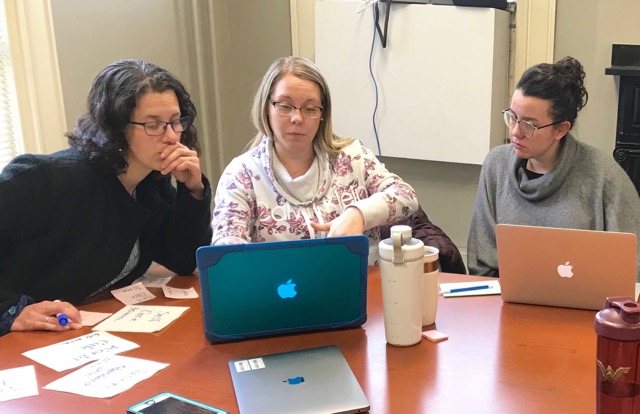
VISION TEAM

Vision Team members Dana Legawiec, Jen Driscoll, Lynda Leonas, Jake Sturtevant, and Sue Barre. Skyping in: Shawna Barnes, Jen Acosta

The Vision Team is a think-tank tasked with establishing a system and structure for MALI to grow and thrive into the future. It is comprised of 7 MALI Teacher Leaders and Teaching Artist Leaders, including Jake Sturtevant (Phase 1), Jen Acosta (Phase 1), Shawna Barnes (Phase 8), Sue Barre (Phase 3), Jennie Driscoll (Phase 1), Dana Legawiec (Phase 7), Lynda Leonas (Phase 5) and Martha Piscuskas (MAC). The team members have had a variety of powerful MALI experiences, and agree that the organization has had a lasting impact on Maine Arts Education.

The Vision Team has reviewed the MALI vision and mission statements, as well as the current structure of MALI. It is their goal to ensure that MALI will continue to foster a community of passionate Arts Educators and Teaching Artists. The community will allow for professional growth that will directly impact students. It is their intent to help maintain, and sustain, the positive aspects of MALI, while strengthening the organizational mission that MALI represents.

In order to focus discussion they have been investigating answers to these questions:

  1. What does it mean to be a MALI Teacher Leader/Teaching Artist Leader?
  2. How can MALI gain fiscal stability?
  3. How can the MALI community bring in more passionate Arts Educators and Teaching Artists?
  4. How can MALI develop an institutional governance structure that allows for flexibility and growth, and maintains a grassroots approach for developing a community of Arts Educators?

They will continue discussions, and would welcome thoughts and ideas from anyone who has been touched by the MALI community. They will develop a future MALI Vision at the Winter Retreat on Saturday, February 29, 2020.

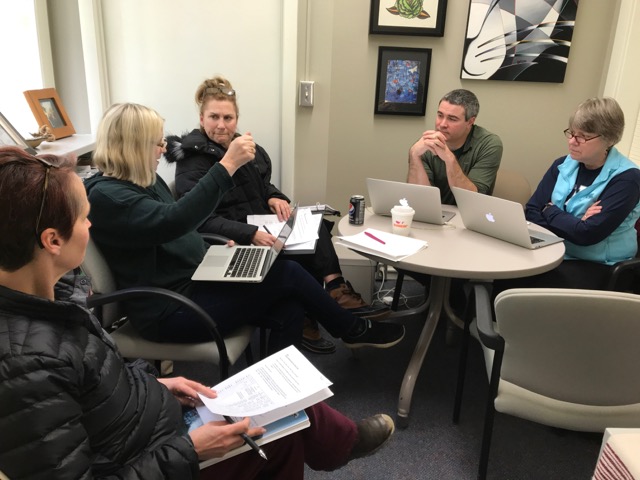
PROGRAM TEAM

Program Team members Kate Smith, Dorie Tripp, and Kaitlin Young deep in thought. Other side of table include Melanie Crowe, Bronwyn Sale, Iva Damon, and Brigid Rankowski

The Program Team was tasked with maintaining MALI’s current offerings such as the Winter Retreat, a call for new members, the Summer Institute and Critical Friends’ Day. The Program Team members are Kate Smith (phase 4), Bronwyn Sale (higher ed rep), Iva Damon (phase 5), Melanie Crowe (Phase 3), Kaitlin Young (phase 7), Dorie Tripp (Phase 7), Emma Campbell (phase 4), Brigid Rankowski (Phase 6)  and Martha Piscuskas (MAC). The team has met several times via zoom conference and in person on January 26th. They have chosen the themes “teacher leadership” and “self-care” for the MALI Winter Retreat on February 29th and look forward to seeing all MALI members past and present.

MALI Teams thank all Maine arts educators for all you do and continue to do, and look forward to hearing from you. To share feedback or for more information, or to MALI folks for sign-up information, please connect with a Team member, or Martha Piscuskas, Director of Arts Education at the Maine Arts Commission: martha.piscuskas@maine.gov 207-287-2750.

h1

Art Dance

January 15, 2020

Lil Buck

This dance was created to celebrate an exhibit in Paris that included several modern artworks. I couldn’t take my eyes off of the moves this dancer, Lil Buck, made while moving through the exhibit.

h1

The Art of Education

December 9, 2019

Photo booth in the classroom

Informative blog post put out by The Art of Education. Seven Reasons You Need a Photo Booth in the Art Room. A Lightbox is one and a studio photo setup is another. The ARTICLE expands on these two topics providing you with useful information.

The Art of Ed University provides resources in a variety of ways. Check out the WEBSITE to learn more.

h1

What Does Standards Based Education Look Like?

November 11, 2019

Frequently asked question

Jen Etter

I am often asked: What does standards based education or proficiency based education look like in the visual or performing arts classroom? A handful of years ago the Maine Arts Leadership Initiative (MALI) took on that question and answered it by creating a series of videos of arts teachers in their classrooms teaching. Over a two year period Debi Lynn Baker and I visited these schools to gather footage that Debi than created into short videos to provide resources

Brian McPherson

Brian McPherson

for the field.

I am grateful to the following MALI leaders who let us in to their classrooms and school world and shared the work they were doing everyday. Lisa Ingraham, Brian McPherson, Andrea Wollstadt, Jane Snider, Jen Etter, Charlie Johnson, and Rob Westerberg. I hope you’ll find them inspirational and thought provoking. All videos are located on the Maine Arts Assessment website.

Andrea Wollstadt

Even though practices change these life-long learners will provide you something to use for food for thought and perhaps inspire you to consider the teaching and learning practices in your classrooms.

Elementary School Visual Art – Lisa Ingraham, Madison Elementary School

Elementary School Visual Art – Brian McPherson, Woodside Elementary School, Topsham

Jane Snider

Jane Snider

Elementary School Music – Andrea Wollstadt, John F. Kennedy Memorial School, Biddeford

Middle School Visual Art – Jane Snider, Hancock Grammar School

Middle School Music – Jen Etter, York Middle School

Andrea Wollstadt

High School Visual Art – Charlie Johnson, Mount Desert Island High School

High School Music – Rob Westerberg, York High School


Charlie Johnson

Rob Westerberg

h1

National Art Ed Conference

October 30, 2019

Registration open

National Art Education Association conference, March 26-28, 21020, Minneapolis. REGISTRATION IS OPEN!

h1

National Assessment Governing Board

October 6, 2019

Apply to be a member

The National Assessment Governing Board sets policy for the nation’s largest ongoing assessment of what U.S. students know and can do—the National Assessment of Educational Progress (NAEP), also known as The Nation’s Report Card.

Wouldn’t it be great to have an arts educator serving on this board? When non-arts teachers understand assessment in the arts classroom, your perspective and expertise is always appreciated and valued. Other educators and administrators turn to arts teachers more and more to sit at the assessment table and contribute.

The National Assessment Governing Board identifies subjects to be tested, determines the content and achievement levels for each assessment, approves test questions, and pursues innovative ways to make NAEP results more meaningful and relevant to the public. The Board’s work is guided by its Strategic Vision, which includes two broad goals: inform and innovate.

Deadline to Apply: October 18. LEARN MORE!

h1

Maine Music Survey

September 24, 2019

Supporting the work of Maine music educators

Dorie Tripp, Maine Arts Leadership Initiative summer institute, August 2017

A message from Dorie Tripp – music educator and Maine Arts Leadership Initiative Teacher Leader:

I am a PK-5 General Music Teacher for Maranacook Area Schools. A group of elementary Maine music educators, including myself, have been working on a project (initially facilitated by the Maine Arts Leadership Initiative – MALI). We are active Maine music teachers, from several Maine counties, who share a common interest in supporting our colleagues within our profession. Our goal is to collect information from other PK-5 General Music Teachers about what they do and what they need.
I am contacting you because we would love it if your could share our Professional Development Survey with your blog membership. If are a PK-5 General Music Teacher please complete this professional development survey (and share with other others who teach music at this level). In doing so, it will help us learn what our music teachers need/want for professional development and support. We’d greatly appreciate you completing the survey at this link

Elementary Music for ME Survey

And thank you for your time! If you have questions please don’t hesitate to contact Dorie Tripp at dorie_tripp@maranacook.com.
Elementary Music for Maine is a group of general music teachers, who are committed to furthering music education, and supporting our music colleagues. We hope that you will take just a few short minutes to fill out the survey, so we can learn more about what types of professional development you want/need.