Archive for the ‘Communication’ Category

h1

Learning and Teaching about Indigenous Cultures, Languages, and Territories

October 12, 2020

Global Oneness Project Webinar

If you’re not familiar with the Global Oneness Project now is a good time to learn more. Cleary Vaughan-Lee is an amazing person and serves as the Executive Director of the Global Oneness Project. Recently they provided a webinar entitled Learning and Teaching about Indigenous Cultures, Languages, and Territories. The webinar was hosted by Christine McRae from Native Land Digital. This is a timely resource since today is Indigenous People Day in Maine. The webinar was attended by close to 900 people and fortunately the webinar was archived so you can access it and also use the many resources that have been gathered to help support your work as educators.


The recording is available to view on the Global Oneness Project website and the resources are in this Google Doc. I’m looking forward to viewing the recording and taking a close look at the resources that are filled with  quotes, websites, books, articles, films, curricula, and podcasts, all of which provide ways to learn from Indigenous voices around the world.

Christine shared ways to engage with the mapping tool Native Land and communicated that there are complexities when mapping Indigenous territories. She said, “When we think of maps in the modern context, they often represent colonial boundaries or colonial understandings of the world. It’s a balance to communicate Indigenous relationships to land, which are so much deeper than shapes.”  

In addition, at the last minute, Margaret Noodin, Obijwe poet and linguist, joined the webinar and read one of her poems that was included in the slides. It is called “Babejianjisemigad/Gradual Transformation,” which she read in Anishinaabemowin and in English. She said, “I think one of the things I got from my dad and his mother was the ability to listen to the world singing around me and the desire to sing back to it.”

Thanks to Cleary Vaughan-Lee and the Global Oneness Project for their dedication and thoughtfulness about education. Most of the blog post was from a recent email from Cleary.  

h1

I LOVE The Muppets!

October 2, 2020

With a Little Help from My Friends

I’ve always loved The Muppets and for many years I’ve been inspired by Jim Henson. Hard to believe that he’s been gone for 30 years. I am so happy that the Muppets have continued in different ways for so long. And, here they are on the Late Show with James Corden.

Although James Corden, Reggie Watts and The Late Show Band The Muppets couldn’t be together in a studio, the group came together on video chat to sing The Beatles classic “With a Little Help from My Friends.” Sing along with Kermit, Fozzie, Miss Piggy, Swedish Chef, Animal, Gonzo and so many more.

Looking for silver linings? I suggest that you watch this (and sing at the top of your voice) today or tomorrow – at the end of another week during a pandemic. I promise you’ll be moving by the end of it! Afterwards call a friend.

h1

Camden Rockport Middle School

October 1, 2020

Welcome back 8th graders

Camden Rockport Middle School 8th graders were greeted by the 8th grade teachers video called Welcome Back 8th Graders. They’ve started at a new school using cleaning supplies, masks, social distancing, and all that other stuff that is keeping us safe! Just like the rest of us!

Enjoy and be inspired by music educator Allysa Anderson and the CRMS staff and friends.


h1

Open Art Teachers Studio: Quarantine Edition

September 30, 2020

MALI art making sessions

The Maine Arts Leadership Initiative (MALI) is offering a second round of Open Art Teachers Studio: Quarantine Edition, starting October 7.  Yay!  The same MALI teacher leaders are running it, so it’ll be fun and efficient: Melanie Crowe, Iva Damon, and Bronwyn Sale. As a reminder, this is a virtual half hour of jumping right into creating together per provided prompts, followed by a half hour of discussion.

TO REGISTER CLICK HERE 

Attached is a poster with the details. Open to all at no cost. Join in on the fun – another way of knowing you’re not alone! To register/attend click above.

h1

Kate’s Picks

September 29, 2020

Teaching in a Pandemic

Below is a blog post contributed by Kate Smith, Central School, South Berwick Music Teacher. Kate is the 2014 York County Teacher of the Year and is a leader in the Maine Arts Leadership Initiative. Kate has made an amazing list of some of her favorite children’s books with information and suggestions on how to use them in your classroom. THANK YOU Kate for providing not only books but your passion for teaching! The post starts out with this message from Kate…
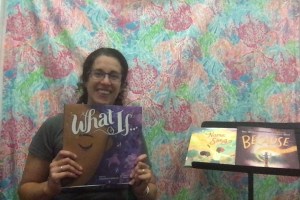
Kate Smith with What If…

Hello colleagues! If I have learned anything these past six months, it is this: keep your friends close and your ARTS colleagues closer! I have learned so much from interacting with all of you through MALI events, Tuneful Talk webinars, DOE-hosted events, virtual book clubs, Facebook groups and, on the rare occasion, socially distanced gatherings. You inspire me, encourage me, support me, make me laugh, understand the frustration, and your authenticity and vulnerability in these unsettling times remind me I am not alone. THANK YOU. To attempt to pay it forward, I have offered to write a blog post for Argy (I owe her big time), and hopefully there will be something here that will benefit you in some way. Better, I hope you will comment with your own resources and we can make this an even more valuable blog post.

Favorite books Kate is using in her teaching…
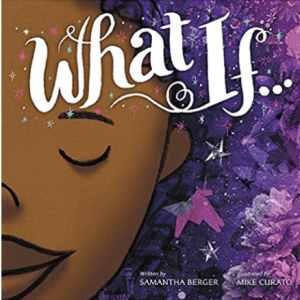
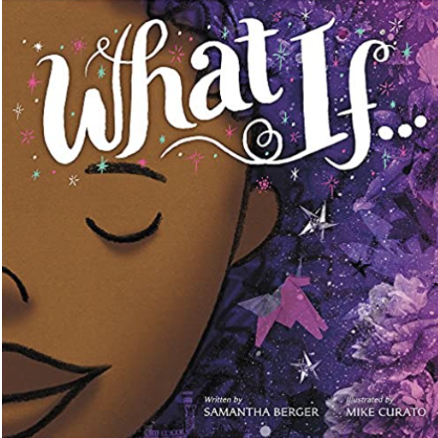
WHAT IF by Samantha Berger and Illustrated by Mike Curato. This book came recommended to me by Kaitlin Young, a music teacher at SeDoMoCha and the 2018 Maine Teacher of the Year. It’s called “What If” and it is written by Samantha Berger and illustrated by Mike Curato. This would be a great book for art, music, dance or theater teachers and their students.  I used this book to explain what we can and can’t do in the music room this year.  Little, Brown and Company do allow us to videotape ourselves reading the book but with restrictions which you can find on their website.
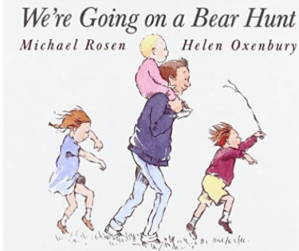
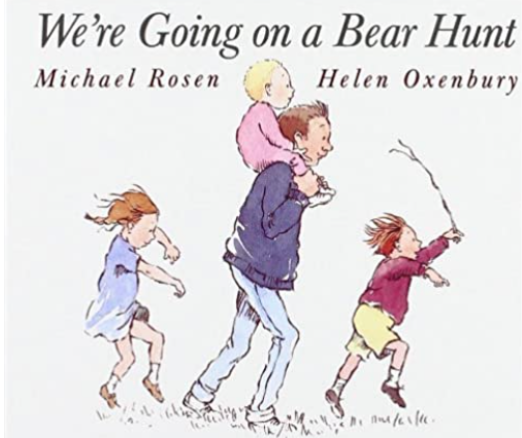
I’m Going on A Bear Hunt by Michael Rosen and Helen Oxenbury. This is an oldie (1997) but goodie. It works just fine as a chant. Adding hand motions and body percussion can make this a crowd pleaser, add instruments and they’ll be begging for more. First we acted out the book as a chant and added motions for each obstacle. Then we talked about how to make appropriate sound for each challenge using a drum. Each child had their own drum. We rubbed, scraped, tapped and banged our way to the bear cave and back!
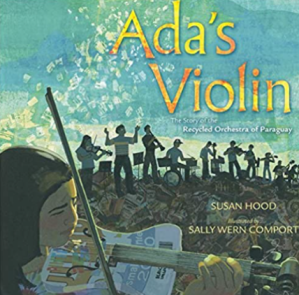
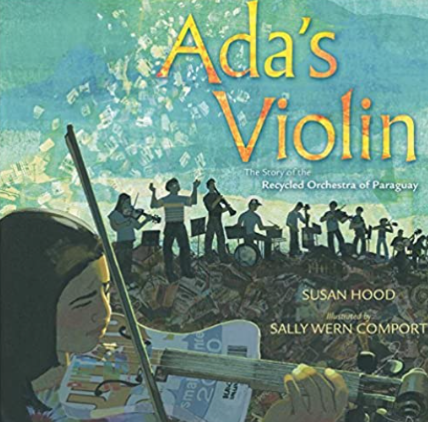
Ada’s Violin: The Story of the Recycled Orchestra of Paraguay by Susan Hood and Sally Wern Comport. Are you having your students make their own instruments? This book can be inspiring and eye opening. A true story, a quick google search and you’ll find some videos of the actual orchestra to share as well.
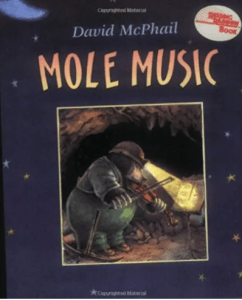
 

Mole Music by David McPhail. Another oldie but goodie. This one is great for discussing hopes and dreams with your students, music’s impact on our feelings and emotions (sometimes when we don’t even know it!), and that learning a new instrument takes time and a lot of practice. I once invited a violin player to play while I read. It was awesome. Especially the screechy part at the beginning. 😉
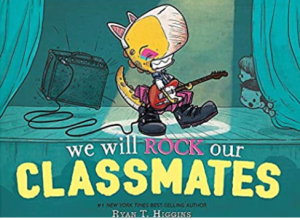
 

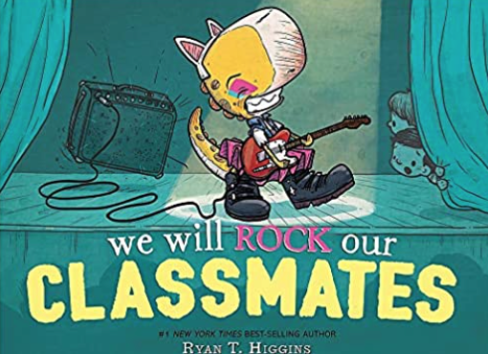
We Will Rock Our Classmates by Ryan T. Higgins, a Maine author with a fantastic sense of humor (if you haven’t read Mother Bruce, you must drive to the nearest bookstore right now.) This book addresses nerves when it comes to performing, in this case, the school talent show.
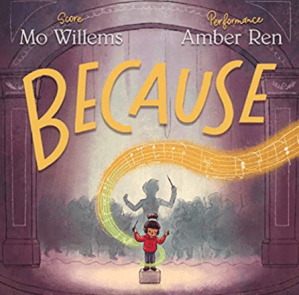
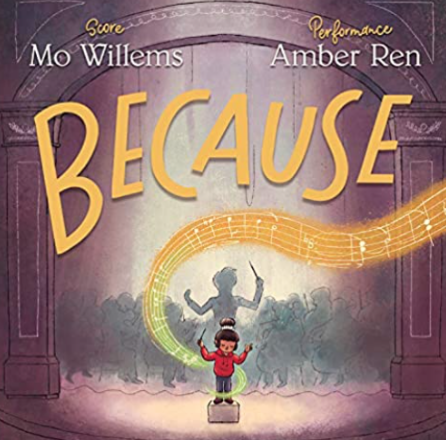
Because by Mo Willems and Amber Ren, published in 2019. This beautiful book speaks of persistence, hard work, inspiration, legacy, community and discovery. How did this book come to be? I will let Mo and Amber tell you at THIS LINK.  And here is THE LINK to Hilary Purrington’s symphony, The Cold, featured in this book!

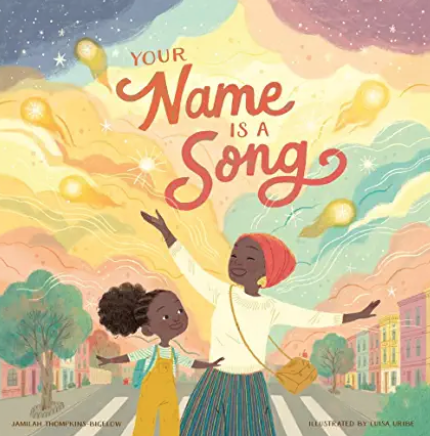
Your Name is a Song by Jamilah Thompkins-Bigelow is a wonderful book that celebrates the beauty, history and magic of names. Saying them correctly is important and it matters. CLICK HERE for a video of a read aloud and THIS LINK will help to pronounce the names in the book from the author!

I will be reading this book to the students soon, have you used it in your classroom? Some teachers have their students draw their name in an artistic way to show what their name means to them. How powerful!

Please consider sharing one of your ideas or work that you have underway with the Maine Arts Education Blog readers! Email me your ideas at meartsed@gmail.com

h1

Story Corps

September 28, 2020

Great resource

StoryCorps was established in 2003 and has a mission to record, preserve, and share the stories of Americans from all backgrounds and beliefs. Their website has several great tips and resources on how to get started in telling your story in the best possible way. I like knowing that StoryCorps was modeled after the efforts of the WPA – Works Progress Administration of the 1930s. I know artists benefited from the work of the WPA during the Depression and the impact still carries over today.

In March 2020 StoryCorps Connect was established in response to COVID-19 pandemic. It enables people who are interested to record an interview with someone using video conference technology. The audio and a still photo from each interview goes into the archive at the American Folklife Center of the Library of Congress. Your interview becomes part of American history, and hundreds of years from now, future generations will listen in. “We think of StoryCorps as an ever-growing archive of the wisdom of humanity.” You can make a recording at THIS LINK. StoryCorps is an independently funded nonprofit organization.

In addition StoryCorps connect has created a Downloadable Toolkit for Teachers and Educators. The toolkit is filled with multimedia resources and lessons to support young people as they learn to interview, record, and listen to the stories of family members and loved ones. There are so many possibilities for ways to use this with your learners – no matter what age or subject you may teach.

The video below provides the 5 easy steps to record your story.


h1

Teaching in the Pandemic

September 22, 2020

Charlie’s story

One of the Maine Arts Leadership Initiative (MALI) Teacher Leaders from the first phase is Charlie Johnson. Charlie teaches Digital Design, 3D Design and Photography at Mount Desert Island High School. For many years he has been a proponent of student centered learning and using technology as a tool for effective teaching. He wrote the essay below “Teaching in the Pandemic” for the Union of Maine Visual Artists Journal.

Charlie has worked tirelessly as an art educator since 1973 and over the years I’ve been happy to watch him be recognized for his commitment to Arts Education. Charlie received the Carol Trimble Award for Exemplary Service to Education Award in 2015, was a finalist for the 2008 Maine Teacher of the Year, and is the 2006-07 Maine Art Teacher of the Year from the Maine Art Education Association.

Matilda A., Spring, Mixed Media, 12” x 12”, May, 2020 “I’m grateful for spring coming and all the flowers starting to come up.”

My initial concern as a high school art instructor with the closure of school buildings within our district was that I had no time to prepare my students for the transition. Fortunately students in my classes used the Google Suite of applications on a regular basis, primarily for presenting their work on Google Drive to obtain formative feedback and ultimately to organize their summative portfolios. Their previous work with the structures and protocols of digital submission of work did provide them a basic foundation.

Working with a Digital Media class in a computer lab equipped with the Adobe CC Suite did not translate to student laptops or home computers. Adaptations to software available on student laptops had to be constructed, causing a shift in curriculum structure and constricting student choice for exploration purposes within a less robust software .

The class that caused me the most regret for my students was Black & White Photography, as the creation of individual darkrooms labs in student homes was impractical. Even with these changes, the photography class has been particularly resilient, with the requirement to switch to digital imaging and to shoot in grayscale causing several students to improve the content and quality of their work significantly.

Alex S., What Makes Me Happy, Mixed Media/Photograph, 12” x 12”, May 2020 “I am grateful for the ability to create, both physical and emotional, to keep my inner colors bright and vivid, even when I’m the only one who sees them.”

While there remains a visual and performing arts requirement for graduation at our school, all of these classes are elective by students, and in some cases are chosen out of necessity rather than interest. Being present physically in these classes allows the instructor to personalize instruction and teaching as students become more familiar with both the content and the teacher.  Because this had already taken place during the school year for semester long classes, there was a certain basic foundation to work from during the transition period.

The group of students that I am in contact with in the most meaningful ways during this pandemic is the National Art Honor Society art students. Now, this is not an art class, but a group of the most interested and dedicated visual artists in our school, and from the very first “virtual” meeting we all shared not only time, but ideas and concepts for artworks, emotional states in reaction to the closure of classroom doors, and an artistic fellowship that was purely exuberant! During the second weekly meeting of this group, students decided to create “squares” of their feelings of gratitude that would eventually become a “GRATITUDE QUILT”, expressing the variety of things to be thankful for during the difficult time of the pandemic. 

Charlotte P., Technology, Digital, 12” x 12”, May 2020 “I’m grateful that technology is able to keep us connected even if it can become a little too overwhelming sometimes.”


MDI NAHS, Gratitude Quilt, Digital Assemblage, 4’ x 4’, May 2020
“A collaborative piece by members of the MDI HS Chapter of the National Art Honor Society”

IMAGE LIST/CAPTION:

  1. MDI NAHS, Gratitude Quilt, Digital Assemblage, 4’ x 4’, May 2020

“A collaborative piece by members of the MDI HS Chapter of the National Art Honor Society”


  1. Charlotte P., Technology, Digital, 12” x 12”, May 2020

I’m grateful that technology is able to keep us connected even if it can become a little too overwhelming sometimes.”


  1. Matilda A., Spring, Mixed Media, 12” x 12”, May, 2020

            “I’m grateful for spring coming and all the flowers starting to come up.”


  1. Alex S., What Makes Me Happy, Mixed Media/Photograph, 12” x 12”, May 2020

I am grateful for the ability to create, both physical and emotional, to keep my inner colors bright and vivid, even when Im the only one who sees them.”


h1

Teacher in a Strange Land

September 21, 2020

Message to parents

Nancy Flanagan is a retired music teacher in Michigan and the state’s 1993 Teacher of the Year. She has been blogging for 15 years at Teacher in a Strange Land. Perhaps because she’s in the arts I find that many of her posts really speak to me. She put together a list of ‘tips’ for parents. Knowing how busy you teachers are day to day, especially during the pandemic, you might find this list useful to share with parents and won’t have to write a list yourself.

The post is called Five (Conservative) Ideas about Going Back to School in the Fall and below are the five ideas – to save you time from going to the post.

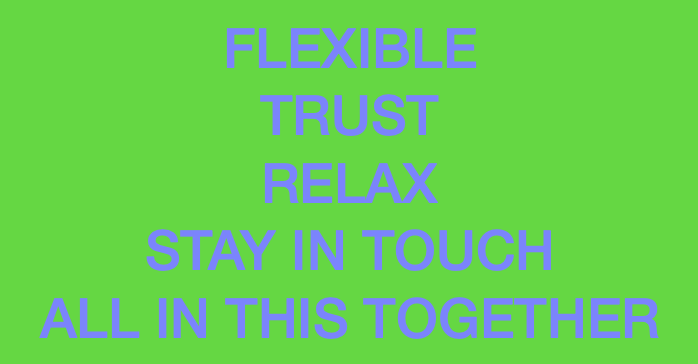
  • Be flexible. This may be the hardest thing for parents and teachers—and students as well. We’ve become accustomed to guidelines and traditions: School always starts in the fall and ends as summer begins. School is held in buildings, in classrooms. But this year, we just don’t know what will happen. It will be tempting to assess blame—against school leaders or the government—when we are frustrated. The pandemic is nobody’s fault, however—and the most useful ideas for schooling in a pandemic are often unusual. Will your child meet his teacher outdoors, twice a week? Perhaps. Might the school close and reopen multiple times? Maybe. Will there be distance learning, online or via printed packets? Likely, even if it’s not optimal. Stay open and amenable to change. Your children will follow your lead.
  • Relax—there is no such thing as ‘falling behind.’ First, nearly allschoolchildren are experiencing this disruption to their regular school routine. More important, any veteran teacher will tell you that students do not learn in uniform, year-by-year levels of progress. There are spurts and plateaus, times when new skills and content are gained and times when students merely practice using the things they know and are able to do. Your child—with a little gentle help from you—can continue to grow or solidify their learning: Reading (out loud or silently). Walking in nature. Choosing their own interests and projects to pursue. When in doubt, Google learning ideas for children. And stop stressing over tests and competing. Your child will be OK, in the long run.
  • Stay in touch with your school. If you have bright ideas about how to cope with stemming the spread of infection, or if your children have specific needs, share this information with school leaders and teachers. Give them a chance to help your family adapt. If at all possible, stick with the school—whether public or private—your family chose last year. This is not the right time to go school shopping, hoping to find something ‘better.’ A school where your child is known is a better bet than rolling the dice, academically, during a dangerous national health crisis.
  • Trust school leaders and teachers. They are between a viral rock and the hard place of public needs. They are also willing to take risks and learn new things to provide an education for your child. They deserve our support. Their rules and procedures are designed to keep children safe and create order in the school. If your family does not agree with all of the school’s plan and requirements for re-opening, keep in mind that schools are responsible for communities of children, not just your child. Our democratic society was built on the rule of law; modeling that has never been more important. It is vital for children to respect their school’s directions and decisions right now, around masking, distancing and sanitizing. It’s an important step in building their adulthood and citizenship.
  • We are all in this together. Your children are like millions of schoolchildren across the country, your family’s problems are shared by families across the state. The most productive approach to solving these problems is doing so in a way that benefits everyone in your community, keeping them as safe as possible. Our ability to remain calm and approach a national emergency with a can-do spirit is something Americans have been proud of, in past crises.  We will survive this, and even learn from the struggle, if everyone does their part.

Thank you Nancy for sharing your wisdom and experience!

h1

Role of Joyful Music

September 18, 2020

Report from Wolf Brown

Dennie Palmer Wolf is a friend of Maine Arts Education having been the consultant in our first state wide census that was a project of the Maine Alliance for Arts Education. The Maine Department of Education and the Maine Arts Commission collaborated on the project in 2007.

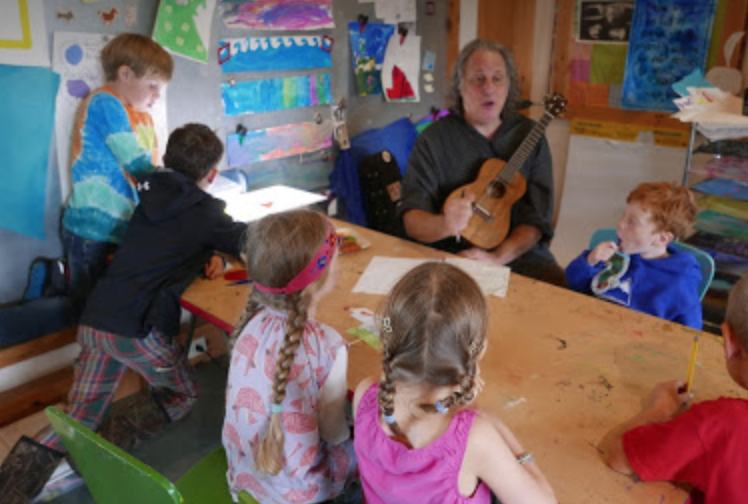
In July 2020 Wolf Brown released a report for the Bernard van leer Foundation called Making a Joyful Noise: The Potential Role of Music Making in the Well-Being of Young Families. I encourage you to download the report (no matter what grade level you teach) and use segments of it to support your music programs. It is timely with the pandemic dictating parents to take a more active role in their child’s education. We know it is critical that the school and home teaching and learning be filled with balance. Not to mention the enormous benefits to the development of young children and how to support learners on the ‘human’ side through all of this.

The report highlights several areas and provides a substantial overview of why music is important to our youngest learners. It is broken down by periods of development; Pre and Perinatal Period, Early Infancy: 2-5 Months, Later Infancy: 6-12 Months, Interdependence and Autonomy: 1-3 Years, and Expanded Learning: 4-5 Years. Researchers looked closely at programs across the country and around the world. Schools with pre-school programs would find this report useful. Many of our students have younger brothers and sisters so sharing the report through school and district newsletters would help build future elementary programs.

Wolf Brown include techniques and activities for adults to guide young children in their development and joy of making music, what an emphasis on music provides young children and families, and how music impacts their well being and social emotional learning.

Interestingly enough the opening report statement on “why music matters” is comprehensive and supports why music matters for every individual and family in the world.

Find the report at THIS LINK

h1

Dance Education

September 16, 2020

Andrew auditions – don’t miss this

Watching this video reminds me of why we should focus on the whole child and why dance is so important. It’s often the art form forgotten in schools. And, during the pandemic dance education is more critical. The dance education programs in place across the state are excellent, sadly there are not many, especially at the high school level. The good news is that almost all music and physical education teachers at the elementary level include dance and movement in their curriculum in some way.

The benefits that dance offer to developing and supporting the body and mind are enormous. There is plenty of research that emphasizes the benefits of dance.

Interestingly enough the Maine Arts Commission (MAC) Teaching Artist Roster has 14 dance teaching artists. Consider bringing a dance educator to your school this year. There is funding available through MACs Arts Learning grants which will become available in January 2021 with a deadline of April 2, 2021. Plan ahead for the next school year.

Let’s think about the possibilities for dance and why the time, right now, is PERFECT!

  • We’re wearing masks, dance doesn’t require speaking or singing, just movement
  • Some dancing requires close contact but it certainly doesn’t have to as you’ll see in Andrew’s video below
  • Dancing doesn’t require dirty hands so there is little reason to be concerned about hygiene
  • Bodily-Kinesthetic is one of the 8 Multiple Intelligences and it is ‘dancing’ – coordinating your mind and your body.

If you’re wondering about the benefits of dancing for all learners watch Andrew in this video.