Archive for the ‘Communication’ Category

h1

Using Pronouns

May 27, 2021

Take a close look

In the fall of 2017 I included a series of six blog posts called Who Are They? Portland Stage that described the education program at that time of Portland Stage. I worked with two of the education staff from Portland Stage, Hannah Cordes and Julianne Shea. Both are positive, upbeat and happy people who have a natural sense of theater education along with their formal education in the area. It was a delight to learn about their programs and work with them. You can search for those posts in the side bar.
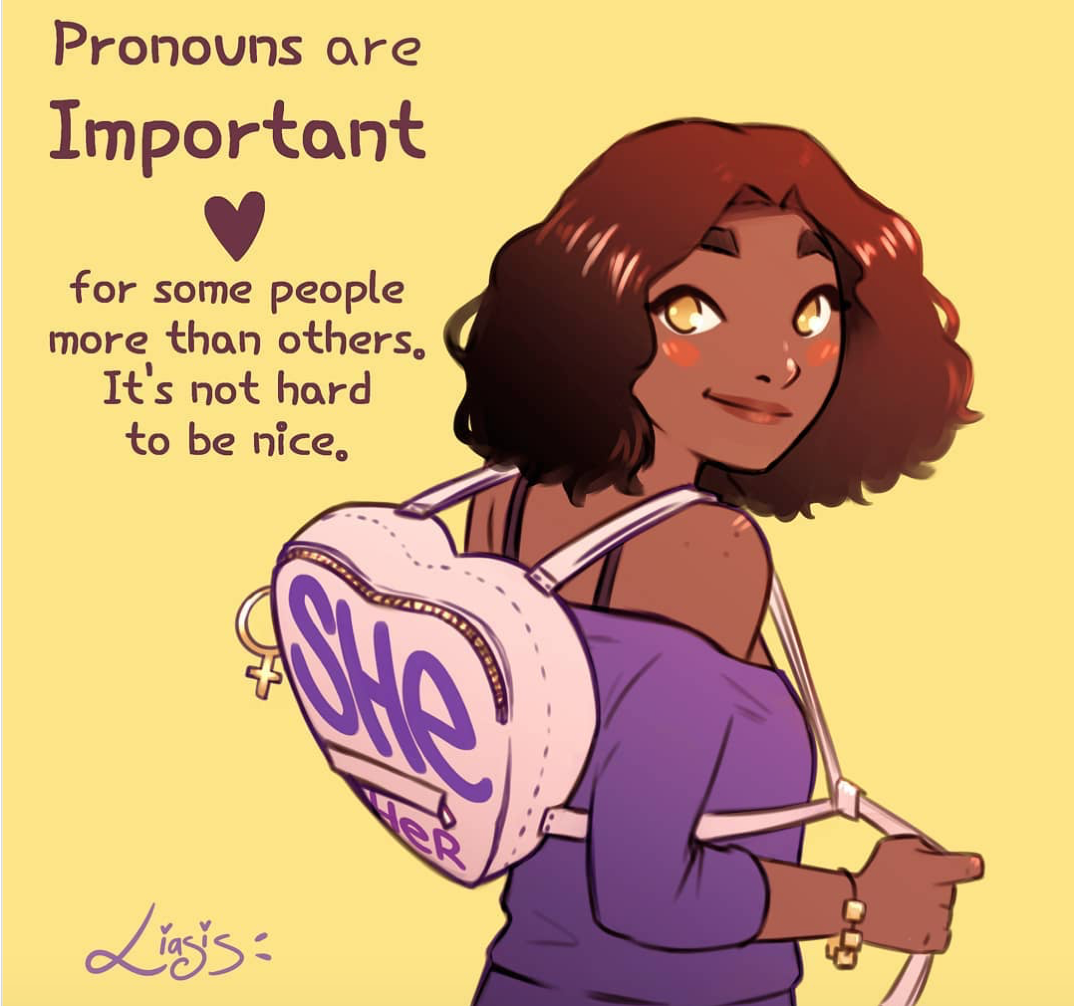
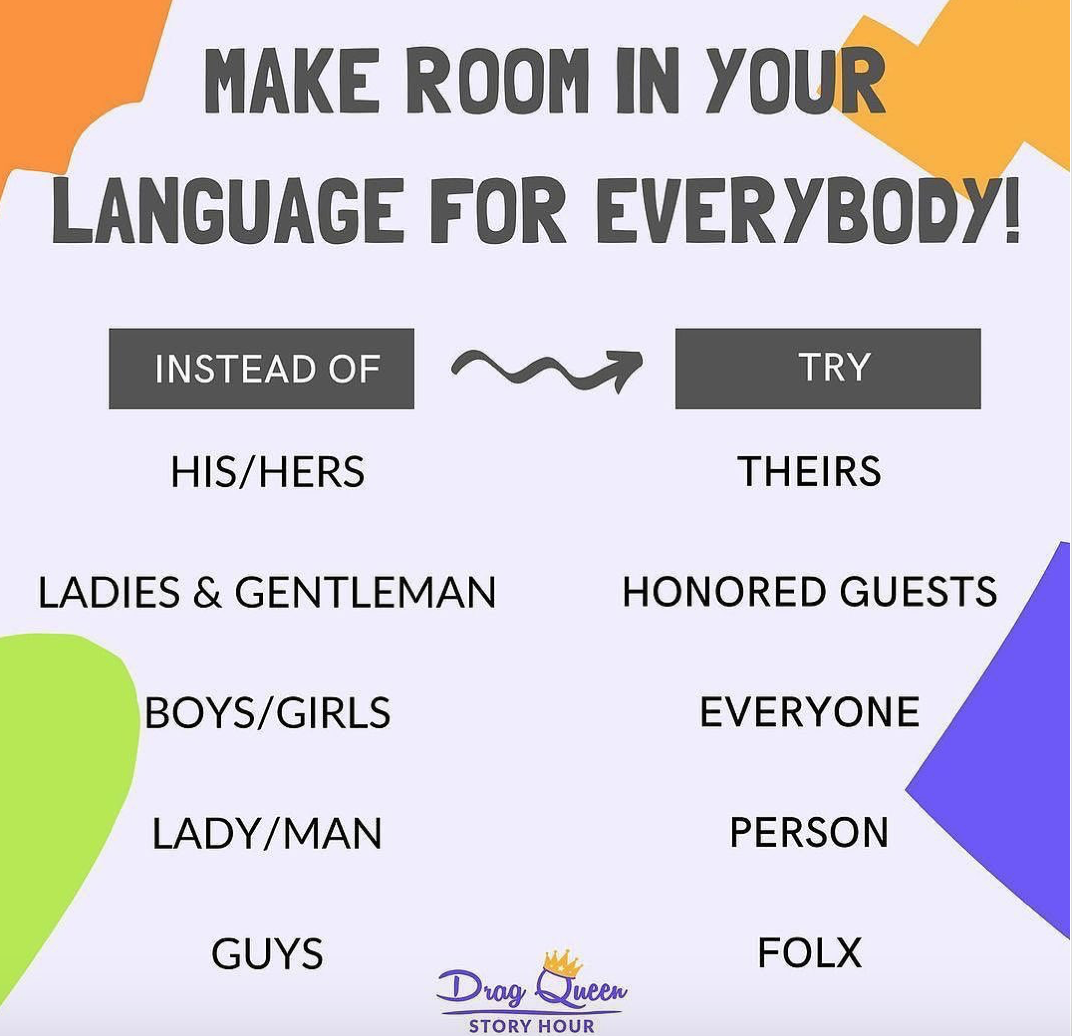
Not long afterwards I noticed that people were beginning to use ‘pronouns’ and it dawned on me that I needed to become educated in this area. I couldn’t find anything online or recommended readings so I reached out to Hannah since they were one of the people in my communications that I noticed using pronouns in their ‘signature’. She willingly met for a cup of coffee to discuss the topic. My main goal was to be sensitive and respectful in my blog writing. Hannah’s teaching and advice helped me enormously and I went from asking “what is this all about, will it go away, and how do I get started?” to “OK, this is fairly straightforward to understand and it really is about being respectful.” The other thing I learned and most importantly was it was OK to make mistakes in this area.

Now that I’m back in the classroom and interacting with young people on a regular basis my focus on pronouns is not just important in my writing but also face to face. I was happy to find this quick guide to pronouns recently published online by Upworthy called Why pronouns are important, how to get them right, and what to do if you slip up. Most of what Hannah shared with me five years ago is explained in this piece and spelled out more comprehensively. I notice the use of pronouns today in almost every corner of my world; email signatures, on zoom, in articles, research and books. I remember asking Hannah if she thought this was a fad and would it go away. The answer was no and now I agree. If you’re not comfortable with pronouns and are wondering where to start this guide may be useful. Most importantly, at the heart of using pronouns is being respectful and kind to students, colleagues, families in your professional and personal lives. I’m sure you’ll agree – that’s a good thing!

Respectfully, Argy Nestor, she/her
h1

The Art of Education University

May 24, 2021

Learning opportunities for art teachers

PODCAST

The Art of SEL is a limited-run podcast about connecting social-emotional learning to what we already do every day in our teaching. Throughout eight episodes, Jonathan Juravich and his guests will explore how we can help ourselves and our students understand emotions, thoughts, feelings, and behaviors and why that understanding is crucial right now.

Each episode is based on one of the core competencies of SEL, self-awareness, self-management, social awareness, relationship skills, and responsible decision-making, with practical applications at every turn for you and your students. The first episode was released on Monday, May 17th.

Find The Art of SEL podcast and get started listening to the informative content that the Art of Education University is providing.

SUMMER CONFERENCE

Art teachers world-wide are invited to attend the summer conference provided by The Art of Education University on July 29. Enjoy a day full of artmaking, creativity, and discovery with thousands of art teachers from around the world—all without leaving your home! You’ll walk away with loads of inspired ideas, resources, and downloads you can immediately implement into your art room.

Highlights include:

  • Highly-engaging, fast-paced TED Talk-style presentations full of real-world, practical art room strategies.
  • Connect with over 2,000 art teachers from around the world!
  • Over 20 highly-practical and relevant art ed presentations, handpicked and expertly curated by AOEU.
  • Useful downloads ensure you can actually put the tips and strategies you learn to use right away in your real-world art room.

REGISTRATION

h1

Influenced by Art Teacher

May 11, 2021

Letter from US Secretary of Education Dr. Miguel A. Cardona

How wonderful that we have an educator in the position of Secretary of Education at the federal level who was influenced by an art teacher during his elementary education. I urge you to embrace this moment and consider our roles as educators and ask yourself: what can I do to take a leap in moving visual and performing education forward? You have the potential to encourage, challenge and guide learners to wrap their arms around being life long learners of the arts!

I never could predict what might happen in Mr. O’Neil’s art classes; I just knew I couldn’t wait for the next assignment.  Back then I didn’t realize all the ways this dynamic educator, a rare man of color leading our diverse classroom of second graders, was serving as a pioneer and role model for me and my peers in John Barry Elementary School.  But I’ll never forget how his teaching made me feel.  As a second grader, I remember looking up — watching him encourage, challenge and guide us – and thinking: “I want to be like him.”

In the years since embracing that calling and starting my career as a classroom teacher, I’ve kept that sense of purpose and wonder.  And my goal in all the administrative roles I’ve held is to facilitate great teaching and learning: to support and expand the transformative impact that skilled, caring classroom teachers have for students, schools, and communities.

Every day America’s teachers change lives, and every day those lives change the world.

Dr. Miguel A. Cardona US Secretary of Education

Now, this truth can seem to recede as you rush to keep up with the day’s intense pace, and your students’ needs and opportunities. Yet, from the first bell on the first day of the school year, you build a relationship with each of them. You learn their strengths and struggles, laugh with them, cry with them, worry over them, cheer for them – and at the end of the school year, help them transition to their next grade level adventure. You know all those experiences – both the academic and life lessons – have changed both you and them for the better.  You empower them to grow in skill and character — expand their understanding of the world and how to shape it — explore their interests and decide where to make their mark.

Teaching is not a job anyone just falls into. It is mastery of a craft: in fact, the craft that enables all the others. In my experience, great teachers are also quintessential lifelong learners. You use your command of learning science, your insights into your students’ unique needs and aptitudes, as well as the lessons of the past, the realities of the present and the inspiration, innovation and ingenuity of the future to help each new generation become leaders for today and tomorrow. Throughout the year you support your fellow educators, add to your tools through professional development, provide feedback on assignments, sponsor sports, service learning, clubs and other extracurricular activities, collaborate with parents –in addition to everything you pour into your students during class.

Even in this unprecedented year, you rallied, finding new ways to engage with students. In the face of tragedy, you learned new technologies and built virtual classroom communities, all while caring for yourselves and your own families.  As we heal, recover, and rebuild, this pandemic presents a chance to forge opportunity from crisis and reimagine education on every level. We will use this time to address inequities in our education system, and your contributions will be invaluable.  The work won’t be easy, but the impact of your success will be profound, for students and communities. I urge state, local, and elected officials to make sure classroom teachers have a voice in your plans and efforts to reimagine education; second to parents, they know our students best.

I look forward to learning and listening from you in the days ahead.  And, from all of us at the Department of Education: Happy Teacher Appreciation Week. There’s a reason teacher like Mr. O’Neil – and all of you – are memorable.  There’s a reason student in America’s classrooms watch you share your curiosity, energy and passion for ideas and think, “I want to be like them.”

You are embodiments of possibility, champions of your students’ potential and stewards of their success.

Dr. Miguel A. Cardona, U.S. Secretary of Education.

h1

Happpppppy Teacher Appreciation Week

May 3, 2021

May 3-7, 2021

During the last year teachers have probably faced enormous challenges – the most difficult of their career. It’s Teacher Appreciation Week so I’m taking a moment to stop and THANK YOU for all of the moments you have leaned in and did what you needed to do. We know at the heart of your work are students. They are so fortunate!

Since 1984, National PTA has designated one week in May as a special time to honor the men and women who lend their passion and skills to educating our children. Despite the challenges of the COVID-19 pandemic, you have worked hard to ensure every student has a quality arts education. I know that you’ll continue to do an amazing job despite the challenges.


h1

Theatre Videos

April 29, 2021

American Alliance for Theatre & Education

Outstanding videos are being created by the American Alliance for Theatre & Education and are periodically being released. The video below features award-winning playwright Alvaro Saar Rios who shares the importance of ‘telling your story’. He speaks from his heart and encourages the viewer to ‘just tell your story”. All the videos are located at THIS LINK.

h1

Lewis Prize for Music

April 7, 2021

RSVP

RSVP by CLICKING HERE

The Lewis Prize for Music is thrilled to invite you to our virtual Open House for Music CYD Rural Leadership on Thursday, April 22 from 5pm – 7pm ET. We are hosting an informal conversation with rural and tribal creative youth development practitioners and youth participants, members of state arts agencies, rurally based community centers, advocates and supporters for rural and indigenous communities.

Creative Youth Development is a recent term for a longstanding practice that integrates creative skill-building, inquiry, and expression with positive youth development principles, including holistic wellbeing. The Lewis Prize for Music team is eager to learn about rural communities and the experiences of working and getting funding for out of school music programming.

We will share information about our annual Accelerator Awards application and how to apply beginning in May 2021, as well as how to share about the award opportunity with other rural CYD music organizations that qualify for this opportunity. 

Please note, we are capping attendees to the first 100 people to sign up. Honorariums will be provided for attendees that qualify as being a part of CYD Music Organizations.

h1

Being a Searcher

April 2, 2021

Rob Shetterly and Jim Carrey

As another month comes to an end today I’m sharing this post that might help you close another chapter in a wondering state of mind. In Elizabeth Gilbert’s book “Big Magic” she talks about ideas that come into our thinking and how if we don’t act on them they fly out and keep circulating out there until they land somewhere else. Not sure if this has happened to you but it has to me multiple times, some small topics, others very monumental.

Recently Rob Shetterly from Americans Who Tell the Truth (AWTT) was sharing with my students his story about becoming the painter of the Truth Tellers. Rob has painted over 250 portraits of truth tellers and if you’re not familiar with them please take the time to view the AWTT site – there are many teaching and learning resources and opportunities for your learners.

Anyway, Rob said something that hit me upside my head. It went something like this: A few days later Ellsworth High School art teacher Leah Olson shared a video about Jim Carrey. First, I was surprised that the video had a similar message to Rob’s and that it was coming to me not long after I heard Rob say it. Needless to say it was my “big magic” moment and I knew that I had to act on it. So, I followed up with Rob, shared Jim Carrey’s video, and asked him to repond. Rob’s response pushed on my thinking and the importance of Rob’s paintings became more clear. I am so grateful for his work and wisdom.

Rob’s thinking on The Searcher

Fascinating little video about his art. He’s a searcher. And when you are a searcher, you are also sought. Allowing yourself to be found by what’s searching for you is one of the most important moments in your life. So much of our lives is in preparing ourselves  to be ready for the  recognition of that moment. Being open to the voice. It’s an annunciation one can decline, but at the peril of avoiding the deepest meaning you may be capable of.

Jim’s video

When I went back to view Jim’s video what I found, along with “the searcher”, was how meaningful this video is for students and adults alike. I have been reminded over and over in the last month how serious some parents and educators are about “preparing kids for the future”. Sadly, not about the importance of living each day to the fullest. The video has many messages along with the important one “what you do in life chooses you”. It’s about how important color is (I equate this with the lack of sun during Maine winters), relationships, engagement in learning, observation, love and so much more. I urge you to take the 6 minutes and 18 seconds to watch it and encourage you to share with a friend and/or colleague and of course, if appropriate with your students.

h1

Malaga Island

March 30, 2021

Resources available

The Maine State Museum is a wealth of information for teachers of all content and grade levels. One topic that they have excellent resources on is Malaga Island. The story of the island and the people who lived there have been of interest to me for some time.

If you’re not familiar with Malaga it is a 41 acre island located near Phippsburg at the mouth of the New Meadows River in Casco Bay. It was the site of an interracial community from the Civil War until 1911, when the residents were forced to leave their homes.

From the Maine State Museum webpage

By July 1, 1912, the community on Maine’s Malaga Island ceased to exist. The State of Maine had evicted the mixed-race community of fisherman and laborers in order to clear the small coastal island of “It’s Shiftless Population of Half-Breed Blacks and Whites”, as one 1911 newspaper article described it. The mixed-race community was controversial in the state; many people saw the island as an ugly mark on the pristine beauty of Maine’s coast. After years of well-publicized legal battles, the state succeeded in removing the community of around forty people, committing eight to the Maine School for the Feeble Minded. By the end of 1912, all visible traces of the community disappeared – houses were moved and the cemetery was exhumed.

Not long ago the museum had a comprehensive exhibit on the community and they’ve been able to include many of the resources online (links below) so we can continue to learn from them.

The museum has also archived 5 lessons which include background info, teaching resources, and photographs from the island settlement. Lessons are located at THIS LINK.

If you have any questions about the museum’s resources please contact Joanna Torow, Chief Educator at the museum at Joanna.Torow@maine.gov.

In addition to the above resources Kate McBrien, Maine State Archivist, presented at the Southwest Harbor Public Library and that recorded presentation is below. At some point there was a shift in the attitude towards Malaga Island. In 2010 Governor John Baldacci visited the island and apologized for the wrong that had been done on the island and to its residents. One of the descendants accepted the apology and communicated how grateful the state of Maine acknowledges the history. You can hear the recording from the ceremony and other stories documented at THIS LINK.

h1

The Arts and Cognitive Skills

March 29, 2021

Recent research published

Some of the latest brain research supports the notion that the arts impact the neural pathways including cognitive and social skills. T. Christina Zhao and Patricia Kuhl have been studying the impact of music on babies brains. Kuhl explains in a TED Talk that music is positively impacting Executive Functions. In a video, embedded below, which was found on the Edutopia website, the research is highlighted. For school age children a study in Texas that followed 10,000 students researchers learned that students who participated in arts programs not only scored higher on writing tests but were also more engaged in school and had more compassion for fellow students, among other points. Another study showed that drawing had a positive impact on memory among other points. These reports and other research can be found in an Edutopia article at THIS LINK

h1

MECA Courses

March 25, 2021

May Online Term

Maine College of Art’s (MECA) Office of Continuing and Professional Studies in collaboration with the college’s Master of Arts in Teaching program are pleased to offer two fully online courses for this May term. These Graduate-level courses offer 3 credits each at a discounted, non-matriculated rate. The two art education classes are certification requirements for folks seeking a Visual Art teaching endorsement. If you know any community artists or educational technicians that may be interested in becoming an art teacher, this would be a perfect opportunity for them to move closer to that endorsement. 

To learn more go to MECAs Continuing Studies webpage with the class listings.

May Term at MECA is five weeks, from May 15 to June 20. May Term 2021 offers: MAT 806: Teaching Exceptionality in the Art Classroom with Heather Nunez-Olmstead. MAT 815: Methods of Teaching Art in the K-12 Classroom with MAT Program Chair, Dr. Rachel Somerville, Ed.D.

Below is a video that provides information on the two courses being offered.

If you have questions please contact Rachel E. Somerville, Ed.D. Interim Chair & Director of Art Education Outreach at rsomerville@meca.edu. For more information about May Term classes, visit: https://cs.meca.edu/​ or call us at 207.699.5061.