Archive for the ‘Community’ Category

h1

Teaching in the Pandemic

September 22, 2020

Charlie’s story

One of the Maine Arts Leadership Initiative (MALI) Teacher Leaders from the first phase is Charlie Johnson. Charlie teaches Digital Design, 3D Design and Photography at Mount Desert Island High School. For many years he has been a proponent of student centered learning and using technology as a tool for effective teaching. He wrote the essay below “Teaching in the Pandemic” for the Union of Maine Visual Artists Journal.

Charlie has worked tirelessly as an art educator since 1973 and over the years I’ve been happy to watch him be recognized for his commitment to Arts Education. Charlie received the Carol Trimble Award for Exemplary Service to Education Award in 2015, was a finalist for the 2008 Maine Teacher of the Year, and is the 2006-07 Maine Art Teacher of the Year from the Maine Art Education Association.

Matilda A., Spring, Mixed Media, 12” x 12”, May, 2020 “I’m grateful for spring coming and all the flowers starting to come up.”

My initial concern as a high school art instructor with the closure of school buildings within our district was that I had no time to prepare my students for the transition. Fortunately students in my classes used the Google Suite of applications on a regular basis, primarily for presenting their work on Google Drive to obtain formative feedback and ultimately to organize their summative portfolios. Their previous work with the structures and protocols of digital submission of work did provide them a basic foundation.

Working with a Digital Media class in a computer lab equipped with the Adobe CC Suite did not translate to student laptops or home computers. Adaptations to software available on student laptops had to be constructed, causing a shift in curriculum structure and constricting student choice for exploration purposes within a less robust software .

The class that caused me the most regret for my students was Black & White Photography, as the creation of individual darkrooms labs in student homes was impractical. Even with these changes, the photography class has been particularly resilient, with the requirement to switch to digital imaging and to shoot in grayscale causing several students to improve the content and quality of their work significantly.
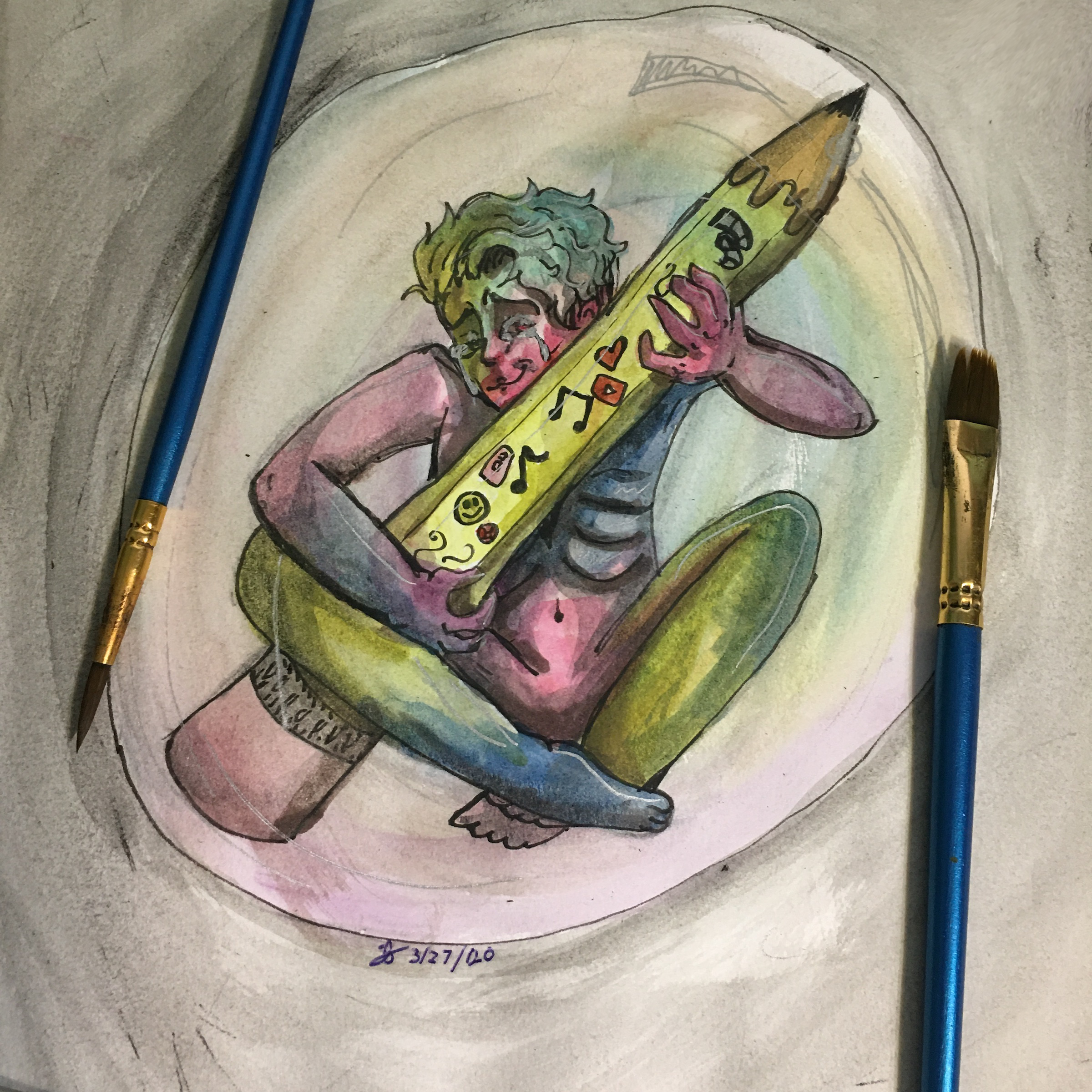
Alex S., What Makes Me Happy, Mixed Media/Photograph, 12” x 12”, May 2020 “I am grateful for the ability to create, both physical and emotional, to keep my inner colors bright and vivid, even when I’m the only one who sees them.”

While there remains a visual and performing arts requirement for graduation at our school, all of these classes are elective by students, and in some cases are chosen out of necessity rather than interest. Being present physically in these classes allows the instructor to personalize instruction and teaching as students become more familiar with both the content and the teacher.  Because this had already taken place during the school year for semester long classes, there was a certain basic foundation to work from during the transition period.

The group of students that I am in contact with in the most meaningful ways during this pandemic is the National Art Honor Society art students. Now, this is not an art class, but a group of the most interested and dedicated visual artists in our school, and from the very first “virtual” meeting we all shared not only time, but ideas and concepts for artworks, emotional states in reaction to the closure of classroom doors, and an artistic fellowship that was purely exuberant! During the second weekly meeting of this group, students decided to create “squares” of their feelings of gratitude that would eventually become a “GRATITUDE QUILT”, expressing the variety of things to be thankful for during the difficult time of the pandemic. 

Charlotte P., Technology, Digital, 12” x 12”, May 2020 “I’m grateful that technology is able to keep us connected even if it can become a little too overwhelming sometimes.”
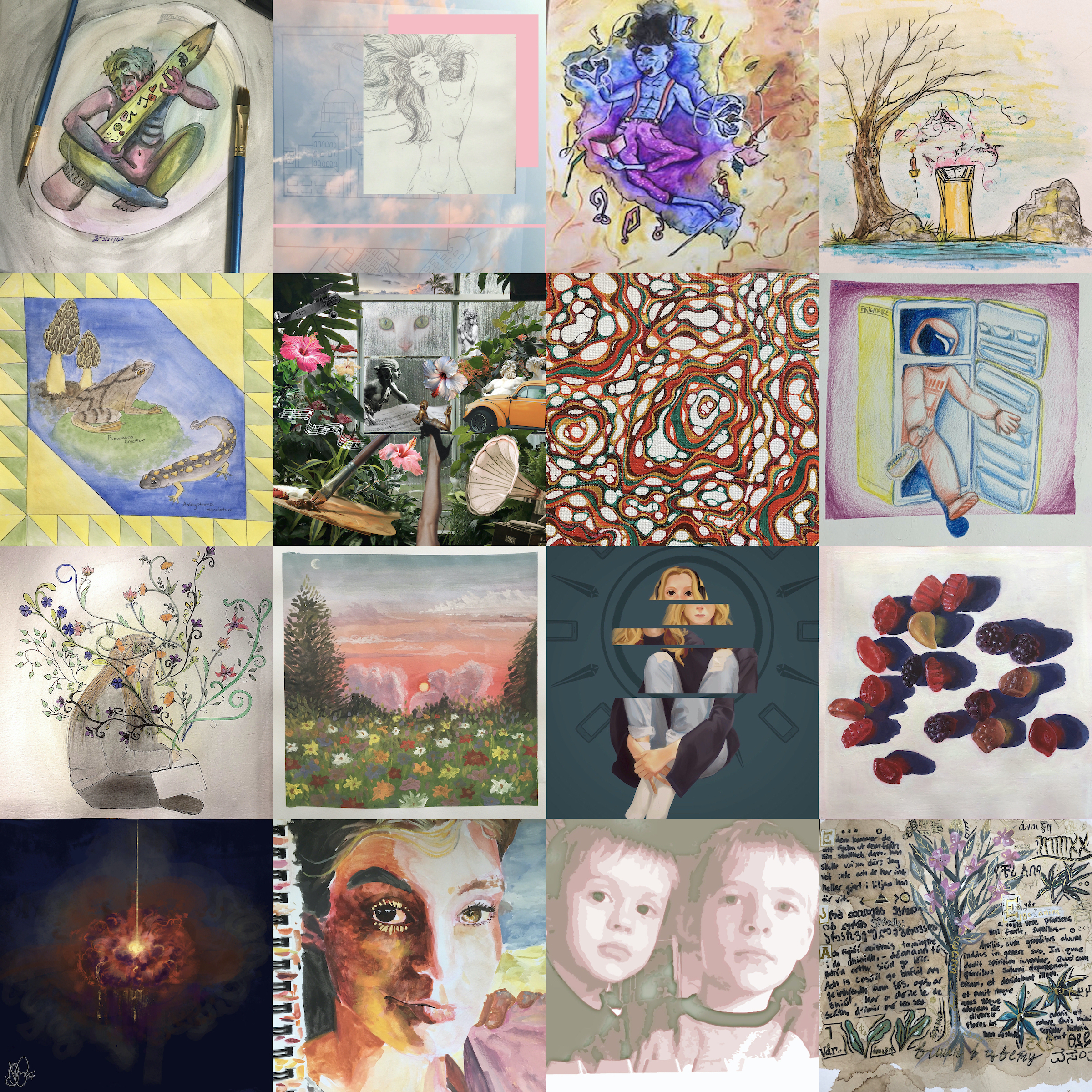
 

MDI NAHS, Gratitude Quilt, Digital Assemblage, 4’ x 4’, May 2020
“A collaborative piece by members of the MDI HS Chapter of the National Art Honor Society”

IMAGE LIST/CAPTION:

  1. MDI NAHS, Gratitude Quilt, Digital Assemblage, 4’ x 4’, May 2020

“A collaborative piece by members of the MDI HS Chapter of the National Art Honor Society”


  1. Charlotte P., Technology, Digital, 12” x 12”, May 2020

I’m grateful that technology is able to keep us connected even if it can become a little too overwhelming sometimes.”


  1. Matilda A., Spring, Mixed Media, 12” x 12”, May, 2020

            “I’m grateful for spring coming and all the flowers starting to come up.”


  1. Alex S., What Makes Me Happy, Mixed Media/Photograph, 12” x 12”, May 2020

I am grateful for the ability to create, both physical and emotional, to keep my inner colors bright and vivid, even when Im the only one who sees them.”
 

h1

Teacher in a Strange Land

September 21, 2020

Message to parents

Nancy Flanagan is a retired music teacher in Michigan and the state’s 1993 Teacher of the Year. She has been blogging for 15 years at Teacher in a Strange Land. Perhaps because she’s in the arts I find that many of her posts really speak to me. She put together a list of ‘tips’ for parents. Knowing how busy you teachers are day to day, especially during the pandemic, you might find this list useful to share with parents and won’t have to write a list yourself.

The post is called Five (Conservative) Ideas about Going Back to School in the Fall and below are the five ideas – to save you time from going to the post.

  • Be flexible. This may be the hardest thing for parents and teachers—and students as well. We’ve become accustomed to guidelines and traditions: School always starts in the fall and ends as summer begins. School is held in buildings, in classrooms. But this year, we just don’t know what will happen. It will be tempting to assess blame—against school leaders or the government—when we are frustrated. The pandemic is nobody’s fault, however—and the most useful ideas for schooling in a pandemic are often unusual. Will your child meet his teacher outdoors, twice a week? Perhaps. Might the school close and reopen multiple times? Maybe. Will there be distance learning, online or via printed packets? Likely, even if it’s not optimal. Stay open and amenable to change. Your children will follow your lead.
  • Relax—there is no such thing as ‘falling behind.’ First, nearly allschoolchildren are experiencing this disruption to their regular school routine. More important, any veteran teacher will tell you that students do not learn in uniform, year-by-year levels of progress. There are spurts and plateaus, times when new skills and content are gained and times when students merely practice using the things they know and are able to do. Your child—with a little gentle help from you—can continue to grow or solidify their learning: Reading (out loud or silently). Walking in nature. Choosing their own interests and projects to pursue. When in doubt, Google learning ideas for children. And stop stressing over tests and competing. Your child will be OK, in the long run.
  • Stay in touch with your school. If you have bright ideas about how to cope with stemming the spread of infection, or if your children have specific needs, share this information with school leaders and teachers. Give them a chance to help your family adapt. If at all possible, stick with the school—whether public or private—your family chose last year. This is not the right time to go school shopping, hoping to find something ‘better.’ A school where your child is known is a better bet than rolling the dice, academically, during a dangerous national health crisis.
  • Trust school leaders and teachers. They are between a viral rock and the hard place of public needs. They are also willing to take risks and learn new things to provide an education for your child. They deserve our support. Their rules and procedures are designed to keep children safe and create order in the school. If your family does not agree with all of the school’s plan and requirements for re-opening, keep in mind that schools are responsible for communities of children, not just your child. Our democratic society was built on the rule of law; modeling that has never been more important. It is vital for children to respect their school’s directions and decisions right now, around masking, distancing and sanitizing. It’s an important step in building their adulthood and citizenship.
  • We are all in this together. Your children are like millions of schoolchildren across the country, your family’s problems are shared by families across the state. The most productive approach to solving these problems is doing so in a way that benefits everyone in your community, keeping them as safe as possible. Our ability to remain calm and approach a national emergency with a can-do spirit is something Americans have been proud of, in past crises.  We will survive this, and even learn from the struggle, if everyone does their part.

Thank you Nancy for sharing your wisdom and experience!

h1

Role of Joyful Music

September 18, 2020

Report from Wolf Brown

Dennie Palmer Wolf is a friend of Maine Arts Education having been the consultant in our first state wide census that was a project of the Maine Alliance for Arts Education. The Maine Department of Education and the Maine Arts Commission collaborated on the project in 2007.

In July 2020 Wolf Brown released a report for the Bernard van leer Foundation called Making a Joyful Noise: The Potential Role of Music Making in the Well-Being of Young Families. I encourage you to download the report (no matter what grade level you teach) and use segments of it to support your music programs. It is timely with the pandemic dictating parents to take a more active role in their child’s education. We know it is critical that the school and home teaching and learning be filled with balance. Not to mention the enormous benefits to the development of young children and how to support learners on the ‘human’ side through all of this.

The report highlights several areas and provides a substantial overview of why music is important to our youngest learners. It is broken down by periods of development; Pre and Perinatal Period, Early Infancy: 2-5 Months, Later Infancy: 6-12 Months, Interdependence and Autonomy: 1-3 Years, and Expanded Learning: 4-5 Years. Researchers looked closely at programs across the country and around the world. Schools with pre-school programs would find this report useful. Many of our students have younger brothers and sisters so sharing the report through school and district newsletters would help build future elementary programs.

Wolf Brown include techniques and activities for adults to guide young children in their development and joy of making music, what an emphasis on music provides young children and families, and how music impacts their well being and social emotional learning.

Interestingly enough the opening report statement on “why music matters” is comprehensive and supports why music matters for every individual and family in the world.

Find the report at THIS LINK

h1

The Ways of Our World

September 17, 2020

Rapid changes

I don’t know about you but ideas continue to fly into my email box on how best to do “school” at this time. I trust and value some resources more than others, sometimes depending on the source. Edutopia from the George Lucas Educational Foundation provides thought provoking and action packed articles, many times written by practicing educators. When I see that, it’s a 5 Star resource. Below are links to articles sent by Edutopia that contain valuable teaching strategies. Most of them include addressing the social and emotional learning needs of students. Even though not all are not specific to arts education they can be adapted and I hope you find at least one useful. You can sign up to receive Edutopia emails by going to their website.

  • Teaching Drama in Distance Learning written by Shana Bestock. Shana provides tips for transferring practices to virtual spaces, how to dig deeper with students, create community, and reminds us that how in uncertain times the arts helps us embrace uncertainty and foster resilience.

h1

Incredible Resources in Maine

September 15, 2020

Ashley Bryan

As educators around the world seek ways to incorporate racial justice into their curriculum right here in Maine we have a treasure that leads us to multiple resources. Ashley Bryan, now 97, has been sharing stories, songs, history, and the culture of black people for years through his work as an artist.

Ashley first came to Maine in 1946 to study at the Skowhegan School of Paining and Sculpture Ashley. In 1988 he retired from Dartmouth College and moved to Little Cranberry Island where he has continued to create. In 2013 the Ashley Bryan Center was established to preserve the over nine decades of Ashley’s work. His art has a strong message but is stated in a joyful way, as only Ashley Bryan can do. He has received many awards including the Coretta Scott King Award for illustrators multiple times and the John Newberry Medal.

Ashley’s work is on display in the Maine State House until December 30 as part of Art in the Capital provided by the Maine Arts Commission (MAC) with a virtual show on the MAC site.

Recently Maine Public Broadcast featured I Know a Man … Ashley Bryan, a film created by Kane Associates and available streaming.

The Ashley Bryan Resource & Activity Guide is available for free. In addition is the companion short film. Thanks to Richard Kane, Melody Lewis-Kane, and Kane Productions for their outstanding work.
In 2018 Kate Smith and I traveled to Ashley’s home on Little Cranberry. It was a special day and I shared the adventure in a blog post.
h1

9/11 Boatlift!

September 11, 2020

Narrated by Tom Hanks

Today marks 19 years since 9/11. I’m sure that many of you remember exactly where you were on September 11, 2001 when our country was attacked and many Americans lost their lives. There are many stories from that day but I am forever moved by the community of boat owners and captains who put others first and made a difference.

NEARLY 500,000 CIVILIANS WERE RESCUED BY BOAT IN LESS THAN 9 HOURS 

The epic story of the 9/11 boatlift that evacuated half a million people from the piers and seawalls of Lower Manhattan. The American spirit and resilience is shown in “Boatlift”, narrated by Tom Hanks. I had no idea that the 9/11 boat evacuation was larger than the evacuation at Dunkirk during World War Two and they completed it so fast. Everyone who participated in the search and rescue operation on 9/11 and the days after is a true hero. Never Forget the lives lost on this tragic day or the heroes that emerged from it.

h1

New Blog

September 8, 2020

Bill Buzza

Bill at the Richard Rodgers Theater, NYC, set of Hamilton

Many of you know veteran music educator (27 years) Bill Buzza. He’s one of those people who has a warm smile and a soft voice. And, he’s such a thoughtful person that when he enters a conversation you know he’s listening carefully to what you’re saying (and not focusing on how he’ll respond). Bill is the music teacher/band director at Edward Little High School in Auburn.

Just like the rest of us he’s been dealing with the pandemic since March 13. Always one for thinking deeply Bill decided to start a blog that will document his learning and begin a dialogue.  Bill’s calling it Teaching Instrumental Music During COVID-19.

Bill says: As I think about the coming year, I anticipate many new experiences and a journey that will redefine my career of instrumental music education.

This is a great opportunity for you to read about Bill’s experiences and know that you’re not alone. While thinking about returning to school and all the details of it Bill’s been doing research on how to play an instrument with a face mask on. Yes, of course you can read all about it on Bill’s blog. Subscribe in the sidebar of the front page of the blog.

Bill earned his M.S. Ed in Educational Leadership from the University of New England and B.M. in Music Education from the University of Southern Maine. At Edward Little High School, he conducts the concert, marching, pep and jazz bands. He also teaches three levels of guitar, and a beginning band class. Bill was a Finalist for the 2011 Maine Teacher of the Year and was chosen as a Teacher Leader, phase 1, of the Maine Arts Leadership Initiative (MALI). He also served on the MALI Leadership Team.

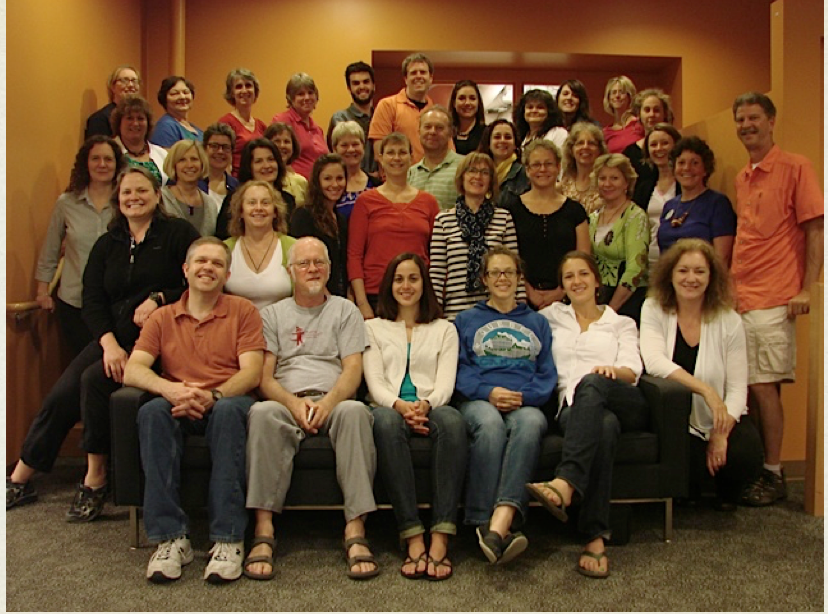
Phase 2, MAAI/MALI, Bill front row, 1st on left

h1

Spoken Word

September 7, 2020

Brandon Leake – America’s Got Talent

I’ve been thinking, listening, reading, having conversations and researching on how to address racial justice in my teaching and learning. I think the world works in magical ways when ‘stuff’ happens that I’m not looking for. And sometimes ‘different stuff’ intersects which, in this case, has led to this blog post.

First I want to say that my favorite podcast at the moment is Cult of Pedagogy started by a middle school Language Arts teacher Jennifer Gonzalez. Jennifer has brought together an experienced group of educators who help make the Cult of Pedagogy. If you’re looking for a podcast that will push on your thinking and curious where you might find ideas that are sometimes raw and grounded in reality combined with thoughtful educational research, then I suggest that you check out Cult of Pedagogy. Many of the episodes are Jennifer’s interviews with teachers, learning experts, parents, and other people who make things happen in education. There are a handful on the social justice topic. If you’d rather read than listen, each new episode comes out also in an email, on Sunday’s. You can learn about all that she has to offer and sign up for her weekly emails on the START HERE PAGE. An example of the podcast resources that Jennifer provides is episode #147 Why White Students Need Multicultural and Social Justice Education  from June 7th an interview with Sheldon Eakins who founded the Leading Equity Center, an online resource for educators.

I was first introduced to poetry by my 7th grade language arts teacher Mrs. Leeds. Each week on Friday we would learn about a poem, write it down in our poetry notebook, and over the next week memorize it and each student in my class would stand and recite it. I can dig into my memory today and recite Stopping by Woods on a Snowy Evening by Robert Frost and In Flanders Fields by John McCrae and probably a few others. Every so often I rediscover my poetry notebook and think about how nervous I was standing up in my front my class. I don’t recall actually learning how to recite poetry. We’ve come a long way in this area; now we have poetry slams, hip hop, jazz poetry, beat poetry, spoken word, and Poetry Out Loud (POL). POL is a partnership of the National Endowment for the Arts, Poetry Foundation, and the state and jurisdictional arts agencies. The Maine Arts Commission administers the recitation program.

I’ve been curious for some time about how ‘poetry’ has, for the most part, been taught in English or language arts class. Why poetry is considered an art form yet in schools we don’t include it when we reference visual and performing arts. In our standards documents it’s not clearly defined as part of the arts. When I try putting poetry in context I explain it like this: in schools poetry is behind the English teaching door and in the real world it is part of the performance arena.

I wanted to better understand this separation so I did a little sleuthing on the internet and, of course, I start with the Greeks. From the Ancient Greek word ποιεω (pronounced poieo) which means ‘I create’. Definition: an art form in which human language is used for its aesthetic qualities in addition to, or instead of, its notional and semantic content. In most poetry, it is the connotations and the “baggage” that words carry (the weight of words) that are most important. Poetry.org.

And further on about ‘spoken word’. Spoken word is poetry, and more recently spoken word poetic performance art that is word-based. It is an oral art that focuses on the aesthetics of word play such as intonation and voice inflection. It is a “catchall” term that includes any kind of poetry recited aloud… Unlike written poetry, it has less to do with physical, on the page aesthetics and more to do with phonaesthetics, or the aesthetics of sound. Wikipedia

A focus on words, sounds, presentations and performances using poetry has become more prevalent in our society since about the 1980’s but certainly it is embedded and has been for years in many cultures and their traditions. The connection between poetry as a performance and music is closely aligned.

In fact, in Ancient Greece, the spoken word was the most trusted repository for the best of their thought, and inducements would be offered to men (such as the rhapsodes) who set themselves the task of developing minds capable of retaining and voices capable of communicating the treasures of their culture.

I think poetry’s biggest potential is to light kids up and engage them in learning about themselves and the world. If only Mrs. Leeds had someone guide her in the pedagogy of teaching poetry. A good reason to promote integrated curriculum.

Here’s where the intersection of learning takes place for me. On my phone last week a video from America’s Got Talent popped up. A powerful performance by Spoken Word Artist Brandon Leake began to help me formulate curriculum for racial justice. You can LEARN more about Brandon and the organization he established Called to Move. I suggest using Brandon’s performance with your students.

h1

Teaching Empathy

September 1, 2020

TEDEd

TEDEd provides multiple opportunities for teachers and students. Teachers can create video based lessons, students can create student talks and educators can give TEDEd talks. What a wonderful avenue TEDEd is for teachers to tell their stories, share their ideas and use their voices. Art educator and 2018 Ohio State Teacher of the Year Jonathan Juravich provided a presentation on the TEDEd stage on Empathy. He is a K-5 art teacher at the Liberty Tree Elementary School in Powell, Ohio.

Jonathan is “interested in finding ways to teach empathy, go beyond catchphrases, and instill an awareness of others that can be expressed through action”. Growing up with his blind grandmother had a huge influence on Jonathan’s development of empathy. I love hearing Jonathan’s story and hope you will as well. At the end of the story you can engage in the questions, thinking and discussing that TEDEd provides. You can sign up for a daily email from TEDEd with a lesson plan.

https://ed.ted.com/lessons/hYl7p8BU

h1

Th!s is Our Chance

August 31, 2020

Film Festival

Lindsay, Alex, and myself – Helsinki, November 2020

One of the educators I met while in Helsinki, Finland in 2018 while attending the HundrED Summit was Alex Bell who is the founder and director of Portland Education. One of the first questions I asked Alex was, why would a guy from the UK name his consulting business ‘Portland Education’?  I quickly learned that he had gone to school at USM in Gorham and loved Maine so much that he wanted to honor his time spent in our beautiful state, hence, the name. After the summit we stayed in touch with Alex. The ‘we’ is my colleague, Lindsay Pinchbeck, who I traveled to Helsinki with as Ambassadors.

Alex is a likeable guy who has big ideas about education and believes in the power of the voices of children. He was working with a group of educators in a different part of Malawi which paralleled our project in Malawi. Alex has a few projects going on in other parts of the world.
For one of the projects this year Alex teamed up with volunteers, educators, and organizations in the US create the world’s first free online film festival about how to confront, examine, reimagine and create our education ecosystem. Alex says: “If you’ve got kids, are a kid or care about the bigger picture of education in our society, then you really are going to want to watch.” The film festival will include some amazing and beautiful films all about young people and education.

Th!S is Our Chance film festival runs October 6-27, 2000. Sign up at THIS LINK.

SOCIAL MEDIA LINKS

https://www.facebook.com/OurChanceFilms

https://twitter.com/OurChanceFilms

https://www.instagram.com/ourchancefilms/

Alex promises a family bucket of popcorn if you sign up to attend TH!S IS OUR CHANCE film festival.