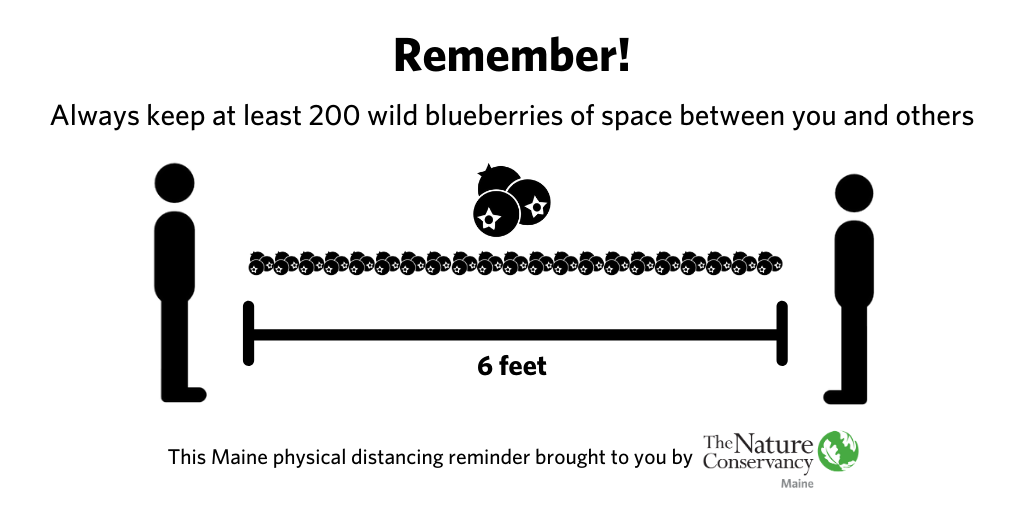
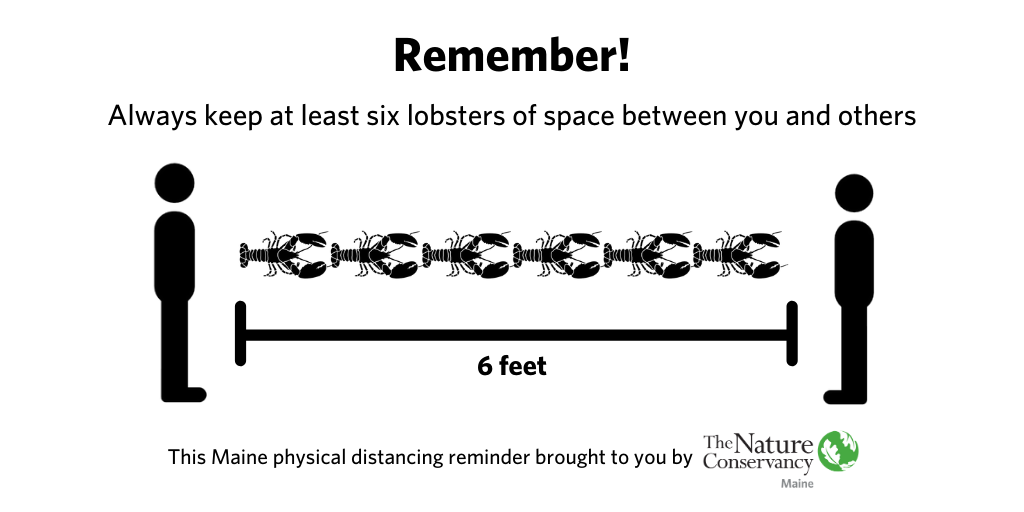
The Nature Conservancy of Maine has created images that illustrate what and in some cases how many of something represents 6 feet distance. They asked me to share but to be sure and give them credit if you reuse them.
I’ve been thinking, listening, reading, having conversations and researching on how to address racial justice in my teaching and learning. I think the world works in magical ways when ‘stuff’ happens that I’m not looking for. And sometimes ‘different stuff’ intersects which, in this case, has led to this blog post.
First I want to say that my favorite podcast at the moment is Cult of Pedagogy started by a middle school Language Arts teacher Jennifer Gonzalez. Jennifer has brought together an experienced group of educators who help make the Cult of Pedagogy. If you’re looking for a podcast that will push on your thinking and curious where you might find ideas that are sometimes raw and grounded in reality combined with thoughtful educational research, then I suggest that you check out Cult of Pedagogy. Many of the episodes are Jennifer’s interviews with teachers, learning experts, parents, and other people who make things happen in education. There are a handful on the social justice topic. If you’d rather read than listen, each new episode comes out also in an email, on Sunday’s. You can learn about all that she has to offer and sign up for her weekly emails on the START HERE PAGE. An example of the podcast resources that Jennifer provides is episode #147 Why White Students Need Multicultural and Social Justice Education from June 7th an interview with Sheldon Eakins who founded the Leading Equity Center, an online resource for educators.
I was first introduced to poetry by my 7th grade language arts teacher Mrs. Leeds. Each week on Friday we would learn about a poem, write it down in our poetry notebook, and over the next week memorize it and each student in my class would stand and recite it. I can dig into my memory today and recite Stopping by Woods on a Snowy Evening by Robert Frost and In Flanders Fields by John McCrae and probably a few others. Every so often I rediscover my poetry notebook and think about how nervous I was standing up in my front my class. I don’t recall actually learning how to recite poetry. We’ve come a long way in this area; now we have poetry slams, hip hop, jazz poetry, beat poetry, spoken word, and Poetry Out Loud (POL). POL is a partnership of the National Endowment for the Arts, Poetry Foundation, and the state and jurisdictional arts agencies. The Maine Arts Commission administers the recitation program.
I’ve been curious for some time about how ‘poetry’ has, for the most part, been taught in English or language arts class. Why poetry is considered an art form yet in schools we don’t include it when we reference visual and performing arts. In our standards documents it’s not clearly defined as part of the arts. When I try putting poetry in context I explain it like this: in schools poetry is behind the English teaching door and in the real world it is part of the performance arena.
I wanted to better understand this separation so I did a little sleuthing on the internet and, of course, I start with the Greeks. From the Ancient Greek word ποιεω (pronounced poieo) which means ‘I create’. Definition: an art form in which human language is used for its aesthetic qualities in addition to, or instead of, its notional and semantic content. In most poetry, it is the connotations and the “baggage” that words carry (the weight of words) that are most important. Poetry.org.
And further on about ‘spoken word’. Spoken word is poetry, and more recently spoken word poetic performance art that is word-based. It is an oral art that focuses on the aesthetics of word play such as intonation and voice inflection. It is a “catchall” term that includes any kind of poetry recited aloud… Unlike written poetry, it has less to do with physical, on the page aesthetics and more to do with phonaesthetics, or the aesthetics of sound. Wikipedia
A focus on words, sounds, presentations and performances using poetry has become more prevalent in our society since about the 1980’s but certainly it is embedded and has been for years in many cultures and their traditions. The connection between poetry as a performance and music is closely aligned.
In fact, in Ancient Greece, the spoken word was the most trusted repository for the best of their thought, and inducements would be offered to men (such as the rhapsodes) who set themselves the task of developing minds capable of retaining and voices capable of communicating the treasures of their culture.
I think poetry’s biggest potential is to light kids up and engage them in learning about themselves and the world. If only Mrs. Leeds had someone guide her in the pedagogy of teaching poetry. A good reason to promote integrated curriculum.
Here’s where the intersection of learning takes place for me. On my phone last week a video from America’s Got Talent popped up. A powerful performance by Spoken Word Artist Brandon Leake began to help me formulate curriculum for racial justice. You can LEARN more about Brandon and the organization he established Called to Move. I suggest using Brandon’s performance with your students.
Many of you have read Carol Dweck’s Mindset and have incorporated some of this line of thinking into your work as an educator and perhaps applied it personally. If you’re not familiar with the book Dr. Dweck provides insight on the power of mindset, how we think about talents and abilities and how mindset influences success in school and every part of life.
People with a fixed mindset—those who believe that abilities are fixed—are less likely to flourish than those with a growth mindset—those who believe that abilities can be developed.
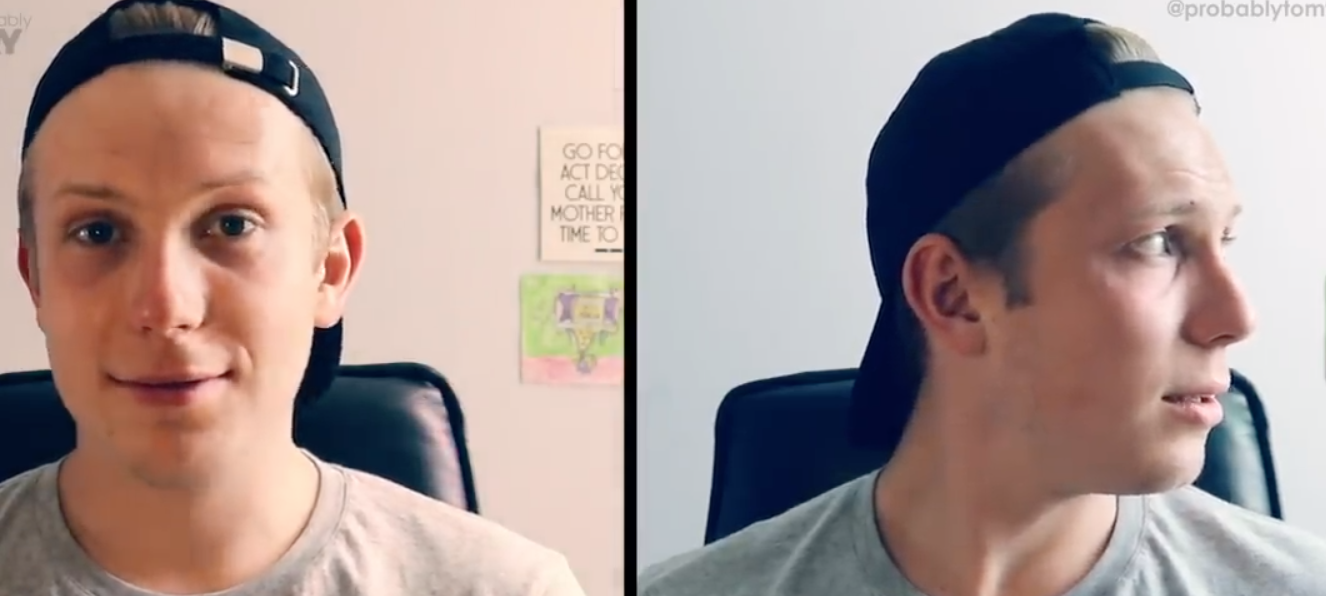
In this video called A Tale of Two Mindsets, the young British poet and filmmaker Tom Roberts provides examples of what each mindset might sound like in dealing with today’s reality.
Roberts also created the poem The Great Realisation, a bedtime story video about the world in March and leading up to it. In 48 hours it went viral and had over 20 million views. Find it at THIS LINK. Roberts uses the name Tom Foolery in his posts.
Tennessee elementary art teacher Cassie Stephens continues to remind her readers that ‘we got this’. And, the reality is that she continues to seek ideas and design lessons that ‘walk that walk’.
Recently she interviewed family doctor Dr. Deborah Gilboa who is a resilience expert and whose skills are in high demand with the pandemic. Cassie learned some tips on how to manage her own stress during the school year and you can listen to part of the interview at THIS LINK.
In her first two weeks in her classroom Cassie realized what she misses most is being able to tell how her students are really doing since she couldn’t see their faces where they normally provide the continuous reminder of feelings. Cassie’s response? She built a lesson around creating facial expressions so each student has the necessary tools to communicate with Cassie. Find the lessons at THIS LINK. I plan to use the idea with my middle schoolers. If you have ideas you’d like to share please contact me at meartsed@gmail.com.
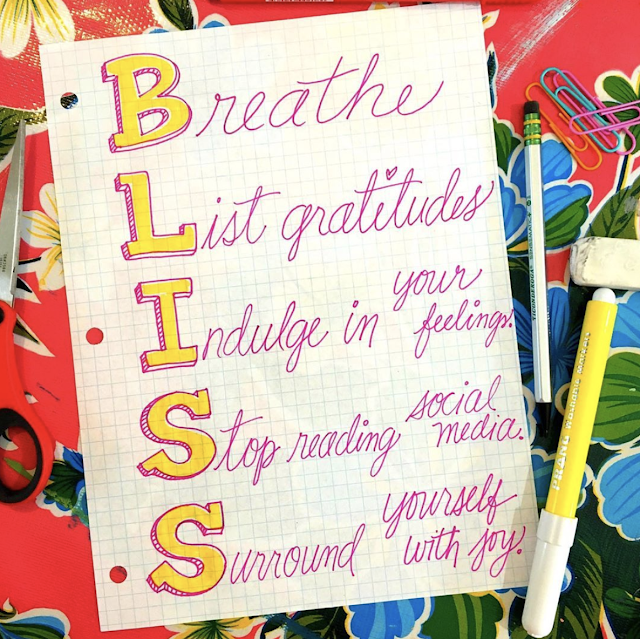
Please remember in order to provide for our students we need to take care of ourselves.
Lindsay, Alex, and myself – Helsinki, November 2020
One of the educators I met while in Helsinki, Finland in 2018 while attending the HundrED Summit was Alex Bell who is the founder and director of Portland Education. One of the first questions I asked Alex was, why would a guy from the UK name his consulting business ‘Portland Education’? I quickly learned that he had gone to school at USM in Gorham and loved Maine so much that he wanted to honor his time spent in our beautiful state, hence, the name. After the summit we stayed in touch with Alex. The ‘we’ is my colleague, Lindsay Pinchbeck, who I traveled to Helsinki with as Ambassadors.
Alex is a likeable guy who has big ideas about education and believes in the power of the voices of children. He was working with a group of educators in a different part of Malawi which paralleled our project in Malawi. Alex has a few projects going on in other parts of the world.
For one of the projects this year Alex teamed up with volunteers, educators, and organizations in the US create the world’s first free online film festival about how to confront, examine, reimagine and create our education ecosystem. Alex says: “If you’ve got kids, are a kid or care about the bigger picture of education in our society, then you really are going to want to watch.” The film festival will include some amazing and beautiful films all about young people and education.
Th!S is Our Chance film festival runs October 6-27, 2000. Sign up at THIS LINK.
Upper Elementary and Middle School virtual classrooms
Start off the year by combining creativity and a willingness to utilize technology for the advantage of getting to know your learners and you’ll be creating a classroom culture that will serve you well throughout the year. If you’re starting the year virtually these ideas from an Edutopia article written by Susan Yergler should serve you well. We all know that unlike in March when we were forced to go remote overnight starting this year with new students provides a different challenge. Below are the authors suggestions for students in grades 3-8 to feel a sense of belonging. Use these activities during the first several weeks of class – short and meaningful to help create the culture.
ICEBREAKERS
Share a drawing or an object that represents their personality or interests. As you move around your virtual classroom from student to student, they will hold their item or drawing offscreen while the rest of us try to remember.
Students complete one-pagers or a Frayer Square on themselves on a shared Google Slides deck and then present to the class.
Include favorite pastimes such as Hangman, interviewing partners in breakout rooms
Flipgrid introductions
Students enjoy a round of thumbs up/down with slide shows of foods, sports, and other images. Instead of (or in addition to) the “two truths and a lie” game, try “two objects and a lie.” That calls for students to show two objects that belong to them and one that doesn’t. After completing these activities, a fun way to cement these impressions is by playing a Kahoot! or Quizizz game about the members of your class
CREATING CLASSROOM RUL.ES AND EXPECTATIONS
Collaborating on a list of classroom rules. Ask them how they envision the virtual classroom that supports their individual learning and the community.
Consider using a plus-delta chart, so that students can indicate what worked well in remote learning in the spring and what they would like to change this school year. You can use a digital idea-sharing platform such as Mural or Google Jamboard to collaborate. The list of rules and expectations will can be displayed on the class’s virtual classroom wall or resource page.
CREATE CLASS TRADITIONS
Establishing classroom traditions can happen online similarly to what happens in a classroom space. Depending on your class size perhaps a bell-ringer or a short journal-writing assignment or a song, dance or art making exercise. Students can be assigned different roles in the tradition you’re establishing.
At the end of a class there can be an exit question like what kind of food you like that most people don’t? Or who is your superhero power? Or have the students brainstorm a list of them and you pick one for each class ending.
COLLABORATIVE PROJECTS
Service learning projects bring students together with the opportunity for them to focus on their strengths.
Solving a community problem – perhaps collecting food to donate to the local food bank. They still exist and food is needed more than ever.
Creating art together by each contributing a photograph or a line of a song. These can be publish in a Google Slide format as a book or digital notebook. Each can contribute to a script and then perform it collaboratively online.
FORGING INDIVIDUAL CONNECTIONS
This is probably the most difficult component of online learning – how to get to know your students individually. Individual conferences on zoom or by google meet.
Emailing each one or sending individual videos for them to respond to.
Good old fashion phone calls make the connection unique.
Responding to their work individually in Google classroom can mean the world to them.
We know that the disconnect existed before with so many people communicating online and not face to face. The pandemic has exaggerated that. Continue trying ideas in a variety of formats for learner. You can make a difference!
Since mid-March Katie Semro has been making the podcast Transmission Timesusing audio diaries from people around the world about life during the pandemic. She’s planning a special episode with the voices of Performing Artists & Artists, and asking artists of all kinds to do one recording answering 4 questions. It’s a fairly easy process and wonderful feeling to participate! Are you interested in answering the questions?
All you need to do is record your answers to the questions below on a smartphone and email them to Katie at ksemro@gmail.com, or call 847-354-4163 and leave your answers as a voicemail.
What impact has this pandemic had on your life?
What role is your art playing for you during this time?
What influence is the pandemic having on your art?
What are you missing the most?
Please send your recordings in by September 15th. Thank you!
Details
When you record please include the date, where you live, and what kind of artist you are, including your name is optional. The stories will be anonymous on the podcast.
If you are using a smart phone Apps like Voice Memos for iPhone and ARS for android work well. Then email the recording to Katie at ksemro@gmail.com — this can usually be done right from the app.
Typically people record for 3 – 6 minutes, but the recordings can be as long or short as you want. Don’t worry about mistakes Katie will edit these out, just speak from the heart.
Katie hopes to collect a lot of responses and will fit as many as she can into the podcast, and the podcast episode may be broadcast on the radio. All of the replies will be saved in the Transmission Times Archive to document this time for future generations.
Katie is an Independent Audio Producer and appreciates your help with this project! If you have any questions, technical or otherwise, please contact Katie at ksemro@gmail.com.
The world loses an incredible voice for creativity and the Arts
In 2006 the first six TED Talks (Technology, Entertainment, Design) were published online. One of them called Do School’s Kill Creativity was presented by author and educator Sir Kenneth Robinson. During that talk and ever since Sir Ken’s life has taken on twists and turns, and his voice and message have been cherished around the world. In fact his TED Talk has been seen more than 65 million times, more than any other. He has inspired educators and worked with governments, corporations, and cultural organizations helping them unlock their creativity. He has influenced classrooms, schools, districts and country’s.
He encouraged all who listen to change the way we do business while criticizing the educational system which he believed was about teaching students to “become good workers, rather than creative thinkers.” For over 20 years Robinson’s message was clear: “A top-down focus on math, reading and testing, at the expense of the arts and creative pursuits, stifled their (children’s) abilities.”
In an 2018 interview with the head TED Chris Anderson Robinson said: “The best evidence of human creativity is our trajectory through life. We create our own lives. And these powers of creativity, manifested in all the ways in which human beings operate, are at the very heart of what it is to be a human being.”
“We have to recognize that human flourishing is not a mechanical process; it’s an organic process. And you cannot predict the outcome of human development. All you can do, like a farmer, is create the conditions under which they will begin to flourish.”
Sir Ken authored and co-authored several books including The Element: How Finding Your Passion Changes Everything, (New York Times bestseller, translated into 23 languages), Creative Schools, Out of our Minds, and You,Your Child and School. Sir Ken was born in Liverpool and led the British government’s 1998 advisory committee on creative and cultural education, which looked into the significance of creativity in education and the economy. For his achievements he was knighted in 2003.
Sadly Sir Ken Robinson died at the age 70 on Friday, August 21, 2020, after an extraordinary life as one of the world’s leading thinkers on creativity and innovation. He influenced my thinking and was an inspiration to the work I’ve done as an arts educator in my classroom and beyond. I’ve watched (and shared) his TED Talk over and over – delivered with humor, grace and filled with wonderful stories. My favorite is the one about Twyla Tharp. I’m so grateful for his offerings and the messages that will live on into the future. I bow down to you kind sir – Rest in Peace Ken Robinson!
“The best evidence of human creativity is our trajectory through life. We create our own lives. And these powers of creativity, manifested in all the ways in which human beings operate, are at the very heart of what it is to be a human being.”
Here we are at the last full week of August and the end to a summer vacation like no other. The Maine Arts Education blog returns today and will continue to provide resources, information, stories from teachers and learners, opportunities and so much more! I know many of you are planning for another odd school year. Schedules will vary from class to class, school to school and district to district with a mixture of half classes, two days a week, hybrid model, remote learning, on a cart, face to face and on and on. I’m certain whatever comes your way that your resilience will serve you well and that you’ll reach out to colleagues to support you along the way. I am continually amazed at the great ideas that arts educators have and on top of that their willingness to share!
Please know that I am happy to support your work in any way that I can. I invite you to share your ideas in video clips or short paragraphs that can be posted here on the Maine Arts Education blog. Please don’t hesitate to contact me at meartsed@gmail.com.
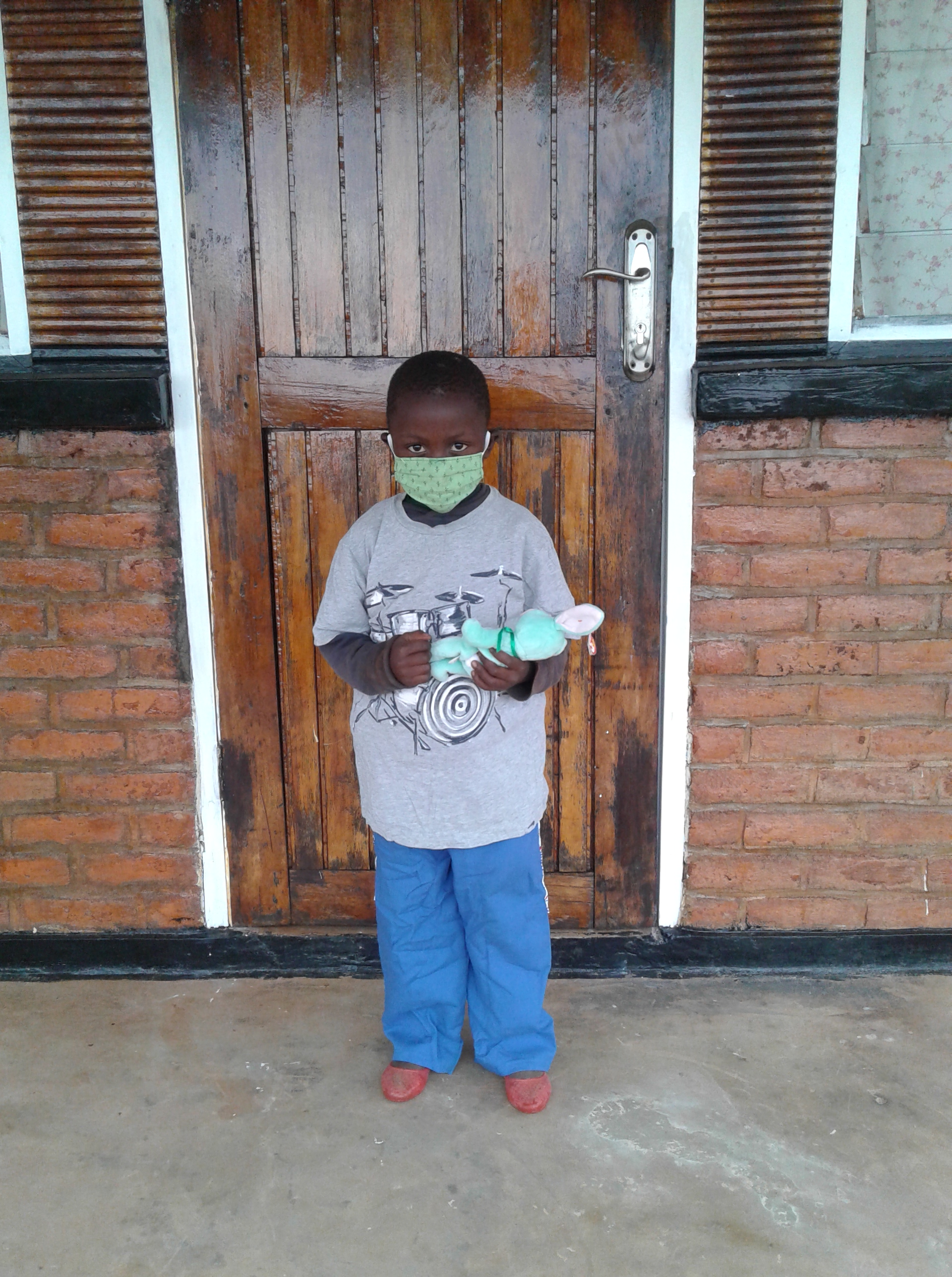
My summer has been filled with reading, exploring teaching ideas, attending zoom meetings to learn how educators are navigating this challenging time, making art, time on the water, visiting with friends and family from a distance, gardening, and canning and freezing food. Many of you are familiar with the work I’ve been part of in Malawi with the Go! Malawi program. Several volunteers sewed 300 dresses and pants for the children, and 300 masks for members of the community. They were shipped on July 29th along with integrated arts education lesson plans. Even though we couldn’t travel to Malawi in June to take everything and to provide workshops we were thrilled we found a way to ship everything. Our friends in Malawi are grateful for the gifts and to everyone who helped!
Argy Nestor
Arts Educator, Blogger, Artist, Connector meartsed@gmail.com
https://sites.google.com/view/anestor/
Argy’s Blog
The purpose of this blog is to share stories about people and places; and to celebrate the amazing work (and play) that students, educators, and organizations are doing in and for arts education. In addition, the blog has a plethora of resources and innovative ideas. This forum gives blog readers the opportunity to learn from each other. It is essential that we listen, learn, and collaborate in order to build on teaching practices for the benefit of every learner in Maine and beyond.









 me arts ed