Sadly, we lost a giant in the arts on Friday, February 4. Ashley Bryan was 98 years old and lived everyday joyfully! His face in the photo below is how I will remember this amazing artist, advocate, storyteller, poet, and humanitarian.
Just a couple of weeks ago I read an interesting story in the Maine Sunday Telegram about a family in Virginia who purchased a home where their great grandparents lived as slaves on a plantation. I thought of Ashley Bryan and his book, Freedom Over Me. I cut the article out of the paper and sent it to him. As Ashley has done in so many books it is a beautiful collection of words and pictures. On the mainland near Ashley’s home on Little Cranberry Island he heard there was to be an auction that included paperwork from a plantation where slaves were held. Interestingly enough, the paperwork was from an auction that was selling 11 slaves. The paperwork described only the necessary items to buy and sell slaves; name, age, height, price, and little else. Ashley imagined much more about these individuals and gave them lives; describing their skills, their hopes and dreams, in poetry and images. Each are alive for the reader on the pages of the book.
Freedom Over Me is one of over 50 books that Ashley has written and illustrated. For years his children’s books have been steady and gently forceful educating on issues of color and racial diversity. He has used song, poetry, spirituals, folktales and much more to share Black culture. He received awards and recognition for many of his books including including two Coretta Scott King awards and the Laura Ingalls Wilder Award. He found joy in telling his stories with people of all ages through singing, tapping and moving. Ashley’s presentations started with a Langston Hughes poem My People. The youtube video below will help you understand why Ashley shared this poem and you’ll hear him reciting.
My People
The night is beautiful, So the faces of my people.
The stars are beautiful, So the eyes of my people.
Beautiful, also, is the sun. Beautiful, also, are the souls of my people.
In 2013 the Ashley Bryan Center was created to to “preserve, celebrate and share broadly artist Ashley Bryan’s work and his joy of discovery, invention, learning and community. The Ashley Bryan Center will promote opportunities for people to come together in the creation and appreciation of visual art, literature, music, and the oral and written traditions of poetry. The Center is fiercely committed to fostering cultural understanding and personal pride through scholarship, exhibitions and opportunities in the Arts.” The center has been doing impactful work since its inception. One component is the distribution of Ashley’s book Beautiful Blackbird. Each year copies are given to schools, libraries, and organizations serving underserved children. To date, over 20,000 books have been distributed in Maine, New York City, Atlanta, and Philadelphia.
I was fortunate in August of 2018 to travel with Central Elementary music teacher Kate Smith to Islesford to meet and visit with Ashley in his home. We were touched by his energy, joy and childlike view of the world. What a gift! We visited the Storytelling Pavilion where we viewed his amazing puppets and stained glass windows. Yesterday I shared the sad news of Ashley’s passing with friend and colleague, Catherine Ring. We agreed that there are some people that should live forever, they enrich every life they touch and make the world a better place. Ashley was one of those people, and fortunately as he reminds us in the video (linked above), that what we create will last. The art he created during his 98 years on this earth will last and there’s no doubt in my mind that it will continue to impact people of all ages in a positive and thoughtful way. At some level his message lives on in each of us touched by Ashley and his work (and play) so he’s not really gone.
If you ‘d like to learn more about Ashley visit the Ashley Bryan Center website. To contribute and to learn what a donation could support visit the donate page on the center’s website.
Earlier blog posts on “Argy’s Point of View” blog are linked below. They are filled with photos, ideas, resources, links, and so much more. One of my favorites is the story of a former student, Aaron Robinson, who collaborated with Ashley to write an African-American requiem for chamber orchestra, choir and spoken voice called A Tender Bridge.
The word watershed (noun) means a time when an important change takes place. Over the years Watershed Center for Ceramic Arts, located in Newcastle, Maine has shifted and grown as changes were needed and I’d say most, if not all, were important to the organization. At its inception the focus was on bringing artists together to learn and create. And, for many years Watershed has offered professional development for educators, many of them Maine K-12 visual art teachers.
Watershed Center for Ceramic Arts story started thousands of years ago. There is an abundance of glacial marine clay from the mountains to the sea because at one point Maine was covered by a giant glacier. Watershed is located in Newcastle, a place that has an abundance of clay with a blue-green tinge. Clay can be found throughout our state along banks of rivers and streams and also in fields. Sometimes it takes time to locate; it can be very pure or filled with other components that need to be picked and sifted out. Fortunately, one of the resources that Watershed provides for teachers is a video depicting the exploration to find clay.
This blog post tells the story of Watershed with several topics; history, philosophy, educationalopportunities, audience, pandemic – ups and downs,changesunderway, and supporting Watershed. Some of the blog content is taken directly from Watershed’s website; some is provided by the founders, teachers who have taken workshops, artist working at the center, and some from staff. A great big thanks to Claire Brassil, Watershed’s Outreach & Communications Director for her assistance with this post.
Original studio space
HISTORY
The history of Watershed begins with the geological gift of clay found along the banks of local rivers in midcoast Maine. For much of the 19th century, the local community relied on vital income from the manufacturing of waterstruck brick (so called because it was made from a wet mixture of clay and water). Waterstruck brick had lasting historical appeal, and in the 1970s an attempt was made to re-establish its manufacture on the site that is now the Watershed campus in Newcastle. While the brick business folded after a year, a group of artists became inspired to make use of the abandoned factory and the tons of local marine clay left at the site.
In 1986, Margaret Griggs, George Mason, Lynn Duryea and Chris Gustin collaborated on a new vision for the brick-making factory—as a place for clay artists to live and work in community. The open layout of the facility encouraged the artists to approach their work with a new vigor and awareness, and the seeds for what would become Watershed Center for the Ceramic Arts took hold.
Founders George Mason, Lynn Duryea and Chris Gustin
During Watershed’s early years, small groups of 10-12 artists would spend the summer living and working together on the campus. The first residents formed connections and friendships in a space that provided opportunities to create without hierarchy. Artists developed their personal work and envisioned new possibilities for a creative community. Watershed soon began to attract artists from far corners of the world who sought a creative environment in which to engage and explore. Today, more than 100 artists a year come to Watershed to create and connect with like-minded makers.
I’ve been fortunate to know Ceramic ArtistGeorge Masonfor many years. In 1987 he created a Percent for Art Project at the new school building where I was teaching in Union. He is an amazing, thoughtful and kind artist. When I asked George what his vision was when he first came together with his colleagues, this was his response:
“You know, this all started among friends inviting friends. We sensed a creative opportunity to find out what might unfold by just living and working together with no aesthetic agenda or expectation of result. Even before the name Watershed Center for the Ceramic Arts came into being after the first season, this place was already a refuge apart from career; where the magic of relationship and creativity had the space to spark the unexpected.“
PHILOSOPHY
Central to Watershed’s philosophy is a belief that the unexpected sparks creativity and that new people, ideas and spaces nurture the evolution of artistic practice. Our dual mission is to provide artists with time and space to explore ideas with clay; and to promote public awareness of the ceramic arts. Through residencies, workshops, public events, talks and exhibitions, Watershed supports the process and work of clay artists from around the country and world.
This video on youtube is very informative.
EDUCATIONAL OPPORTUNITIES, YES FOR TEACHERS
Watershed offers educational programs and resources for grades K-12 art teachers and students of all ages. From workshops and classroom-based experiences, to professional development and online tutorials, Watershed works to support ceramic art educators and the next generation of ceramists.
Watershed provides professional development opportunities; workshops, residencies, and resources. Teachers hone their clay education skills, develop curricula, and connect with other educators from around the state. Watershed provides newly created online tutorials, Digging & Processing Wild Clay and Raku Firing, developed by Teaching Artist Malley Weber.
Teaching Artist Malley Weber who created educational videos for Watershed
“Watershed has been so important to my development as an artist and teacher. We’re incredibly fortunate to have this facility here, in Maine. It serves as a gathering and sharing place for all of the acquired knowledge of the American, and to some extent the international, ceramic scene, at the same time as providing world class studio facilities and learning opportunities. If we think of art as a language, and the different techniques and styles available to us as our vocabulary, working through Watershed allows me to say an entire range of things that I would be otherwise unable to express through my artwork. Having Watershed available to me in Maine means I have the opportunity to say anything I can conceive with clay.”
Winthrop Middle School Art Teacher Lisa Gilman commented after the workshop she attended:
“Watershed nourishes the whole artist. They provide space and time for an artist to grow. They support the artist’s mind, body and soul. Watershed is a rare gem in today’s world. Not once all week did I miss technology or really even think of it. I was able to truly connect and grow as an artist and engage in deep thoughtful art making. Pure magic!”
Vinalhaven’s K-12 art teacher, Heather White, comment:
“I’ve participated in countless professional development opportunities over the years, and my time spent at Watershed ranks at the very top of the list. The instructor and everyone on the Watershed staff was knowledgeable and encouraging, I got a lot accomplished in a short time, I’m going back to my classroom with new and fresh ideas, everyone I met was fun and friendly, and the food was amazing! Hopefully every art teacher in the state has an opportunity to go at some point!”
Teaching Artist Malley Weber demonstrates to a session with art teachers
AUDIENCE
Watershed’s audience is wide and varied. From artists who have different focus to teachers looking for learning opportunities to communities members who appreciate and wish immerse themselves and support ceramic programming. Some of listed below.
Artists who can work independently in a clay studio and come from Maine, around the country, or abroad take part in our residency program. We aim to foster community and connection among practicing artists at all stages of their careers, from students and recent graduates to established professionals looking for an opportunity to connect with other ceramists. Scholarships are available for all populations. For example in 2017 The Zenobia Fund was established for BIPOC artists, Black, Indigenous, and People of Color (BIPOC)
Artists with some experience in clay who are looking to further their skills and knowledge. Guest artist and kiln firing workshops are available.
Maine K-12 educators and students. The teacher education program prioritizes skill-building and technique-sharing in clay for Maine’s art educators. Teachers know their students best and can tailor what they learn at Watershed to suit their particular needs and interests. The teacher sessions also provide an opportunity for art educators who usually work solo to connect and collaborate.
Watershed offers some programs for student groups as well. Art classes come to campus to learn about Raku firing.
Ceramic art lovers & appreciators. While the bulk of our programs prioritize hands-on learning for artists, Watershed offers opportunities for the public to learn more about and appreciate ceramic work via exhibitions, artist talks, special events, and Salad Days, our annual fundraiser and celebration of ceramic work.
PANDEMIC– UPS and DOWNS
In person Watershed programming was on hold during the summer of 2020 due to the pandemic. However, the timeline for the building of the new studio (see more under ‘changes underway’ below) was pushed forward and completed more quickly since the campus was quiet.
New ways for artists to create and connect became a priority and the following are some of the programs developed:
Online gatherings for artists around topics that mattered to them. For example a partnership was formed with The Color Network and Ayumi Hori to facilitate online conversations for artists who focused on racial equity, economic parity, and creativity during Covid-19.
Kiln firing opportunities for Maine artists during the summer were available since because they’re usually in constant use by artists-in-residence.
An outdoor sculpture exhibition called “Outstanding in the Field” (details under “past exhibitions”) supported clay artists and offered the public an opportunity to safely view work outdoors.
During the last 20 years or so Watershed has been able to maintain and upgrade some of the facilities on the property. They built and fully insulated artist cabins, built a kiln shed, and updated Thompson Hall to name a few changes.
Phase 1, 2015-17: Included project planning, a feasibility student and conceptual facility designs. From this first phase action has taken place and so many wonderful and much needed changes have occurred.
Phase 2, 2018-19: A beautiful historic building, the Joan Pearson Watkins House is located about a quarter mile down the road from the main campus. Watershed purchased the house and the accompanying 20 acres, which abut the land that leads to the studio. It was renovated and restored and holds Watershed’s Barkan Gallery, which offers year-round exhibition, lecture, and event space. Watershed’s administrative offices and retail shop are also located in the house.
Phase 3, 2020: Studio Annex provides climatized, flexible space for adjunct programming and material and equipment storage.
Phase 4, 2021-21: Windgate Studio is a 7,500 square foot studio, weatherized and ADA-compliant, supporting an expanded residency and workshop season. Features include a state-of-the-art filtration and ventilation system, spacious glaze area, custom spray booth, plaster room, and a single-level floor plan offering a seamless transition between studio and kilns.
Supports artists working on commissions or large scale projects.
Brings (inter)nationally-known guest artists to lead workshops.
Provides opportunities for student groups to make and fire work.
Enables Watershed to collaborate with partner organizations.
Offers space for artists to create and connect throughout the year.
Tap into limitless potential!
Recently opened Windgate Studio
Phase 5: Campus Commons design and construction, 2022-2023. The Commons will replace the existing Thompson Hall. The plan includes comfortable dining facilities, a commercial kitchen, and weatherized housing for staff.
SUPPORTING WATERSHED
After reading about Watershed you might be wondering how they’ve been able to accomplish so much. Like anything successful they’ve had a vision, commitment from amazing staff and supportive board of directors and advisors. And, they’ve had donors (small and large contributions) who have contributed generously to the mission and success of Watershed. Their Capital Campaign called ‘Watershed NOW’ is creating spaces that inspire bold artistic practice and community. LEARN MORE.
There are opportunities to support Watershed with donations to the scholarship fund, the capital campaign, and the annual fund. Occasionally, Watershed seeks volunteers for specific events and projects.
Watershed is well-known in the national ceramics community but has perhaps less name recognition in Maine. As capacity for year-round programming grows, Watershed plans to offer more ways for Mainers to connect.
Co-founder Lynn Duryea shared her remembrance and thoughts on Watershed:
It really was Peg’s vision that got Watershed going. She was a long-time seasonal resident of the area and an investor in the brick factory. When it ceased to be financially viable, she really wanted to see artists use the space, did a lot of outreach and research to see how that might happen, contacting clay programs as well as individual artists. She knew George and ultimately convinced him to try the pilot program in 1986. George invited artists he knew and who had been recommended to him. He invited me because I was working on large-scale planters for a Percent for Art installation that couldn’t be executed in my Congress St. Portland studio. He knew Chris and invited him to come with his students at Swain School of Design early in the fall. I was still working at Watershed when Chris came with his students. It was conversations that came out of that week that moved us forward. I don’t recall that we were looking too far down the road – as it were. I don’t know that we were thinking we were laying the groundwork for what would become a major institution in our field. We definitely saw the potential of a group of people coming together to work in what was then a very raw space, just to see what might happen collectively and individually. Watershed has always been about community – people working together on an equal footing regardless of their reputation, status, age, etc. Watershed in its early years was about as grass roots as you could get: a group of artists and a small board of directors figuring it all out. And it has worked. The growth has been organic, uneven and amazing, particularly amazing in the last decade. Fran (Rudoff, executive director) has worked wonders – along with a very dedicated staff and board. In no way did we envision the specifics of Watershed’s programming today in the fall of 1986, but we knew something significant could happen. And it has, by putting one collective foot in front of the other for all these years, never giving up on the ideas and potential.”
NEXT STEPS
Hopefully you’ve read to the end of this long blog post. And either learned about a new place in Maine or reminisced about your own experience(s) at Watershed. It’s a beautiful gem where thousands have traveled to, learned, and left with a full heart. When I think about the co-founders (in their 30’s at the time) who were brave enough to take a chance, I am reminded of Vincent van Gogh’s words: “What would life be if we had no courage to attempt anything…”
I am grateful for the help Watershed’s Outreach & Communication Director, Claire Brassil provided in putting together this blog post. As for the future of Watershed, Claire’s thoughts below:
In the spring, we celebrated the building’s completion and collectively reoriented after such a rapid metamorphosis. The studio can contain any program we dream up. But … how will Watershed’s limitless future take shape? As an organization known for its scrappy rough edges, what will it mean to nurture the best parts of our original identity while making the most of our shiny new vessel? These coming-of-age throes find us wrestling with invigorating yet challenging questions of who we’ve been and who we want to become.
The shape and scope of Watershed’s next chapter will begin to emerge over the coming year. I feel confident that my colleagues, the board, and our greater community share a collective passion for refining and growing this unique place. Watershed is a quantifiable physical space: 54 acres, 7,500 square feet of studio space, 31 dining room chairs, 15 bedrooms, 11 kilns, and one gallery. But in an equally real sense, we are an experience, an idea, and a respite during an era when few places affirm that creative practice and artists matter.”
Blowing glass is magic – ask anyone that’s done it!
Waterfall Arts in Belfast realized that they had a unique opportunity offered to them during the pandemic. But they faced many challenges just trying to get the idea off the ground. With a positive attitude and a new partnership their journey is already making a huge impact. This is the story of how that came about and a reminder of the importance of commitment, collaboration, and believing in an idea! Without these in place the dream would not reach fruition. And, it’s only at the beginning! I recognize and celebrate Waterfall Arts and their new partnership and what they’re providing for learners of all ages, especially local high school students.
PLEASE NOTE: At the end of this post I invite you to leave a comment and/or to use the questions for a local conversation.
BACKGROUND
Veteran glass blower David Jacobson realized his well established glass blowing business, Jacobson Glass Studio in Montville, was at a crossroads when the pandemic hit. In September 2020 David approached Waterfall Arts and spoke to Executive Director Kim Fleming about donating his glass studio equipment to Waterfall. Realizing what an opportunity this was Kim enthusiastically consulted with the Waterfall board. They agreed and collaborated with David and his glass blowing colleague Carmi Katsir to transform the Waterfall Arts basement into a glass studio.
David and Carmi demonstrating
THE STORY
When I listened to their story I was amazed how quickly things happened. David first communicated with Kim in the middle of September 2020 and during the first week in October the equipment was moved into the building. In the spirit of true artists they climbed over the logs in their pathway to problem solve, research, ask questions and learn, and find ways to attack the challenges. Combined with hours and hours of work, physical and mental, and financial support from funders and the greater community they opened the studio with a variety of purposes in mind.
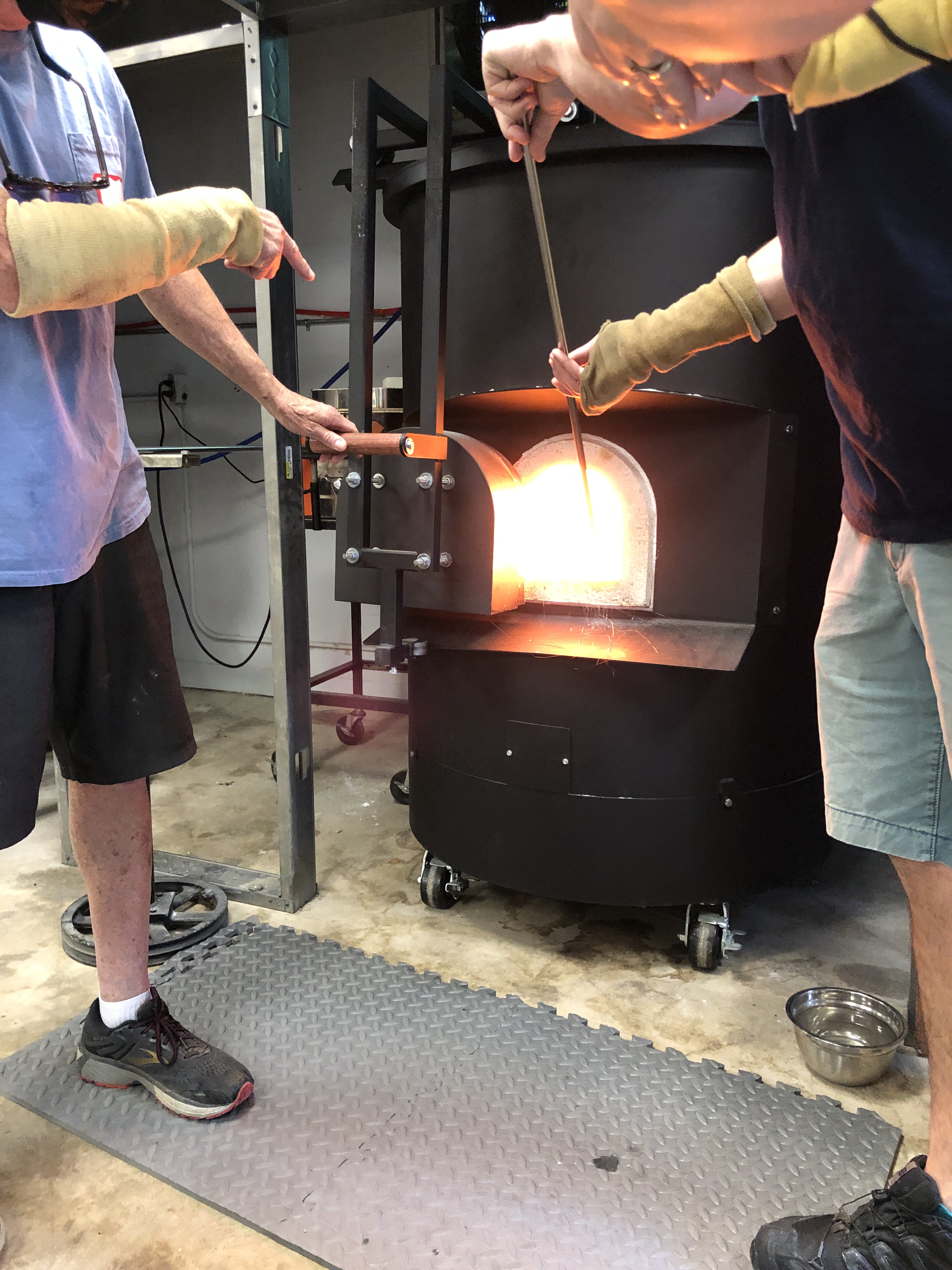
Before they could open the studio there were many details to figure out besides just putting equipment in place. Investing money in this project was an enormous commitment. Kim secured funding from individuals and foundations including $10,000 to be used for disadvantaged students. The budget to run the program for two semesters is $25,000. One of the bigger hurdles was how to fuel the furnace that holds 100 pounds of clear, liquid glass and is kept at about 2,100 degrees. Plus the two forges that are used to heat up the glass as a piece is being formed and is kept at 2,300 degrees. Waterfall’s philosophy includes a commitment to be as green and as carbon-neutral as possible. So using natural gas or propane was not feasible. They researched to learn how they could build the system using discarded vegetable oil that is donated by a local donut shop. There are no models in Maine so it meant communicating with people outside of the state. They also learned that along with being the only community based glass studio in Maine they are only one of a handful of programs in the entire country that offer glass classes through the public school for students.
Miles opening the glass
WATERFALL ARTS STUDIOS
Waterfall Arts ceramics, printmaking, and photography studios are well established at the non-profit organization. Adding a glass studio was an easy decision but with filled with unknowns. Kim was able to acquire funding to purchase what they needed and build on the equipment and tools that David was providing to make a studio large enough for several people. David really wants to share his love for glass blowing with as many people as possible. So there are classes available to anyone from almost any age, no matter what their financial situation. David’s passion coupled with Waterfall’s goal of reaching others, who have not had this type of opportunity in the past, is a perfect marriage. It wasn’t long after the studio was set up that they began offering classes to individuals and groups. During the summer many people took advantage of the studio.
MAINE ART EDUCATION ASSOCIATION FALL CONFERENCE
I had the privilege in September to participate in the Maine Art Education Association (MAEA) conference. Hats off to this year’s conference planners Brooke Holland and Anthony Lufkin who shifted from the traditional conference at Haystack Mountain School of Crafts, due to the pandemic, and planned sessions in 12 studios across the state. I was in the glass studio at Waterfall Arts and it was a spectacular and fun experience. I was so impressed with the teaching of David and Carmi. I had only one previous glass blowing experience and this was quite different and extensive compared to that one. Our abilities varied greatly and yet the participants easily collaborated and supported each other making four pieces during the 2-day workshop.
Collaborating to open the top of the glass to form the shape
WATERFALL ARTS’ STORY, PURPOSE AND MISSION
To create community in harmony with nature through the transformative power of the arts. When the founding group of Waterfall Arts formed the idea in 2000 their shared goals for the future: to create aesthetic experiences that enhance and inspire people’s creative abilities and transform their lives. An equally important goal was to reach people who had not had such opportunities before.
Along with the studios used for classes and by individuals Waterfall has 16 private studios which are fully occupied at this time. During the pandemic it was difficult for some of the artists to pay rent. Waterfall was able to support these artists by waiving 2 months of rent. An amazing gesture to support individuals who needed it most.
In addition, Waterfall Arts has a variety of ongoing programs and events that are available year round. I suggest you spend some time on their WEBSITE.
Gathering glass
BELFAST AREA HIGH SCHOOL CLASS
In January 2021 the principal, Jeff Lovejoy, contacted Kim to learn what might be available for Belfast Area High School students to take for a semester long elective class. The high school building is a stone’s throw, across the road from Waterfall, so the outreach from school is a no-brainer. Mr. Lovejoy visited Waterfall for a walk through and discuss possibilities. He got excited about the glass lab. Kim put together a budget proposal to run a semester long class, twice a year. Kim scurried to secure funding in time to promote the class for the fall semester.
Jonah rolling the glass on the marver
PROCESS
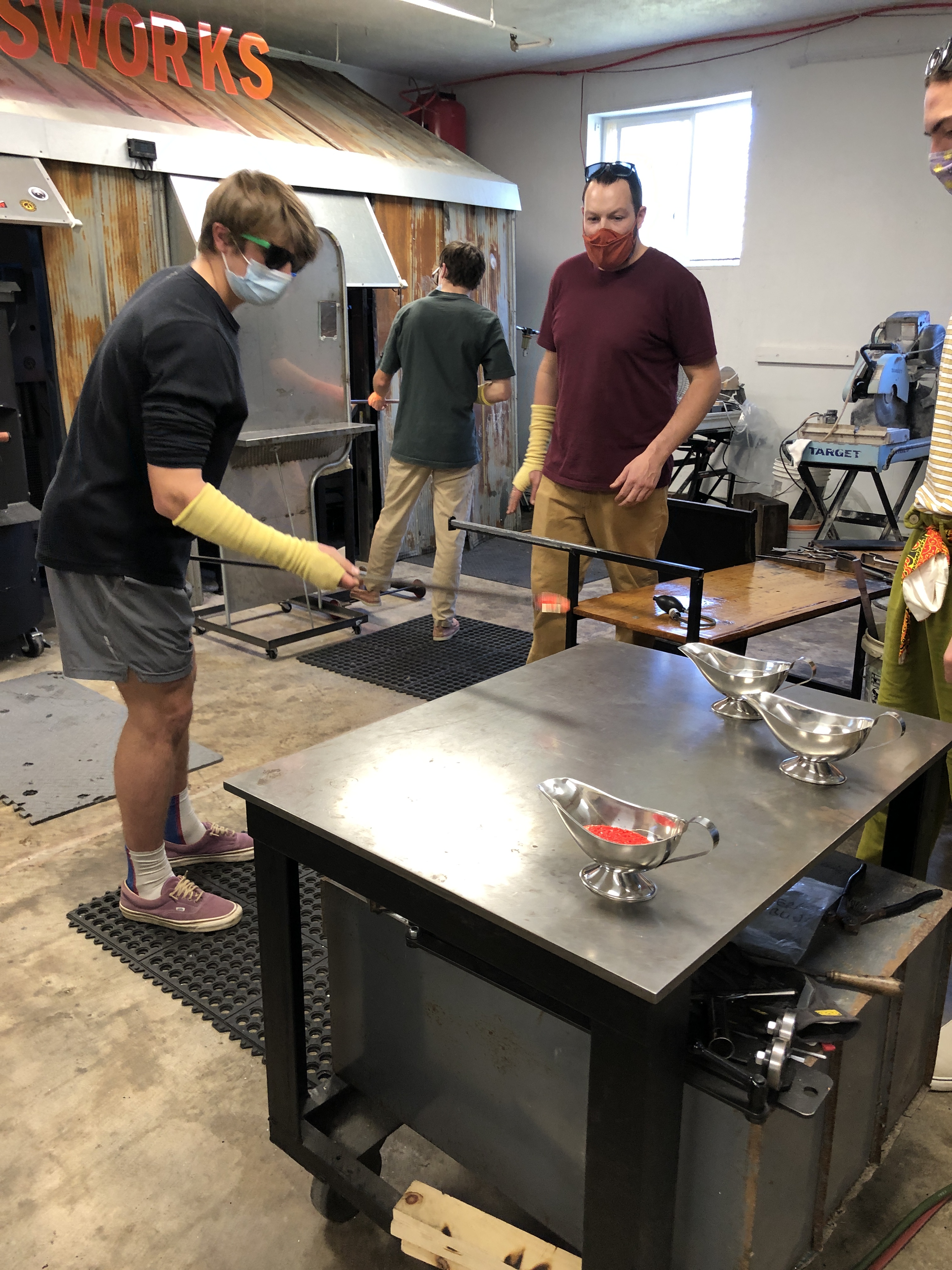
There are not a lot of tools needed for the process of glass blowing. Steel rods are kept warm and dipped into the molten glass which sticks to the metal when ‘gathered’. The ‘gather’ is rolled on a thick steel table called a ‘marver’. Color can be added by rolling the clear glass in pieces of colored glass on the marver and put into the forge to keep it hot enough to manipulate. The entire time the rod is being rotated. The next step includes sitting at a wooden bench where the liquid can be shaped sometimes with a wooden paddle, a wooden cup with a handle, shears and/or tweezers. Several times in between forming the piece it is put back into the forge to maintain the heat. When completed it is taken off the rod with a bit of water to break the seal and a tap on the rod. The entire process is magical to do and to watch.
CLASS BENEFICIARIES
I had the chance to visit the high school class, watch David and Carmi teach, and have conversations with some of the six students enrolled for the weekly semester class. In a word the entire experience for me was IMPRESSIVE. I’m sure some of my response is based on my 2-day class in September. Part of it is based on the ease with which the seniors handled the glass and navigated the tools and space. And, a lot of it comes from the teaching and collaborative spirit of the classroom/studio culture. We know that a teacher sets the tone and David and Carmi are TOP NOTCH! The students were serious about their work while having fun. I could see their confidence growing as they went through the process. Mr. Lovejoy said: “I am thrilled that Waterfall Arts, Carmi and David have been so accommodating to make this work for Belfast Area High School. I am excited to bring students from the Belfast Community Outreach Program in Education (BCOPE, the school districts community based alternative educational program) and underclassmen into the spring semester starting in February”.
Paddling the base to flatten it
STUDENTS COMMENTS
Ronin: “I was surprised on day 1 how we jumped right into the process even without any previous experience.”
Anna: “There is so much collaboration, that is a surprise. Each class has a different goal but we’re learning techniques that I didn’t realize I would use again and again. Like the ‘starter bulb’ we learned our first week while making pumpkins. I use it every class.”
Miles: “Everybody should do glassblowing – it’s awesome. It’s less scary than I thought it would be.” Miles is only applying at colleges that offer glassblowing.
The workspace with tools
DAVID AND CARMI
I’m impressed with the level of teaching. Many successful artists are not good at teaching. David and Carmi are successful at both. Watching them in action with the high schoolers is magic. They’ve been pleased and/or surprised about the following:
every week the students are enthusiastic about learning
student team work is amazing – they’re very generous and helpful to each other
very dedicated
we communicate with them like we would with adults
thought they would be more ‘product’ oriented, instead they are ‘process’ focused
2 hours is not enough, extended class time to 3 hours for those who can stay longer and they all do
students are fearless
David and Carmi will make some changes for the next semester based on what they’re learning this first semester with and from the six seniors. Like any good teacher this information will help them build and expand on the program for the future. Between the dedicated staff and the establishment of this new program I’m certain we’re going to hear about this fantastic Waterfall program for many years. Kim is working to make Waterfall Arts everybody’s place, a destination. Not just through programs but also taking care of the maintenance on the building. The capital campaign has raised funding to replace the roof, re-surface the parking lot, and plans to replace 72 of the buildings windows. The glass studio expands Waterfall’s creative involvement. Kim said: “People want to be part of something successful. Our future is bright.”
Glass with a pinched handle
ARE YOU CURIOUS?
Perhaps you’re one of those people who would like to become part of something successful or you’re curious. If so, be sure and plan a trip to Waterfall Arts. If you’re interested in learning more about how you can get involved, take a class or perhaps give someone a unique gift of a 2-hour class for the holiday please go to Waterfall’s website at THIS LINK. If you’re interested in supporting the program please contact Kim Fleming at kim@waterfallarts.org.
FOLLOW-UPQUESTIONS for you to ponder, discuss with your own community, use as a starting place for a conversation to start doing work (or play) differently or by responding to the blog below in the section called ‘Leave a comment‘ or ‘Like‘this post.
Why are the Belfast High School seniors so successful?
What makes this collaboration with Waterfall Arts, Belfast High School, and the glass studio so beneficial?
What are some ideas to make this into an interdisciplinary unit in the school curriculum with perhaps Art, Science, Writing?
Is there a potential partnership brewing in your community? What can you learn from the glass studio at Waterfall that might help in your partnership?
What are you already doing in your own work (or play) that mirror success?
If you’ve never been to the botanical gardens in Boothbay I suggest that you add it to your list of places to visit. The Coastal Maine Botanical Gardens has an exhibit of trolls. Now, these are not just any ordinary trolls but very large, interesting and each one has their own story. The exhibit is called ‘Guardians of the Seeds’ and the 5 trolls were created by Danish artist Thomas Dambo. Some of you know that I studied in Denmark while a junior year in college (100 years ago) so an exhibit by a Danish artist touches my heart. For me the magic of the little Scandinavian country is interwoven in the exhibit throughout the beautiful forest found along Back River.
I met music teacher Kate Smith and her family at the gardens on one of the hot and humid days last week. You might think there was a breeze since the gardens are located on the salt water but nope, not that day. We did our best to ignore the heat and to be honest it wasn’t hard since the trolls are so amazing.
The Botanical Garden makes education a priority and they do a really good job in all of their gardens so anyone can take the time and learn as they tour. The Guardian of the Seeds exhibit is no different. Walking through the woods is beautiful and at each troll there is ‘lesson’ that teaches why each part of the tree is important to the forest. Each troll’s clue helps visitors eventually find the ‘seeds’.
The Trolls
SOREN: Branches
LILYA: Flowers
GRO: Leaves
ROSKVA: Trunk
BIRK: Roots
ROSKVA and the Smith family and friends
It takes some time to walk from one troll to the next but well worth the adventure since each one is different and their personalities really come through. Plan about 3 to 4 hours for visits to all 5 plus the seeds.
Learn more about the trolls at THIS LINK. You can also use google to find video footage of them on youtube.
I can’t wait to go back and see this one in the winter with his beard filled with snow. The exhibit is scheduled to be there from 3 to 5 years. I do hope that you’ll have a chance to visit the trolls.
This would be a great topic to use to design stand alone and/or integrated curriculum lessons about. So many ideas popped into my head as I walked along the trails. If you can go, please do, you won’t regret it. This would be a great use of the Maine Arts Commission Ticket to Ride funding to help pay for your busses to transport students there.
Here’s what one teacher did since they couldn’t sing during the pandemic. Students of Saint-Michel-Garicoïts de Cambo School, in the Basque region of southwest France, have given a *striking* performance using their bodies. Using an elaborate mixture of claps, leg slaps, stomps, finger clicks and taps, the 185 students transform the orchestral movement into a body percussion. The sound is fascinating and to top it off a drone recorded the performance. The ensemble rehearsed in groups of 50 every day for five months during the 2020 school year. All students are masked in the final performance, one to remember as part of their pandemic learner.
The story was shared on Classic fm digital radio and found at THIS LINK.
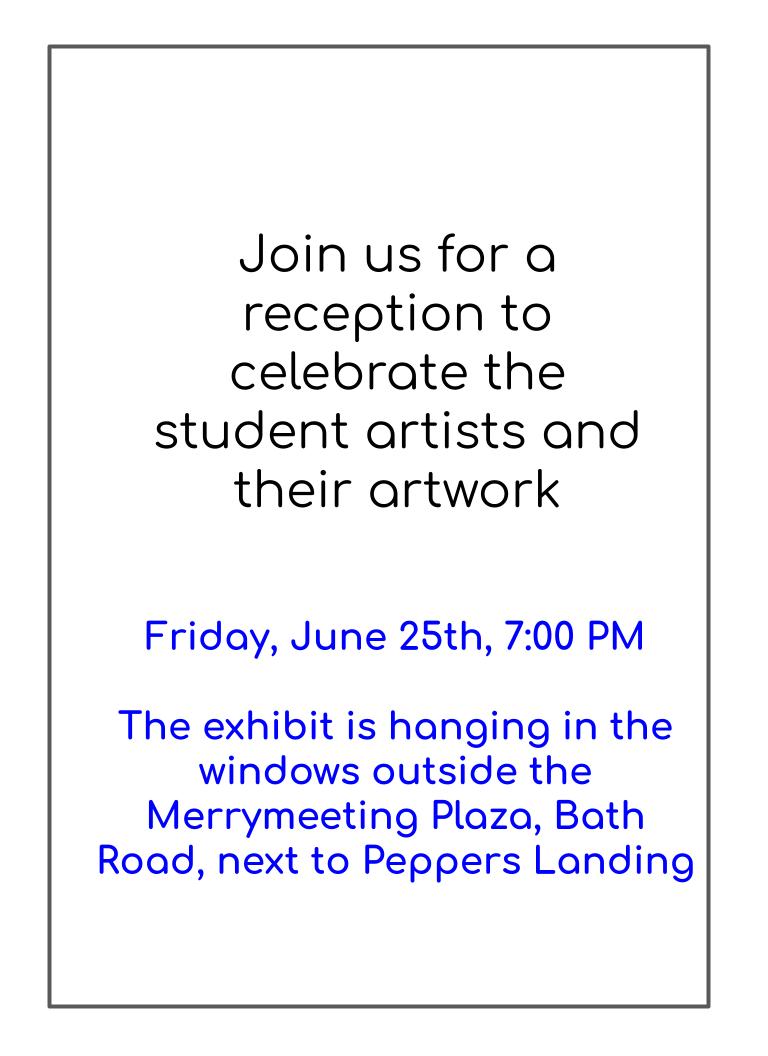
How We See Now, New Dimensions of Photography is an exhibit of works by Brunswick High School photography students hosted by Brunswick Public Art and Merrymeeting Plaza. The work seeks to question how photography can be used to visualize new realities. Students worked with the Portland artist Justin Levesque, One Dynamic System, in a virtual visiting artist residency sponsored by a grant from the Maine Department of Education with support from the Maine Arts Commission. Deconstructed and reconstructed photographic images allowed students to question our perception of reality. Photographs become manipulated into new imagery utilizing digital tools such as Googles Poly and Photopea. Come drive by this window exhibit in Brunswick at 147 Bath Road next to Peppers Landing. The work will be on exhibit from June through August.
Curious about the Maine Arts Commission (MAC) program, Maine Arts Education Partners in Leadership (MAEPL)? Wonder why you should consider applying? Listen to arts educator and veteran MAEPL Teacher Leader Charlie Johnson at THIS LINK explain his reasons and the benefits that he’s experienced during his ten years of participation!
DEADLINE TO APPLY IS TOMORROW, JUNE 22, 2021! DON’T DELAY!
Interested in getting together with other Maine Arts Educators and Teaching Artists? Learn more about Maine Arts Education Partners in Leadership (MAEPL) and consider applying to attend the summer institute and become a Teacher Leader or Teaching Artist Leader for the 2021-22 school year.
At the Summer Institute new Teacher Leaders and Teaching Artist Leaders will learn foundational practices in instructional design and leadership skills. Participants will take part in a variety of workshops focused on emerging needs in Arts Education professional development.
Collaboration, networking, and the sharing of resources are an expectation as a member of the MAEPL community. During the Institute participants will develop an individualized growth plan that will be shared with others for feedback and suggestions.
Throughout the school year, participants will continue to share how their individualized growth plan is developed and implemented, and they will have the opportunity to share at a Critical Friends Day, and with a thought partner.
There is a Winter Retreat with participants to review and reflect on the work done, and allow for time to get feedback to plan for the next Summer Institute.
JOIN US! Become a Teacher Leader and Change Lives.
APPLY TODAY — CLICK HEREJune 22, 2021 deadline for new and returning applicants
IMPORTANT THINGS TO KNOW:
SUMMER INSTITUTE
Pilgrim Lodge is a camp run by the United Church of Christ of Maine on Lake Cobbosseecontee in West Gardiner, with cabins with electricity and plumbing, large indoor and outdoor meeting spaces, modern dining facilities, wifi in main buildings and good general cell reception, and recreation options, including swimming, human-powered boating, and trails.
APPLICATION
Administrator Name/contact information
Paragraph of Interest — Selected individuals will be expected to be active leaders in helping to develop and support excellence in teaching and learning in Maine. A full commitment to the Institute timeline is expected as seen in the online information sheet. Please attach a brief overview of your interest and current/past experience (if any) in Leadership. Include your experience collaborating with other arts educators and experiences relevant to the initiative. (Please no more than ~ 500 words, about 1 page.)
Resume/CV — If you are a Teaching Artist, please also include websites or documentation of your teaching work.
Letter of Reference – TEACHERS: This should be from your administrator. TEACHING ARTISTS: This should be from a school or community organization with whom you have worked. Please attach a Letter of Recommendation in which the person includes comments and/or examples reflecting your leadership potential and your ability to work collaboratively. Selected individuals will be responsible for sharing their newly developed expertise and related classroom experiences with other arts educators.
Questions? Contact Maine Arts Commission Director of Education, Martha Piscuskas at Martha.Piscuskas@maine.gov.
Interested in bringing TED-Ed Student Talks to your classroom or school next year? You have until July 15th to apply!
The standards-aligned TED-Ed Student Talks Program supports students as they discover, explore and present their big ideas in the form of short, TED-style talks. If you’re an educator at a school or educational organization, apply to receive our free program resources and step-by-step instructions in time for next semester. Don’t miss this window!
What is the Student Talks Program?
A curriculum to help your students develop their best ideas.
A space to amplify students’ ideas around the world.
A program that connects students with other groups around the world.
There are two more application cycles this year.
Application cycle 2:
Opens on April 1 and closes on July 15. Applications submitted during this cycle will receive approval on August 1.
Application cycle 3:
Opens on August 1 and closes on November 8. Applications submitted during this cycle will receive approval on December 1.
Click here for the Information Packet. Click here to apply. This program is underway isn 130 countries around the world. Seems like a great way to connect your students with others.
Argy Nestor
Arts Educator, Blogger, Artist, Connector meartsed@gmail.com
https://sites.google.com/view/anestor/
Argy’s Blog
The purpose of this blog is to share stories about people and places; and to celebrate the amazing work (and play) that students, educators, and organizations are doing in and for arts education. In addition, the blog has a plethora of resources and innovative ideas. This forum gives blog readers the opportunity to learn from each other. It is essential that we listen, learn, and collaborate in order to build on teaching practices for the benefit of every learner in Maine and beyond.








 me arts ed