“There is nothing more rewarding than being in a room full of students who are productive and teaching each other the skills you have shared with them. When all the art rooms are full of active learners at every level and they are teaching each other a broad range of skills, that feeling is intoxicating. I still marvel at it to this day and I cannot think of anything like it.“
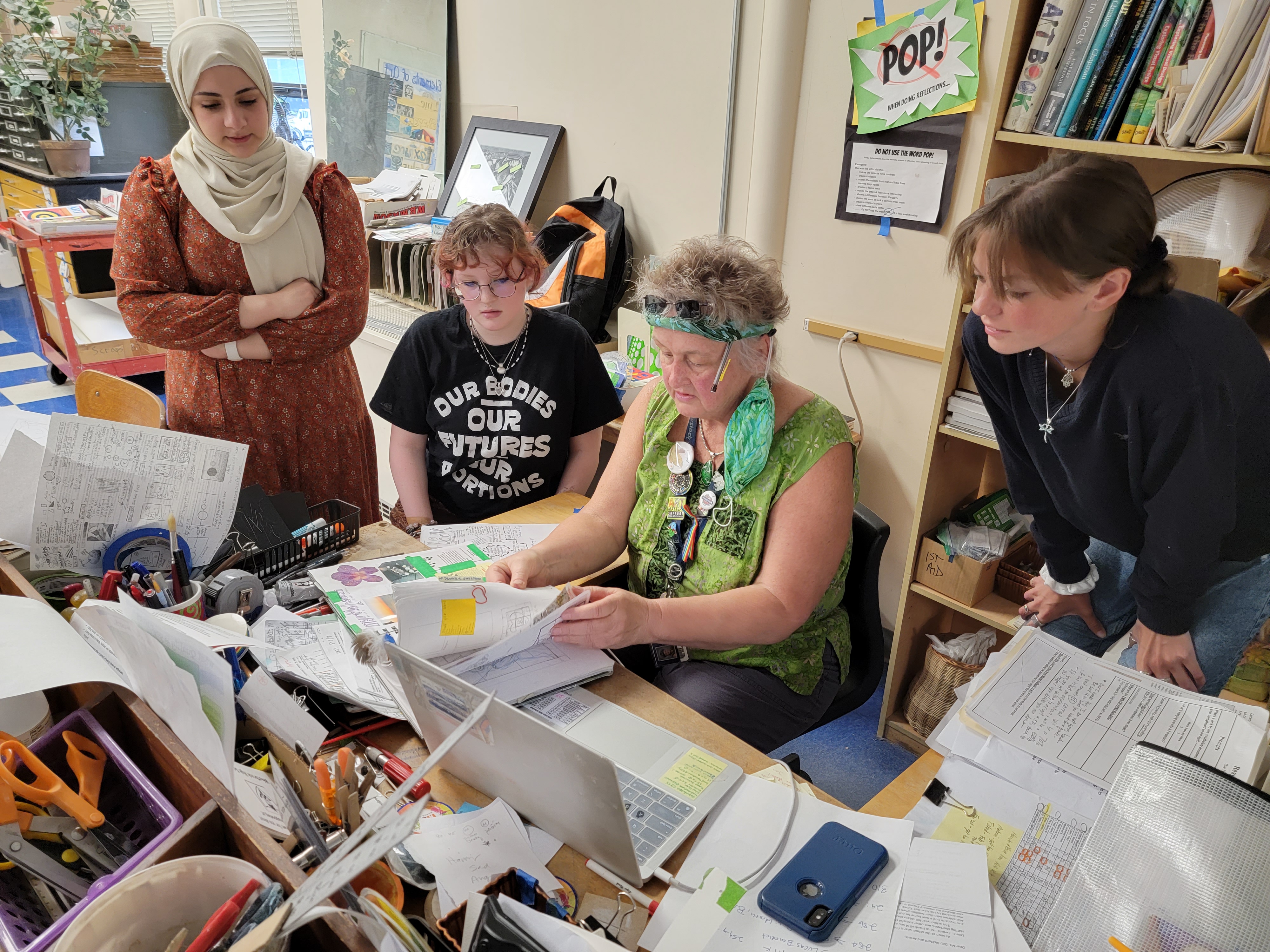
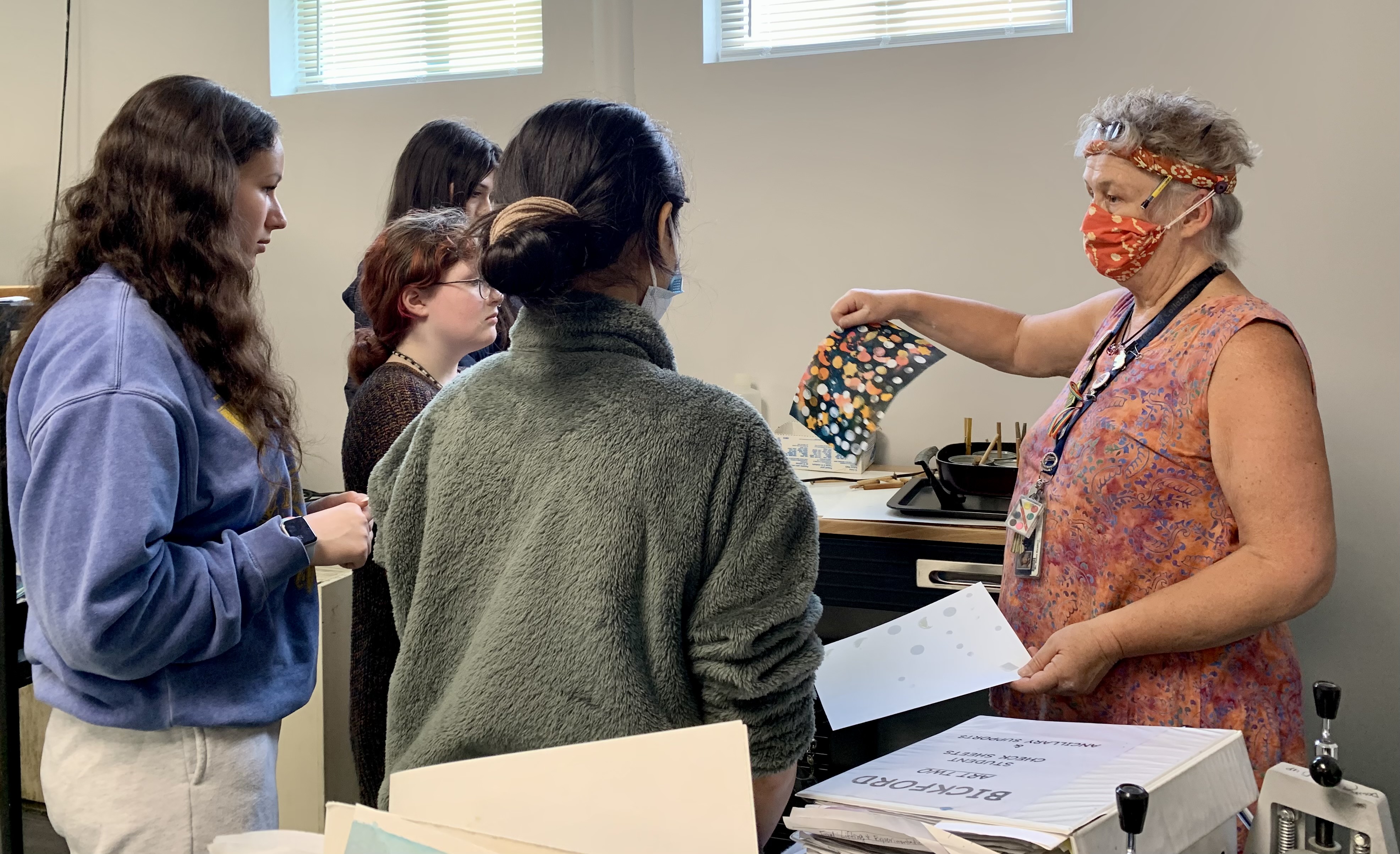
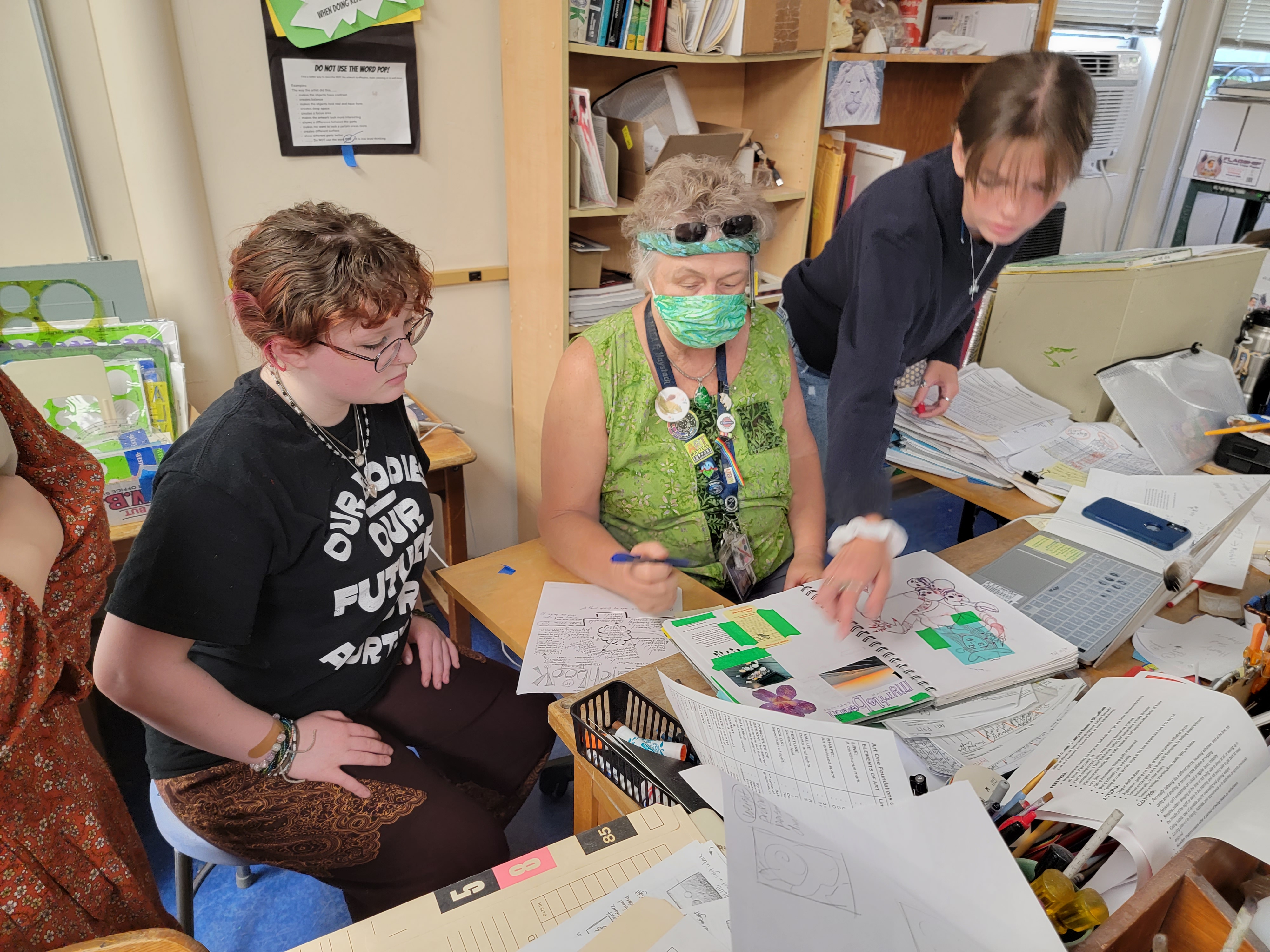
Debra Bickford, better known as Deb, is retiring this year after 37 years teaching visual art. Her career started at Wells Jr. High School (1 year), she moved on to Westbrook Middle School (2 years), and she is ending her career at Westbrook High School (34 years).
Her early experiences as a student have influenced her teaching and her life. She learned at a young age that she loved learning but didn’t care for school. When she arrived at Maine College of Art & Design – then called Maine College of Art (MECA), she fell in love with being in a space where people were hungry for learning about the same thing. She earned a Bachelor of Fine Arts from MECA and went on to the University of Southern Maine where she received a Bachelor of Science degree in Art Education. During her formal learning she was engaged in pre-service teaching at Waynflete School in Portland and student taught at Gorham Schools and Thornton Academy in Saco.
Deb and I had a conversation about her teaching career and what became clear is her passion comes through every single day in and out of the classroom. She has positively impacted thousands of students! She’s proud of the fact that she is honest with students, even when it is hard. And, she has NEVER taken a sick day! Many people have influenced Deb over the years. She’s had the opportunity to work with many positively astonishing educators who have shown her what excellence looks like and how to make it happen.
“It would be really inspiring to make some sort of visual map or “who” and “what” I learned from so many. Like a mind map with art education inspiration at the center and people fanning out all around the center.“
I hope Deb takes the time to make this visual map and send a copy to everyone on the map. It would be an amazing representation exhibiting the numbers that influence teachers!
Deb has had many unforgettable moments during her 37 years in the classroom. Here are a few highlights:
The day a student in my adaptive art class shared how much her family loved her art work and said: “I never knew I could be an artist”.
The day both parents met a students guidance counselor at 7a.m. to have her drop another content area to start Pre-AP Studio Art. The student had made the request but was told she had already had an art class. That same student went on and received a $10,000 scholarship at class night and earn a BFA in Painting at MECA.
The many texts, visits and emails from students thanking me for preparing them to be successful in college level visual arts classes. Many have even reported being asked to lead critiques in class. This makes me so happy.
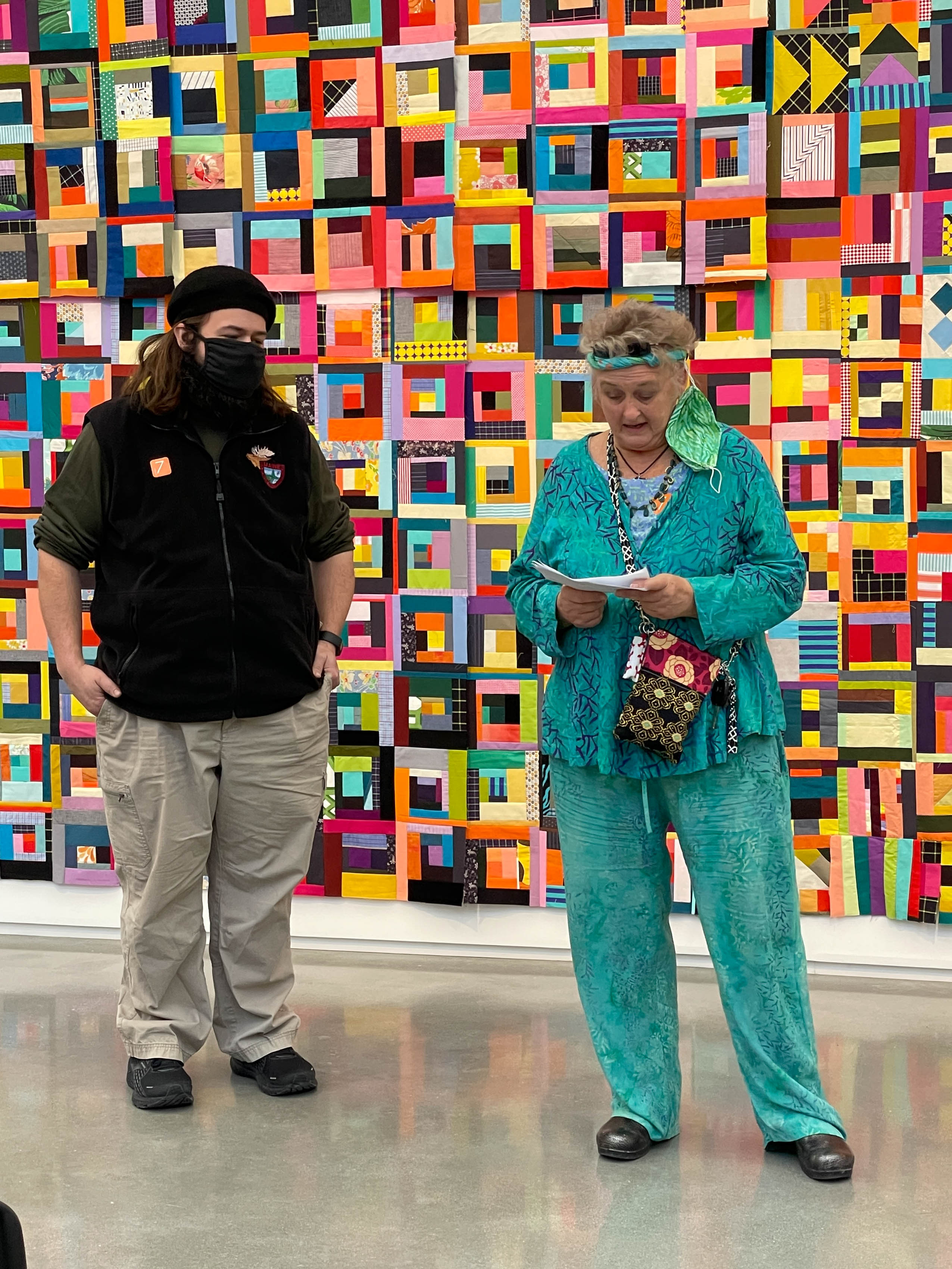
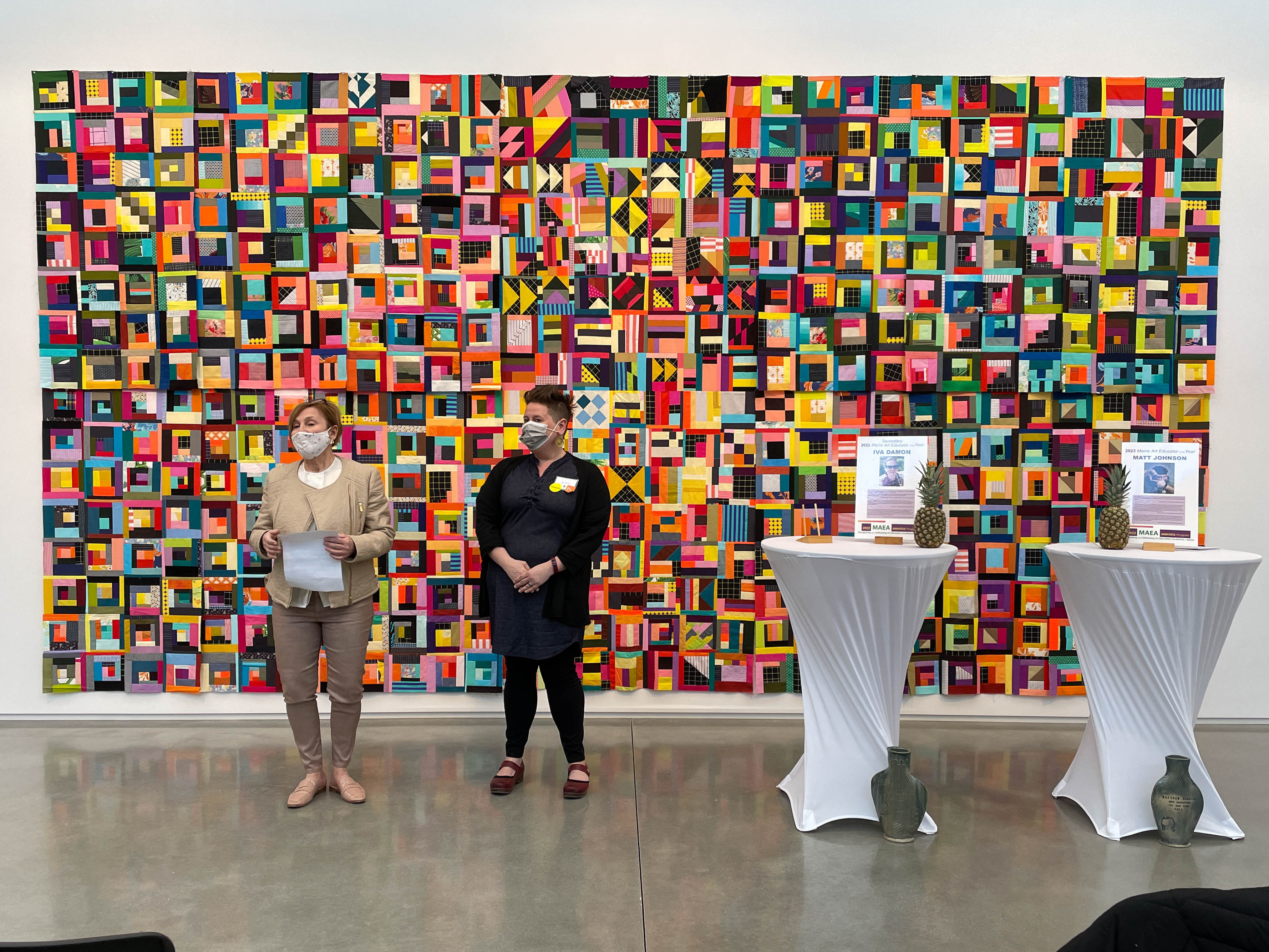
Deb presenting her colleague Matt Johnson the Maine Art Education Association (MAEA) Art Teacher of the Year award in April at the spring MAEA conference at CMCA, Rockland
During Deb’s career she has experienced many changes, both positive and negative. She is pleased to see “more students who desire a broader, deeper education in the arts and are willing and prepared to advocate for what they want even when there are roadblocks.” The negative aspect: “Over a decade of lower expectations in just about every aspect of what makes a strong, successful student has had a powerful impact on adequate progress. In general, students who used to be in the average range are finding the typical stress of high school level classes too much to cope with and organize for. What it means to “be a student” has, on average, deteriorated.“
Deb’s program has evolved over the years. She’s grateful for the educators she has worked closely with who have influenced the evolution. Her classes are often mixed groups with AP, Art 1, and advanced students in one space. And, Art 3, 4, AP and Studio Art the same. Juniors and seniors enrolled in Studio Art have their own studio spaces within the art room. Her colleague Matt Johnson teaches in an adjoining classroom. Students migrate between Matt’s and Deb’s classes, moving where learning needs can be met. Deb and Matt’s collegial relationship promote a common studio space that encourages a cross pollination between students. Flexibility has been critical in leading to student success. The teachers move to meet the needs of the kids, not visa versa. A great example of ‘student-centered’ learning environment.
These are the four key ingredients that Deb believes are essential to any successful visual art education program:
Know your content inside out, backward, forward and upside down and be willing to honor tradition whilst embracing the future.
Understand that art skills and teaching skills are two very different things.
Make sure that ‘what’ you are teaching and ‘how’ you are teaching it provides real world, valuable skills to every student no matter what level (skill level, experience in art) they are, or why, they are taking your class.
Embrace Advocacy at every single turn. Never, ever pass up the opportunity to help people understand how and why arts education matters, no matter how exhausting it is.
Deb’s advocacy has been ongoing and her successes have served students well. I asked Deb to look into her crystal ball and offer advice to teachers.
“Being an educator is not for the faint of heart. Wanting to help others learn and grow takes courage. When you do your preservice, think really hard about ‘why’ you want to pursue this. Teaching Art is not easy or fluffy or romantic. If you want to work hard and can commit to being a lifelong learner – go for it.”
Deb’s future is bright with a retirement plans filling her days with activities she loves. She’ll be tending her multiple gardens. 60X40 vegetable, fruit trees, and perennials. She has willow gardens for traditional willow basket making. Deb and her husband are tearing up 20 year old floors in her home and replacing them with something easier to care for time in retirement. Deb will include time in her studio on a regular basis; printmaking and painting. She plans to pursue becoming a Golden Artist Educator and run a few painting workshops. Deb and her husband love visiting remote locations and plan to travel to the Cabot Trail on Cape Breton and make a return visit to Jasper National Park, Alberta, Canada as well as several other beautiful highways.
I’m sure all your colleagues and the blog readers are joining me to wish you well on your retirement Deb!
If you know of other visual or performing arts teachers retiring this year please let me know by emailing meartsed@gmail.com.
This has been a very difficult couple of weeks for me and I know for many others. On reflection, my sadness and anger started with the Columbine High School massacre on April 20, 1999 when 12 students and one teacher were killed by two 12th grade students. On April 16, 2007, a student at Virginia Tech killed 32 students. On December 14, 2012 at Sandy Hook Elementary School a 20 year old killed 20 children between 6 and 7 years old and six adult staff members. On February 14, 2018, a 19 year-old opened fire on students and staff at Marjory Stoneman Douglas High School in Parkland, Florida murdering 17 people and injuring 17 others. The perpetrator pleaded guilty and is still awaiting sentencing.
Since January 1, 2022 there have been 27 shootings, with injuries or deaths, that have taken place in schools across the United States. We all know that school shootings have been going on for decades. The first one that I found documented took place in 1840 when a student entered a classroom on the campus of the University of Virginia and shot his professor who died three days later.
The latest heart wrenching event on May 24, 2022 at Robb Elementary School in Uvalde, Texas 19 fourth graders and their two teachers were gunned down in their classroom by an 18 year old. I say ENOUGH!
These innocent young faces below each have a story and for their stories to end abruptly and unnecessarily is very sad. And the two teachers smiling and such happy faces who guided and taught these young children – to have their teaching careers cut short by a gunman is totally unfair.
Precious victims from Robb Elementary School
I’m sure you’ve heard the horrific stories connected to this event which include the police not entering the classroom for over an hour and the gunman shooting his grandmother before going to the school and on and on. As I process the event I can’t help but feel and think so many emotions. From what I’ve read…
it’s OK to feel scared and sad AND also feel joy and hope.
I choose to imagine the bright stories. Read about these children and teachers. Ten year old Alithia Ramirez loved to draw and wanted to be an artist. She recently submitted a drawing to the “Doodle for Google” contest.
TAKING ACTION
I wanted to volunteer in the school district where I live and taught for 30 years but due to the pandemic, I was unable to be in the schools. So, I decided in January to start substituting, after the local district increased the substitute daily pay which they’ve based on experience and formal education. They’re using federal Covid relief funds and it has increased the number of substitutes exponentially. The idea is working! I was called to sub for elementary art two days after the shooting in Uvalde and I admit I hesitated to say ‘yes’. I took out the sub manual and didn’t read anything about what to do in a similar situation. I asked in the office when I arrived at the school for the protocol. Little information was provided and I felt scared that if there was a similar emergency, I would not be able to act on anything but my gut of what to do. My message to teachers and substitutes is…
Review the school policy and protocols with your colleagues and administrator. Do what you can to arm yourself with the knowledge and options so you can be as prepared as possible. Do it for yourself and for your students safety!
At the end of my day substituting for art, I sent an email to the Assistant Superintendent who oversees the substitute program. Ten days later, I’m still waiting a reply. I will circle back to the administrator since I understand how busy school personnel are at every level.
MY THOUGHTS ON GUNS
I want you to know that I’m not opposed to individuals owning guns but I think owning a gun for the ‘right’ reason is important and perfectly fine. Here’s an example of what I mean. Last week in a House Judiciary Committee hearing on gun violence, Representative Ken Buck from Colorado dismissed a proposal to regulate AR-style rifles. He said: “An AR-15 is a gun of choice for killing raccoons before they get to our chickens.” I understand that the farmers and ranchers in Colorado need to protect their chickens however, there are other guns that can be used for this purpose. Owning an AR-15 for this reason is simply not ‘right’.
An example of what I believe is a right reason. I grew up in a hunting family. My father was a rabbit and deer hunter so there were always guns in our home, locked in a gun cabinet when not in use. The animals my dad shot helped put meals on our supper table and sustain our family of six. My brothers were taught to hunt and so were my sister and I. Safety was a priority and I can hear my father’s voice emphatically saying: “never, ever point a gun at a human being”. You see, my father proudly served in the Army in WWII, 26th Infantry Regiment of the 1st Division (known as the Big Red One). He was trained in desert fighting and sailed on the Queen Mary to England to prepare for the invasion of Africa. On the first day, Corporal Nestor’s first day in battle anywhere, he was awarded the Silver Star medal and promoted to Sergeant. He fought against General Rommel’s German troops in Northern Africa and fought across Sicily. On June 6, 1944, his division was part of the second hour landing on Omaha Beach at Normandy. He continued the fight across France, Belgium, and crossed the Rhine River into Germany including The Battle of the Bulge. For 34 months he served as a Forward Observer until he was seriously wounded. He put himself in extreme danger in order to save a battalion of fellow First Infantry soldiers guarding an air base. His injury on the battlefield sent him home and for this action he was awarded the Distinguished Service Cross. His exemplary valor, bravery, and leadership also earned him a Silver Star with an Oak Leaf Cluster, a Bronze Star with Four Oak Leaf Clusters, two Purple Hearts, The French Croix de Guerre, a battlefield commission to 2nd Lieutenant, as well as numerous other commendations. My dad never talked about the difficult parts of the war but he told stories about the many friendships and shared his mementos. He was proud to have served and to be an American and humbly served our country for the many freedoms we have. After the war he put his energy towards his family and community and made a lasting positive impact. In my opinion, all his life he used guns and owned guns for the right reasons.
TEACHERS AND GUNS
We all know that teaching is a challenging and also a rewarding career. The stresses that exist today due to the pandemic and another massive school shooting have teachers asking the hard questions. They’re struggling to find time to take care of themselves. We all know self-care is critical. The shortage of teachers has been ongoing for several years, especially in certain subject areas, more so in school districts with low- income households and in rural areas. According to Education Week typically about 8% leave every year. Some states are discussing arming teachers with guns to stop school shootings. In my opinion that is a bad idea for many reasons. First of all, we have more guns in America than people. Has this kept individuals and schools safer? According to the Maine Criminal Justice Academy website it looks like 120 hours of training is required to be eligible to be a Maine State Police officer. I don’t see where any state is suggesting 120 hours for teacher training however, expecting teachers to train to respond to a shooter in school is unreasonable. Here are other reasons I believe this is an unfair expectation:
In a moment of duress and confusion when an intruder enters a classroom, there is no way to predict how a teacher may respond.
This increases the chances of their own students being shot.
The liability for the school district will be near to impossible.
Do we really want students to be watching this type of scenario played out?
Teachers are hired to teach not to be law enforcement and security personnel. Their jobs are enormous already.
WHAT CAN SCHOOLS DO?
When I was in elementary school (a hundred years ago) we practiced for fire drills and we also had ‘duck and cover drills’ preparing us for an atomic bomb. We silently filed into the hall, kneeling up against the wall with our arms crossed over our heads without moving, until the teacher said it was OK to release our position. Yes, we were scared but we practiced so we’d be prepared, just in case. If drills are done with the best interest of the children to help alleviate the fears, practicing can contribute to the effectiveness and ease their fears. I was on a zoom call last week with several Maine teachers who shared that there are problems with the various situations in school buildings. Some examples include: outside doors don’t lock without a certain key, turning off lights in classrooms without windows makes it very difficult to get 20 students to the designated safe space in the classroom, and passing students out windows can be very risky when you don’t know where the shooter is located.
WHAT CAN OUR ELECTED OFFICIALS DO TO MITIGATE THIS DREADFUL PROBLEM?
MCSTOYA is an organization whose members are Maine county and state teachers of the year. A week ago members were invited to discuss ideas for addressing the complex issues related to school safety. We landed on two ideas and met with an aide of Senator Collins last Friday to share our requests.
Request #1: Raise the age of people purchasing an AR-15 to 21
WHY? Part of the answer lies within understanding the effects of bullets from an AR-15. This information is taken from the The Atlantic: What I Saw Treating the Victims from Parkland Should Change the Debate on Guns written by Heather Sher. Bullets travel at a higher velocity from an AR-15 and are far more lethal than routine bullets fired from a handgun. The damage they cause is a function of the energy they impart as they pass through the body. The bullet leaves the barrel traveling almost three times faster than-and imparting more than three times the energy of a typical 9mm bullet from a handgun. When these guns are outfitted with a magazine with 50 rounds it allows many more lethal bullets to be delivered quickly without reloading.
The second part of the answer lies within understanding the brains of a young person. Many educators know this information. According to theUniversity of Rochester Medical Centerthe rational part of a teens brain isn’t fully developed until 25 or so. An adult brain and teen brain work differently. Adult brains think with the prefrontal cortex, the brain’s rational part. This is the part of the brain that responds to situations with good judgment and an awareness of long-term consequences. Teens process information with the amygdala. This is the emotional part. In teens’ brains, the connections between the emotional part of the brain and the decision-making center are still developing – and not always at the same rate. That’s why when teens have overwhelming emotional input, they can’t explain later what they were thinking. They weren’t thinking as much as they were feeling.
Request #2: Funding for school violence prevention and intervention programs
WHY? It makes perfect sense that if we could identify the struggling students and provide them the support they need to begin to articulate their needs and process their stresses school personnel would be assisting to address some of the problems. In many schools there is one social worker or guidance counselor responsible for hundreds of students. This makes it impossible for the existing staff to service students.
WHAT CAN YOU and THE PUBLIC DO?
Consider your options. Don’t be afraid to ask questions or be in fear of losing your gun if stricter laws are put in place to keep schools safe. Have conversations with your neighbors and community members. Often they do not know what goes on in schools. You’re the expert, share information, enlighten them.
Contact your legislator to share your opinions and beliefs. Vote every time you have the opportunity. Below is a sample to help start a phone conversation. And, you will find the phone numbers for Senator King and Collins’ offices.
Hi, my name is ……………
I am a constituent from (name of town) and an educator in Maine.
I am calling about (state the issue)
Please consider supporting legislation that will……………. Or I am concerned about (issue) and would like this looked into.
Thank you for hearing my concerns.
Phone numbers:
Senator Angus King Washington Office: Phone: (202) 224-5344
Senator Susan Collins: Washington Office: (202) 224-2523
Caribou Office: (207) 493-7873
Lewiston Office: (207) 784-6969
TAKE CARE OF YOURSELF
This is a book that you might find helpful at this point in your career (no matter how long you’ve been teaching) and the school year (with all that has been going on during the last 27 months.
Emily’s Masters’ degree is in counseling and Amelia’s is in choral conducting; one day they realized they both got graduate degrees in how to listen and feel feelings.
Thank you for your ongoing commitment to education. Please don’t hesitate to post a comment below in this blog post and/or reach out to me if you have questions/comments at meartsed@gmail.com.
The Camden Hills Regional HS Chorale, Chamber Singers and Treble Choir will present their Spring Choral Concert on Tuesday, May 17th at 7:00 PM in the Strom auditorium. The ensembles, directed by Kimberly Murphy and accompanied by Matthew Mainster will perform a variety of selections, featuring many soloists and guest artists.
Kim Murphy
Of special note will be BSO percussionist Nancy Rowe accompanying the Treble Choir on xylophone in their performance of Mark Patterson’s “Edges of the Night” – a song that highlights the plight of refugees. Ms. Rowe will also play the djembe to accompany two selections by the Chorale and Chamber Singers. A guest string quartet: Sarah Glenn (violin), Heidi Karod (violin), Linda Vaillancourt (viola) and April Reed-Cox (cello) will accompany the Chamber Singers’ performance of “Deep Peace” written by Elaine Hagenberg and Ola Gjeilo’s “The Ground.” Both selections incorporate the theme of peace, with Ola Gjeilo’s composition ending with the lyrics “Dona Nobis Pacem” (grant us peace).
Nancy Rowe
Additional themes concurrent in many of the selections are that of youth, and hope through music. Young singers in grades 3 – 8 will join the high school Chorale in a stirring rendition of “Rise Up” – a song made popular by Andra Day. The performance will feature many soloists including Sara Ackley, Alyssa Lewis, Lenigha White, Noelle Delano and young singers Rowan McWilliams and Nathan Gomez. The string quartet will return to accompany the Treble Choir in a selection which highlights the beauty and hope of music in “Alway Something Sings.” With text by Ralph Waldo Emerson and music by Dan Forrest, this selection also highlights guest singer, Lydia Day. The theme of hope for our youth continues with the Kyle Pederson composition of “Remember the Children.” This song will feature four soloists: Audrey Leavitt, Aly Shook, Lucas Marriner-Ward and Daniel McGregor.
Seniors Audrey Leavitt and Aly Shook will return to the stage as they lead the student a cappella ensemble: Fortissima in three selections. This extra-curricular student-led ensemble has been rejuvenated under their direction and is flourishing in dedication and musicality. Of special note will be a Fortissima performance of Tom Petty’s “Wildflowers,” arranged by Junior, Grace Yanz.
Throughout the evening many soloists will be featured, including Joshua Kohlstrom, Iselin Bratz, Nora Finck, Abigail Kohlstrom, Trey Freeman, Grace Yanz, Jocelyn Serrie, Charlotte Thackeray, Charlotte Nelson, Sophie Ryan, George Bickham, Maren Kinney, Alyssa Bland, Isabella Kinney and flautist Cabot Adams.
During this joyful concert student achievements in the MMEA District III and All State music festivals will be recognized, along with a tribute to our outstanding senior musicians. The concert is free to the public. As of this writing, masks, for both performers and audience members, are optional. For more information, contact director Kimberly Murphy at kim.murphy@fivetowns.net See you at the show!
I’m certain this is going to be a spectacular concert since Kim is retiring at the end of this school year.
I’m always surprised how much I learn when traveling from home for a length of time (more than 4 days). The pandemic has slowed down my opportunity to travel but fortunately, I had the chance during two weeks in April. I boarded a plane on April 5 and returned on the 19th and in total I took 5 flights including round trip to Dublin. It was an amazing adventure in the UK, Ireland, and the Netherlands. Most of the time I was with my son, Nicholas, and part of the time I traveled with Central School, South Berwick’s music teacher Kate Smith and her two daughters. Many friends and colleagues asked me to share my trip so this blogpost gives you the highlights along with some of my favorite photos.
DAY 1, Dublin to Northern Ireland, April 6
I landed in Dublin, after a short night from Boston, at 8am. Nicholas was the official driver and adapted quickly, from the opposite side of the car on the opposite side of the road (of what is familiar to Americans).
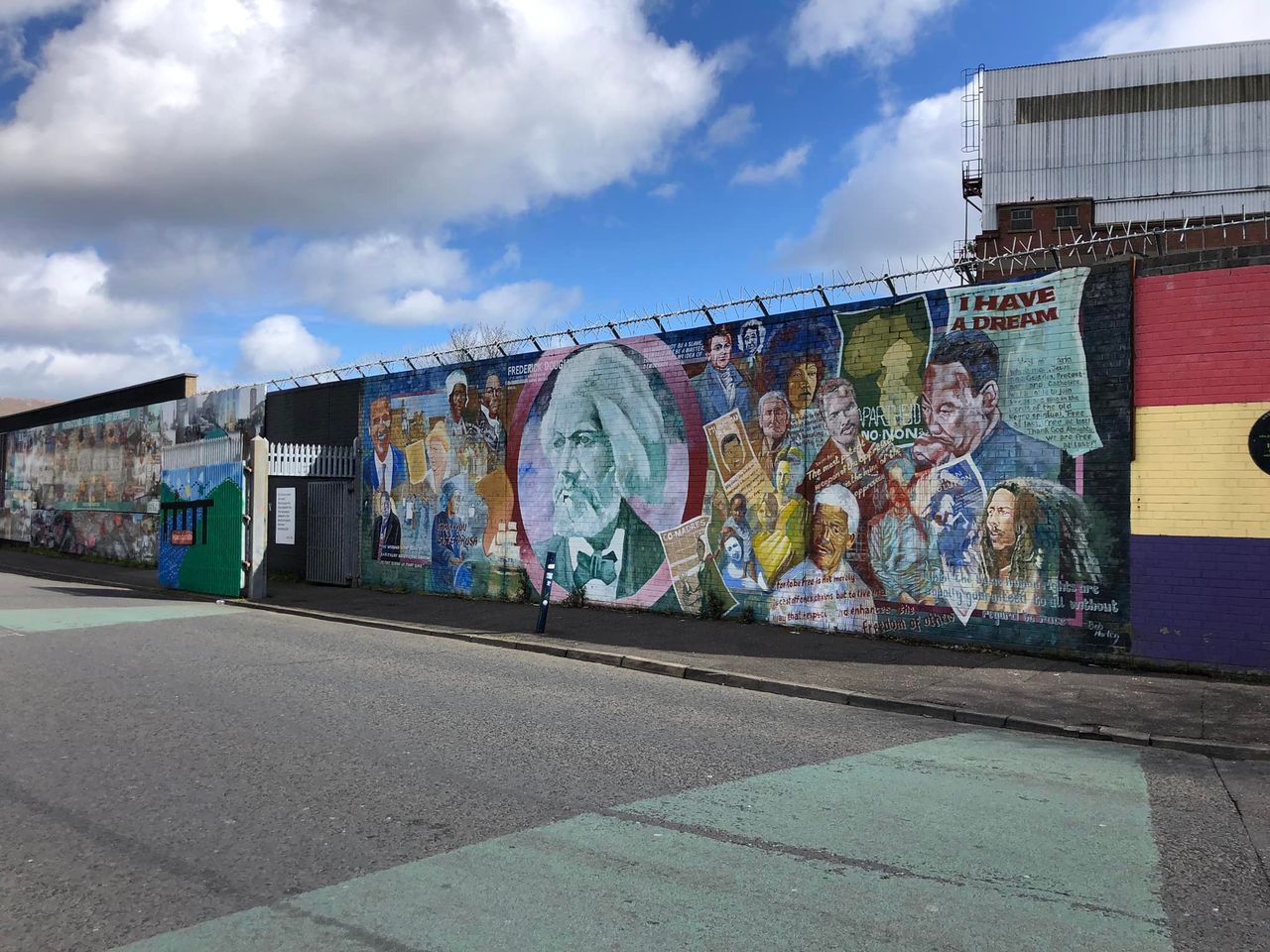
We headed north to Belfast. Nicholas visited the Titanic Museum while I toured the city to see the many murals that document the stories of the unrest that has gone on for years between the Catholics and Protestants. My guide, Joe, was very knowledgeable and holds George Mitchell (Maine’s past Senator) in high esteem. I’m sure that many of you know Mitchell served as the US Special Envoy for Northern Ireland (1995–2001), appointed by President Clinton and negotiated the peace treaty. Negotiations took place in a church, since it was viewed ‘safe’, and Joe was sure to point it out. We stopped at the four gates that continue to separate the communities. Each day at 6pm three of the gates are closed and not unlocked until morning. The tall fences that separates the two sides are still in place.
The Peace Mural
The troubles still exist but if Joe was any reflection, life will continue to get better for all. He joked with other tour guides along the almost 2 hour tour. At the last mural I took a photo of Joe and another guide, arms around each other, big smiles. When we returned to the car he said “I’m Catholic and he’s Protestant. Things will be better.” He holds such hope!
After a delicious fish and chip lunch we walked along the harbor and headed north to our Airbnb near the Northern Ireland coast. Our hosts were amazing, Mary Jane and Hugh and daughter Katie. We were in a cottage on their sheep farm in Cloyfin – a beautiful view in all directions with lush green farmland. They invited us for meatballs and pasta supper. Katie was working on her senior sculpture project, a huge welded abstract piece. Needless to say, it was fun and we were grateful to be able to relax in their cozy home after a long day.
Day 2, Northern Ireland, April 7
We woke up in our warm cottage to a sky that looked stormy and by 7am the rain was really coming down. So we packed our rain pants and jackets as I remembered my guide Joe in Belfast saying: “if you don’t like the weather at the moment just wait, because in Ireland we have all four seasons in one day.” (Sounds similar to our Maine saying about the weather). Interestingly, not long after we started, the sun came out and stayed for most of our day on the Causeway Coast.
We could see with our first glimpse of the water that it was very windy. We learned later that the wind was blowing 50 miles per hour. Dunluce Magheracross was a quick stop. We could barely open the car doors and walk the 100 feet to the lookout it was so windy. I thought I saw the car lift off the ground on the way back to it.
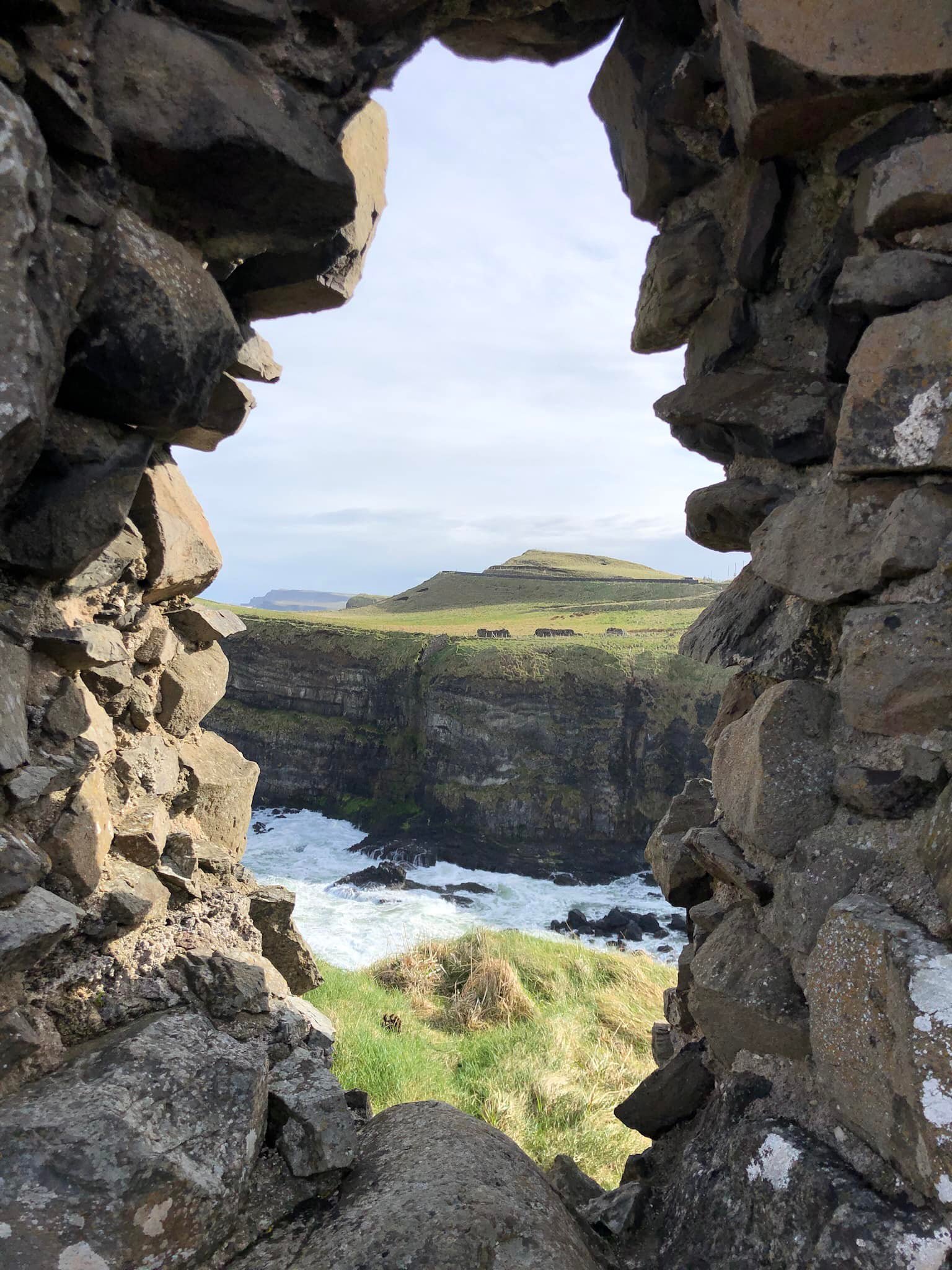
We headed east to Dunluce Castle which, due to the high winds was free for visitors. The visitors center was well done (educational info) and filled with about 25 grade K and 1 students and their teachers who said it was their first field trip since the start of the pandemic. The castle was built on the edge of a steep crag in the 16th century. Considering it’s age is well preserved and maintained. As we left the castle area, the children were entering and with every gust of wind the children screeched. What a site and sound!
Looking out from Dunluce Castle
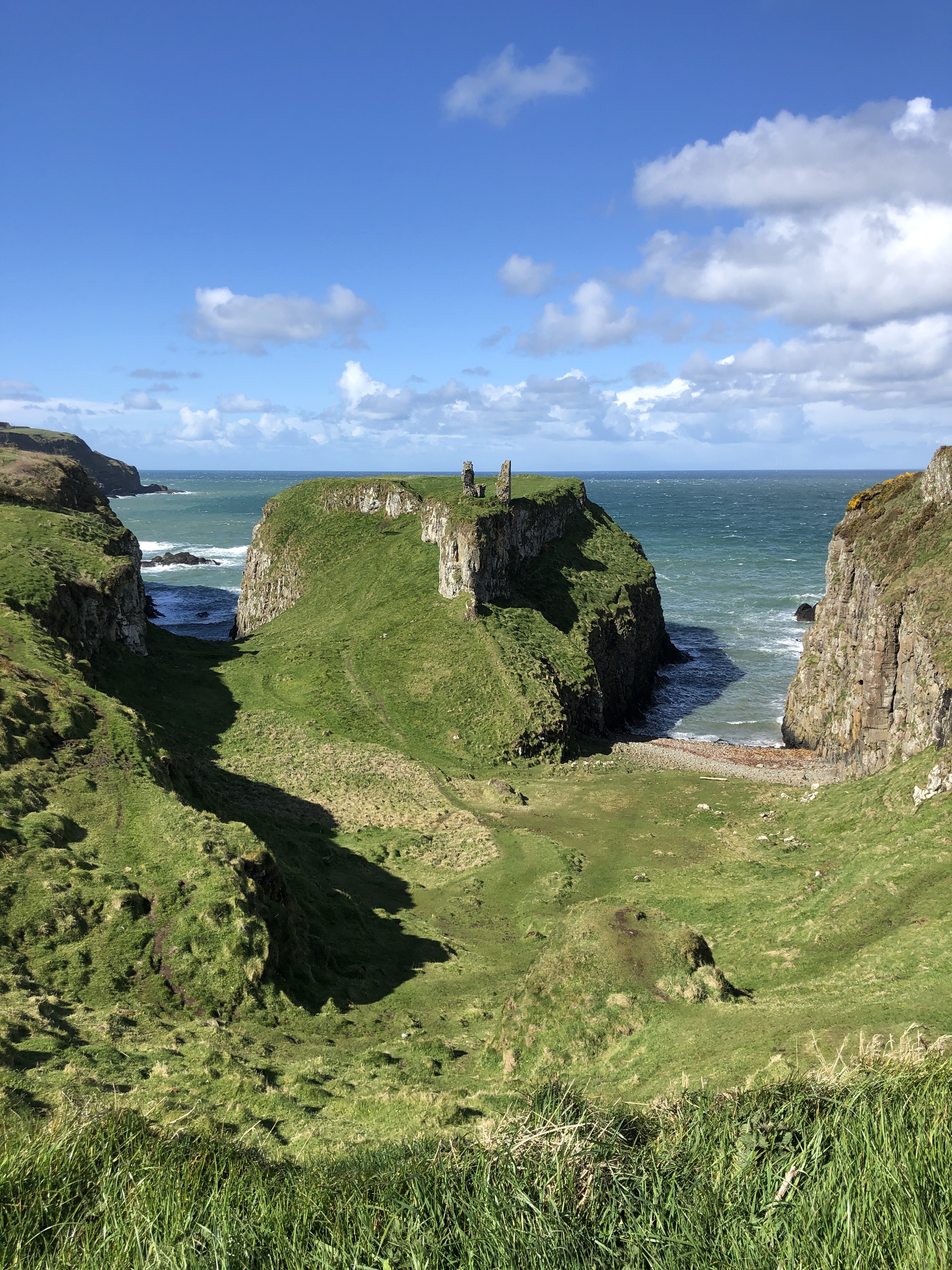
We visited a second castle, Dunseverick, which was very different than Dunluce, with only one wall remaining but the setting incredible. The view and lush green invited us to walk high above the water.
Remains of Dunseverick Castle
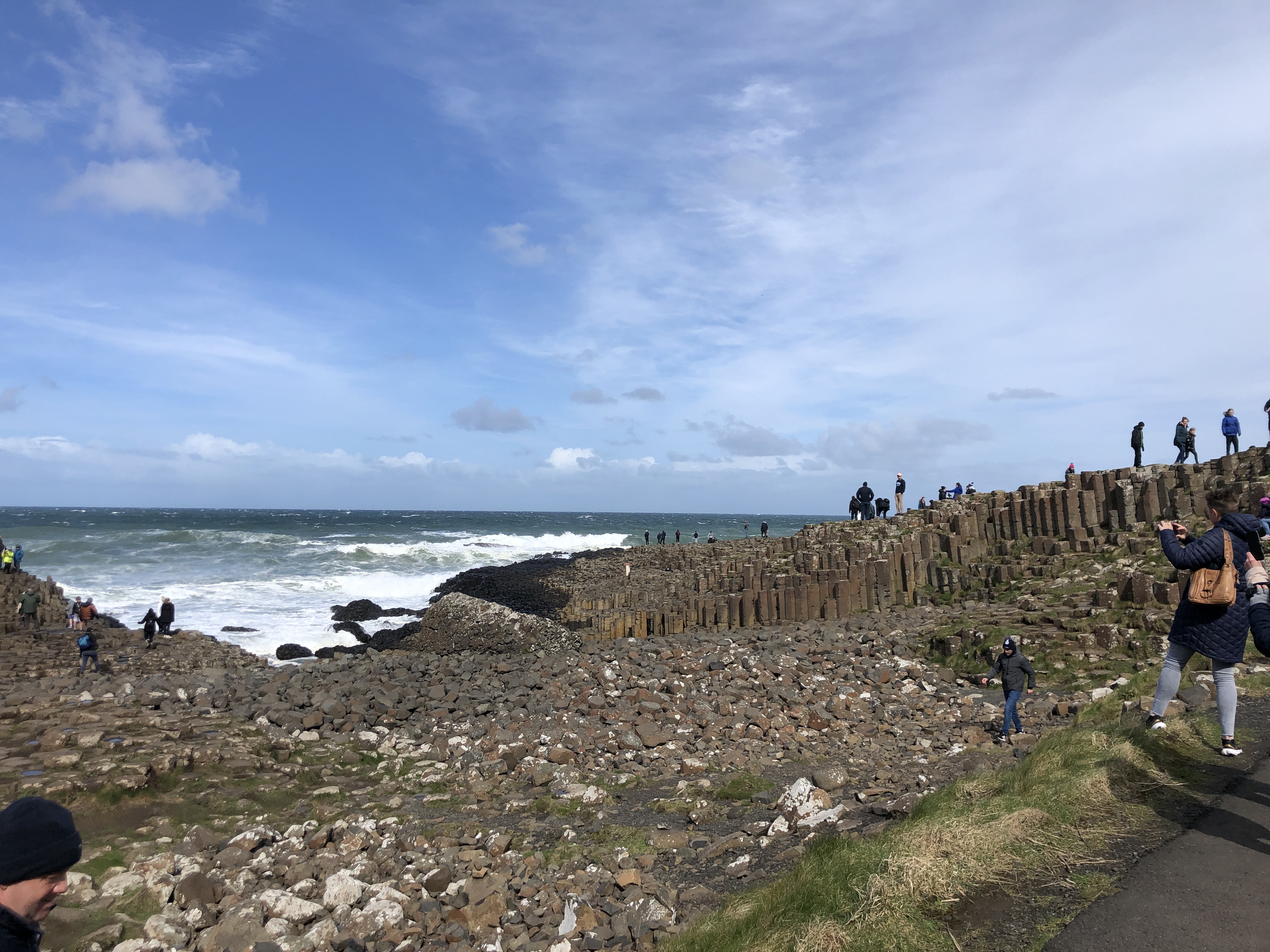
Giants Causeway was our next stop. The visitors center was very good with demonstrations of how the volcano formed Giants Causeway. In the 1740s it was an artist who was partially responsible for spreading the word of the amazing place. Susanna Drury spent 3 months painting the rock formation. She made two prints from her paintings and they traveled to spread the work of the “astonishing place”. The octagon shaped rocks are a site to behold. With only a 2 meter tide, the salt water preserves the rocks – deep and dark blackness. Climbing from one to the next rock felt like they were intentionally placed just for our fun. Ahhhh… mother natures gifts! The spot was the only location the entire day where we experienced many visitors. We continued on the trail beyond Giants and found few people. The sweep of the ocean views – simply breathtaking, every step of the way. When we weren’t looking at the ocean, we feasted our eyes on the lush green fields filled with sheep including many new borns.
Giants Causeway
Lunch at The Nook, which used to be a school, close by Giants for delicious seafood chowder made with salmon, mussels, cockles, prawns, haddock and brown bread on the side. Sooooo good!!
Onto Carrick-a-Rede Rope Bridge which, yes, it is a rope bridge, 100 feet above the water. It leads to the fisherman’s island where in 1803 the report read: 82 fishers, 21 salmon fishers 19 fish carriers (it’s about a mile walk to the bridge from the visitors center). Unfortunately, due to high winds, the bridge was closed. Fortunately, we could see the island and imagine the fisherman at work. Sadly the salmon fishery is all but gone.
Carrick-a-Rede Bridge
Our last stop for the afternoon was at the Dark Hedges. One hundred and fifty Beech trees were planted in 1775 by James Stuart to line the entrance to the family home he built. This has been a filming location for HBO’s series Game of Thrones®, representing Kingsroad. The trees are off shoots from the originals and are intertwined and entangled to create a stunning site. A great way to end an amazing day!
Dark Hedges
DAY 3, heading southwest into Ireland, April 8
We woke to hail beating on the cottage windows. In our first hour of driving we went through rain, sleet, hail and snow and we could see snow on the mountain tops in the distance. Not long afterwards the sun came out for the rest of the day.
We stopped in Derry or Londonderry which is a walled city built in the 1500’s. There are amazing political murals throughout. We walked alongside of the wall, through archways and on top of the wall. We were surprised how wide the wall was in some places – enough for two cars.
Onto county Donegal for a stop at Lough Eske Castle for a lovely “afternoon tea” (at noon). We had delicious golden Irish tea, savory sandwiches, pastries and sweet treats. The castle, sculptures, 2D art including photographs were all spectacular. It was fun to learn the ‘proper way’ to drink tea. By the way it doesn’t include extending your pinky finger.
Lough Eske Castle, afternoon tea
On to the Donegal Craft Village which consists of 8 artists studios and shops. My favorite was The Pear in Paper. Artist Lynn and two young woman were making linoleum prints and letterpress cards. They use a treadle base letterpress that was built in 1872. Lynn is self-taught using books and YouTube videos written and created by Americans. The shop, studio, art and conversation were all delightful!
Our next Airbnb named Lignaul Cottage was a 1/2 mile down a small dirt road. Our view again was a field of sheep and it was very quiet. We had a delicious supper at a local pub.
DAY 4, traveling south near the western coast, April 9
We woke to sunshine and yet again a brief rain shower within an hour. It didn’t last long and the day was a warmer, no wind and lots of sunshine. We started the day with a traditional Irish breakfast at Mrs. B’s in Kellybegs. We opted for the smaller version, called the ‘mini’. Afterwards, a walk along the water to see the giant colorful fishing boats and a stop at a very pretty beach for a short walk on our way west.
Traditional Irish breakfast
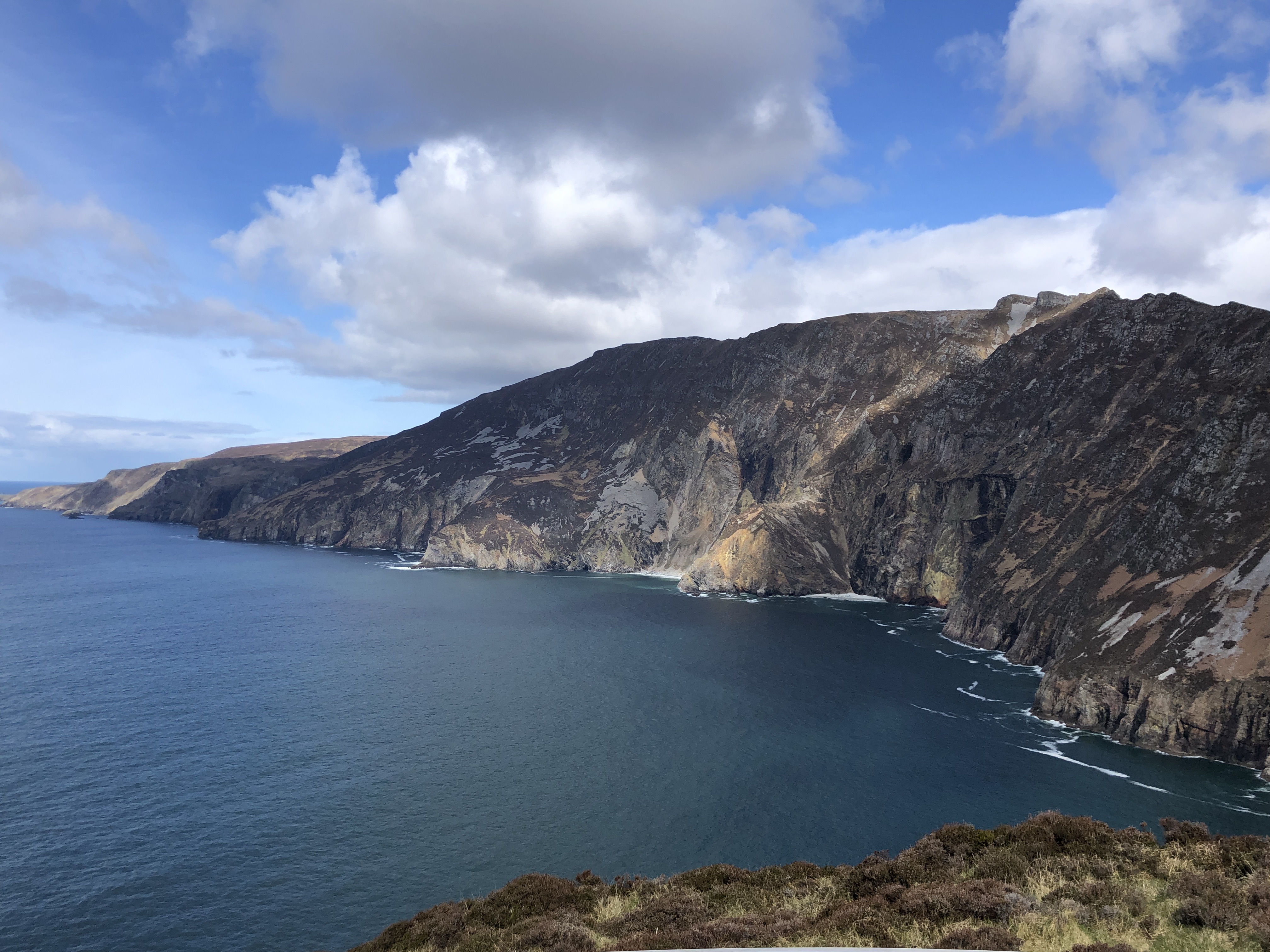
Onto Slieve League – amazing cliffs above the sea. All along our 30 minute walk to the top we stopped for pictures and for our eyes to absorb the beauty. The great distances on the steep walk were dizzying. We could see to the very top of the cliffs. It resembled Katahdin’s Knifes Edge. In the visitors center we read many stories and mysteries about Slieve League Cliffs, including this one: In the late 1600’s a young girl, Bridget McGinley, was snatched by an eagle and later dropped and she survived. Her grandchildren remember her showing them the scars on her left chest where the eagle held on with his talons.
On the way down this majestic mountainside (200 feet high), Nicholas walked on a piece of land that jutted out in the water. He was but a speck at the furthest point. This was an important area during WWII, pilots depended on the words made out of rocks on the mountain sides and the lookouts that were installed to worn the pilots that the area was neutral territory.
Slieve League Cliffs
Rockwell Kent lived and painted close by in 1926. When he arrived he asked where the most remote place was to live for 2 years. We learned from a couple of Irish hikers that we were fortunate to be at Slieve League with the weather sunny and no wind. They had tried to visit on several occasions with no luck due to the wind and rain.
We spent the afternoon scooting along narrow roads stopping at a beautiful and remote waterfall, admiring the sea, and watching the young lambs play in the grassy knolls.
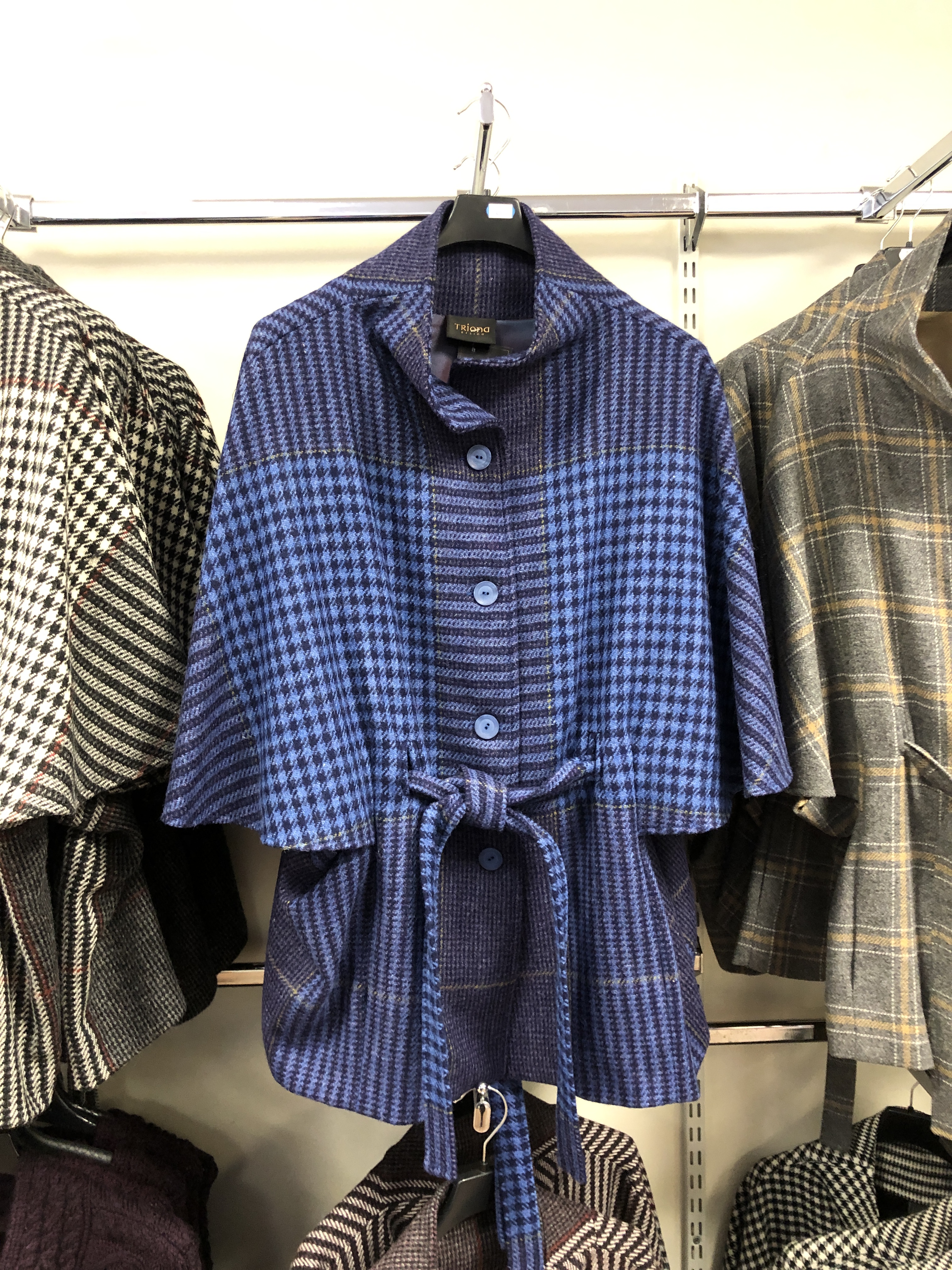
Our last stop for the day was at Ardara where they make and sell beautiful tweed clothing, hats, and scarfs. The main weaver works on a 300 year old loom and he’s 85 years old. From start to finish it takes 3 weeks to create a batch of capes. I have such an appreciation for the crafters and the process having done some dabbling w the craft in the past. And all of the items absolutely beautiful!
Beautiful cape, Ardara
DAY 5, Donegal to Sligo, April 10
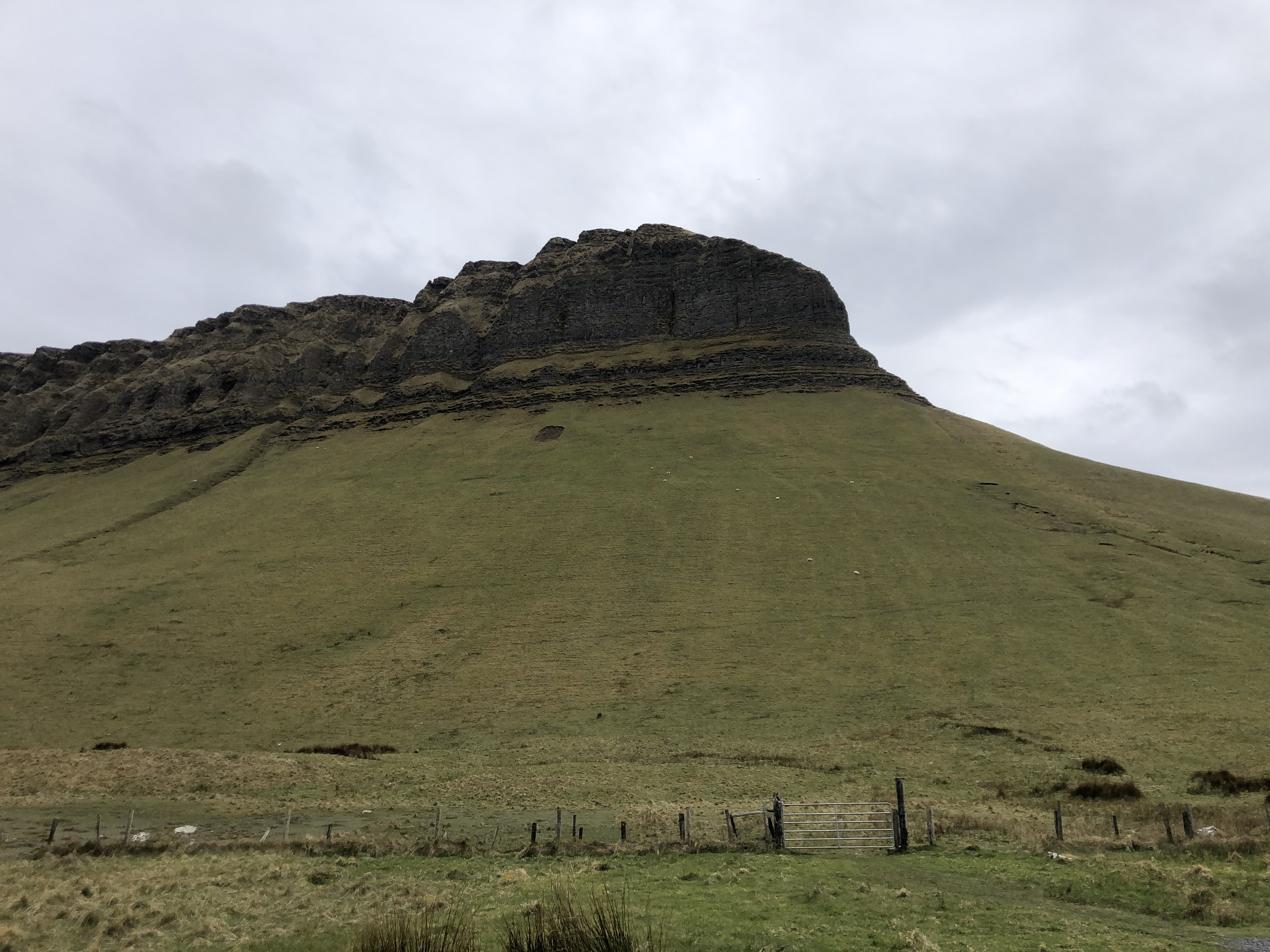
We drove from Donegal to Sligo with two stops. The first was at Eagle’s Rock in County Leitrim. A short path led us to a gate with a walk over ladder or stile, as it’s called. The stone covered road is in fine condition for a hike over commonage. A commonage is land held in common ownership on which 2 or more landowners or farmers, in this case all over Ireland, have grazing rights.
In the distance to our left Eagle Rock loomed up. It was formed about 12,000 years ago by two small glaciers that dug into the mountain’s horizontally-embedded limestone. It was somewhat magical and eerie at the same time with the wind whistling through the cracks and the angle seemed to shift as we walked along. Even more magical were the hundreds of sheep who were slowly moving along eating the grass. They’re everywhere! Each with a dyed spot of blue or pink, to identify the owners. Even the newborns were marked.
Eagle Rock
All day long it looked like the sky would open up dropping rain but it surprisingly remained grey and damp. We stopped at the church and cemetery in Sligo where William Yeats is buried before heading to hike Benbulbin.
Benbulbin is a flat topped mountain in County Sligo. The mountain loomed up as we hiked a trail that circled near the base. The area is well maintained even w what appeared to be clear cutting taking place. We landed at a BandB with a room that looked up at the amazing mountain. And what a surprise to find Maine products in the bathroom. Our very kind BandB owner Maureen had no idea where she got them.
Benbulbin
DAY 6, east to Dublin, April 11
Today we drove from the west side of Ireland in Sligo to the east side, Dublin. It took about 3 hours. Dropped our stuff at the Leixlip Manor, dates from 1700, very cool place.
We drove into Dublin, 25 minutes away. First stop was at EPIC which is home to small eating places and shops with the majority being the home of the Irish Emigration Museum. It is very well done. With passport in hand visitors wind their way through several rooms that include the stories of almost 300 Irish people. It includes the history while intertwining the journeys, education, politics, the arts, and much more.
Afterwards we walked and walked through the city viewing flowers, sculptures, and the Irish people themselves. We stopped at the sculpture of Oscar Wilde, walked the Trinity College campus to see other sculptures. Some of the buildings were very ornate with interesting details.
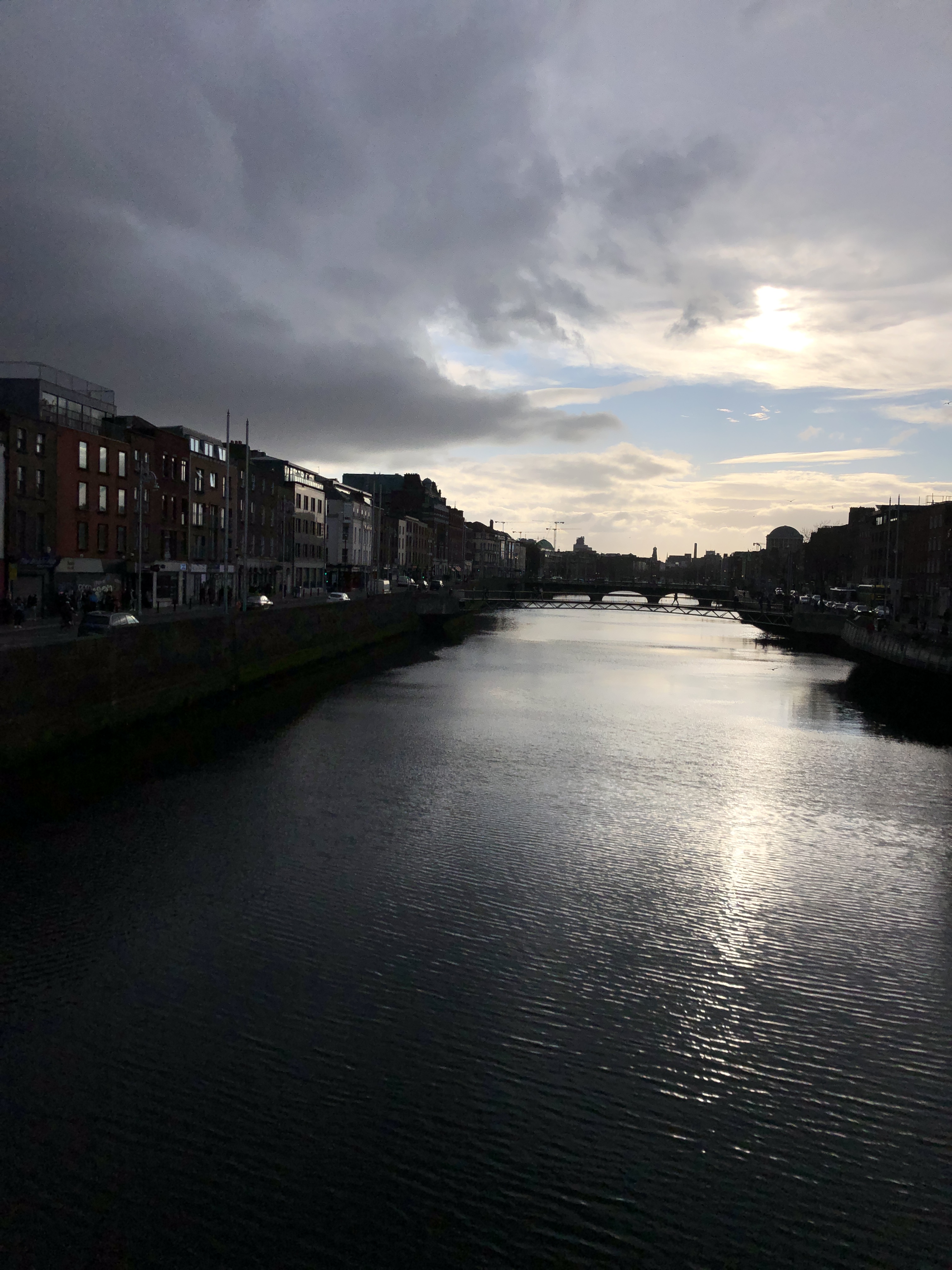
We met a friends granddaughter who is studying in Dublin and had a pleasant visit over supper. Our walk back to the car was pleasant especially walking over the bridge again with the end of day light for our last full day in Ireland. Back to the manor for a short night.
Day is done, Dublin
DAY 7, Flight to Amsterdam, April 12
I was pretty excited especially when I realized my last trip to Amsterdam was in 1975 when I was traveling during spring break. I was at the university in Copenhagen as an exchange student. We spent the day at the Rijksmuseum, mostly to see the Rembrandt’s The Night Watch. Newly cleaned and hanging behind glass. And, there were others that I really love by Johannes Vemeer, Peter Claesz, Van Gogh.
Afterwards we walked along the canals being careful not to step in front of the many, many people on bicycles. We had supper on the canal as we watched the boats go by peacefully. Beet Dutch meatballs called Bitterballens. Ordered them w beets instead of meat. Mmmmm!
DAY 8, a visit to the tulips, WOWZER!, April 13
This day was a dream day! I am so very fortunate to have this adventure and I am doubly grateful for it! I’ve dreamed about walking through the tulips, grateful this dream came true!
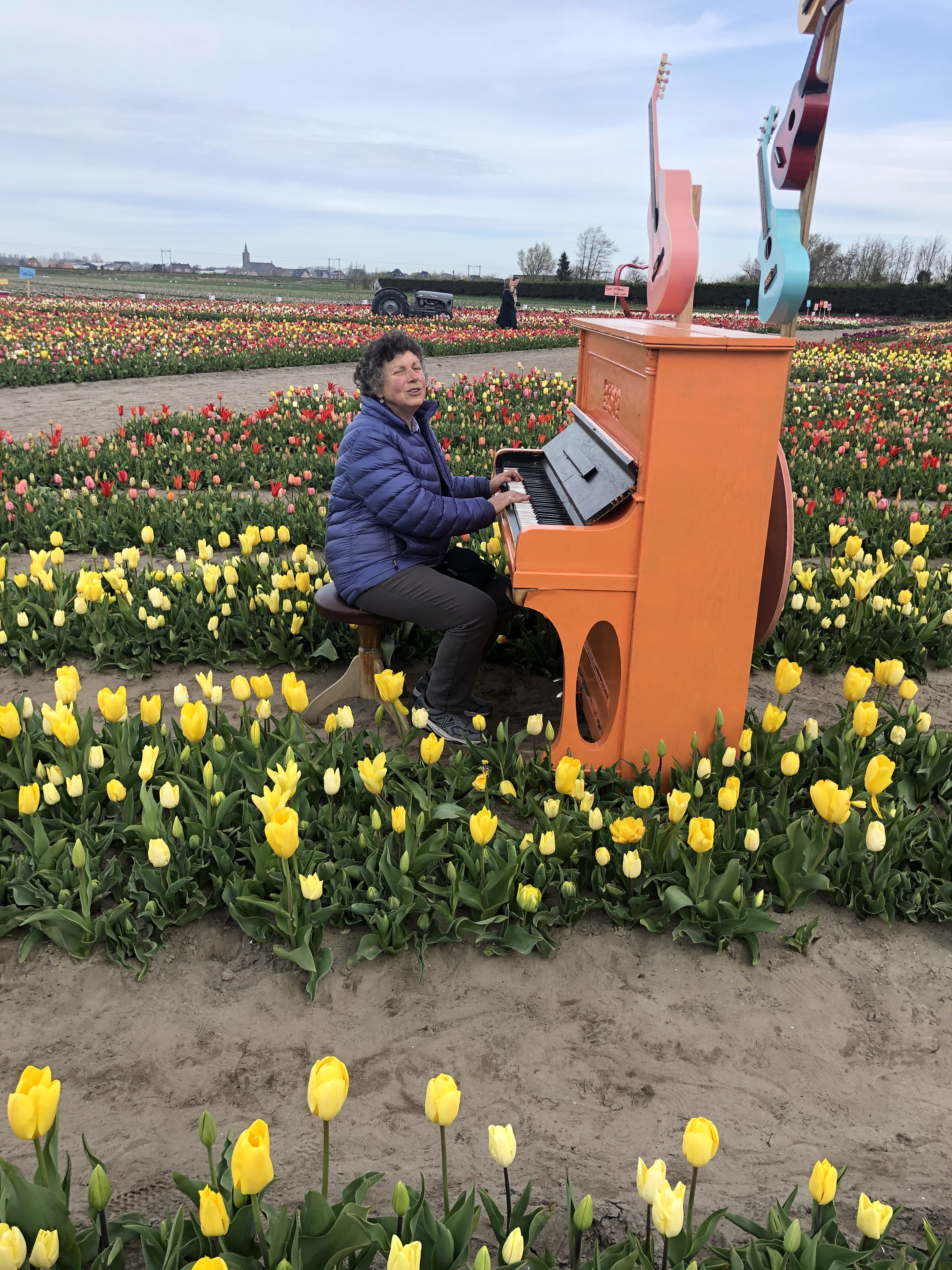
We met Nicholas’ friend Pegah who has lived in Amsterdam for many years at the train station to travel 30 minutes out of Amsterdam to see and walk through the tulip fields. The tulip area we went to is in the town of Hillegrom. We walked 20 minutes from the train station to Ruigrok fields and were glad that a young tulip grower created a place where visitors can actually get up close with the tulips. We learned so much about growing tulips, FOR THE BULBS, while speaking to the owner who was a delight! It makes perfect sense that the tulip farmers are not interested in people walking all over their fields. The place was fun as you can probably tell from the photo.
Singing in the tulips
We continued walking another 15 minutes to the center of town and along the way we passed several more fields of tulips, daffodils and hyacinths. The smell was amazing as well. We had a lovely lunch and headed back to Amsterdam.
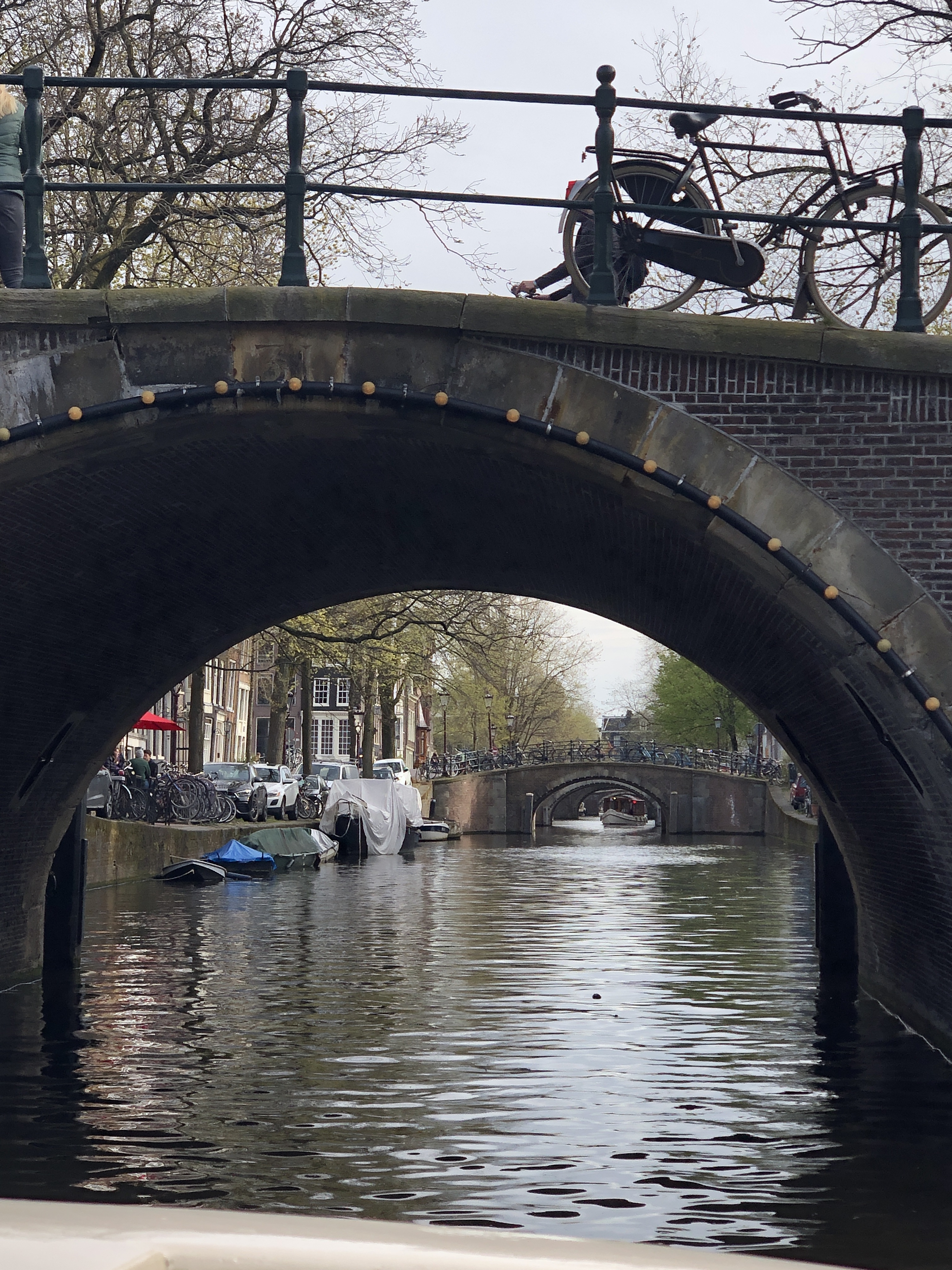
It was a sunny day so took the afternoon and toured the canals by boat learning the history of the canals. Amsterdam is a beautiful city, easy to get around. Fun to watch the people, bike riders, and enjoy the food and art everywhere.
Amsterdam canals seen from the water
It was a wonderful last day with Nicholas. He has been an amazing guide and traveling buddy. I said so long to Amsterdam.
DAY 9, off to England, April 14
I got on an early morning flight from Amsterdam to London and met Kate and Mikayla Smith at the airport. They flew all night from Boston. We hopped on a bus and headed to Oxford where Kate’s daughter Alaina spent the semester. spending two days in Oxford. Oxford has mostly very old structures, some from the 1100’s, and are well cared for. The blending of the new structures w the old is fabulous.
We enjoyed street artists, the old prison, a short walk along the canal, and visiting a couple of shops. The day ended in a traditional English pub with fish and chips!
DAY 10, Oxford, April 15
A delightful day starting with breakfast and morning prayer at a small and amazingly beautiful Catholic Church. I was reminded that it is “American Good Friday”. Soon after we met up with Mik and Alaina and spent much of the day at the Museum of Natural History and the Pitt Rivers Museum. I found both collections impressive and mind boggling, not to mention the physical spaces of each building, attached but separate.
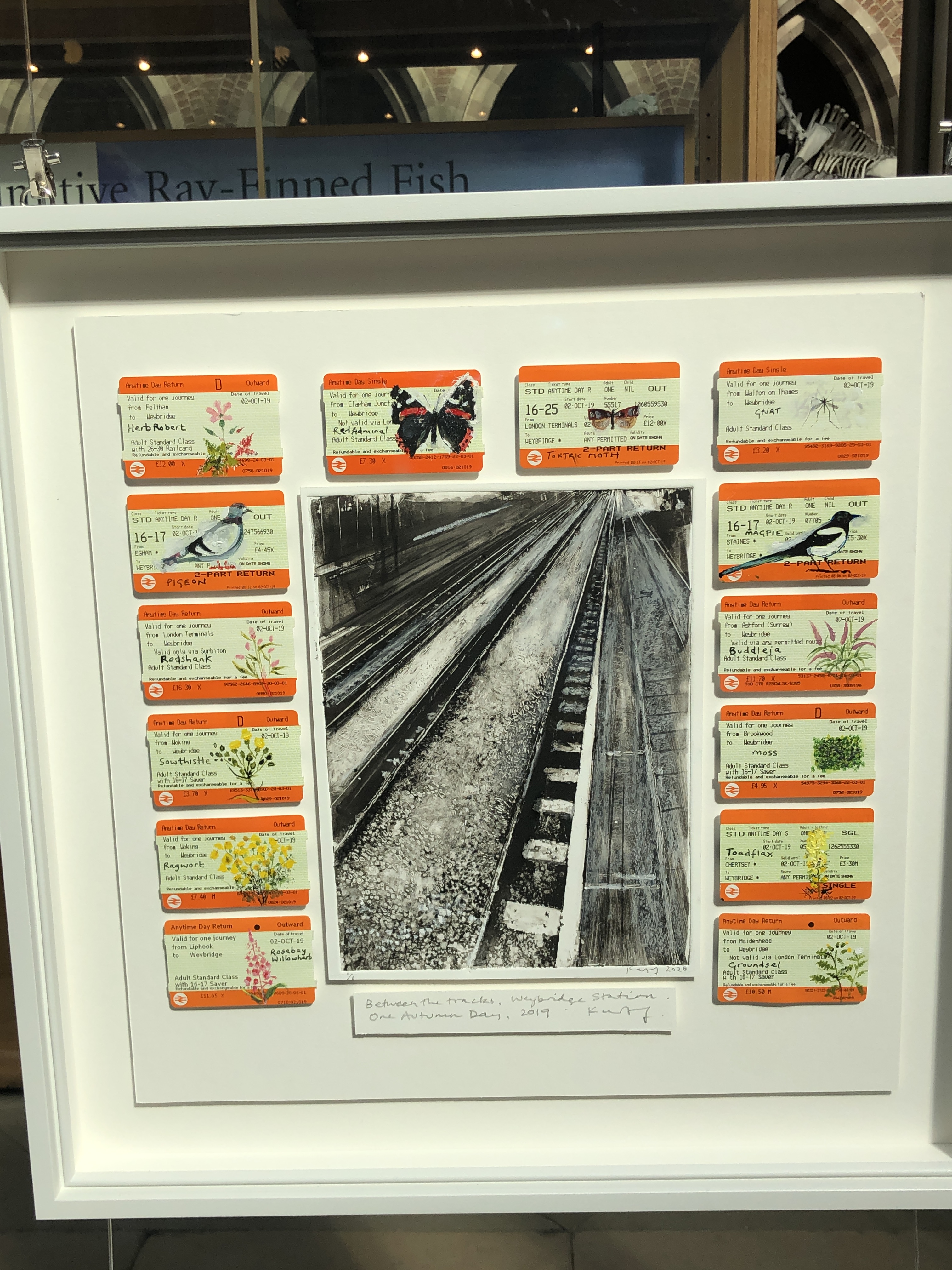
My favorite part of the Museum of Natural History included a show on biodiversity that combined the art of contemporary artist and environmentalist Kurt Jackson and responses of Oxford researchers. Kurt’s art is from locations across the UK. I loved the way the exhibit articulates the importance of the artists observations. His small studies and large paintings are lovely.
One of Kurt Jackson’s art
Walking into Pitt Rivers was like walking into a huge organized antique shop. It has over 500,000 objects from many parts of the world. Three floors full. I loved looking at the patterns on the fabrics, baskets, pottery, masks, tools, dishware, and weapons. And imagining the people wearing and using and creating them. How the people lived each day with their daily rituals and traditions and the stories they told.
The weather is sunny and 68 degrees, so pleasurable walking and seeing buildings and details on doors, fences, streets, and so much more. The day ended at a local restaurant w a beer, local musician singing and playing guitar and in the next room an art closing. The show included paintings created during the pandemic by a woman who is full of energy and a zest for living fully.
Grateful for this amazing day!
DAY 11, Oxford and London, Saturday, April 16
We started the morning with breakfast at a little cafe with a interesting designed pizza oven with outside tables next to the bazaar in Oxford. We visited the Ashmolean Museum, thrilled to see the Camille Pissarro exhibit. Their collection has many of his and those he painted side by side with Claude Monet and Paul Cezanne. He established a group that included 15 artists who were learning together. Pissarro is considered by many the father of Impressionism but what I saw in the show was a ‘learning from each other’ artists-friends community. There was even one Vincent Van Gogh piece and a few by Georges Seurat. The light, color, texture and depiction of the every day lives of ‘regular people’ – spectacular. And the story behind the story was how Pissarro’s wife held the family together and enriched their lives, artists and their 7 children, all artists. Not enough time to explore the rest of the museum, but the collection is enormous. I am so glad we visited.
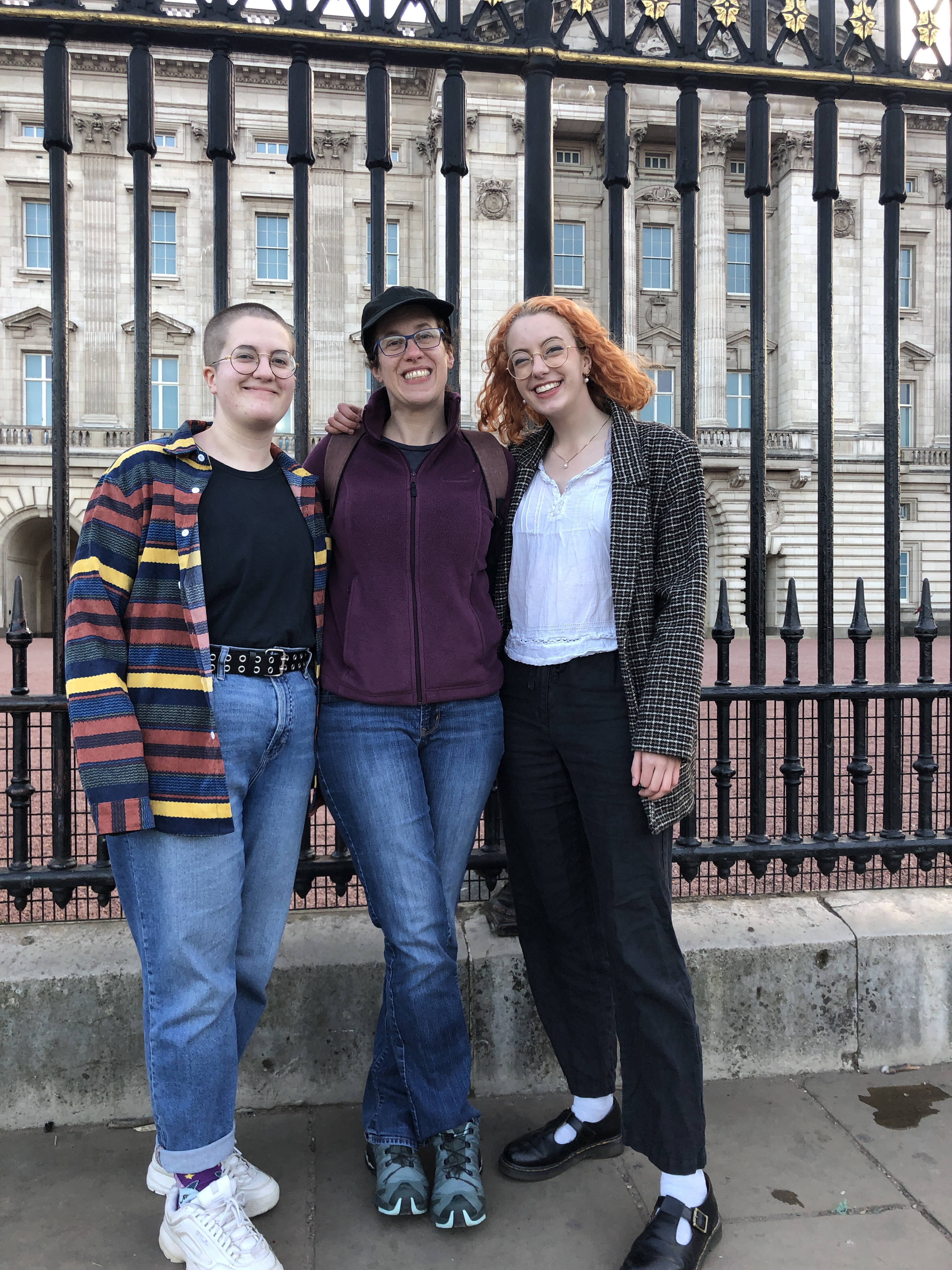
We headed to London by bus and did some walking to see Buckingham Palace, Trafalgar Square, London eye, flower beds, birds, sculptures, and tons of people everywhere.
Mik, Kate, Alaina
DAY 12, London, Sunday, April 17
Fortunately our apartment for 2 nights was in a location where a short walk led to interesting locations and small surprises. On my way to see Big Ben I saw people looking through a black iron fence. It was the royal band being inspected for the day. Not exactly like Frank inspecting the troops at MASH 4077. Orderly, precision in a relaxed way.
My next surprise was the open and inviting doors to the Royal Military Chapel. I was greeted at the door by a priest who invited me to stay for the Easter service starting in 30 minutes. I thanked him and asked about listening to the choir who was practicing for the morning service. The church was enormous and beautiful but even more so was the sound of the organ and choir. I listened as the priest gave the guard details about where to seat the royal family members in their arrival.
Walked along admiring the beautiful flowers in the park that extends for blocks in front of Buckingham Palace. Big Ben loomed up in front of me as I came onto Parliament Square with elaborate churches and a small park with several monuments. David Lloyd George’s was dramatic. The sound of a bag piper was warming along with the sunshine and 65 degrees. The massive number of people going every which way was mind boggling! In contrast, on the route back to the apartment I took side streets and was struck at the sight of no one.
My last fun surprise of the morning was the sound of the royal band leaving their inspection area and marching to the palace. Stopped at a cafe for brunch and a chance to wonder where people were going as they zipped by.
A highlight of the trip was attending Hamilton at the beautiful Victoria Palace Theater. The best word that describes the performance for me: STUNNING, in every way!! The set, use of stage, costumes, actors, music. What a performance-wow, wow, wow!
Victoria Palace Theater, Hamilton performance
The day was complete with a meal at Its All Greek to Me. Yum!
DAY 13, Monday, April 18
I said so long to Kate, Alaina, and Mikayla and headed to the airport. Today I traveled from Gatwick airport in London to Dublin, Ireland. I took a Bolt ride (no Uber in England) to Blackfriar train station, three stops to Gatwick, flight to Dublin, and I stayed at one of the airport hotels to be close by for my flight home to Boston the next day.
It’s been an incredible journey-sooooooo grateful for every moment! Sooooo happy to be traveling again. Appreciate Nicholas, Kate, Mikayla, and Alaina! The world where I’ve been is definitely opening up once again. Of my 5 flights I only had to show any Covid documentation once. I’m sad knowing my journey is coming to an end but my memories will continue and I’m happy to be headed towards the states. Travel is special to me, from my first trip out of the US in 1973 with my sister Niki to Greece and Egypt, I knew it was something I’d want to continue. I’m soooo grateful for the many travel opportunities I’ve had and all the learning along the way.
World Collage Day is an international celebration of the fine art of collage being recognized this year on on Saturday, May 14th, 2022! Celebrate with enthusiasts around the globe. If you google ‘world collage day’ you can see what some others are doing to recognize the day. And right here in Maine, the Bangor Public Library has put a call out for collages that will be included in a display at the library. The details are below with hopes of having your students participate or, if the library is not a convenient location for your students, create something similar and get some energy going around World Collage Day! This is a great way to celebrate spring and to help turn the corner from the pandemic. Using the theme “Hopeful” because we know that there are many reasons to focus on what gives us hope.
Bangor Public Library Plans– your invited or use this idea to adapt for your community!
Join in the fun and make a collage to be on display at the Bangor Public Library!
You are invited to submit a collage if you are preK-grade 12 students.
Collages must be no larger than 9”x12” and must be made of paper (no 3-D objects). You can use magazines, colored paper, newspaper, paper bags, tissue paper, wrapping paper, etc. and mount your collage on thin cardboard (cereal box thickness is sturdy enough to use for the backing of the collage).
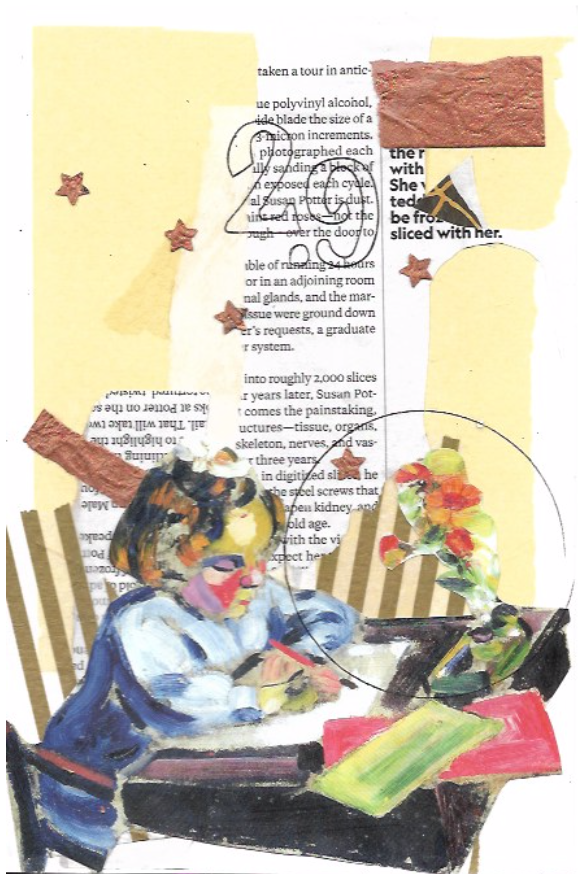
Created by Kal Elmore
What is a collage?
Usually a collage is an art work made up of photos, clippings, or found items that are attached to a sturdy surface. An example is a picture of a tree made up of pictures of things that are green. You can search on the internet for many interesting examples of collage, if you would like to get ideas.
The theme is ‘Hopeful‘
There are many reasons why this is a good time to focus on the things that give us hope. Brainstorm some ideas with a friend or family member and think about these ideas as you make your collage.
Collages are mostly made up of scraps of paper so you can also think of this as a recycle/reuse project. (Do not use special pictures or papers without permission).
All you will need is some paper scraps, some glue, scissors (if you need to cut things), and your imagination!
If you don’t have scrap materials at home you can go to the Bangor Public Library Children’s room and pick up a paper bag with paper scraps inside. You still need your own glue and backing material and scissors. These bags will be available at the library from May 2 – May 12, during library hours.
Submit collages
Your finished collage needs to be submitted to the Children’s Room in the Bangor library on May 12-14, during library hours. (There will be a box for submissions.)
Before submitting your collage you might want to take a picture of it or a picture of you and your collage. The library is not responsible for lost or damaged work, and sometimes things happen. If you want your collage, back you need to pick it up at the library on May 31 during library hours.
If you want, you can post the picture of you and your collage on Instagram with the hashtag #meworldcollageday2022.
On the back of your collage please put your name, the title of your work, and a parent or guardian signature that shows you have their permission to submit the work.
If you have any questions, please contact one of the librarians or Candis Joyce, Reference Department, Adult Program Coordinator, Bangor Public Library, 145 Harlow Street, Bangor, ME 04401, (207) 947-8336 ext. 127, (207) 922-6054 direct.
This story starts with the design that was selected for the Maine Learning Technology Initiative (MLTI) conference t-shirt. But, it’s about much more than that. It’s about a 7th grader who LOVES the arts. Congratulations to Penny Graham who attends Waterville Jr. High School. Her art work, seen below, was selected to be printed on t-shirts that will be worn by Maine middle schoolers and their teachers while they attend the virtual student conference being held, May 26. Registration is open for the MLTI Virtual Conference and all grade 7 and 8 Maine students are invited to participate.
I had the pleasure of speaking with Penny recently about her design that connects with this years conference theme: Space2Connect. Before getting to the creating part Penny looked at t-shirts from past years which helped to guide her decisions. She wanted it simple so she considered ideas with space, specifically planets. She decided on one color so it could be seen and read easily. She tried different colors including pink and green but kept coming back to purple. She’s been using the digital app Procreate on her iPad for about a year so it made sense to use it for designing the t-shirt idea. In fact, she has created a video that demonstrates her knowledge and how she went about accomplishing her design. Video about using the app Procreate. Penny’s video will be included on an upcoming episode of theMLTI SLAM Show, which focuses on student leadership in technology integration.
Penny drawing
After being on the phone with Penny for about 45 minutes I realized that I was not only speaking to a t-shirt designer by an incredible arts advocate. “The Arts are important to me. My whole life I’ve always loved doing music and art because they’re my passions. I’ve done art clubs, I draw a lot, I played a little saxophone, guitar, and the recorder. This year I can see myself improving.”
In addition Penny loves to write, narratives and some poetry. She’ll often learn something while writing in school and goes home and practices what she’s learned. She’s had several different learning opportunities in the arts. “I love doing art with materials and using my hands and getting dirty. It is such fun.” She enjoys pen and ink, sketching, water color, rock painting and pottery. Penny also loves creating with digital tools because “I can change the design quickly and the process goes much smoother.“
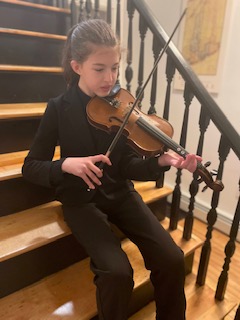
The arts rotate through the schedule for students at Waterville Jr. High and as a 7th grader she doesn’t have visual art but she does have music. She selected the violin which she played when she was younger and is happy to return to it. She enjoys playing in the school orchestra and likes the performances.
She also loves theatre and has participated in the Sound of Music and Nobody Believes in Fairies which was written by one of the school’s 6th English teachers. She’s excited about the musical coming up this spring called Middleschool Madness. Penny says: “Theater is a really nice bonding experience. It’s a fun, social thing that I just love to do. I got to meet so many new people in the two plays I’ve been in. My theater experiences have all been really great.”
Penny as Gretl
Penny also shared her experience of the pandemic. She was glad to have alone time to draw and bake and was able to pursue her hobbies. “I feel like without the pandemic I wouldn’t have been able to move forward that much. I feel like I could take big strokes that I wouldn’t have had time to do.”
Penny’s dad shared: “Waterville is a wonderful place for artistic and curious children like Penny.”
I’m certain that Penny has a bright future and I’m grateful to have met her and for our conversation.
The Maine Art Education Association (MAEA) concluded an outstanding spring conference by presenting three, no four, awards to deserving educators. But first a word about the conference. I’ve been around long enough to see institutions transform, some for the third and fourth time. I had the pleasure of working on the planning committee for the MAEA spring conference that was held on Saturday, April 2 in Rockland at the Farnsworth Art Museum and CMCA. I’m not just talking about a conference that was held in both facilities but what took place was magical. It was delightful to see the two institutions partner with MAEA to put together a very worthwhile day for art educators.
Presentation by Daniel Salomon
The conference entitled Radical Reuse was planned and implemented by a group of people who had never worked together before, some new to their positions, and everyone went above and beyond. Over a two month period every Thursday the education staffs of both institutions and the MAEA conference planners came together on zoom to plan the annual spring conference. THANK YOU to everyone for a job well done! From CMCA: Mia Bogyo, and representing the Farnsworth: Gwendolyn Loomis Smith, Katherine Karlik, and Alexis Saba. MAEA president, Lynda Leonas, coordinated the effort with board members Iva Damon and Christine Del Rossi supporting. From the Rockland school district Richard Wehnke helped.
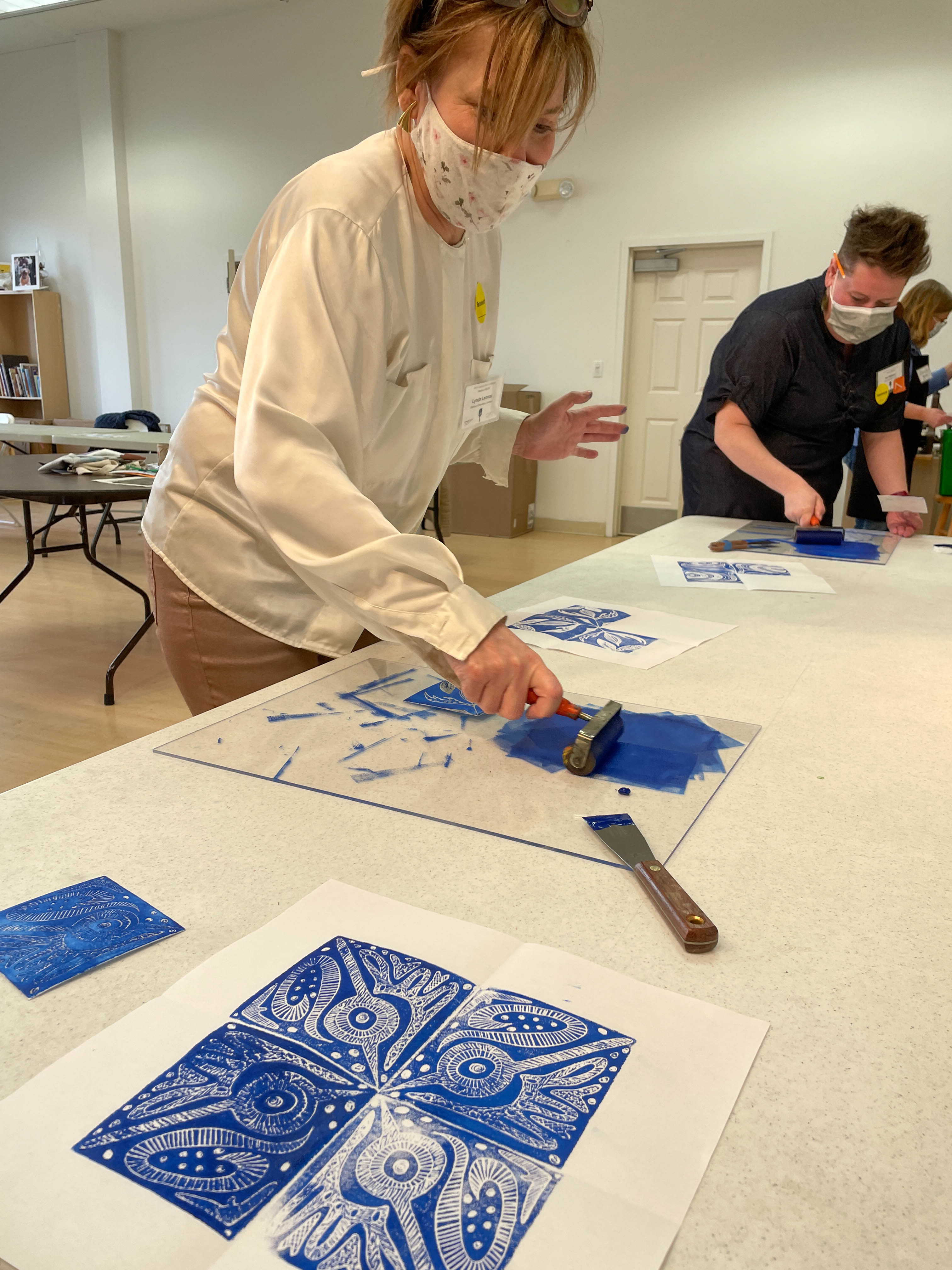
Printmaking with Sherrie York – Lynda Leonas and Iva Damon
The keynote was provided byKrisanne Baker, Medomak Valley High School art and ecology teacher and artist. She is committed to advocating for the ocean and inspires her students to learn about water quality, availability and rights, and ocean stewardship. Guest speaker Daniel Salomon who teaches in The Hatchery at Camden Hills Regional High School provided background information on the work he is doing with students utilizing and reusing materials and the role we each can play.
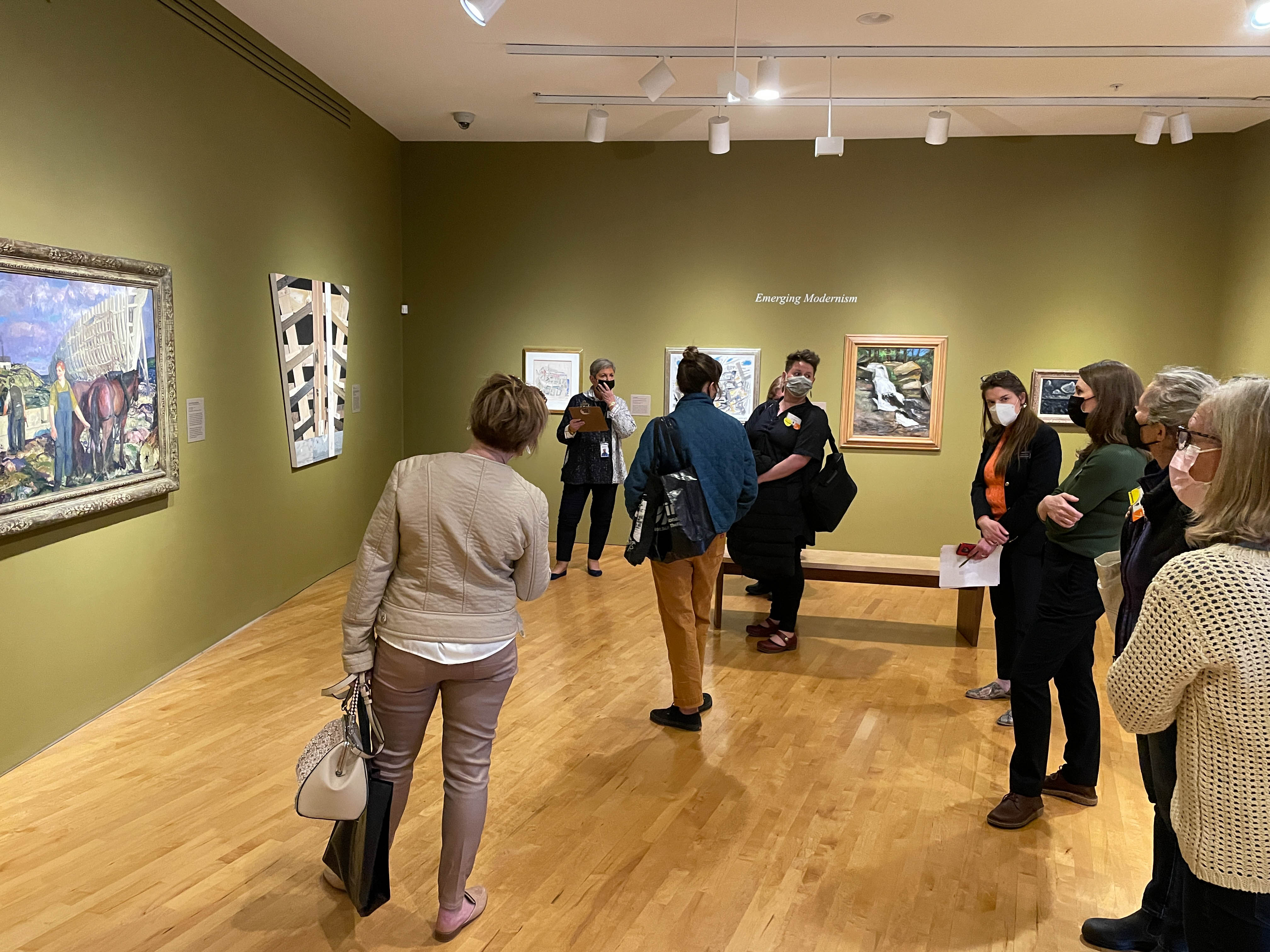
Gallery tour, Farnsworth
After the opening speakers, conference participants attended sessions on printmaking with Sherrie York, art making around ‘place’ with Alexis Iammarino, toured the Farnsworth Museum, and toured CMCA. Several merchants from Downtown Rockland supported the conference goers with discounts. During the middle of the day Daniel’s students from the Hatchery, set up outside CMCA, shared several of the projects they have been involved in this year.
Alexis Iammarino demonstrating, CMCA
AWARDS PROGRAM
The day concluded with honoring the work of four educators with an amazing backdrop of quilts at CMCA. The educators are outstanding in and out of the classroom, engaged in work at the local, regional, and state level. They work (and play) tirelessly, sometimes alone and often collaborating with others. Every day they exhibit all that is right about education. In their respective institutions they have a place at the table where they continuously advocate for students and art education. We know that an excellent education in the arts is essential, and these educators strive for every student to experience just that.
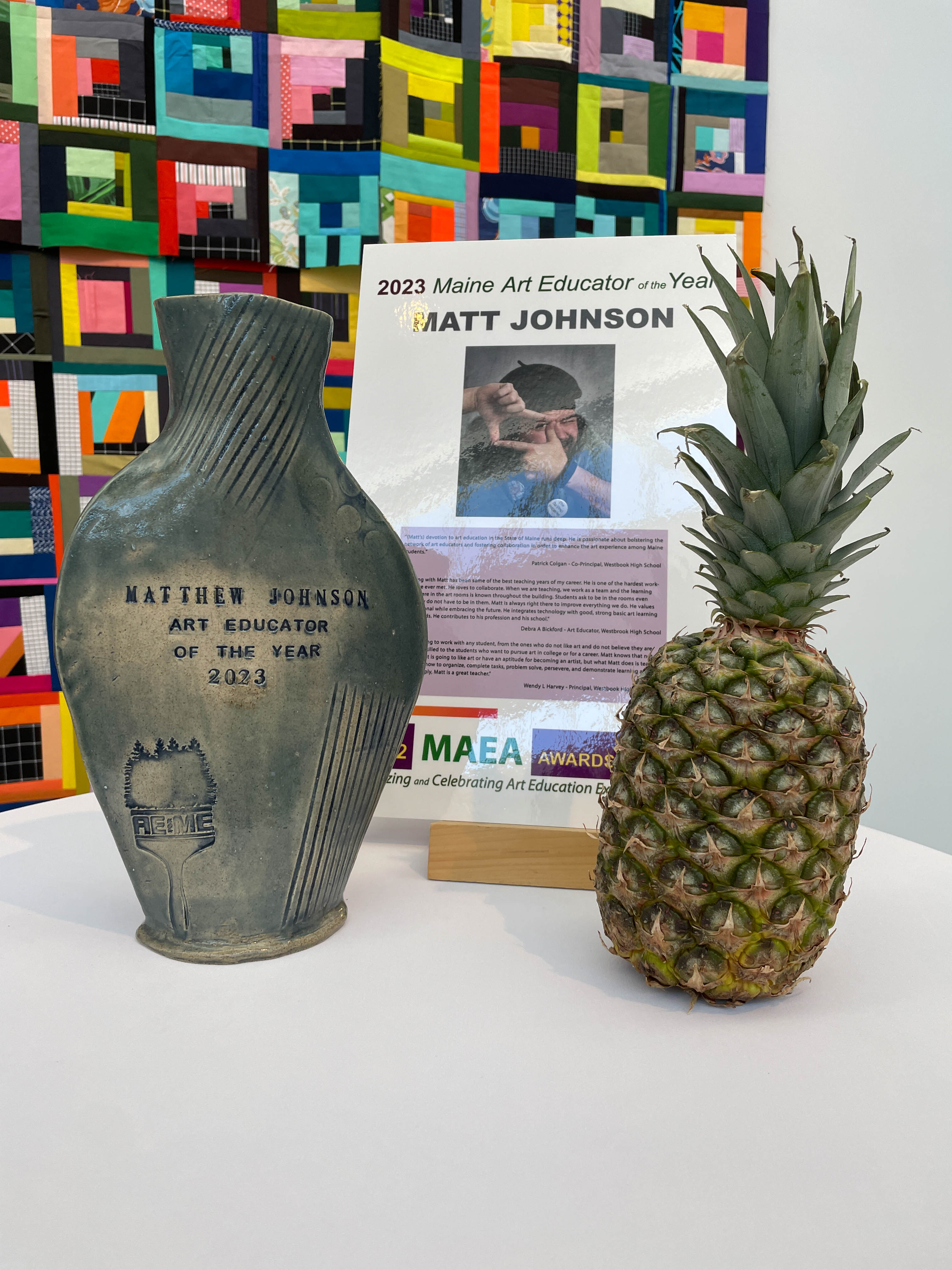
The awards committee was led by Belfast Area High School art teacher Heidi O’Donnell. Members of the committee included Hope Lord, Maranacook Middle School art teacher and Suzanne Goulet, Waterville High School art teacher, and myself. The awards, clay vessels, were created by Carolyn Brown, Camden Hills Regional High School art teacher. In addition each educator received a plaque for their classroom and a pineapple.
The 2022 Administration/Supervision Art Educator of the Year was presented to Dr. Rachel Somerville who is at Maine College of Art & Design and Westbrook Schools. She was introduced by Melissa Perkins, Congin Elementary School art teacher, Westbrook.
Melissa presenting Rachel
The 2022 Secondary Art Educator of the year was presented to Iva Damon, art teacher at Leavitt Area High School in Turner. She was introduced by Lynda Leonas, president of MAEA and an art teacher at Walton and Washburn Elementary Schools in Auburn.
Lynda presenting Iva
The 2023 Maine Art Educator of the Year was presented to Matthew Johnson, art teacher at Westbrook High School. He was introduced by Deb Bickford who also teaches art at Westbrook High School.
Lynda Leonas presented a surprise pineapple award to Heidi for outstanding leadership and contributions to the MAEA board. She is stepping down from the board as she takes on a leadership position with the National Art Education Association.
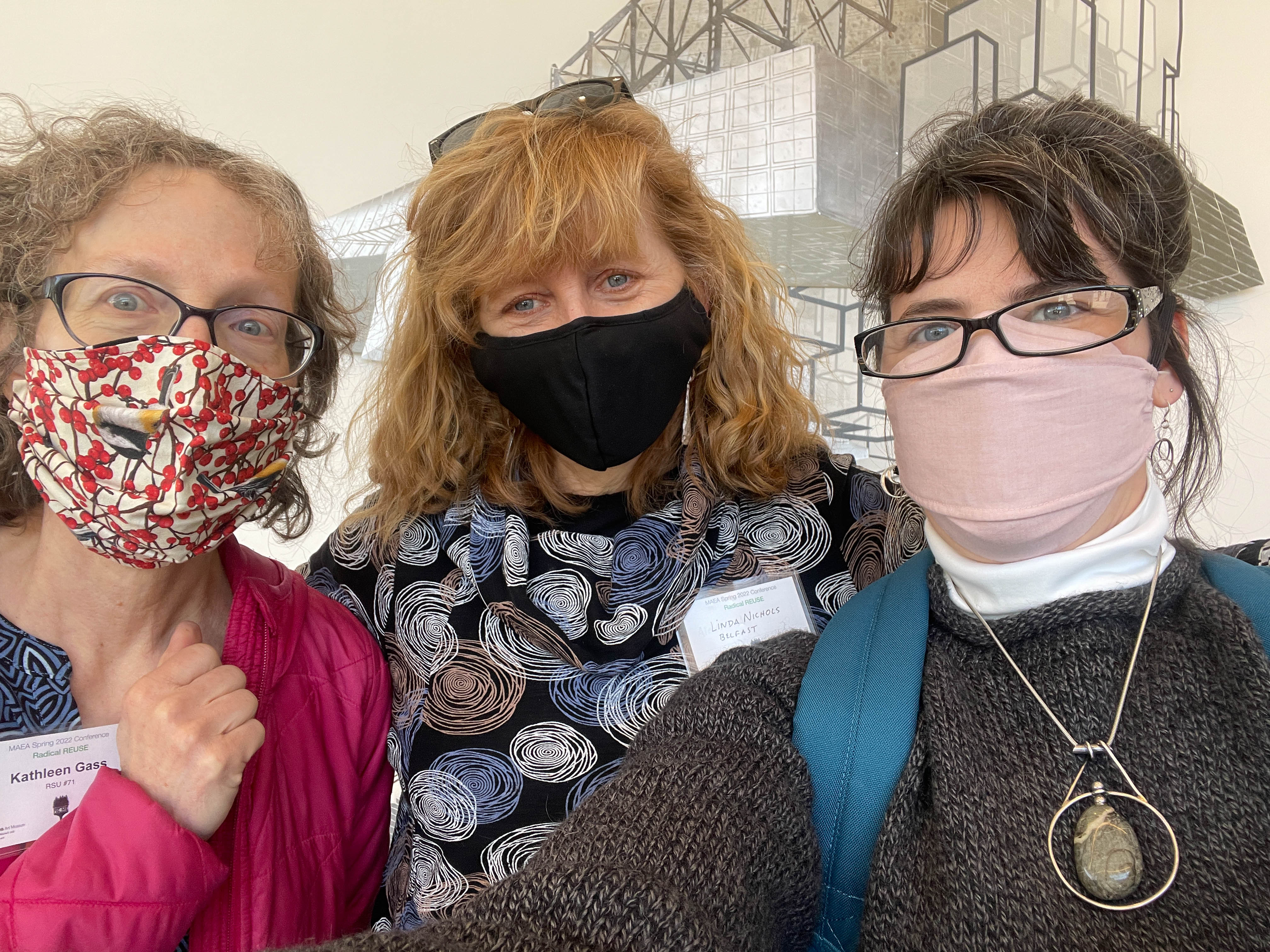
Heidi O’Donnell, right with her Belfast colleagues Linda Nicholas, middle and Kathie Gass, left
As we move away from the challenges of the pandemic I urge you to consider:
Become a member of MAEA, if you are not already one
Volunteer to become a board member and take on a leadership role
Nominate a colleague who is worthy of recognition
For more information please go to the MAEA website.
If you’re interested in connecting with a global audience of educators, please read this post. I’ve blogged about HundrED in the past. In 2018 I was selected as a HundrED Ambassador and was invited to attend the HundrED Summit in Helsinki in 2018 and 19. I met amazing educators from around the world. Some of my follow up roles with HundrED have been to assist in the selection of innovations that best represent HundrED’s mission.
What is HundrED?
HundrED is a global education non-profit, recognized as one of the world’s leading experts on scalable innovations in K-12 education. HundrED’s mission is to help every child flourish in life by giving them access to the best possible education innovations. HundrED annually selects 100 leading education innovations globally packages and shares their amazing work with the world, for free.
Applications are open for the HundrED 2023 Global Collection – DEADLINE: JUNE 1ST, 2022
Are you an education innovator? We want to hear from you! Submit your initiative to the HundrED 2023 Global Collection before June 1st, 2022. If you are not an innovator, but know an organization doing great work in the field of education, send us an email at research@hundred.org with a link to their website. APPLICATION.
In an unprecedented way, the global pandemic has highlighted the importance of building social and emotional skills (SEL) to help children thrive in school, the workplace, and life. In this report we highlight 13 of the most impactful and scalable education innovations fostering SEL skills in students. In addition, the report offers 5 successful strategies for implementing these programs.
HundrED and Ukraine
Of course HundrED has Innovators and Ambassadors from Ukraine. They’re reaching out to these people and in this writing you can read about the crisis from a Ukrainian teachers perspective. In addition HundrEd provides resources on how to speak with children about the crisis in Ukraine.
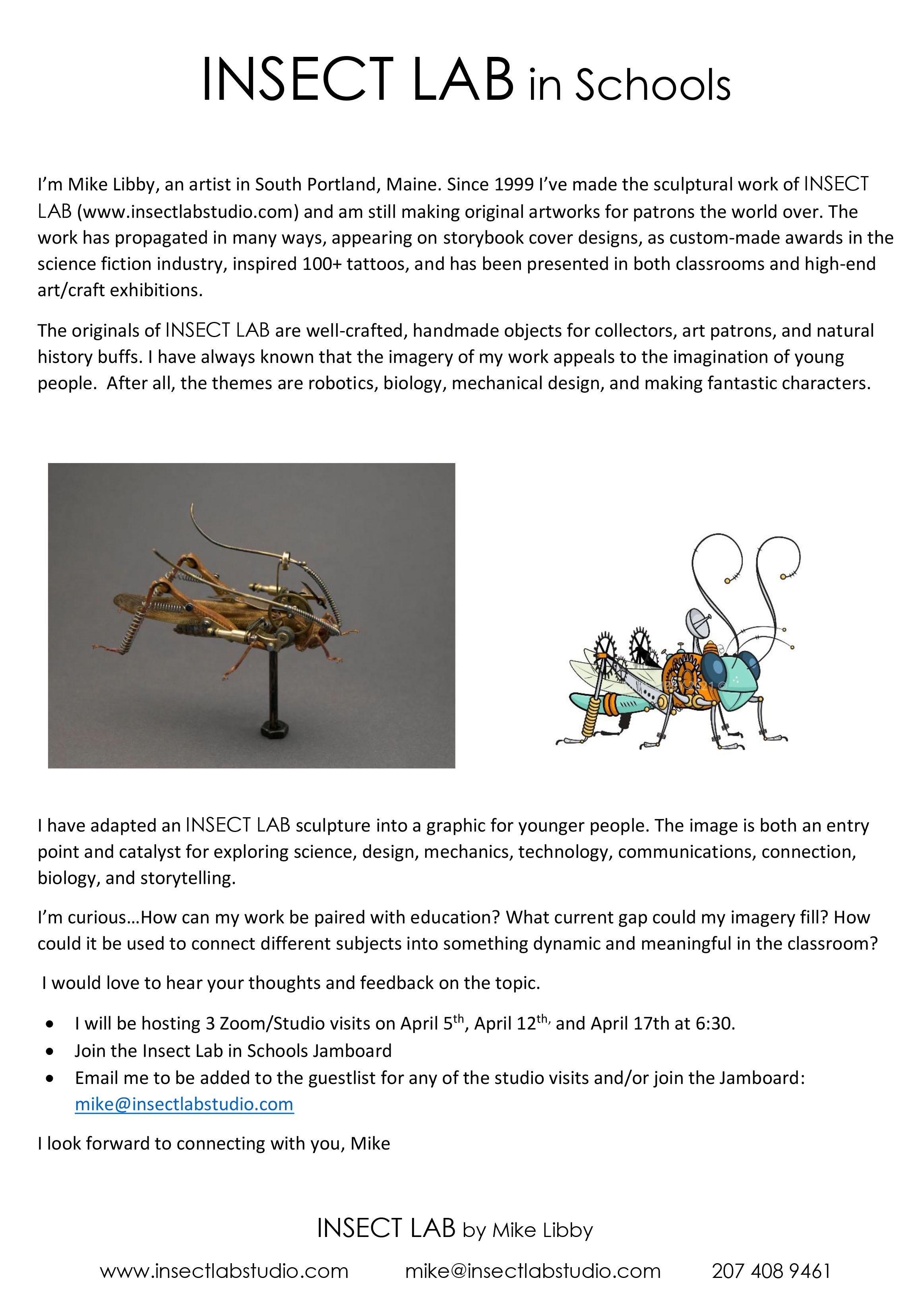
Below is an invitation from Maine artist Mike Libby! Mike is a graduate of Bangor High School and is an amazing artist who established INSECT LAB. Now, he’s sharing his ideas with teachers. I encourage you to respond to Mike and join him on zoom during one or all of the sessions. What a super opportunity to consider how Insect Lab could be part of a lesson or perhaps your school curriculum.
With a few spaces left to attend the spring conference, the Maine Art Education Association (MAEA) is extending the deadline – don’t delay. How wonderful it is to know that teachers can come together IN PERSON for professional development once again. Join colleagues from across the state on April 2, 9:00 a.m.-3:30 p.m. MAEA is partnering with the Center for Maine Contemporary Art and the Farnsworth Art Museum in Rockland to offer this learning opportunity for Maine teachers who are *members of MAEA. Register at THIS LINK.
Keynote will be given by Medomak Valley High School teacher and artist Krisanne Baker. Daniel Salomon from Camden Hills Regional High School is a guest speaker. Several members of the Downtown Rockland Association are offering a discount during the conference including restaurant.
**You can become a member at the same time you register. Ignore the registration deadline below.
Argy Nestor
Arts Educator, Blogger, Artist, Connector meartsed@gmail.com
https://sites.google.com/view/anestor/
Argy’s Blog
The purpose of this blog is to share stories about people and places; and to celebrate the amazing work (and play) that students, educators, and organizations are doing in and for arts education. In addition, the blog has a plethora of resources and innovative ideas. This forum gives blog readers the opportunity to learn from each other. It is essential that we listen, learn, and collaborate in order to build on teaching practices for the benefit of every learner in Maine and beyond.



















 me arts ed