Wisdom Middle/High School – St. Agatha

Aroostook county
Most days I feel fortunate to do the work I do. Let’s face, I believe working with Maine’s Visual and Performing Arts teachers is a great job! Most days it doesn’t feel like work because I love it so much. (Don’t mistake this for an easy job!) I don’t get to Aroostook County or the areas of Maine that are further away from the Maine Arts Commission office as much as I’d like but, when I do it is a wonderful treat.
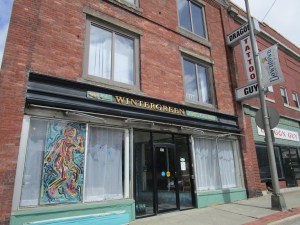 Recently I traveled to the County (as Aroostook is affectionately know to many) and learned a great deal AND had a fabulous time. The early morning drive north on 95, once I reach Bangor, is an opportunity to turn off the radio and look and think. It took me almost 4 hours from my home to my first destination, Wintergreen Arts Center in Presque Isle.
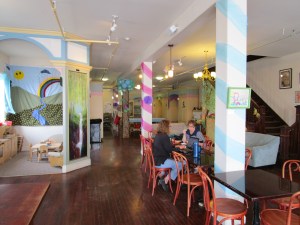
Wintergreen Arts Center, Presque Isle
I met with Dottie Hutchins, the Executive Director of the Wintergreen Arts Center and with the co-chairs of the center board members Heather Harvell, and Kim Guerrette Michaud. I felt like I had known them for a long time. The center has many successful programs that range from pre-school programs to after school art programs for young kids through teenagers to programs for adults. They are a growing center with so much to offer. If you are in Presque Isle be sure and stop in and say hello to the folks there. Dottie and the crew are working on a series of blog posts for meartsed so you can learn more in depth about their programs.
 From there I headed north to visit Maine Arts Leadership Initiative (MALI) Art Teacher Leader and Leadership Team member Theresa Cerceo. First stop, after my hour drive was at the Dr. Levesque Elementary School in Frenchville where Theresa was teaching a science lab. Yes, art integration in action. It wasn’t about the product but about learning by asking questions and experimenting with materials. For example, students were grinding leaves with a little bit of water. Students test scores in math and reading have increased due to the work that ALL teachers are doing during the weekly labs.
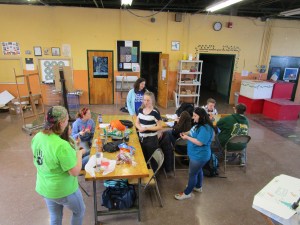
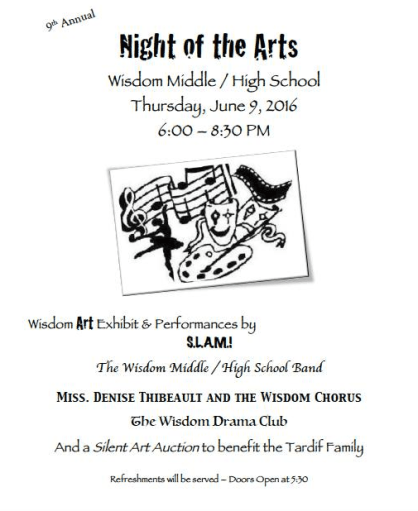
SLAM at Wisdom High School, St. Agatha
From there I headed north again to Wisdom Middle/High School in St. Agatha to visit with the Students Leaders in the Arts Movement (SLAM). It provided the opportunity to talk and listen to the members of SLAM at their own school. We exchanged ideas on the school board presentation they are preparing for. SLAM kicked off the statewide arts education census in December by creating a video inviting principals to submit the survey. It was great to share some of the results – 95% response. So proud of the advocacy work this group is doing. If you are interested in learning more or starting your own SLAM chapter please contact Theresa at tcerceo@msad33.org.
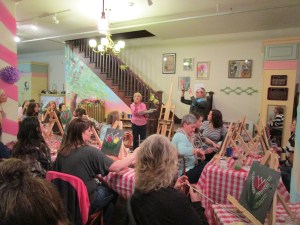
Sip and Paint
Back to Presque Isle for supper with the MALI Teacher Leaders who planned the workshop I was attending the next day including Sue Beaulier who teaches Art K-12 in Ashland, Josh Bosse (and his lovely wife), Music PK-12 in Madawaska, Leadership Team member, Pam Kinsey, Music K-12 Easton, and Theresa. After supper we stopped into the Wintergreen Arts to see the center filled with 31 adults painting as part of a fundraiser, Sip and Paint.

Jake Sturtevant presenting long distance
The next day I headed west for the MALI Mega Workshop at the beautiful Ashland School. Students were in session but you couldn’t tell. The school is laid out beautifully and the rooms are lovely places to work. Thanks Sue for hosting. It was a wonderful day with the following workshops offered:
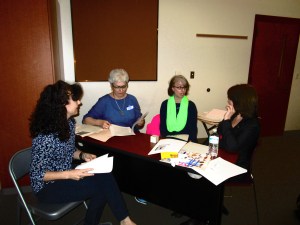 The day was complete with a discussion on PBE to learn where arts teachers in the County are on the continuum. And, two woman from the Partners in the Arts Presentation shared information about the organization and encouraged teachers to apply for grant funding.
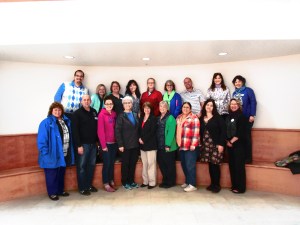
MALI Mega participants
Lunch was delicious and the company was wonderful! Congratulations to the MALI Teacher Leaders and to Dave Ouellette from CACE who planned a great professional development opportunities for their colleagues in the County. The drive to the County is far but it is well worth the distance. I learned a great deal and had fun talking with folks about their arts education program. I had never been that far northeast but I must say the trip was so beautiful, especially along Long Lake (ice still on) in St. Agatha. I still need to get to Madawaska – next trip to the County (Josh!).
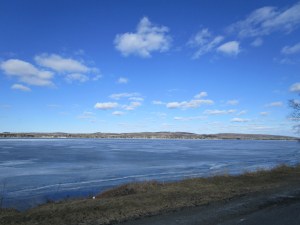
Long Lake
Where art and science meet
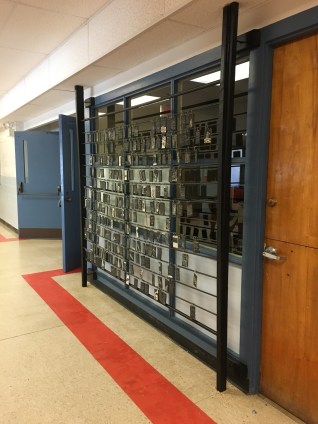
Completed piece
Not to long ago I had a delightful visit at the Camden-Rockport Middle School. Middle school art educator Kristen Andersen had invited me to learn more about a collaborative teaching unit that she had undertaken with teaching artist Tim Christensen. I met Kristen many years ago and have visited her classroom on occasion. (I love it when teachers contact me to visit and learn what they are up to. So, please contact me if you’d like to share. It gives me the opportunity to share what you are doing so others can learn from you)! I met Tim at Haystack Mountain School of Crafts five years ago where he was facilitating a clay workshop at the Maine Art Education Association conference. Tim is a full-time artist and in addition does school residency’s.
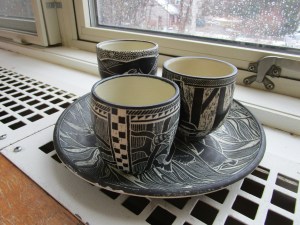 Tim and Kristen put their heads together to develop this unit. They are working with the Farnsworth Art Museum’s Stories of the Land and It’s People program. In Tim’s personal work as an artist, he is documenting the habitat of animals and microcosms that are living today that will become extinct, some in our lifetime. The way he explained it is we know that the wooly mammoth existed during the Pleistocene epoch. The mammoth was identified as an extinct species of elephant by Georges Cuvier in 1796. So, we know the mammoth existed but we are unsure of its habitat. In order to preserve this information of the animals and microcosms living today Tim has taken it upon himself to document their habitats on pottery. Animals live here and they have systems that support them – its about the interactions and relationships. And, we know that pottery has told stories for hundreds of years.
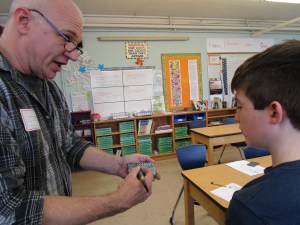 Ninety grade 7 students are participating in this undertaking along with the science teacher Patty Crawford and Language Arts teacher Katie Urey. In fact, the artwork has been created during several of Patty’s classes. (Kristen is on multiple teams so her schedule doesn’t coincide with all of Patty’s classes). The work directly relates to the grade 7 science curriculum and students are writing haiku poems in Katie’s classes.
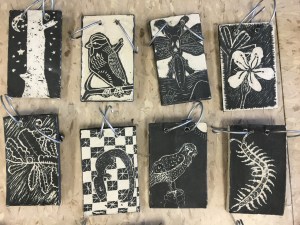
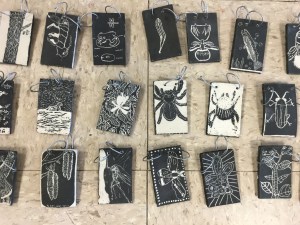
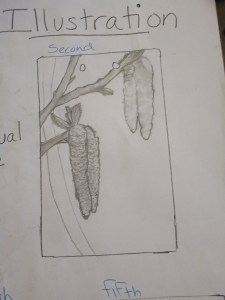 Each student is responsible for 3 clay tiles about 2″x4″. They started by drawing a name out of a hat of an organism and researched it. The tiles were underglazed black on raw clay. The drawings are being carved on one tile to create various shades and textures by using a variety of marks (lines, crosshatching, stipples to name a few). The technique is called sgraffito on porcelain. A second tile has the facts that they learned about their animal and the third has their haiku poem. Each tile has two small holes at the top which will be used to hang the tiles on copper rods that will be hanging between wooden braces. It will be like an abacus. The exhibit will be an educational tool so others can read and learn and try to match up the fact tiles with the image tiles.
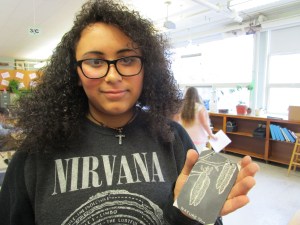 The connected unit has been supported by principal Jamie Stone who moved to Camden-Rockport Middle School from an expeditionary school in Baltimore. They’ve connected with the Coastal Mountains Land Trust who is very excited about the work. They set up locations and field trips so the students could visit a location where their organism actually exists. This study is providing an opportunity for students to become stewards of the land (in their back yard). On the field trip many of the students actually saw them. The land trust plans to exhibit the traveling show on location this summer.
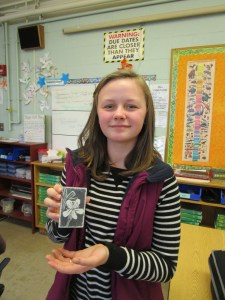 This unit is a great example of how the expertise of both the art educator and teaching artist are critical. Tim’s expertise as an artist as well as his knowledge of the science helps elevate this unit to a higher level of teaching and learning.
When visiting classrooms and schools Tim’s role is to supplement the teacher’s knowledge in the area of pottery and all of the components of ceramics that accompany it. In addition, he supports young people who are considering being an artist and show interest in expressing themselves visually. Tim is a role model and a living example that anyone can be a full-time artist if the field is chosen. He wants students to know that “they can have a rich full life and be heard if they develop their artistic skills”, said Tim.
Kristen finds that the Camden-Rockport Middle School art curriculum is enhanced by the artists that she invites into the school. Kristen has done at least one major installation every year for several years and it is not viewed as an extra but an important part of the students’ education. The installation creates a collaborative atmosphere for the entire school.
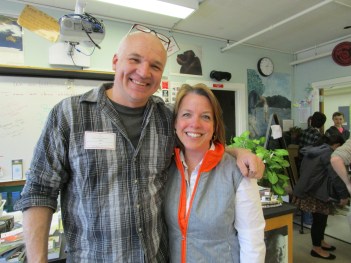
Tim and Kristen
The artwork will be on display for the community to view on Thursday, April 28, 5:30 to 7:30 PM for Arts Alive Night being held at the Camden-Rockport Middle School.
Regional VPA Teacher Leader Search
Maine Arts Leadership Initiative (MALI) – Phase VI
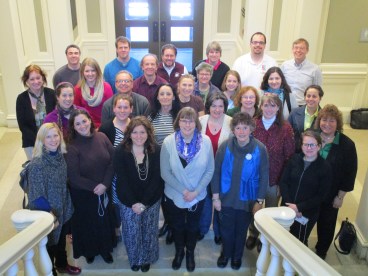
MALI winter retreat, March 2016, Bowdoin College
Join us for a GREAT opportunity! The Maine Arts Leadership Initiative invites YOU to be part of Phase VI. We are looking for teachers interested in leading and in taking a close look at assessment in the arts. If you are selected, you will be required to attend the summer institute, August 10, 11, and 12, 2016. We will provide professional development and ask that you take what you’ve learned and share it with other educators in your region and beyond.
 If interested, please send a completed application by the Friday, May 6, 2016, 11:59PM deadline to Argy Nestor at argy.nestor@maine.gov ASAP. Details are below. TEACHER LEADER APPLICATIONS ARE AVAILABLE AT http://mainearts.maine.gov/Pages/Education/MAAI#
Selected teacher leader responsibilities for the 2016-17 school year include:
Maine Arts Leadership Initiative Background Information
OVERALL DESCRIPTION
 Committed to the development of Teacher Leaders to ensure deep understanding and meaningful implementation of high quality teaching, learning and assessment in the Arts for all students.
Since 2011 the initiative has been building capacity by training arts educators on the “what” and “how” of arts assessment so they can provide the leadership in Maine through professional development opportunities. The details of the initiative are at http://mainearts.maine.gov/Pages/Education/MAAI#.
MALI’s OVERALL OBJECTIVES
 Create and implement a statewide plan for teacher leadership in arts education. This includes professional development opportunities, regionally and statewide, which will expand on the knowledge and skills of teachers to better prepare them to teach in a proficiency-based learning environment.
HISTORY – Phase I, II, III, IV, V – Summer 2011 to present
 Seventy – three teacher leaders attended summer institutes on assessment,
Phase VI components
 August 3,4,5, 2015: Summer Institute, Portland
For More Information
The Initiative is a partnership with MAC, MDOE, USM, MAEA, MMEA, MLTI, University of Maine Performing Arts, and New England Institute for Teacher Education
New England Institute for Teacher Education
EDAR 528 Brains on Fire: Rekindling Imagination in the Classroom, K-8. This course has been approved as one of four courses toward Gifted Talented endorsement 690 K-12 by the Maine Department of Education.
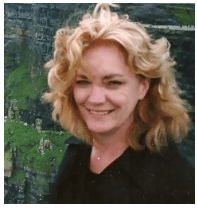
Catherine Ring, course instructor
This exciting arts integration course will explore the significant role the arts can play in learning. Educating gifted and talented learners will be included as a component of this study and we will also explore the latest research on the brain and creativity.
You will get to see examples of student learning through visual art, dance, music and drama; learn about the critical evidence of improved achievement in all subject areas by students who are regularly exposed to the arts; and participate in practical, hands-on arts integration lessons which can be used immediately in the classroom. Helpful resources, including books, videos, websites and lesson plans will be shared. Collaborative work between arts teachers and classroom teachers are encouraged. You will take away a renewed sense of confidence that you CAN make a difference in your classroom by making room for the arts, promoting engaged students through a rich learning culture.
The New England Institute honors the individual needs of teachers taking our classes, and you will create a self-designed course study with guidance from the instructor, using the wealth of materials provided to you, making the course relevant and immediately applicable to your classroom.
So join instructor, Catherine Ring, in this wonderful opportunity to learn, create, network and grow in your ability to make your teaching and learning for your students even more dynamic and engaging.
CLICK HERE to learn more and to register.
Sooooo proud!
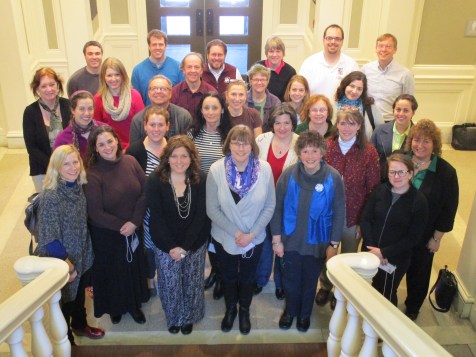
MALI at Bowdoin for Winter Retreat
I am continually amazed and proud of the commitment and passion of Maine’s visual and performing Arts educators. Yesterday I had the opportunity to spend all day at Bowdoin College with the Maine Arts Leadership Initiative’s (MALI) for the Phase 5 winter retreat. Twenty five MALI members were able to join us. Thank you to the Bowdoin College Art Museum for hosting. The beauty of the room and the delicious food added to the energy, thoughtfulness, and incredible knowledge of the MALI Teacher Leaders.
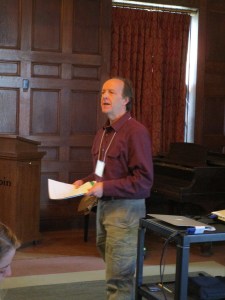
Teaching Artist and Teacher Leader John Morris
The topics of the day included overarching questions that are helping us to formulate the details of MALI’s Phase 6. The ideas are created based on the needs of teachers to meet the needs of Maine’s PK-12 students in the Arts. Who better to know about the needs of Arts education than Maine Arts educators?!
MALI’s Mission
MALI is committed to the development of Teacher Leaders to ensure deep understanding and meaningful implementation of high quality teaching, learning and assessment in the Arts for all students.
Teaching Artist/Teacher Leader – John Morris
During phase 5 John put together Creativity resources for the Resource Bank located at http://www.maineartsedresources.org/. The description of the Creativity resource: This discussion group model will help participants make connections with creativity research, while promoting inquiry and dialogue about the nature of creativity, as well as the role of creativity in K-12 teaching, learning and assessment. John facilitated the use of the model yesterday and the conversation was one that I wish every educator in the state could engage in. Contact John if you have questions about the resource at JohnMorris08@gmail.com.
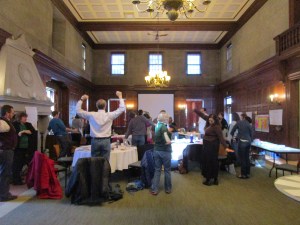 MALI and Teaching Artists
We spent some time yesterday considering the role of the Teaching Artist and brainstormed ideas on possibilities for Phase 6. The Maine Arts Commission is committed to continue to develop opportunities. The Teaching Artist roster located at https://mainearts.maine.gov/Pages/Education/Teaching-Artist-Roster will continue to grow and be available for those interested in contracting with a Teaching Artist to provide learning opportunities for students.
MALI focus
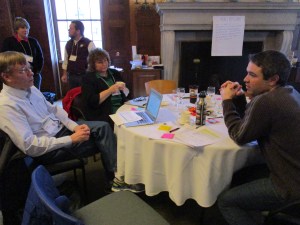
Deep in thought, Rob Westerberg, Mari-Jo Hedman, Jake Sturtevant
The bulk of our day was spent on looking at and discussing the MALI topics that have become essential components of our work. Using the MALI Logic Model we asked two questions: 1) What is the role of the Teacher Leader working with the MALI mission? and 2) What activity or output could be created or included to implement the essential topics? The topics include: Arts Integration, Creativity and 21st Century Skills, Proficiency-Based Learning and Reporting, Educator Effectiveness, Advocacy, Assessment Literacy, Effective Teaching and Learning/Best Practices, Funding, Legislative Policy, and Guiding Principles.
It was a great day and I am so grateful to know and be part of a group that is so positive about the work they do educating PK-12 student in Arts education. It is a pleasure to LISTEN to what each Teacher Leader is doing and has to offer! If you are considering applying to be a Teacher Leader for Phase 6 please watch for the “call” and email me at argy.nestor@maine.gov.
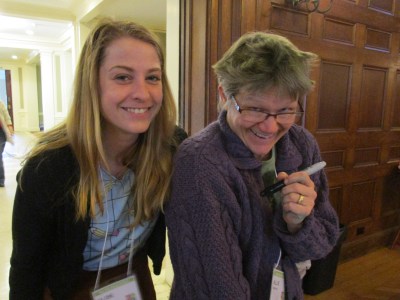
Gorham School district Art teachers Elise Bothel and Allie Rimkunas
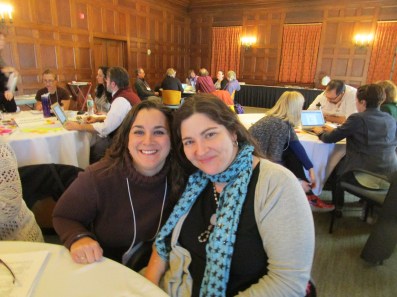
Beth Lambert, DOE VPA specialist and St. Agatha art educator Theresa Cerceo
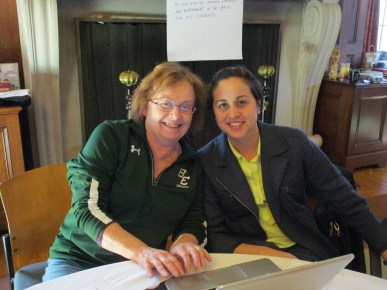
Dance teacher MaryEllen Schaper and Music teacher Jen Nash
March it is!
When others are looking out the window waiting for Spring, Visual and Performing Arts Educators and others committed to excellent quality and access to arts education, are celebrating Arts in the Schools Month!
The month of March officially marks Youth Art Month, Music in Our Schools Month, Theatre in Our Schools Month, and Dance Education Month. A time for everyone to recognize students and their involvement in Arts education. We celebrate all that is “right” and “great” about visual and performing Arts education and a time to shout about it!

Celebrating Arts in Our Schools Month
March provides an opportunity for Arts education to shine even greater than it does day to day. How will you take advantage of this opportunity? I suggest that you read the post I wrote one year ago called Arts Education Month for ideas or borrow language from this post to communicate with others. Use your voice to let others know why you believe that a quality Arts education is essential for all students, PK-grade 12.
Parts of this blog post have been borrowed from HomeRoom, an education blog of the US Department of Education who borrowed the post from the Office of Innovation & Improvement. Other parts are from the professional dance, music, theatre, and visual arts organizations websites.
The arts are an important part of a well-rounded education for all students. Arts-rich schools, those with high-quality arts programs and comprehensive course offerings, benefit students in and outside of the art or dance studio, music room, or stage. “All children deserve arts-rich schools,” Secretary Duncan told an audience of arts education advocates in 2012, as he discussed the disappointing results of an ED survey that showed many students lacking adequate access to arts education.
There’s no better time to echo the secretary’s pronouncement than in March, widely known as “Arts in the Schools Month.” Under the leadership of national associations representing teachers of dance, music, theatre, and the visual arts, a variety of activities unfold throughout the month — some that showcase the achievements of students and others that focus on the professional growth of arts educators committed to achieving the goal of arts-rich schools for all students.
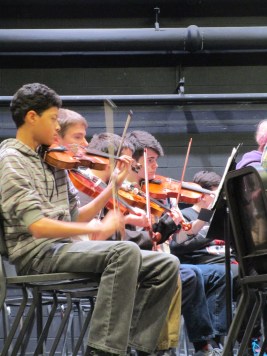
Waterville Senior High School band students
MUSIC
Music in Our Schools Month was established nation-wide in 1985 by the National Association for Music Education.
Music teachers celebrate Music In Our Schools Month (MIOSM) in many ways by offering special performances, lessons, sing-alongs and activities to bring their music programs to the attention of administrators, parents, colleagues, and communities to display the positive benefits that school music brings to students of all ages.
Each year the National Association for Music Education sponsors a concert for MIOSM. You can view the concert videos by CLICKING HERE.
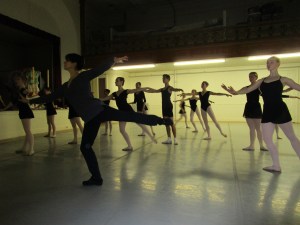
Bossov Ballet, Maine Central Institute
DANCE
For students of dance, March is when the National Dance Education Organization celebrates the artistic and academic achievements of exceptional students through the National Honor Society for Dance Arts (NAHSDA), which recognizes students who display outstanding artistic merit, leadership, and academic achievement in studying dance. Students who are members of NHSDA have an opportunity to be nominated for one of the highest honor programs for dance in the U.S., the NDEO Artistic Merit, Leadership, and Academic Achievement Award.
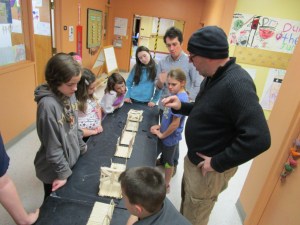
Poland Community School STEAM camp
VISUAL ART
Youth Art Month (YAM) focuses on the value of visual art and art education for all children, with the theme of “Start With Art, Learn for Life.” State affiliates of the National Art Education Association (NAEA) help with support of YAM programs throughout the month, and NAEA members locally sponsor art exhibits and other activities to direct attention to benefits of visual arts learning and to increase community understanding and support of their schools’ arts education programs.
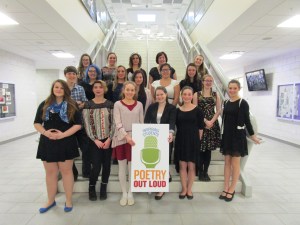
Maine Northern Maine Regional Final participants
THEATRE
Theatre In Our Schools (TIOS) is a celebration of theatre in our schools and schools in our theatres. Sponsored by the American Alliance for Theatre & Education (AATE) and the Educational Theatre Association (EdTA), the goals of TIOS are to raise public awareness of the impact of theatre education and draw attention to the need for more access to quality programs in and out of school for all students. While TIOS presentations and advocacy may happen anytime in schools, theatres, and other public spaces, AATE and EdTA will recognize and promote March as the official Theatre In Our Schools month.
PROFESSIONAL LEARNING
Like all academic areas, students of the arts are successful because of teachers who are highly skilled, knowledgeable of developments in their fields, and motivated.
The Maine Arts Leadership Initiative provides resources aplenty at THIS LINK.
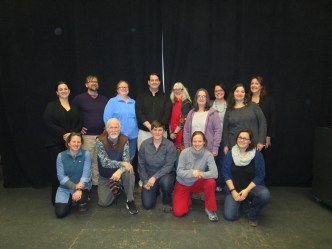
Maine DOE Maine Arts Education Resource Project – Integration participants
It’s your turn to get involved
Arts-rich schools benefit everyone. Research increasingly shows that arts education heightens engagement for all students and can increase motivation and persistence for those most at risk of failing or dropping out of school. Learning in the arts also uniquely equips students with the skills in creativity and divergent thinking as well as problem-solving and teamwork that they need to be college and career ready. The Arts Education Partnership, with support from ED and the National Endowment for the Arts, has publications and a research clearinghouse, ArtsEdSearch, to help you learn more about why the arts in our schools are worth honoring for a month.

Attend Maine’s Arts Advocacy Day at the State House in Augusta, March 24. For more information CLICK HERE for the Maine Alliance for Arts Education website. I hope to see you there!
Take advantage of Arts Education Month to engage others in the conversation of why a quality arts education is essential for all students. Be sure that your principal and school have participated in the statewide Arts Education Census that is underway and being facilitated by the Maine Arts Commission. To learn more CLICK HERE.
Art and Science
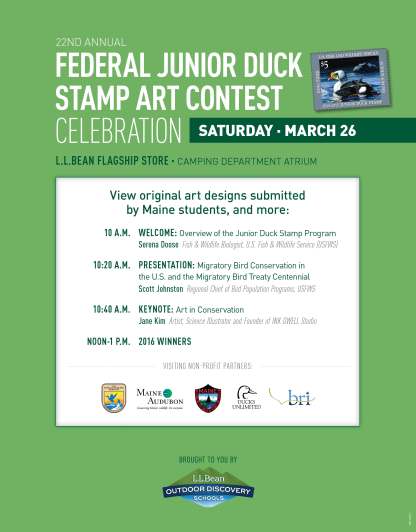
The 22nd Federal Junior Duck Stamp Contest and associated celebration on March 26th. The Federal Junior Duck Stamp Conservation and Design Program is a dynamic art- and science-based curriculum that teaches wetland and waterfowl conservation to students in kindergarten through high school.
Students K-12 submit artwork of native ducks, geese, and swans. The winning artwork from a national art contest serves as the design for the Junior Duck Stamp, which the U.S. Fish and Wildlife Service produces annually. This $5 stamp has become a much sought after collector’s item. One hundred percent of the revenue from the sale of Junior Duck stamps goes to support recognition and environmental education activities for students who participate in the program. The deadline to submit artwork is March 15, 2016.
The 2016 Federal Junior Duck Stamp Contest Celebration will take place on Saturday, March 26th at the LL Bean flagship store in Freeport, ME. The event will be from 10:00 AM- 2:00 PM.
Keynote speakers include Scott Johnston (USFWS Migratory Birds), who will speak about the Centennial of the Migratory Bird Treaty, and Jane Kim (Ink Dwell Studio), who will speak about her experience using art to promote conservation. Kim is based in San Francisco, has an extensive career as an artist and science illustrator, and recently finished painting the Wall of Birds mural at the Cornell Lab of Ornithology.
In the afternoon, winning contestants will be recognized and given awards. Non-profit partners will have booths in the adjacent room to share their research and conservation projects throughout the day.
If you have any questions about this event please contact Serena Doose at Serena_Doose@fws.gov.
Arts Based Learning of STEM Works
Wondering about the impact on STEM that the Arts are making? If so, I suggest that you check out the following information.
Article: http://m.huffpost.com/us/entry/8724148
Research Project Summary: http://www.artofsciencelearning.org/3rd-year-project-update-report/
Related STEAM Resource Website: http://www.artsciencematchup.org/
• The high school students who had arts-based learning showed large and statistically significant pre/post improvements in such creative thinking skills as idea range (13%), problem analysis (50%) and number of solutions generated (37%). In many cases, students who had traditional STEM learning actually declined in these aspects of creative thinking — so the overall differentials between arts-based and traditional learning was even more dramatic (idea range = 22%, problem analysis = 121%, solutions generated = 43%). Thus, it appears as though arts-based learning may be an effective way to “inoculate” learners against the collapse of creativity that may sometimes accompany traditional forms of high school learning.
• Arts-based learning had a far more powerful impact on the collaborative behaviors of adults than traditional learning, based on actual observed behaviors. Examples from the final week of the study: arts-based teams exhibited 56% more instances of empathic listening, 33% more instances of mutual respect being shown, 119% more instances of trust being demonstrated and 24% more sharing of leadership. All differences cited here are statistically significant.
• The innovation outputs of high school student teams who had arts-based learning showed 111% greater insight into the challenge, a 74% greater ability to clearly identify a relevant problem, a 43% improvement in problem solving, and their innovations had 68% more impact. All are statistically significant.
• 120 days after the study, high school students who had arts-based learning were 24% more likely to have been able to apply the learning to school, extracurricular, work or volunteer activities, than students who had traditional learning. They were also 44% more optimistic in their belief that the training would prove helpful in those realms in the future.
You are currently browsing the archives for the Integration category.

 me arts ed