Archive for the ‘Integration’ Category

h1

President’s Committee on the Arts and Humanities

February 1, 2012

Webinar tomorrow on report: Reinvesting in Arts Education: Winning America’s Future Through Creative Schools

On Thursday, February 2, at 5 PM ET, please join us for an insider’s look at Reinvesting in Arts Education: Winning America’s Future Through Creative Schools, the recent report released by the President’s Committee on the Arts and the Humanities (www.pcah.gov).  The research clearly shows the effect of arts education on student academic achievement and creativity.  Additionally, among its specific recommendations, the report suggests the following…

•             Build robust collaborations among different approaches to arts education
•             Develop the field of arts integration
•             Expand in school opportunities for teaching artists
•             Utilize federal and state policies to reinforce the place of arts in K – 12 education
•             Widen the focus of evidence gathering about arts education

Of particular concern to our members, of course, is the issue of teaching artists and their role in the classroom.  Rachel Goslins, Executive Director of PCAH (http://www.pcah.gov/staff), will share more about the study, and answer questions in what will be a unique learning and discussion opportunity.  We encourage all officers and members to take advantage of this chance to engage Rachel, and to plan detailed questions about the subject matter in advance.

For more information about the study, please visit: http://www.pcah.gov/sites/default/files/PCAH%20Arts%20ED%20%20Report%20Summary%20&%20Recommendations_0.pdf.

Webinar registration is free.  https://www1.gotomeeting.com/register/703925017

We look forward to having you with us on February 2 at 5 PM ET.

h1

John Bohannon: Dance vs. Powerpoint

January 30, 2012

Dance those thoughts

This post is about a TEDx presentation by John Bohannon, an American, who presented in Brussels on this theory of dancing to present information instead of using power point. He is a biologist and a journalist and uses an alter ego known as the Gonzo Specialist. He runs the “Dance Your Ph.D.” contest.

This presentation is not only about that concept but John does it with an example of teaching/conveying science ideas. It also is about the information age and creativity and so many other ideas may popped into my mind as I watched this TEDx. John has challenged his students to use dance to present findings for Ph.D. research and it has turned into a world-wide contest. If you google Ph.D. dance you will see numerous examples of submitted ideas for the contest. But if you don’t have time right now to look at several right you can bookmark this link that has the 2011 winners of the contest. I suggest on the next snow day you can view them. And, perhaps this might give you ideas on how to engage your students in their learning/assessment in a different way. And here is one example that shows the epic mating battle of the fruit flies stars three dancers who undertake extremely clever choreography to depict various stages in the process. Consider sharing this information with your students. It would be great to hear their feedback.

Thank you to Karen Montanaro for sharing this information.

h1

Arts Standards, 21st Century Skills, Common Core

January 24, 2012

Webinar explains connections

Last Tuesday my colleague, Joyce Huser, from Kansas presented a webinar to SEADAE (State Education Agency Directors of Arts Education), our professional organization of state arts specialists on the topic of arts standards, ELA Common Core, and the 21st Century Skills Map. The webinar was very helpful and I hope you will have 45 minutes to listen to it. The resources and link to the webinar are on the arts education webpage at the Maine Department of Education at http://www.maine.gov/education/lres/vpa/eor.html#webinars

Joyce was on the team that created the Art Skills Map for the Partnership for 21st Century Skills. The partnership is a national organization that advocates for 21st century skills for every student. The document provides information on how the arts teach 21st century skills and fulfill the needs for today’s learners. The webinar provides the connections (crosswalk) between arts standards, Common Core ELA standards, and the 21st century skills. The power point includes a graph that exhibits the skill demands for arts related careers for 2008 – 2018 which shows the skills taught in arts education classes.

h1

The Art of Technology in Music Workshop

December 19, 2011

Free MLTI music workshop for teachers

Date: January 10, 2012
Facilitator(s): Steve Garton
Location: Mt. Ararat High School, Topsham
Time: 8:00 AM – 3:00 PM

We were fortunate to have Steve Garton at the statewide arts education conference at USM in October present to all participants. Here is another opportunity that MLTI is offering with Steve. A free workshop for music teachers who are interested in integrating more technology in their teaching practice. The workshop is designed primarily for middle and high school music teachers, but all are welcome.

Agenda:
8:00 – 9:00: Keynote – Steve Garton: The Art of Technology in Music
9:00 – 11:30: Hands-on workshop: Pushing the Limits of Garage Band
11:30 – 11:45: Jim Wells – A Remote Musical Tribute Using Garage Band (A very cool global interactive musical project)
11:45 – 12:45: Lunch (on your own)
12:45 – 1:15: A Different Look at Musical Assessment Using Technology
1:15 – 2:00: Music Notation on the Computer (A comparison and appropriate use of MuseScore, Garageband, Sibelius, and Finale for different scoring needs.)
2:00 – 2:45: Music Educator Round Table: Teaching with Technology (discussion and sharing of current practices, ideas, challenges, needs for PD, etc.)
2:45 – 3:00: Wrap-up and Evaluation

Please bring your MLTI device, head phones. Participants will receive a certificate for 6 contact hours. This session is limited to 25 participants.

A link to online registration can be found at http://www.maine.gov/mlti/events

Steve Garton – Bio:
Steve Garton is the Coordinator of Educational Technology for the Maine Department of Education. He provides oversight and logistical support for Maine’s education technology programs with a primary focus on the Maine Learning Technology Initiative providing 1-to-1 computing for the students in Maine.

He received his bachelor’s degrees in Piano Performance from Eastern Illinois University and Math from Slippery Rock University. His Masters is in Educational Technology from Youngstown State University.

Steve was able to navigate the dual life of a serious musician paying his way through school as a keyboard player in local bands. He was fortunate to be involved in the evolution of music technology as the keyboard players were always pushing the envelope of integration and acceptance. From the humble 16 channels of MIDI that were difficult to synch up, Steve’s studio now runs 512 MIDI channels controlling ten physical keyboards and countless virtual instruments as well as 96 channels of digital audio.

Steve believes that all musicians need to have an understanding of where the technology is today. He also believes that music is in the heart, the soul, and the practice studio. Technology does not make music, it allows us more options and easier ways to create, capture, and share what we do. It would be difficult today to have a career in music that did not involve technology in some way.

Steve has been involved in music in about as wide a range as you can get. From playing the Brahms first piano concerto with an orchestra to having no address for two years as he traveled the country playing top forty tunes five hours a night, six nights a week. He sold pianos and organs in Florida and can play “Somewhere My Love” and juggle at the same time. He was an assistant band director for five years and even assumed the head role for a playoff season that went to the state championship. He even received a few technical fouls with the pep band. He was musical director for 13 plays at Sharon High School and did a lot of arranging for the Warren Philharmonic Orchestra. He likes to sit around the house and play the acoustic guitar while watching amazing musical videos on YouTube.

Come spend a day and share with a like-minded group of people as we talk about the state and proper use of technology in music today.

I just learned from Barbara Greenstone, MLTI technology specialist, that this workshop is full! Soooooooo…. if you haven’t signed up and are interested in this workshop please post a comment below and let us know (include the school district where you teach). If enough teachers are interestred from your region, perhaps MLTI will travel to your region!

h1

The Arts Connect Naturally

December 6, 2011

STEM/STEAM and other connections

Recently a comment was posted to the blog that was made by a person who is not trained as an arts educator nor an artist. It was in response to the post called Reaching Students Through STEM and the Arts which was posted on January 11, 2010. Not sure why the individual didn’t comment on the several other STEM/STEAM posts that have been made since that date. The comment made me pause since I have seen two other articles of note this week. One that connect the Arts to STEM in Education Week and one from the Maine Sunday Telegram about students at Waynflete School in Portland collaborating to create 23 – 7 feet tall and 4 feet wide trees.

First a look at the Ed Week article called STEAM: Experts Make Case for Adding Arts to STEM written by Erik W. Robelen. Mr. Robelen provides examples of schools across the country where the arts are connecting with STEM. One example is “the Philadelphia Arts in Education Partnership, with support from a $1.1 million Education Department grant, is working with city schools to help elementary students better understand abstract concepts in science and mathematics, such as fractions and geometric shapes, through art-making projects.

“Educators are finding where the arts intersect with the STEM fields to enhance student engagement and learning, and educators are finding that it helps unlock creative thinking and innovation.

Doesn’t sound like anything new to me or to arts educators who have been connecting curricula to deliver arts education in practice for years. In fact, arts educators understand the connections and our understanding is much greater than just to other content as stated in the Maine’s 2007 Learning Results: Parameters for Essential Instruction.

Standard E – Visual and Performing Arts Connections:

  1. The Arts and History and World Cultures
  2. The Arts and Other Disciplines
  3. Goal-Setting
  4. Impact of the Arts on Lifestyle and Career
  5. Interpersonal Skills

The work at Waynflete this month is a great example of the value of connecting content. The outcome is an exhibit called “Arboretum”. This is taken from the December 4th article written by Bob Keyes: Students conducted all kinds of research about trees, including their environmental impact, their ecological value, their role as habitat for animals and the sacred nature of trees in certain religions. Jeff Tarling, the city’s arborist, came in to talk to the students about trees in Portland, and why some survive and others do not.

As part of the process, Waynflete art teacher and gallery director Judy Novey challenged the students to create something artistic from their research. She urged them to think about the form and rhythm of trees, and to visually represent their research through their work.

These students did not approach their work as an art project at all. It had more to do with science and culture than anything with a creative quality. But as they worked through their tasks, the students said they felt their creativity willing itself to the fore.

When I reflect on my teaching the most successful and memorable work was when students had no idea what classroom they were sitting in nor what subject they were focusing on but it was the magic of learning that was taking place. Life-long learning that becomes embedded in the way we think. The culture of the classroom and school is transformed.

So, I ask you… should we be connecting with the STEM movement currently taking place in education, should we encourage our students to think beyond STEM to help them think and create artistically?

h1

Quasicrystals

October 24, 2011

Daniel Shechtman, Israeli scientist has won the Nobel Prize in Chemistry

Several years ago when I went to space camp in Huntsville, AL, the staff went out of their way to articuluate and provide examples of the many connections between the arts and space education. While I was teaching in the 90’s, two colleagues, one math and one art teacher and I starting looking at and figuring out how to teach fractals. The geometric shape dates back to the 17th century however it wasn’t coined “fractal” until in 1975 when Benoît Mandelbrot named it that. Another math teacher and I worked together, also in the 90’s, to create an integrated unit on tessellations. Artist M.C. Escher never thought of himself as a mathematician as he created tesselations but we know today that the foundation for his creations were strong in the understanding of mathematical concepts.

Once again, the connections between art and math are evident when earlier this month the Nobel Prize in Chemistry went to Daniel Schechtman. When I read this sentence found in the PBS Newshour, Oct. 5, 2011 article entitled What are Quasicrystals, and What Makes Them Nobel-Worthy? I wondered if science and math educators know how many of the terms are found in the visual art curriculum?

Most crystals are composed of a three-dimensional arrangement of atoms that repeat in an orderly pattern. Depending on their chemical composition, they have different symmetries. For example, atoms arranged in repeating cubes have fourfold symmetry. Atoms arranged as equilateral triangles have threefold symmetries. But quasicrystals behave differently than other crystals. They have an orderly pattern that includes pentagons, fivefold shapes, but unlike other crystals, the pattern never repeats itself exactly.

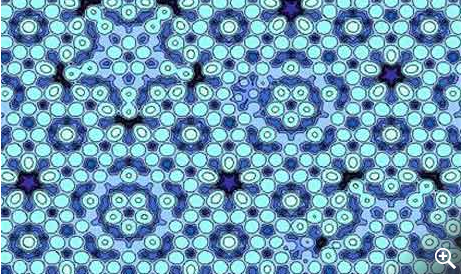
Silver/aluminum quasicrystal

Waterville High School art teacher, Suzanne Goulet, sent me the link to the article on Schechtman which got me to thinking. She suggested I google image search “patterns in Islamic tiles”. At first I didn’t use the “image” in my search, and started reading about Sir Roger Penrose, a mathematical physicist, from Oxford University and the work he was doing in the 1970s. I recalled a book of his tilings that I used to encourage students to find the shapes, patterns, repeated and others in the images. And I read about the Harvard graduate student in physics who traveled to Uzbekistan becasue he was fascinated by the patterns in the 800 year-old buildings and was curious as to how the artisans created them. Lu looked at hundreds of photographs of Islamic architecture and his research landed him an article in Science.

Finally I got to the images and was engrossed in the intracate work of the Islamic Mosaic Design. Just in case you’re looking for a connected unit with visual art and math or science (or both). I suggest you do a google search and expect to go on a journey that will suggest several ideas to broaden your knowledge. It will arm you with ideas to share with classroom teachers, math, chemistry, and/or physics teachers. Using these ideas and concepts can be the vehicle to start brainstorming with your colleagues. Imagine how these ideas might have an impact on engaging some disengaged students in school?!

h1

Dancin’ at Camden-Rockport Middle School

October 19, 2011

Erma teaches dance

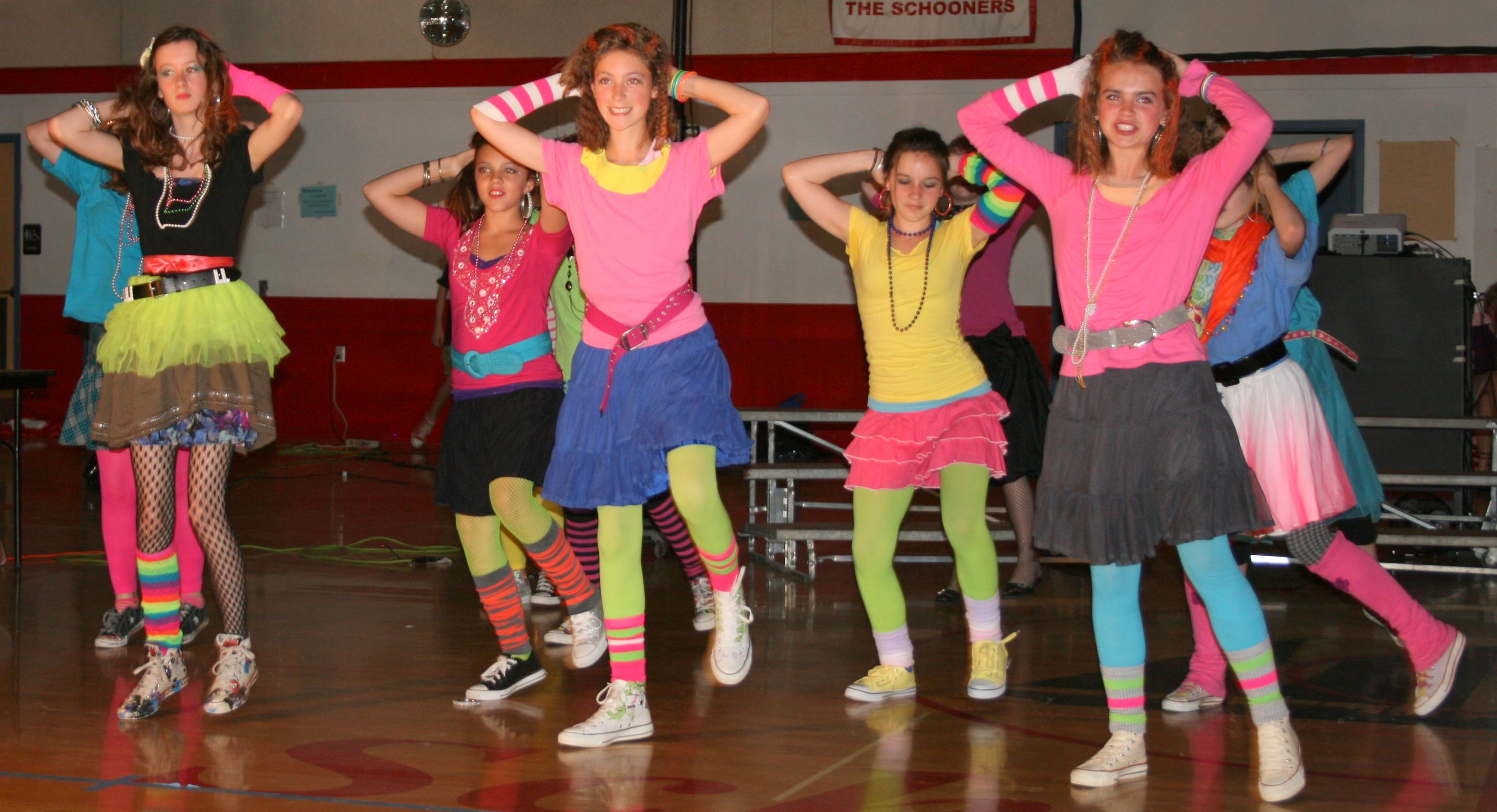
80s- Dances of the Decades

I am a dance educator at Camden –Rockport Middle School in Camden, Maine. I have a BFA in dance performance. My dance journey has taken me from the love of performing, to the love of teaching dance to middle school students as a part of their academic studies. It has been a rewarding journey. Seven years ago I took a job as a substitute teacher with the ulterior motive of learning the academic curriculum, getting to know the teachers, and seeing where I could insert my dance training and knowledge into the school day.

No Child Left Behind and the “teaching to the test” have made my quest more of a challenge. My personal mission statement:

All children should feel comfortable with their bodies and enjoy expressing themselves through movement and dance.

This is most evident in the middle school population. The pre-teen years are a time of discovery and change, physically and mentally. For most students (particularly the boys) dance is tied to social events and all of the insecurities there in. I want all of the students to discover that dance is an individual activity that helps one develop self-esteem and just feel good inside.

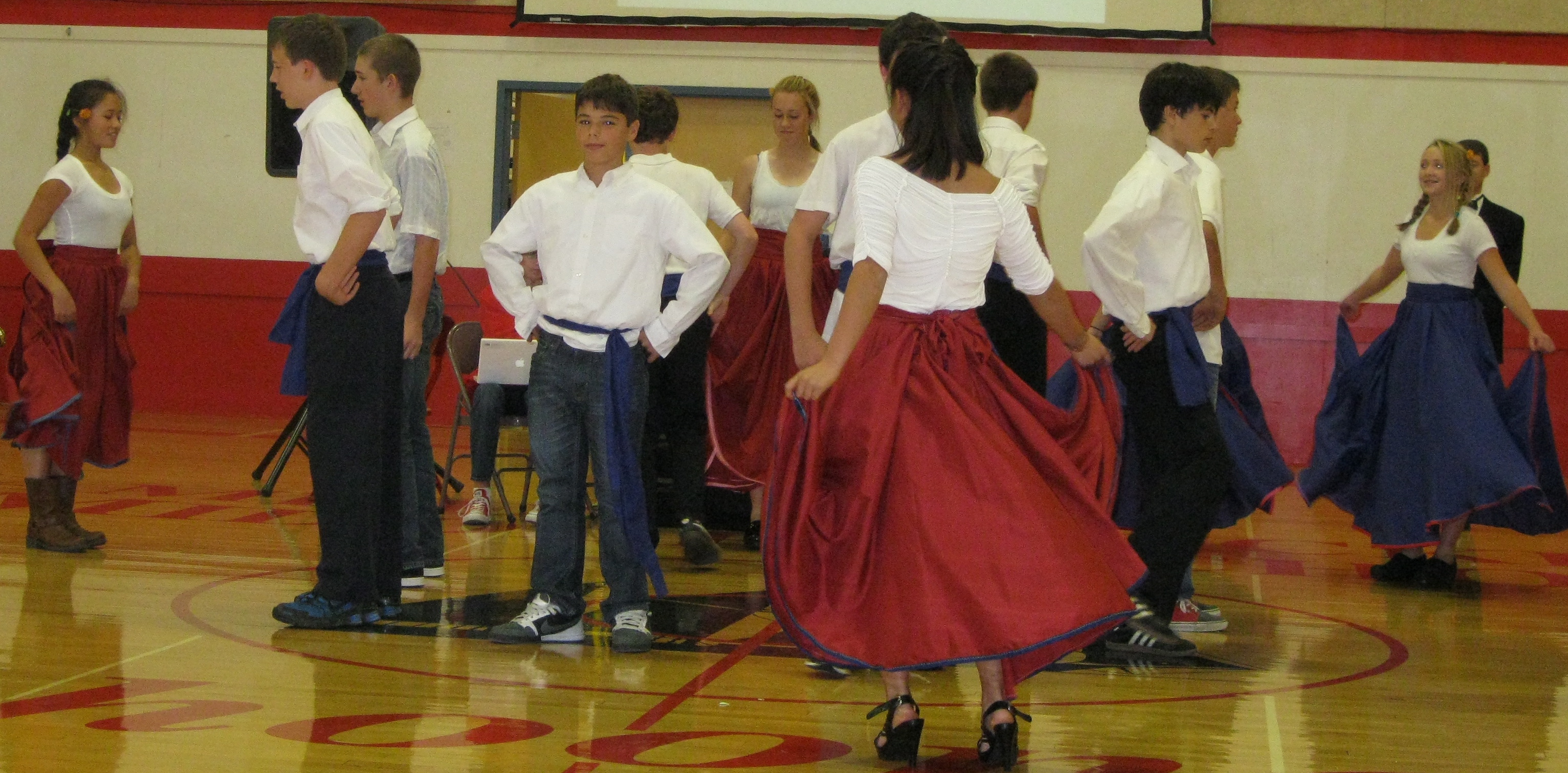
La Cucaracha

Working with the 6th Grade Social Studies teacher, I developed a dance component for his academic unit called “Late 20th Century”.  Through dance, the students became a part of those decades. My success with that program is documented through 100% attendance during the residency week and the continuing mention of the event through high school. We are now in our 7th year. The new 6th graders are already asking me about the dances that will not take place for another 8 months.

This year, I collaborated with the 8th grade Spanish teacher to celebrate the National Hispanic Heritage Month. I was concerned that the 8th Graders would be more self-conscious than the 6th graders. I was pleasantly mistaken. All of the students were eager to get involved. I taught traditional dances from Hispanic countries in Latin America and the Caribbean. The 8th grade Spanish teacher gave the students Spanish vocabulary and we taught the dance classes in Spanish (as best as I could, not having a Spanish language background). Students also researched the different dances and created a slide show to accompany the dances.

Erma at the state-wide arts coference, At the Creative Center, the Arts in Maine Schools in 2007

There are many different ideas of how dance should be taught in public schools. Dance can be taught through the Performing Arts program, Physical Education and integrated into the academic curriculum. My interest is in the third choice. Learning dance through the academic curriculum has benefits. It does not take away from the precious academic time. It introduces dance to the entire student body. It connects students to real people in other cultures and time periods. It brings classes of students together to work on a group project. Dance is an integral part of the human experience. I hope students will keep these experiences in their memories for years to come.

Thanks to Erma for contributing this great post!

h1

WatchMEUseTheArts

August 31, 2011

WatchMECreate

WatchMECreate is a collaborative effort between ACTEM & the MLTI. It consists of a series of serious challenges put out to Maine’s grade 7-12 schools, asking students (and perhaps teachers) to collaboratively develop and submit video responses.  While posed as a “student challenge,” it is assumed that some students may come to it independently while others will be directed towards it by a teacher.

The Maine Alliance for Arts Education is welcomed as a WatchMECreate Partner for the first WatchMECreate challenge of the 2011-12 school year – lending their passion for both creative thinking and action to help assure wide distribution of the challenge along with encouragement for many student teams to get involved.

This challenge is called WatchMEUseTheArts. Maine’s Grade 7-12 students get much of their formal support in developing their creative skills in Arts classrooms, working with Arts teachers in studio art, choral and instrumental music, dance, theater and other areas.  This is where opportunities exist to be purposefully creative, to not simply talk about “outside the box” thinking and action, but to practice it.

We want to know what Maine students, grades 7-12, are doing with those creative capabilities after they leave those Arts classrooms.

The challenge asks students to create a 3-minute video response to, “Show us how the arts have moved, or could move, beyond the music rooms, beyond the art room, beyond the theater, beyond the darkroom, beyond the expected spaces to help students like you make their school or their community a better place for all.”

WatchMEUseTheArts is live on the WatchMECreate web site. Uploads will be accepted from now through December 15. Entries will be judged between December 15 and January 13, 2012, with winners being announced on January 17, 2012.

Rewards: The top Middle School and High School teams will each be awarded $500 to be used by them to help their school move creativity forward. In addition, each student team member will receive an iPod nano.

All information is available on the website: http://watchmecrerate.org

Questions? Write to: watchmecreate@me.com

Thank you,
The MLTI Team

h1

Integrating the Arts Across the Curriculum Webinar

July 24, 2011

Education Week Webinar

Perhaps you joined in on the webinar that was held this past Tuesday, July 19th, on Integrating the Arts Across the Curriculum. I was glad I had the hour to listen to Sandra Ruppert, director of the Arts Ed Partnership and Shana Habel, dance demonstration teacher, Los Angeles Unified School District and co-president of the California Dance Education Association. The presentation was moderated by Erik Robelen, assistant editor from Education Week.

We know that integrating the arts is not a new idea. In fact, I was doing graduate work in 1974 when there was very little research available. Today I did a google search using “arts integration” as the key words and got 47,700,000 results. WOW! Those promoting the idea say that it is gaining a stronger foothold.

You can listen to the webinar by going to this website: http://edweek.org/go/webinar/arts

h1

Integrating the Arts Across the Curriculum Webinar

July 1, 2011

Wednesday, July 19, 2011 2 p.m. EDT

Sandra Ruppert, director of the Arts Education Partnership and Shana Habel, dance demonstration teacher, Los Angeles Unified School District and co-president of the California Dance Education Association will present Integrating the Arts Across the Curriculum webinar.

Many arts advocates suggest integrating dance, music, theater, and visual arts across the curriculum holds great promise to enhance student learning—and revitalize the arts in public schools.

Although not a new idea, teaching “through” the arts appears to be gaining a stronger foothold, proponents say. Examples span the country and content areas. Take dance, where the art form has been used in a Baltimore County, Md., school to help teach scientific concepts like photosynthesis, and in suburban Minneapolis to bring the Underground Railroad to life.

A White House advisory panel recently made the case for “reinvesting” in arts education and drew special attention to arts integration, suggesting that it can boost student motivation and provide both academic and social benefits.

This webinar will explore the potential of bringing together the arts with other subjects in a mutual learning experience and point to promising examples, as well as the challenges to ensure that such efforts achieve their academic goals.

If you are interested please register now for this FREE live event by clicking here.