
Dance education funding – “Hopes for the Future”
This is the second of three blog posts that will be included, February 9 – 11, describing the dance education residency that took place in December 2016 from a special grant called the “Hopes for the Future” funding. Maine Arts Leadership Initiative (MALI) Teacher Leader and dance educator from Thornton Academy Emma Campbell collaborated and planted a seed and it grew into a dance education opportunity for Maine students. Please note: funding will be available again during 2017. Please watch the blog and the Maine Arts Commission arts education list-serv for information. Thank you to Theresa Cerceo and Charles Michaud for their contributions to this blog post.
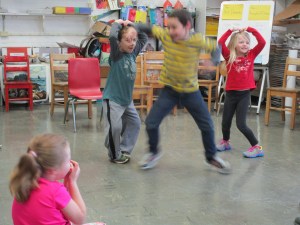 On a chilly Friday night in early December the Wisdom Middle / High School Arts Faculty hosted the Holiday Night of the Arts. The performance was very well attended with the Wisdom High School cafeteria being filled nearly to capacity. The audience was treated to a variety of holiday songs, new and old. In addition, SLAM!, the Student Leadership in the Arts Movement, Wisdom’s student led arts advocacy group, created a performance art piece as a form of arts advocacy. The evening included the Pioneer Band, solo performances, student artwork, and for the first time ever, thanks to the Teaching Artist Dance Grant from the Maine Arts Commission and the Thornton Academy dance program, two dance performances under the direction of teaching artist, John Morris. The students created dance performances were the result of a week-long residency with Mr. Morris. Students worked with Mr. Morris & art educator Ms. Theresa Cerceo to create original dance pieces based on students’ poems around the theme of identity & community.
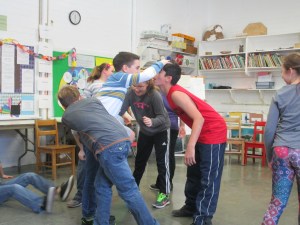 Throughout the week, John worked with two groups of high school students, S.L.A.M.! and a volunteer group of 8 students that became known as, The Butterfly Group. The students worked with John, first learning basic techniques, warm ups and then exploring concepts around identity. S.L.A.M.! used a poem about artistic process and struggle written by member, Jasmine DeMoranville, as inspiration for exploring personal expression and collaboration. The Butterfly Group took time to write “I am…” poems and then, individually created movements in response to their writing. Through much planning; reflection, critique and practice, the students worked with John to use their individual work and build a unified dance that expressed their interdependence as a community.
Student comments
“This work was more intense then I thought it would be and I learned more about physical motion then I thought I would. It opened my eyes to a new medium of expression that I never explored before. SLAM!” ~ Daley
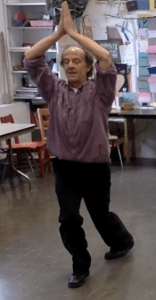
John Morris
“The experience last week was beyond words. It actually taught me that any idea can be turned into something great and to never give up, no matter how stupid it may seem. It also taught me that there can be different interpretations to your idea that may contribute to other great ideas. Yes, I was shy because that shell of me is still not gone but I think this experience finally cracked my shell a bit and I know that SLAM! is capable of cracking and breaking my shell little by little. This dance residency helped me think of new ideas for SLAM!. What I want to do with SLAM (since it is my first and final year) is to have fun and really advocate for art (music, dance, art, drama) in the community and I think the things that happened (the week of the dance residency) is really going to help me throughout the entire year with my ideas because I have learned that no idea is going to go wasted and it could trigger other ideas!” ~ Kelly
“As the author of the poem, it was an incredible experience to see and be a part of the process of transforming my poetry into another form of art. Watching (other students) interpret my work deeply and out loud is something I’ve never really had before. Seeing the thought process and the thoughts that it instilled was amazing. Then performing it was really incredible.” ~ Jasmine
 In addition to the work Mr. Morris did at the Wisdom Middle/High School, he had a full week, teaching in the elementary visual art and music classes as well. Along with Mr. Charles Michaud, John worked with general music classes, using dance to teach music elements. The work done in the Ms. Cerceo’s classroom was integrated with visual art lessons that were implemented before Mr. Morris’ arrival, around the theme of individual and community identity. Under John’s direction, students used dance to further explore their compositions as well as artistic purpose and communication. These dances included individual, small group and whole class collaboration.
Reflections from grade 5 students:
- “I learned to personify a painting (using elements; pattern, repetition, etc.).”
- “There are more categories of dance than I thought.”
- “Dances need cooperation & teamwork.”
- “You can see a painting and then dance it out!”
- “I figured out that movement is a type of beautiful art.”
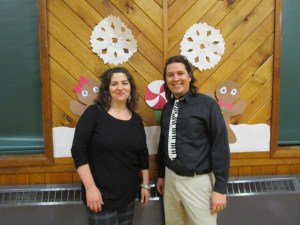
Theresa Cerceo and Charles Michaud
“As arts educators, our goals are centered around the students. We are here to give our learners a place to be self directed, a place to explore and express themselves and their emotions, and a community where their differences are strengths instead of mistakes. Being able to include dance into our arts program at MSAD #33 has expanded our the students’ understanding of arts and arts education and has increased our knowledge base as educators.” ~ Theresa Cerceo and Charles Michaud
Highlights
This video provides highlights of the dance education residency. Thank you to Theresa for creating it! https://vimeo.com/198665764
February 9-11 are the blog posts about the dance education residency in MSAD #33. If you have questions please don’t hesitate to contact me at argy.nestor@maine.gov.
 In November of 2015 a collaborative performance was held at Thornton Academy in Saco. Two schools and five dance studios work together as part of the Community Dance Project to create the performance and raise funds to help establish a dance education grant. The “Hopes for the Future,” funding was available to schools/districts who have no dance education program in place during the school day. Applications were accepted with a handful of guidelines. Two of them being that the funding was to be used during the 2016-17 school year and a dance educator from the
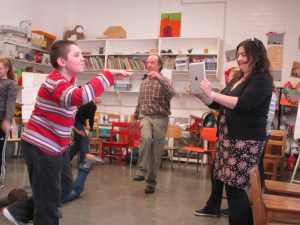
  I was thrilled to be able to travel to the County and visit the classrooms and see the students in action working with John Morris. Along with John worked closely with art teacher Theresa Cerceo and music teacher Charles Michaud to be sure that the learning opportunity was at an extremely high level. The preparation work that both teachers did before John arrived was evident. The 5 days were documented very well with photos, video footage, quotes from students and staff. It was obvious at the culminating performance on a chilly Friday night in St. Agatha that the opportunity exceeded the expectations.
 Dr. Fern Desjardins, Superintendent of Schools, MSAD #33 said the following:
 Lisa Bernier Principal at the Dr. Levesque Elementary School, Frenchville said the following:
 Stars and Stairs, Where am I now and Where am I going? How can the use of Stars and Stairs in your classroom help to inform you and your students of their learning progression and actively engage them in the learning process. This will be a round table discussion. Looking at your standards and your curriculum how can you use the Stars and Stairs model in your classroom. All grade levels. All content.
 Dive into iBooks Author to harness the power of developing multi-modal, Multi-Touch iBooks. You’ll learn features which make iBooks come to life for learners by incorporating audio files, 3D widgets, image glossaries, study cards, jailbreaking templates, and much more. Be prepared to create an art history chapter together. You can also use this app for making comics and graphic novels or creating art portfolios. This session is great for MLTI beginners and experts. MLTI MacBooks with iBooks Author preinstalled is encouraged. Grades 7-12
 Many arts educators in K-12 education have never had the opportunity to work with a teaching artist. Knowing where to start and identifying the most important steps to take can feel daunting. This workshop provides a framework for creating a high-quality teaching artist residence in the schools. We will focus on the steps needed to create a powerful residency, and the nature of an effective collaboration between teaching artist and arts educator. We will provide experiential work and guidance in addressing the complexities and sometimes different languages of the teaching artist and the school-based educator. All grade levels. All content.
 Playing and composing songs on your own is a blast for some, however there’s something special about making music in collaboration with other like-minded folks that just can’t be beat. In this hands-on, music making session, participants will use GarageBand to learn the basics of song writing and music production. Participants will have plenty of time to explore and experience the fun of collaborative music creation. Musicians of any and all skill levels are welcome. Make sure to bring your Mac and/or iOS device with GarageBand installed. All grade levels.
 When you are deeply engaged in Arts Integration you realize it is about learning with you mind, body and heart in the present moment. This hands on workshop explores this idea through drama, music, movement, poetry, storytelling, and the visual arts. Come prepared to experience arts integration through your own individual lens in a safe environment. All grade levels. All content.
 A combination of sketching and traditional note taking results in rich educational documents to support learning. Studies show that sketching leads to better retention of information and helps clarify ideas. Sketching is one of our original forms of communication. Visualizing ideas is a great way to learn. Why not bring this creative form of learning into your classroom? Explore how visual notes support learning. Discover techniques to create, share and integrate visual notes into your instructional practice. Visual notetaking, often called sketch noting, uses two parts of your brain, which is referred to as Dual Coding Theory. This has been found to improve learning. Research has shown that people who doodle while listening retain 29% more information (Andrade, 2009). Join this hands-on session and start sketching your notes today. Please bring your updated MLTI iPad, if available, with Notability installed. Arts supplies will also be available. All grade levels. All content.
 This workshop focuses on a collection of techniques that aim to support literacy in the art classroom. From using word walls, sight words, and phonemic awareness participants will leave with a fresh perspective on incorporating literacy while still adhering to their art curriculum. K-5 Visual Arts, adaptable for middle school.
 Guiding the Young Padawan to Become a Jedi Music Master
 The Cloud Ate My Portfolio: No More Excuses…Start a Digital Portfolio Today
 Beginning with early Atari and Nintendo video games, the 8-bit aesthetic has been a part of our culture for over 30 years. No longer just nostalgia art, contemporary 8-bit artists and chiptunes musicians have elevated the form to new levels of creativity and cultural reflection. In this session, we will focus on tools that assist in creating 8-bit images, animations, and music. Please bring your MLTI MacBook. All grade levels.
 The Heart of Advocacy
 Theatre as a Tool: Using Theatre Across the Curriculum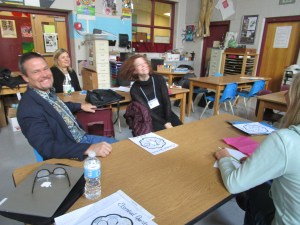
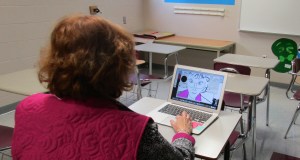

 SLAM! Nurturing Student Leadership through Arts Advocacy
 Networking within Local School Administrations to Increase Art Programming
 Easy Jazz Improvisation Teaching Techniques for Nervous Beginners
 “Who Lives, Who Dies, Who Tells Your Story?”
 Arts Integration
 Teaching Hamilton in the Classroom
 Writing Across the Curriculum in a Performing Arts Classroom
 Forming, Storming, Norming, and Performing: Care and Feeding Teaching Artists as part of a Long Term Education Plan
 Next Step Rubric Makes Learning More Progressive
 Looking in the Mirror: The Importance of Student Self-Reflection
 Using Multiple Intelligences to Teach Students with Disabilities
 All 2016-17 Megas Dates and Locations
 Stars and Stairs, Where am I now and Where am I going? How can the use of Stars and Stairs in your classroom help to inform you and your students of their learning progression and actively engage them in the learning process. This will be a round table discussion. Looking at your standards and your curriculum how can you use the Stars and Stairs model in your classroom. All grade levels. All content.
 Dive into iBooks Author to harness the power of developing multi-modal, Multi-Touch iBooks. You’ll learn features which make iBooks come to life for learners by incorporating audio files, 3D widgets, image glossaries, study cards, jailbreaking templates, and much more. Be prepared to create an art history chapter together. You can also use this app for making comics and graphic novels or creating art portfolios. This session is great for MLTI beginners and experts. MLTI MacBooks with iBooks Author preinstalled is encouraged. Grades 7-12
 Many arts educators in K-12 education have never had the opportunity to work with a teaching artist. Knowing where to start and identifying the most important steps to take can feel daunting. This workshop provides a framework for creating a high-quality teaching artist residence in the schools. We will focus on the steps needed to create a powerful residency, and the nature of an effective collaboration between teaching artist and arts educator. We will provide experiential work and guidance in addressing the complexities and sometimes different languages of the teaching artist and the school-based educator. All grade levels. All content.
 Improve content literacy with a tool box of formative assessments and literacy strategies to gauge what your students already know, how well they are learning content, and help drive your classroom instruction. All grade levels. All content.
 Playing and composing songs on your own is a blast for some, however there’s something special about making music in collaboration with other like-minded folks that just can’t be beat. In this hands-on, music making session, participants will use GarageBand to learn the basics of song writing and music production. Participants will have plenty of time to explore and experience the fun of collaborative music creation. Musicians of any and all skill levels are welcome. Make sure to bring your Mac and/or iOS device with GarageBand installed. All grade levels.
 Participants will learn how to use graphic notation as a visual tool to reach all learners in the music classroom. (This is a great STEAM lesson!) Grades 4-6
 When you are deeply engaged in Arts Integration you realize it is about learning with you mind, body and heart in the present moment. This hands on workshop explores this idea through drama, music, movement, poetry, storytelling, and the visual arts. Come prepared to experience arts integration through your own individual lens in a safe environment. All grade levels. All content.
 A combination of sketching and traditional note taking results in rich educational documents to support learning. Studies show that sketching leads to better retention of information and helps clarify ideas. Sketching is one of our original forms of communication. Visualizing ideas is a great way to learn. Why not bring this creative form of learning into your classroom? Explore how visual notes support learning. Discover techniques to create, share and integrate visual notes into your instructional practice. Visual notetaking, often called sketch noting, uses two parts of your brain, which is referred to as Dual Coding Theory. This has been found to improve learning. Research has shown that people who doodle while listening retain 29% more information (Andrade, 2009). Join this hands-on session and start sketching your notes today. Please bring your updated MLTI iPad, if available, with Notability installed. Arts supplies will also be available. All grade levels. All content.
 This workshop focuses on a collection of techniques that aim to support literacy in the art classroom. From using word walls, sight words, and phonemic awareness participants will leave with a fresh perspective on incorporating literacy while still adhering to their art curriculum. K-5 Visual Arts, adaptable for middle school.
 Use stations and sites fostering independence to help students collect assets for creating art infused iMovie productions. This session will showcase how a green screen and some photos can provide opportunities for all learners to showcase their creative side. MLTI MacBooks with the most current version of iMovie is encouraged. Grades 7-12. All content.
  This workshop will demonstrate a scaffolded instruction process and assessment system created to guide middle school band students through the basic levels of performance to highly skilled musicianship. Grades 4-12
 This is a step by step experience designed to help you to consider how to use a digital portfolio to help students self-asses and manage the evidence of their learning. Access to Google Drive, Drawing, email, built in camera and mic ideal…but not required. . All content areas. All levels.
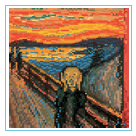 Beginning with early Atari and Nintendo video games, the 8-bit aesthetic has been a part of our culture for over 30 years. No longer just nostalgia art, contemporary 8-bit artists and chiptunes musicians have elevated the form to new levels of creativity and cultural reflection. In this session, we will focus on tools that assist in creating 8-bit images, animations, and music. Please bring your MLTI MacBook. All grade levels.
 Educators will leave with the knowledge of how to create and present a variety methods to advocate for issues pertinent to their arts educational causes and how to organize those methods to feel comfortable in beginning personal advocacy efforts. All grade levels. All content.
 Introduction to the process of using devised theatre as a teaching tool. I will take participants through that process and give them strategies for using devised theatre across curriculum areas and grade levels. All grades levels. All content.
 Dates and Locations
 SLAM! Nurturing Student Leadership through Arts Advocacy
 Networking within Local School Administrations to Increase Art Programming
 Easy Jazz Improvisation Teaching Techniques for Nervous Beginners
 “Who Lives, Who Dies, Who Tells Your Story?”
 Arts Integration
 Teaching Hamilton in the Classroom
 Writing Across the Curriculum in a Performing Arts Classroom
 Forming, Storming, Norming, and Performing: Care and Feeding Teaching Artists as part of a Long Term Education Plan
 Next Step Rubric Makes Learning More Progressive
 Using Multiple Intelligences to Teach Students with Disabilities
 For two weeks this month, Tim Christensen was a visiting artist in Holly Houston’s high school visual art classes at Yarmouth High School. In Advanced Placement Art (AP), Advanced Drawing and Painting (ADP), Ceramics I, and Art Fundamentals, Tim and Holly have led the students through a project documenting the systems around endangered United States animals, from beluga whales to ocelots, from Key deer to orcas. As well, most days after hours, the art room has been open to students from the entire school to come learn to work on the potter’s wheel independently, creating a busy and vibrant creative space where students could start to find new uses for their creative voice.
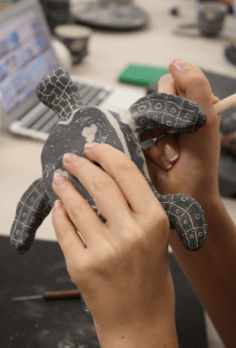
 Three approaches were used with the art classes. AP and ADP worked with8x8 clay slabs, creating a visual design capable of communicating the facts and challenges discovered during their research into their animal. These designs were etched onto black slip on white porcelain, using the sgraffito method, a 6000 year old practice traditionally used to create culturally vital historical documents in a visual way.
 Similarly, Art Fundamentals created hollow bodied sculptures of their organism, and covered their sculpture with their interpretation of vital biological system data related to their animal.
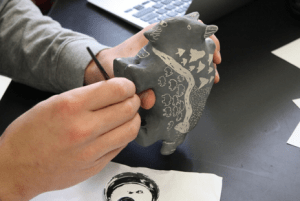 Combining the challenges of working with clay and sgraffito with a subject of personal interest and relevancy fosters an investment in the work, and allows students to overcome big challenges, finding multiple correct ways of communicating and creating. Students assisted in defining the assessable goals of the project, and have been able to gauge their progress through formative self-assessment by understanding the proficiencies they must demonstrate in the execution of the project. How they show those proficiencies is up to them.
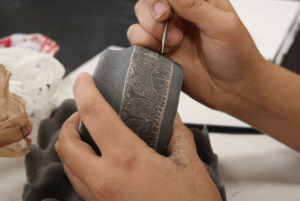 When Holly and Tim work together in the classroom, they communicate beforehand about the tasks that will be demonstrated and skills introduced for each class session, and share observations or areas of concern or elation for each incoming group of artists. During the session, they address issues and answer questions, provide encouragement or demonstrate techniques, often referring the other to students in need of a little extra attention. As a team, they are able to bring a broad range of experiences and skills to bear, and the students benefit from having multiple perspectives on the challenges they are tasked with meeting.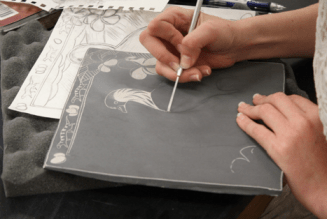
 Ellsworth High School, USM Portland, and UMaine Orono, and Hebron Station School Hebron, Easton Schools
 Dates and Locations
 Sessions for Ellsworth Mega
 me arts ed