Archive for the ‘Integration’ Category

h1

New Hampshire Conference

October 29, 2016

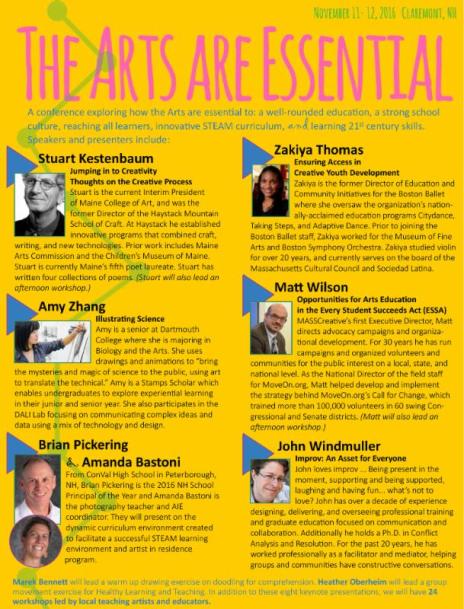
November 11 and 12 – Claremont, New Hampshire

New Hampshire State Council on the Arts & Arts Alliance of Northern New Hampshire present

01b1b514-67e1-4ac3-b5bf-55416adf37c0

Register By Sunday and Save! If you’re not seeing conference presenters above please CLICK HERE.

“Opportunity is missed by most people because it is dressed in overalls and looks like work.”- Thomas Edison
 
“Most creative work is a process of people passing ideas and inspirations from the past into the future
and adding their own creativity along the way.”- Joichi Ito
 
“Your work is going to fill a large part of your life, and the only way to be truly satisfied is to do what you believe is great work. And the only way to do great work is to love what you do. If you haven’t found it yet, keep looking. Don’t settle. As with all matters of the heart, you’ll know when you find it.” -Steve Jobs

Registration prices for the annual NH Statewide Arts Education Partnership Conference increase Monday! Sign up by this weekend.
Read more about the CONFERENCE HERE or REGISTER HERE! Special lodging deals starting at $55!

Please help us spread the word by forwarding this email to friends, colleagues and anyone you think may be interested!

h1

Grandmaster Flash Used Science

October 5, 2016

Commitment

An interesting article that provides the inside scoop on a young man’s quest to find the right turntable. Below is an excerpt from the article named “Grandmaster Flash on ‘The Get Down’ and how he used science to pioneer DJ techniques”, written by Bethonie Butler, August 23, 2016, published in The Washington Post.

screen-shot-2016-09-29-at-10-06-28-am“I did extensive studies on the stylus. I had to figure out the proper needle that would stay inside the groove when it’s under the pressure of the vinyl being moved counterclockwise. That was the first step. The second step was figuring out what to do with the rubber matting that comes with the turntable. When I was trying to move the vinyl counterclockwise, it caused too much drag and too much friction, so I had to remove it. Then under that was the steel platter. The problem was I couldn’t put the vinyl on the steel platter because if there was a cut on the other side, I would ruin the record.

My mother was a seamstress so I knew different types of materials. When I touched felt, I said, “This could possibly work.” The problem with felt is that it draped, it was limp. So I ran home and got a copy of my album and I bought just enough felt to cut out two round circles the same size as a 33’ LP and — when my mother wasn’t looking — I turned the iron all the way up high and I used my mother’s spray starch. I sprayed it until this limp piece of felt became — I called it a wafer, like what you get in church at Easter. Today it’s called a slipmat.”

Read the entire article by CLICKING HERE and I’d suggest that you share it with your students.

h1

Maine International Conference on the Arts

September 14, 2016

MICA – Lewiston/Auburn – October 6-7

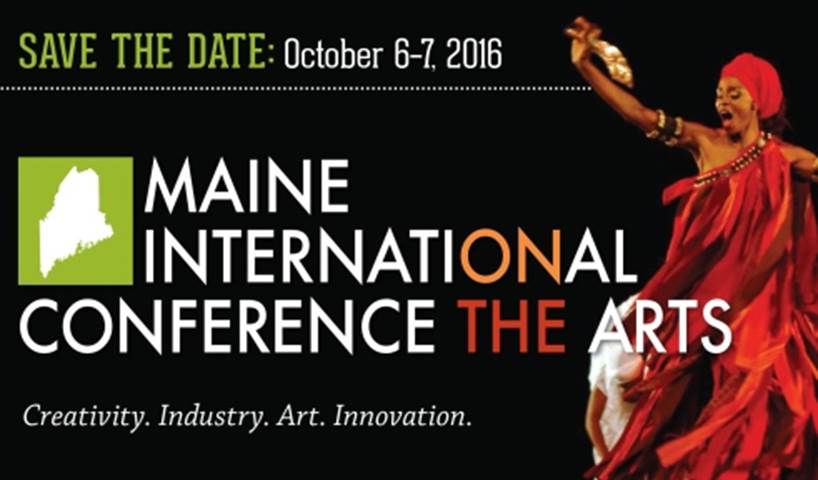
image003October 6 and 7 will be two days filled with great learning opportunities and lots of excitement for the Arts in Maine. This is Maine’s ONLY statewide convening of artists, arts organizations, arts educators, public policy makers, and community and economic developers who know the power arts and culture brings to Maine’s communities.

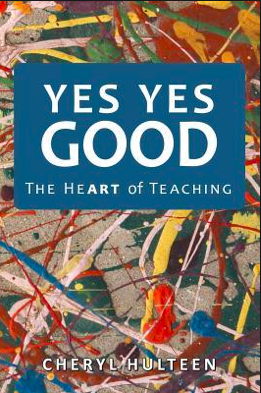
The October 6 focus will be arts education with Cheryl Hulteen ” “Teaching Artful Practice/Practice Artful Teaching”. Cheryl is the author of YES YES GOOD: The heART of Teaching.

DESCRIPTION of CHERYL’S SESSION
Arts teaching professionals have much to share in their partnership to create personal artful pathways for students to express and explore creative voice through the arts. Using the Multiple Intelligences Theory, join us in a collaboration defining, exploring, celebrating and understanding different practices of artful teaching. We will build a learning community that reflects the role the arts play in everything we do, teach and learn by strengthening the creative exchanges of artful process and practice-defining, exploring, celebrating and
understanding different practices of artful teaching. We will build a learning community that reflects the role the arts play in everything we do, teach and learn by strengthening the creative exchanges of artful process and practice.

We will meet at the Franco American Heritage Center, Lewiston, 11:30 am – 4:00 pm, $40 (includes lunch). For details CLICK HERE. For registration CLICK HERE.

MAINE INTERNATIONAL CONFERENCE ON THE ARTS (MICA)

Following the arts education conference, the MICA will officially open at 4:00 pm on Thursday, October 6 with a reception at 4:30 pm, Franco Center, Lewiston. Following the reception Pam Breaux, CEO of the National Assembly of State Arts Agencies (NASAA) will provide a brief “State of the States”. Crystal Williams will be the opening keynote at 5:30 pm for MICA. Poet, essayist, and Bates College VP and Chief Diversity Officer Crystal’s keynote address “Practical Approaches to Creating Impact: Getting to Cultural Equity,” will establish several themes to be furthered during the rest of the conference. Following the keynote in downtown Lewiston: cultural offerings including Downtown Lewiston Gallery Crawl, showcases at The Community Little Theater in Auburn, Franco-Fest at Bates College, Poetry Reading at the Lewiston Library, and more.

FRIDAY, OCTOBER 7

MICA starts on Friday morning with an Idea Lab – 5 artists presenting in a Pecha Kucha format. Included in the Idea Lab is Nancy Frolich who works with the arts and literacy with a program she created called LEAPS of Imagination. Following the opening there are over 20 sessions – 5 different strands with 4 sessions under each of these topics: Leveraging Investment, Visibility of the Arts & Culture Sector, Arts Education, Cultural Tourism, and Building Capacity. A general schedule is located at THIS LINK. A pdf and more schedule info is located at THIS LINK.

REGISTRATION

Advance Registration is now open, and still offers a discount over registration at the door. Registration is located at THIS LINK. Conference website pages START HERE.

h1

Two Articles

September 9, 2016

Arts Ed Partnership Arts Ed Digest articles

Writer, Stacy Teicher Khadaroo looks at how arts education is increasingly being considered as an effective way of fostering creativity and critical thinking skills. The School that Art Saved includes information about the pre-K-8 Roosevelt School located in Bridgeport, Connecticut. The classroom description includes learners engaged and focused on learning – not a focus on the test. This doesn’t mean that they aren’t measuring their success since they’ve infused arts education into the instruction. In fact, they’ve scaled back on the testing. “The school has gone from being one of the lowest performing in Connecticut to a significantly improved institution: Disciplinary infractions are down, academic performance is up, and both parent and teacher pride in the school are increasing.” CLICK HERE to read the entire article published in the Christian Science Monitor.

IMG_1919

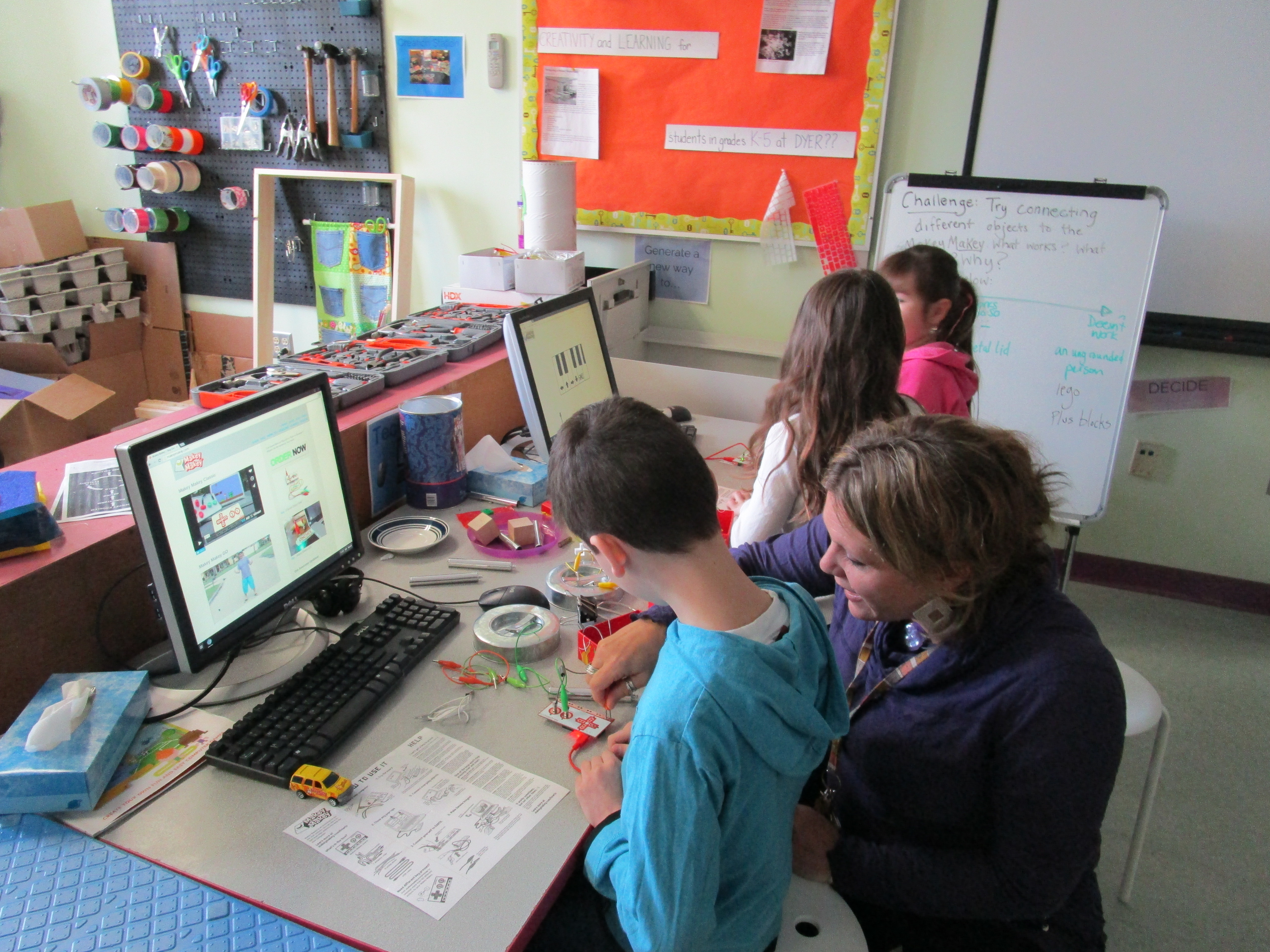
Maker Space at Dyer Elementary School, South Portland

You’ve been hearing about the “Maker Movement” and in fact, I visited schools last spring to learn more about what’s going on in Maine on the topic. Vermont educator, Cynthia Day wrote an editorial called Why Making and the Arts Need Each Other to Survive and Thrive in Schools and explores why they can’t survive on their own. Partnering with the arts can provide for a powerful teaching and learning environment that can help transform schools for this time period we live in.

Cynthia’s list for “Making mentality,”:

  • Creativity: Making engages a student’s mind creatively and practically. The senses are engaged as emotions and thoughts are shared in community with others.
  • Technical Skills: In Maker culture, engineering skills develop without always needing to be explicitly taught. Tools used in the world outside of school are put into the students’ hands.Time seems to fly by, and students don’t want to put away their work.
  • Collaboration: Real problems are solved and social groups are formed around relevant, challenging endeavors.
  • Reflection: Reflection happens as students discuss their progress and wonder aloud about the possibilities.

CLICK HERE to read the entire piece that was published in Edsurge.  Cynthia Day is an educator at Barre Town Middle and Elementary School in Vermont.

h1

Arts Education Conference

August 30, 2016

Pre-MICA

TEACHING ARTFUL PRACTICE/PRACTICE ARTFUL TEACHING

Pre-MICA (Maine International Conference on the Arts) – 6 October 2016

MICA – 6 and 7 October

THURSDAY DESCRIPTION – This ones just for you PK-12 arts educators, teaching artists, others interested in arts education!

Screen Shot 2016-08-30 at 9.03.10 AMThe Maine Arts Leadership Initiative celebrates teaching and learning through “Teaching Artful Practice/Practice Artful Teaching” featuring Cheryl Hulteen, author of YES YES GOOD: The heART of teaching. Arts teaching professionals have much to share in their partnership to create personal artful pathways for students to express and explore creative voice through the arts. Using the Multiple Intelligences Theory, join us in a collaboration – defining, exploring, celebrating and understanding different practices of artful teaching. We will build a learning community that reflects the role the arts play in everything we do, teach and learn by strengthening the creative exchanges of artful process and practice. Come and celebrate the heART of teaching.

DETAILS

Thursday, 6 October 2016, 11:30am – 4:00pm

Franco American Heritage Center

46 Cedar St, Lewiston, ME

4 contact hours provided

$40 includes lunch (no cost for full time students)

Registration located at http://mica.bpt.me/ (Scroll down on the page)

PRESENTER

Screen Shot 2016-08-30 at 9.03.58 AMAuthor of “YES YES GOOD, The HeART of Teaching”, Master Teaching Artist Cheryl Hulteen has spent over 20 years providing consulting services for school districts, teachers, administrators, parents and students to foster greater learning and insight through building Creative Classroom Cultures. “YES YES GOOD” works with stakeholders across the educational landscape to build exciting, innovative and positive environments for teaching, learning, and arts integrated curriculum development through motivational workshops, professional development and one-on-one coaching. In addition to founding YES YES GOOD, Cheryl also serves as teaching faculty for Connecticut Higher Order Thinking Schools, an initiative of the Connecticut Office of the Arts, managed in partnership with Wesleyan University’s Green Street Arts Center.  “However we may speak, it is through the voices of our children we will most clearly be heard.”

image003MICA – Thursday night and all day Friday

ARTS EDUCATION TRACK for FRIDAY MICA plus other great sessions being offered Lewiston Bates Mill

Registration located at http://mica.bpt.me/

Stories and Images of Malawi No one can show you the sunDzuwa Salodzelano with Lindsay Pinchbeck and Argy Nestor

An 18-day journey to Malawi in July led to the most amazing teachers doing incredible work with very little resources (financial or tangible). The arts were the powerful tool that guided the daily workshops with 12 teachers and opened the hearts and minds of all involved. Join Lindsay and Argy on a visual journey and hear stories of songs and traditions gathered along the paths in Malawi.

STEAMing up in Maine with Kate Cook Whitt, Jonathan Graffius, Malley Weber, and Chuck Carter

What is all the buzz about STEAM (Science, Technology, Engineering, Arts, Math) going on across the country? What are the benefits of STEAM in Maine education and beyond? This presentation, in panel format, will bring together four people who are focusing on the topic in their work and play. From PK to higher ed, from teaching artist to game creator. Your questions and ideas are welcome!

Creativity: A Group Inquiry with John Morris

What is creativity? How can it potentially impact our lives? And how do we talk about it with each other? This structured group dialogue will help artists, advocates and educators make connections between creativity research and creativity in practice, while promoting inquiry into the nature of creativity, as well as its role in art, education and community.

Creative Aging

Details being constructed.

If you have any questions please contact me at argy.nestor@maine.gov.

h1

Arts Education and Malawi-2

August 3, 2016

The Malawian teachers

This is the second in a series of stories about my recent trip to Malawi in Africa. You can read the first post by CLICKING HERE.
IMG_2990

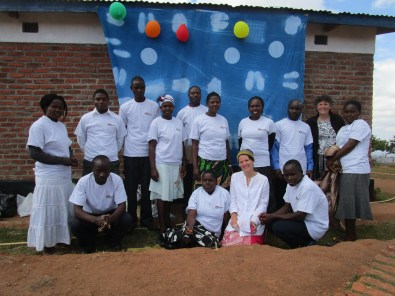
The teachers at the ceremony with their cyanotype banner.

As part of the Go! Malawi program I traveled to the Ntchisi District of Malawi to provide teacher workshops on arts integration. I collaborated with Sweetland School (in Hope) founder and director Lindsay Pinchbeck to work with 12 teachers from Mpamila, Pondani and Katete Primary Schools. The  teachers that we had the privilege to work with were AMAZING in more ways than one.
IMG_2697

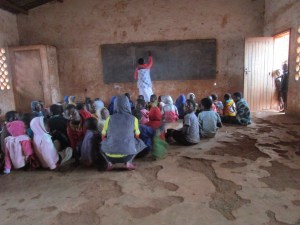
Jane with standard 1 students

Teachers are paid $85.00 per month and are assigned schools when they finish their teacher training program. They can be moved to another school at any time without warning. The school has no power or running water, some classrooms have no chairs or desks.

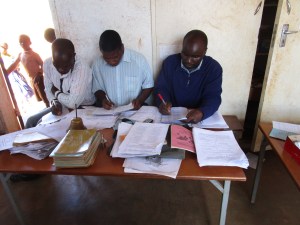
The grades are called standards and the primary schools each have standards 1 through 8. At the Mpamila School in Jane’s class she had 116 students. On paper the class sizes ranged from 17 to 131. (Did I mention that the teachers we met were amazing?). The lower standards have the largest numbers. As the students grow many drop out for a variety of reasons. It was the last two weeks of the school year (and winter) while we were there and the students were taking their exams. How well they do on exams determines whether they move on to the next standard.

IMG_2930

Thom sharing his quilt/banner.

Each morning we had the opportunity to visit the Mpamila School and classrooms. As the students arrived they were outside playing – we saw some jumping rope with vines and others playing Chinese jump rope. The teachers were meeting to do the kinds of things we might find happening across America – collecting papers and preparing for their teaching day. They shared some of the exams with us and we were able to view the test questions that we used later on as part of the instruction in the teacher workshops. The school day officially starts at 8:30 but we found the classes didn’t necessarily start on time and students wandered in after the lesson started. Many children were looking in the windows or outside playing while lessons occurred.

The teacher training is based on the British educational system. We watched while the teachers instructed the learners to repeat after them in speaking voices and/or singing voices. They used their bodies to emphasize or demonstrate an idea and the students repeated. Clapping was frequently used to engage and celebrate the learners successes.

Two of the teachers had young babies that they carried on their backs or fronts. They taught with them, brought them to the workshops and periodically during the workshops would have a young girl watch after the child.
IMG_2785

In the teachers room preparing for the exams.

DAILY THEMES – learning through an art form

We found that using a theme each day launched the ideas and combined feelings with art making, thinking with creativity. And, it helped launch the environment to a place of trusting one another. I was surprised by the teachers willingness to take risks with us so quickly – strangers from America.

  • Day 1 – Hopes and Dreams: Journal making, planing seeds, paint explorations
  • Day 2 – Traditions: Sharing stories of customs and traditions
  • Day 3 – Patterns and Rhythms: Song, box making and poetry
  • Day 4 – Trust: Cyanotypes, Trust walk, Introduce Individual Action Plans
  • Day 5 – Stories: Felting. Telling, sharing, applying stories to action plans and lessons
  • Day 6 – Making mistakes and letting go: Drawing and printmaking
  • Day 7 – Walls – What holds us back?: Talking Walls Book by Margy Burns Knight – Accordian books with Malawian sayings. Watercolor techniques
  • Day 8 – Another way: Patterns and colors, kaleidocycles, folding books
  • Day 9 – Support and reflection: Completing action plans, letter writing, pendulum
  • Day 10 – Celebration and sharing
IMG_2675

Head teacher Mirium with her baby.

We tried to scaffold their learning from day to day and the daily themes assisted in that. Their willingness and desire to learn was powerful. More importantly, the arts were the vehicle for each of them no matter what their past experiences were with the arts.

DAILY SCHEDULE

  • Opening Circle – sharing inspiration, checking in and sharing new ideas and questions through books and stories. Introducing the theme for the day.
  • Experiential Learning – sharing new skills and materials. Drawing, painting, poetry bookmaking, drama and storytelling activities, printmaking, felting, photography, and more.
  • Journaling/Share – Daily time for reflection to consider how activities can be applied to the classroom. Individual and group work.
  • Projects – Quilt focus and individual action plans.
  • Closing circle – Traditions of song, take aways, 3 happy moments and a question.
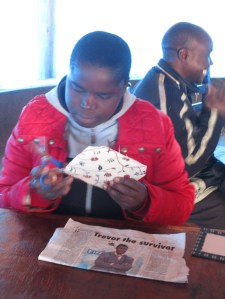
IMG_2748

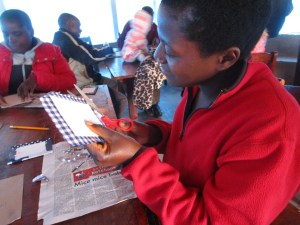
Olipa working on her book cover. Photo by Lindsay Pinchbeck

During the project time the teachers were learning different techniques that they made onto a 6″ X 6″ piece of fabric. The pieces were sewn together in banner or quilt-like form. For example, the day the teachers learned how to felt they actually felted a fabric square that became part of their quilts/banners. On the day they made cyanotypes they did an individual square with their hands and collaborated with secondary students to make a full size sheet one. What a great way to integrate science and visual art.

The teachers arrived at noon each day for lunch and at 1:00 we started the workshop. We were amazed at how quickly the teachers jumped in without hesitation. The art making was the vehicle to their comfort level. Some of the teachers didn’t know each other beforehand yet that was not evident as they sat side by side and created.

IMG_2766

Depicting what a wall means to the teachers or their students.

Five o’clock came quickly each day and before we knew it the end was near and each teacher was hanging their quilt for the critique. On the last day they set up a display of all of the artwork they created. We had a community celebration with the local chiefs, Go! Malawi community committee, students, and the teachers. Afterwards the participants were invited to visit the gazebo to see the art. It was a goose bump experience as I watched the teachers faces filled with pride as they shared their work with the community.
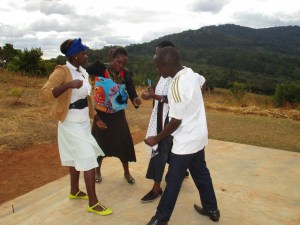
IMG_2393

Creating tableaus with sentences from their exams.

A couple days into the workshops one of the teachers pulled me aside and gently informed me of a Malawian custom and suggested that I adopt it. He said: “When someone is leaving you are to walk and talk with them.” At first I thought he was joking but I quickly learned that it was an important custom. Each day following, we made sure that we walked and talked with them and before we knew it the 10 day workshop was over and we were waving so long to our new friends!

How fortunate I was to have this unique opportunity. The Malawian people often use sayings. One of them is: Ulendo ungatalike bwanji umayamba ndi phawzi limodzi – Every journey starts with a step. I am so glad to have taken the step. I learned much more from the people with huge hearts than I was able to share. Each of them provides the hope for all children in their country.

We’re hoping that the work Lindsay and I started this summer will continue from a distance by sending packages of materials and supplies. If you’d like to contribute arts supplies, pencils, pens, books or other items please email me at argy.nestor@maine.gov. And, Lindsay and I hope that some of you reading this blog post, who are teachers or teaching artists, will consider a trip next summer to continue the work. If not an educator there is other volunteer work you can engage in. Please email me if you might be interested.
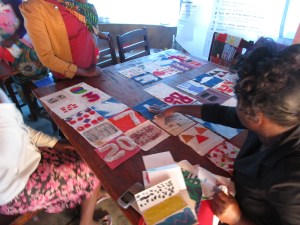
Laying out the quilts, getting ready to sew on the treadle machine.

Laying out the quilts, getting ready to sew on the treadle machine. Photo by Lindsay Pinchbeck
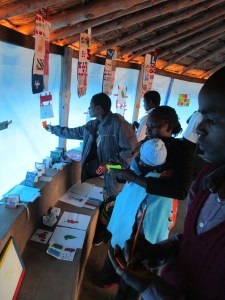
 

IMG_2967

Gallery walk to provide feedback on each others artwork.
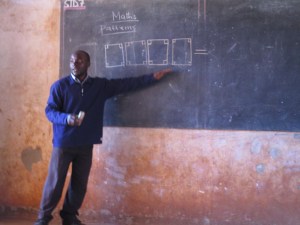
 

IMG_2802

Mr. Zima teaching patterns


IMG_2741

Vivian working on a book cover. Photo by Lindsay Pinchbeck
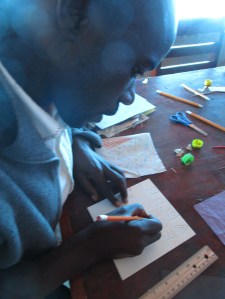
 

IMG_2762

Kagwa printmaking Photo by Lindsay Pinchbeck

h1

Watershed Center for Ceramic Arts

July 30, 2016

Art teachers soaking it in

IMG_3045

Teaching Artist Malley Weber

I had the privilege of visiting the Watershed Center for Ceramic Arts earlier this week and it was such a treat. A dozen art teachers creating individually and at the same time collaboratively – sharing their knowledge and soaking up the wisdom of each other. In my undergraduate program I had a ceramics focus so the smell of the clay environment, the feel of the clay in my hands, coupled with the buzz of teachers, enlightened all my senses. And right before my eyes was the center of Watershed’s philosophy, a belief that the unexpected sparks creativity and that new people, ideas and spaces nurture the evolution of artistic practice.

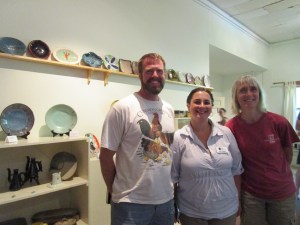
How fortunate for the art educators (mostly from Maine) to take the opportunity to nourish their minds and their souls. The teachers had their own studio space where they were continuing to develop their skills and ideas. It was great to see and speak to the teachers about their work. Visiting also was Beth Lambert, Maine Department of Education Visual and Performing Arts Specialist. Participating in the week were Maine Arts Leadership Initiative Teacher Leaders Jeff Orth and Gloria Hewett. And this years recipient of the Monhegan Artists’ Residency and colleague of mine from MSAD #40, Krisanne Baker.

Jeff Orth, Beth Lambert, and Gloria Hewett

Jeff Orth, Beth Lambert, and Gloria Hewett

While visiting, Maine Arts Commission Teaching Artist member Malley Weber shared her present research project – creating ceramic water filters. Malley was intrigued by the idea and has been communicating with and learning from Potters for Peace.

Potters for Peace has provided information has helped in her research.  Since 1998, representatives of Potters for Peace have traveled the world assisting with the establishment of small factories or workshops that produce a low-cost ceramic water filter that can bring clean, potable water to those who need it most. They don’t actually make, store or distribute ceramic water filters or operate filter production facilities. They assist local partners to set up their own filter production and distribution facilities. Much of their work has been in Central America with woman potters.

Malley is experimenting with Watershed clay to find the right recipe to create the filters for the local water supply. The lesson is designed for students to:

  • understand the global issues around water and the importance of clean water for everyone,
  • to experiment with filtering bacteria from water by making their own ceramic water filters,
  • to create a well designed and functional receptacle and lid using elements of art and principles of design that will hold the filter, store and deliver water to a glass by either pouring spout or spigot, and
  • to observe and draw conclusions based on their experiment.

DSC_0447What an incredible idea that is all about the connections between art and science! Malley’s lesson was filled with the language of both disciplines.
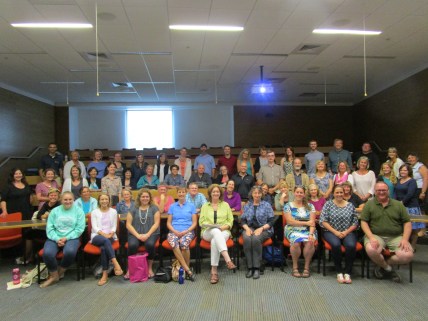
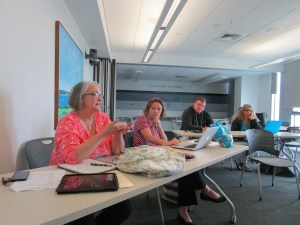
One of the founders of Watershed is my dear friend George Mason. It has been a while since I visited the Newcastle facility that was established in 1986. Such a treat! You can read their story at http://www.watershedceramics.org/about/our-story/. Be sure and check out the opportunities they provide under the watchful eye and commitment of Executive Director Fran Rudoff. Classes are invited during parts of the year and there are community events that are always wonderful!

Thanks to Fran for inviting me to visit and to Malley for sharing her experience!

h1

MALI Summer Conference – Success!

June 29, 2016

Opportunity!

IMG_2303

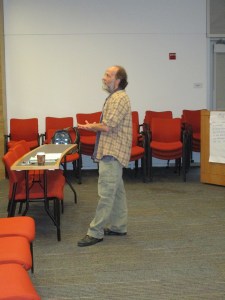
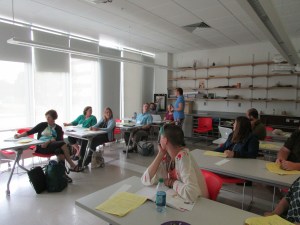
Yesterday at Wishcamper, USM in Portland, 68 arts educators convened for the Maine Arts Commission Maine Arts Leadership Initiative (MALI) Summer Conference. The day was filled with listening, speaking, demonstrating, networking, and learning, learning, learning. The feedback provided by participants shows an appreciation for the opportunity and all 14 workshops scored very high!

IMG_2291One educator said: “It is so nice to be able to talk with other arts educators about their views”. Yes, these were all arts educators conversing with other arts educators – the same tribe, our peeps, educators who share a basic understanding about what we contribute in the world. Another participate was grateful to know that “Others are going through the same frustrations as I am”. 
The Maine Arts Assessment website is filled with a variety of resources. One person said: “The MALI website is FULL of resources to help me with all I do in my music classroom and also with communication with colleagues and administrators”.

In the Creativity workshop participants learned about one of the resources in the MALI Resource Bank. It is a good one to use with your colleagues (arts and non-arts). One participant in the session’s feedback was: “Great conversations about creativity. This is something I normally don’t get to do.”

IMG_2293One of my favorite feedback comments of the day is not about assessment or standards or arts skills but about a broader critical piece of what we do: “I learned about helping children to become fearless about making a mistake – mistakes are okay.”
WHO ATTENDED?

  • PK-12 Arts educators
  • Higher ed instructors
  • Maine and NH arts educators
  • Dance, Music, and Visual Arts educators
  • Teaching Artists
  • Science, Media Arts, and Technology teachers
  • Pre-service teachers, new to teaching teachers, and  veteran teachers

WHAT ELSE DID THEY LEARN?

  • Students can create an ensemble at all levels that are student led.
  • Allowing students to take ownership in their concerts.
  • Starting students transposing is not impossible.
  • That engaging students in ownership of curriculum and content design can help teach competencies and keep them engaged in other curriculum goals.
  • More evidence for choice and student advocacy – yahoo!
  • Practical applications of the Studio Habits…tying them to the Guiding Principles.
  • Crating crosswalks between MLR, NCAS and HOM is a great advocacy tool.
  • To focus on speaking about the arts using academic language

IMG_2290WHAT QUESTIONS DID PARTICIPANTS HAVE AT THE END OF EACH WORKSHOP?
  • Why does it seem like great initiatives already being used by art educators are consistently overlooked by admin even when the information is shared by teachers?
  • How does this work when students use these techniques on their own artwork?
  • How do I ensure that every student has access to technology and able to access the assignments this way?
  • Can we eliminate grade levels in proficiency based education?
  • Why can’t administrators answer questions about applying competency grading to ensembles?
  • How can using Google Classroom be used in advocacy for the arts efforts?
  • What more creative ways are there to meet with classes?- I have 750+ students in my 3rd-5th school with block scheduling for math and reading – very little flexible time.

GREAT BIG THANKS TO THE WORKSHOP PRESENTERS – MALI TEACHER LEADERS, LEADERSHIP TEAM MEMBERS plus 1!

  • IMG_2284Theresa Cerceo
  • Jake Sturtevant
  • Jan Gill
  • Danette Kerrigan
  • Sue Beaulier
  • Jen Etter
  • Rob Westerberg
  • Iva Damon
  • Elise Bothel
  • Patti Gordan
  • Holly Leighton
  • Nancy Kinkade
  • Mandi Mitchell
  • Samantha Armstrong
  • John Morris

HEARTFELT APPRECIATION TO THE MALI LEADERSHIP TEAM FOR HELP IN PLANNING

  • Catherine Ring
  • Rob Westerberg
  • Kate Smith
  • Theresa Cerceo
  • John Morris
  • Barb Vinal
  • Pamela Kinsey
  • Beth Lambert
  • Jeff Beaudry

IMG_2287If you couldn’t join us yesterday some of the workshop leaders provided their resources and they are posted online on the Maine Arts Assessment site. You can access them by CLICKING HERE.
MALI has another opportunity for Teaching Artists coming up in August – watch for the blog post that will provide details and registration information. During the 2016-17 school year there will be multiple professional development opportunities as well.

If you have any questions about MALI or any other Maine Arts Commission program please contact me at argy.nestor@maine.gov.

h1

Top Notch Teacher

June 22, 2016

Jimi Herd

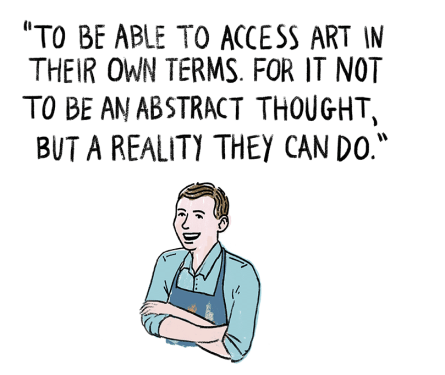
This NPR website highlights the work of outstanding teachers. This link is about Jimi Herd who teaches art at Swift Creek Elementary in Midlothian, VA. The story is told in an illustration with little text. To view the story please CLICK HERE.

Screen Shot 2016-06-22 at 8.31.27 AM

Screen Shot 2016-06-22 at 8.30.44 AM


h1

Turnaround Arts

June 6, 2016

Everyday People

Turnaround Arts is using the Arts to create success in struggling schools. Currently  Turnaround Arts, a program of the President’s Committee on the Arts and Humanities works in 68 schools in 36 districts and 15 states and the District of Columbia. The program has several artists, organization partners and the First Lady Michelle Obama collaborating and of course, the results are positive. If Turnaround Arts selected the state of Maine as a location, the programming and funding would have an enormous impact.

It was announced recently that the program will continue after President Obama leaves office. And, they released the inspirational video below. You can learn more about the Turnaround Arts program by CLICKING HERE.