Watershed Center for the Ceramic Arts Executive Director to Retire – Thank you Fran!
Watershed Center for the Ceramic Arts, located in Edgecomb, has a long tradition of providing amazing experiences for artists and educators. In January of this year I provided a blog post that shares their story.
The Board of Trustees announces that Executive Director Fran Rudoff will retire in early 2023.
Fran Rudoff
Rudoff began her tenure as Watershed’s executive director in 2013. During her time leading the organization, she spearheaded substantial improvements and additions to the campus. Under her guidance, the Center’s Watershed NOW capital campaign has enabled the organization to open a new gallery space; create year-round offices for staff; host outdoor installations on 22 newly-acquired acres; build a Studio Annex, complete with a wood shop and workshop space; offer new housing for staff; and construct Watershed’s new 7,500 square foot Windgate Studio, the cornerstone of the capital campaign.
In addition to these transformative campus changes, Watershed’s assets have grown significantly under Rudoff’s leadership, $1.2 million in 2013 to over $5 million in 2021, in addition to a $3 million operating endowment. The organization now offers more residency and workshop programs and supports more artists with scholarships than ever before.
Rudoff has also deepened Watershed’s commitment to antiracism, diversity, equity, and inclusion. She worked steadily to increase access to artist programs by creating new funding streams, developing outreach initiatives, and building relationships with partner organizations. A significant partnership with The Color Network (TCN) has resulted in two residency sessions funded by the National Endowment for the Arts. Nearly thirty artists of color who are taking part in TCN’s mentorship program convened on the Watershed campus in 2021 and 2022 to work together in person and grow their creative practices. Watershed also serves as TCN’s fiscal sponsor as they grow from a national affiliation of artists into an independent nonprofit.
“In my years of experience with non-profit boards, I’ve never met a more competent and energized executive director than Fran Rudoff,” shared Watershed Board President Bernie Toale. “Fran easily juggles nine things at one time with efficiency and grace. Her achievements over the past ten years are hard to number, but the crowning glory is the construction of our new $3 million Windgate Studio built during COVID lockdown.”
Prior to her time at Watershed, Rudoff worked for the State of Maine in regional planning and resource management, followed by nearly fifteen years as Executive Director of KIDS Consortium, a nonprofit that supported service learning opportunities for Maine students. Rudoff brought her expertise in education to bear on Watershed’s K-12 outreach programs by creating new professional development opportunities for Maine art teachers to hone their ceramics skills and reach more students. The popular grant-funded programs have positively impacted the artistic development of thousands of Maine youth.
All of these accomplishments are buttressed by Rudoff’s abiding care for Watershed’s community. While the organization is based in the small town of Edgecomb, Watershed’s extended network of friends, alumni, and supporters stretches from coast to coast. Rudoff forged lasting and meaningful connections with artists, collectors, and supporters around the country.
“It has been my privilege to steward Watershed over the past decade,” she shared. “The organization’s mission and focus on artists is more important than ever. I am filled with gratitude for the many professional relationships and friendships that have become so important to me and for the opportunity to contribute to Watershed’s growth.”
The search process for a new executive director has begun, with an expectation of having a new leader in place at the beginning of 2023.
“A visionary new director will bring a fresh perspective to this leadership role during a pivotal time in the organization’s development,” said Bernie Toale. “With a new state-of-the-art studio, the stage is set to expand our signature residency program and explore the next chapter of innovative and inclusive programming.”
Watershed seeks candidates with demonstrated fundraising and financial management experience, proven success managing a motivated team, an appreciation for the power of art and artmaking, and an understanding of artist residencies. The full position description and application information can be found on the organization’s website at watershedceramics.org.
About Watershed
Founded in 1986 on the site of a former brick factory, Watershed Center for the Ceramic Arts’ mission is to provide artists with time and space to explore ideas with clay. The organization was founded by artists with a common vision: to offer a supportive and enriching environment where artists could fully engage in creative practice while working with clay. This vision meets a critical need in the clay community and remains at the heart of Watershed’s programs.
The organization’s internationally-recognized residency model prioritizes the development of creative community; artists work alongside one another in an open-concept studio, collaborate on kiln firings, share meals, and forge lasting personal and professional connections. In addition to the residency program, Watershed’s extensive atmospheric wood and gas kilns draw artists from the region, and guest artist workshops offer hands-on learning experiences led by nationally-known ceramists. Watershed’s K-12 education program provides popular professional development workshops for Maine art educators and connects teaching artists with regional schools.
I was so happy to have a lengthy conversation with Mia Bogyo and to learn her story. Mia has a bubbly personality and is an enthusiastic creative person who approaches each task at hand positively. When Mia smiles it is with her whole being. She is totally committed to her work in art education and applies her energy so everyone benefits. Her story…
Mia Bogyo uses the pronouns, she/her and is the Education Programs Manager at the Center for Maine Contemporary Art (CMCA) in Rockland. Mia’s high school experience at George Stevens Academy in Blue Hill heavily influenced her pathway to art making and teaching. She was able to take advantage of all the programming that Haystack Mountain School of Crafts in Deer Isle had to offer high school students.
Mia at work!
Mia went to the University of Southern Maine (USM), started in the Studio Arts program and then switched to the Art and Entrepreneurship program. During her freshman year she was involved with Oak Street Studios (downtown Portland) and Side X Side and really loved teaching with both programs. She was experimenting with teaching in the community arts programming and in-school/out of school and after school programs. With further consideration she had the choice of majoring in the community art education program or study for a BFA with a K-12 certification. She jumped into the art education program and continued doing some teaching at Oak Street Studios and Side X Side, gaining in-depth experiences. She taught during the school year as well as during the summer. She student taught at Oceanside Elementary School in Portland, Falmouth Middle School, and Casco Bay High School in Portland and graduated in 2018 which gave her comprehensive experiences to help her consider public school teaching or a community education pathway.
Mia took on a long-term substitute position at Canal Elementary School in Westbrook. She was contracted for three months and it turned into six. The experience provided something that she couldn’t possibly have planned for. She was impressed with the Westbrook art education program and received a great deal of support while there. She had the chance to attend department meetings with the K-12 art staff and she had ongoing communication with department chair Rachel Somerville who provided incredible support. She even had the chance to advise a student teacher from Maine College of Art + Design. This was a unique experience, chaotic at times, however, between the student population and the support she was provided, everyday was an adventure. She was inspired and walked away with a new confidence and clarity a direction.
She also taught at the Gorham Arts Alliance in their pre-school and after school programs. This experience provided Mia a better understanding of younger learners which was invaluable. This gave her the confidence to work with young children. Soon after she left there, the pre-school became more a part of the public school. Mia views this positively because it helps facilitate a sequential art education program starting at a younger age. Schools adjust their art programs since students have art education prior to kindergarten.
MOVE TO ROCKLAND
Two and half years ago Mia moved to Rockland and visited CMCA to learn about their programming. She was impressed with their educational offerings and that most of it was being facilitated by a volunteer, Sandy Weisman. They had a serious conversation about CMCA’s five year plan which included a comprehensive art education program. Mia’s philosophy and CMCA’s were so aligned that they offered her the position of Education Programs Manager. She is grateful for the mentoring that Sandy provided and for her collaborative ongoing work with Community Arts Instructor Alexis Iammarino, who oversees the ‘Arts @ Work’ program.
Look Inside program
CMCA EDUCATION PROGRAMS, for all ages
VISION – Dedicated to promoting dynamic engagement with contemporary art and artists, the Center for Maine Contemporary Art offers programs that fuel the imagination, stimulate forward thinking, and cultivate conversation.
The priority is to develop programming that:
Expands access to the new ideas and modes of expression inherent in contemporary art
Provides authentic and experiential art education that engages local artists as teachers and mentors
Empowers individuals to explore their own capacities as creative thinkers and makers
CMCA learning programs:
Art Lab – Offering hands-on education programs year round for all ages.
Look Inside specifically geared to K-12 school visits, created by professional museum educators and assisted trained volunteer education staff, invites students to look at and understand the world in new ways. The program strengthens the following:
Visual literacy
Interdisciplinary learning
Deep and thoughtful looking
Hands-on creating making
Expanded program supporting K-12 school visits and professional development for Maine art teachers online and in person
February and April school vacation workshops
Summer Art Camp facilitated by guest teaching artists
Arts @ Work is a free mentorship program connecting high school students across the mid-coast region to arts leadership, career development, volunteer opportunities and studio practice development. This program is facilitated by Community Arts Instructor Alexis Iammarino.
Community Partners are plentiful at CMCA which help to connect artists of all ages, races, genders, socio-economic status, and abilities to contemporary artwork and artists.
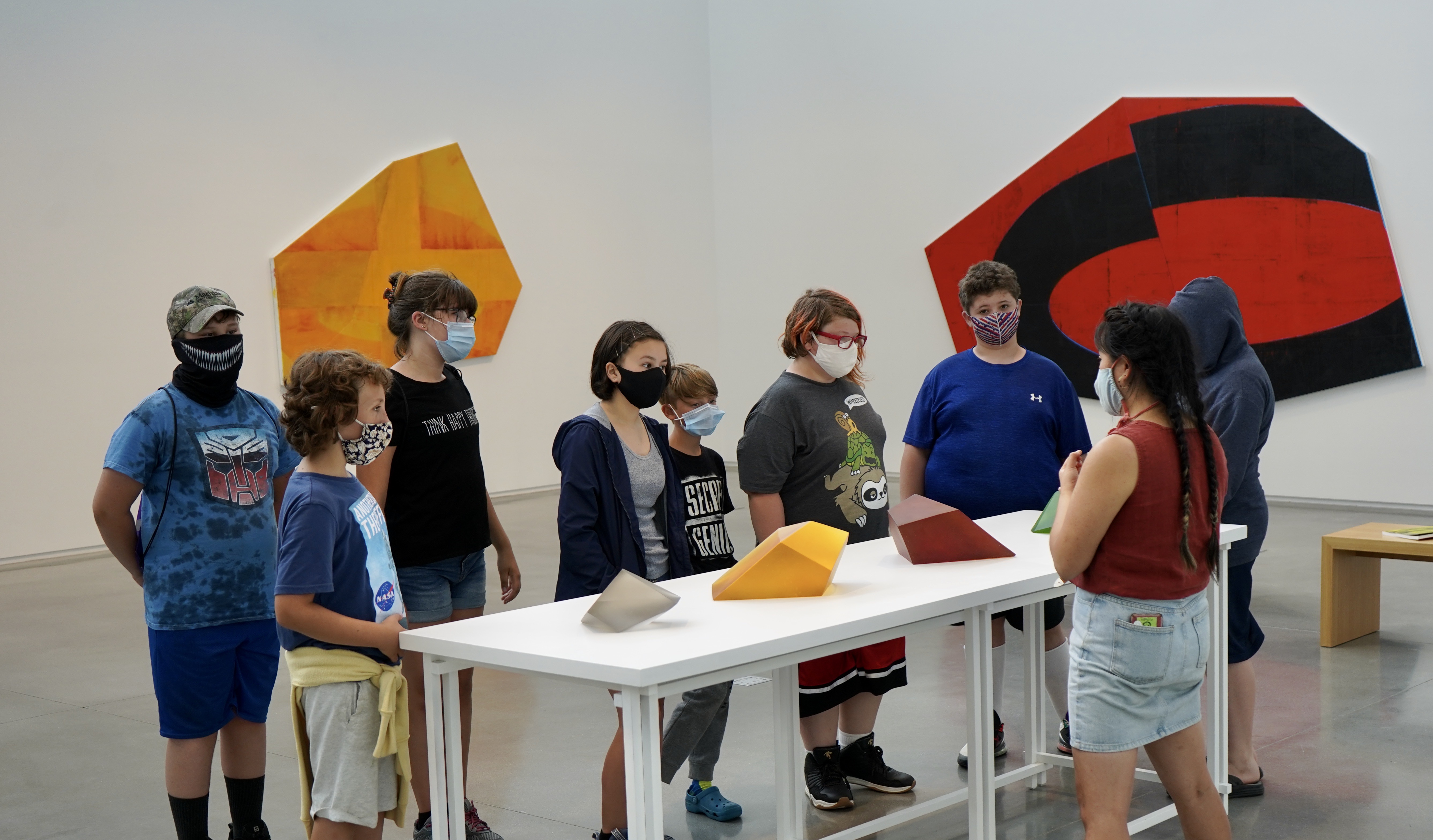
Mia leading Look Inside program
PANDEMIC
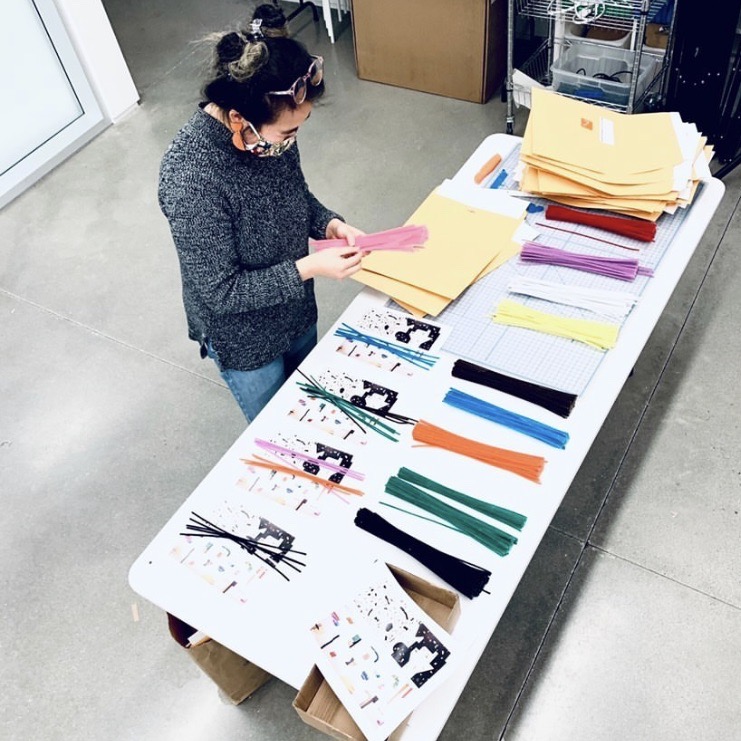
The pandemic offered Mia and CMCA some challenges along with opportunities. They quickly shifted to online offerings. They built over 1,300 art kits with each kit being attached to one lesson. Over time students participating collected tons of ideas and materials. Parents are grateful for the quality art supplies to help steer their child while at home and most likely will last for a very long time. They worked with the local teen shelter providing art kits while they were doing food distribution.
Covid influenced and impacted decisions and direction. They are building on the challenges. Returning from the pandemic to in-person has been a different kind of challenge. They continue to offer online opportunities and will not lose what they learned during the most difficult part of the pandemic. They have streamlined their communication. CMCA is the only organization in the area providing online. They are now very open for schools and love having groups visit.
The other big learning is that they are clear that “creativity can be a step away from technology now.” They used technology to engage people while simultaneously making and offering the art kits, serving all ages, PreK through adults. Since it was difficult to get kids online they pre-recorded the lessons and the local school district communicated the information to students.
The instruction reached quite a distance during the pandemic. Schools as far away as Machias and Kennebunk participated during the heart of the pandemic. CMCA provided virtual tours and workshops. Perhaps due to the pandemic programs with classroom teachers are growing.
Mia has connected with the teachers at Harbor School and George Stevens Academy and provides workshops for students there.
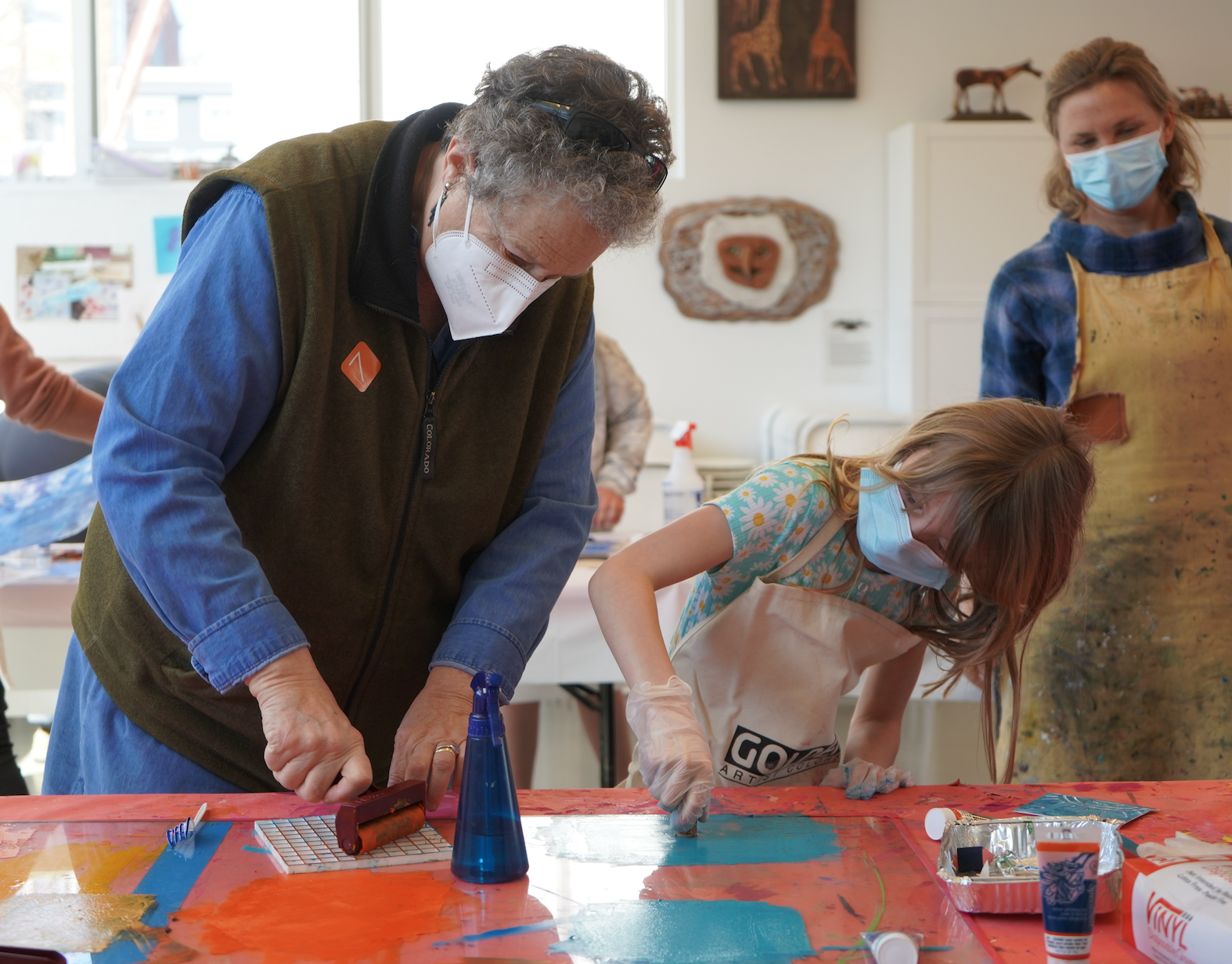
Artlab
SCHOOL AND COMMUNITY RELATIONSHIPS, OPPORTUNITIES
CMCA has a free membership for Rockland residents. In many cases this starts with the teacher and the local schools.
CMCA is at a turning point, growing from what they’ve learned about young and adult learners. They are diversifying their teaching staff and including artists from the mid-coast. Many are interested in teaching and sharing what they do. Covid has shown that teachers, formally trained or not, can and wants to give back. Adult community members are interested in learning from an expert.
Mia teaches the elementary and middle school gifted and talented program in RSU 13 (Rockland) which she teaches at the school. The students also visit the CMCA shows throughout the school year.
The After School program involves partnering with the local schools through their 21st century program.
Rockland High School program is called ‘Arts at Work’, established in 2017, and CMCA partners with that program. Teaching artist, Alexis Iammarino facilitates this program. Internship for high school students at CMCA, focusing on the community. Alexis also oversees the mural program in the summer as lead artist for Arts in Action, which has been painting murals for several years in public spaces throughout Rockland. The town is being visually transformed thanks to the murals these young people have created with Alexis.
The ArtLab portion will expand to be more community based space for teaching artists.
CMCA is building on their relationship with the Mid-coast School of Technology. Together they are considering alternative learning spaces with an interest in the Graphic Design and Film programs offered at the school.
CMCA is part of the RSU 13 Youth Alliance. The organization is made up of more than 15 organizations who put out a newsletter and meet monthly. The organizations are located in the mid-coast, from Rockland to Camden, and are connected with youth, trying to build connections with youth and/or provide opportunities for youth. The group also supports each other by checking in with members to learn what is needed for youth, to help address struggles and to understand what is being heard from youth.
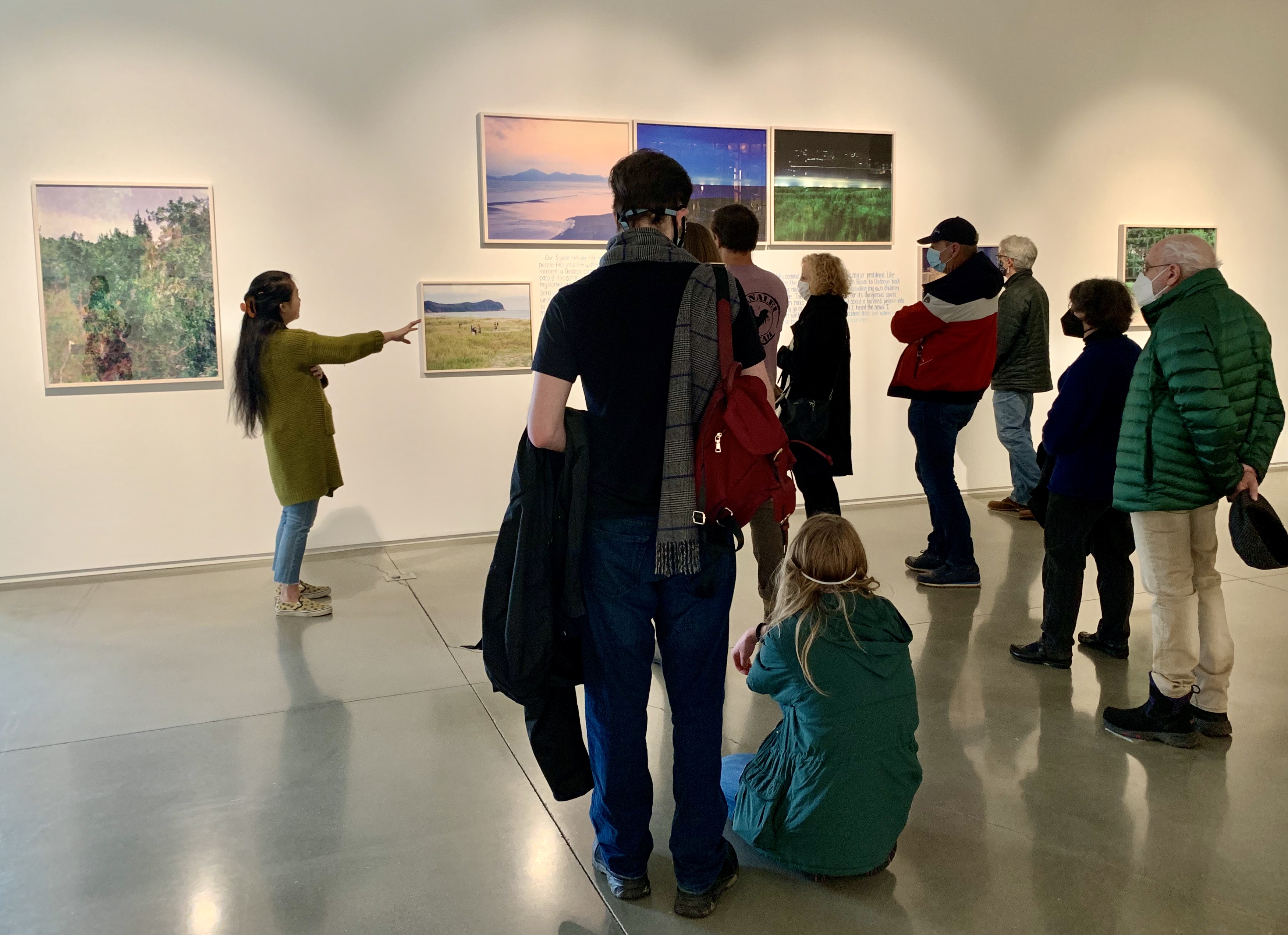
Mia leading Third Sunday
MAEA RELATIONSHIP
Mia works closely with Maine Art Education Association, hosting conferences and communicating about the resources that CMCA has for educators. She enjoys exploring this together with teachers and providing professional development in a collaborative manner, planning and implementing.
SUMMER
CMCA is 70 years old and the 5th year that they’ve been in their new facility in Rockland. On the 3rd Sunday of the month they have Sunday tours. In partnership with the Farnsworth Art Museum this summer they are offering joint field trips for children and summer camp programs for children in RSU13. Mia is honored that organizations wish to collaborate with CMCA but focusing on the numbers is a priority for them. And, getting everyone on the same timeline is a challenge.
LOOKING AHEAD
The education portion of CMCA will continue to grow while being mindful of their mission and goals. They will hire a part-time employee (10-15 hires a week) to help maintain the programs that they are currently housing. In Mia’s own words: “It is so exciting to have new work that turns over, exciting to have this space to use, exciting to make connections. I am wanting to do (provide programming for). “I am always reminding myself to slow down.”
Thank you Mia for providing so much information for the blog readers so they can learn (more) about you and the education programs at CMCA.
“LOVE WHAT YOU DO AND NEVER STOP LEARNING ABOUT WAYS YOU CAN ENGAGE STUDENTS!”
While reading Janie Snider’s reflections below you will understand who she is and the impact she has had, not only on her elementary and middle school students, but the adults in her life also. Janie is a gem whom I’m certain will be missed in her daily teaching role. I’m confident that she will continue to make a difference in this world through her interactions with others as she enjoys her retirement. Thank you Janie for your service to the field of education! I know the blog readers join me in wishing you the very best in your retirement.
Last week of school, Hancock Grammar School
IN JANIE’S WORDS…
I have been teaching for 30 years. My first ten years teaching were in SAD#37 including Columbia Falls, Millbridge, Cherryfield, Harrington, and Addison. I started as a long-term art substitute, then as a kindergarten teacher and the following year as the art teacher. In 2002 I started teaching at Hancock Grammar School, where I spent the last 20 years. As a result of consolidation, I also taught art at Lamoine Consolidated for four years from 2011-2015. I received a Bachelors Degree in Elementary Education, K-8 from University of Maine, Machias and K-12 Visual Arts Certification.
My favorite part of teaching is building the most wonderful relationships with students that revolve around art making! Painting is my favorite discipline. Guiding students through color exploration and expression is so rewarding.
Cherryfield School – notice all the art styles included?
It has been quite the journey from when I was a young itinerant art teacher. I remember being so overwhelmed in my early years; five schools, 600 students and all the different challenges. In year three I was considering giving it up. I was feeling isolated and unsure of my impact on students. Then one day as I was introducing landscape to third graders I learned that I was! As I explained the horizon line, a little boy who normally didn’t participate suddenly started waving his hand, so I called on him. He was so excited to have made this connection, he said, “I saw it this weekend when I was on the lobster boat with my Dad, there it was and I knew it had something to do with art!!!” From that moment on, I never questioned my ability to connect students with the wonders of art in their world. It was my inspirational moment. Nature is my inspiration for my own work and it easily found it’s way into my lessons!
I have seen many changes in education and art education over the years. I truly believe that being included in the “Maine Learning Results” gave validity to arts education. However, it was challenging to keep up with the interpretation of standards that serve as guidance in developing strong arts programming. I was fortunate to have been an active part of this process, a member of the Maine Arts Leadership Initiative (MALI, now MAEPL), a local leader, and advocate for arts education. All of which helped me tremendously with meeting students needs! As a result of my work, I was recognized as the 2014 Maine Middle School Art Teacher by the Maine Art Education Association. This was a very important time in affirming my career. Representing Maine and attending the National Art Education Association conference in New Orleans was a definite highlight!
Another huge change is how technology has developed and changed the art curriculum, this boggles my mind. I started my career without using any technology and in 2020 developed an online art curriculum for remote learning.
Three things that are really key to a successful art program are:
KNOW your students, develop a relationship with them!! Listen to them!!
SHOW your passion for your profession!! Be creative in your approach!!
GO WITH THE FLOW, be flexible, be current with best practices and meet students where they are!
Janie in her classroom at Hancock Grammar School
I am most proud of my ability to guide students and help them understand and appreciate art in education and the world. I recently received a message from a former student who was in Washington DC at the National Gallery and was thinking back to the many lessons she learned in my classes. She thanked me for that. I have many young adults that have reconnected with me and shared their fond memories in art!
Looking into my crystals ball….My advice to teachers is “LOVE WHAT YOU DO AND NEVER STOP LEARNING ABOUT WAYS YOU CAN ENGAGE STUDENTS!”
K-8 mural, D.W. Merritt Elementary School, Addison. Kindergarten students started at the bottom and the mural grew as each grade contributed.
Stay curious, involved and be a life long learner. Take classes and reach out to others in your area of expertise, they are a gift!
I have come to realize that I was supposed to be an art teacher. So I guess the innate ability to teach was there, I just needed to become aware of it. I knew early on I had some artistic talent and wanted to be an artist. However, life happened and that dream had to be on hold. So I learned a lot of teaching skills over the years that helped me in my work! I’m still learning more about my work through my reflection. I am hopeful that during retirement I will rediscover that innate “art-self” that will bring my life-long dream into being.
Hancock Grammar School
I plan to make time for me and my art! I plan to take art classes, garden, read, travel with my honey and spend time with family and friends. I have grandkids that I am excited to have more time with!❤️ I know me and I am always busy, so my goal is to slow down just a bit and smell the roses!!
If I was given $500,000….definitely, buy a camper to continue my trips to the national parks. Contribute to my grandkids education fund and invest in my community arts programming!
I hope to be 94 and looking back!! My mom made it to 93 and we had a conversation about regrets before she passed. No regrets here, I have lived a good life, learned many lessons to carry me into the present! I have listened to my intuition and followed my heart, which is full of love!!❤️
This is a great opportunity to become part of a dynamic network of arts educators across the state of Maine. This year-long experience begins with a 3-day Summer Institute, held at a beautiful outdoor setting sure to jumpstart your leadership journey.
August 1-3, 2022. APPLICATION deadline June 23. There is no cost.
If you’re selected your role begins with the 3-day institute at Pilgrim Lodge, August 1-3.
MAEPL would love to build community with educators and teaching artists who know or have someone interested in arts integration. If you have someone in your building or your community or have partnered with someone in the past please have them attend this summer with you!
MAEPL recently moved from the Maine Arts Commission and is now a program of the Maine Department of Education.
August 1-3, 2022. APPLICATION deadline June 23. There is no cost.
SUMMER INSTITUTE LOCATION Pilgrim Lodge is a camp run by the United Church of Christ of Maine on Lake Cobbosseecontee in West Gardiner, ME. This beautiful venue has cabins with electricity and plumbing, large indoor and outdoor meeting spaces, modern dining facilities, wifi in main buildings, good general cell reception, and recreation options including swimming, human-powered boating, and trails.
PURPOSE
The Maine Arts Education Partners in Leadership (MAEPL) is committed to developing and promoting high quality arts education for all. MAEPL operates on the premise of “teachers teaching teachers.” All of our design teams, institutes, and professional development opportunities offer/encourage collaboration.
Teacher Leaders: Maine Visual or Performing Arts Educators with a professional teaching certificate who teach an Arts discipline in a public or private school.
Teaching Artist Leaders: Professional Teaching Artists in Maine with demonstrated experience collaborating within educational or civic environments to design and lead student-centered, values-driven residencies drawn from mastery of their artistic discipline.
TRAININGS, COLLABORATION, & WORK
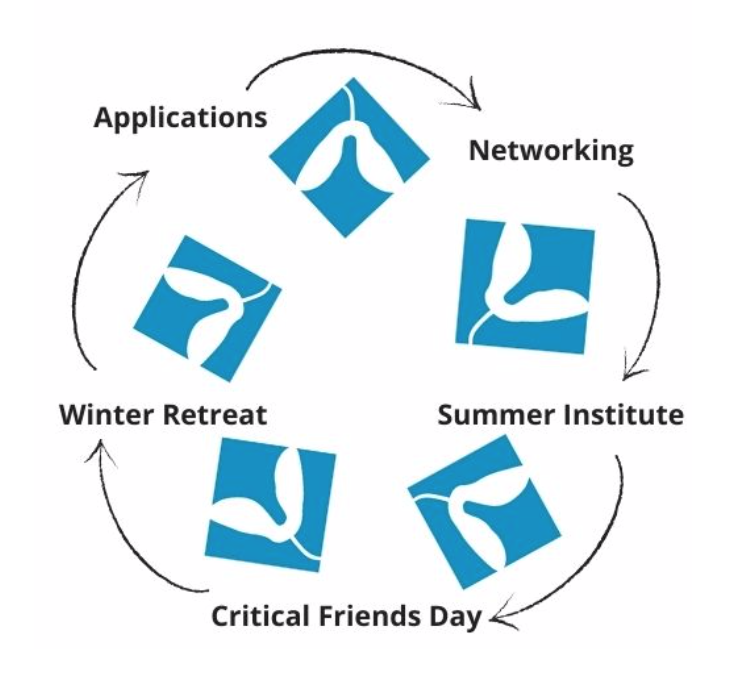
MAEPL is built on an institute model, by application. There is a Summer Institute for Teacher Leaders and Teaching Artist Leaders. Returning community members are encouraged to participate.
At the Summer Institute new Teacher Leaders and Teaching Artist Leaders will learn foundational practices in instructional design and leadership skills. Participants will take part in a variety of workshops focused on emerging needs in Arts Education professional development.
Collaboration, networking, and the sharing of resources are an expectation as a member of the MAEPL community. During the Institute participants will develop an individualized growth plan that will be shared with others for feedback and suggestions.
Throughout the school year, participants will continue to share how their individualized growth plan is developed and implemented, and they will have the opportunity to share at a Critical Friends Day, and with a thought partner. At the Winter Retreat participants review and reflect on the work done, and allow for time to get feedback to plan for the next Summer Institute.
TEACHER LEADER/TEACHING ARTIST LEADER ANNUAL EXPECTATIONS
Attend Summer Institute
Work with a thought partner
Develop a individualized growth plan
Share the outcomes of your individual growth plan within the MAEPL community and beyond (i.e. workshop, resource, video, article, etc.)
Share feedback and information about MAEPL through teacher leader stories and as part of your outcomes of your personal growth plan
Collaborate, network, and share resources
Participate in Critical Friend Day
Attend Winter Retreat
August 1-3, 2022. APPLICATION deadline June 23. There is no cost.
The 2022 County Teachers of the Year were announced recently in Augusta at the State House. I love that there are so many teachers each year nominated who represent all that is ‘right’ with education. Each of us in the profession, no matter what our role is, should feel the pride!
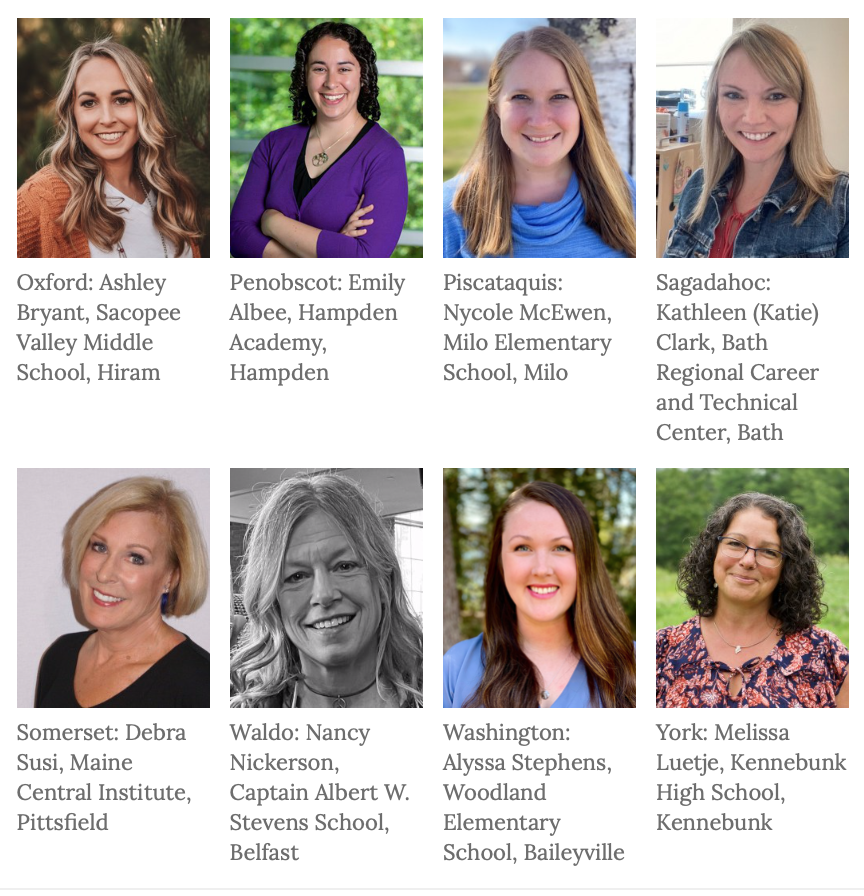
I’m especially excited this year that there are two performing arts teachers; representing Hancock County is Rebecca Edmondson who teaches music at Conners-Emerson School, Bar Harbor and representing Somerset County is Debra Susi who teaches theatre at Central Institute, Pittsfield.
Hundreds of teachers across Maine are nominated by a member of their school community. The application process is rigorous, not a lightly designed ordeal, with a teacher selected from each county by a panel of educators and other individuals who are members of each county.
Maine County Teachers of the Year serve as ambassadors for teachers, students, and quality education state-wide throughout the year. The Maine County Teachers of the Year are available to make presentations to local and regional organizations. Throughout the summer, they will continue to participate in an intensive selection process. In the fall one of these sixteen teachers will be named the 2023 Maine State Teacher of the Year.
I’m sure the blog readers join me in congratulating all of the county teachers of the year, especially Rebecca and Debra!
The Maine Department of Education’s Teacher of the Year Program is administered through a collaborative partnership with Educate Maine. To learn more about the Teacher of the Year Program visit: https://www.mainetoy.org/.
This has been a very difficult couple of weeks for me and I know for many others. On reflection, my sadness and anger started with the Columbine High School massacre on April 20, 1999 when 12 students and one teacher were killed by two 12th grade students. On April 16, 2007, a student at Virginia Tech killed 32 students. On December 14, 2012 at Sandy Hook Elementary School a 20 year old killed 20 children between 6 and 7 years old and six adult staff members. On February 14, 2018, a 19 year-old opened fire on students and staff at Marjory Stoneman Douglas High School in Parkland, Florida murdering 17 people and injuring 17 others. The perpetrator pleaded guilty and is still awaiting sentencing.
Since January 1, 2022 there have been 27 shootings, with injuries or deaths, that have taken place in schools across the United States. We all know that school shootings have been going on for decades. The first one that I found documented took place in 1840 when a student entered a classroom on the campus of the University of Virginia and shot his professor who died three days later.
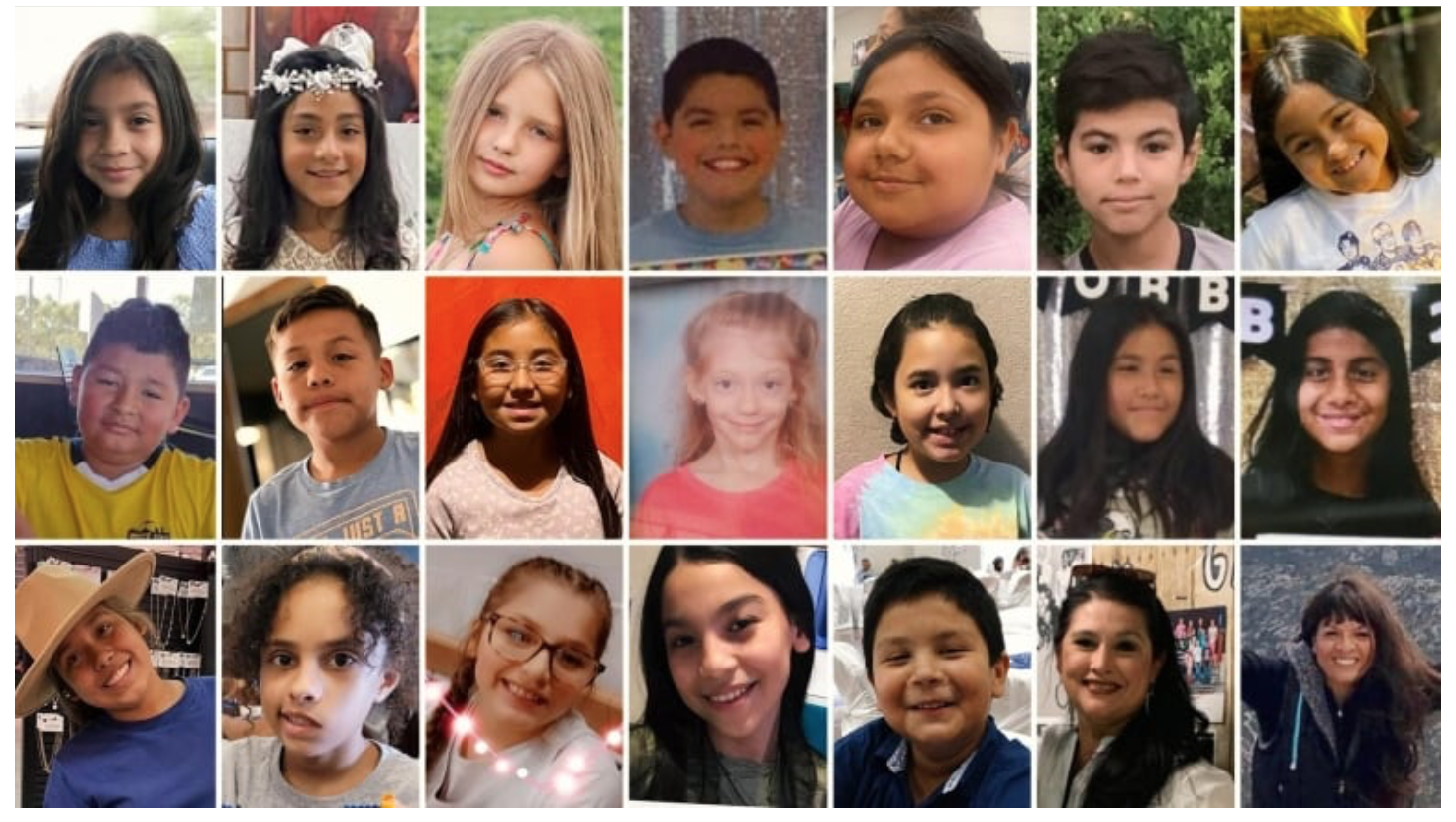
The latest heart wrenching event on May 24, 2022 at Robb Elementary School in Uvalde, Texas 19 fourth graders and their two teachers were gunned down in their classroom by an 18 year old. I say ENOUGH!
These innocent young faces below each have a story and for their stories to end abruptly and unnecessarily is very sad. And the two teachers smiling and such happy faces who guided and taught these young children – to have their teaching careers cut short by a gunman is totally unfair.
Precious victims from Robb Elementary School
I’m sure you’ve heard the horrific stories connected to this event which include the police not entering the classroom for over an hour and the gunman shooting his grandmother before going to the school and on and on. As I process the event I can’t help but feel and think so many emotions. From what I’ve read…
it’s OK to feel scared and sad AND also feel joy and hope.
I choose to imagine the bright stories. Read about these children and teachers. Ten year old Alithia Ramirez loved to draw and wanted to be an artist. She recently submitted a drawing to the “Doodle for Google” contest.
TAKING ACTION
I wanted to volunteer in the school district where I live and taught for 30 years but due to the pandemic, I was unable to be in the schools. So, I decided in January to start substituting, after the local district increased the substitute daily pay which they’ve based on experience and formal education. They’re using federal Covid relief funds and it has increased the number of substitutes exponentially. The idea is working! I was called to sub for elementary art two days after the shooting in Uvalde and I admit I hesitated to say ‘yes’. I took out the sub manual and didn’t read anything about what to do in a similar situation. I asked in the office when I arrived at the school for the protocol. Little information was provided and I felt scared that if there was a similar emergency, I would not be able to act on anything but my gut of what to do. My message to teachers and substitutes is…
Review the school policy and protocols with your colleagues and administrator. Do what you can to arm yourself with the knowledge and options so you can be as prepared as possible. Do it for yourself and for your students safety!
At the end of my day substituting for art, I sent an email to the Assistant Superintendent who oversees the substitute program. Ten days later, I’m still waiting a reply. I will circle back to the administrator since I understand how busy school personnel are at every level.
MY THOUGHTS ON GUNS
I want you to know that I’m not opposed to individuals owning guns but I think owning a gun for the ‘right’ reason is important and perfectly fine. Here’s an example of what I mean. Last week in a House Judiciary Committee hearing on gun violence, Representative Ken Buck from Colorado dismissed a proposal to regulate AR-style rifles. He said: “An AR-15 is a gun of choice for killing raccoons before they get to our chickens.” I understand that the farmers and ranchers in Colorado need to protect their chickens however, there are other guns that can be used for this purpose. Owning an AR-15 for this reason is simply not ‘right’.
An example of what I believe is a right reason. I grew up in a hunting family. My father was a rabbit and deer hunter so there were always guns in our home, locked in a gun cabinet when not in use. The animals my dad shot helped put meals on our supper table and sustain our family of six. My brothers were taught to hunt and so were my sister and I. Safety was a priority and I can hear my father’s voice emphatically saying: “never, ever point a gun at a human being”. You see, my father proudly served in the Army in WWII, 26th Infantry Regiment of the 1st Division (known as the Big Red One). He was trained in desert fighting and sailed on the Queen Mary to England to prepare for the invasion of Africa. On the first day, Corporal Nestor’s first day in battle anywhere, he was awarded the Silver Star medal and promoted to Sergeant. He fought against General Rommel’s German troops in Northern Africa and fought across Sicily. On June 6, 1944, his division was part of the second hour landing on Omaha Beach at Normandy. He continued the fight across France, Belgium, and crossed the Rhine River into Germany including The Battle of the Bulge. For 34 months he served as a Forward Observer until he was seriously wounded. He put himself in extreme danger in order to save a battalion of fellow First Infantry soldiers guarding an air base. His injury on the battlefield sent him home and for this action he was awarded the Distinguished Service Cross. His exemplary valor, bravery, and leadership also earned him a Silver Star with an Oak Leaf Cluster, a Bronze Star with Four Oak Leaf Clusters, two Purple Hearts, The French Croix de Guerre, a battlefield commission to 2nd Lieutenant, as well as numerous other commendations. My dad never talked about the difficult parts of the war but he told stories about the many friendships and shared his mementos. He was proud to have served and to be an American and humbly served our country for the many freedoms we have. After the war he put his energy towards his family and community and made a lasting positive impact. In my opinion, all his life he used guns and owned guns for the right reasons.
TEACHERS AND GUNS
We all know that teaching is a challenging and also a rewarding career. The stresses that exist today due to the pandemic and another massive school shooting have teachers asking the hard questions. They’re struggling to find time to take care of themselves. We all know self-care is critical. The shortage of teachers has been ongoing for several years, especially in certain subject areas, more so in school districts with low- income households and in rural areas. According to Education Week typically about 8% leave every year. Some states are discussing arming teachers with guns to stop school shootings. In my opinion that is a bad idea for many reasons. First of all, we have more guns in America than people. Has this kept individuals and schools safer? According to the Maine Criminal Justice Academy website it looks like 120 hours of training is required to be eligible to be a Maine State Police officer. I don’t see where any state is suggesting 120 hours for teacher training however, expecting teachers to train to respond to a shooter in school is unreasonable. Here are other reasons I believe this is an unfair expectation:
In a moment of duress and confusion when an intruder enters a classroom, there is no way to predict how a teacher may respond.
This increases the chances of their own students being shot.
The liability for the school district will be near to impossible.
Do we really want students to be watching this type of scenario played out?
Teachers are hired to teach not to be law enforcement and security personnel. Their jobs are enormous already.
WHAT CAN SCHOOLS DO?
When I was in elementary school (a hundred years ago) we practiced for fire drills and we also had ‘duck and cover drills’ preparing us for an atomic bomb. We silently filed into the hall, kneeling up against the wall with our arms crossed over our heads without moving, until the teacher said it was OK to release our position. Yes, we were scared but we practiced so we’d be prepared, just in case. If drills are done with the best interest of the children to help alleviate the fears, practicing can contribute to the effectiveness and ease their fears. I was on a zoom call last week with several Maine teachers who shared that there are problems with the various situations in school buildings. Some examples include: outside doors don’t lock without a certain key, turning off lights in classrooms without windows makes it very difficult to get 20 students to the designated safe space in the classroom, and passing students out windows can be very risky when you don’t know where the shooter is located.
WHAT CAN OUR ELECTED OFFICIALS DO TO MITIGATE THIS DREADFUL PROBLEM?
MCSTOYA is an organization whose members are Maine county and state teachers of the year. A week ago members were invited to discuss ideas for addressing the complex issues related to school safety. We landed on two ideas and met with an aide of Senator Collins last Friday to share our requests.
Request #1: Raise the age of people purchasing an AR-15 to 21
WHY? Part of the answer lies within understanding the effects of bullets from an AR-15. This information is taken from the The Atlantic: What I Saw Treating the Victims from Parkland Should Change the Debate on Guns written by Heather Sher. Bullets travel at a higher velocity from an AR-15 and are far more lethal than routine bullets fired from a handgun. The damage they cause is a function of the energy they impart as they pass through the body. The bullet leaves the barrel traveling almost three times faster than-and imparting more than three times the energy of a typical 9mm bullet from a handgun. When these guns are outfitted with a magazine with 50 rounds it allows many more lethal bullets to be delivered quickly without reloading.
The second part of the answer lies within understanding the brains of a young person. Many educators know this information. According to theUniversity of Rochester Medical Centerthe rational part of a teens brain isn’t fully developed until 25 or so. An adult brain and teen brain work differently. Adult brains think with the prefrontal cortex, the brain’s rational part. This is the part of the brain that responds to situations with good judgment and an awareness of long-term consequences. Teens process information with the amygdala. This is the emotional part. In teens’ brains, the connections between the emotional part of the brain and the decision-making center are still developing – and not always at the same rate. That’s why when teens have overwhelming emotional input, they can’t explain later what they were thinking. They weren’t thinking as much as they were feeling.
Request #2: Funding for school violence prevention and intervention programs
WHY? It makes perfect sense that if we could identify the struggling students and provide them the support they need to begin to articulate their needs and process their stresses school personnel would be assisting to address some of the problems. In many schools there is one social worker or guidance counselor responsible for hundreds of students. This makes it impossible for the existing staff to service students.
WHAT CAN YOU and THE PUBLIC DO?
Consider your options. Don’t be afraid to ask questions or be in fear of losing your gun if stricter laws are put in place to keep schools safe. Have conversations with your neighbors and community members. Often they do not know what goes on in schools. You’re the expert, share information, enlighten them.
Contact your legislator to share your opinions and beliefs. Vote every time you have the opportunity. Below is a sample to help start a phone conversation. And, you will find the phone numbers for Senator King and Collins’ offices.
Hi, my name is ……………
I am a constituent from (name of town) and an educator in Maine.
I am calling about (state the issue)
Please consider supporting legislation that will……………. Or I am concerned about (issue) and would like this looked into.
Thank you for hearing my concerns.
Phone numbers:
Senator Angus King Washington Office: Phone: (202) 224-5344
Senator Susan Collins: Washington Office: (202) 224-2523
Caribou Office: (207) 493-7873
Lewiston Office: (207) 784-6969
TAKE CARE OF YOURSELF
This is a book that you might find helpful at this point in your career (no matter how long you’ve been teaching) and the school year (with all that has been going on during the last 27 months.
Emily’s Masters’ degree is in counseling and Amelia’s is in choral conducting; one day they realized they both got graduate degrees in how to listen and feel feelings.
Thank you for your ongoing commitment to education. Please don’t hesitate to post a comment below in this blog post and/or reach out to me if you have questions/comments at meartsed@gmail.com.
This story starts with the design that was selected for the Maine Learning Technology Initiative (MLTI) conference t-shirt. But, it’s about much more than that. It’s about a 7th grader who LOVES the arts. Congratulations to Penny Graham who attends Waterville Jr. High School. Her art work, seen below, was selected to be printed on t-shirts that will be worn by Maine middle schoolers and their teachers while they attend the virtual student conference being held, May 26. Registration is open for the MLTI Virtual Conference and all grade 7 and 8 Maine students are invited to participate.
I had the pleasure of speaking with Penny recently about her design that connects with this years conference theme: Space2Connect. Before getting to the creating part Penny looked at t-shirts from past years which helped to guide her decisions. She wanted it simple so she considered ideas with space, specifically planets. She decided on one color so it could be seen and read easily. She tried different colors including pink and green but kept coming back to purple. She’s been using the digital app Procreate on her iPad for about a year so it made sense to use it for designing the t-shirt idea. In fact, she has created a video that demonstrates her knowledge and how she went about accomplishing her design. Video about using the app Procreate. Penny’s video will be included on an upcoming episode of theMLTI SLAM Show, which focuses on student leadership in technology integration.
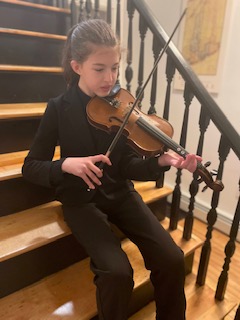
Penny drawing
After being on the phone with Penny for about 45 minutes I realized that I was not only speaking to a t-shirt designer by an incredible arts advocate. “The Arts are important to me. My whole life I’ve always loved doing music and art because they’re my passions. I’ve done art clubs, I draw a lot, I played a little saxophone, guitar, and the recorder. This year I can see myself improving.”
In addition Penny loves to write, narratives and some poetry. She’ll often learn something while writing in school and goes home and practices what she’s learned. She’s had several different learning opportunities in the arts. “I love doing art with materials and using my hands and getting dirty. It is such fun.” She enjoys pen and ink, sketching, water color, rock painting and pottery. Penny also loves creating with digital tools because “I can change the design quickly and the process goes much smoother.“
The arts rotate through the schedule for students at Waterville Jr. High and as a 7th grader she doesn’t have visual art but she does have music. She selected the violin which she played when she was younger and is happy to return to it. She enjoys playing in the school orchestra and likes the performances.
She also loves theatre and has participated in the Sound of Music and Nobody Believes in Fairies which was written by one of the school’s 6th English teachers. She’s excited about the musical coming up this spring called Middleschool Madness. Penny says: “Theater is a really nice bonding experience. It’s a fun, social thing that I just love to do. I got to meet so many new people in the two plays I’ve been in. My theater experiences have all been really great.”
Penny as Gretl
Penny also shared her experience of the pandemic. She was glad to have alone time to draw and bake and was able to pursue her hobbies. “I feel like without the pandemic I wouldn’t have been able to move forward that much. I feel like I could take big strokes that I wouldn’t have had time to do.”
Penny’s dad shared: “Waterville is a wonderful place for artistic and curious children like Penny.”
I’m certain that Penny has a bright future and I’m grateful to have met her and for our conversation.
The Maine Art Education Association (MAEA) concluded an outstanding spring conference by presenting three, no four, awards to deserving educators. But first a word about the conference. I’ve been around long enough to see institutions transform, some for the third and fourth time. I had the pleasure of working on the planning committee for the MAEA spring conference that was held on Saturday, April 2 in Rockland at the Farnsworth Art Museum and CMCA. I’m not just talking about a conference that was held in both facilities but what took place was magical. It was delightful to see the two institutions partner with MAEA to put together a very worthwhile day for art educators.
Presentation by Daniel Salomon
The conference entitled Radical Reuse was planned and implemented by a group of people who had never worked together before, some new to their positions, and everyone went above and beyond. Over a two month period every Thursday the education staffs of both institutions and the MAEA conference planners came together on zoom to plan the annual spring conference. THANK YOU to everyone for a job well done! From CMCA: Mia Bogyo, and representing the Farnsworth: Gwendolyn Loomis Smith, Katherine Karlik, and Alexis Saba. MAEA president, Lynda Leonas, coordinated the effort with board members Iva Damon and Christine Del Rossi supporting. From the Rockland school district Richard Wehnke helped.
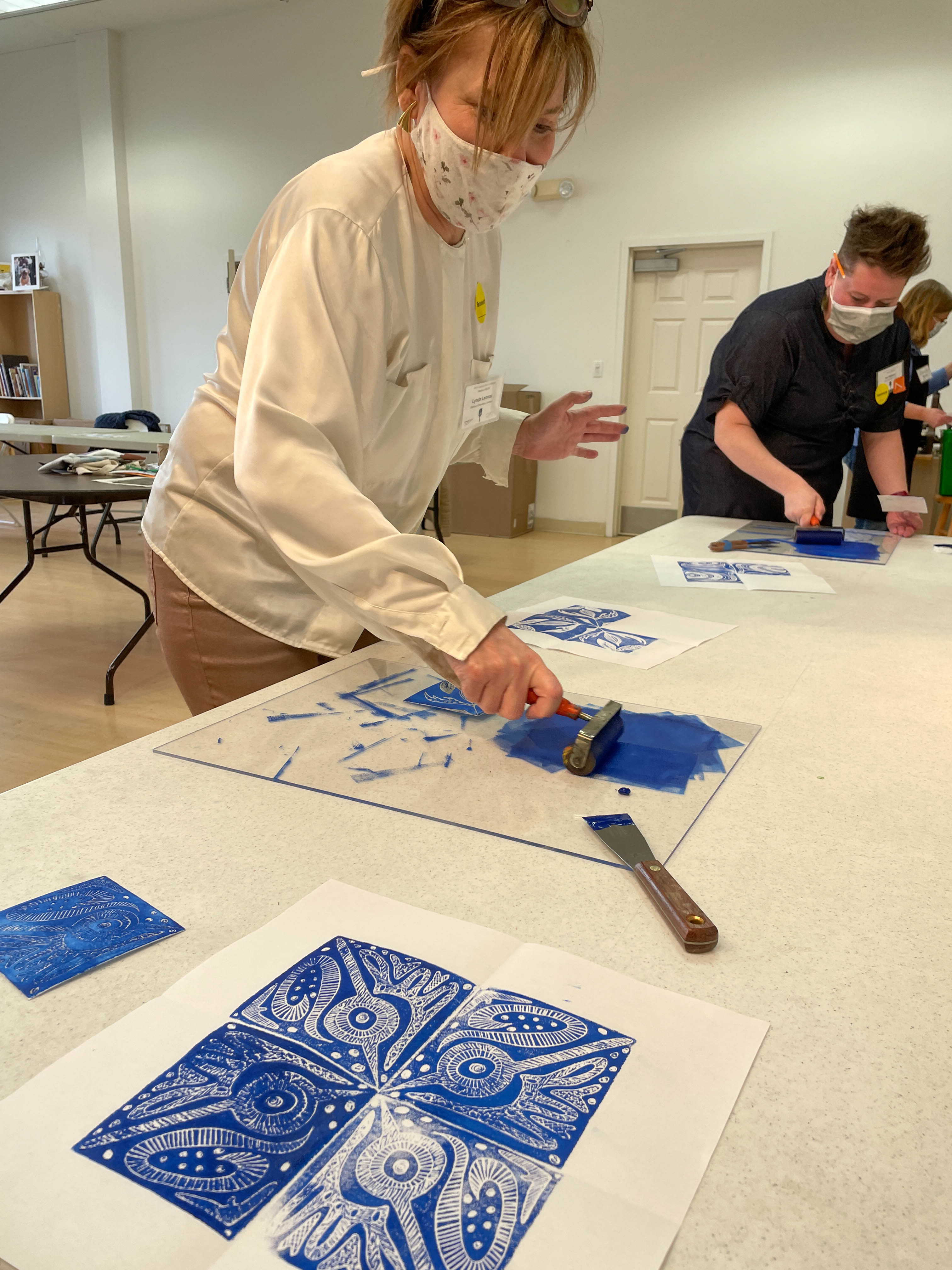
Printmaking with Sherrie York – Lynda Leonas and Iva Damon
The keynote was provided byKrisanne Baker, Medomak Valley High School art and ecology teacher and artist. She is committed to advocating for the ocean and inspires her students to learn about water quality, availability and rights, and ocean stewardship. Guest speaker Daniel Salomon who teaches in The Hatchery at Camden Hills Regional High School provided background information on the work he is doing with students utilizing and reusing materials and the role we each can play.
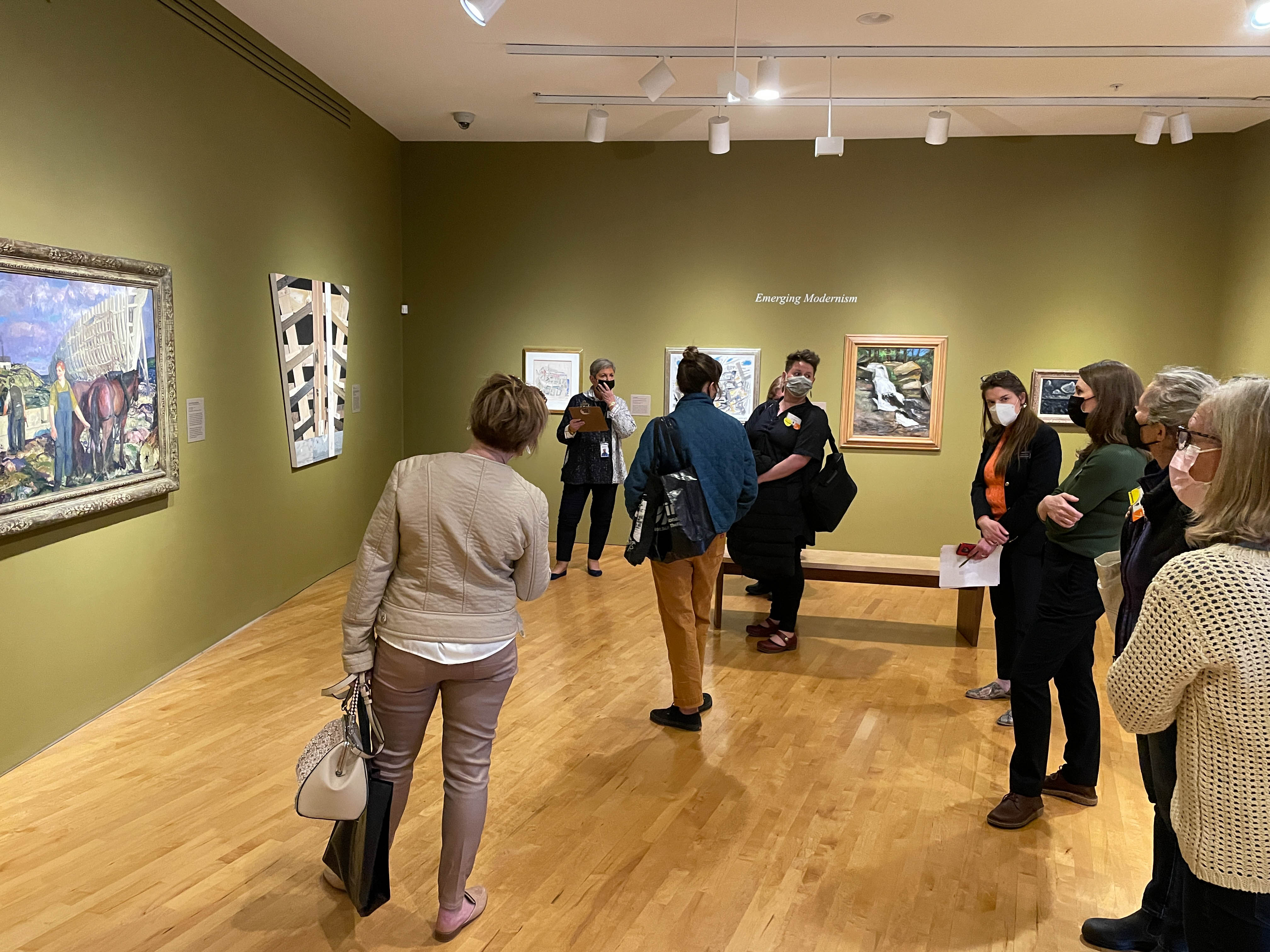
Gallery tour, Farnsworth
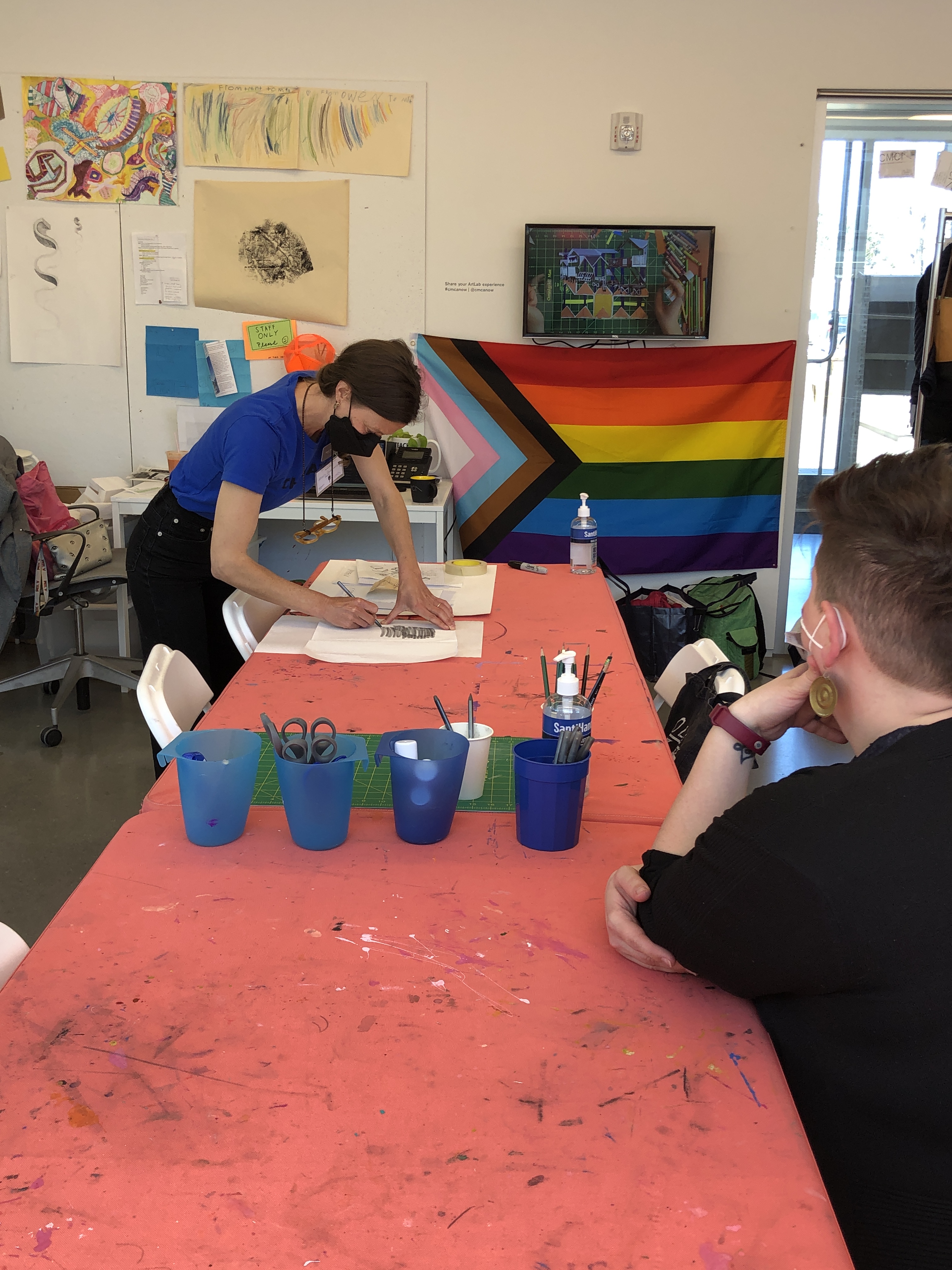
After the opening speakers, conference participants attended sessions on printmaking with Sherrie York, art making around ‘place’ with Alexis Iammarino, toured the Farnsworth Museum, and toured CMCA. Several merchants from Downtown Rockland supported the conference goers with discounts. During the middle of the day Daniel’s students from the Hatchery, set up outside CMCA, shared several of the projects they have been involved in this year.
Alexis Iammarino demonstrating, CMCA
AWARDS PROGRAM
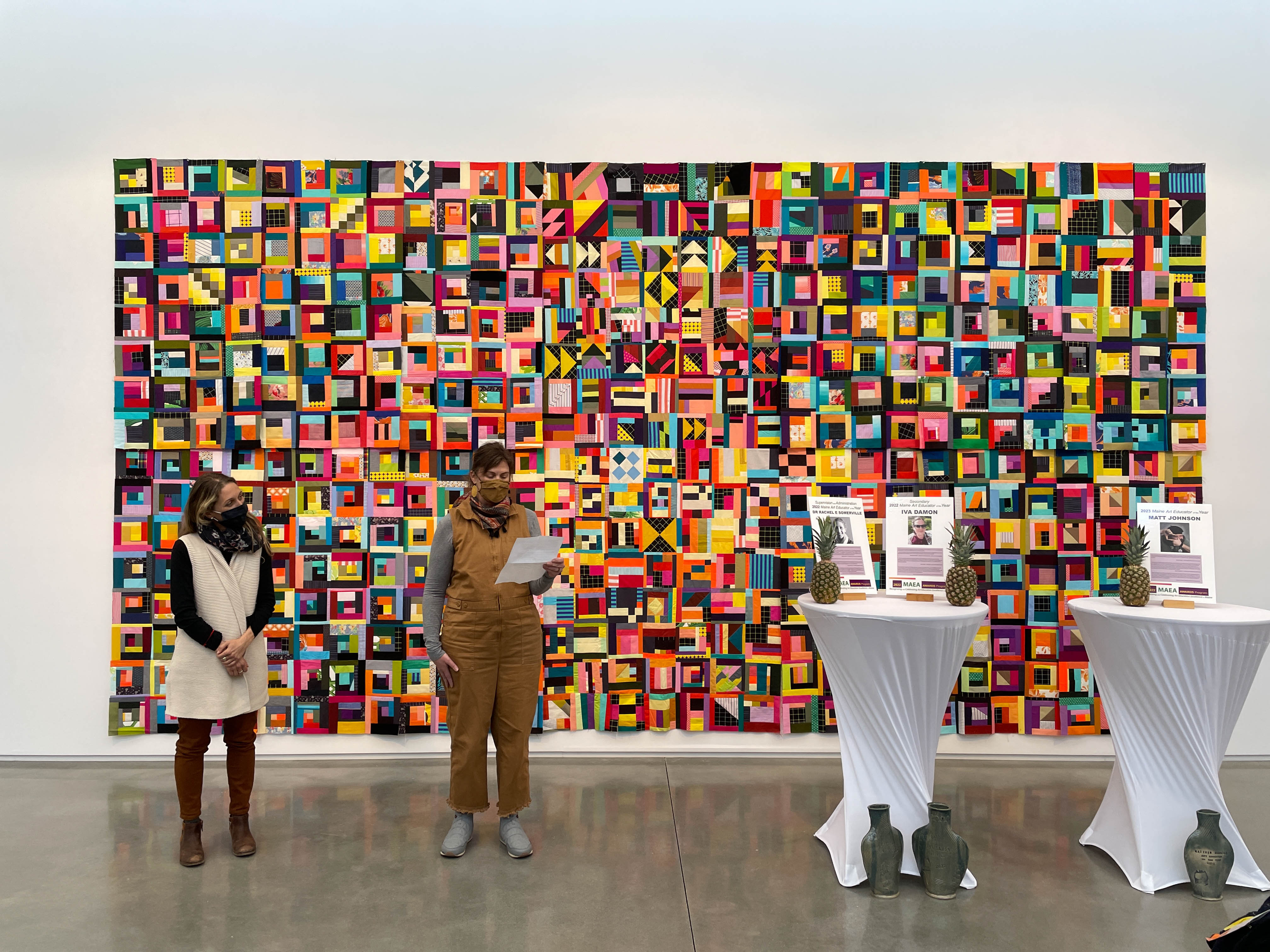
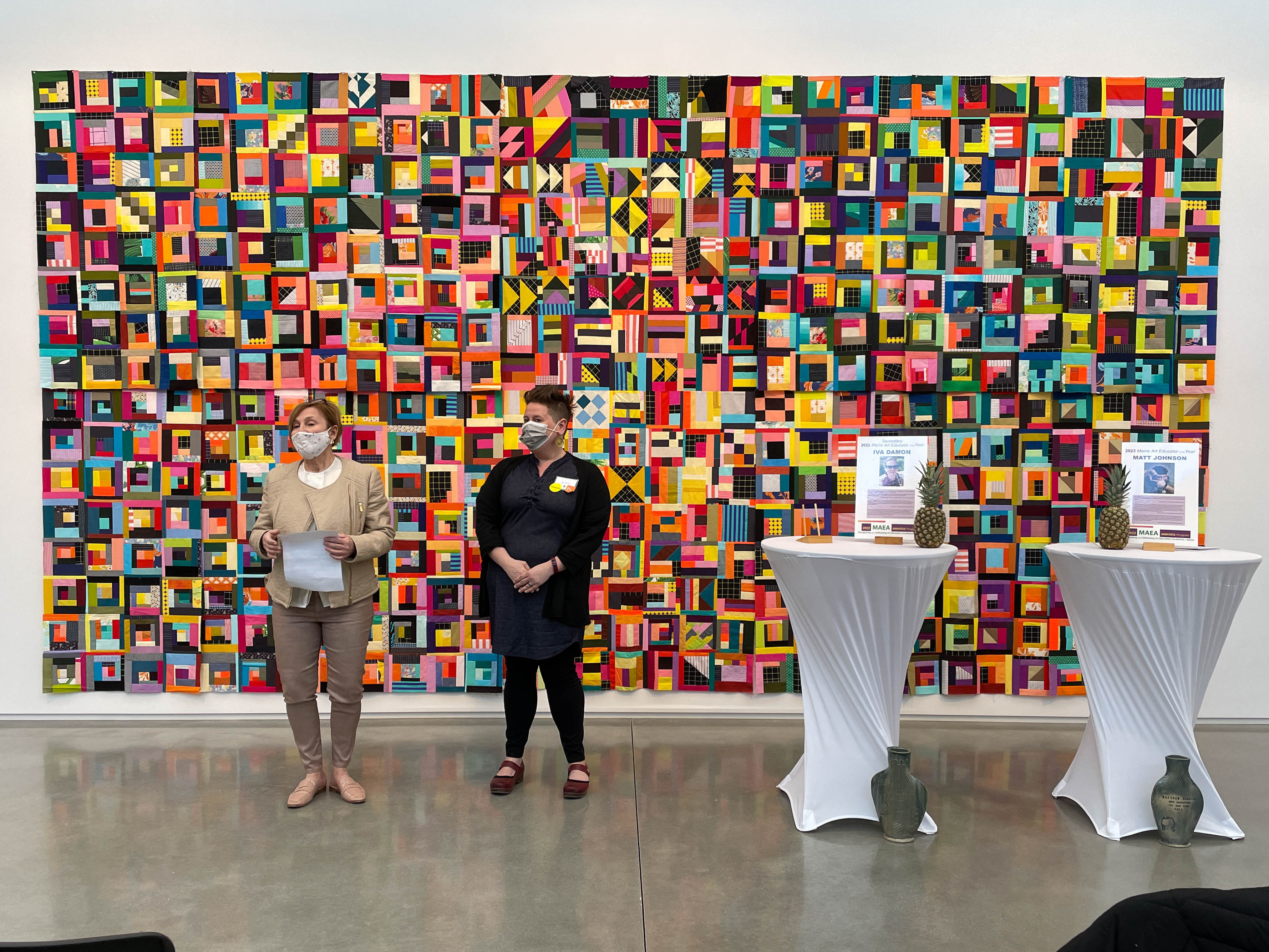
The day concluded with honoring the work of four educators with an amazing backdrop of quilts at CMCA. The educators are outstanding in and out of the classroom, engaged in work at the local, regional, and state level. They work (and play) tirelessly, sometimes alone and often collaborating with others. Every day they exhibit all that is right about education. In their respective institutions they have a place at the table where they continuously advocate for students and art education. We know that an excellent education in the arts is essential, and these educators strive for every student to experience just that.
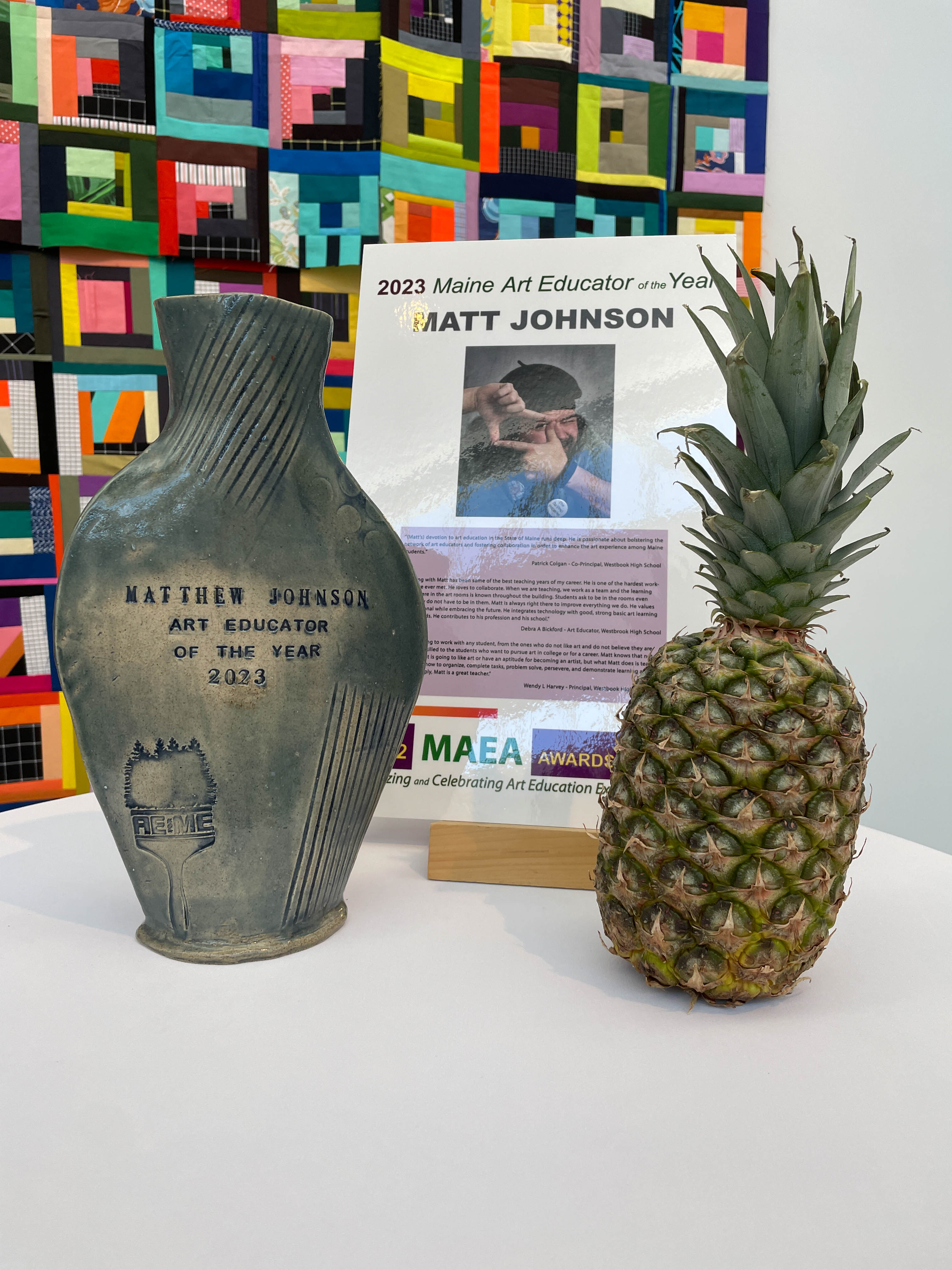
The awards committee was led by Belfast Area High School art teacher Heidi O’Donnell. Members of the committee included Hope Lord, Maranacook Middle School art teacher and Suzanne Goulet, Waterville High School art teacher, and myself. The awards, clay vessels, were created by Carolyn Brown, Camden Hills Regional High School art teacher. In addition each educator received a plaque for their classroom and a pineapple.
The 2022 Administration/Supervision Art Educator of the Year was presented to Dr. Rachel Somerville who is at Maine College of Art & Design and Westbrook Schools. She was introduced by Melissa Perkins, Congin Elementary School art teacher, Westbrook.
Melissa presenting Rachel
The 2022 Secondary Art Educator of the year was presented to Iva Damon, art teacher at Leavitt Area High School in Turner. She was introduced by Lynda Leonas, president of MAEA and an art teacher at Walton and Washburn Elementary Schools in Auburn.
Lynda presenting Iva
The 2023 Maine Art Educator of the Year was presented to Matthew Johnson, art teacher at Westbrook High School. He was introduced by Deb Bickford who also teaches art at Westbrook High School.
Lynda Leonas presented a surprise pineapple award to Heidi for outstanding leadership and contributions to the MAEA board. She is stepping down from the board as she takes on a leadership position with the National Art Education Association.
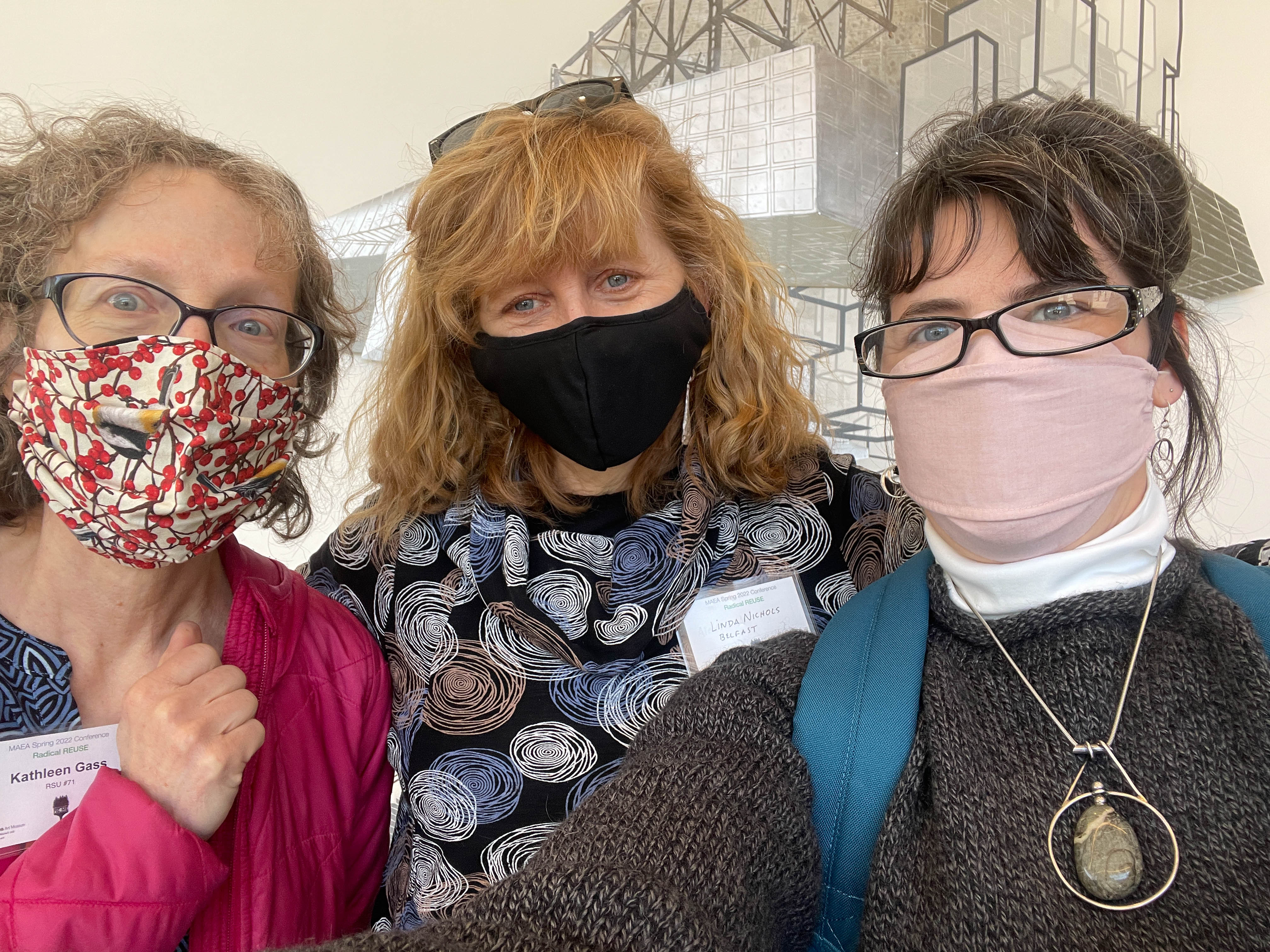
Heidi O’Donnell, right with her Belfast colleagues Linda Nicholas, middle and Kathie Gass, left
As we move away from the challenges of the pandemic I urge you to consider:
Become a member of MAEA, if you are not already one
Volunteer to become a board member and take on a leadership role
Nominate a colleague who is worthy of recognition
For more information please go to the MAEA website.
If you’re interested in connecting with a global audience of educators, please read this post. I’ve blogged about HundrED in the past. In 2018 I was selected as a HundrED Ambassador and was invited to attend the HundrED Summit in Helsinki in 2018 and 19. I met amazing educators from around the world. Some of my follow up roles with HundrED have been to assist in the selection of innovations that best represent HundrED’s mission.
What is HundrED?
HundrED is a global education non-profit, recognized as one of the world’s leading experts on scalable innovations in K-12 education. HundrED’s mission is to help every child flourish in life by giving them access to the best possible education innovations. HundrED annually selects 100 leading education innovations globally packages and shares their amazing work with the world, for free.
Applications are open for the HundrED 2023 Global Collection – DEADLINE: JUNE 1ST, 2022
Are you an education innovator? We want to hear from you! Submit your initiative to the HundrED 2023 Global Collection before June 1st, 2022. If you are not an innovator, but know an organization doing great work in the field of education, send us an email at research@hundred.org with a link to their website. APPLICATION.
In an unprecedented way, the global pandemic has highlighted the importance of building social and emotional skills (SEL) to help children thrive in school, the workplace, and life. In this report we highlight 13 of the most impactful and scalable education innovations fostering SEL skills in students. In addition, the report offers 5 successful strategies for implementing these programs.
HundrED and Ukraine
Of course HundrED has Innovators and Ambassadors from Ukraine. They’re reaching out to these people and in this writing you can read about the crisis from a Ukrainian teachers perspective. In addition HundrEd provides resources on how to speak with children about the crisis in Ukraine.
A lot has been said about education and educators since the pandemic started in March of 2020. During the earlier months educators were the heroes. People began to realize the value of teachers. I read on a facebook post by a teacher this week that she wished to return to the early days of the pandemic when teachers were appreciated. When parents, especially parents, realized how challenging teaching is and how critical the teacher was to their child. We all know that doesn’t just refer to the ‘teaching’ part of a teachers day but the support teachers give to social and emotional learning, and so many other pieces that teachers teach individual students.
This morning I listened to a 6th grade student from Georgia on public radio say that her mother gave her a journal recently to document her stories of the pandemic. She only wished she had started writing at the beginning of the pandemic because she’s forgetting how she felt and what happened during those earlier days.
As we know time seems to race faster as the years go by. I’m sure some of you can relate to the 6th grader. Those of you that wear both hats – juggling teaching and parenting, in many cases, handled even more than usual.
What did you try during the early days of remoteness that you felt was a disaster and what actually turned into a success? In the spring of 2020 I remember gathering on zoom each morning with my middle schoolers for ‘breakfast club’. Students had a chance to connect with each other and their teachers. They ate, laughed, and connected in ways unmeasurable. It was optional but almost every student was there almost every day. It helped them to remember the importance of connecting and communicating in a ‘non-learning’ way. Let’s face it, we know how important it is for many to connect, not because we have to but because we want to.
Here are a few questions to help you sort your role as teachers during the pandemic. Answer the questions by writing or an art creation (movement, acting, musically, visual art, poetry):
What have you learned earlier in the pandemic that you continue to apply?
As things got turned on their head, what did you try that you found was successful or a complete failure?
What were the points in time that caused you to pivot?
Name what you felt when teachers were being referred to on a daily basis as ‘heroes’?
Make a list of what you want to remember from the pandemic as a teacher; the positives, and the challenges?
Select a quote that you can identify with in your role as a teacher. Make it large and post it (at home or at school) and use it as motivation and a remembrance that what you’re doing is amazing, every day!
Compile a list of quotes from the amazing work teachers are doing that are helpful in keeping your spirits up and remembering: whatever you’re doing is enough!! I can’t say that enough.
bell hooks, September 25, 1952 – December 15, 2021
As we start another calendar year and head towards two full years of living in a world-wide pandemic here are thoughts and what’s been learned from teacher leaders; on teaching, adapting, pivoting, and noticing students to help them do their best at learning.
A HUGE THANK YOU to Rob Westerberg, Anthony Lufkin, and Iva Damon for going above and beyond and sending their thoughts. Valuable information from Maine Arts Educators. You’re invited to share your thoughts. Please post at the bottom or email them to me at meartsed@gmail.com and I will update this post.
What are your ah-ha moments in teaching this year? What’s most important to you?
Two things have helped me pretty profoundly. The first is staying hyper organized. I tend to lean that way ordinarily, but by always staying a step or two ahead of everything that needs to be done, it has helped to relieve a LOT of stress and peripheral distractions from my school day and my interactions with classes/students. The other thing is treating each individual school day as its own mountain climb… I climb a different mountain every day. Consequently at the end of the day I feel a genuine sense of accomplishment. Some climbs are easy, others hard. But either way I leave school feeling very proud and, honestly, very happy. It has helped me keep my focus off of what I cannot control, and instead on the most important things in my professional life: the students. In some ways I already feel like 2021-2022 is the best professional self I have ever been. ~Rob
Students are so excited to be back in the classroom. It is why I love teaching. The privilege to provide the space to have students learn and explore what they are capable of doing is why I love going in every day. It’s also so important to remember to remember what is within one’s control and what isn’t. A new technique I learned was to think of oneself as a river, it’s okay to have things flow in, but allow them to continue to flow on and not hold onto what isn’t healthy or supportive to you.~Iva
Do you have any techniques/daily rituals/helpful hints for others that help you and your students focus?
Every start of every class, every day: I prompt the students to show me fingers, 5 means “I’m doing amazing”, 1 means “I shoulda stayed in bed…”. I look them over and it’s a conversation starter for me, reacting to what they are showing. If someone’s a 1 or a 2 I may ask, “School or stuff or both?” I certainly don’t need to know more than that, but even that response can lead to other discussions as a class (strategies for dealing with stress, compartmentalizing home stuff and school stuff, being a teenager in the 21st Century or even specific things). It also allows me to provide empathetic stories in my own experience if the situation fits. After we’ve done that, I have the class itinerary on the board, talk them through it, and off we go. The students have expressed directly to me how much they deeply appreciate this. They know it’s not just a quick tack on, that I truly care. EVERY teacher truly cares, but we don’t always have a platform to empathize in real time with our kids. This allows me to do so. It’s amazing how much this one piece – even over just a few minutes – centers and focuses my kids as we prepare to work together. For some the effect lasts the rest of their school day. It’s made a difference for me too. ~Rob
I have been using walks as a transition to class. We have been starting each class by doing a loop around the building outside. It has been a great opportunity to informally check-in with students, how their day is going, and makes for a more seamless transition for class to begin when we return inside.~Iva
The structure of my art classes has changed a lot for me over time, significantly with the adaptations need to cope with the pandemic, but also as I develop a better understanding of learning processes, and gain more experience teaching art. Creating a studio mindset is something that I have worked to achieve, while still maintaining the structural instructional practices needed to develop new skills and understanding.
Working at the elementary level, time is always an issue with one of the biggest inhibitors I have found being the way schedules are set up. Because of the limited time available, I have really had to focus on what is important, and what can be discarded. There are a few strategies that I have implemented that while I had concerns about them taking away from instructional or production time at first, I have found to be invaluable.
One process that a colleague shared with me is something called a “silent doodle”. This is a little piece of paper on the student’s desk when them come it that they “warm up” with when they first some into class. The primary reason for implementing this was to help them settle in after a transition, and give me time to get things ready (especially when I did have not time between classes). What I have found though, is that this becomes an amazing creative outlet, and a form of reflection where they often draw images using the skills we have worked on in class. We only spend 2-3 minutes on this, and so while it takes that time, when they are done, they are ready for instruction and creation.
Another process I have implemented in many classes that I got from some of the collaborative projects I have done with the Farnsworth Art Museum Educational Program, is a quick noticing activity using visual thinking skills. We do what we call an I see…I think… I wonder critique of an artwork. A few times a week at the beginning of class I portray an artwork, sometimes relevant to our project but often not, that we spend a few minutes looking at. I have students raise their hands to tell me what they see in the picture, things like colors, shapes, objects, etc. I then ask for what they think the art work is supposed to show or mean, or why it was created based on those observations. Finally, I ask what else they wonder about the artwork based on what they have seen and what they think. I usually fill them in with a little information about the art and artist, but it is brief, intended to help them realize that there are not always answers to some of those questions. This again takes a few minutes, usually 5 minutes or so, but has created the framework for looking more critically at art, and developing ways to talk about one another’s work using effective constructive criticism.
The speed of which I go through instructions, and the modeling of techniques are also significant components to giving students adequate time to work on their projects. Having lots of examples including student examples in progress and completed are also key contributors to helping students understand the steps and processes we are working on. One of the areas I struggle with is giving students the opportunity to “complete” projects. I have the mind set of ‘process over product’, focusing on giving them as many opportunities to try new techniques and mediums as possible. I understand that this can be very frustrating for students who are more methodical in their approach so that balance between finishing and moving on is one I am constantly adjusting.
While there are many other small factors in my teaching approach that contribute to my teaching “style”, one of the other structural features I have been trying to incorporate more is the use of choice for students. While some of them are adaptive choices, many of them are simply an alternative. For example, I have had a 3D printer donated to our program by the Perloff Family, and have been using some cad programming in my projects. Giving students the option of using 3D printing versus clay, allows those with tactile discomfort, the opportunity to express their ideas in a different form. I still make sure they experience the nature of clay in other projects, but by having some choice, even with miniscule differences, has made a big difference in student motivation. ~Anthony
Now that we’re in the second year of the pandemic; please share what you’ve noticed about students and how they’re adapting to the challenges?
My students have never been more grateful for the things we often took for granted pre-pandemic. There is an excitement around rehearsals and classes that is almost tangible, because the kids really missed it. They are struggling too… back in school full time, singing with masks on, social/emotional issues that continue from this past year, but their gratitude seems more overt and embedded in what they do in my classes. I think that gratitude has helped them to move forward even as it remains a challenge. ~Rob
They need space to talk through their concerns, hopes, and have adult models to help them establish healthy tools to cope with their new world they are a part of. Students are the most resilient and have been able to bounce with the extreme changes that keep coming their way, but time to stop and reflect is so very important. ~Iva
Argy Nestor
Arts Educator, Blogger, Artist, Connector meartsed@gmail.com
https://sites.google.com/view/anestor/
Argy’s Blog
The purpose of this blog is to share stories about people and places; and to celebrate the amazing work (and play) that students, educators, and organizations are doing in and for arts education. In addition, the blog has a plethora of resources and innovative ideas. This forum gives blog readers the opportunity to learn from each other. It is essential that we listen, learn, and collaborate in order to build on teaching practices for the benefit of every learner in Maine and beyond.














 me arts ed