Maine Arts Commission appoints David Greenham as Interim Executive Director
AUGUSTA, MAINE–At its meeting on January 26, the Maine Arts Commission voted to appoint David Greenham of Gardiner as the interim Executive Director of the Maine Arts Commission for a term of at least two years.
Greenham, 60, replaces Julie Richard, who served as Executive Director for eight years before accepting a new position in Arizona in December.
“I’m honored and surprised at this turn of events,” said Greenham, who had served two years as the Commission’s chair. “I know the Maine Arts Commission well and am excited to work with the wonderful staff at the Commission and with the field of so many creative individuals and organizations.”
David Greenham
Greenham has spent the past decade working for the Holocaust and Human Rights Center of Maine, and for the past two years as the Associate Director. He led the HHRC’s award-winning educational programs, and also created numerous exhibits and events. Since 2009 Greenham has also been a lecturer in Drama at the University of Maine at Augusta. Prior to his work for the HHRC, Greenham led The Theater At Monmouth for 14 years and has been active in the arts community of Maine since coming to the state in 1985.
“For the past two years, David has led with a commitment to process, transparency and inclusion,” said Cynthia Orcutt, the Vice Chair of the Maine Arts Commission. “His love for the arts, for artists, creatives and makers throughout the state of Maine drives his passion. The Board is thrilled David will now focus his efforts on directing the work of Commission staff and partners as they strengthen and support arts, artisans and culture.”
Greenham assumes the leadership role as the COVID-19 pandemic continues to hit arts organizations and individual artists particularly hard. Arts venues were among the first to shutter last March and will likely be among the last to open in the aftermath of the public health crisis. During the leadership transition, Julie Horn, the Arts Commission’s Director of Visual Arts, was appointed to serve as the Assistant Director of the agency.
“We are elated that David will play a major role in our agency’s development over the next two years,” Horn said. “His commitment to the arts in Maine is unquestionable, and as Chair he always inspired us to find imaginative ways to meet the needs of the arts and culture community.”
The Maine Arts Commission staff will first focus on COVID relief and helping the field recover for this long and challenging pandemic. While the loss of life and the loss of livelihood have been the central detriment, Greenham said he still finds hope in the way that so many artists and organizations have found creative ways to share their work. “I know we’ll use these experiences to emerge with new strength and determination to celebrate,” Greenham said. “The arts will lead the emotional recovery from COVID.”
Each year the Super Bowl includes the arts at some level with music, movement, and creativity at its best and oh, those commercials! I sometimes wonder how many individuals who work on creating the commercials were “ARTS” kids in school? This year many of the commercials communicated much more about where we are as a country and how much work and thought and change needs to happen in order to grow. My favorite commercial by far was the Jeep one with Bruce Springsteen. It wasn’t the promoting of Jeep that struck me but the message was so well communicated. The photography, the emotion, transitions, images, movement, color, and more – all of it grabbed me. If you didn’t see it, embedded below.
I grew up in a football family but I’m not crazy about the game this point in my life. However, I do watch for the ‘entertainment’ value which, as you know, sometimes it means sifting through ‘not so good stuff’ to get to the outstanding content. I was moved by the three individuals who were called Honorary Captains – veteran James Martin, educator Trimaine Davis and nurse manager Suzie Dorner. Suzie tossed the official on-field coin toss ceremony before the Tampa Bay Buccaneers and Kansas City Chiefs faced off.
I was so proud to watch as one of us, a teacher, represented all of the amazing work that teachers are doing this year during the pandemic. Trimaine Davis said this about his role: “I’m really excited about this opportunity just to showcase that all three of us, myself, James and Suzie, share this common bond of service and stewardship,” Davis said. “The fact that we’re able to highlight the importance of this, that it comes from everyday folk who are in the position to do this work to inspire others, I think is incredible, and I’m so honored to have that opportunity.”
My favorite new poet, Amanda Gorman, recited the poem she wrote specifically to honor the three Honorary Captains. Amanda included these words describing Trimaine and below is the entire poem.
As the nation explores the future of education and embraces opportunities for new and innovative approaches to student instruction and assessment, the Maine Department Of Education (DOE) is excited to develop a more meaningful approach to assessment.
The federally-mandated State summative assessment is an essential component of an equitable instructional cycle. The assessment serves multiple purposes for educators, students, parents, policy makers, and community members, all with the shared goal of supporting student growth for lifelong learning.
The COVID-19 global pandemic has afforded educators the opportunity to meaningfully reflect on instructional practice, outcomes and student learning. As educators continue to explore opportunities for authentic learning, we are observing an increase in interdisciplinary/integrated instruction and the ability of students to apply their learning in a real-world context. With this in mind, and to ensure we are assessing student learning in a similar and authentic manner, the redesign of state assessment is underway.
The Maine DOE is seeking individuals interested in being involved in role specific assessment redesign focus groups. These focus groups will serve as collaborative thought partners as Maine’s approach to assessment and accountability is redefined, reframed and redesigned.
From these role alike focus groups, an ESSA Advisory/Maine TAC will be established. The ESSA Advisory/Maine TAC will represent the geographic and demographic diversity across the state and will be responsible for assisting the Department in synthesizing focus group feedback, suggestions, and best practice approaches to develop a cohesive assessment and accountability plan that addresses and supports the needs of Maine students while assisting Maine in meeting ESEA Federal assessment and accountability requirements
In the coming months, role specific focus groups will meet for a half day on a bi-monthly basis. Additionally, those nominated from within focus groups to serve on the ESSA Advisory/Maine TAC will meet for ninety (90) minutes once per month for an extended period of time. If you are interested in being a part of this work, please complete the intent to participate form by February 26.
Sponsored by the Maine Alliance for Arts Education and the Arts are Basic Coalition, and supported by the Maine Department of Education, this 90-minute plenary session, featuring reports by Governor Janet T. Mills, Education Commissioner Pender Makin, and state arts education association leaders, will report on the impact of this year’s pandemic on arts education. The plenary will kick-off a week of meetings between high school arts advocacy student teams and their state legislators.
Maine Music Educators Association president Sandra Barry and president elect Andy Forster speak to News Center Maine about the work they are doing encouraging the rules to change around singing with students in schools across the state.
You can view the News Center Maine coverage at THIS LINK.
The annual holiday celebration starring The Windham Chamber Singers from Windham High School and surprise special guests. This year the performance has a Maine theme to celebrate the bicentennial. Thanks to music educator Rick Nickerson for helping to create this opportunity for the participants and those who are viewing this video. Enjoy!
This conference will focus on proven practices during the current climate to be shared by educators with educators.
We are encouraging 30 min. sessions and collaborative “team-presenting” with your colleagues. Sessions will be delivered via the Zoom platform. Sessions will be considered through the lens of diversity, equity, inclusion, and access in music education for all students.
Culturally responsive teaching, social and emotional awareness, creative and innovative teaching concepts and engaging delivery of instruction are among the themes we would like to see infused across all conference strands.
Conference Strands: Band elementary & secondary, Modern Band, Choral elementary & secondary, Research Higher Ed, Orchestra elementary & secondary, Urban Music, Classroom elementary, Collegiate pre-service, Classroom secondary, Music Admin
Conference Co-Chairs: Michael Brownell (NY),Tina Bennett (PA) Keith Hodgson, President (NJ/PA) Marc Greene, Past President (NY) Sue Barre, President-Elect (ME)
MJA Extravaganza Information
The Massachusetts Judges Association is putting on the MJA Extravaganza during the month of January! This is basically a chance for students of ALL AGES – and even adults- to submit any performance video for high quality feedback from professional judges. They can go for a rating only, or they can go in the competitive lane and be eligible for State Champion awards in all of the categories! They have so much – it is a great option for solo students – small ensembles-large ensembles…..anything really!
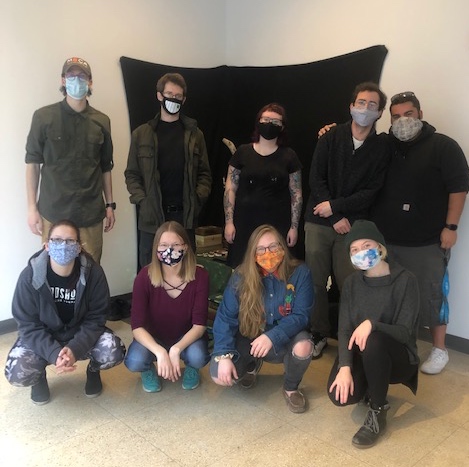
This is Part III of a blog post about the Masters in Arts and Teaching (MAT) students at Maine College of Art (MECA). Together with Part I and Part II you can get a snapshot of their program this fall. Students presented their work in an exhibit called “Getting There“, November 28 – December 7 at the college in Portland. The last two days of Maine Arts Ed blog posts include images from the show, their thoughts on visual art education, and their role as artists and future teachers. It also includes their successes and challenges, and their hopes for the future, post pandemic. I hope I am able to have a more personal conversation with this group of people in the near future. They have so much to offer, are is very articulate and thoughtful, and are bright lights during this dark time.
These MAT voices are strong and I’m sure you’ll agree with me that the future is in good hands. I’ve mentioned over the years how important our role is as educators to mentor, encourage and seek out the future teachers to insure that arts education continues moving forward to provide an excellent education for all students. Here is an opportunity for veteran teachers – read and listen carefully and if you’re inclined, reach out to these students.
In the Part I post there are examples of each students work. In Part II you can hear their voices and below are the responses to questions that I asked the students.
What do you see going on or what are you doing right now (in the midst of Covid) that is so dynamic and creative and alive that you hope doesn’t go away once Covid does?
Even though so much of education and the world is in a precarious state, the pandemic is helping me realize how important grounding learning with an arts education is for kids. I’m happy that there’s new energy being channeled into making education more accessible for everyone, and it’s amazing to be in a cohort of teacher candidates as we are all so eager to bring fresh perspectives to classrooms. ~ Philippa Grace, Massachusetts College of Art and Design, Sculpture, 2016
Education and healthcare seem to be never quite completely accessible. During the pandemic, when everything moved online, we evolved in creating tools of still allowing these things to happen and even flourish virtually. Though an end to the pandemic seems to be in the foreseeable future, I hope to see a continued mix of virtual and in person experience. It allows for more voice and choice. School and doctors are more accessible to those without cars through virtual platforms and if we made decent internet connection a necessity, we could be a lot more productive and connected from within our homes where we are most comfortable. ~ Audrey Robidoux, Maine College of Art
Oh gosh great question! I have caught myself noticing the present SO much more- the color of a meadow this fall after a recent rainfall, how this random lady sitting on a bench laughed exactly the same way that my roommate does, the soul settling experience of paddling in a canoe on a lake. I hope to maintain this awe of the moment, (and teach others to do the same!) once quarantining ends. ~Sophie Olmsted, Bates College, Lewison, Studio Art (ceramics), 2018
I don’t think I’m doing anything in my personal life that I hope continues after Covid. I do see a silver lining when it comes to my teaching practice. I was blessed enough to get a teaching job that both supplements my student teaching requirements and my wallet during this time. This type of experience would not have happened if it was not for the circumstances that we are in. ~Cooper Binette, Maine College of Art, Portland ME, BFA in painting 2020
Refining skills as an artist and a teacher is my life’s work. I am grateful for the time and opportunity to study at Maine College of Art even if we work remote. Allowing me to continue to create an enriching environment for Maine’s youth. It is during the epidemic that I am able to work harder than I ever have to make this a career. ~Seth Baron, Maine College of Art, BFA in Illustration 2020
I unfortunately don’t feel that I have achieved anything so dynamic or exciting that it is going to stick around post Covid. I have found myself feeling trapped inside, and uninspired/overwhelmed due to the stressful climate of my surroundings. One positive thing that has come out of the situation is that I have had a lot of time to sit and work inside of my sketchbook, something I usually do despite Covid times but it feels very accomplished to be able to sit and just draw for hours while being stuck inside. These sketchbooks will be reminders of this unexpected situation, and bring a sense of accomplishment to these hard times. I will then be able to share this experience with my future students, so I guess you could say there’s a small sliver of a silver lining there. ~Lauren Ashlee Anderson, Maine College of Art, BFA in Ceramics 2020
I am feeling so inspired by food right now and have been pouring all of my creative energy into cooking and baking. Since the pandemic began, my partner and I have started growing our own vegetables and herbs and have had a lot more time to experiment with new recipes. I never would have guessed I would be so excited about street corn or heirloom tomatoes! ~Madison Mahoney, University of Vermont, Burlington, VT, BA in Studio Art, 2019
Unfortunately as of right now, I don’t have any creative and dynamic practices that will stay with me post Covid. My ceramics practice was cut short due to Covid and I do not have the means to continue it right now. In all honesty, I hope for things to go back to a seminormal if/when Covid is gone. The silver lining for me is that I’m thankful to be in the Master’s of Art in Teaching program to become an art educator. I will be able to share my passion for art to students and hope to inspire them to achieve their dreams. ~Shelby Pyrzyk, Maine College of Art, BFA in Ceramics 2020
When Covid first hit back in March, I didn’t make any art for 4 months. I was newly unemployed, broke, and depressed. However, about a month before I moved to Maine from Kentucky, I started doing all these paintings of retro video game covers for my friends, and it helped me rejuvenate my creative confidence. Throughout the MAT program I have been able to keep doing these video game commissions for friends, on top of many other creative endeavors, and so I have been able to sustain that motivation to create, but it wasn’t easy. I think that being an artist during a pandemic has reminded me that there are always ups and downs, but art will always be there for me when I’m ready. ~Trent Redmon, Transylvania University, Lexington, KY, BA in Studio Art 2016
Storytelling is very important to my life and work as an artist. Traditionally, I tell my stories through comics and graphic novels. Since Covid, however, I’ve invested myself more in the creation of artifacts and life size set pieces from out of my fictional worlds. I’m hoping in the coming years I continue to expand on the idea of bringing the fictional into the real world. ~Sean Dillon, Eastern University 08-12, Exercise Science
What has it been like jumping from student to teacher while continue to nourish your own creative practices?
I audited a porcelain class taught by Cathy Hammond at MECA this fall. When I was a few years younger, I was so afraid of failure, but now that I’m learning about mindfulness and bringing our whole selves to the classroom, I was so eager to show Cathy my failures and ask her “what do I do now?!” I learned so much about the materials just by being in a classroom (albeit masked and distanced!) with BFA students at all levels, and Cathy was always willing to share her decades of ceramics teaching experience with us. It was so powerful to be able to fail in front of her and have that be an empowering experience of growth. ~Philippa Grace (favorite color: orange)
The journey from artist to teacher has expanded my perspective on the world. As a working artist, I often felt isolated, deeply buried in late studio nights and internal thought. I love to create but it wasn’t enough. I couldn’t invest every piece of myself into it. I felt as though it wasn’t a sustainable practice for myself or my well being. As much as I loved it, I needed something different, a different purpose. After four years of focusing on the art world, I felt the pull to come to the teaching program. Despite the pandemic, and the upheaval of the world around me, I knew that it was the right decision. ~Audrey Robidoux(favorite color: red)
I see the role of teacher and student as interchangeable hats- in one moment, I may have the teacher hat on, but I’m wearing the student one in the next. Flipping back and forth informs both experiences. I feel so lucky to be a student in my 800 studio class because it reminds me of the student experience- what it is like to not know what’s next, how uncomfortable it can be to not know, how to navigate teacher expectations and social interactions. The MAT program (so far) has been the perfect bridge between feeling mostly student to feeling mostly teacher (I plan to identify as a partial student for the rest of my life). ~Sophie Olmsted (favorite color: lavender)
Jumping straight from student to Teacher has been a crazy experience. I’ve had to strengthen my time management skills along with prioritizing my school and teaching over my personal practice without allowing it to fizzle out completely. ~Cooper Binette(favorite color:pastel purple)
Starting my practice of teaching has been an incredible new experience. New experiences such as meeting a group of students for the first time will continue to inspire my digital paintings. ~Seth Baron (favorite color: cyan)
Jumping from student to teacher while continuing to nourish my creative practices has been a big challenge for me. Coming out of quarantine to this program has to be the biggest challenge. My semester in undergrad was cut short due to Covid so all of my studio privileges unfortunately disappeared. I found myself in a creative slump with a lack of inspiring materials. I have worked my way out of the slump by creating awesome lesson plans for future students, and being able to create art while making lesson plans is exciting. I haven’t made much art for myself, but no matter what I still continue to doodle, work in my sketchbook, and pull from the world around me to inspire me. ~Lauren Ashlee Anderson(favorite color:terra cotta)
It has been a transition for sure. Some parts of teaching have come easy to me, while others have been harder to grasp. Jumping into teaching after months of uncertainty and quarantine felt like a huge change of pace. But luckily this cohort has been able to offer me amazing support. I’ll admit, at the start of this program I found myself neglecting my creative practice. That quickly shifted when we were given the opportunity to join a BFA class to continue our making. It felt amazing to be back in the studio and since I have gained back more of my creative energy that had been lost in quarantine. ~Madison Mahoney (favorite color: slate blue)
It has been interesting but I like the transition because I am able to apply my knowledge from when I was a student to what I am doing while teaching. It also has been helpful when creating lesson plans to have experience with some of the media. ~Shelby Pyrzyk(favorite color:teal or pink)
It has been challenging to say the least. It requires so much discipline and drive to be able to change gears from academic work, to studio work, and back and forth. It’s taken lots of perseverance. ~Trent Redmon (favorite color: red)
Teaching has gradually become a part of my practice as I’ve become closer with my audience. I started doing art tutorials and live streams for my following a few years ago and educating others has become just another hat I wear. ~Sean Dillon(favorite color:green)
Was there evidence of the teacher as artist or artist as teacher in the show?
Getting There is a time capsule of our cohort on the verge of student teaching with our mentors this winter, in the midst of this pandemic. We are all in different stages of discovering the balance of being a teacher and an artist (for me and some other peers, we have been out of school for a few years and are falling back in love with art and school–others are fresh out of their BFA programs). As we have grown together since August learning about art education, I am so grateful to be able to share this space as artists in our field as well. It is a potent reminder for me to never stop making–even as my creative practice shifts and changes, being an artist is what guides my teaching and grounds me. ~Philippa Grace (pronouns: she/they)
For my exhibit I created a sketchbook and a curriculum map, tying in all of the sketchbook prompts. It’s designed for high school students, based off a curriculum map that I dreamt up. High school education is a difficult experience in the current society, and art can teach the lifelong lessons of creative and critical thinking. Giving a young adult a sketchbook can awake a childhood passion that seemed lost and change their perspective on life. The sense of individuality that is born within a sketchbook can inspire. Art and creativity is what every student needs in this current world, where we have no idea what the next few years looks like, let alone the rest of our lives. I want to equip my students with skills that will stay with them no matter what path they take. And it takes an artist to teach these concepts. There really is an art to teaching. And I’m getting there. ~Audrey Robidoux(pronouns: she/hers)
Yes, absolutely. I made some jars using a technique on the wheel that I had never tried before (or even heard of!). I absolutely plan to make jars in this way again and to teach others to give it a try. The process served as a reminder that you can always learn new ways to do things and you can always teach students to keep looking for those ways of making that spark energy and intrigue. I plan to hold this experience of discovery with me as I step into my role as a teacher. ~Sophie Olmsted (pronouns: she/her)
I think there is evidence about the importance of the teacher as an artist in every piece in the shell. The artwork helps bridge the gap between what we are learning in class and what we are practicing in our studios. This information will only benefit our teaching practice. It will make all of our learnings more accessible to both the audience and the artist. ~Cooper Binette (pronouns: he/him)
The show contains an array of illustrations, paintings, ceramics and sculptures. All of which are created by some incredibly diverse perspectives inspired by pedagogy based readings and studies. I highly recommend everyone follow meca.mat on instagram to see all of the pieces from the show. ~Seth Baron (pronouns: he/him/his)
Getting There is a show depicting each of our individual journeys as artists and future educators. There is both evidence of teacher as artist, and artist as teacher. In my work specifically I have honed in on the idea of “Embracing being a novice”. My work displayed is a variety of new techniques I learned in my BFA class this semester called “The Sculptural Imagination”. As I am learning to be a teacher, I am still continuing to add new tools into my personal tool box that I will carry with me for the rest of my life. These new techniques are now some that I can share with my future students! Embracing being a novice not only means learning new things, but also means that I am learning things I can teach my students in the future. ~Lauren Ashlee Anderson(pronouns: she/hers)
Absolutely. In my work there is evidence of teacher as artist in the way I approach a new material; in this case, porcelain. For this exhibition I focused on play and embracing possibility in a medium that was brand new to me. As a painter, I primarily work 2D, but I wanted to get a feel for how my students might experience a 3D material. I was the only handbuilder in a class of wheel throwers and I wanted my pieces to reflect that. All of my pieces in this show are my firsts and many experiment with balance as well as glazes. ~Madison Mahoney (pronouns: she/her)
Our show Getting There is centered around us as both artists and future teachers. We were tasked with continuing or learning a form of art while being able to tie it back to what we are learning in our program. Many of us have highlighted that in the pieces of our work in the show. I feel this show is important to the program to show us that we can continue our art practices while still being teachers. ~Shelby Pyrzyk(pronouns: she/hers)
There is definitely evidence of that in our show. Just going around reading everyone’s artist statements is evidence that everyone put a ton of thought into what they made. Everyone’s perspective is so different, but all the work is still unified by our dual perspectives as both artists and teachers. ~Trent Redmon (pronouns: he/him/his)
It’s a subtle message, you really have to look into the details of my piece to decode the artist-teacher relationship. For me the piece is more of a physical waypoint in a mostly spiritual journey to become a teacher. ~Sean Dillon(pronouns: he/him)
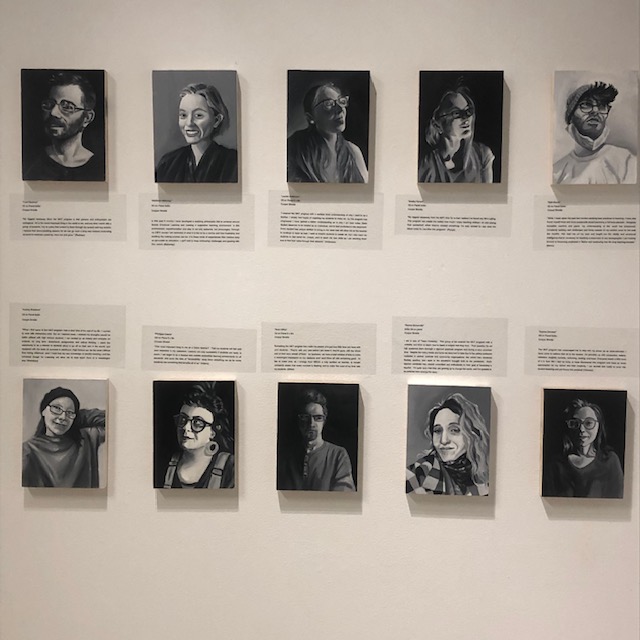
This is Part II of a blog post about the Masters in Arts and Teaching (MAT) students and along with Part I a snapshot of their program this fall at Maine College of Art (MECA). Students presented their work in an exhibit called Getting There, November 28 – December 7 at the college in Portland. Included in the exhibit was a piece that connects each artist and future teacher together. Called Team Awesome, artist Cooper Binette created ten 6×8 inch portraits, oil on panel, of each student. Included in the piece are statements from each of the ten. Their words, below, say it best.
Cooper Binette
Team Awesome
Cooper Binette
10 6 x 8in Oil on Panel
I’m getting there…
The journey from artist to teacher has changed my outlook on everything I thought I knew about the subjects. Through readings, guest speakers, field work, and our amazing community of teachers and students, we are all bettering ourselves and deepening our knowledge of the practice. The education system is designed to condition students out of their creativity and to discourage mistakes. The only way to combat this is for teachers to encourage exploration while fostering a safe environment where students can not only make a mistake, but learn from it and discover something new.
Through this MAT program, I have developed a completely new outlook on art as a whole. My art has always been inspired by a deep interest in the traditional academic style of painting. I was enveloped in the ideas of “mastery” and obsessed with learning different techniques to accomplish what I was trying to convey. These ideas and techniques work for some people, but I have found that each and every student learns differently. There are so many different tastes, styles, and students. The teacher has to have a wide variety of skills and knowledge to help foster an inclusive environment where all students can learn.
The teacher candidates I work alongside at Maine College of Art have such diverse and creative backgrounds. To capture this I painted each teacher candidate and had them concoct a paragraph describing where each individual is at in their studies. The Masters of Art for Teaching program has introduced me to many incredible new people and ideas. It is my hope that through our study of inclusivity and best practice we can reform not only the future of teaching, but the future of all of our students.
Trent Redmon
“My biggest takeaway from the MAT program is that passion and enthusiasm are contagious. Art is the most important thing in the world to me, and any time I work with a group of students, I try to make that evident to them through my speech and my actions. I believe that demonstrating passion for art can go such a long way towards motivating students to embrace creativity, have fun and grow.”
Seth Baron
“While I have spent the past few months studying best practices in teaching. I have also found myself more and more passionate about becoming a full time educator. Alongside incredible mentors and peers, my understanding of the world has broadened. Constantly tackling new challenges and living outside of my comfort zone for the past few months. Has kept me on my toes and taught me the vitality and emotional intelligence that is necessary for teaching a classroom of any demographic. I am looking forward to becoming employed in Maine and continuing this life long learning process.”
Lauren Anderson
“I entered the MAT program with a surface level understanding of why I want to be a teacher. I simply had hopes of inspiring my students to make art. As this program has progressed I have gained a better understanding as to why I am here today. Each student deserves to be treated as an individual, and to feel comforted in the classroom. Every student has unique abilities to bring to the table that will allow me as the teacher to continue to learn as well. I want to inspire students to create art, but I also want my students to feel cared for, unique, and to teach me new skills as I am teaching them how to find their voice through their artwork.”
Philippa Adams
“The most important thing to me as a future teacher? That my students will feel safe and respected in my classroom. Lessons are only successful if students are ready to learn. I am eager to be a teacher who creates accessible learning environments for all students, and turns the idea of “accessibility” away from something we do for some students into something that benefits all of us.”
Sean Dillon
“Something the MAT program has made me aware of is just how little time you have with your students. They’re with you, and before you know it, they’re gone, with the whole rest of their story ahead of them. As teachers, we have a brief window of time to make a meaningful impression on our students and send them off with something good. I’d like to make sure, as I emerge from MECA a fully certified art teacher, to remain constantly aware that every moment is fleeting and to make the most of my time with my students.”
Audrey Robidoux
“When I first came to the MAT program I had a clear idea of the rest of my life. I wanted to work with elementary kids. But as I learned more, I realized my strengths would be better utilized with high school students. I am excited by art history and complex art projects, by long term sketchbook assignments and critical thinking. I want the opportunity to be a mentor to students about to go off on their own in the world, and equipped with the tools to succeed in adulthood. High School can be the most difficult time during childhood, and I hope that my new knowledge of mindful teaching and the Universal Design for Learning will allow me to best teach them in a meaningful way.”
Shelby Pyrzyk
“My biggest takeaway from the MAT thus far is that I believe I’ve found my life’s calling. This program has made me realize how much I enjoy teaching children art and seeing their excitement when they’ve created something. I’m truly excited to see what the future holds for me after this program!”
Sophie Olmsted
“The MAT program has encouraged me to step into my power as an artist-educator. I have come to believe that art is the answer. Art provides us with connection, beauty, reflection, laughter, honesty, reckoning, healing, and hope. Everyone needs a little more of it in their life! I feel so lucky to have discovered this program and have so much appreciation for my cohort and their creativity. I am excited and ready to jump into student teaching and put theory into practice!”
Madison Mahoney
“In the past 5 months I have developed a teaching philosophy that is centered around Social Emotional Learning and creating a supportive learning environment. In this environment, experimentation and play is not only welcome, but encouraged. Through my BFA course I am reminded of what it is like to be a novice and how frustrating and exciting the making process can be. It is these kinds of experiences that I believe keep us grounded as educators. I can’t wait to keep embracing challenges and growing with this cohort.”
Rachel Somerville
Dr. Rachel Somerville is the Interim Program Chair of Art Education, Assistant Professor at MECA and works directly with each of the ten MAT students.
“I am in awe of ‘Team Amazing.’ This group of ten entered the MAT program with a curiosity and drive to learn how to teach a subject that they love. Their passion for art has sustained them through a rigorous graduate program and during a very uncertain time. Despite the many twists and turns we have had to take due to the safety protocols instituted in partner schools and community organizations; the cohort has remained flexible, positive, and open to the conditions brought forth by the pandemic. Each teacher candidate has remained committed and enthusiastic to their goal of becoming a teacher. I’m quite sure that they are gearing up to change the world, and I’m grateful to be pictured here among the stars. ”
Argy Nestor
Arts Educator, Blogger, Artist, Connector meartsed@gmail.com
https://sites.google.com/view/anestor/
Argy’s Blog
The purpose of this blog is to share stories about people and places; and to celebrate the amazing work (and play) that students, educators, and organizations are doing in and for arts education. In addition, the blog has a plethora of resources and innovative ideas. This forum gives blog readers the opportunity to learn from each other. It is essential that we listen, learn, and collaborate in order to build on teaching practices for the benefit of every learner in Maine and beyond.






 me arts ed