Archive for the ‘Opportunity’ Category

h1

Reflecting and Listening

January 15, 2022

Taking time to process and remember over time

A lot has been said about education and educators since the pandemic started in March of 2020. During the earlier months educators were the heroes. People began to realize the value of teachers. I read on a facebook post by a teacher this week that she wished to return to the early days of the pandemic when teachers were appreciated. When parents, especially parents, realized how challenging teaching is and how critical the teacher was to their child. We all know that doesn’t just refer to the ‘teaching’ part of a teachers day but the support teachers give to social and emotional learning, and so many other pieces that teachers teach individual students.

This morning I listened to a 6th grade student from Georgia on public radio say that her mother gave her a journal recently to document her stories of the pandemic. She only wished she had started writing at the beginning of the pandemic because she’s forgetting how she felt and what happened during those earlier days.

As we know time seems to race faster as the years go by. I’m sure some of you can relate to the 6th grader. Those of you that wear both hats – juggling teaching and parenting, in many cases, handled even more than usual.

What did you try during the early days of remoteness that you felt was a disaster and what actually turned into a success? In the spring of 2020 I remember gathering on zoom each morning with my middle schoolers for ‘breakfast club’. Students had a chance to connect with each other and their teachers. They ate, laughed, and connected in ways unmeasurable. It was optional but almost every student was there almost every day. It helped them to remember the importance of connecting and communicating in a ‘non-learning’ way. Let’s face it, we know how important it is for many to connect, not because we have to but because we want to.

Here are a few questions to help you sort your role as teachers during the pandemic. Answer the questions by writing or an art creation (movement, acting, musically, visual art, poetry):

  • What have you learned earlier in the pandemic that you continue to apply?
  • As things got turned on their head, what did you try that you found was successful or a complete failure?
  • What were the points in time that caused you to pivot?
  • Name what you felt when teachers were being referred to on a daily basis as ‘heroes’?
  • Make a list of what you want to remember from the pandemic as a teacher; the positives, and the challenges?
  • Select a quote that you can identify with in your role as a teacher. Make it large and post it (at home or at school) and use it as motivation and a remembrance that what you’re doing is amazing, every day!

Compile a list of quotes from the amazing work teachers are doing that are helpful in keeping your spirits up and remembering: whatever you’re doing is enough!! I can’t say that enough.

bell hooks, September 25, 1952 – December 15, 2021

As we start another calendar year and head towards two full years of living in a world-wide pandemic here are thoughts and what’s been learned from teacher leaders; on teaching, adapting, pivoting, and noticing students to help them do their best at learning.

A HUGE THANK YOU to Rob Westerberg, Anthony Lufkin, and Iva Damon for going above and beyond and sending their thoughts. Valuable information from Maine Arts Educators. You’re invited to share your thoughts. Please post at the bottom or email them to me at meartsed@gmail.com and I will update this post.

What are your ah-ha moments in teaching this year? What’s most important to you?

  • Two things have helped me pretty profoundly. The first is staying hyper organized. I tend to lean that way ordinarily, but by always staying a step or two ahead of everything that needs to be done, it has helped to relieve a LOT of stress and peripheral distractions from my school day and my interactions with classes/students. The other thing is treating each individual school day as its own mountain climb… I climb a different mountain every day. Consequently at the end of the day I feel a genuine sense of accomplishment. Some climbs are easy, others hard. But either way I leave school feeling very proud and, honestly, very happy. It has helped me keep my focus off of what I cannot control, and instead on the most important things in my professional life: the students. In some ways I already feel like 2021-2022 is the best professional self I have ever been. ~Rob
  • Students are so excited to be back in the classroom. It is why I love teaching. The privilege to provide the space to have students learn and explore what they are capable of doing is why I love going in every day. It’s also so important to remember to remember what is within one’s control and what isn’t. A new technique I learned was to think of oneself as a river, it’s okay to have things flow in, but allow them to continue to flow on and not hold onto what isn’t healthy or supportive to you.~Iva

Do you have any techniques/daily rituals/helpful hints for others that help you and your students focus?

  • Every start of every class, every day: I prompt the students to show me fingers, 5 means “I’m doing amazing”, 1 means “I shoulda stayed in bed…”. I look them over and it’s a conversation starter for me, reacting to what they are showing. If someone’s a 1 or a 2 I may ask, “School or stuff or both?” I certainly don’t need to know more than that, but even that response can lead to other discussions as a class (strategies for dealing with stress, compartmentalizing home stuff and school stuff, being a teenager in the 21st Century or even specific things). It also allows me to provide empathetic stories in my own experience if the situation fits. After we’ve done that, I have the class itinerary on the board, talk them through it, and off we go. The students have expressed directly to me how much they deeply appreciate this. They know it’s not just a quick tack on, that I truly care. EVERY teacher truly cares, but we don’t always have a platform to empathize in real time with our kids. This allows me to do so. It’s amazing how much this one piece – even over just a few minutes – centers and focuses my kids as we prepare to work together. For some the effect lasts the rest of their school day. It’s made a difference for me too. ~Rob
  • I have been using walks as a transition to class. We have been starting each class by doing a loop around the building outside. It has been a great opportunity to informally check-in with students, how their day is going, and makes for a more seamless transition for class to begin when we return inside. ~Iva
  • The structure of my art classes has changed a lot for me over time, significantly with the adaptations need to cope with the pandemic, but also as I develop a better understanding of learning processes, and gain more experience teaching art.  Creating a studio mindset is something that I have worked to achieve, while still maintaining the structural instructional practices needed to develop new skills and understanding.

Working at the elementary level, time is always an issue with one of the biggest inhibitors I have found being the way schedules are set up. Because of the limited time available, I have really had to focus on what is important, and what can be discarded. There are a few strategies that I have implemented that while I had concerns about them taking away from instructional or production time at first, I have found to be invaluable.  

One process that a colleague shared with me is something called a “silent doodle”. This is a little piece of paper on the student’s desk when them come it that they “warm up” with when they first some into class.  The primary reason for implementing this was to help them settle in after a transition, and give me time to get things ready (especially when I did have not time between classes). What I have found though, is that this becomes an amazing creative outlet, and a form of reflection where they often draw images using the skills we have worked on in class. We only spend 2-3 minutes on this, and so while it takes that time, when they are done, they are ready for instruction and creation.  

Another process I have implemented in many classes that I got from some of the collaborative projects I have done with the Farnsworth Art Museum Educational Program, is a quick noticing activity using visual thinking skills. We do what we call an I see…I think… I wonder critique of an artwork. A few times a week at the beginning of class I portray an artwork, sometimes relevant to our project but often not, that we spend a few minutes looking at. I have students raise their hands to tell me what they see in the picture, things like colors, shapes, objects, etc. I then ask for what they think the art work is supposed to show or mean, or why it was created based on those observations. Finally, I ask what else they wonder about the artwork based on what they have seen and what they think. I usually fill them in with a little information about the art and artist, but it is brief, intended to help them realize that there are not always answers to some of those questions. This again takes a few minutes, usually 5 minutes or so, but has created the framework for looking more critically at art, and developing ways to talk about one another’s work using effective constructive criticism. 

The speed of which  I go through instructions, and the modeling of techniques are also significant components to giving students adequate time to work on their projects. Having lots of examples including student examples in progress and completed are also key contributors to helping students understand the steps and processes we are working on. One of the areas I struggle with is giving students the opportunity to “complete” projects. I have the mind set of ‘process over product’, focusing on giving them as many opportunities to try new techniques and mediums as possible. I understand that this can be very frustrating for students who are more methodical in their approach so that balance between finishing and moving on is one I am constantly adjusting.  

While there are many other small factors in my teaching approach that contribute to my teaching “style”, one of the other structural features I have been trying to incorporate more is the use of choice for students. While some of them are adaptive choices, many of them are simply an alternative. For example, I have had a 3D printer donated to our program by the Perloff Family, and have been using some cad programming in my projects. Giving students the option of using 3D printing versus clay, allows those with tactile discomfort, the opportunity to express their ideas in a different form. I still make sure they experience the nature of clay in other projects, but by having some choice, even with miniscule differences, has made a big difference in student motivation. ~Anthony

Now that we’re in the second year of the pandemic; please share what you’ve noticed about students and how they’re adapting to the challenges?

  • My students have never been more grateful for the things we often took for granted pre-pandemic. There is an excitement around rehearsals and classes that is almost tangible, because the kids really missed it. They are struggling too… back in school full time, singing with masks on, social/emotional issues that continue from this past year, but their gratitude seems more overt and embedded in what they do in my classes. I think that gratitude has helped them to move forward even as it remains a challenge. ~Rob
  • They need space to talk through their concerns, hopes, and have adult models to help them establish healthy tools to cope with their new world they are a part of. Students are the most resilient and have been able to bounce with the extreme changes that keep coming their way, but time to stop and reflect is so very important. ~Iva
h1

Glassblowing in Belfast

December 1, 2021

Blowing glass is magic – ask anyone that’s done it!

Waterfall Arts in Belfast realized that they had a unique opportunity offered to them during the pandemic. But they faced many challenges just trying to get the idea off the ground. With a positive attitude and a new partnership their journey is already making a huge impact. This is the story of how that came about and a reminder of the importance of commitment, collaboration, and believing in an idea! Without these in place the dream would not reach fruition. And, it’s only at the beginning! I recognize and celebrate Waterfall Arts and their new partnership and what they’re providing for learners of all ages, especially local high school students.

PLEASE NOTE: At the end of this post I invite you to leave a comment and/or to use the questions for a local conversation.

BACKGROUND

Veteran glass blower David Jacobson realized his well established glass blowing business, Jacobson Glass Studio in Montville, was at a crossroads when the pandemic hit. In September 2020 David approached Waterfall Arts and spoke to Executive Director Kim Fleming about donating his glass studio equipment to Waterfall. Realizing what an opportunity this was Kim enthusiastically consulted with the Waterfall board. They agreed and collaborated with David and his glass blowing colleague Carmi Katsir to transform the Waterfall Arts basement into a glass studio.

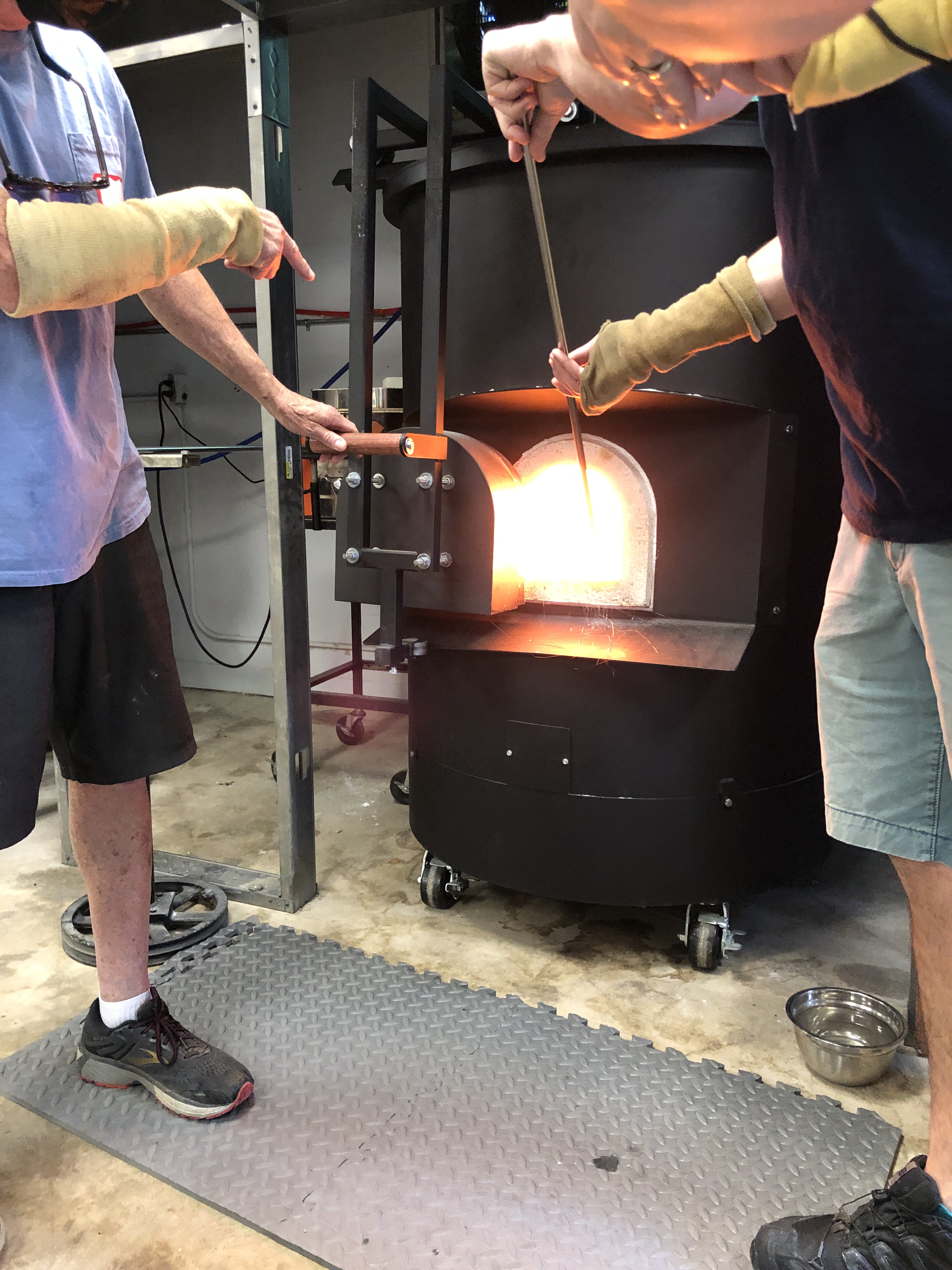
David and Carmi demonstrating

THE STORY

When I listened to their story I was amazed how quickly things happened. David first communicated with Kim in the middle of September 2020 and during the first week in October the equipment was moved into the building. In the spirit of true artists they climbed over the logs in their pathway to problem solve, research, ask questions and learn, and find ways to attack the challenges. Combined with hours and hours of work, physical and mental, and financial support from funders and the greater community they opened the studio with a variety of purposes in mind.

Before they could open the studio there were many details to figure out besides just putting equipment in place. Investing money in this project was an enormous commitment. Kim secured funding from individuals and foundations including $10,000 to be used for disadvantaged students. The budget to run the program for two semesters is $25,000. One of the bigger hurdles was how to fuel the furnace that holds 100 pounds of clear, liquid glass and is kept at about 2,100 degrees. Plus the two forges that are used to heat up the glass as a piece is being formed and is kept at 2,300 degrees. Waterfall’s philosophy includes a commitment to be as green and as carbon-neutral as possible. So using natural gas or propane was not feasible. They researched to learn how they could build the system using discarded vegetable oil that is donated by a local donut shop. There are no models in Maine so it meant communicating with people outside of the state. They also learned that along with being the only community based glass studio in Maine they are only one of a handful of programs in the entire country that offer glass classes through the public school for students.

Miles opening the glass

WATERFALL ARTS STUDIOS

Waterfall Arts ceramics, printmaking, and photography studios are well established at the non-profit organization. Adding a glass studio was an easy decision but with filled with unknowns. Kim was able to acquire funding to purchase what they needed and build on the equipment and tools that David was providing to make a studio large enough for several people. David really wants to share his love for glass blowing with as many people as possible. So there are classes available to anyone from almost any age, no matter what their financial situation. David’s passion coupled with Waterfall’s goal of reaching others, who have not had this type of opportunity in the past, is a perfect marriage. It wasn’t long after the studio was set up that they began offering classes to individuals and groups. During the summer many people took advantage of the studio.

MAINE ART EDUCATION ASSOCIATION FALL CONFERENCE

I had the privilege in September to participate in the Maine Art Education Association (MAEA) conference. Hats off to this year’s conference planners Brooke Holland and Anthony Lufkin who shifted from the traditional conference at Haystack Mountain School of Crafts, due to the pandemic, and planned sessions in 12 studios across the state. I was in the glass studio at Waterfall Arts and it was a spectacular and fun experience. I was so impressed with the teaching of David and Carmi. I had only one previous glass blowing experience and this was quite different and extensive compared to that one. Our abilities varied greatly and yet the participants easily collaborated and supported each other making four pieces during the 2-day workshop.

Collaborating to open the top of the glass to form the shape

WATERFALL ARTS’ STORY, PURPOSE AND MISSION

To create community in harmony with nature through the transformative power of the arts. When the founding group of Waterfall Arts formed the idea in 2000 their shared goals for the future: to create aesthetic experiences that enhance and inspire people’s creative abilities and transform their lives. An equally important goal was to reach people who had not had such opportunities before.

Along with the studios used for classes and by individuals Waterfall has 16 private studios which are fully occupied at this time. During the pandemic it was difficult for some of the artists to pay rent. Waterfall was able to support these artists by waiving 2 months of rent. An amazing gesture to support individuals who needed it most.

In addition, Waterfall Arts has a variety of ongoing programs and events that are available year round. I suggest you spend some time on their WEBSITE.

Gathering glass

BELFAST AREA HIGH SCHOOL CLASS

In January 2021 the principal, Jeff Lovejoy, contacted Kim to learn what might be available for Belfast Area High School students to take for a semester long elective class. The high school building is a stone’s throw, across the road from Waterfall, so the outreach from school is a no-brainer. Mr. Lovejoy visited Waterfall for a walk through and discuss possibilities. He got excited about the glass lab. Kim put together a budget proposal to run a semester long class, twice a year. Kim scurried to secure funding in time to promote the class for the fall semester.

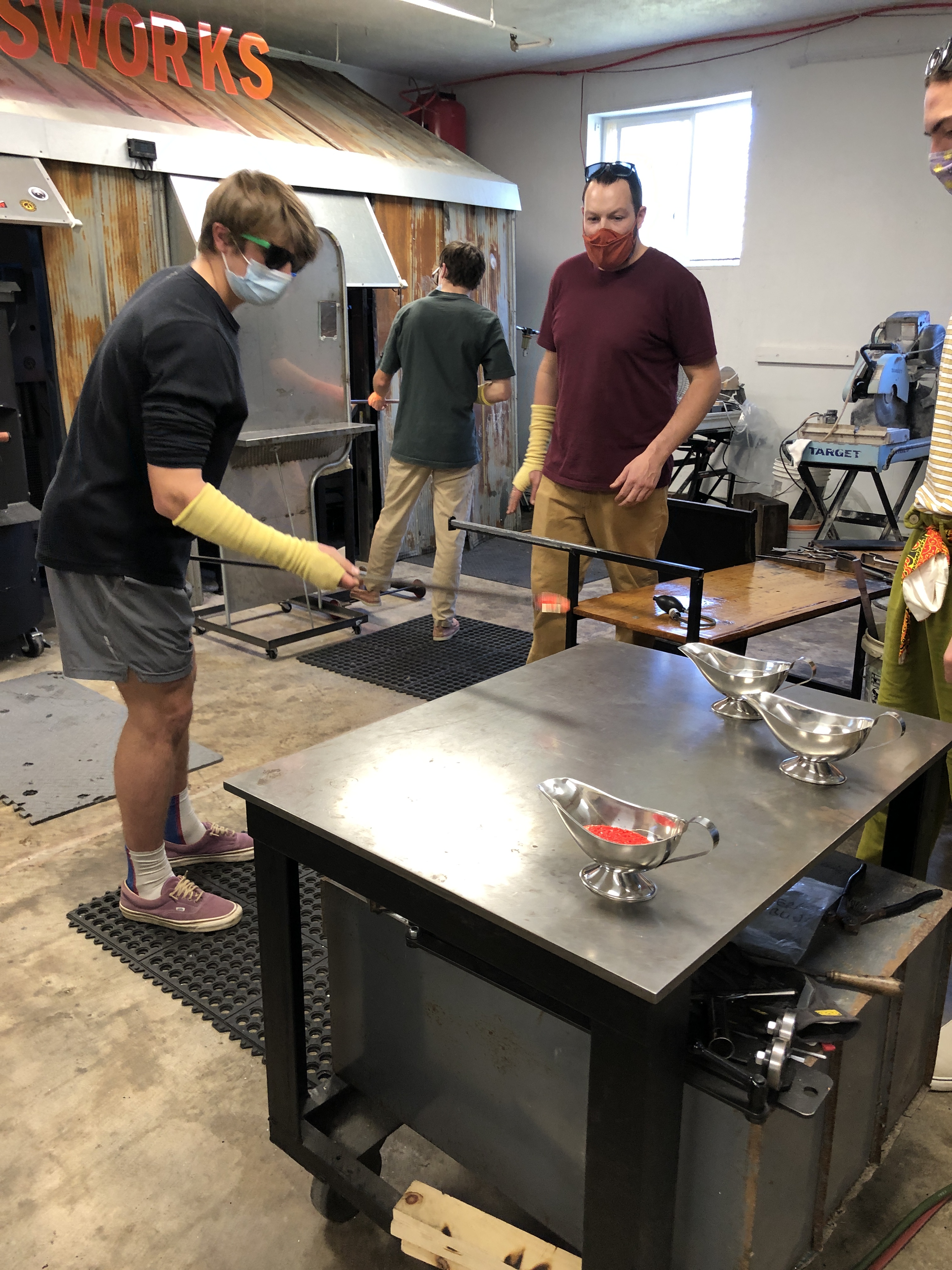
Jonah rolling the glass on the marver

PROCESS

There are not a lot of tools needed for the process of glass blowing. Steel rods are kept warm and dipped into the molten glass which sticks to the metal when ‘gathered’. The ‘gather’ is rolled on a thick steel table called a ‘marver’. Color can be added by rolling the clear glass in pieces of colored glass on the marver and put into the forge to keep it hot enough to manipulate. The entire time the rod is being rotated. The next step includes sitting at a wooden bench where the liquid can be shaped sometimes with a wooden paddle, a wooden cup with a handle, shears and/or tweezers. Several times in between forming the piece it is put back into the forge to maintain the heat. When completed it is taken off the rod with a bit of water to break the seal and a tap on the rod. The entire process is magical to do and to watch.  

CLASS BENEFICIARIES

I had the chance to visit the high school class, watch David and Carmi teach, and have conversations with some of the six students enrolled for the weekly semester class. In a word the entire experience for me was IMPRESSIVE. I’m sure some of my response is based on my 2-day class in September. Part of it is based on the ease with which the seniors handled the glass and navigated the tools and space. And, a lot of it comes from the teaching and collaborative spirit of the classroom/studio culture. We know that a teacher sets the tone and David and Carmi are TOP NOTCH! The students were serious about their work while having fun. I could see their confidence growing as they went through the process. Mr. Lovejoy said: “I am thrilled that Waterfall Arts, Carmi and David have been so accommodating to make this work for Belfast Area High School. I am excited to bring students from the Belfast Community Outreach Program in Education (BCOPE, the school districts community based alternative educational program) and underclassmen into the spring semester starting in February”.

Paddling the base to flatten it

STUDENTS COMMENTS

Ronin: “I was surprised on day 1 how we jumped right into the process even without any previous experience.”

Anna: “There is so much collaboration, that is a surprise. Each class has a different goal but we’re learning techniques that I didn’t realize I would use again and again. Like the ‘starter bulb’ we learned our first week while making pumpkins. I use it every class.”

Miles: “Everybody should do glassblowing – it’s awesome. It’s less scary than I thought it would be.” Miles is only applying at colleges that offer glassblowing.

The workspace with tools

DAVID AND CARMI

I’m impressed with the level of teaching. Many successful artists are not good at teaching. David and Carmi are successful at both. Watching them in action with the high schoolers is magic. They’ve been pleased and/or surprised about the following:

  • every week the students are enthusiastic about learning
  • student team work is amazing – they’re very generous and helpful to each other
  • very dedicated
  • we communicate with them like we would with adults
  • thought they would be more ‘product’ oriented, instead they are ‘process’ focused
  • 2 hours is not enough, extended class time to 3 hours for those who can stay longer and they all do
  • students are fearless

David and Carmi will make some changes for the next semester based on what they’re learning this first semester with and from the six seniors. Like any good teacher this information will help them build and expand on the program for the future. Between the dedicated staff and the establishment of this new program I’m certain we’re going to hear about this fantastic Waterfall program for many years. Kim is working to make Waterfall Arts everybody’s place, a destination. Not just through programs but also taking care of the maintenance on the building. The capital campaign has raised funding to replace the roof, re-surface the parking lot, and plans to replace 72 of the buildings windows. The glass studio expands Waterfall’s creative involvement. Kim said: “People want to be part of something successful. Our future is bright.”

Glass with a pinched handle

ARE YOU CURIOUS?

Perhaps you’re one of those people who would like to become part of something successful or you’re curious. If so, be sure and plan a trip to Waterfall Arts. If you’re interested in learning more about how you can get involved, take a class or perhaps give someone a unique gift of a 2-hour class for the holiday please go to Waterfall’s website at THIS LINK. If you’re interested in supporting the program please contact Kim Fleming at kim@waterfallarts.org.

FOLLOW-UP QUESTIONS for you to ponder, discuss with your own community, use as a starting place for a conversation to start doing work (or play) differently or by responding to the blog below in the section called ‘Leave a comment‘ or Like this post.

  • Why are the Belfast High School seniors so successful?
  • What makes this collaboration with Waterfall Arts, Belfast High School, and the glass studio so beneficial?
  • What are some ideas to make this into an interdisciplinary unit in the school curriculum with perhaps Art, Science, Writing?
  • Is there a potential partnership brewing in your community? What can you learn from the glass studio at Waterfall that might help in your partnership?
  • What are you already doing in your own work (or play) that mirror success?

h1

Cultural Alliance of Maine

June 30, 2021

Born during the pandemic

I’ve been reflecting on the many silver linings of the pandemic lately – not to look back and feel sad but to look forward and encouraged. Collectively there are so many and ones that we can learn from to help form our future work and play.

The Cultural Alliance of Maine (CAM) pilot project was established during the pandemic which starkly illuminated that Maine lacks structures to enable the cultural sector to learn, organize, and act as a unified statewide community .

Leaders from across the state, representing diverse nonprofit cultural organizations, came together to establish this alliance to:

  • explore models to address infrastructure gaps long-term
  • advocate for solutions to the unique challenges facing the sector now, and 
  • create pathways for ongoing peer-to-peer learning and information exchange. 

With generous support from The Onion Foundation, Morton-Kelly Charitable Trust, Virginia  Hodgkins Somers Foundation, and Libra Foundation, CAM hired Carla Pugliese as the Pilot Project Director to lead the work of convening stakeholders, assessing needs, researching comparable sector-wide alliances, building bridges with state government and other sectors, and determining next steps following the pilot project period.

CAM represents their members’ interests. Carla said: “We are collectivizing the cultural voice so there is more power at the State House, at the federal level and at the local level for the cultural sector. The pandemic shed light on the need for this type of organization but Carla also said: “the Cultural Alliance of Maine “is not a pandemic response. It is about building something that is useful and valuable and rich for many, many years going forward.”

Arts organizations are represented in CAM but also included are historical societies, libraries, and both for-profit and nonprofit entities such as galleries, theaters and museums, as well as individual artists and makers. “The attempt to bring together such an encompassing umbrella organization is a first”, Carla said.

To learn more CLICK HERE and read Carla’s letter to the cultural sector which provides the plan for the pilot.

To sign up for the monthly newsletter to hear ongoing news CLICK HERE.

Carla Pugliese, Cultural Alliance of Maine Director

Steering Committee

  • Mark Bessire, Portland Museum of Art
  • Steve Bromage, Maine Historical Society
  • Shoni Currier, Bates Dance Festival
  • Ben Fowlie, Points North Institute & Camden International Film Festival
  • Hugh French, Tides Institute
  • David Greenham, Maine Arts Commission
  • Sarah Hansen, Greater Portland Landmarks
  • Stuart Kestenbaum, Maine State Poet Laureate & Monson Arts
  • Monica Kelly,  Bay Chamber Concerts
  • Nat May, Onion Foundation
  • Daniel Minter, Indigo Arts Alliance
  • Linda Nelson, Portland Ovations
  • Chris Newell, Abbe Museum
  • Bari Newport, Penobscot Theatre Company
  • James Ritter, Maine State Library
  • Abbe Levin, Maine Office of Tourism – Contractor
  • Molly O’Connell, Maine Association of Nonprofits – Liaison
h1

Maine Bicentennial Parade

June 22, 2021

August 21, 2021

The State of Maine Bicentennial Parade presented by Poland Spring, is back on, now scheduled for Saturday, August 21, 2021, in Lewiston and Auburn.

This statewide parade will feature an intergenerational marching band, under the direction of John Neal, and we are hopeful that you will pass this invitation to participate along to your band members and any others you know in Maine who have musical talent. We would love to have horns, woodwinds and percussion performers from all across our great State.

We are also eager to welcome other full bands, whether marching or on a float, to participate in the parade, if your group is interested in performing as an individual unit. Please visit our webpage, www.Maine200Parade.com for all the information and the participation form.

Sign-up is open through the end of June for both the parade and the band. Rehearsal information, music and other details are posted at https://www.maine200parade.com/bicentennial-band.

Please do not hesitate to get in touch if you have any questions and thank you for helping to spread the word about the opportunity to participate in this historic event. We are on social media at @OfficialME200 if you could also please share our posts about the parade with your members/students.

If you have questions please contact Kristen Muszynski, director of communications, Maine Department of the Secretary of State at  Kristen.Muszynski@maine.gov

h1

APPLY now!

June 21, 2021

Deadline tomorrow for MAEPL

Curious about the Maine Arts Commission (MAC) program, Maine Arts Education Partners in Leadership (MAEPL)? Wonder why you should consider applying? Listen to arts educator and veteran MAEPL Teacher Leader Charlie Johnson at THIS LINK explain his reasons and the benefits that he’s experienced during his ten years of participation!

DEADLINE TO APPLY IS TOMORROW, JUNE 22, 2021! DON’T DELAY!

DETAILS – THIS LINK

APPLICATION – THIS LINK

DOWNLOAD THE BROCHURE that contains all the information you need!

h1

JuneTeenth

June 19, 2021

Resources

Even though school is over for students and teachers in most PreK-12 schools across the country there are still plenty of reasons to take a look at to understand and recognize JuneTeenth. Gettingsmart.com has put together at thread of resources on twitter. Below are two youtube cartoon videos that explains what JuneTeenth is all about. If you don’t know you can learn what state actually has made Juneteenth a state holiday.

h1

Great Opportunity

June 18, 2021

What are you doing July 27-28?

Interested in getting together with other Maine Arts Educators and Teaching Artists? Learn more about Maine Arts Education Partners in Leadership (MAEPL) and consider applying to attend the summer institute and become a Teacher Leader or Teaching Artist Leader for the 2021-22 school year.

At the Summer Institute new Teacher Leaders and Teaching Artist Leaders will learn foundational practices in instructional design and leadership skills. Participants will take part in a variety of workshops focused on emerging needs in Arts Education professional development.  

Collaboration, networking, and the sharing of resources are an expectation as a member of the MAEPL community.  During the Institute participants will develop an individualized growth plan that will be shared with others for feedback and suggestions.  

Throughout the school year, participants will continue to share how their individualized growth plan is developed and implemented, and they will have the opportunity to share at a Critical Friends Day, and with a thought partner.        

There is a Winter Retreat with participants to review and reflect on the work done, and allow for time to get feedback to plan for the next Summer Institute.  

Listen to Teacher Leader Kris Bisson talk about her experiences being involved with MAEPL

Teacher Leader/Teaching Artist Leader Annual Expectations: 

  • Attend Summer Institute 
  • Work with a thought partner 
  • Develop a individualized growth plan 
  • Share the outcomes of your individual growth plan within the MAEPL community and beyond (i.e. workshop, resource, video, article, etc.) 
  • Share feedback and information about MAEPL through teacher leader stories and as part of your outcomes of your personal growth plan 
  • Collaborate, network, and share resources 
  • Participate in Critical Friend Day 
  • Attend Winter Retreat

Teacher Leader/Teaching Artist Leader Opportunities: 

  • Membership in the vibrant MAEPL community
  • Access to online resources 
  • Learn/Experience creative activities together 
  • Collaboratively develop educational resources 
  • Establish and work toward an individualized growth plan
  • Take on leadership and facilitator roles in MAEPL, Arts Organizations, and school communities 
  • Connect and make long-lasting relationships with other arts educators  
  • Network across diverse arts disciplines 
  • Access cutting edge professional development for emerging needs of our students and leaders within the arts educational community and beyond
  • Learn from experienced leaders 
  • Gain recertification hours 
  • Partner with the Maine Arts Commission Arts Education Program 

JOIN US!  Become a Teacher Leader and Change Lives.  

APPLY TODAY — CLICK HERE  June 22, 2021 deadline for new and returning applicants

IMPORTANT THINGS TO KNOW: 

SUMMER INSTITUTE

Pilgrim Lodge is a camp run by the United Church of Christ of Maine on Lake Cobbosseecontee in West Gardiner, with cabins with electricity and plumbing, large indoor and outdoor meeting spaces, modern dining facilities, wifi in main buildings and good general cell reception, and recreation options, including swimming, human-powered boating, and trails.  

APPLICATION

Administrator Name/contact information

Paragraph of Interest — Selected individuals will be expected to be active leaders in helping to develop and support excellence in teaching and learning in Maine. A full commitment to the Institute timeline is expected as seen in the online information sheet.  Please attach a brief overview of your interest and current/past experience (if any) in Leadership. Include your experience collaborating with other arts educators and experiences relevant to the initiative.  (Please no more than ~ 500 words, about 1 page.) 

Resume/CV —  If you are a Teaching Artist, please also include websites or documentation of your teaching work.  

Letter of Reference – TEACHERS: This should be from your administrator.  TEACHING ARTISTS: This should be from a school or community  organization with whom you have worked.   Please attach a Letter of Recommendation in which the person includes comments and/or examples reflecting your leadership potential and your ability to work collaboratively.  Selected individuals will be responsible for sharing their newly developed expertise and related classroom experiences with other arts educators.

Questions? Contact Maine Arts Commission Director of Education, Martha Piscuskas at Martha.Piscuskas@maine.gov.

h1

TED-Ed Student Talks

June 17, 2021

Deadline – July 15

Interested in bringing TED-Ed Student Talks to your classroom or school next year? You have until July 15th to apply!

The standards-aligned TED-Ed Student Talks Program supports students as they discover, explore and present their big ideas in the form of short, TED-style talks. If you’re an educator at a school or educational organization, apply to receive our free program resources and step-by-step instructions in time for next semester. Don’t miss this window!

What is the Student Talks Program?

  • A curriculum to help your students develop their best ideas.
  • A space to amplify students’ ideas around the world.
  • A program that connects students with other groups around the world.

There are two more application cycles this year.

Application cycle 2:

Opens on April 1 and closes on July 15. Applications submitted during this cycle will receive approval on August 1.

Application cycle 3:

Opens on August 1 and closes on November 8. Applications submitted during this cycle will receive approval on December 1.

Click here for the Information Packet. Click here to apply. This program is underway isn 130 countries around the world. Seems like a great way to connect your students with others.

h1

MAEPL

June 16, 2021

You’re invited

Join us for a GREAT opportunity!

Now in its 10th year, The Maine Arts Education Partners in Leadership invites YOU, with other selected Maine visual and performing arts teachers and teaching artists, to be part of a year-long exploration in leading your school communities and the profession in effective teaching and learning in the arts.  If you are selected, you will be expected to attend the 2021 Summer Institute, taking place in person July 26-28 at Pilgrim Lodge on Cobbosseecontee Lake in West Gardiner.  Themes of this year’s Institute are: Reflection & Renewal ~ Sharing Successes ~ Partnerships ~ Individualized Goal-Setting.  

2021-22 Deadline Application – June 22

If you are selected, there is no cost to attend the Institute; however the expectation is that you integrate your learnings in your classroom, your school community, and share with other educators in your region of Maine and beyond.  Full participants will receive documentation of contact hours. 

MAEPL PURPOSE 

The Maine Arts Education Partners in Leadership (MAEPL) is committed to developing and promoting high quality arts education for all. MAEPL operates on the premise of “teachers teaching teachers.” All of our design teams, institutes, and professional development opportunities offer/encourage collaboration.

If interested, please complete the online application form by June 22.

Returning? Complete THIS FORM  by June 22. 

Questions? Contact Martha Piscuskas, Director of Arts Education at the Maine Arts Commission, Martha.Piscuskas@maine.gov  207-287-2750

For more information ….

FLYER – CLICK HERE

MORE DETAILS – CLICK HERE

APPLICATION FORM – CLICK HERE

Listen to a message from Martha Piscuskas at THIS LINK.

h1

Summer Learning

June 15, 2021

Opportunities, deep and deeper

I know that considering learning opportunities for the summer may be the last thing you wish to do after such a challenging year. Thankfully there are a variety of learning opportunities happening this summer that put your emotional needs at the top of the list. Perhaps one of the resources below will fit your needs. Don’t hesitate – dated information!

Maine Arts Education Partnership in Leadership – MAEPL is offering a summer institute, July 27 and 28, Pilgrim Lodge Retreat Center, Lake Cobbosseecontee, W. Gardiner. DEADLINE to apply: JUNE 15. Join MAEPL for Reflection & Renewal, Partnering, and Individualized Goal Setting. If you are selected you will be part of the 2021 cohort and the expectation is that you integrate your learnings in your classroom, your school community, and share with other educators in your region of Maine and beyond. Full participants will receive documentation of contact hours. There is no cost to participate in this yearlong teacher leadership program, including the 2-day Institute.

Maine Art Education Association – Summer retreat at Pilgrim Lodge, August 2-5, Lake Cobbosseecontee, W. Gardiner. Indoor and outdoor spaces to create art in a beautiful uninterrupted environment. The waterfront includes a large swimming area with kayaks, canoes, prams, and access to an island. Trails to get away from it all and a large woodland labyrinth to walk when you need to do some deep thinking. All meals and lodging, use of facility for $220. REGISTRATION OPENED YESTERDAY! You must be a member to attend.

New England Institute for Teacher Education – Earn 4.5 CEUs (the equivalent of 45 contact hours) for recertification. All courses are accepted by the Maine Department of Education.

Confronting Racism in America – starting JUNE 21

Starting JULY 5

Engaging Digital Learners

Google Suite 101 for Educators

Promoting Social & Emotional Learning 

Educating Gifted and Talented Learners

Encountering the Arts: Voice, Choice and Creativity

Engaging Literature for Children and Adolescents K-12

When Trauma Comes to School

Best Practices in Teaching Literacy

Teaching Children of Poverty: Why Culture Counts

Black Authors Matter

Teaching the Exceptional Child in the Regular Classroom

Introduction to Education for Paraprofessionals

Managing Classroom Behavior

The Art of Education University – Perhaps you’d like to work totally independently this summer. The Art of Ed offers a ton of resources for you to do just that. Here are some of the readings/podcasts that you can access. Perhaps make yourself a schedule and tackle one topic a week. They have many more on their website.

10 Art Teachers Reflect on a Year of Challenges and New Opportunities

Why We Need SEL Right Now

5 Effortless Adaptive Art Strategies That Won’t Compromise Your Curriculum