Archive for the ‘Research’ Category

h1

Music Ed and Neuroscience

July 16, 2013

Webinar: July 25, 3:30

For immediate release
July 12, 2013

Music education and neuroscience take center stage at the latest public webinar from the NEA Interagency Task Force on the Arts and Human Development

You are invited to a live, public webinar on Thursday, July 25, 2013 from 3:30 pm until 4:30 pm ET.

As part of a growing body of research on arts and brain function, music research has many people listening.  Neuroscience  has helped to demonstrate the work of innovative music-education programs around the country.  One such program, Harmony Project –http://www.harmony-project.org, is an award-winning organization that  provides research-based music education to at-risk youth in Los Angeles, California.

For two decades, neurobiologist Nina Kraus has pioneered multidisciplinary research on how music affects brain function across the lifespan. Dr. Kraus, principal investigator at the Auditory Neuroscience Lab – http://www.soc.northwestern.edu/brainvolts/at Northwestern University, will share her latest findings on music learning and brain development as they relate to Harmony Project.

This is the latest public webinar hosted by the NEA Interagency Task Force on the Arts and Human Development – http://www.arts.gov/national/TaskForce/index.html, an alliance of 17 federal departments, agencies, divisions, and offices that encourage more and better research on how the arts help people reach their full potential at all stages of life.

The NEA and the Interagency Task Force periodically host public webinars to share compelling research, practices, and/or funding opportunities for research in the arts and human development. Task Force members include representatives from the U.S. Department of Health and Human Services, the National Institutes of Health, the National Science Foundation, the U.S. Department of Education, the U.S. Department of Veterans Affairs, Walter Reed National Military Medical Center, and other agencies and departments.

Guests and speakers:

  • Jerry Kyle, Management & Program Analyst, Professional Development for Arts Educators  Program Officer, U.S. Department of Education
  • Margaret Martin, Founder, Harmony Project
  • Nina Kraus, Hugh Knowles Professor and Principal Investigator, Auditory Neuroscience Lab, Northwestern University

Sunil Iyengar, Director of Research & Analysis, NEA, will
moderate the webinar

To join the webinar

The webinar takes place on Thursday, July 25, 2013, 3:30 pm – 4:30 pm ET. It is free and open to the public. Please register in advance  – http://cirrus.mail-list.com/necap/19319081.html Media may RSVP to Sally Gifford, NEA Public Affairs Specialist at giffords@arts.gov.

You may listen using your computer’s speakers or dial-in to 1-877-685-5350 and use participant code: 739587. Attendees will be muted but able to type in questions and comments through a text Q&A box.  Please note, a video  will be featured during the presentation, the audio will be available only via computer.

Follow us on Twitter as we live-tweet this webinar @NEAarts, hashtag
#NEAtaskforce.

An archive of the webinar will be available at http://www.arts.gov/podweb/webinars.html
h1

Turnaround Arts

July 11, 2013

President’s Initiative

Screen shot 2013-07-01 at 7.16.33 AM

I wrote about the series on NPR that includes the Turnaround Arts Initiative and finally had a minute to go to their website. Very good information there, that I recommend taking a close look at. The following information is taken (just a part) from the Turnaround Arts website at http://turnaroundarts.pcah.gov/.

The President’s Committee Turnaround Arts Initiative was created by the U.S. Department of Education and the White House Domestic Policy Council. The partnership was designed to help transform some of the nation’s lowest performing schools through comprehensive and integrated arts education. Developed from the recommendations in PCAH’s recent report Reinvesting in Arts Education: Winning America’s Future Through Creative Schools, the Committee’s landmark research publication of May 2011, Turnaround Arts will test the hypothesis that high-quality and integrated arts education can be an effective tool to strengthen school reform efforts-boosting academic achievement and increasing student motivation in schools facing some of the toughest educational challenges in the country.

Screen shot 2013-07-01 at 7.16.10 AM

The first federal study of research data on the effectiveness of arts education in over a decade, Reinvesting in Arts Education: Winning America’s Future through Creative Schools (May 2011) analyzed the challenges and opportunities in arts education in America. Turnaround Arts puts into practice several of the recommendations in the report, including using arts education as a powerful tool for whole school reform in high poverty, low-performing schools, and the need for a wider range of evidence on its impact.

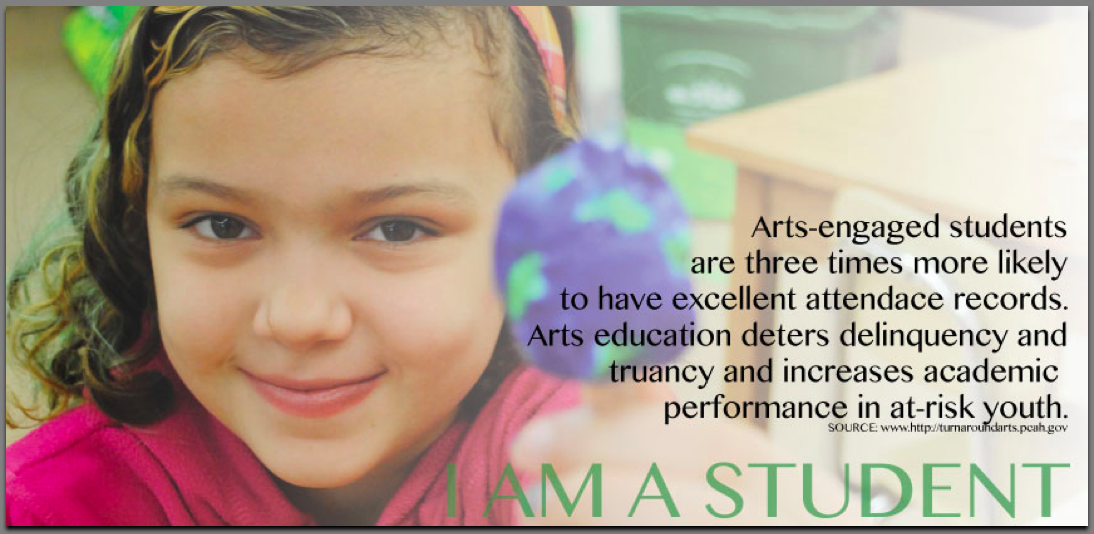
Studies included in this report show that when students participate in the arts they are four times more likely to be recognized for academic achievement, have higher GPA/SAT scores, and demonstrate a 56 percent improvement in spatial-temporal IQ scores. They show significantly higher levels of mathematics proficiency by grade 12, are more engaged and cooperative with teachers and peers, and are more self-confident and better able to express their ideas. These benefits are particularly pronounced in high-poverty, low-performing schools, and work in tandem with other pedagogical approaches. Arts education works best as a part of overall school and education reform strategy.

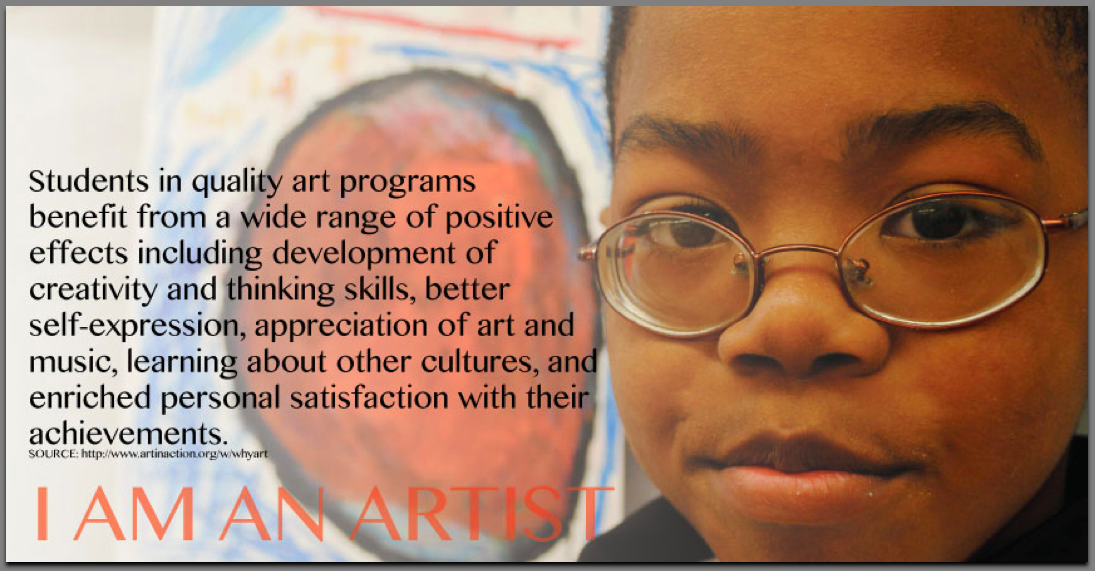
I love the three images with text that I’ve included in this post that go along with the initiative. I think you will agree that they are very well done and coooooool! You can read more at the Turnaround Arts website at http://turnaroundarts.pcah.gov/.

Screen shot 2013-07-01 at 7.17.11 AM

h1

Schools Adding Time to Teach Arts

June 29, 2013

Funding used to conduct research

Boston-based National Center on Time & Learning has conducted research and learned that there are schools that have an understanding of the impact of arts education on the development of students and is doing something about that. Apply new thinking to the structure of learning is a common thread in the blog post which you can read by clicking here.

h1

Another Successful MAAI Summer Institute

June 28, 2013

I am totally exhausted from another summer Maine Arts Assessment Initiative summer institute. THANK YOU to the INCREDIBLE TEACHER LEADERS, LEADERSHIP TEAM, MECA and to the administrators who support your arts teachers who have committed to taking on the leadership role. It was an amazing three days – the discussion around “what does proficiency look like in the arts education classroom” was so worthwhile I thought: wouldn’t it be great if every visual and performing arts teacher could have the opportunity to participate in a similar discussion?!

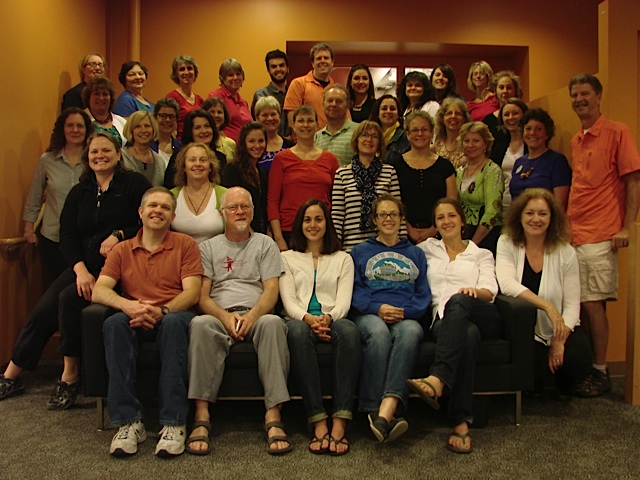
More details will be included in other blog posts in the near future but for now you can see the group photo of phase 3 teacher leaders and leadership team.

DSC02227

h1

MAAI Summer Institute – YAY!

June 24, 2013

Institute starts tomorrow!

This is an exciting week and today and tomorrow are jock full of preparing for it! As you know (if you’ve been following the blog) we have launched phase 3 of the Maine Arts Assessment Initiative (MAAI) and tomorrow is the first day of the summer institute. This is a week that I tell myself “Argy, no one ever died of lack of sleep!” since there are so many details to pay attention to. Fortunately, the MAAI leadership team is a wonderful group of educators who have guided the initiative every step of the way. It is an ongoing volunteer job that they have committed to and I want to THANK each and every one of them:

  • Catherine Ring, New England Institute for Teacher Education, Executive Director
  • Jeff Beaudry, USM Associate Professor, Ed Leadership
  • Bronwyn Sale, Bates College, Lecturer in Education
  • Bill Buzza, Edward Little High School, Music Educator
  • Pamela Kinsey, Easton Schools, Music Educator

So what is the excitement all about? For starters, we have 14 new teacher leaders and 21 returning taking on leadership roles for phase 3. Thirty-five teacher leaders will be creating assessment workshops that will be based on research, practical knowledge and experience, professional development at the institute, and will be on topics that are relevant to visual or performing arts education. They will provide the workshops over the next school year at the regional, mega-regional, and statewide level. The dates for all of these workshops will be made available in the near future. How fortunate we are in Maine that 35 (52 counting all the teacher leaders from the past) visual and performing arts educators are committed to helping other arts educators. This is a HUGE commitment and I certainly appreciate their willingness to take on the leadership role! THANK YOU to the teacher leaders who represent pre-school, elementary, middle, and high school, dance, music, theatre, and visual arts, and all regions of Maine.

  • Drew Albert
  • Allysa Anderson
  • Susan Barre
  • Sasha Bladen
  • Andrea Chase
  • Amy Cousins
  • Melanie Crowe
  • Jennie Driscoll
  • Jen Etter
  • Judy Fricke
  • Patti Gordan
  • Suzanne Goulet
  • Mari-Jo Hedman
  • Gloria Hewett
  • Lisa Ingraham
  • Charlie Johnson
  • Susan Jones
  • Jane Kirton
  • Beth Lambert
  • Lisa Marin
  • Jen Nash
  • Jen Neal
  • Jenni Null
  • Brian McPherson
  • Linda McVety
  • Leah Olson
  • Jeff Orth
  • Pam Ouellette
  • MaryEllen Schaper
  • Ashley Smith
  • Jane Snider
  • Shari Tarleton
  • Shannon Westphal
  • Andrea Wollstadt
  • Rebecca Wright

The teacher leaders and feedback from the over 800 arts educators who have participated in some way in the first two phases of the initiative have identified these focus areas for phase 3.

  • Standards
  • Depository
  • Advocacy
  • Outreach

We will hit the ground running using these Essential Questions to guide the standards segment of the work.

  • What is proficiency in the arts in reference to the Maine Learning Results?
  • How do teachers in the arts articulate what proficiency is?
  • What does it look like at different grade levels?
  • How will we do this in Maine?

This work is a direct response to preparing Maine arts educators for LD 1422 which goes into effect with the graduating class of 2018. I hope that you are having conversations around these same questions at the district level to be ready for students graduating showing proficiency of the standards. This will transition us from discussing “seat time” or “one credit in Fine Arts” to talking about what will be in place for students to “fulfill the standards and the guiding principles”?

So, as I spend today and tomorrow gathering resources, organizing groups, answering questions, packing the car, crossing items off the forever long “to do” list, I can’t help but smile! I know how fortunate I am to work in a state with outstanding arts educators and people who truly care about the quality of arts education programs. Each student benefits from the work that each teacher does!  I look forward to the traditional group photo that shows the teacher leaders at the end of the institute – tired and full of new ideas ready to hit the ground running! You can look for that photo as well – posted on the blog at the end of this week!

h1

Summer Reading: Articles – Resources

June 19, 2013

Below are several resources that you might find helpful and useful to your teaching. THANK YOU to everyone who emails links to interesting articles, research, and in general SOME REALLY GREAT STUFF! to share with others!

h1

Carnegie Hall Partners on Music Ed Study

June 5, 2013

ISKME

The Institute for the Study of Knowledge Management in Education (ISKME), in collaboration with Carnegie Hall’s Weill Music Institute, has recently released a new study on open educational resources in K-12 music education. As the study covers the key role OER can play in helping music educators access curriculum resources and professional development, you may be interested in letting your site visitors know about this new research, described and linked below. Please feel free to post the following blurb and to contact me if you have any questions or would like more information. Sincerely, Kari Jones Contract Writer, ISKME New study explores open educational resources in K-12 music education Music open educational resources (OER) have the potential to fill resource gaps for K-12 music teachers and learners, and to support teachers and learners as content creators and collaborators in meeting educational goals. A new study by ISKME, in collaboration with Carnegie Hall’s Weill Music Institute, and with support from the William and Flora Hewlett Foundation, explores the current state of music OER, the audiences that these resources serve to benefit, and the opportunities and challenges involved in adopting an open approach to the development of music education resources. Check out the full study, “Composing Possibilities: Open Educational Resources and K-12 Music Education” here: http://iskme.org/our-work/changing-score-open-educational-resources-k-12-music-education

h1

Arts Ed Partnership Research

May 22, 2013

Info from Sandra Ruppert

Below is information from the Director of Arts Ed Partnership, Sandra Ruppert, announcing the newly released report called Preparing Students for the Next America: The Benefits of an Arts Education. You can download a .pdf of the report which I am certain you will find useful by clicking here.

The Arts Education Partnership (AEP), a division of the Council of Chief State School Officers, is pleased to announce the release of Preparing Students for the Next America: The Benefits of an Arts Education. This new research bulletin offers an evidenced-based snapshot of how the arts support achievement in school, bolster skills demanded of a 21st century workforce, and enrich the lives of young people and communities. It draws upon the vast body of research in AEP’s new ArtsEdSearch.org, while reinforcing the relevancy to the Common Core State Standards for English Language Arts and Mathematics.

Because evidence is power, we hope this new resource will further your work and strengthen our collective voices in keeping the arts an essential part of a complete and competitive education for every young person in America.
Screen shot 2013-05-21 at 8.05.40 AM

h1

SEADAE News!

May 6, 2013

Argy’s national professional organization – State Education Agency Directors of Arts Education

Screen shot 2013-05-05 at 8.54.27 PMOn June 26, 2012, the State Education Agency Directors of Arts Education (SEADAE) released a paper entitled “Roles of Certified Arts Educators, Certified Non-Arts Educators, & Providers of Supplemental Arts Instruction” ( http://www.seadae.org/Corporatesite/files/c8/c8ddc6ce-bbf6-467b-af6a-4a1d1eebe8d5.pdf,) during a SupportMusic Coalition call streamed from Washington D.C.

SEADAE  received more than 9,000 hits on  their  website during the month of July, following the release of the paper, mainly from practitioners in the field.

The publication of the white paper was only the first step in what is hoped to be an on-going dialogue in the larger field of arts education regarding the roles and responsibilities of all involved in providing a high-quality, sequential and meaningful arts education for America’s children.

To that end, SEADAE will be hosting a National Accord Summit gathering of arts education leaders and policy experts on May 6, 2013 in order to ratify a newly developed guidance document on Professional Practice in Arts Education.

The intent behind the creation of such a statement is to develop and commit to a coherent and shared vision involving key partners in arts education to insure all students are provided with a quality arts education.  This upcoming Summit will be hosted at the Kennedy Center for the Performing Arts, thanks to the leadership of Darrell Ayers, Vice President for Education.  The Summit was made possible by support from the Advocacy wing of the National Association for Music Education.

SEADAE is proud to have played a part in making this important moment a reality.  For further information on the summit or to download the white paper, please contact SEADAE through their website at  http://www.seadae.org

h1

Arts and CCSS

February 19, 2013

Aline Hill-Ries writes in ASCD Express that the Arts should be viewed at the heart of the Common Core State Standards (CCSS) for ELA and math. By looking at what has been learned on how arts education can impact student achievement, no wonder others are utilizing the arts in relationship to the new CCSS. The report completed and published in 2011 by the President’s Council on the Arts and Humanities, Reinvesting in Arts Education: Winning America’s Future through Creative Schools includes this information.

The article states “that numerous studies have found that incorporating the arts into core learning can positively affect students’ academic achievement, both in their language and literacy development and in their mastery of mathematics.” To some this information is a surprise. With the release of the CCSS this information is being viewed with a critical eye.

You can read the entire ASCD article by clicking here.

Thanks to MAAI teacher leader Barbie Weed for sending this information.