Archive for the ‘Research’ Category

h1

Arts and the Common Core

February 17, 2013

ELA and Math

Here is a webinar that you might want to attend being held on Tuesday, February 19, 2 PM called Art and Common Core. This title is referring to the ELA and Math Common Core State Standards.

As educators work to help students meet the demands of the common-core standards, many arts education advocates are making the case that the arts can be a valuable partner. In this webinar, join two experts who will discuss the potential for arts integration with the common core and offer practical examples. 

Presenters:
Susan M. Riley, expert in arts integration, curriculum innovation and resource development specialist, Anne Arundel County public schools, Md.

Lynne Munson, president and executive director, Common Core

Moderator:
Erik Robelen, assistant editor, Education Week

You do need to register beforehand and can do so by clicking here: https://vts.inxpo.com/scripts/Server.nxp

h1

Habits of Mind

February 4, 2013

Studio Thinking

Studio Thinking: The Real Benefits of Art Education was written by Lois Hetland, Ellen Winner, Shirley Veenema and first published in 2007. (new printing is due out next month) It is a book that provides some answers to why art education is essential. The authors provide research on how the habits of mind are learned by studying visual arts. Practicing teachers voices, lessons, and pictures are included in the book.

Thank you to Pam Ouellette who has shared a summary of the book. Pam teaches visual art at Lisbon High School and is a teacher leader for the Maine Arts Assessment Initiative.

Belfast High School art teacher Heidi O’Donnell shared this link to an online assessment project where students are sharing their ideas on Studio Habits of Mind.

STUDIO THINKING

Students develop valuable dispositions in art classes.

Dispositions:  Skills, alertness to opportunities to use these skills, and the inclination to use them—a trio of qualities that comprise high-quality thinking. These habits of mind are important not only for the visual arts but for most disciplines/areas of study or employment.

1.  Craft – Learn to use and care for tools, materials, and procedures.  Learn technique to enable you to create what you intended.

2.  Engage and Persist – Learn to embrace problems of relevance within the art world and/or of personal importance, to develop focus and other mental states conducive to working and persevering at art tasks.  Make a personal connection to the art assignment.  Practice!

3.  Envision – Learn to picture mentally what cannot be directly observed and imagine possible next steps in making a piece.

4.  Express and Create – Learn to create works that convey an idea, a feeling, an atmosphere, an emotion, a narrative/story, a drama, a sense of movement, or a personal meaning.

5.  Observe – Learn to attend to visual contexts more closely than ordinary “looking” requires, and thereby to see things that otherwise might not be seen.  Notice, pay attention, learn to SEE!

6.  Reflect – Question and Explain:  Learn to think, explain, and talk with others about an aspect of your work or working process; Evaluate:  learn to judge your own work and working process, and the work of others in relation to standards.  Reflect in your journals!  Learn to articulate about your work and process, record your ideas and growth.  This helps you self-monitor and become independent.

7.  Stretch and Explore – This is the heart of creativity.  Learn to reach beyond your capacities, to explore playfully without a preconceived plan, and to embrace the opportunity to learn from mistakes and accidents. Think about several versions of the same idea or different ways of getting to the same idea.  There are no clear right or wrong answers.  Don’t worry about how a piece will end up, experiment, take risks, go beyond your comfort zone, be brave, be creative!

8.  Understand Art World –Learn about art history and current art practice and how it can inform your work. Learn to interact as an artist with other artists (i.e. in classroom, in local arts organizations, and across art communities) and within the broader society.  Understand how what you learn in school connects to what people do outside of school.  Understand that art is a part of your everyday life.

Encourage Reflection, Envision, and Stretch and Explore:

Decisions, planning think about, what if, you might consider, I wonder if, experiment, it might be because, you could try (x or y or z).

Hetland, L., Sheridan, K. M., Veenema, S., Winner, E.  (2007).  Studio Thinking: The Real Benefits of Visual Arts Education.  New York, NY:  Teachers College Press.

h1

Live Stream: National Core Arts Standards

January 18, 2013

Technical difficulties

If you tried to join the live stream today on the National Core Arts Standards you may not have had any luck with the connection or getting in to the stream. I am not sure who said: “Technology is great when it works.” Periodically, that statement rings VERY true. I am guessing that my colleagues in New York who were trying to make the opportunity feasible for everyone across the country were very frustrated. Fortunately everyone will have the opportunity to access the event since the archive will be posted starting this Sunday!

I am taking this opportunity to provide some information that you might be wondering about.

As I learn more I will provide an update here on the meartsed blog. If you have questions please go to the National Coalition for Core Arts Standards website at http://nccas.wikispaces.com/ or contact me at argy.nestor@maine.gov.

Screen shot 2013-01-18 at 9.04.02 PM

h1

Happy New Year!

January 1, 2013

Reflecting

I have taken some time today to reflect on 2012 and realize how fortunate I am to work with incredible arts educators in Maine and throughout the United States. Educators who are dedicated, passionate, and fully committed to providing an outstanding arts education for every student!

The year has been filled with many successes, some challenges, and sad losses! I wish I had time to go back through all the blog posts that I wrote in 2012 to help me remember all of the successes, challenges, and losses but instead I will provide the highlights.

Successes

The biggest success is the Maine Arts Assessment Initiative (MAAI). The second phase of MAAI officially kicked off in the spring with the identification of 20 teacher leaders. These arts educators joined the 18 teacher leaders from phase one. They participated in a 4-day institute in August at the Maine College of Art (MECA) in Portland where they expanded their knowledge in the areas of assessment, leadership, technology, and creativity. They have created workshops that are being delivered throughout this school year at the regional and mega-regional level. (Registration for the mega-regional workshops is now open – FREE and contact hours are available.) The topics of the sessions are as varied as the individual teacher leaders. I am so grateful for their commitment to the work that is making a difference for arts teachers and in arts classrooms across Maine each day. The impact on students learning is amazing!

And, uniquely the Mega-regional workshops are being co-sponsored with the Maine Learning Technology Initiative (MLTI). At these workshops their will be at least one session that is integrated with an MLTI integrator to provide a first time opportunity for educators!

The MAAI would not be possible without the commitment of the leadership team who have consistently shepherded the work. A GREAT BIG THANK YOU to Catherine Ring, Rob Westerberg, Jeff Beaudry, Bronwyn Sale, Pam Kinsey, and Matt Doiron. Their willingness to lead has made a difference! Close to 1000 arts educators have taken advantage of the professional development opportunities during the last year and a half.

The MAAI is aligned with the Maine Department of Education’s Strategic Plan: Education Evolving: Maine’s Plan for Putting Learners First.

In July Catherine and I flew to Denver for a national conference on arts assessment held at the Rocky Mountain College of Art + Design. I was proud to let others know of the grassroots efforts that Maine arts educators are involved with.

Art educator Chris Milliken, on sabbatical from Wells schools, has been following and doing research on the MAAI during this past year. He will join art teacher Lisa Marin and present a session on their findings at the Mega-regional workshop at Ellsworth High School on March 29, 2013.

Literacy is a statewide focus with the Literacy for ME being launched this fall and arts education has stepped up to become an integral part of the cross content literacy connections. Arts educators Jen Nash, Suzanne Goulet, and Lisa Gilman have been facilitating literacy webinars. Suzanne is also co-facilitating face to face sessions.

We have had 4 wonderful art exhibits at the Maine Department of Education during this past year from Maranacook Community Schools, Bangor Elementary and Middle Schools, Lake Region High School, and Messalonskee High School. Along with the exhibits we had receptions at the Blaine House with music and dance performances from each school/district. Participating and collaborating are First Lady Ann LePage, the Maine State Board of Education, and the Commissioner of Education, Steve Bowen.

First Lady Ann LePage partnered with the Barbara Bush Foundation to create a new baby journal to present to parents at hospitals across Maine when their babies are born. We did a call for K-8 artwork and 867 young artists submitted work. Thirty two pieces were selected to be published in the book which will be completed in June 2014.

The Maine arts education list-serv has grown to 1200 and the meartsed blog is growing as a source of information, not only for arts educators but for all educators. If you are not on the list-serv but would like to be, please email me at argy.nestor@maine.gov. On December 5, 2013 the blog set a record high day of 976 visitors. And a record high week happened during that same time of 2508 visitors. Thank you for taking the time to visit and informing others about what is available on the Maine arts education blog.

Challenges

  • Common Core standards for ELA and Math were released this year and teachers are being asked to incorporate them into their curricula.
  • We are waiting patiently for the next iteration of the national arts standards to be released in March March 2013.
  • Arts education in Maine is underserved. As the economy continues to be a challenge so is providing adequate arts education programs and teachers.
  • Determining how to provide quality arts education to be ready for the “proficiency based graduation requirement” slated for the graduating class of 2018.
  • What will determine “teacher effectiveness” for arts educators (the non-tested content)?

Sadness

In March music teacher Beth Polletto died in a car accident driving to school. Beth taught at Gray New Gloucester and Georgetown Central School. In May art teacher Jackie McTigue died in a car accident on her way to school. Jackie taught at Glenburn Elementary School. Both teachers were amazing arts educators and have left a huge hole. My friend and colleague 2nd grade teacher and Maine’s 2010 Teacher of the Year Kevin Grover died on Thanksgiving day after returning from a run. He is greatly missed by family, friends, and colleagues.

Looking forward

photoBeing forever optimistic, I know that 2013 will be filled with many more successes and that the challenges will be small mountains for us to climb. I invite you to collaborate with your colleagues to face the challenges and enjoy the successes. I hope you will continue to use the meartsed blog for resources and to access information. Many of you have heard me say “none of us is as smart as all of us”. Please continue to share information that I can pass on to others through the blog. I appreciate it!

I am confident that 2013 will be filled with opportunities for arts education to move forward. For example part of phase 2 of the MAAI is videotaping arts classrooms to respond to your request “what does a standards based arts education classroom look like?” So, Debi Lynne Baker (newly retired art teacher) will be visiting arts classrooms in the next few months and creating 4 short videos with examples. This is just one example of resources being developed for arts teachers.

I enjoy the challenges that my work at the Maine Department of Education provides for me. I especially love the opportunity to interact with you, the readers of the meartsed blog. So please take a moment when possible and drop me an email at argy.nestor@maine.gov or make a comment at the bottom of a blog post. You can subscribe to the blog by clicking on “Sign me up!” located on the right side of the front page of the blog.

I hope your year is filled with love and laughter and that you continue to provide outstanding opportunities for your students in arts education! Best Wishes for a wonderful 2013 and THANKS so much for all the good that you do in education!

Only one photo and one quote included in today’s post. Hopefully the photo will put a smile on your face and the quote will provide you with some “food for thought” as we dive into 2013!

The purpose of arts education is not to produce more artists, though that is a byproduct. The real purpose of arts education is to create complete human beings capable of leading successful and productive lives in a free society. – Dana Gioia, Chairman of the National Endowment for the Arts

h1

Omari Rush

December 6, 2012

Walking the walk

imagesOmari Rush is the education manager for University Musical Society but that is not all he does. He serves in an advisory role for numerous organizations of varying cultural and geographic scopes: as a governor-appointed Council member for the State of Michigan Council for Arts and Cultural Affairs, as a member of the Kennedy Center Partners in Education National Advisory Committee, and as chair of the board of directors for the Ann Arbor Public Schools Educational Foundation.

Omari earned degrees in music from the University of Michigan and Florida State University, and while his concert performances as a clarinetist are now infrequent, Omari fills his downtime with running, watching the Cartoon Network, and reading (especially American Revolution literature).

Omari has been committed to creating rich arts education opportunities and experiences for many years. In a recent blog post for a blog in Ann Arbor, Michigan Omari articulated that commitment. He reminds the reader why the arts belong in the K-12 education. He sites 4 research reports that support the topic.

  1. A study about Mosaic Youth Theatre of Detroit clearly connects arts participation and increased graduation rates and optimism about life potential
  2. MSU researchers Robert Root-Bernstein and Rex LaMore have found that high achievers in engineering and the sciences commonly possess a trait of sustained arts engagement. (This one is especially interested in connection with the conversations around STEAM).
  3. The National Endowment for the Arts demonstrates that arts participation enhances civic engagement, empathy, and tolerance/cooperation.
  4. In addition to research telling us the arts belong, so are Fortune 500 CEOs who are craving a creative workforce.

Please take a few minutes and click on this link to the blog post so you can read about his beliefs on the topic!

Please note: some of the information for this post is taken directly from the blog post that you can link to which was written and put together by Tanya Muzumdar and published in “concentrate”.

h1

Maine Association for Middle Level

October 29, 2012

MAMLE

This past Thursday and Friday I attended the MAMLE conference at Sugarloaf where arts educators were well received in the workshops they presented on a variety of topics. I have included a bit of information below on each of the sessions where the arts teachers presented.

Allied Arts in the Standards World

Sacopee Valley Middle School art teacher and Maine Arts Assessment Initiative teacher leader Danette Kerrigan and Medomak Middle School music teacher Julie Sanborn participated in a panel presentation on the work they are doing at their respective middle schools and in their classrooms. The other panel members Lisa Hogan from Mt. Ararat, Barbara Greenstone from Boothbay and Phil Brookhouse from MLTI also made connections to the arts. Friend of arts education, Jill Spencer facilitated the session.

Panel members: Lisa Hogan, Julie Sanborn, Barbara Greenstone, Phil Brookhouse, Danette Kerrigan

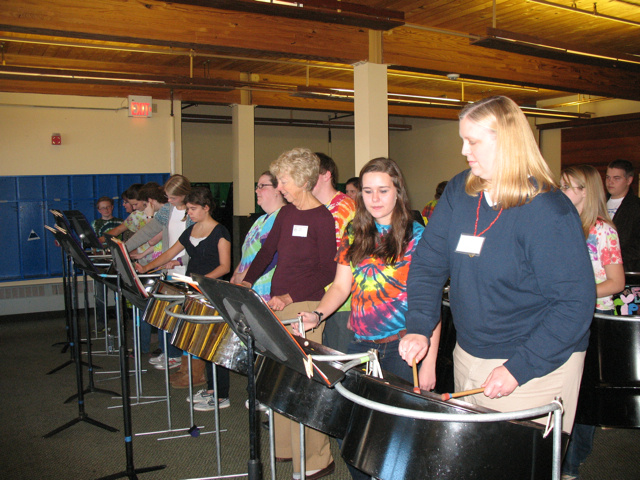
Steel Drum Band

Julie also presented a session with the Pantastics, the school’s steel drum band. The band performs at community events and has traveled to other schools and events in and out of Maine. The students played several pieces at the start of the conference as well as in an individual workshop. Other middle school teachers were invited to play one of the drums as well. The members of the band promised to write a blog post on their involvement playing the steel drums. Look for that in the future.

How Can I Teach for Creativity?

Danette was joined by MAAI leadership team member Bronwyn Sale from Bates College for a session on creativity. They made quite a team with Bronwyn presenting foundational information on the creative process, creativity, and creative problem solving. Danette shared the practical components of addressing the topic in a classroom setting and provided participants with hands-on exercises including SCAMPER which stands for Substitute, Combine, Adapt, Magnify, Put to Other Uses, Eliminate (or Minify), and Rearrange (or Reverse).

Bronwyn Sale and Danette Kerrigan

Service Learning and Music Appreciation

Leonard Middle School music teacher Shianne Priest had students join her to share a service learning project that she her music appreciation class has undertaken for two years now. The 8th graders this past year raised $1600 for the Make-A-Wish Foundation. They collaborated to write the lyrics for a song that 9th grader Lily Muscatell took a step further and wrote the music for and performed. Selling the CD was one part but hearing about their learning and how the experience affected them was amazing.

Shianne and Lily listen while the 8th graders explained the project.

Thank you to everyone for their fabulous work and sharing the opportunities that you afford Maine students!

h1

What a Week!

October 9, 2012

Some weeks are crazy

Last week was filled with adventures! I started the week in Washington D.C. at the Arts Education Advisory Group (AEAG) meeting. They are part of the National Assembly of State Arts Agencies (NASSA) which is made up of the state arts commissions including the Maine Arts Commission. Every year the AEAG plans a professional development institute (PDI) for the arts in education associates at the state arts commissions which includes Meagan Mattingly. I am the representative to AEAG for my national professional organization called State Education Agency Directors of Arts Education (SEADAE) which is comprised of the arts education specialists from the Departments of Education. I had a chance to be with AEAG at the opening of their PDI. It was wonderful to meet people who are committed to arts education in each state. Not to mention they are interesting, knowledgeable, creative, and FUN! The National Endowment for the Arts (NEA) are affiliated with the AEAG and NASSA since funding is provided by the NEA. Consequently, there were a handful of staff from the NEA who are responsible for arts education who attended as well. In attendance was Ayanna N. Hudson, the NEA Director of Arts Education. She agreed to write a blog post for meartsed that will explain the programs/funding that is available for teachers, schools and communities. This will provide an overview to help you learn what is available. One of the evening highlights was the opportunity to see the performance of the DC Youth Slam Team. They were INCREDIBLE!
Next my travels took me to Reston, VA where SEADAE met with the chairs of the National Arts Standards writing teams and the National Coalition for Core Arts Standards leadership team. The writing teams are moving along with their work in spite of the little funding that has been provided. The most recent draft of the framework was shared by Co-Chairs, Marcia McCaffrey and NH DOE arts specialist and Lynn Tuttle, AZ arts specialist and president of SEADAE. The writing teams have taken the first draft with the components including Disciplines, Essential Questions, Enduring Understandings, Artistic Processes, Cornerstone Assessments, and re-arranged the direction of the document to make it  more user friendly. The work was shown to us on the website where the document will be housed so we could also see the work that has been done on the site. It will include a “quick view” button for finding stuff in a hurry, the use of tagging and keywords, and links to other works. All of this will be important aspects since it will be a web based document. You can view some of the ideas that are being considered at this link.

We had a discussion on what to call the final document so if you have any suggestions please email them and I can pass them along. The document will be arranged by grade level, PreK-8 but the high school format is still under discussion. You can read more about the format by clicking here.

At this point the expected date for the release of the “framework” will be in December. The first draft of the standards document which includes Dance, Media Arts, Music, Theatre, and Visual Arts will be within a few months after that, perhaps in March. Most likely the cornerstone assessments will be included when the standards draft comes out at grades 2, 5, and 8. The format will require feedback on the standards and the “userness” of the website.

Nancy Rubino from the College Board reported on recent research that looks at the Common Core State Standards for ELA and Math (CCSS) and the National Standards for the Arts. The research looks at the overlapping components of the CCSS and the arts frameworks and where the arts references are present in the CCSS. For example the research includes tells us that there are 26 ELA standards that have references to reading a work of drama. Looking closely at “college level learning” in the arts has been included in the research. The research will be released as soon as the final framework is determined and I am sure you will find it helpful. The College Board has done other research which I have mentioned in past blog posts and you can find links to this valuable information on the right side of the National Coalition for Core Arts Standards wiki.

The end of the day included the live stream from the meeting to provide an overview of the event. If you weren’t available or couldn’t get on since the system was full I understand that it will be archived on the site in the near future.

I flew back to Maine early on Thursday morning and headed to Point Lookout in Northport where the Maine Arts Assessment Initiative (MAAI) teacher leaders and leadership team met that night and all day Friday. We worked on the Depository for arts education resources in Maine located at MaineLearning.net and continued plans for the Mega-regional workshops to be held throughout the 2012-13 school year. On Friday the teacher leaders from phase 2 presented their workshops so they could gather feedback on their sessions to determine if they’d like to tweak anything before taking their session on the road for the regional workshops. The regional workshop sessions will be posted on the Department arts assessment page in the next two weeks so you can see what is available. The energy and expertise of their topics was inspirational and truly amazing. I was reminded of how fortunate we are in Maine to have such outstanding arts educators who are willing to share information and expand their horizons to become teacher leaders in the arts. I am sure when the Cornerstone Assessments are released from the national standards work that Maine will be ready to take on the task of reviewing them to provide feedback that will inform the nation.

Needless to say when the week ended on Friday evening I was exhausted! However, I am extremely proud of the work that arts educators are doing throughout the state and urge you to continue to read and stay abreast of the opportunities that are offered. If you have questions or comments on any of this please feel free to email me at argy.nestor@maine.gov or post a comment at the bottom of this post.

MAAI arts educators fall workshop

h1

Arts Integration Transforming Schools

October 7, 2012

Edutopia recent focus on arts integration

Edutopia focused on integration and as they do so well covered many areas within the topic. The article Schools Transformation Through Art Integration written by Mariko Nobori for Edutopia explains what is going on at the Wiley H. Bates Middle School, a public school in Annapolis, Maryland after they became fully arts integrated in 2009. The transformation has positively impacted student behavior and learning.

The Edutopia staff wrote a piece called A Research-Based Approach to Arts Integration that includes the NAEP research along with other background information. Also included is the Bates Middle School information on the student growth in math and reading that was reported to the Maryland State Department of Education.

You can see the program in action in this YouTube and hear from students as well as school educators. I suggest that when you click on one of the links above that you read the other articles including How the Arts Unlock the Door to Learning.

h1

Articles (lots of them!)

October 6, 2012

Food for thought

I am forever finding interesting thought-provoking articles to read and share with the meartsed readers. Below are a list that have accumulated during the last month or so to share with you.

  • Luminaries in Convention City Advocate for Arts Education written by  Andrew Ujifusa, Education Week, September 6, 2012. The former U.S. Secretary of State Madeleine Albright, based on her drumming chops, got the nickname “Sticks” and she was one of several who joined a discussion called Arts Speak.
  • Rule Making in the Classroom written by Nancy Flanagan Education Week, August 14, 2012. How do we shift to students making the rules for a better classroom environment.
  • Expanding the impact of Excellent Teachers written by Bryan C. Hassel and Celine Coggins Education Week, August 16, 2012. At this time in education with so many changes occurring how do we look to excellent teachers and expand on their impact?
  • Graduating all Students Innovation-Ready written by Tony Wagner Education Week, September 23, 2012. “What matters today is not how much our students know, but what they can do with what they know.”
  • Travels in Education written by Deborah Meier, Education Week, September 23, 2012. How one educator travel experiences have and continue to impact her teaching.
  • Teacher PD Needs More on Emotions written by Anthony Rebora, Education Week, June 8, 2012. Perhaps teachers need more training in order to provide emotional support for students.
  • Tools for Teaching: The Amazing Sticky Note written by Ben Johnson, Edutopia, September 10, 2012. I just had to end this list of readings on a topic that I find very fun – the use of sticky notes. Those of you that know me are aware of how sticky notes on my computer are a lifesaver. Thanks to Chris Milliken for sending me this link!
h1

MAAI Resources!

September 5, 2012

Maine Arts Assessment Resources

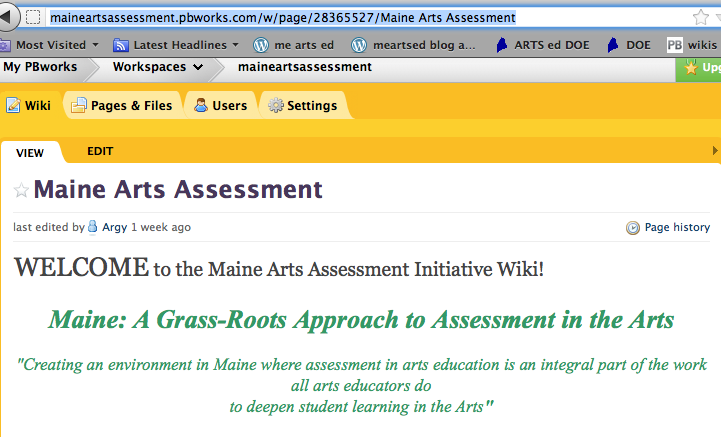
Recently revamping the Maine Arts Assessment Initiative wiki moved to the top of the list of “things to do”. It was prompted by a question from the field, a high school art teacher who emailed asking if the information (“notes and/or minutes”) from the summer teacher leader assessment institute sessions was available. He has been following the work of the Maine Arts Assessment Initiative (MAAI) including the blog posts, webinars, and other resources we have made available on the wiki http://maineartsassessment.pbworks.com and Department assessment webpage http://www.maine.gov/education/lres/vpa/assessment.html. It was as if the teacher had whacked me upside the head. I thought “why don’t we post the handouts, links, and information that we provided in each of the sessions?”

That is when I moved the task up to the top of the “to do” list and Catherine Ring and I skyped to determine who had time to do what, and where we wanted to make changes on http://maineartsassessment.pbworks.com to provide as many resources to all of you as possible from the summer institute.

This is another example of the MAAI transparency. If you want to get to the summer resources page quickly here is how to do that. Go to http://maineartsassessment.pbworks.com read through the front page, and towards the bottom you will see in capital letters INFORMATION AND RESOURCES. Click there for the  Table of Contents. Click on 2012 Summer MAAI Institute Resources which will take you to a TON, I mean MEGA amounts of resources on the four main topics of the summer institute; ASSESSMENT, LEADERSHIP, TECHNOLOGY, and CREATIVITY. The workshop facilitator is listed with the information so you know the sources. Along with the four topics there are many other resources including books, .pdfs, articles, research, and so much more it will take you several rainy days to get through all of it. Is everything included from the summer institute? No, this would be impossible since the Teacher Leaders and other participants shared continuously throughout the 4-day institute held at MECA in July/August. But you know what it is like when you get together with arts educators; the willingness to share is unbelievable! Is it only from the summer institute? No, but most of it is. There are arts education resources that have been shared during other workshops and on the Department site.

My suggestion is to share this page with your colleagues, administrators, and determine what you can use for your local curriculum and assessment development work that you are doing this school year. Please let me know how you use the resources that we’ve provided for all of you!!

A great big THANK YOU goes to the MAAI Leadership Team who facilitated the MAAI summer sessions and our New England colleagues who stepped in and did sessions on the Common Core State Standards and National Arts Standards. I won’t mention any names here with fear of omitting some but please know that it is several amazing arts educators!