Archive for the ‘Research’ Category

h1

International Visual Literacy Association Conference

August 29, 2012

44th Annual Conference at USM, October 13th

October 10 to 13 in Portland, USM, Mapping the Visual Beyond the Visible, annual conference of the International Visual Literacy Association, www.ivla.org.

Established in 1969, IVLA members represent a wide range of disciplines and includes researchers, educators, designers, media specialists and artists. Through its meetings, publications, and website, IVLA provides a forum for issues dealing with education, instruction, and training in modes of communication and their application. Paper proposals for conference: www.ettc.net/ivla/proposals.

The 2012 confereence is hosted by The Osher Map Library and Smith Center for Cartographic Education at the University of Southern Maine in Portland.

SCHEDULE OF EVENTS

Wednesday, October 10, 6:30 PM

Keynote address by Ken Jennings, author of Maphead, a personal account of his lifelong fascination with maps and geography. Best known for his 2004 record-breaking appearance on Jeopardy, the TV quiz show, Ken Jennings has since published two bestsellers, Brainiac and Maphead.

www.ken-jennings.com

Note: The lecture on the USM Portland campus in Hannaford Hall is also free and open to the public.
Due to limited seating, please RSVP by Friday, October 5 to (207) 780-4850 or oml@usm.maine.edu.

Thursday, October 11
Conference sessions at the Clarion Hotel followed by an evening reception at the Maine College of Art in Portland.

Friday, October 12

All daytime sessions held at the Glickman Family Library on the USM Portland campus. Midday tour of the Osher Map Library and its exhibition, Iconic America: The US Map Outline as National Symbol, accompanied by presentation by John Fondersmith, guest curator whose collection is on display.

Evening: Gala event with dinner and musical entertainment at Clarion Hotel.

Saturday, October 13

Keynote presentation by David Sobel, author of Mapmaking with children: sense of place education for the elementary years. Sessions at Clarion Hotel will focus on K-12 education. Day registration for area educators is encouraged.

h1

Measuring the Therapeutic Benefits of the Arts

June 24, 2012

Studying the brain for the value of the arts

The National Endowment for the Arts (NEA) is looking at the studies underway on how the arts are being used for therapeutic purposes. NEA is interested because the study could have an impact on future arts funding. Art, music, and writing is being used to heal soldiers on their return from war areas to help them with post-traumatic stress disorder. This isn’t new but the latest technology is providing a way to is measure the impact the arts are having. It can actually look at the part of the brain that is being impacted. One of the questions being asked is “it is known that art therapies can help with the psychological effects of these invisible wounds, but can they promote physical healing?”

The first study is being conducted by the National Intrepid Center of Excellence. At this link http://www.bbc.co.uk/news/magazine-18401167 you can watch the clip and learn more.

h1

Summer Reading, Watching, Listening, and Learning

June 17, 2012

Points of interest wrapped up in one blog post

The information in this blog has come across my desk from a variety of sources and people. I have rolled it into one post to make reference easier for you… I am guessing there is at least one story here that will peak your interest.

  • A 5 minute+ film about John Baldessari created by Tom Waits. He is recognized for his height 6′ 7″ and his white beard and hair.  He is been called the Godfather of conceptual artist, surrealistic for the digital age. He has had over 200 solo shows, and 1000 group shows and has received many awards. You can learn more about him and watch the entertaining 5 minutes and 55 second video by clicking here. John has a great website as well – http://www.baldessari.org/.
  • While looking at the Baldessari film I discovered the website called Short of the Week which contains links to short videos. The topics are varied. This might come in useful as a resource for you and/or your students.
  • Thanks to MAAI teacher leader, music teacher at Aetna-Dixmont Jen Nash who sent me this info. I talked to Kern Kelley, who is the technology integrator for us. He shared this blogspot link with me and in her words: “The students picked a piece of art and had to put a video together. They had to talk about the different aspects of the piece of artwork and incorporate music. I thought that this would be neat to share.”
  • Will Richardson is one of those people who I find very interesting. He encourages me to think differently about school. This is a TEDx where he talks about young people and learning and starts out by referencing his daughter playing the piano.     
  • Eight schools across the country were selected to receive over $14.7 over a three year period to integrate dance, music, theater, and visual arts into the curricula. The President’s Committee on Arts and Humanities working with the US Department of Education hopes to prove that failing schools can be impacted by encouraging the expansion of creative expression. Public Radio has an interview that you can listen to by clicking here. And you can read more about the Turnaround Arts Initiative.
  • Not to long after I posted Eagles Have Landed about Suzanne Goulet’s art classroom at Waterville High School being the center of the viewing stage for the new born eagles someone sent me this video of young robins.
  • Mystery of a Masterpiece was aired on Public Television in January 2012 and tells the story of a painting that was sold for $20,000 in October of 2007 and now is thought to be a Leonardo da Vinci worth more than $100 million. Cutting-edge imaging analysis solves the mystery. You can watch the 52 min. program by clicking here. Thanks to Wiscasset Middle School art teacher Molly Carlson for sharing this information.
  • Playing for Change Day – changing the world through music. All over the world on September 22nd there will be people collaborating to inspire people to support music education. Portland is one of the locations, planned by the Maine Academy for Modern Music, and it will happen at 8:00-11:30 PM.
  • The photographs are amazing! Starstruck: The Fine Art of Astrophotography at the Bates College Museum of Art provides local teachers a FREE resource to explore a meeting point of art and science. 36 photographers from around the world are included in one of the very first exhibitions to examine astrophotography as a fine art genre. Starstruck opened June 8 and will be on view through December 15, offering ample opportunity for science and art teachers to plug in. Companion shows at the Bates planetarium are an option. To learn more or to schedule a tour, contact ashostak@bates.edu or cjones5@bates.edu. A full color catalogue with essays by the jurors is available.

ARTICLES

h1

Literacy for ME

May 18, 2012

Maine’s Comprehensive State Literacy Plan

Lisa Gilman teaches visual arts at the Winthrop Middle School. During the last year she has served as a content specialist on the State Literacy Committee. Recently she wrote this post for the meartsed blog to provide information to arts educators of the work the committee has done.

The committee was formed during the Fall of 2010. The MDOE applied for a Striving Readers Comprehensive Literacy (SRCL) formula grant to be used to establish a Statewide Literacy Team charged with assisting the MDOE to develop a Statewide Literacy Plan. The Maine Department of Education was awarded the SRCL grant in November 2010. 

Along with many state literacy specialists and classroom specialists we began this journey by looking at other states that had completed their literacy plans. At the helm is Leeann Larsen, Literacy Specialist, MDOE, who has been a great leader for this daunting task of creating a plan for the state.   

“Literacy for ME outlines steps and identifies resources to help educators and others provide children with a strong early childhood foundation in literacy, provide students with effective literacy training throughout their years in school, and provide adults with low levels of literacy with the adult-level training they need.”

The literacy plan is organized around the following 6 components:

  • Strong leadership
  • System-wide commitment and partnerships
  • Standards and curriculum
  • Instruction and intervention
  • Assessment
  • Professional learning

These same components are familiar to Maine educators because they have the same components as other initiatives such as RTI and standards based education. This plan is not in addition to literacy efforts but a guide for ongoing work at the State and local level. Literacy for ME hopes to develop a cultural shift in how we think of literacy. Literacy for ME intends to broaden literacy for all residents of Maine. The plan is designed to initiate partnerships beyond the classroom walls.

The state of Maine defines literacy as: The ability to construct and convey meaning for a variety of purposes through an array of contextual forms and symbols, including reading, writing, speaking, listening, and viewing.  As an art educator who has taught reading along with my regular visual arts curriculum, literacy must not be designated to just Language Arts classes. Literacy is continually defined and expanded in our contemporary world.

Be looking for the formal plan to be launched in August 2012. 

Thank you Lisa for providing this information!

h1

Arts Ed Partnership New Site

May 11, 2012

Resources for educators, parents, school leaders, community members

ArtsEdSearch.org contains research, policy, and advocacy resources. It contains information about the “essential role the arts play in developing students’ creative thinking, problem solving, communication, and collaboration skills—attributes many education and business leaders identify as important in preparing young people for college and career success.”

Click here to go directly to the new website.

h1

The Science of Learning

April 26, 2012

How much is too much?

Practice makes perfect or does it help to really learn something. For a short period I gave end of unit “tests” to see if students had learned the concepts and skills related to the artwork. This was often very separate from assessing their art work.

In an article written by Annie Murphy-Paul she discusses the idea of practicing and how much it takes to really learn something, overlearn it, learning beyond mastery. Scientists are studying how the brain performs when learning something new and the continuous process of learning. I wonder how this information relates to teaching and learning in the classroom setting considering most arts educators see students for relatively short time each week. And how much impact the student who works individually “practicing”?! You can read the entire article by clicking here.

Thank you to friend and colleague Anne Kofler for sharing this article.

h1

ARTS Articles, Articles, Articles

April 21, 2012

The news is peppered lately with articles about the Arts

This post provides you with links to articles that I found interesting and think you will as well! Some of the articles below are on the newly released, April 2012, report: Arts Education in Public Elementary and Secondary Schools: 1999-2000 and 2009-10 from a congressionally mandated study on arts education in public K–12 schools. You might wonder why I would include all of the articles on the same topic?! It provides you with the perspectives of different writers. Of course, I urge you to go to the report itself which is linked above.

Article written by Erik Robelen, April 2, 2012, Education Week. Thank you to colleague Paula Hutton for sharing it.

March 30, 2012, Art Works, National Endowment for the Arts

ASCD Capital Connection, April 10, 2012.

Written by Erik Robelen April 3, 2012, for Curriculum Matters blog, published in Education Week, April 16, 2012. Thank you to my Washington state colleague AnnRené Joseph for sharing this link.

Written by Roberta Smith, April 11, 2012, Art & Design from the New York Times. Thank you to colleague World Language Specialist Don Reutershan for sharing it.

Article by staff and wire services reports, February 15, 2012 from eSchool News Thank you visual art teacher Lisa Marin for sharing it.

Written by Erik W. Robelen, Education Week, April 16, 2012.

Written by Andrew Miller, Edutopia, March 5, 2012. 

Featured Company from the Directory of Teacher PD Sourcebook.

This isn’t exactly an article however, it is from National Art Education Association from Linkedin. The question was asked by an art teacher from New York and many teachers answered the question. It provides many ideas and resources that you might find useful. Thank you to Leah Olson, art teacher from Hampden Academy, for sharing this link.

The Portland Press Herald, by Mark Schwartz, April 11, 2012. Thank you to Maine Arts Assessment Leadership Team member, Bates College teacher, Bronwyn Sale for providing this link.

Written by Leslie Postal for the Orlando Sentinel, April 7, 2012. Thank you to colleague Mike Muir for sending me this information.

Written by Sarah Clune, American Graduate Education Health, March 22, 2012, PBS News Hour.

h1

Musical Scores Made from Tree Rings

April 13, 2012

German artist Bartholomaus Traubeck

A record player (the kind we used when I was growing up) was modified to be able to read the growth rings of a tree to create music. Bartholomaus Traubeck created what he calls Years to analyze the rings for their strength, thickness, and rate of growth. It transform this data and outputs it as music. You can read more, see photos, and hear music by clicking here.

h1

US Department of Education

April 6, 2012

New study: Arts Education in Public Elementary and Secondary Schools

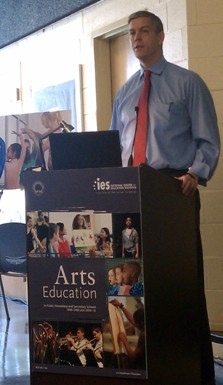
US Department of Education Secretary of Education, Arne Duncan

On April 2, the U.S. Department of Education released a study entitled Arts Education in Public Elementary and Secondary Schools 1999-2000 and 2009-10. This study was previously published in 2002, prior to implementation of the No Child Left Behind Act (NCLB). Arts education advocates are very pleased to finally see an update, even if a full decade later.

The report offers mixed results in support of arts education. According to the report, music and visual art are widely available in schools in some form in schools nationwide; however, dance and theater are far less available. U.S. Education Secretary Arne Duncan stated, “despite the importance of providing equal educational opportunities in the arts, today’s report shows we are falling well short of that goal.”

Despite being designated a “core academic subject” in NCLB and being included in mandated elementary school curriculum in 44 states, this survey demonstrates that access to arts education remains elusive to a tremendous number of students across the nation.

From the Department’s announcement of the study we learned that:

  • 1.3 million of our nation’s public elementary school students receive no specific instruction in music, and nearly 4 million students receive no specific instruction in the visual arts.
  • 800,000 public secondary school students do not receive music, and 11 percent of secondary schools do not provide the visual arts.
  • Only 3 percent of elementary schools offer any specific dance instruction and only 4 percent offer any specific theater instruction. In secondary schools, the numbers improve somewhat as 12 percent offer dance and 45 percent offer theater.

Finally, this report found that the nation’s poorest students, the ones who could benefit the most from arts education, are receiving it the least.  A decade ago, the data showed that 100 percent of high poverty schools offered music instruction, but currently, only 80 percent offer music instruction. The percentage offering visual arts, dance, and theater is even lower.

In his remarks, Secretary Duncan called the disparity between high-poverty and low-poverty schools “deeply disturbing” and “absolutely an equity issue and a civil rights issue.”

For further details on this federal study, read this post on ARTSblog, “Ten Years Later: A Puzzling Picture of Arts Education in America.”

This information was provided by the Americans for the Arts.

h1

Needing the Humanities

April 6, 2012

Why STEM is not enough

Valerie Strauss posted an article called Why STEM is Not Enough on March 5, 2012 in the Washington Post that was written by Cathy N. Davidson, Paula Barker Duffy, and Martha Wagner Weinberg, members of the National Council on the Humanities. It is a fascinating article that refers to the importance and value of the humanities needing to be intervowen into the teaching of science and technology. Please click here for the entire article.

Thanks to Social Studies specialist Kristie Littlefield for providing the link.

Science Art Connection

At the University of Colorado Museum of Natural History they have an exhibit
called the Invisible Connectedness of Things. Students at the Manhatten Middle School created “smog collector” plates. Read more by clicking here.
Students at t