Beautiful wooden tree carving
Archive for the ‘Resources’ Category

The Poetry Place
December 7, 2020Teaching Artist Brian Evans-Jones

Maine is fortunate to have Brian Evans-Jones as a poet and writer. He has established a unique website called The Poetry Place. What’s so interesting about it is that he offers The Poetry Parlor to offer support and an online learning environment for participants to write poetry. If you’re interested in writing poetry or perhaps you write poetry but want to learn more about writing poetry, I recommend Brian and The Poetry Place. Here are some questions (from Brian’s site) that can help you get a better idea:
- Do you want to write better poems?
- Do you wish you knew more about the techniques of poetry?
- Do you need help with ideas and getting poems written?
- Would you love to connect with like-minded poets?
There are many free resources on the site including a 30 page .pdf that you can download. It is called 8 Steps to Better Poems and is filled with a plethora of ideas and information to guide you to writing better poems. The document is broken into 3 segments: Poetry Techniques, Mastering Drafting and Your Next Steps. You can’t go wrong since the document is free! I suggest that you check it out and recommend that your colleagues and students do the same. You can also sign up for his newsletter which is filled with inspiring ideas.

LOOKING FOR INSPIRATION?
“Poetry Parlor took me on a positive journey from using an existing poem as an idea to developing the first draft of my poem. The chosen poem and the discussions were inspirational in my own poetry writing.
Then, there were excellent tips on editing that helped to produce a published poem.”
— Sue B.
Brian is a teacher who is providing the motivation and guidance on an individual basis as well as providing time with others who write poetry. You can become a member of the parlor and benefit from following:
- Getting authentic feedback and support from Brian and others
- Learning techniques
- Reading great poetry
- Writing every month
- Meeting other poets
Poetry Parlor can work for you if…
- You have written poetry before, maybe for years, and you would like to broaden your knowledge and skills
- You would like to learn more about the techniques and forms of poetry
- You are looking for regular inspiration to help you create poems
- You want to get feedback on your poems to help you improve
- You want to know more about poetry being published now
- You’re just starting poetry and would like some structure and guidance to help you
- You’d like to get to know other poets in similar positions to yourself, for support, friendship, and encouragement.
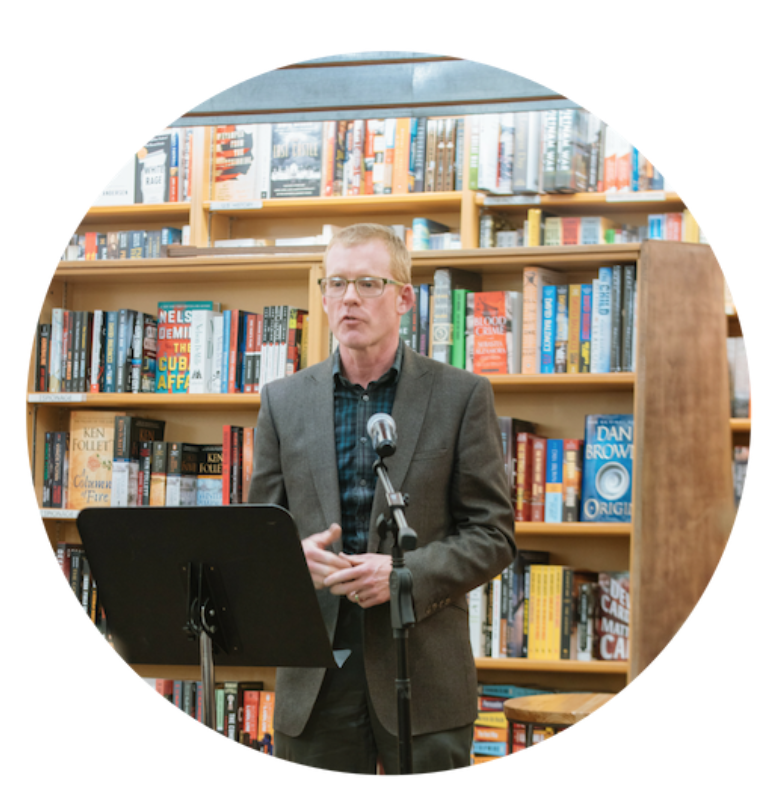
ABOUT BRIAN
I was Poet Laureate of Hampshire in the UK (where I used to live) in 2012‑13, and in America I won the Maureen Egen Award from Poets & Writers in 2017. I’ve had poems published in magazines, competitions, and art events on both sides of the Atlantic. And I’ve taught at three colleges/universities, visited dozens of schools as a visiting Teaching Artist, and worked with hundreds of adult students through my own workshops and courses.
Brian coached the Maine State Poetry Out Loud (POL) champion Joao Victor before he traveled to the national competition where he finished in the top 10. Brian served as a judge for POL during 206-2018. POL is open to all Maine high school students and administered by the Maine Arts Commission (MAC). Brian is a member of the MAC Teaching Artist roster and a Teaching Artist Leader with the Maine Arts Leadership Initiative (MALI) established in 2011.
If you want to learn more check out the site and contact Brian at brian@brianevansjones.com and please let him know I sent you.
I Am Grateful for Dance
December 1, 2020Thornton Academy Dance program
The dance education program at Thornton Academy is well established and meeting the needs of all learners who are deeply engaged in their learning. Thornton Dance educator and Maine Arts Leadership Initiative Teacher Leader Emma Campbell has high expectations and understands how to connect with all students.
Every year Emma has students respond to the question – What am I grateful for? In a non-Covid year student responses write their gratitude notes on giant cut out leaves and tape them to the mirror in the dance studio.
This year the assignment was adapted to replicate while students are at home this year. They use the Google app called jam board to draft the notes. So everyone contributes a sticky note and then they get to pick from that as groups of that makes sense. Students use this format so there was no need to learn a new concept for the project.

Emma splits the group into breakout rooms to brainstorm thoughts and ideas and recorded one voice from each group and sent Emma the recording. She screen recorded them saying the phrase. Emma takes the footage and voices and does the editing and uploaded it to YouTube. The results are below. A wonderful way to incorporate dance into student thoughts and the outcome is amazing! Thank you Emma and Thornton Academy dancers for sharing your love for dancing and your gratefulness during this season.
Celebrating Indigenous Song
November 29, 2020Global Oneness Project
Global Oneness Project is providing incredible resources which you will find below and linked.
We are part of an old story, and involved in it are migrations of winds, of ocean currents, of seeds, and songs of generations of nations.
—Joy Harjo, member of the Mvskoke Nation and first Native American Poet of the United States

Songs often reflect cultural values, ethics, and beliefs. In Indigenous cultures, songs are passed down from generation to generation and contain stories that honor ancestors and the living world: rivers, the earth, and animals. Many Indigenous songs do not translate directly into another language, a reflection of how the messages are unique and specific to people and place.
In partnership with Google Earth’s Voyager story, Celebrating Indigenous Languages, we produced an in-depth discussion guide, Exploring Indigenous Language Vitality, which provides ways for students to explore the linguistic diversity and vitality of Indigenous languages from speakers around the world. Students discover how Indigenous languages are interconnected through identity, cultural heritage, traditional ecological knowledge, and how Indigenous peoples and communities are a vital part of the fabric and story of humanity.

Use the following four question sheets we developed to further explore the Google Earth Voyager story, which contains eighty-four Indigenous peoples who share their favorite phrases and songs. Students are encouraged to make their own observations and connections.
Margaret Noodin—American poet, linguist, and Anishinaabemowin language teacher—briefly joined us during our recent webinar, “Enhancing Our Understanding: Learning and Teaching About Indigenous Cultures,” with Christine McRae from Native Land Digital. She said that one of the things she learned from her father and paternal grandmother was “the ability to listen to the world singing” around her. And, with that, she said, “there is a desire to sing back to it.” Listen to Noodin sing a beautiful poem, “Chickadee Song” (at the 1:09:55 mark) in her Native language, Anishinaabemowin. There is so much joy in this song.
If you use any of these resources in your classes Cleary Vaughan-Lee, Executive Director of the Global Oneness Project would love to hear from you by emailing info@globalonenessproject.org.
Thanksgiving Takeaway
November 23, 2020Food for thought
Susannah Remillard is a language arts teacher in Cape Cod where she has been working to “present a balanced Thanksgiving story to students.” She has been building her knowledge by participating in professional development online sessions being offered by the National Museum of the American Indian, Shelburne Farms and the Tarrant Institute at the University of Vermont. The archived webinar is available at THIS LINK.
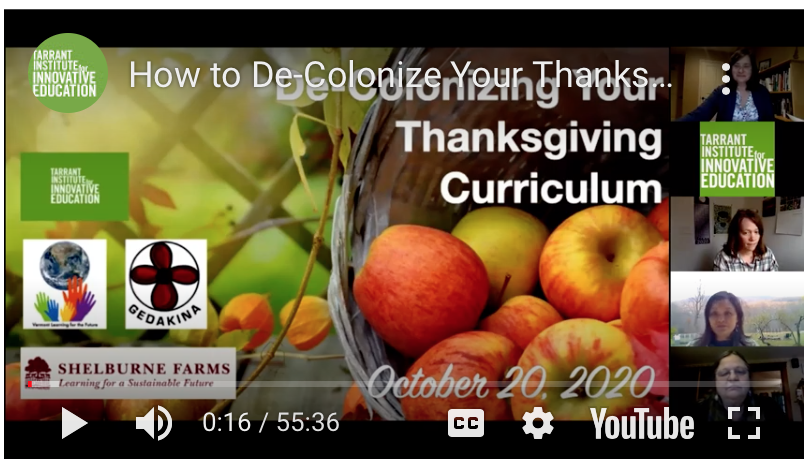
Recently she wrote Thanksgiving Takeaway for the Atlantic Black Box Project. These are her sharing points taken directly from Susannah’s writing:
- Scrub the word tribe. So many good things happen when you focus on the indigenous groups that live in your particular area and use their names. Adopt words like peoples and communities. Drop Squanto for Tisquantum and use Ousamequin instead of Massasoit. These may seem like small switches, but the thinking behind them, and the thinking you ask students to do because you have made these priorities, can teach them much about honor and respect.
- Release the primary sources into the classroom. Students need the skills we teach with primary sources, the skills of discernment and comparative analysis, even though these documents can be challenging to analyze. Present them with voiceovers. How is your colonial English accent? It doesn’t really matter. When students examine sources from a time period, they feel that they are solving the puzzles of the past, so they often come to realizations in authentic and deeply felt ways. Give them the time and space to do this work.
- Talk about the difference between inaccurate and inappropriate. Talk about how an inaccuracy can start a conversation, but inappropriateness can often shut one down. Bring in the mascot debate, even when it’s hard to talk about or you can’t find an easy counter argument for every justification. Use examples with white people. Talk about pain. These are important conversations that bring up hard historical truths that need unpacking today. You are in a position to do this.
- Finally, just keep doing the work. It took years for our educational system to look like it does today. It’s not a bad system, but we know how to break through some of the most damaging remnants of our colonial past, as long as we keep doing the work.
What Susannah says makes good sense and reminds me of the work my colleagues and I did when we established a Holocaust unit when we realized that the number of survivors of the Holocaust were dwindling. Primary sources and resources on the topic are plentiful today. A fair and comprehensive curriculum honoring and recognizing truth is at the foundation of education that we must all be committed to and strive for in all subjects – for the learners we presently teach and the ones not born yet.
Susannah teaches language arts at Cape Cod Lighthouse Public Charter School. She holds degrees from Colby College and the University of South Carolina and is a National Geographic Certified Educator, an NEH Summer Scholar, and a lifelong Cape Codder.
Freeport High School Theatre
November 3, 2020Antigone Now
At the end of October Freeport High School theatre program created something pretty special! Everyone felt the success and benefits from students and staff to administration and the community.
I met Natalie Safely about 3 years ago when she and dancer Nancy Salmon worked together after receiving a dance grant from the Maine Arts Commission. Natalie is the theatre teacher at Freeport High School. I had a chance to chat with Nancy last week and she mentioned the work that Natalie did this fall. I was impressed!
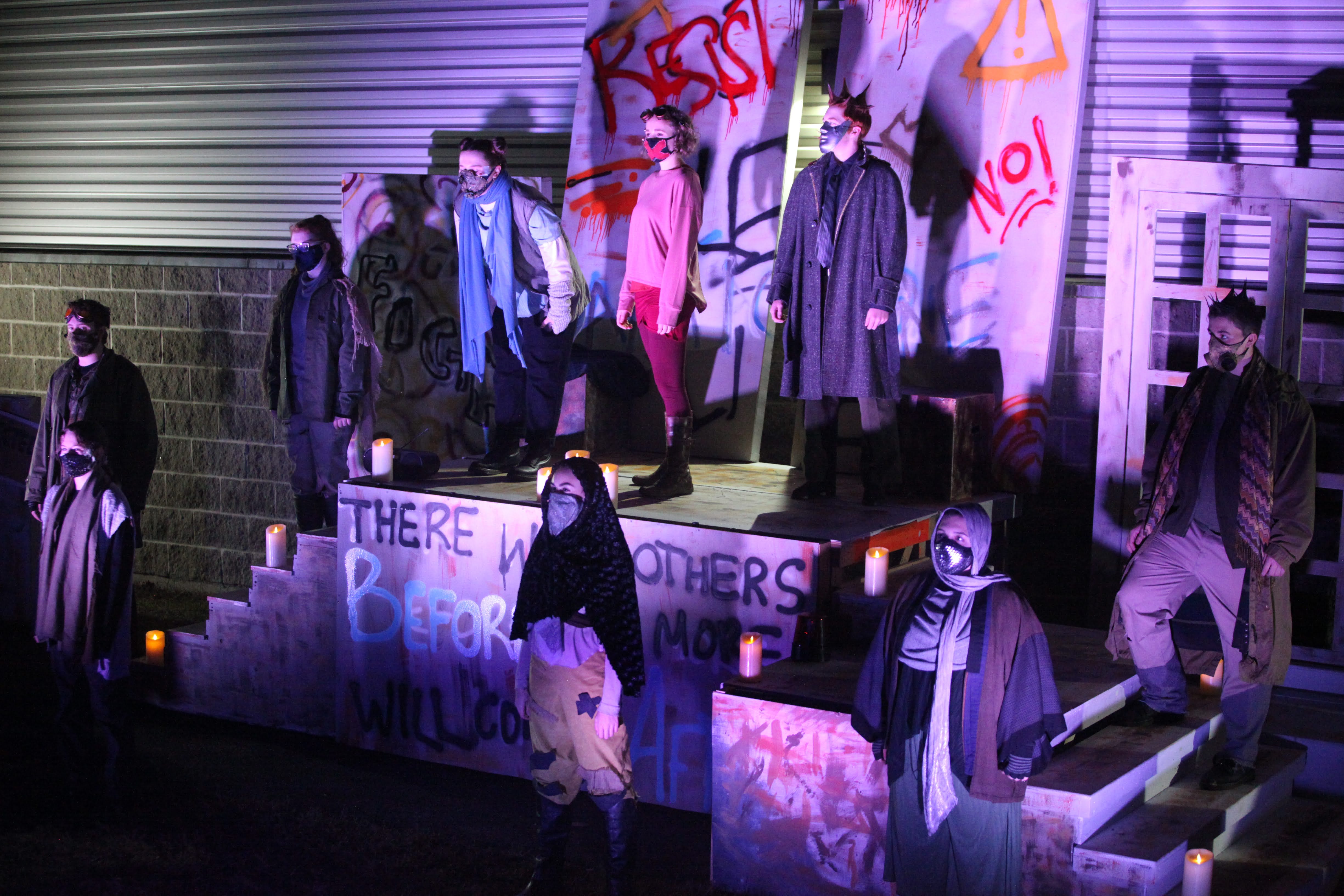
At our first meeting in the spring of 2019 I visited Freeport High School to learn more about the dance residency and the teaching and learning underway. I immediately noticed Natalie was an outstanding collaborator! This fall Natalie worked with Nate Menifield, Zoe Konstantino, and Ben Potvin and Freeport students and in five weeks they put together and performed the play Antigone Now. It is a GREAT example of the amazing work that takes place when we collaborate and focus on the pathway and possibilities! Looking at the file of photos taken by parent Ingrid van Duivenbode illustrates the magic of the performance. It was performed outside practicing appropriate pandemic safety abiding by the CDC guidelines.
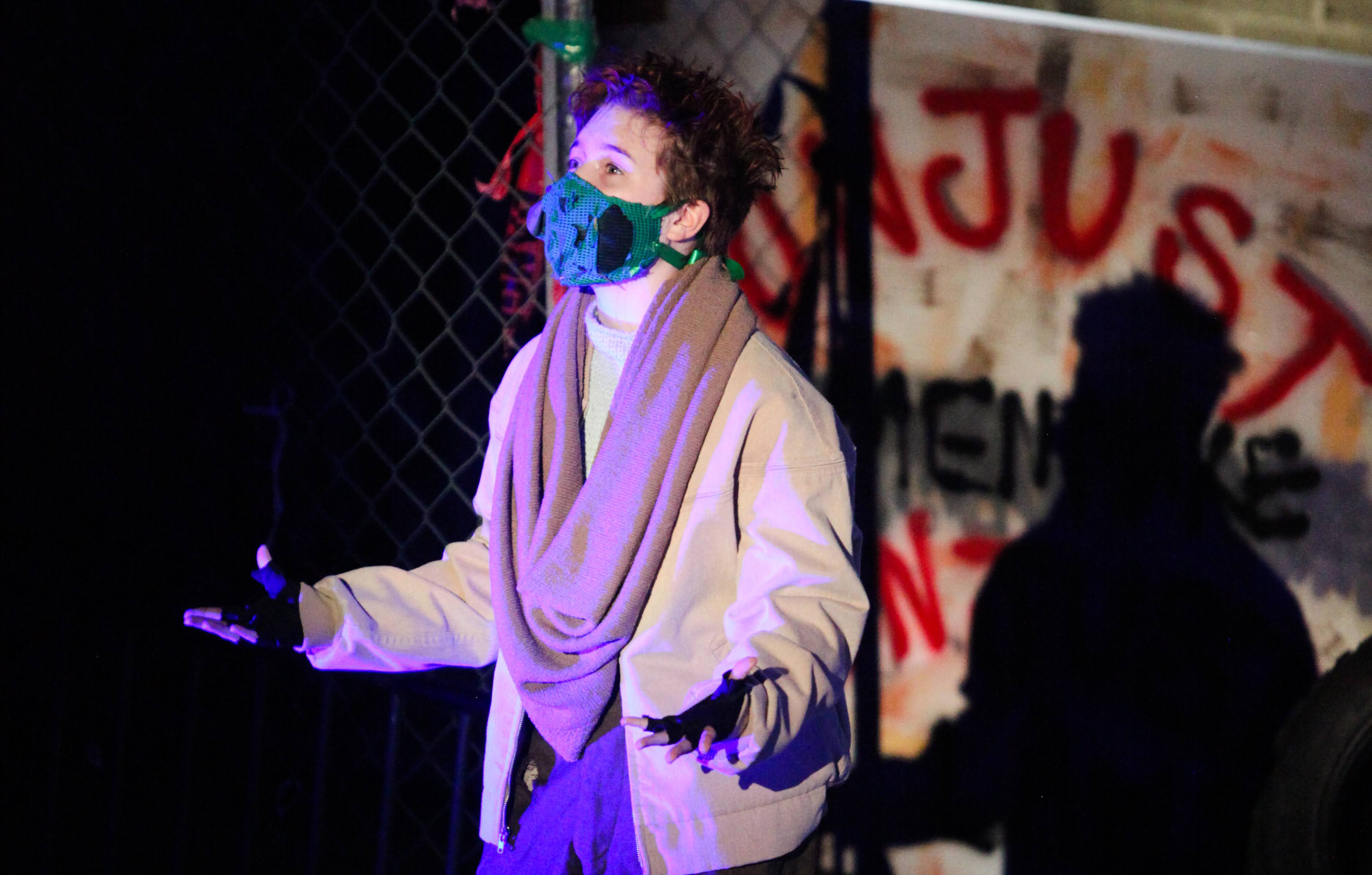
Antigone Now, by Melissa Cooper was performed by Freeport High School’s Theatre Arts program on October 23, 24, 25. Nancy Salmon was fortunate to attend and she said: “My husband and I saw the 2nd night of Antigone Now at Freeport High School, tucked into a U-shaped alcove outdoors. We were SO impressed by and proud of the students (on “stage” and tech), the directing staff and the administration who made this COVID-safe, live performance of quality, resonating theater a welcome relief from Zoom.“
They had to keep the cast and crew under 50 in order to be able to rehearse indoors.


I am grateful to Natalie that she took a few minutes out of her busy schedule to answer a few questions.
How did you come up with the idea to perform outside?
“When schools closed last March, we were working on two different productions. As the days became weeks, and the weeks became months, we soon realized that our stage, like thousands of others, would remain dark. We didn’t know when we would be able to perform again. During a socially distanced walk with a friend, I was explaining how we couldn’t do a musical, how we can’t dance, and on and on. She said, “Natalie, why don’t you do a play with masks?” I was too close to the situation. I was focused on all of the things we couldn’t do instead of focusing on the things we could do! Sometimes, we get in our own way. When we are able to look outside ourselves: other perspectives, other options, other interpretations, the impossible becomes possible. With perseverance and flexibility we were able to create a live piece of theatre that six months ago seemed impossible.“

What did it involve taking the performance out of doors?
“In two words: Ben Potvin…It was a lot more difficult than I had anticipated. The first challenge was agreeing where on campus we could put up a set that had access to power, where cars would not drive by and where we would not be competing with sporting events and practices. When we finally agreed on a location, then came the logistics of building a moveable set. Once we got into tech week the lighting and sound had to be set up and taken down each night. We set up the soundboard in a classroom that acted like a booth where the stage manager called the cues, sound board op and spot operator ran their cues from there, however we had to set the light board up in a different location because we couldn’t keep social distancing with four students in the area we were using as a booth. The sound was our biggest challenge. There were so many outdoor factors that came into play: airplanes flying over, sound from the traffic on I-95, masks and mic placement, sound signals cutting in and out for a variety of reasons. When I approached my principal, I said, “No problem, we can do it outside!” It took a knowledgeable tech director (Ben Potvin) to work through a lot of logistical challenges.“

How did you keep the students safe while practicing, creating set, and performing?
“Everyone had to use hand sanitizer before entering the space and throughout rehearsal. Longer rehearsals everyone was reminded to take a moment to wash their hands. Masks were worn by all inside and out.To keep the actors safe during rehearsal we put tape marks on the floor indicating 6 feet distancing, no actors shared props–we did have one prop that needed to be brought on by one actor and then used by another–as a cast we figured out that he could wear rubber gloves to bring it on stage. The actors did not wear makeup, they executed their own hair design, put on their own microphones and did not have any costume changes. During tech calls, all tools were sanitized before and after each use. Techs wore masks when working inside and outside as well as maintaining social distancing.“
Tell a bit about the support and from who to make it happen
“Our principal, Jen Gulko, is incredibly supportive of our program. After explaining to her how we would adhere to all guidelines she approved our pursuit of producing a fall play.
We have an amazing artistic team: Ben Potvin (Technical Director), Nate Menifield (Music Director) and Zoe Konstantio ( Choreographer) and myself as Director and Producer. These positions were in place for the fall musical, however we quickly transitioned our roles to put on a play in 5 weeks. It took each member of the team to make this happen! Nate focused on the text analysis and vocal performance, Zoe and I focused on staging and movement, and Ben focused on the tech. With each one of us able to focus on one area, the students were more focused and remained on task.“
I hope that this blog post provides you with inspiration to figure out how you also can perform with your students. I’ve included the Press Release below so you can get the full impact and hopefully take away some ideas that you can adapt for your own work this year.
Antigone Now, FALL PLAY, PRESS RELEASE
A battle for honor takes place in Freeport High School’s upcoming production of Antigone Now, a modern adaptation of Sophocles’ Antigone, written by Melissa Cooper.
Contact: Natalie Safley, 207-865-4706 ext. 801, safleyn@rsu5.org
October 12, 2019
Freeport, ME– “Theatre artists have been wearing masks since 400BC, so why can’t we?” said Natalie Safley, Theatre Arts Director at Freeport High School, when discussing their upcoming fall play performance. When schools shut down last March due to the Covid-19 pandemic, hundreds of theaters also went dark, cancelling shows across the country. Once Safley learned that RSU 5 was going to return to school this fall under a hybrid plan (where students attend in person part of the time), she immediately reached out to FHS Principal, Jen Gulko, to discuss doing a fall production. Maine CDC guidelines prevent musical performances at this time, and currently limit outdoor gatherings to 100. Safley and Gulko determined that a small-cast fall play – produced outside and in accordance with all current safety guidelines – could take place. Safley rushed to choose a script, gather her artistic team, and conduct auditions. Of the experience, she notes, “Putting together a show in 5 weeks instead of 10 is an unbelievable undertaking, but FHS accepted the challenge!”
Playscripts, Inc. describes this adaptation as a “…contemporary response to the myth of Antigone…” Antigone (played by FHS junior, Ella Vertenten) strives to bury her brother, Polyneices, with honor, defying a decree from the king (who also happens to be her uncle) that, “No one may bury him, no one may touch him. It’s against the law.” Drama ensues as the characters fight to preserve the laws of the city while keeping the family intact.
All performances will be held outdoors, Friday-Sunday, October 23-25, at 7PM, adjacent to the entrance to the Joan Benoit Samuelson Stadium (30 Holbrook St., Freeport, Maine). Tickets must be purchased in advance; no tickets will be sold at the door. All patrons must wear a mask, practice social distancing, and should bring a blanket or chair to sit on.
Purchase tickets to live performances here:http://bit.ly/FHSAntigone
Direction: Natalie Safley, Nate Menifield, Zoe Konstantino
Technical Direction: Ben Potvin
* Patrons must bring their own chair or blanket to sit on
*Masks and Social Distancing in place
Contact Natalie Safley, safleyn@rsu5.org
Art and Climate Change
November 2, 2020Student response
Thank you to Cynthia Pease, art teacher at Deer Isle Stonington High School, for providing the information for this blog post.
The Deer Isle Stonington High School 8th grade Art students have produced a number of paintings reflecting their thoughts and feelings about climate change and their global concerns. In this show, you will see hope, anger, humor, and a plea for everyone to wake-up and take action. Above all else, the art show reflects the concerns our students have for their future. This show is about raising awareness!
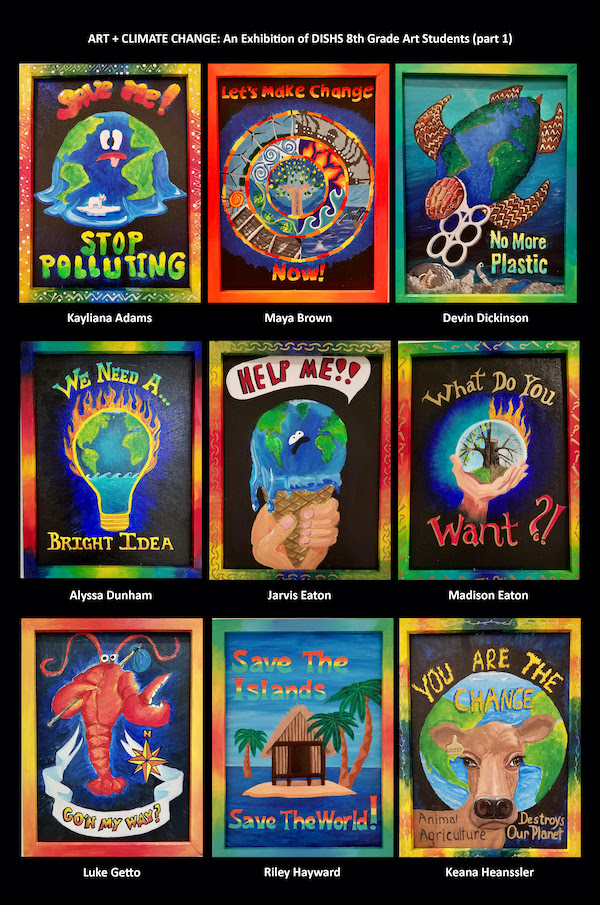
In order to achieve this level of work, students researched the topic they connected most with. There were weekly critiques and class discussions on each topic chosen. Sketches were created and refined with a focus on the Elements and Principles of Art and included Type Face as an element of their designs. Color compositions and final drawings were created prior to the final work being painted. These students “earned” a higher level of recognition because of the hard work, grit, awareness, and level of honesty they have portrayed in their final work.
To bring this show into the public light, we give great thanks to the climate change organization, Climate Action Net (CAN), and to the DIAA Gallery for hosting this show. Other elements of this initiative included a conversation with these young artists about their work and the climate situation they are inheriting. The interviews were conducted by Rob Shetterly of Americans Who Tell the Truth. The paintings will be displayed on the CAN website in order to select a painting which powerfully communicates a young person’s view of Climate Change. The most popular painting will be reproduced on ‘T’ shirts and offered for sale in order to raise money for school ecological initiatives, such as solar panels.

Special thanks to Tony Ferrara for his support, commitment and passion to inspire and motivate young people to take action. From the bottom of our hearts, we thank you! Our deep gratitude goes to DIAA for hosting this event.
Cynthia expresses many thanks to Dennis Duquette for positive energy and support and Little Eagle for making all the frames.
Bates College Museum of Art
October 29, 2020Ashley Bryan
In the October 18 edition of the Portland Press Herald I learned that Henry Isaacs and Donna Bartnoff Isaacs have donated several of Ashley Bryan’s paintings to the Bates College Museum of Art. They made a commitment years ago when they started collecting Ashley’s art that it would remain in Maine. Henry painted with Ashley on Little Cranberry Island for years and Donna was the teacher in the islands one-room school house where Ashley was a visiting artist. When the Isaacs’ decided to move to Vermont they knew they wanted to insure that some of Ashley’s paintings will remain in Maine where they were created. The Ashley Bryan Center on Little Cranberry Island donated Ashley’s personal papers, to the University of Pennsylvania in Philadelphia. Over the next few months the center plans to donate other works to Bates as well as Bowdoin and Colby museums, Portland Museum of Art and Farnsworth Art Museum and the bulk of his puppets going to the College of the Atlantic.
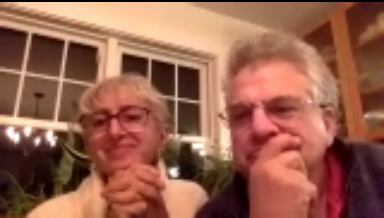
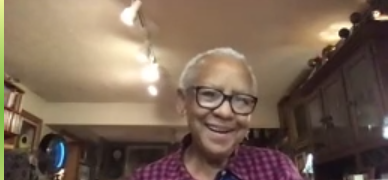
On Thursday, October 22 the staff, Dan Mills, the museum’s director and Anthony Shostack, curator of education provided a zoom event. Ashley’s good friend and poet Nikki Giovanni shared stories and knowledge of Ashley’s work through their long friendship and many collaborations. It was a treat to have Henry and Donna on the zoom session. A much larger treat was Ashley Bryan himself. Ashley had COVID-19 in the spring while living in Texas. He recovered but for the first time he was unable to travel to his beloved Little Cranberry Island. Recently he broke his wrist but is recovering well. Now 97 years old he is hoping to be able to travel again to the island next summer.
The information below is from the Museum of Art Bates College website about the Ashley Bryan exhibit which opened on October 20. Unfortunately the museum is not open to the public at this time but the staff is providing an enormous amount of resources online specifically about the Ashley Bryan exhibit and many other resources as well.

Fortunately the museum recorded the zoom session and you can view it at <a rel="noreferrer noopener" href="http://" data-type="URL" data-id="<iframe width="560" height="315" src="https://www.youtube.com/embed/9_CuajU6tEE" frameborder="0" allow="accelerometer; autoplay; clipboard-write; encrypted-media; gyroscope; picture-in-picture" allowfullscreen>THIS LINK. In addition they will be creating a virtual tour of the exhibit which can be viewed on the museum website.
October 21, 2020 – March 20, 2021
African American artist Ashley Bryan is one of Maine’s cultural treasures. A noted painter, printmaker, illustrator, author, puppet maker, and storyteller, Bryan, who turned 97 on July 13, came to Maine as a member of the first class to attend Skowhegan School of Painting and Sculpture in 1946. He began to summer regularly in the Cranberry Isles, a group of islands off Mount Desert Island, in the late 1940s, and has lived on Little Cranberry Island year-round since the late 1980s. In 2019, Henry Isaacs and Donna Bartnoff Isaacs, longtime friends and neighbors of Bryan’s on Little Cranberry Island, donated over fifty works of art including paintings, drawings, and prints, and numerous other items including copies of his books. The core of this exhibition is drawn from this generous gift.
Bryan’s passion for storytelling was fueled by trips to the public library as a child, where he read folktales, novels, biographies, and poetry. However, there were few opportunities to identify with African-Americans in the books he found. This is a problem he has been determined to address in his books ever since. Bryan has written and illustrated more than fifty books, many inspired by African folktales and Black American spirituals. These include award winning titles such as: Infinite Hope: A Black Artist’s Journey from World War II to Peace (2020); I Am Loved (2018), Freedom Over Me: Eleven Slaves, Their Lives and Dreams Brought to Life by Ashley Bryan (2016); Ashley Bryan: Words to My Life’s Song (2009); Beautiful Blackbird (2003); All Night, All Day: A Child’s First Book of African American Spirituals (1992), among many others. Illustrations from selected books, and a reading area are part of the exhibition.
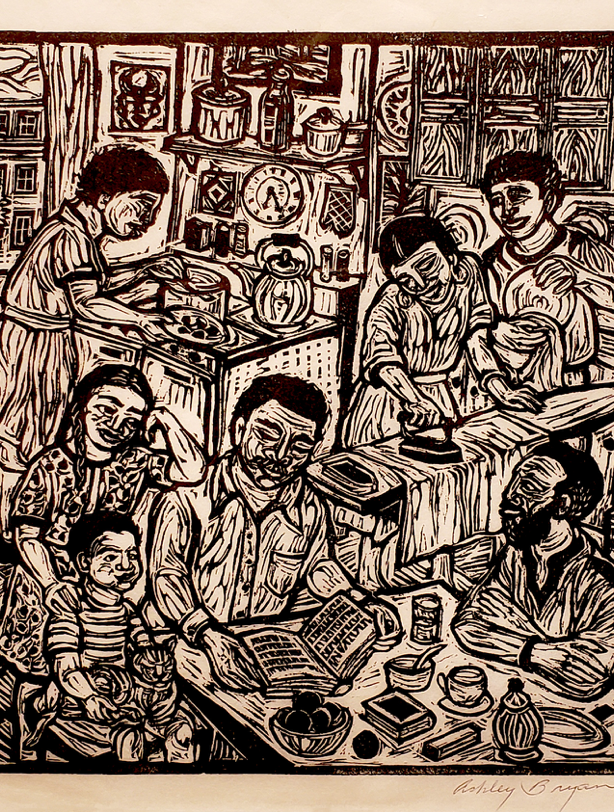
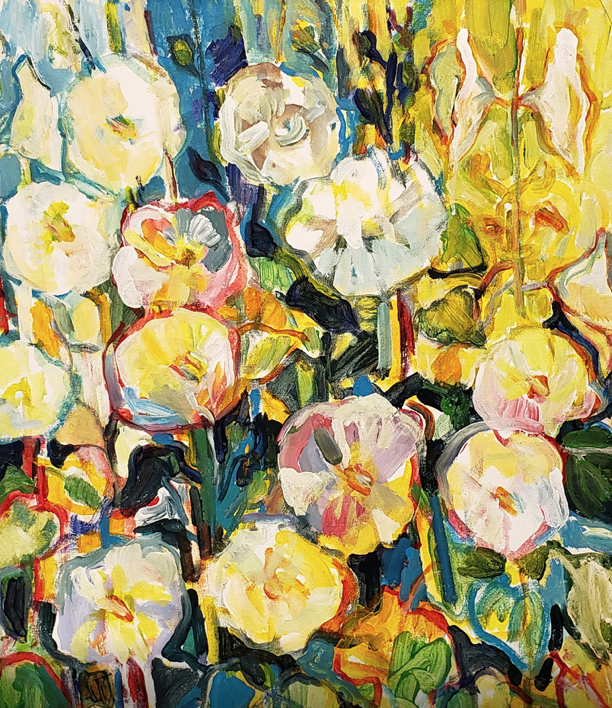
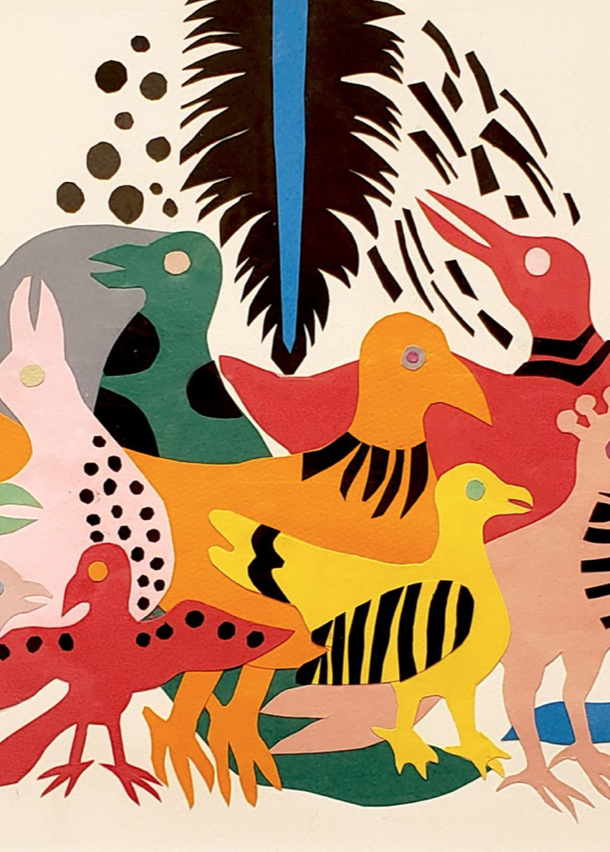
Like his book illustrations, Bryan’s paintings are varied in subject. Works from earlier in his career are often expressionistic and representational painted in a naturalistic palette, with subjects including family, friends, musicians, landscapes and gardens, and images painted while abroad. Later paintings share the brilliantly colorful palette of many of his book illustrations, and include lush and vivid gardens and scenic images from Little Cranberry Isle. In the artist’s words,
“I can’t remember a time when I have not been drawing and painting. In kindergarten, when I learned the alphabet and then drew the pictures for each letter, it was a wonderful experience because the teacher said I had published a book when I reached the end and sewed it together. Because of the encouragement I received as a child, in school and at home, I continued doing those books. I don’t know how much those experiences were actually behind what I’m doing now in a direct sense, but it was the spirit in which it was opened to me, that in which I really believed.”
Ashley Bryan was born in Harlem, New York, in 1923, and grew up in the Bronx during the Great Depression. His parents emigrated from Antigua in the Caribbean and settled in New York City after the First World War. When applying for scholarships to art schools as a 16-year old, he was told his portfolio was among the most impressive submitted, but he was denied acceptance, because “…it would be a waste to give a scholarship to a colored person.” He was accepted to Cooper Union School of Art and Engineering in 1940 where the application process was based solely on Bryan’s portfolio and “they did not see me.” Bryan was drafted into the segregated US Army while a student, and he was on Omaha Beach on D-Day in World War II. Bryan earned a BS cum laude from Columbia University, received a scholarship to attend the Skowhegan School of Painting and Sculpture, and continued his studies at Université d’Aix-Marsaille, France, in the 1940s, and at the University of Freiburg, Germany on a Fulbright scholarship in the 1950s. He taught art at numerous institutions In New York and Philadelphia between 1960 and 1973, and taught at Dartmouth from 1974-88.
The museum is deeply grateful to Henry Isaacs and Donna Bartnoff Isaacs for so generously donating their Ashley Bryan collection of art and books, and for sharing their knowledge and insights into Bryan’s work. With this gift as a wonderful foundation, the museum hopes to develop a significant collection of Bryan’s art, particularly his paintings, in Maine, the state he has been connected to for almost 75 years. Thank you to Henry and Donna for supporting the exhibition and its education/outreach programs for area schoolchildren.
The museum is also indebted to Merry White for lending a fine painting to the exhibition. A special thank you to Marcia and Daniel Minter, and Ashley Page, of Indigo Arts Alliance in Portland for collaborating with us on educational materials and activities from The Beautiful Blackbird Children’s Book Festival, which are included in the exhibition and part of the educational programming for area schoolchildren. A heartfelt thank you to Virginia Fowler and Nikki Giovanni for generously supporting the exhibition’s education programming. Thank you to Diverse BookFinder, and especially Krista M. Aronson, Professor of Psychology and Associate Dean of the Faculty, for advice and participation in programming.
This exhibition and programming are funded in part by the Jane Costello Wellehan Endowment Fund.
I’ve blogged about Ashley Bryan several times in the past. Got to the side bar and type in Ashley Bryan in the search archives window and you can click on each of the links if you’d like to learn more. My favorite post from the past was the story about music teacher Kate Smith and I traveling to Little Cranberry to visit Ashley in his home and studio. It was a magical day! Read about it!
Institute for Arts Integration and STEAM
October 28, 202013 Strategies for Making Thinking Visible in the Classroom
For many educators focusing on the process and not the product has been a gradual change. The pandemic has forced this shift rapidly and educators are gracefully embracing it in many cases. This requires a growth mindset and ideas and suggestions from supportive colleagues. Susan Riley’s Institute for Arts Integration and STEAM has put together a comprehensive list of strategies that you can apply (in person and/or remotely) in your classroom environment that will make your students thinking visible.
Why make learning more visible you may wonder? Critical and creative thinking skills are an integral part of teaching and learning, always have been part of arts education. I’m glad that other educators have gotten on board with this in this 21st century. One key for developing and assessing critical and creating thinking skills is to making thinking more visible. If we can see the process students are using to analyze problems, make predictions and draw conclusions, teaching and guiding students thinking becomes easier.
I encourage you to take a look at the ideas Susan Riley suggestions below to support your teaching and students learning.

- Use Artful Thinking Routines
- Try Close Reading of an Art Composition
- Connect with Cooperative Poetry
- Explore Ekphrasis Poetry for Vivid Language
- Generate One Word Focal Points
- Develop Collaborative Narrative
- Sketch to Write
- Create an Art Recipe
- Design Haibun Poems
- Perform a Human Slideshow
- Build Summarizing Skills
- Composing a Soundtrack
- Produce Curriculum-Based Reader’s Theatre
Resources Supporting Arts Education
October 19, 2020Amazing work

I know how time consuming it can be for teachers to collect resources so I’ve put together another list to help support your work – this one compiled over the last several weeks. Hopefully you’ll find the information informative!
- Neuroscience and Music written by Cassandra Sheppard – At a time when singing in school is marginalized this article/research reminds us that we need to sing!
- ArtsEdSearch A hub for research on the impact of arts in education where you’ll find academic studies and resources
- pink portfolio exercises As in Daniel Pink who I heard speak about the importance of the creative thinking people.
- Onion Foundation Funding source for Maine education
- STE(A)Mrolled Blog post from Americans for the Arts. Writer Daryl Ward is the principal of the Harrison School for the Arts in Florida.
- Teaching Arts Education Advocates Blog post for Americans for the Arts. Written by Jennifer Katona, Director and Founder of the Graduate Program in Educational Theatre at the City College of New York (CCNY), oversees the certification of pre and in-service Theatre teachers and training of non-certified theatre educators.
- The Teaching Channel has outstanding resources. Here’s one: Post Modern Art: Everything Is Information
- Collective Impact in the Arts – Createquity. One persons information on the possibility of developing a collective impact model for the arts. Written by Ian David Moss a few years ago but information is still relevant for those interested in this work.
- Deeper Learning: Why Cross-Curricular Teaching is Essential written by Ben Johnson for Edutopia. More difficult but so many benefits that outweigh not doing this type of teaching.
- Unlocking Passion in Education written by Tom Segal for Education Week. Another older article but good information.

 me arts ed