Archive for the ‘Standards’ Category

h1

National Endowment for the Arts Webcast

February 21, 2012

Arts Education Standards & Assessment Focus of National Endowment for the Arts (NEA) Roundtable and Webcast
On Valentine’s Day the NEA held an all-day webcast that was very interesting and engaging. The panels scheduled throughout the day shared relevant information to arts education. Many of the points made and the information shared about standards and assessment, Maine is either involved with doing or it is on our radar to explore or to put in place.

A recording of the entire day is scheduled to be available starting today, February 21, 2012 at this link http://www.arts.gov/research/convenings.html. At this link you can download the report (listed as National studey of arts educadtional assessment tools and strategies) NEA had released prior to the webcast: Improving the Assessment of Student Learning in the Arts – State of the Field and Recommendations. Also available is the agenda for the day, and information about the individuals who participated on the panels.

The following is information that provides an overview of what occurred during the day.

As the field of educational assessment advances, and as alternatives to standardized tests emerge, the tools used to evaluate student learning, such as portfolio reviews, are beginning to gain greater currency. Given this development, it is even more important to examine arts educational standards and assessment tools to ensure that arts learning can become a vital force for enhancing 21st -century skills. This is the first time that the NEA has taken a comprehensive look at this issue via the roundtable, webcast, and new research report, Improving the Assessment of Student Learning in the Arts: State of the Field and Recommendations.

NEA Chairman Rocco Landesman and the U.S. Department of Education Assistant Deputy Secretary for Innovation and Improvement James H. Shelton III opened the roundtable. Following the welcome, a series of panels and presentations examined the latest trends, current practices, and future directions for arts learning standards and assessment methods.

Commissioned by the NEA from the evaluation firm WestEd, this national research report describes the current state of arts learning assessment tools and techniques. It provides a description of the current state of arts assessment from the perspective of two groups of stakeholders: district and school staff as one group, and policy-makers, arts organizations, and researchers as a second group. That report includes a literature review and an examination of stakeholders’ experiences with assessment, common practices, and needs of the field as identified by stakeholders.

Below are some of the quotes that I found that resonate with the work we are doing in the Maine Arts Assessment Initiative:

  • Stuart Elliott (Director, Board on Testing and Assessment (BOTA) of the National Research Council): “Standards don’t make a difference, implementation does“.
  • Sammy Hoi (Otis College of Art and Design): “Three keys: 1) Understand change 2) Shift from goods to services and 3) Readiness to solve problems
  • Dennie Palmer Wolf (Wolf/Brown Associates) : “When we talk about the arts we need to look at the long haul as well. Cultural change takes a fairly long time.”
  • Phil Shephard (Project Manager, National Core Arts Standards): “The National Core Arts Standards will include a web-based environment with teacher practice examples, student portfolios, and the ability to make changes to the document so it won’t become stagnant.”
  • Nancy Rubino (College Board): “The research we did for the National Coalition for Core Arts Standards including the review of arts standards from 15 countries – research structures, learning outcomes, guiding principals, and where possible assessment strategies. Noteworthy was learning outcomes that featured students connections to other avenues. China art and emotion and art and culture and art and science.  Also, attitudes and values, connect the arts to real learning contexts”.
  • Unknown: “Arts ed is prepared to lead the way when it comes to educational reform.”

I hope you will download the WestEd report to learn how it can inform your communication and decision-making at the local level around teaching, learning and assessment in the arts.

I don’t recall who said this but I do love it: CCO – Chief Creative Officer – Arts Teachers!
h1

Arts Standards, 21st Century Skills, Common Core

January 24, 2012

Webinar explains connections

Last Tuesday my colleague, Joyce Huser, from Kansas presented a webinar to SEADAE (State Education Agency Directors of Arts Education), our professional organization of state arts specialists on the topic of arts standards, ELA Common Core, and the 21st Century Skills Map. The webinar was very helpful and I hope you will have 45 minutes to listen to it. The resources and link to the webinar are on the arts education webpage at the Maine Department of Education at http://www.maine.gov/education/lres/vpa/eor.html#webinars

Joyce was on the team that created the Art Skills Map for the Partnership for 21st Century Skills. The partnership is a national organization that advocates for 21st century skills for every student. The document provides information on how the arts teach 21st century skills and fulfill the needs for today’s learners. The webinar provides the connections (crosswalk) between arts standards, Common Core ELA standards, and the 21st century skills. The power point includes a graph that exhibits the skill demands for arts related careers for 2008 – 2018 which shows the skills taught in arts education classes.

h1

National Standards for Arts Education

January 23, 2012

Update on national work

For anyone wishing to listen in on the live video stream of the National Coalition of Core Arts Standards meeting on Tuesday, January 24th in Reston, VA the link is: http://nccas.wikispaces.com/Framing+Meeting+-+Reston%2C+VA+-+Jan+2012

Four State Education Agency Directors of Arts Education (SEADAE) members have been nominated by the National Coalition for Core Arts Standards to serve with the writing teams that will produce the next generation of arts standards. SEADAE member Dale Schmid of the New Jersey Department of Education will serve on the Dance writing team. SEADAE member Dr. Richard Baker of the Louisiana State Department of Education will serve on the Music writing team. SEADAE member Jack Mitchell of the California Department of Education will serve on the Theatre writing team and SEADAE member Joyce Huser of Kansas will serve on the Visual Arts writing team.

The National Coalition of Core Arts Standards (NCCAS) announced the selection of writing teams and chairs for the next generation of arts standards project on Friday December 16th. NCCAS is a coalition of eight national organizations committed to developing new voluntary arts education standards that will build on the foundations created by the 1994 National Arts Standards and, more recently, the 2005 Standards for Learning and Teaching Dance in the Arts, to help guide curriculum designers, teacher training programs, funders, and federal and state policy makers in their arts education decision-making.

NCCAS announced that they received more than 360 applications from throughout the country to serve on one of the four writing teams of dance, music, theatre and visual arts. The coalition’s professional arts education organizations chose the team writers based on breadth of experience and skills in teaching, standards and curriculum writing, assessment and leadership, and practical knowledge in their area of expertise.

Lynn Tuttle, President of the State Education Agency Directors of Arts Education (SEADAE), called the selection of writers for the project “a major leap forward in our efforts to move ahead and actually begin working in earnest.” Tuttle and other SEADAE colleagues have been a guiding force in the effort to re-envision arts standards that will embrace 21st-century technology to help classroom educators better implement and assess standards-based arts instruction. “We know that this will be a complex and challenging project,” said Tuttle. “But we also know how important it is for arts teachers to articulate the skills and knowledge that ought to be available to every student in this country. If we want students to learn, we need to give our educators a framework that will help them create and teach their curricula. I think we have the team that can get this done.”

NCCAS Leadership and the chairs will meet in Reston, Virginia January 23-24 to finalize work on a learning framework that will guide the writers, and to discuss the project’s timeline and plans to include media arts as a discrete fifth arts discipline in the next generation standards. The meeting will include a streaming public Q&A period on January 24. Links to the interactive blog and available video streams will be posted the day of the event on the NCCAS website at http://nccas.wikispaces.com/Framing+Meeting+-+Reston%2C+VA+-+Jan+2012.

h1

Maine Cohort for Customized Learning

January 22, 2012

Student-based Learning

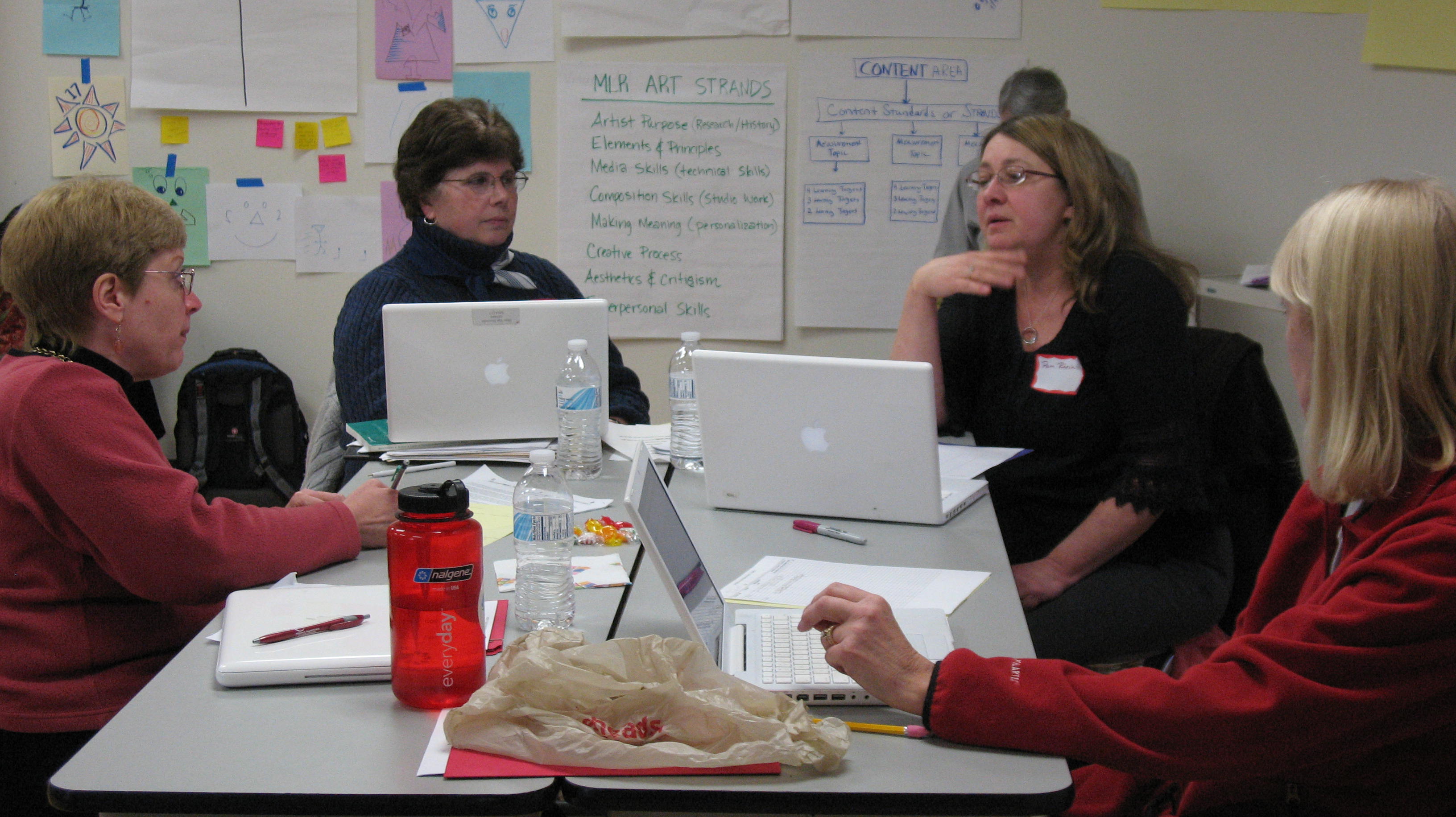
Last week the Maine Cohort for Customized Learning brought together arts teachers from their districts to begin some of the work that will help guide the teaching in arts classrooms in the cohort. At this point the cohort districts are:

  • RSU 57: Massebesic
  • RSU 15: Gray-New Gloucester
  • RSU 18: Messalonskee and China
  • RSU 2: Hall-Dale, Monmouth, Richmond, Drescen
  • RSU 82: Jackman, Forest Hills
  • Milford School Department
  • RSU 3: Brooks, Freedom, Jackson, Knox, Libery, Monroe, Montville, Thorndike, Troy, Unity, Waldo
  • Sanford Schools
  • RSU 25: Bucksport
  • RSU 4: Oak Hill

The participants started the work to create Strands, Measurement Topics and Learning Targets. This which will be the basis for the work in determining what students will need to learn to show proficiency before they leave high school. The arts teachers doing this work are:

  • Wendy Burton and Leone Donovan, visual arts, Pam Rhein, music, Messalonskee
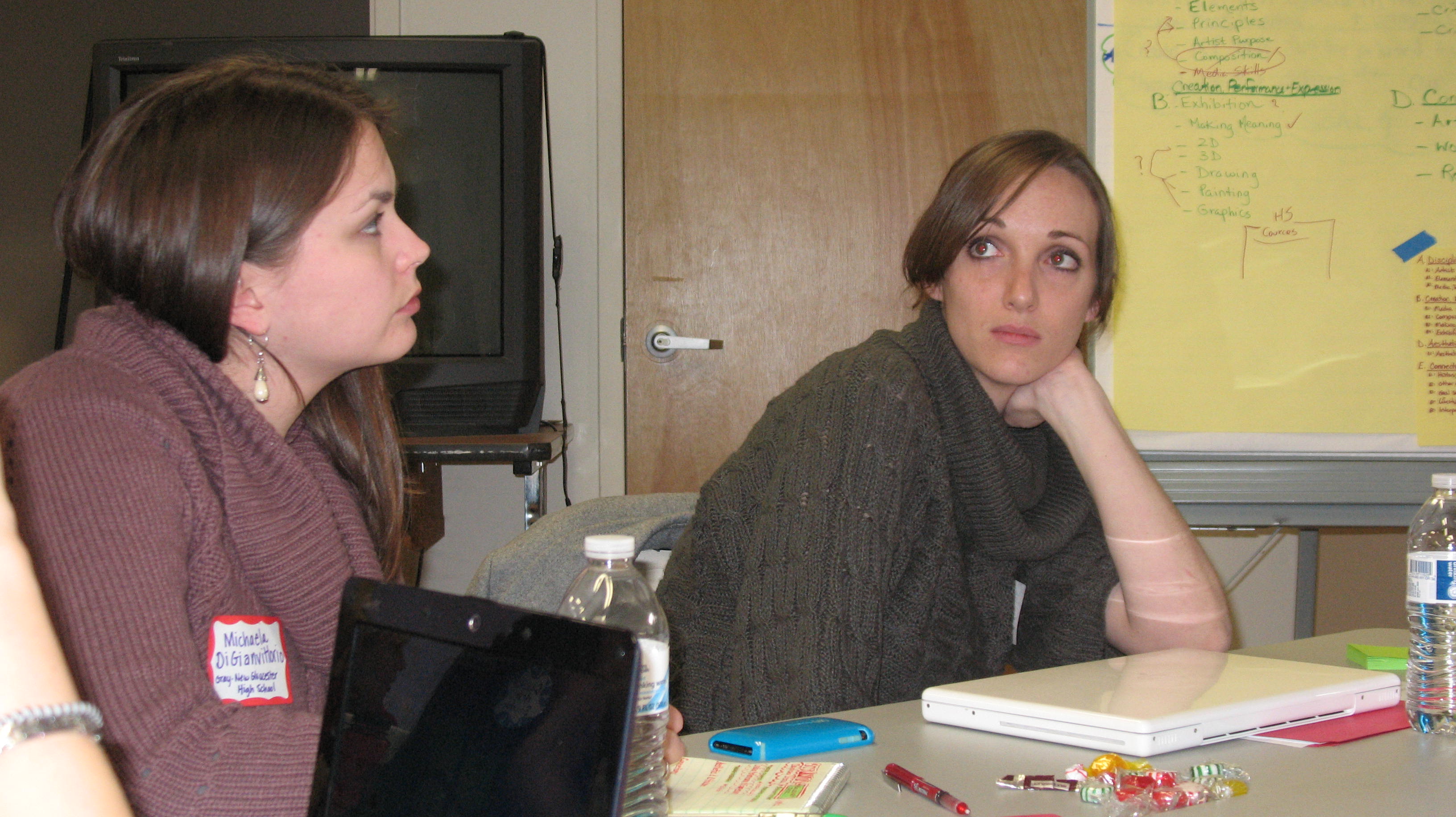
  • Michaela DiGianvittorio and Sarah Gould, visual arts, Gray New Gloucester High School
  • Jeff Orth, visual art, Richmond Middle/High School
  • Cynthis McGuire, music Hall-Dale Elementary School
  • Carrie Abbott, visual art, Jackman/Forest Hills
  • Cathy Geren, visual art, Massabesic High School
  • Matt Doiron and Carol Baker-Roux, music, Sanford High School
  • Theo VanDeventer, music/drama, Mt. View Middle School, Eric Phillips, visual art, Mt. View High School

The work will continue in February and I will keep you posted on its progress.

In the words of music teacher from Sanford High School, Carol Baker Roux:

Sanford is new to the cohort, so this was the first meeting for Matt Doiron and I.  I was glad to see people at this meeting who are also working on the Maine Arts Assessment Initiative, as I am hopeful that the cohort’s work will dovetail with the Initiative’s work, as well as the work being done currently on the national standards.  Some concerns raised at this meeting were, “Is this another passing fad?” and “Are we re-inventing the wheel?”  I think these are valid concerns and am hopeful that these will be addressed as we continue to work on developing shared, consistent strands and measurement topics.  The general sense of the people at this meeting was that the Visual and Performing Arts have good Maine Learning Results and we hope to maintain the integrity of that document going forward.

Every time I get together with arts educators in this state I am completely impressed with their intelligence and commitment to their craft.  As a discipline that has always understood meeting and demonstrating standards at a high level, we are the perfect group to model the cohort’s goals of student-centered, performance based learning.

And in the words of art teacher Leone Donovan from Messalonskee High School:

Various members of the 11 cohort schools gathered in Topsham to begin the shift towards a standards-based learning plan. It was a harder two days then I expected with less accomplished than expected. The representatives from the different schools really are at different levels in the process. Some of us needed to learn the language of this version of standards-based curriculum. Others were already working with a version of those concepts this year.

What I like about the conversations that I’ve been involved in, both in my school and at the cohort meeting, is the concept of the learner at the center of the process. I want to believe that there’s a method to create or encourage students to become active, enthusiastic managers of there own education. As a veteran teacher and a lifelong skeptic, I am still yearning for more evidence that this is truly possible. I want to see a school where it is in process with solid evidence that it is working.

We heard that transparency in the curriculum gives the student clear goals and, thus, a clear path to success or as we say in mass customized learning speak, proficiency. Students will know what we, as teachers, want them to learn. We will act as facilitators pointing out ways to master those concepts or techniques. Students can then seek, plan, and follow their own best path to achieving proficiency.

I love that theoretical view of students and learning. But, again, as the veteran and skeptic, I believe that most, if not all of us, are now very clear about our reasons and goals for the lessons we present. I keep wondering, aloud and to myself, how assessing with a 1-4 scale instead of 0-100 scale, how calling it proficiency instead of whatever our current language is, and by rewording existing curriculum yet again will inspire this change.

I hope that we learn more about places where this is in use and has concrete progress recorded. And, despite my skepticism, I’d be thrilled to see more inspired, successful, and enthusiastic students.

h1

The Arts Connect Naturally

December 6, 2011

STEM/STEAM and other connections

Recently a comment was posted to the blog that was made by a person who is not trained as an arts educator nor an artist. It was in response to the post called Reaching Students Through STEM and the Arts which was posted on January 11, 2010. Not sure why the individual didn’t comment on the several other STEM/STEAM posts that have been made since that date. The comment made me pause since I have seen two other articles of note this week. One that connect the Arts to STEM in Education Week and one from the Maine Sunday Telegram about students at Waynflete School in Portland collaborating to create 23 – 7 feet tall and 4 feet wide trees.

First a look at the Ed Week article called STEAM: Experts Make Case for Adding Arts to STEM written by Erik W. Robelen. Mr. Robelen provides examples of schools across the country where the arts are connecting with STEM. One example is “the Philadelphia Arts in Education Partnership, with support from a $1.1 million Education Department grant, is working with city schools to help elementary students better understand abstract concepts in science and mathematics, such as fractions and geometric shapes, through art-making projects.

“Educators are finding where the arts intersect with the STEM fields to enhance student engagement and learning, and educators are finding that it helps unlock creative thinking and innovation.

Doesn’t sound like anything new to me or to arts educators who have been connecting curricula to deliver arts education in practice for years. In fact, arts educators understand the connections and our understanding is much greater than just to other content as stated in the Maine’s 2007 Learning Results: Parameters for Essential Instruction.

Standard E – Visual and Performing Arts Connections:

  1. The Arts and History and World Cultures
  2. The Arts and Other Disciplines
  3. Goal-Setting
  4. Impact of the Arts on Lifestyle and Career
  5. Interpersonal Skills

The work at Waynflete this month is a great example of the value of connecting content. The outcome is an exhibit called “Arboretum”. This is taken from the December 4th article written by Bob Keyes: Students conducted all kinds of research about trees, including their environmental impact, their ecological value, their role as habitat for animals and the sacred nature of trees in certain religions. Jeff Tarling, the city’s arborist, came in to talk to the students about trees in Portland, and why some survive and others do not.

As part of the process, Waynflete art teacher and gallery director Judy Novey challenged the students to create something artistic from their research. She urged them to think about the form and rhythm of trees, and to visually represent their research through their work.

These students did not approach their work as an art project at all. It had more to do with science and culture than anything with a creative quality. But as they worked through their tasks, the students said they felt their creativity willing itself to the fore.

When I reflect on my teaching the most successful and memorable work was when students had no idea what classroom they were sitting in nor what subject they were focusing on but it was the magic of learning that was taking place. Life-long learning that becomes embedded in the way we think. The culture of the classroom and school is transformed.

So, I ask you… should we be connecting with the STEM movement currently taking place in education, should we encourage our students to think beyond STEM to help them think and create artistically?

h1

National Core Standards and Vacation

November 15, 2011

Beautiful Arizona

The first three days in Arizona were very warm but the weather was dry so it didn’t feel like 92 degrees was terribly hot. The hotel was about 5 blocks from Arizona State University so I had a chance to walk before moving to the air conditioned room where the meetings on the National Core Standards were held. We ate lunch outside and met in small group work outside as well so it made the work even more pleasant.

Thirty one of my colleagues from othe states part of the State Education Agency Directors of Arts Education (SEADAE) organization attended the three day meeting in Phoenix the first week in November. We met with our partners from the National Coalition for Core Arts Standards who are:

  • Lynne Kingsley, Executive Director, American Alliance for Theatre and Education
  • Amy Jensen, Advocacy Director, American Alliance for Theatre and Education
  • Sandra Ruppert, Director, Arts Education Partnership
  • Michael Sikes, Senior Associate for Research and Policy, Arts Education Partnership
  • Nancy Rubino, Director, Office of Academic Initiatives, College Board
  • James Palmarini, Director of Educational Policy, Educational Theatre Association
  • Michael Peitz, Executive Director, Educational Theatre Association
  • Michael Blakeslee, Senior Deputy Executive Director and Chief Operating Officer, The National Association for Music Education
  • Scott Shuler, President, The National Association for Music Education
  • Deborah Reeve, Executive Director, National Art Education Association
  • Robert Sabol, President, National Art Education Association
  • Barry Shauck, Past President, National Art Education Association
  • Jane Bonbright, Executive Director, National Dance Education Organization
  • Susan McGreevy-Nichols, President, National Dance Education Organization
  • Deb Hansen, President, SEADAE, Delaware Department of Education
  • Linda Lovins, National Expectations for Learning in Arts Education Tri-Chair, SEADAE, Florida Department of Education
  • Marcia McCaffrey, National Expectations for Learning in Arts Education Tri-Chair, SEADAE, New Hampshire Department of Education
  • Lynn Tuttle, National Expectations for Learning in Arts Education Tri-Chair, SEADAE, Arizona Department of Education
  • Cory Wilkerson, National Coalition for Core Arts Standards, Communications Co-Chair, SEADAE

One of our tasks was to help determine who the writing teams would be for dance, music, theatre, and visual arts. Ten teachers for each team will be selected. I was proud that 9 Maine arts teachers applied. Thank you to those who took the time and made a commitment to help with this important work.  The chairs of these groups are listed at https://nccas.wikispaces.com/Writing+Team+Chairs

We had an extensive discussion around “media arts” as a 5th discipline in the national core arts standards document. Thank you to those who contributed their opinion on two meartsed blog posts. You can read what your Maine colleagues think about the idea on the two posts. And you can learn more from what the “media arts” investigation committee learned at https://nccas.wikispaces.com/Media+Arts+Investigation+Committee

Much of the discussion in Phoenix was streamed live for those who were available and for those who weren’t the videotapes can be accessed at https://nccas.wikispaces.com/NCCAS+Phoenix+Meeting+11-1-2011

College Board is a full partner on the leadership team and they have done some interesting research for our national core arts standards work. You can read their findings that is already helping to inform the work at https://nccas.wikispaces.com/International+Standards

As the work progresses you can continue to check the latest development by going to the wiki that has been created to house all of the links above and other information and resources at https://nccas.wikispaces.com/.

Botanical Gardens

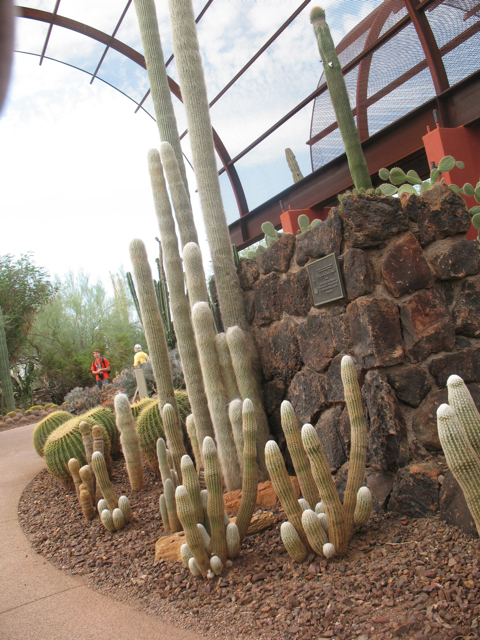
At the conclusion of my three day meeting I had a chance to vacation for a few days in Arizona. For a state that only has on average 7 inchCaes of rainfall each year I was surprised that it rained twice while we were there. Phoenix has a population of 1,445,632 as compared to our entire state of Maine with 1,318,301 people. For a city with such a large population it didn’t feel crowded like other large cities. The city is laid out on a grid with nearly every street straight. Numbered streets go north & south, named streets go east-west. There are “washes” where there are low spots and when it rains (not much even) the water rises in the wash and you guessed it floods the roadways. We ran into one of them and also freezing rain, sleet, and snow. In spite of the weather we hiked in some beautiful places where the saguaro cactus grow perhaps as tall as 50 feet and may live to be older than 200 years.

Joani and Mark

We spent time with old friends and met interesting people. I met Joani, who teaches art at Arcadia High School in 2000, while we were on the Fulbright program in Japan. Joanie’s husband Mark is a Director of Technology in the Kyrene Elementary School District. We traveled north from Phoenix and saw about 8 inches of snow in the Flagstaff where people ski the area mountains, the tallest about 12,000 feet. We traveled northeast from there to Canyon de Chelly National Monument arriving in time to drive the rim as the moon rose. The rich orange rock was beautiful at dusk and the next morning with sunshine, brilliant blue sky and 18 degrees. We traveled by jeep down into the canyon to view and explore the history, culture, artifacts, that are sustained today by a community of Navajo people. It was one of those moments in time when I realize how tiny I am in this great big universe.

Canyon de Chelly

We stopped while traveling back to Phoenix at the Painted Desert, another amazing site at dusk. The next day we hiked in Sedona and were treated to another beautiful blue sky and sunshine day. If you haven’t visited Arizona I recommend it. The landscape is so interesting and provides plenty of inspiration for artists.

Young Navajo artist whose grandparents live in the canyon during the summer

Young Navajo artist whose grandparents live in the canyon during the summer

Sedona

h1

WhooOoooo HooOooo – Phoenix

November 1, 2011

3 day meeting

I left my home this morning with about 4 inches of snow on the ground and drove to Portland where I hopped on a plane for Phoenix. I had a 2 hour layover in Philadelphi and headed for AZ for sunny warm weather. It was 91 degrees when I landed. Wow, like stepping back into July.

There are 31 of my colleagues from the other states here for a three day meeting. The State Education Agency Directors of Arts Education (SEADAE) are gathering to engage with members of the National Coalition for Core Arts Standards. It is exciting, I will be posting this week and keeping you informed about the work.

h1

Experiencing a Standards Based Classroom

October 31, 2011

From another perspective

Christine Anderson-Morehouse is the Director of the Midcoast Regional Professional Development Center. She arranged the professional development opportunity for arts educators at Jefferson School on October 28th. The all-day workshop provided an overview to participants on Maine’s assessment initiative along with breakout sessions facilitated by teacher leaders Allysa Anderson and Shannon Campbell. And a final session on the Open Educational Resources facilitated by Kristen Andersen.

I was thrilled that Christine fully participated in the entire day. She attended Allysa’s breakout session on music assessment and below is the email that she sent to Allysa as a follow-up. It provides a view that sheds light on the importance of including non-arts educators in our work. Not to mention highlights Allysa’s skills as a teacher. I am posting this with permission from Allysa and Christine.

Christine in the center

Dear Allysa:

I’ve heard it said time and again that the most powerful professional development is that which comes closest to the classroom.

Today, I felt as if I were a cherished student in your classroom–thank you so much for all that you did to make today’s “Arts Assessment Workshop” for Midcoast music educators such a powerful learning experience.

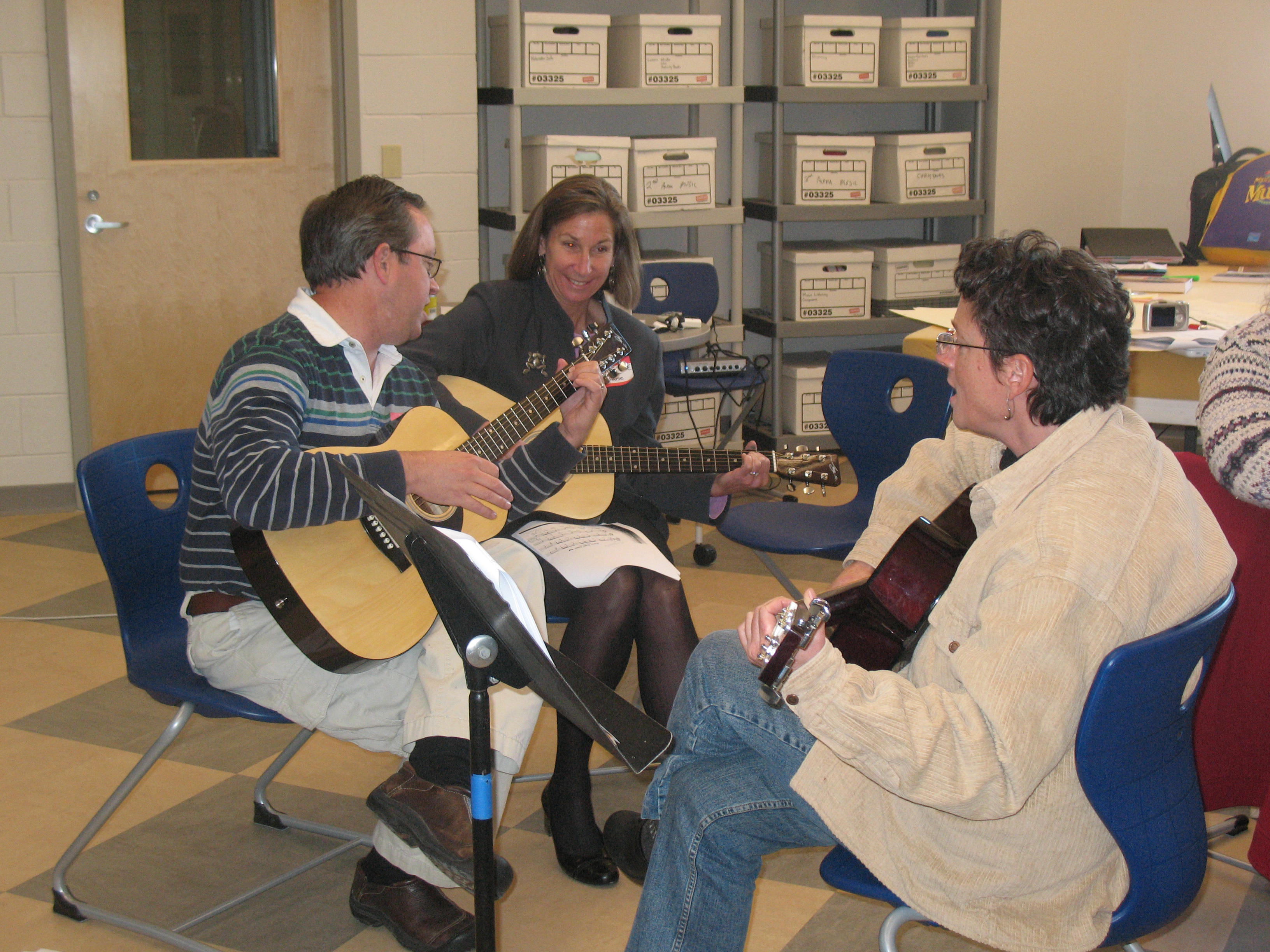
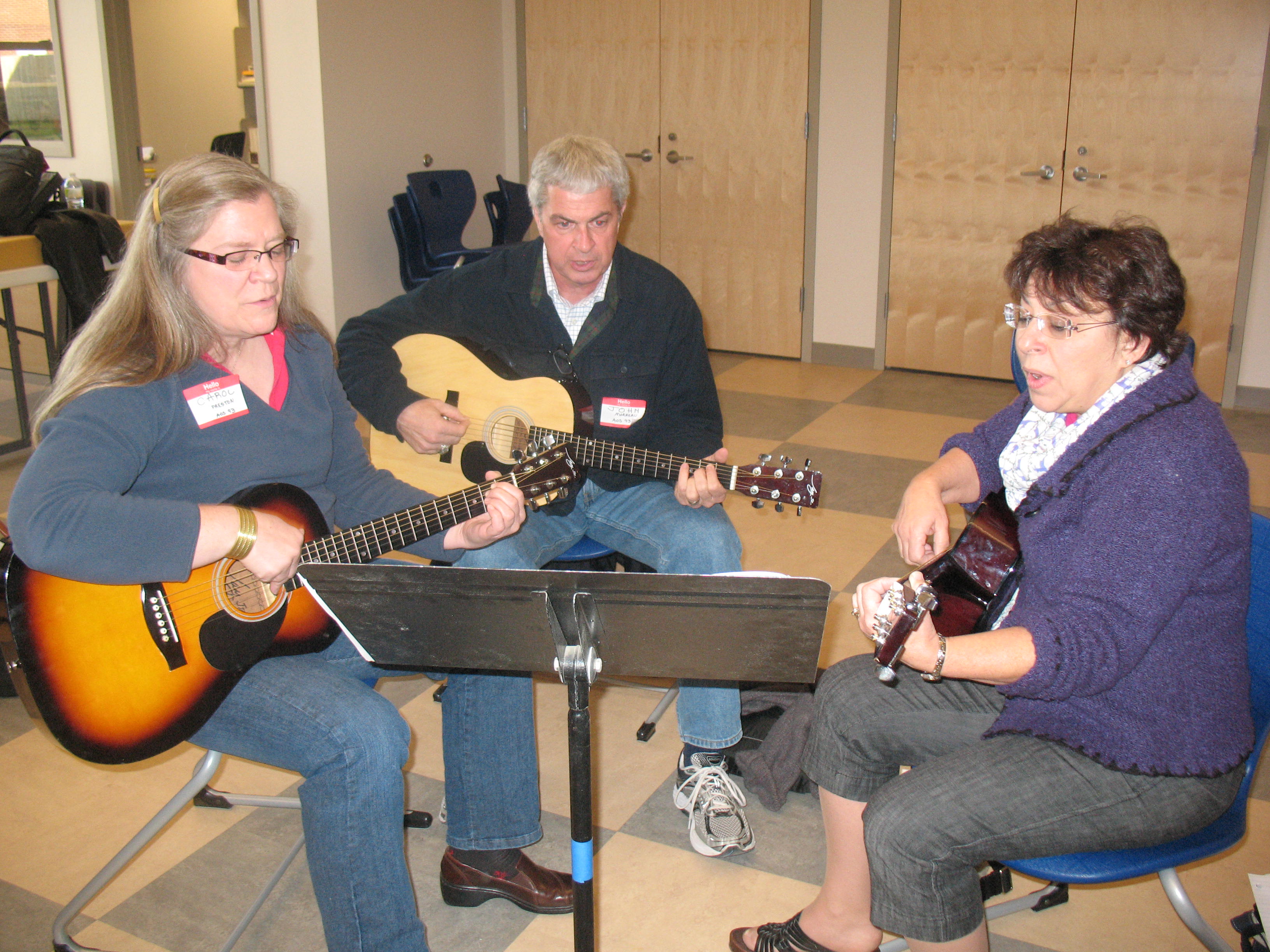
You energetically modeled effective teaching by guiding us through several lessons, helping us to understand how it feels to be learners in a standards-based classroom.  From the lecture to the small-group, collaborative (creative) activities, I really got a sense of the flow that is possible under the tutelage of a gifted instructor.  You warmed us up singing in much the same way that you’d do with your students, with helpful asides as a way of explaining the contexts in which you
would use the instructional strategies you were modeling.  Your rubrics helped me to see where I was in terms of my own personal learning (and where I could go next) and your assumption that I’m already doing some things on the rubric (and that I’m capable of doing those that are next)
left me feeling comfortable enough to pick up that guitar and strum along with those experienced musicians.  What a feat!

The group enjoyed (and learned much from) the student work that you shared, be it the videos of students playing guitar together, the Garage Band sample raps or the written artifacts such as self-assessments.

I don’t know how you did it but you managed to encapsulate snippets of so much of what you do in your teaching/assessment into that one two-hour session in a way that felt very seamless–bravo!

The students of Camden-Rockport Middle School are so fortunate to have you as their teacher and the teachers of the Midcoast region are equally fortunate that you are willing to share with and facilitate them in learning more about what is possible for their own classrooms.

With many thanks and best wishes,
Christine


h1

Mid-coast Regional Assessment Workshop

October 30, 2011

Jefferson, Friday, October 29th

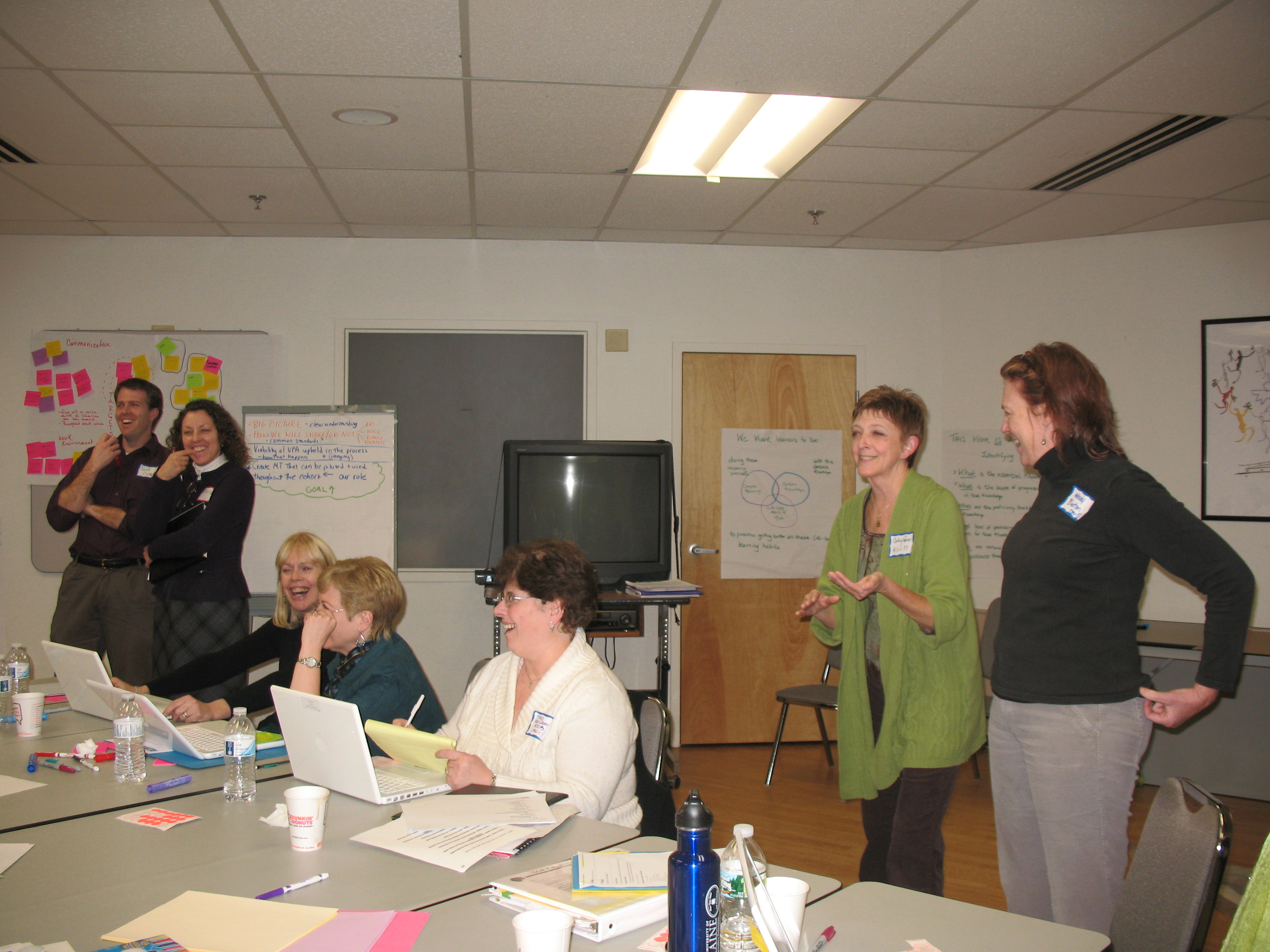
This past Friday in Jefferson another regional assessment workshop was held, this time for the mid-coast arts teachers. It proved to be a wonderful opportunity for 22 arts educators to re-connect and for many it was the first time meeting. The all-day event was arranged by the Director of the Midcoast Regional Professional Development Center Christine Anderson-Morehouse, in the beautiful new Jefferson, K-8 school. A HUGE thank you to Christine for making the arrangements! 

I was glad to have the chance to be with arts educators engaged in learning more about arts education assessment plus I saw two of my previous students. One is the principal at Jefferson School, the other principal at the South Bristol School.

The all-day workshop started with the history and an overview on Maine’s assessment initiative.  Teacher leaders Shannon Campbell, art teacher from Stonington-Deer Isle Elementary School and Allysa Andersen, music teacher from Camden-Rockport Middle School facilitated assessment sessions in their disciplines. Open Educational Resource (OER) and art teacher from Camden-Rockport Middle School shared the many resources identified by the OER arts team last year.

Some comments from participants included what they learned:

  • Assessment Strategies
  • All the technology info thats helpful in quick bursts to assist what we already are teaching
  • I learned about many resources. I’m excited to look into them more.
  • I learned how other teachers are approaching assessment
  • Varied assessment forms and formats
  • I learned that much of what we do as music teachers IS assessment
  • Good ideas that work well!
  • Online free resources

We know that one day is valuable but that it will take many more to make changes that will impact student learning positively. Participants left with many questions and some are included below.

  • How do I streamline figure out what the priorities are?
  • Should there be a statewide standard rubric form?
  • Will this type of workshop be repeated at a higher level with the opportunity for us to bring rubrics to critique them and make them better?
  • Could we have more discussions on standards based assessments?
  • How to implement comprehensive assessment on a schedule where I meet over 300 students once a week for 40 minutes with only 5 minutes between classes, and 2 prep periods a week.

Participants left asking to meet another time during the school year to further develop ideas and to learn more!

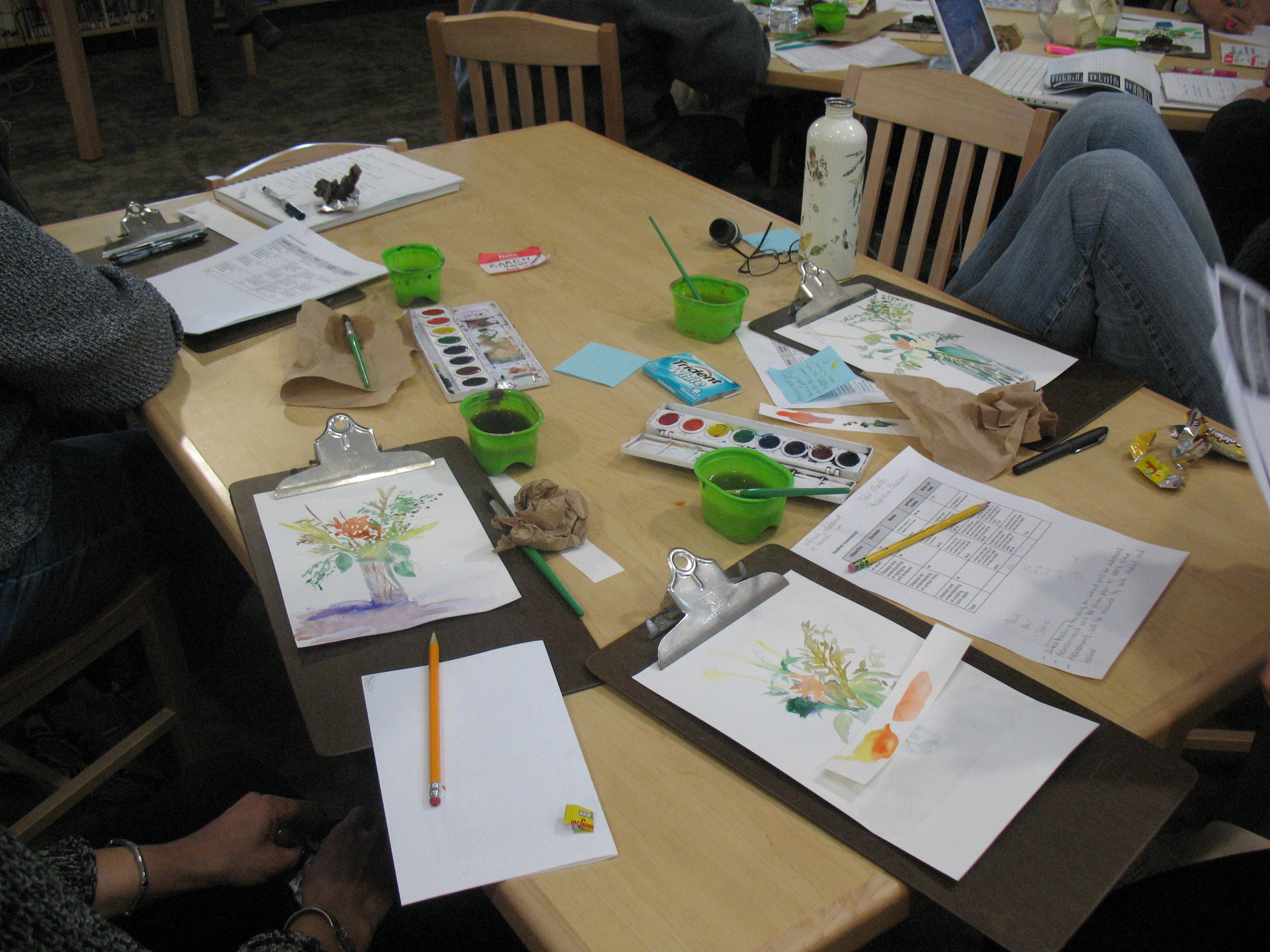
Some of the work created in Shannon's session

Allysa's session

h1

Media Arts: Stand Alone or Integrated?

October 27, 2011

Let’s chat

Please humor me… I know you’re busy and some days you barely have time to eat lunch and use the rest room let alone read the meartsed blog. This is what I need from you… your thoughts, your wisdom, your ideas.

Please weigh in on this topic since it is important to the standards future and could impact your future arts education curriculum …. Should “media arts” be a stand alone topic, like dance, music, theatre, and visual arts, or should “media arts” be intervowen into the 4 arts disciplines as we now know them in the Maine Learning Results and National Arts Standards? I think it is a simple and challenging question that needs your best thinking, especially in Maine where MLTI has helped us “lead” the technology conversation in Maine and beyond.

Periodically I get emails and questions like these: My high school has put in a media arts course where students are receiving fine arts credit. Can that be done? Usually the teacher is upset since students who would normally take the arts courses are taking the media arts courses. My question in return is: have you incorporated any media arts into your traditional courses? If the answer is no, I ask why not? And add that perhaps the reason students are taking another arts type of course is because they are looking for something that contains more 21st century tools and opportunities.  Don’t get me wrong here I am not suggesting we eliminate those traditional experieinces however we need to do business differently.

To help you think differently about education, how you teach and how students learn… I suggest you read the following books:

Inevitable, by Bea McGarvey and Chuck Schwann, both makes the case for mass customized learning, but also lays out a vision of what it might look like and how we might do it. Commission Bowen had all of us at the Department read this book. Our books were passed on to the superitendents in the state and each group is reviewing the book and have been asked to pass theirs on to a school board member or another administration. It would be great to hear what you have to say about this easy read.

Another approach to customized learning is student-designed standards-based projects. The Minnesota New Country School is given much credit for developing this model, and their work has been recognized by the US Department of Education, and others. Ron Newell has captured this work and makes clear the student-designed project approach in Passion for Learning. I haven’t read this one yet but it is on my list.

What books have you read lately that you recommend to others? Please make suggestions in the “comment” section below. And what do you think… Media arts a stand alone or interwoven into the other arts disciplines for delivery of education?