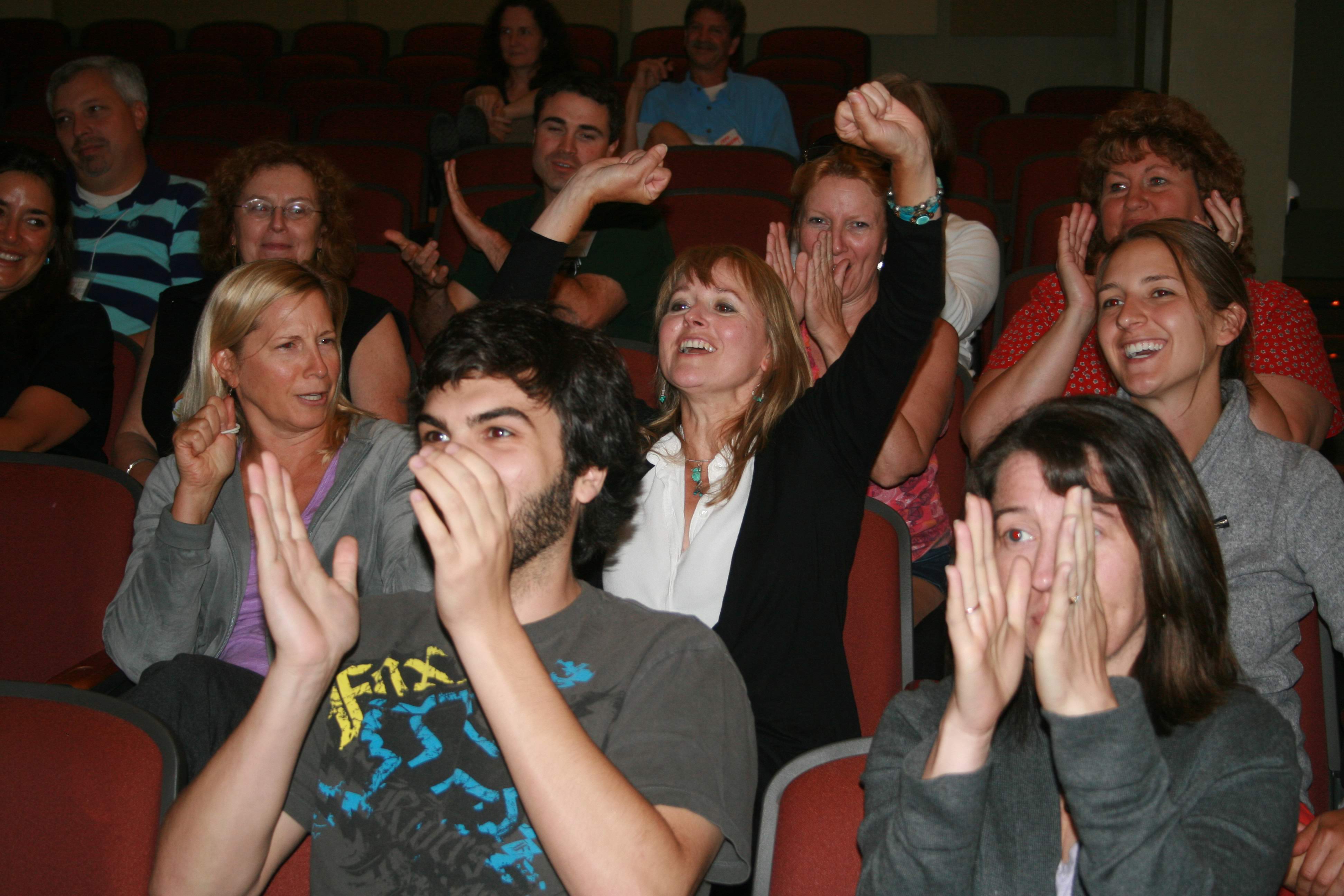
I love attending the high school musicals in the fall. It never fails, I walk away every time thinking, WOW, I am so impressed that high schoolers rise to the level of a great performance. Many of the actors are not new to the stage yet others are just beginning. As you know – the voices, costumes, set, acting, make up, lights, sound, and music are all critical components of the final performance. I am aware that bringing together all of the pieces can be very challenging. When the curtain goes up most people in the audience are not aware of what it takes to create the fall musical. Schedules, illness, grades, transportation, a willingness and commitment from everyone involved (students and adults), and other factors contribute. I was fortunate to have first hand knowledge helping some with middle school plays and again when my own sons were in high school, one on stage and the other on tech I supported in many ways. They both were part of community theatre as well. The commitment that students and staff and parents contribute is enormous. At some level it is collaboration at its VERY best. Perhaps our community (and beyond) leaders should take a close look at theatre programs.
I know that some (perhaps many) will not agree with me when I say IF we could only have one discipline of visual and performing arts education in schools, I’d pick Theatre, every time. Think about it – visual arts students work on the design of the stage, set, program, and costumes. Music students play in the pit band and on stage singing. Dance students are moving. Media Arts students are creating the sound and lights. Theatre students are center stage. I especially love it when the hesitant students are needed to take on a part and right in front of our eyes they grow into the role.
Why do I feel strongly about every student being involved in the theatre program? Besides involving all the arts disciplines it allows learners to literally and figuratively move to the edge (of themselves and the stage). It encourages them to take a chance and challenge themselves. Throughout the “play” process they engage in problem solving and improvising. Let us not forget the literature they are learning, not by reading script and keeping it inside, but speaking and putting into action the words and lines and story. They synthesize, analyze, ideating as the play formulates over a period of months. The story builds within each participate as they learn their positions and parts. Without the others on stage with them it doesn’t come to fruition. They depend on each other to help provide what the audience sees, hears, experiences and in the end hopefully, appreciates. The climax is the applause and perhaps a standing ovation that helps them realize, all the time and commitment they’ve made IS appreciated and worth it! I can tell when I look into their faces during the curtain call, the pride is evident. Sitting in the audience is me smiling from ear to ear. Even though I may not know the actors, musicians, dancers, and artists who made it happen, I can feel their pride.
Whether you have children of your own in high school or not I encourage you to find out when and where the plays in your area are scheduled. Don’t let another fall musical season pass without attending at least one. Below are some listed (some have passed) that I am aware of at this time. If you’d like one added to the list please email me (Argy Nestor) at meartsed@gmail.com.
Medomak Valley High School, Waldoboro, Guys and Dolls, last performance today, November 10, 2:00. Learn more!
Camden Hills Regional High School, Strom Auditorium, Into the Woods, November 15, 16, 17, 22, 23, 24. Learn more!
Freeport High School, Mamma Mia, November 8 and 9.
Thornton Academy, Saco, Little Women, November 22-24. Learn more!
Falmouth High School, Mean Girls High School Edition!, October 25, 26, 27, November 1, 2, 3.
Oceanside High School, Rockland, Legally Blond The Musical, November 8, 9, 15, 16, 17. Learn more!
Mount Desert Island High School, Chicago, November 15, 16, 22, 23. Learn more!
Fryeburg Academy, Amelie the Musical, November 14, 15, 16. Learn more!
Lake Region High School, Little Shop of Horrors, January 17, 18, 19, 24, 25, 26. Learn more!
Mt. Ararat High School, Topsham, Our Town, December 6-8, and Spring musical Mamma Mia, March 7-9. Learn more!
Maine Arts Assessment Institute, summer 2011, phase 2, Maine College of Art + Design
Over the past few months I’ve been working on a talk that I am giving called The ARTS at the Center at the New England League of Middle Schools conference in Springfield, MA. I have 60 minutes to speak about arts education to a room full of about 400 middle school educators. Perhaps half will be arts educators. To prepare I’ve looked at current and past research, I’ve scanned files, I’ve read papers and documents, I’ve found photos, and I’ve spoken to several educators. Every time something seems important to be sure and include I’ve made a note. The content kept growing and when i started to practice I realized that I had about two and a half times more content then I need. I’ve been cutting during the last week. It is filled with stories and I disliked cutting stories but I had no choice. We all have stories, especially educators.
Maine Arts Assessment Initiative, summer 2012, phase 2, Maine College of Art + Design
As I pulled out of the driveway to leave for the conference today my husband assured me that it would go well. As I headed down the road I thought about how important it is, especially as teachers, to challenge ourselves, step out of our comfort zones and really stretch. For one thing it reminds us of how our students feel. For some students, teachers ask them to do hard stuff every day. Stretching ourselves is important and helping our students stretch is equally important. Most adults can put supports in place as we’re stretching. For kids that’s not always the case. It’s important that we are mindful of supporting our students as they grow and learn.
Rob Westerberg and Catherine Ring, Maine Arts Assessment Initiative, winter retreat, Zillman Art Museum
Lately I’ve thought about many of the professional development and learning opportunities I’ve been part of planning and attending. The photos that I’ve looked through have brought back many memorable moments. I especially love the photos I’ve included in this blog post and the sweet memories that accompany them.
Mpamila Village, Malawi, 2016, 10 day Arts Integration workshop
Karen Montanaro, Nick Kleiner perform The Soccer mime, Farnsworth Art Museum, statewide arts education conference, 2008
I think the video embedded below was a Coca-Cola commercial for this year’s Super Bowl; yup, back in February 2023. I don’t know exactly how it was created but Artificial Intelligence, AI was part of it. This came out about the same time that I started to see more information and reading about AI. Some people closest to my circle were concerned, and still are, about the negative impact AI might have on education, learning (or the lack of), creativity, and originality. I find it difficult to take a stand, for or against. For me there is too much grey area on the topic. Take this commercial, for example. I’m guessing that we can all agree that it is well done on all levels, creative and inspiring. It includes many known art works. An entire lesson could be formed around or built on the idea. An integrated lesson for music and visual art and actually many subject areas.
One comment from someone in the advertising community said: “that’s the proper way to use ai stuff. not to make the entire content, but to work alongside traditional methods”. I do agree!
I dug a little to learn about it and this is what I found: The new campaign from Coca-Cola features a combination of film, 3D, and Stable Diffusion, which is deep learning, text-to-image AI model. Traditional production methods coupled with artificial intelligence will bring the next level of creativity to the advertising industry.
I suggest that as educators responsible for the arts, use this as an example of how we can utilize AI for the expansion of the creative process. What do you think?
Recently I joined a book group. I’ve never been part of a formal ‘book group’ (secret is out). I’ve never been interested and truth be told its only recently that I’ve been reading books at a very fast rate, now that my schedule allows. I like this book group for several reasons. It’s pretty non-traditional, no one book is read and discussed like in traditional book groups. Actually, its one of the reasons I decided to join the group. We gather over lunch monthly and each participant shares books, films, podcasts and other forms of stories and ideas. The participants are retired educators who have a keen interest in education and other interesting and sometimes challenging topics. At our April gathering we each shared a poem in recognition of National Poetry Month.
At more than one gathering the conversation has included AI – Artificial Intelligence. I’m certain as we learn more that the conversation will continue. I’m reading and learning about what AI is, where it is, and the potential impact on the world. A 60 Minutes episode from a couple of weeks ago provides foundational information that I suggest you take the time to VIEW. It’s very informative and important as educators that we inform ourselves.
You can google AI and come up with the definition but until you begin to ‘see’ and experiment with the online tools I’m not sure it will provide you with the understanding to consider the impact on education. For example, think about this: The sum of all human knowledge is online. AI is replicating the brain. What are the implications on education? What is the impact on art making? AI can solve problems in very little time compared to the brain. Is humanity diminished because of the enormous capability of AI?
Visual artist Jonas Peterson is creating art work using AI. His collection of art called Youth is wasted on the young is an amazing collection that is his way of celebrating the ‘old’ and a comment on ageism. He used fashion to highlight the personalities of older people. Jonas is a photographer but in this collection he uses AI to create scenes, the people and what they’re wearing. In his own words:
I give specific direction using words only to a program, lenses, angles, camera choice, color theme, colors, styling, backgrounds, attitude and overall look and the AI goes to work, it sends back suggestions and more often than not it’s completely wrong, so I try other ways to describe what I’m after, change wording, move phrases around and try to get the AI to understand the mood. It’s frustrating mostly, the AI is still learning, but getting any collaborator to understand you can be difficult no matter if it’s a human or a machine. After a long stretch of trial and error I get closer to a style and look I want and after that it comes down to curation, picking the renders I believe go well together, I start making it a series. To me the process is similar to that of a film director’s, I direct the AI the same way they would talk to an actor or set designer, it’s a process, we try over and over again until we get it right. Should I get all the credit? God, no, the AI creates with my help and direction, it’s a collaboration between a real brain and an artificial one.
You might be thinking or asking, is this really art? Do I want my students to use this in their art making? Here are some of my thoughts and questions. AI exists in the world. Microsoft introduced ChatGPT, an artificial intelligence chatbot, in November 2022. Bard is a conversational generative artificial intelligence and was released in March 2023. How should educators learn about AI? Should we leave it up to students to teach us? I’m sure that this will be the next wave of education professional development offerings, in person and online.
Jonas Peterson said:
I’m not here to debate the process, I’m a professional photographer, writer and artist myself, I understand the implications, how this will affect many creative fields in the future. I’m simply using a tool available to me to tell stories, the same way I’ve always told stories – to move people. To me that is the point of this, not how I did it. Dissecting something will almost always kill it.
You can learn more about Jonas’s work by googling him and also at this LINK.
I’m sure I’ll circle back to this topic in future blog posts. If you have questions or comments that we can all learn from please don’t hesitate to comment at the bottom of this blog post. Thanks!
For those of us who came in contact with Phil Brookhouse, we are all better for it. You may know Phil from his days with the Maine Learning Technology Initiative. He and Barbara Greenhouse played off of each other while providing professional developing with technology. They were quite a team. For many Maine educators this was their first introduction to technology in the classroom so it needed to be top notch. The delivering was excellent, the content was spot on, but more importantly Phil understood it was ‘all about the relationship’. He was gentle, kind, and knowledgeable, AND he understood how to communicate with teachers because he had teaching in his heart and soul. A teachers teacher!
Phil worked with the State of Maine to roll out and support one of the first “one to one” laptop programs in the country. Phil always had a pleasant look on his face and often he spoke with a ‘pirate accent’. In fact, he was the first ‘pirate’ I ever met. Phil loved music and performed in community theatre. He understood the value of arts education and took the opportunity to include the arts in the work he did. He was proud to be named an Ambassador to Jupiter through NASA. After leaving the state work, Phil returned to the classroom at Edward Little High School in Auburn working with the gifted and talented program before retiring. He will be missed but the seeds of learning he spread will live on. I am grateful for the work he did in Maine education! You can read his entire obituary at THIS LINK.
This story starts with the design that was selected for the Maine Learning Technology Initiative (MLTI) conference t-shirt. But, it’s about much more than that. It’s about a 7th grader who LOVES the arts. Congratulations to Penny Graham who attends Waterville Jr. High School. Her art work, seen below, was selected to be printed on t-shirts that will be worn by Maine middle schoolers and their teachers while they attend the virtual student conference being held, May 26. Registration is open for the MLTI Virtual Conference and all grade 7 and 8 Maine students are invited to participate.
I had the pleasure of speaking with Penny recently about her design that connects with this years conference theme: Space2Connect. Before getting to the creating part Penny looked at t-shirts from past years which helped to guide her decisions. She wanted it simple so she considered ideas with space, specifically planets. She decided on one color so it could be seen and read easily. She tried different colors including pink and green but kept coming back to purple. She’s been using the digital app Procreate on her iPad for about a year so it made sense to use it for designing the t-shirt idea. In fact, she has created a video that demonstrates her knowledge and how she went about accomplishing her design. Video about using the app Procreate. Penny’s video will be included on an upcoming episode of theMLTI SLAM Show, which focuses on student leadership in technology integration.
Penny drawing
After being on the phone with Penny for about 45 minutes I realized that I was not only speaking to a t-shirt designer by an incredible arts advocate. “The Arts are important to me. My whole life I’ve always loved doing music and art because they’re my passions. I’ve done art clubs, I draw a lot, I played a little saxophone, guitar, and the recorder. This year I can see myself improving.”
In addition Penny loves to write, narratives and some poetry. She’ll often learn something while writing in school and goes home and practices what she’s learned. She’s had several different learning opportunities in the arts. “I love doing art with materials and using my hands and getting dirty. It is such fun.” She enjoys pen and ink, sketching, water color, rock painting and pottery. Penny also loves creating with digital tools because “I can change the design quickly and the process goes much smoother.“
The arts rotate through the schedule for students at Waterville Jr. High and as a 7th grader she doesn’t have visual art but she does have music. She selected the violin which she played when she was younger and is happy to return to it. She enjoys playing in the school orchestra and likes the performances.
She also loves theatre and has participated in the Sound of Music and Nobody Believes in Fairies which was written by one of the school’s 6th English teachers. She’s excited about the musical coming up this spring called Middleschool Madness. Penny says: “Theater is a really nice bonding experience. It’s a fun, social thing that I just love to do. I got to meet so many new people in the two plays I’ve been in. My theater experiences have all been really great.”
Penny as Gretl
Penny also shared her experience of the pandemic. She was glad to have alone time to draw and bake and was able to pursue her hobbies. “I feel like without the pandemic I wouldn’t have been able to move forward that much. I feel like I could take big strokes that I wouldn’t have had time to do.”
Penny’s dad shared: “Waterville is a wonderful place for artistic and curious children like Penny.”
I’m certain that Penny has a bright future and I’m grateful to have met her and for our conversation.
Curious about the Maine Arts Commission (MAC) program, Maine Arts Education Partners in Leadership (MAEPL)? Wonder why you should consider applying? Listen to arts educator and veteran MAEPL Teacher Leader Charlie Johnson at THIS LINK explain his reasons and the benefits that he’s experienced during his ten years of participation!
DEADLINE TO APPLY IS TOMORROW, JUNE 22, 2021! DON’T DELAY!
I’ve posted about the Global Oneness Project in the past. They continuous are providing amazing resources, food for thought, asking challenging questions, and pushing on educators thinking. Thank you to Executive Director Cleary Vaughan-Lee recently I received an email with the following information. I’m not re-wording the message that Cleary sent since it is ‘spot on’ (as Rob Westerberg would say)!
A good story has the potential to broaden a student’s worldview, providing a foundation to foster empathy and inquiry. I love this description of storytelling from Pulitzer Prize-winning novelist Eudora Welty, who explored the American South. She said, “Long before I wrote stories, I listened for stories. Listening for them is something more acute than listening to them. I suppose it’s an early form of participation in what goes on. Listening children know stories are there. When their elders sit and begin, children are just waiting and hoping for one to come out, like a mouse from its hole.”
We’ve created a collection of our most viewed films of the year. From an ecologist in the church forests in Ethiopia to a Native teenage basketball player in a remote community in Alaska, these stories document the vulnerability and resiliency of life around the world.
I’ve been watching these films and they are thought provoking and they warm my heart – a good thing for the end of 2020!
“Teaching an Effective Virtual Lesson” will be presented on Wednesday, December 9, 7:00 – 8:00 pm. Sarah Hoad from Saco Public Schools will be leading the session with tips and strategies for teaching online. Included will be a roundtable discussion on this suddenly-extremely-important topic.
This session is free, and is sponsored by the Maine Chapter of the American String Teachers’ Association (ASTA). The session will be presented over Zoom. You can access the session by scanning the QR code below or email maineasta02@gmail.com for the Zoom link.
I don’t know about you but ideas continue to fly into my email box on how best to do “school” at this time. I trust and value some resources more than others, sometimes depending on the source. Edutopia from the George Lucas Educational Foundation provides thought provoking and action packed articles, many times written by practicing educators. When I see that, it’s a 5 Star resource. Below are links to articles sent by Edutopia that contain valuable teaching strategies. Most of them include addressing the social and emotional learning needs of students. Even though not all are not specific to arts education they can be adapted and I hope you find at least one useful. You can sign up to receive Edutopia emails by going to their website.
Teaching Drama in Distance Learningwritten by Shana Bestock. Shana provides tips for transferring practices to virtual spaces, how to dig deeper with students, create community, and reminds us that how in uncertain times the arts helps us embrace uncertainty and foster resilience.
How to Help Middle School Students Learn to Work Independently written by Ryan Steinbach. Learners at home might be juggling so much more than if they were in simply going to school each day. To work around other responsibilities they have will require helping to guide each one towards independent learning. Ryan believes its all about “self-pacing” and provides information on how to support learners.
Argy Nestor
Arts Educator, Blogger, Artist, Connector meartsed@gmail.com
https://sites.google.com/view/anestor/
Argy’s Blog
The purpose of this blog is to share stories about people and places; and to celebrate the amazing work (and play) that students, educators, and organizations are doing in and for arts education. In addition, the blog has a plethora of resources and innovative ideas. This forum gives blog readers the opportunity to learn from each other. It is essential that we listen, learn, and collaborate in order to build on teaching practices for the benefit of every learner in Maine and beyond.