Archive for the ‘Technology’ Category

h1

MLTI Art Workshops

January 27, 2013

The Art Studio in your MLTI MacBook

Opportunities from the Maine Learning Technology Initiative that are being provided over the next three months throughout Maine at no cost.

Join MLTI to discover the art studio in your MLTI MacBook. Learn new ways to create art, explore tools to design digital portfolios, gain understanding in managing your digital art classroom and grow your research process knowledge. This day will be filled with valuable information for the art teacher. This is a repeat of the Fall 2012 session but we encourage you to join us and expand your abilities.

Please visit http://www.maine.gov/mlti/events for a link to online registration and a listing of all current PD sessions.

Dates/Locations:
January 28, 2013: Maranacook PD Center
January 30, 2013: Washington Academy
February 5, 2013: RSU #40 Central Office (Union)
February 12, 2013: Apple Training Facility, Pineland Campus (New Gloucester)
February 14, 2013: Eric L Knowlton School
February 26, 2013: Reeds Brook Middle School
February 28, 2013: Spruce Mountain Middle School
March 6, 2013: Katahdin High School
March 12, 2013: Portland Arts & Technology HS
March 13, 2013: Presque Isle High School
March 20: Woodland Jr Sr High School

h1

Mega-regional workshop UMF

January 19, 2013

A success!

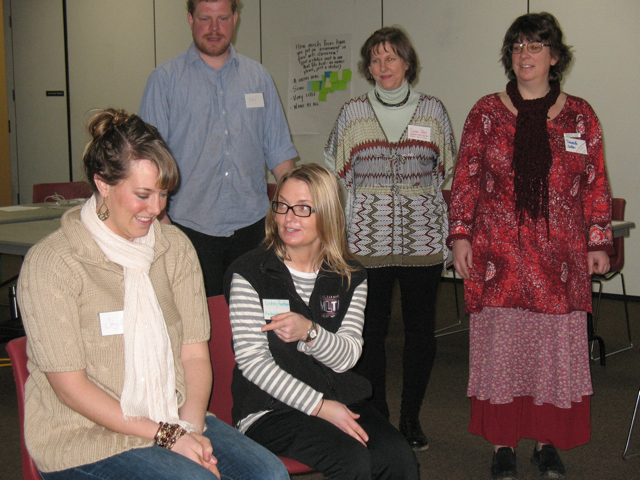
art sessionAll the reports tell us that the first Maine Arts Assessment Initiative/MLTI Mega-regional workshop was a worthwhile professional development for all those involved. Twenty five educators participated in the MAAI workshop that was held at University of Maine in Farmington.

theatre segmentUMF students were still on winter break so the campus was fairly quiet during the all day event. Participants attended three sessions led by MAAI teacher leaders during the day and had a variety of choices at the free workshop.

  • Drew Albert and Ashley Smith presented Getting Started: Incorporating Meaningful Assessment Within the Large Ensemble
  • Leone Donovan presented Title: A Skeptic’s Exploration of Rubrics
  • Susan Jones presented Theatre Games: Learning Through Doing
  • Gloria Hewett presented Formative and Summative Assessment Two Big Words with Practical Applications in an Art Class
  • Susan Beaulier presented There is no I in ART; Working Together to Promote Quality Art Education for all Learners
  • Alice Sullivan and Jim Wells presented Using Digital Tools to Capture Music Assessments
  • Ann Marie Hutton and Lindsey Farnham presented Making Art with MLTI
  • Tim Hart presented Capture the Performance! Using MLTI tools to record, review and share music, dance and theatre assessment pieces

Great job MAAI teacher leaders and MLTI technology integrators. The next three Mega-regional workshops are scheduled and all educators are invited to attend but we ask that all participants be pre-registered by going to http://www.maine.gov/education/lres/vpa/assessment.html and click on the dates for the following sessions.’

  • March 1, USM, Portland Campus
  • March 22, Presque Isle High School
  • March 29, Ellsworth High School
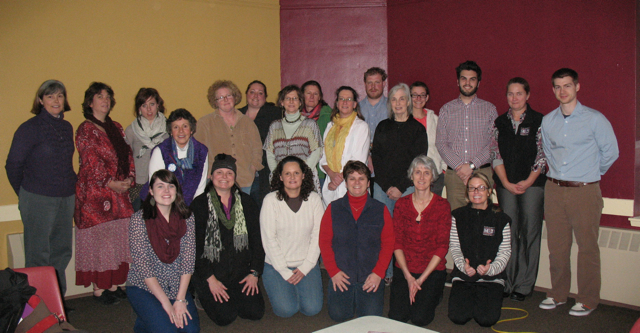
Participants and facilitators at the end of a productive day!

Participants and facilitators at the end of a productive day!

h1

Happy New Year!

January 1, 2013

Reflecting

I have taken some time today to reflect on 2012 and realize how fortunate I am to work with incredible arts educators in Maine and throughout the United States. Educators who are dedicated, passionate, and fully committed to providing an outstanding arts education for every student!

The year has been filled with many successes, some challenges, and sad losses! I wish I had time to go back through all the blog posts that I wrote in 2012 to help me remember all of the successes, challenges, and losses but instead I will provide the highlights.

Successes

The biggest success is the Maine Arts Assessment Initiative (MAAI). The second phase of MAAI officially kicked off in the spring with the identification of 20 teacher leaders. These arts educators joined the 18 teacher leaders from phase one. They participated in a 4-day institute in August at the Maine College of Art (MECA) in Portland where they expanded their knowledge in the areas of assessment, leadership, technology, and creativity. They have created workshops that are being delivered throughout this school year at the regional and mega-regional level. (Registration for the mega-regional workshops is now open – FREE and contact hours are available.) The topics of the sessions are as varied as the individual teacher leaders. I am so grateful for their commitment to the work that is making a difference for arts teachers and in arts classrooms across Maine each day. The impact on students learning is amazing!

And, uniquely the Mega-regional workshops are being co-sponsored with the Maine Learning Technology Initiative (MLTI). At these workshops their will be at least one session that is integrated with an MLTI integrator to provide a first time opportunity for educators!

The MAAI would not be possible without the commitment of the leadership team who have consistently shepherded the work. A GREAT BIG THANK YOU to Catherine Ring, Rob Westerberg, Jeff Beaudry, Bronwyn Sale, Pam Kinsey, and Matt Doiron. Their willingness to lead has made a difference! Close to 1000 arts educators have taken advantage of the professional development opportunities during the last year and a half.

The MAAI is aligned with the Maine Department of Education’s Strategic Plan: Education Evolving: Maine’s Plan for Putting Learners First.

In July Catherine and I flew to Denver for a national conference on arts assessment held at the Rocky Mountain College of Art + Design. I was proud to let others know of the grassroots efforts that Maine arts educators are involved with.

Art educator Chris Milliken, on sabbatical from Wells schools, has been following and doing research on the MAAI during this past year. He will join art teacher Lisa Marin and present a session on their findings at the Mega-regional workshop at Ellsworth High School on March 29, 2013.

Literacy is a statewide focus with the Literacy for ME being launched this fall and arts education has stepped up to become an integral part of the cross content literacy connections. Arts educators Jen Nash, Suzanne Goulet, and Lisa Gilman have been facilitating literacy webinars. Suzanne is also co-facilitating face to face sessions.

We have had 4 wonderful art exhibits at the Maine Department of Education during this past year from Maranacook Community Schools, Bangor Elementary and Middle Schools, Lake Region High School, and Messalonskee High School. Along with the exhibits we had receptions at the Blaine House with music and dance performances from each school/district. Participating and collaborating are First Lady Ann LePage, the Maine State Board of Education, and the Commissioner of Education, Steve Bowen.

First Lady Ann LePage partnered with the Barbara Bush Foundation to create a new baby journal to present to parents at hospitals across Maine when their babies are born. We did a call for K-8 artwork and 867 young artists submitted work. Thirty two pieces were selected to be published in the book which will be completed in June 2014.

The Maine arts education list-serv has grown to 1200 and the meartsed blog is growing as a source of information, not only for arts educators but for all educators. If you are not on the list-serv but would like to be, please email me at argy.nestor@maine.gov. On December 5, 2013 the blog set a record high day of 976 visitors. And a record high week happened during that same time of 2508 visitors. Thank you for taking the time to visit and informing others about what is available on the Maine arts education blog.

Challenges

  • Common Core standards for ELA and Math were released this year and teachers are being asked to incorporate them into their curricula.
  • We are waiting patiently for the next iteration of the national arts standards to be released in March March 2013.
  • Arts education in Maine is underserved. As the economy continues to be a challenge so is providing adequate arts education programs and teachers.
  • Determining how to provide quality arts education to be ready for the “proficiency based graduation requirement” slated for the graduating class of 2018.
  • What will determine “teacher effectiveness” for arts educators (the non-tested content)?

Sadness

In March music teacher Beth Polletto died in a car accident driving to school. Beth taught at Gray New Gloucester and Georgetown Central School. In May art teacher Jackie McTigue died in a car accident on her way to school. Jackie taught at Glenburn Elementary School. Both teachers were amazing arts educators and have left a huge hole. My friend and colleague 2nd grade teacher and Maine’s 2010 Teacher of the Year Kevin Grover died on Thanksgiving day after returning from a run. He is greatly missed by family, friends, and colleagues.

Looking forward

photoBeing forever optimistic, I know that 2013 will be filled with many more successes and that the challenges will be small mountains for us to climb. I invite you to collaborate with your colleagues to face the challenges and enjoy the successes. I hope you will continue to use the meartsed blog for resources and to access information. Many of you have heard me say “none of us is as smart as all of us”. Please continue to share information that I can pass on to others through the blog. I appreciate it!

I am confident that 2013 will be filled with opportunities for arts education to move forward. For example part of phase 2 of the MAAI is videotaping arts classrooms to respond to your request “what does a standards based arts education classroom look like?” So, Debi Lynne Baker (newly retired art teacher) will be visiting arts classrooms in the next few months and creating 4 short videos with examples. This is just one example of resources being developed for arts teachers.

I enjoy the challenges that my work at the Maine Department of Education provides for me. I especially love the opportunity to interact with you, the readers of the meartsed blog. So please take a moment when possible and drop me an email at argy.nestor@maine.gov or make a comment at the bottom of a blog post. You can subscribe to the blog by clicking on “Sign me up!” located on the right side of the front page of the blog.

I hope your year is filled with love and laughter and that you continue to provide outstanding opportunities for your students in arts education! Best Wishes for a wonderful 2013 and THANKS so much for all the good that you do in education!

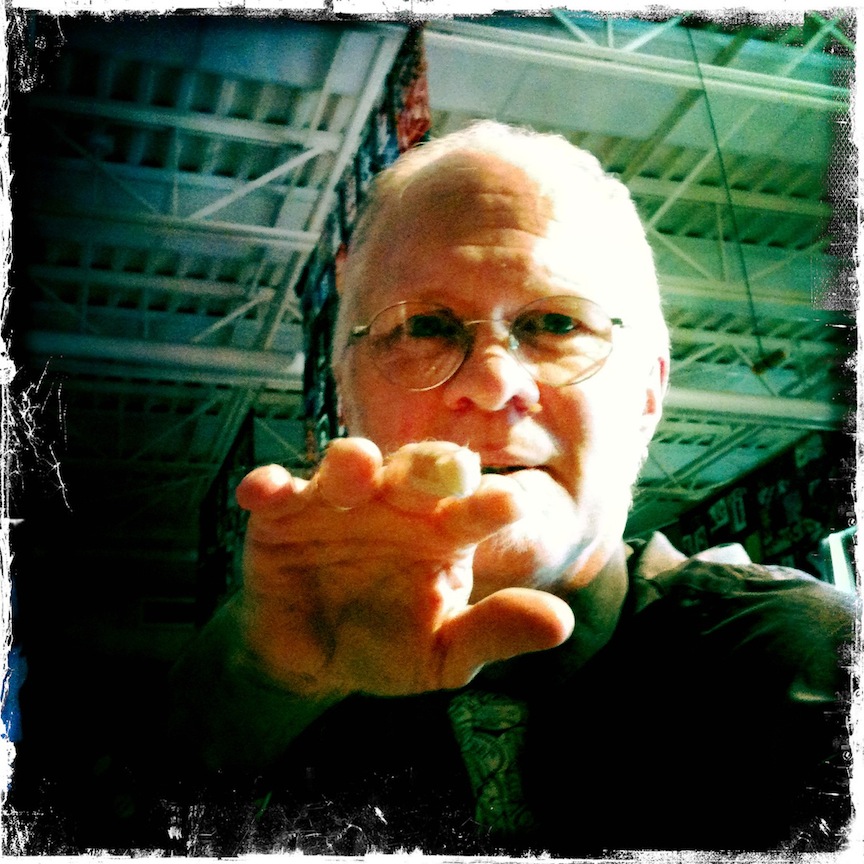
Only one photo and one quote included in today’s post. Hopefully the photo will put a smile on your face and the quote will provide you with some “food for thought” as we dive into 2013!

The purpose of arts education is not to produce more artists, though that is a byproduct. The real purpose of arts education is to create complete human beings capable of leading successful and productive lives in a free society. – Dana Gioia, Chairman of the National Endowment for the Arts

h1

MAAI and MLTI Partner

December 25, 2012

Mega-regional workshops offered

The Maine Arts Assessment Initiative (MAAI) is partnering with the Maine Learning Technology Initiative (MLTI) to offer all-day Mega-Regional workshops. Over 36 sessions will be offered at the four locations; Farmington, Portland, Ellsworth, and Presque Isle. These are FREE all day arts education workshops for elementary, middle, high school, and higher ed educators.

The workshops are provided FREE and contact hours are available. Workshop facilitators are the MAAI teacher leaders (phase 1 and 2) and MLTI technology integrators. At least one workshop included at each location will have an integrated co-facilitated session that connects at least one arts discipline and technology. In addition MLTI staff will be offering sessions. All participants must pre-register. Join us for this unique opportunity! Each participant can select two 1-hour morning workshops and one 2-hour afternoon MLTI session. You will need to bring a computer that has the MLTI image.

These workshops are in response to the feedback from arts educators requesting more professional development opportunities. Also happening all over the state are Regional workshops being presented by the arts education teacher leaders from the second phase of MAAI.

The Mega-Regional Workshops

  • Monday, January 14, 8:00 to 3:30, University of Maine at Farmington
  • Friday, March 1, 8:00 to 3:30, University of Southern Maine, Portland
  • Friday, March 22, 8:00 to 3:30, Presque Isle High School, Presque Isle
  • Friday, March 29, 8:00 to 3:30, Ellsworth High School, Ellsworth

Workshop descriptions are located here. Please click here to learn more and to REGISTER for one or more of the workshop sessions.

h1

Skyping With the Artist

December 21, 2012

Art Students at Boothbay Region High School Interview a Industrial Designer Via Skype

The Intermediate/Advanced Art classes at Boothbay Region High School interviewed industrial designer, Alex Williams (2001 graduate of BRHS) via Skype.  The classes composed probing questions for Alex about the creative process, entrepreneurship and collaboration. In preparation, Manon Lewis, their art teacher sent these questions to Alex ahead of time, via email.

Alex Williams is a young entrepreneur who attended Rhode Island School of Design and is presently living and working in New York City. Alex and two of his classmates from RISD formed a lighting and furniture design company that they call, Rich Brilliant Willing. The company’s name is a clever combination of the three designer’s last names: Richardson, Brill and Williams. Rich Brilliant and Willing have had their product designs featured in such publications as: Elle Décor, Dwell, Surface, Architectural Digest and the New York Times.  Recent honors include the 2011 International Contemporary Furniture Fair “Best New Designer” award and Forbes Magazine’s “30 under 30” working in Art & Design.

Students in Intermediate/Advanced Art are in the process of designing chairs creating 3 dimensional prototypes from clay. Seeing and speaking to an industrial designer working “in the field” gave students an invaluable, “real life” opportunity.

h1

What a Week!

October 9, 2012

Some weeks are crazy

Last week was filled with adventures! I started the week in Washington D.C. at the Arts Education Advisory Group (AEAG) meeting. They are part of the National Assembly of State Arts Agencies (NASSA) which is made up of the state arts commissions including the Maine Arts Commission. Every year the AEAG plans a professional development institute (PDI) for the arts in education associates at the state arts commissions which includes Meagan Mattingly. I am the representative to AEAG for my national professional organization called State Education Agency Directors of Arts Education (SEADAE) which is comprised of the arts education specialists from the Departments of Education. I had a chance to be with AEAG at the opening of their PDI. It was wonderful to meet people who are committed to arts education in each state. Not to mention they are interesting, knowledgeable, creative, and FUN! The National Endowment for the Arts (NEA) are affiliated with the AEAG and NASSA since funding is provided by the NEA. Consequently, there were a handful of staff from the NEA who are responsible for arts education who attended as well. In attendance was Ayanna N. Hudson, the NEA Director of Arts Education. She agreed to write a blog post for meartsed that will explain the programs/funding that is available for teachers, schools and communities. This will provide an overview to help you learn what is available. One of the evening highlights was the opportunity to see the performance of the DC Youth Slam Team. They were INCREDIBLE!

Next my travels took me to Reston, VA where SEADAE met with the chairs of the National Arts Standards writing teams and the National Coalition for Core Arts Standards leadership team. The writing teams are moving along with their work in spite of the little funding that has been provided. The most recent draft of the framework was shared by Co-Chairs, Marcia McCaffrey and NH DOE arts specialist and Lynn Tuttle, AZ arts specialist and president of SEADAE. The writing teams have taken the first draft with the components including Disciplines, Essential Questions, Enduring Understandings, Artistic Processes, Cornerstone Assessments, and re-arranged the direction of the document to make it  more user friendly. The work was shown to us on the website where the document will be housed so we could also see the work that has been done on the site. It will include a “quick view” button for finding stuff in a hurry, the use of tagging and keywords, and links to other works. All of this will be important aspects since it will be a web based document. You can view some of the ideas that are being considered at this link.

We had a discussion on what to call the final document so if you have any suggestions please email them and I can pass them along. The document will be arranged by grade level, PreK-8 but the high school format is still under discussion. You can read more about the format by clicking here.

At this point the expected date for the release of the “framework” will be in December. The first draft of the standards document which includes Dance, Media Arts, Music, Theatre, and Visual Arts will be within a few months after that, perhaps in March. Most likely the cornerstone assessments will be included when the standards draft comes out at grades 2, 5, and 8. The format will require feedback on the standards and the “userness” of the website.

Nancy Rubino from the College Board reported on recent research that looks at the Common Core State Standards for ELA and Math (CCSS) and the National Standards for the Arts. The research looks at the overlapping components of the CCSS and the arts frameworks and where the arts references are present in the CCSS. For example the research includes tells us that there are 26 ELA standards that have references to reading a work of drama. Looking closely at “college level learning” in the arts has been included in the research. The research will be released as soon as the final framework is determined and I am sure you will find it helpful. The College Board has done other research which I have mentioned in past blog posts and you can find links to this valuable information on the right side of the National Coalition for Core Arts Standards wiki.

The end of the day included the live stream from the meeting to provide an overview of the event. If you weren’t available or couldn’t get on since the system was full I understand that it will be archived on the site in the near future.

I flew back to Maine early on Thursday morning and headed to Point Lookout in Northport where the Maine Arts Assessment Initiative (MAAI) teacher leaders and leadership team met that night and all day Friday. We worked on the Depository for arts education resources in Maine located at MaineLearning.net and continued plans for the Mega-regional workshops to be held throughout the 2012-13 school year. On Friday the teacher leaders from phase 2 presented their workshops so they could gather feedback on their sessions to determine if they’d like to tweak anything before taking their session on the road for the regional workshops. The regional workshop sessions will be posted on the Department arts assessment page in the next two weeks so you can see what is available. The energy and expertise of their topics was inspirational and truly amazing. I was reminded of how fortunate we are in Maine to have such outstanding arts educators who are willing to share information and expand their horizons to become teacher leaders in the arts. I am sure when the Cornerstone Assessments are released from the national standards work that Maine will be ready to take on the task of reviewing them to provide feedback that will inform the nation.

Needless to say when the week ended on Friday evening I was exhausted! However, I am extremely proud of the work that arts educators are doing throughout the state and urge you to continue to read and stay abreast of the opportunities that are offered. If you have questions or comments on any of this please feel free to email me at argy.nestor@maine.gov or post a comment at the bottom of this post.

MAAI arts educators fall workshop

h1

MAAI Resources!

September 5, 2012

Maine Arts Assessment Resources

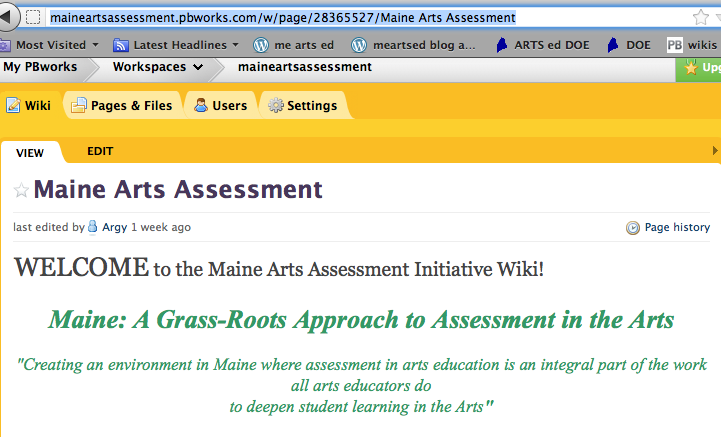
Recently revamping the Maine Arts Assessment Initiative wiki moved to the top of the list of “things to do”. It was prompted by a question from the field, a high school art teacher who emailed asking if the information (“notes and/or minutes”) from the summer teacher leader assessment institute sessions was available. He has been following the work of the Maine Arts Assessment Initiative (MAAI) including the blog posts, webinars, and other resources we have made available on the wiki http://maineartsassessment.pbworks.com and Department assessment webpage http://www.maine.gov/education/lres/vpa/assessment.html. It was as if the teacher had whacked me upside the head. I thought “why don’t we post the handouts, links, and information that we provided in each of the sessions?”

That is when I moved the task up to the top of the “to do” list and Catherine Ring and I skyped to determine who had time to do what, and where we wanted to make changes on http://maineartsassessment.pbworks.com to provide as many resources to all of you as possible from the summer institute.

This is another example of the MAAI transparency. If you want to get to the summer resources page quickly here is how to do that. Go to http://maineartsassessment.pbworks.com read through the front page, and towards the bottom you will see in capital letters INFORMATION AND RESOURCES. Click there for the  Table of Contents. Click on 2012 Summer MAAI Institute Resources which will take you to a TON, I mean MEGA amounts of resources on the four main topics of the summer institute; ASSESSMENT, LEADERSHIP, TECHNOLOGY, and CREATIVITY. The workshop facilitator is listed with the information so you know the sources. Along with the four topics there are many other resources including books, .pdfs, articles, research, and so much more it will take you several rainy days to get through all of it. Is everything included from the summer institute? No, this would be impossible since the Teacher Leaders and other participants shared continuously throughout the 4-day institute held at MECA in July/August. But you know what it is like when you get together with arts educators; the willingness to share is unbelievable! Is it only from the summer institute? No, but most of it is. There are arts education resources that have been shared during other workshops and on the Department site.

My suggestion is to share this page with your colleagues, administrators, and determine what you can use for your local curriculum and assessment development work that you are doing this school year. Please let me know how you use the resources that we’ve provided for all of you!!

A great big THANK YOU goes to the MAAI Leadership Team who facilitated the MAAI summer sessions and our New England colleagues who stepped in and did sessions on the Common Core State Standards and National Arts Standards. I won’t mention any names here with fear of omitting some but please know that it is several amazing arts educators!

h1

Maine Arts Assessment Initiative Summer Institute

July 30, 2012

First day

The last week has been crazy, busy getting ready for the summer institute which starts this morning. The Maine Department of Education’s second summer institute of the Maine Arts Assessment Institute gets underway today at Maine College of Art Thirty five teacher leaders started arriving in Portland yesterday to be ready for the early start at Maine College of Art. The leadership team met to go over the details of the daily schedule and participants continued to communicate electronically.

Over the past six weeks the 20 phase 2 teacher leaders have been communicating on the initiative wiki by responding to questions and having conversations on assessment, leadership, and technology. The standards based, student centered institute will continue to ask questions and provide the time for participants to discuss ideas, share practice, and explore options. Two essential ideas identified by Stiggins in Classroom Assessment for Student Learning:

  1. Teachers must be masters of the five standards of assessment quality in order to communicate accurate, dependable assessment information to any audience or assessment user.
  2. Students are the key users of assessment information and one of the best practices for teachers to improve student use of assessment information is to involve them directly in classroom assessment in appropriate ways as much as possible. 

    Throughout the week I will blog on the institute and keep you posted on the progress. I am excited about the possibilities and opportunities this provides, not only directly for the institute’s participants but for all Maine arts teachers and arts classes this could reach. One outcome of the week is that the teacher leaders will put together a workshop to present at the regional level. This allows the initiative to come to your region of the state! This work aligns with the Department’s strategic plan Education Evolving.


h1

Another Arts Teachers’ Story: Charlie Johnson

July 24, 2012

This is the 18th in a series of blog posts telling arts teachers’ stories. This series contains a set of questions to provide the opportunity for you to read educators stories and to learn from others.

Charlie Johnson started teaching at Mount Desert Island High School in 2004. He started his career as the first visual art teacher at the Jay School Department in 1973. He is the National Honor Society advisor for 20 students. His courses include Photography, Video, and New Media Arts. Charlie is a teacher leader with the first phase of the Maine Arts Assessment Initiative.

What do you like best about being a art educator?

I discovered my love for art at an early age, while my love for teaching did not develop until I was in college, so there is one interest overlapping another, and they make each day different and exciting for me. Teaching something I love and that I can “do” as well as teach makes my connections with students real and meaningful, not only to them, but to me as well. The “best” part is that I can learn from them and their solutions to problems in art every day, and it’s something I love to experience.

Tell me what you think are three keys to ANY successful arts ed program?

  1. Teachers with passion for teaching and the ability to transfer that passion to students.
  2. Teachers with a strong knowledge of pedagogy and the content they teach and who can share this effectively with students.
  3. Teachers who constantly make the value of ARTS education obvious to everyone in their school from students all the way down to administrators.

Express yourself in many forms and let others see you do that!

What specific way(s) do your assessment practices tie into the success of your program?

Students who are given the opportunities to be successful at many levels through understanding completely how they will be assessed and have had input into that assessment are usually on one hand very satisfied with their work and the processes involved in achievement or, on the other hand, understand why their work was not proficient and understand what they need to do to alter their processes to accomplish proficient work.

The vast majority of my students enjoy the task of making their work mean something and seeing purpose and content applied in their work as expression of their own ideals and thoughts and feelings. It is through the process of discussion, critique and revision that draws them into their work and lends to it an enhanced sense of accomplishment and satisfaction.

The “Learning Results” are an excellent structure to have students work within, and as soon as they begin to understand what the structures of the ARTS discipline are, their work begins to improve.

What have been the benefits in becoming involved in the arts assessment initiative?

For me personally, it has been similar to earning my Master’s Degree; as intense, but a shorter period of time. Being involved in the ARTS assessment initiative has really helped me to open my mind around education in general and to understand the need for a shift in the way education works. I think ARTS teachers have had it all together as a package for a while, but need to be more reflective and accountable for the important work they do with young people. It has caused me to “read” more concerning the specifics of my profession in general and myself as a teaching artist through books, professional papers, literature and articles/online content concerning the “how to” of methods and software around what I teach. I have “grown” connections to a small, but dedicated group of teachers within my geographical area of Maine, and feel a closer collaboration to teachers from other schools.

What are you most proud of in your career?

Making a difference to my students and what they accomplish in their lives, by far.

What gets in the way of being a better teacher or doing a better job as a teacher?

Nothing, any other answer to that question would simply be an excuse for not being the best you can be. If we are to expect the best from our students, then we need to be able to overcome all kinds of obstacles in our classrooms, from money to obnoxious administrators.

Apple or PC?

There’s a difference? Really, I own an iPhone, iPad and several PCs. The important understanding is around software, not platform. Apple seems to still be a bit more user friendly overall, but more controlling as well.

What have you accomplished through hard work and determination that might otherwise appear at first glance to be due to “luck” or circumstances?

I am fortunate to be working in one of the best ARTS supported schools in Maine, but the pathway to this school required a lot of dedication, hard work, love of craft, and yes, luck!

Look into your crystal ball: what advice would you give to teachers?

Stand up for yourselves, promote our profession as a profession by acting professionally and setting good examples for students at all times.

Do things for your students/school without expecting extra pay, it is much louder than words and will more often be appreciated rather than expected. This also ties into the concept of being professional and of teaching being respected as a profession. Encourage or help colleagues to step up every chance you get.

Technology is about to change the face of education, get on board or get ready for a long cold swim. Don’t succumb to technology, but embrace it, always leaving time for a walk in the woods or along a beach!

If you were given a $500,000.00 to do with whatever you please, what would it be?

I would fund a subsidized living complex for people with mental illness, making it as comfortable and spacious as the money would allow.

Charlie invites you to visit his blog at http://chartliej.blogspot.com.

Thanks Charlie for telling your story!

h1

Why Arts Education Matters

July 18, 2012

Arts and Technology Academy

This YouTube provides a wonderful opportunity to learn about an intensive arts education environment at the Arts and Technology Academy located in Washington D.C. By listening to these students and teachers at this link you can get a clear picture is evident of the power of the opportunity that the arts provide. You can learn more about the academy by clicking here.

http://www.samchaltain.com/this-is-why-arts-education-matters