Archive for the ‘Theater’ Category

h1

Collective Wisdom

September 16, 2019

New School Year Advice

THIS WAS A POST FROM ONE YEAR AGO BUT WORTH RE-POSTING!

From the voices of veteran visual and performing arts educators on starting a new school year

Make it a delicious school year!

Whether you’re just starting to teach or you’ve been add it for 50 years or somewhere in between you might be excited out of your mind to start or having the back to school dreams and asking yourself “how the heck am I going to do this?!” or somewhere in between. I asked veteran teachers “what’s your message for new and veteran teachers starting off the school year?” Here they are – WORDS FROM THE WISE and EXPERIENCED! It’s an amazing, amazing (and amazing) collection. THANKS to everyone who contributed!

Collectively below is the wisdom of 654 + 65 years of teaching. These are not in any particular order!

Kate Smith – 21 years
Central School, South Berwick Music Educator, Grades PreK-3
-The first friends you should make are the secretaries and the custodians.
-Drink plenty of water.
-Advocate for transition time between classes (see above).
-Don’t take yourself too seriously.
-Take the time to know your students.
-Find an Arts mentor. (MALI teacher leaders are great!)
-Build/maintain/reach out to a network of teachers for a sense of community and just-in-time support.
-You are going to mess up and wish you could forget it all. Write it down instead. Some day it’ll make you laugh like crazy.

Jake Sturtevant – 14 years
Falmouth High School Music Educator
If there is one thing I have learned to do over the course of the time I have been teaching it is to breathe. The power of breath is so important, and it takes moments to do. I still have those feelings of being overwhelmed and always reaching for the surface of the water beneath the pile of to-dos and hope-to-dos, but now I just try to pause and take a breathe and allow that feeling to settle and often it moves further from me.

Jen Etter – 12 years
York Middle School Music Educator 
My biggest words of advice starting a new school year and something that I am attempting to be mindful of is to not lose sight of the big picture getting bogged down in the details. Education is ever changing and constantly evolving and that can be frustrating at times. Keep focused on the big picture and what you know to be important and always keep students at the center!
Patricia Gordan – 38 years
RSU#14 Windham Raymond, Music Educator
  1. I do not just teach music to children. I teach children through music.
  2. Whenever I get to the point where I begin to think I know what I’m doing, I gain more wisdom and realize I still don’t know what I’m doing. (Keeps me humble.)
  3. When I have a student who is a behavior challenge I try to get to know them better and build a relationship with them outside of class.
  4. Music is a vehicle for expressing all thoughts and emotions. It can be scary to share the sad and angry songs with students. Will I get negative feedback from parents? “Go Tell Aunt Rhody” is a song about death! Should I use it? Of course we should be tactful and careful, but songs in music class should cover all emotions.
  5. A musician must have the heart of a gypsy and the discipline of a soldier. -Beethoven – Some students will be really good at the heart thing and some will be really good at the discipline thing. Stretch them toward the other skill.
  6. Sometimes I have a hard time with the word, “fun.” Music is fun but it is also hard work. I want the students to have more than “fun.” I want to feed their souls. I want them to feel the natural high that comes from producing a fantastic product that is the result of extreme effort.
  7. Especially for elementary teachers – Listen very, very closely. The “music” is in there somewhere. 😊
Iva Damon – 11 years
Leavitt Area High School, Turner, Visual Art Educator
Going into this year I am really resonating with going “back to basics”. We’re here for the kids as they are at the heart of everything we do. Remembering that at the end of each day, I am able to make connections and help achieve steps in their learning. At the same time, this year I am going to work harder at self-care and making sure to take time for myself.
Holly Leighton – 11 years
Mattanawcook Academy, Lincoln, Visual Art Educator
Teaching is not something you learn and then implement for the next 30 years. It is a constant.

The more I learn the more I realize what I don’t know. It is the “what I don’t know” that drives me to learn more. This is how I grow as a person and educator. It is a continuous cycle that inspires a fresh outlook to each new school year. Take workshops and conference opportunities, no matter how long you have been teaching. After 20 years of teaching I am always come back with something I can use to positively affect student learning and engagement.

Cindi Kugell – 30 years
Oxford Hills Comprehensive High School, South Paris, Visual Art Educator
Know your “Why”. When we focus on our reason for teaching, and for me it’s because there is nothing cooler than working with kids, it gives our lives purpose, clarity and focus. Working with kids keeps me young, inspired and energized and the gratification that I get from students excitement centered around the arts fuels my passion. I truly feel that teaching is my purpose.
Hope Lord – 29 years
Maranacook Community Middle School, Winthrop, Visual Art Educator
Each school year is a new opportunity for teachers to inspire students, innovate, take risks, collaborate, and celebrate the arts.
Adele Drake – 15 years
Hampden Academy Visual Art Educator
I believe in always being open to learning and receiving help and support from others.
Jane Snider – 27 years
Hancock Grammar School Art Educator
While working outside all day in my gardens to end my summer season I was thinking about all of my gardens, how much they had grown since early spring. I realized how much my teaching is like my gardening! Many plants are now in need of a rest, much like my students and I are in late Spring! I have nurtured the seedlings, plants and bushes throughout the season. I have carefully and thoughtfully helped them showcase their beauty! They’ll be back next year, bigger and brighter! Tomorrow I return to school to nurture my students and showcase the beauty of their learning through their art! I’ve had my rest and restored my spirit, I’m ready to carefully and thoughtfully begin a new season for my students! What do they need to grow and flourish?
Sue Barre – 26 years
Waterville Senior High School Music Educator 
Every year (on the advice of my first principal) I work to learn something about each of my students that has nothing to do with music. This process keeps me on my toes and it is also fun for my students to share their non music passions. I am often uplifted, sometimes saddened, and every so often astounded, to the response I can get from “share three things you did this summer.” My personal goal this year is to greet my students every day at the door……they deserve my attention, whether they are making music or not.
Carmel Collins – 20+ years
Lake Region High School, Naples, Dance Educator
Education today is like working with a living breathing organism. It is forever in a state of flux; morphing, refining, retracting, reshaping……Practice being flexible, adaptable and innovative, learn to let things go and move on, keep light on your feet and don’t get stuck in the mud!
When a parent or guardian becomes angry or frustrated with you, always remember that to them they are fighting for their child, a child they have loved and nurtured since birth. Most of the time they are not angry with you, rather it is the situation they are frustrated with and they are looking for help. Try to stay focused on the issue and don’t make it personal. Practice this and they will become your friend and loyal advocate.
Melanie Crowe –  17 years
Marshwood Middle School, Eliot, Visual Art Educator 
The anticipation of a new school year brings up so many emotions – a changing of the seasons, realizing summer is coming to an end, wiping sand off of my sandals for another season, and the vegetable garden bearing fewer treasures. Although, the excitement of meeting new students and having a chance to bring in a fresh approach and atmosphere to the classroom is a just as much a welcome adventure today as it was entering my first year 17 years ago. I am honored to share the art studio with my middle school artists, the opportunity to engage, challenge, and expand their minds is such a precious experience. The years go by in a blink of the eye, the students faces change, but the desire to light the flame of love for art grows stronger each year. I look forward to working with my colleagues integrating art in as many avenues as I can, bridging the gaps from one content to another so students can see how their learning is not in isolation but interconnected. When students can see how valued they are in the art studio, they begin to believe how valuable their art making experience is. I wish you all a wonderful school year working with the youth of Maine and beyond!
Lindsay Pinchbeck – 13 years
Sweetland School, Hope, Founder, Director, Teacher 
New Beginnings
An opportunity to start again
Still jitters – every year, conditioned since a child
Now knowing
The mix of wonder, unease and transition
Breathe
Fear not the unknown
Anthony Lufkin – 13 years
Friendship Village School, Prescott Memorial School, Union Elementary School, Rivers Alternative Middle School, RSU 40 
Every year is similar, but never the same. Each summer goes by faster and faster, but despite wish for more R&R, I always look forward to the new school year. Art and teaching are similar to me in that they are both all about making connections. In art we attempt to connect with artists of the past to understand their ideas, or we try to connect people with our own ideas and perspectives through creation. Teaching effectively requires making connections with students in a way that they can relate to, understand, and appreciate what we are teaching. If we lose connection, not only does artwork become insignificant to us, so does the purpose for learning. Each school year is an opportunity to make connections in new ways. Being in relatively the same position for several consecutive years gives me the insight for identifying ideas and processes that will relate to specific students. As I prepare to start my 12th year of teaching art, I am looking forward to “reusing” successful lessons, opportunities, and connections I have been able to make thus far.  However, I am also looking forward to experimenting with new ideas to better convey ideas, and give students new ways to understand, and more importantly connect, to what art has to offer.
Andrea Wollstadt – 21 years
John F. Kennedy Memorial School, Biddeford, Music Educator
Allow yourself to get caught up in the excitement. Students involved in music have a passion for music. Their joy and excitement is infectious. These kids are PUMPED UP about playing in an ensemble or participating in a music class. Whatever worries or anxieties you might have about the upcoming school year, make sure you give yourself a chance to catch some of their enthusiasm.
Lisa Marin – 22 years and retired!
Jonesport-Beals High School & Jonesport Elementary Visual Art Educator     
Words of wisdom for the new teacher: I remember that first year being very excited, nervous and worried about doing a good job for my new students, the school system, and my colleagues. I tried to get as much input as I could from my fellow art teacher friends, who were very gracious and generous with advice and materials. I was told to relax, have fun, and realize that it takes a few years to make the program your own. So, cut yourself some slack and you’ll be great. Oh yes, and make friends with the custodial staff. Their help over the years has been invaluable.
Words of wisdom for the veteran teachers: It may sometimes be hard to keep up the energy and enthusiasm in the face of new and increasing demands on your time that have little to do with quality teaching for students. I’ve tried to combat this by finding ways to shake up my lessons. I’m looking for ways to incorporate materials I’ve been unfamiliar with or slightly intimidated by to blow out the cobwebs! It’s been fun and I often find I am helped in my success by my students. We say we are all in this together!
For the soon to be retiring teachers (like me): Plan ahead for what you’d like to do post retirement. That will make the transition so much easier. This sounds like a no brainer but is often overlooked. As much as you might love your job remember, you do the job, you aren’t the job. A new teacher’s approach can be wonderful. We were once new teachers as well with fresh ideas. Enjoy your new year!
Shalimar Chasse – 26 years
Wiscasset Middle High School Visual Art Educator rk Middle School Music Educator 
I like to start right off with hands on- avoiding the loooooonnnnnnnngggggggg and boring “expectations” talk that mostly sounds like “wha wha wha wha, wha wha, wha wha” to students just waking up after a summer of sleeping in until noon. I refer students to my on-line site and a unit binder that holds class expectation information. I send them home with a parent guide to art class and encourage them to review this with their parents and return with a parent note confirming their time together and comments or questions. I encourage students to ask me any question to help them acclimate to our space and class while we are doing our first day art activity. Students know what is expected, some need reminding or clarification or simply to know they might not get away with something they have tested. They come to art to Do art- so I like to meet their expectations hoping they might return the gesture.I love the newness of a brand new school year- with no mistakes in it. I like to think of the upcoming year and classes as the best we will experience yet.
Allie Rimkunas – 15 years en Etter
Great Falls Elementary School, Gorham, Visual Art Educator 
Love your students. The most difficult ones need the most love. As an art teacher, I rarely know the home situations, or past trauma that these little ones might have or are still dealing with. I try to keep that in mind when I know a difficult student is coming into my room. Every day is a new day and a possibility for new positive interactions.
I have been teaching for 14 years, and every August brings a new batch of school anxiety dreams. Never fails. I figure that if I didn’t get them then I am not doing my job and changing it up enough.
Catherine Ring – 65 years
Isle au Haut Visual ArtEducator 
Share your passion for learning with children. It’s contagious!
Jane Kirton – 21 years
Sanford High School Music Educator 
Be Compassionate . . . Be consistent . . . CommunicateBe compassionate – Music is one of the few subjects that connects the heart and the brain. Showing compassion towards my students and my colleagues is who I am. The world is filled with so much pain, we don’t know what our students are going through at home. I take great pride in the fact that from day one I tell my students that my classroom is their home and we are a family.  No bullying is allowed. If there is a drama free atmosphere in the room, our music will sound better!  Show you care, smile (even though you are a nervous wreck). Don’t forget to be kind to yourself.  Take care of you – exercise, drink plenty of water, yoga, anything to relieve stress.

Be consistent – Consistency, in my eyes, is critical in good parenting. Set your classroom code of cooperation on day one and stand by it! Treat everyone the same. Discipline can be challenging for a new teacher. Discipline allows a successful start for the entire class. I always remind myself I can always ease up a bit as we get into the year but hold firm to your rules. Keep up with the paperwork (yes, there are certain things we need to do as part of the job which doesn’t have anything to do with what we teach – just “get it done,” don’t put it off.)

Communication – I always tell my students that I’m not a mind reader. I encourage them to tell me what’s going on. It is also important to communicate with them and their parents – concert schedule, paperwork, etc. Communicating with your colleagues is also important. I recently read a post where a new teacher was critical of older teachers in their district in the ways they were teaching. Not a great way to start!  We’re all in this together. Reach out and communicate.  Communicate with your administration, janitors, secretaries, etc. Ask if you don’t know!!

Rob Westerberg – 33 years
York High SchoolMusic Educator 
It’s not about the product, it’s about the process. Precious few are going to remember your concert or art exhibit or play or dance recital three years from now. But dozens of years from now every single participant will remember their journey with you to create that product, and whether or not you caused them to flourish academically and blossom personally. If you take care of those two things – on a daily basis – the rest will take care of itself. Academic without personal is tedious. Personal without academic is cheating them. Both combined is spot-on and will leave you at the end of the day feeling like it was all worth while. Because it will have been.
Charlie Johnson – 45 years
Mount Desert Island High School Visual Art Educator 
Get to know your learners; it is through positive connections that a teacher can discover that which is not always overt from an individual. We are all unique and we are all special, and if you endeavor to learn about your students in a positive manner, it goes a long way toward developing a teacher/learner relationship that benefits both parties.
I’m just starting my 45th teaching year, and I’m just as excited about my new students and classes as I was my first year, because I haven’t fallen into “the same old thing” trap and have many new pieces to explore with my students!
Barbie Weed – 15 years
Gray-New Gloucester Middle School Visual Art Educator 
I always find that the best way to begin a new school year is to forge connections with students as soon as possible. Whether students are returnees for new to the school, taking a little time to get to know something about them sets a positive tone for the whole year. I’m excited for the new experiences that students will bring to my classroom.
Jean Phillips – 30+ years
Wiscasset Middle High School English and Drama Educator
Life is an occasion; rise to it.
Lisa Ingraham – 13 years
Madison Elementary School Visual Art Educator 
Plan meticulously, but keep your mind open to teachable moments. Some of the best learning experiences in my art room began with a student question, interest, and/or aha! that changed our direction for that day.
I’m looking forward to a great, creative, messy year!
MaryEllen Schaper – 42 years and retired
Dance Educator 
Take your work seriously; don’t take yourself too seriously. The work is VERY important, but you can be replaced.
For new teachers, yes, you want to develop positive relationships with your students, but they are NOT your friends. If you need friends at work, develop friendships with your colleagues.
My former superintendent, used to say, “we are there to teach ALL children. Parents send us their best. They don’t keep “the good ones” home”.
We never know the baggage a student brings to school, so listen and be kind. Help students learn that that baggage may be a reason, but it shouldn’t be used as an excuse by the student, the teacher, or the parent. There’s a difference.
Applicable Lin Manuel Miranda “Hamilton” quotes:
“Why do you assume you’re the smartest in the room?” You might not be. I have learned A LOT from my students.
“I am not throwing away my shot.”  You have amazing opportunity to influence lives now and beyond anything in your wildest dreams, so go in EVERY DAY and give 100%.
“I am looking for a mind at work”. Teach your students to think outside the box, ask questions, and how to find answers, even if they might not be what you had in mind.
“Talk less. Smile more.”  Breathe. listen. You’ll be amazed at what you’ll see and hear.
“I wanna be in the room where it happens”.  You ARE in the room where it happens every day. Savor it. It goes by quicker than you’d think!
Lori Spruce – 11 years
Brewer High School Visual Art Educator 
Contribute to the knowledge and skills that you have not only in your own content area, but also expand out to involve your colleagues content areas as well. By doing so, you help not only yourself,  but also students and teachers can learn and grow in the same way. By getting out of your comfort zone and content area, the relationships that you build are invaluable and help build the confidence needed to model what you learn.
Pam Chernesky – 27 years
Mt. Blue High School, Farmington Visual Art Educator 
Start each school year open and ready to build a new community! Bring your best self and a positive attitude to what you do. Every year there will be new initiatives and demands on your teaching and your time, but the real focus should be meeting your students and sharing the excitement of creating and learning with them. Remember that you have content knowledge, passion, and experiences to share and that your students want to learn from you. Don’t become bogged down by the initiatives, administrative demands, or even the details of lesson plans. Offer challenges and take risks in your classroom! Laugh with your students!  Have fun!
Kris Bisson – 17 wonderful years!
Marshwood Middle School, Director of Choruses 
No matter what type of learners you have in your classroom, every student needs understanding.

When I’m excited about what I’m teaching, my students are excited about what I’m teaching!

Theresa Cerceo – 16 years
Dr. Levesque Elementary School & Wisdom Middle High School, MSAD # 33 Visual Art Educator
Trust your instincts, value your strengths and keep yourself open to learning new things.
Danette Kerrigan – 14 years
Sacopee Valley Middle School Visual Art Educator 
Every year is different, but poses the possibility of new discovery and greatness. Every year is the same – the same bright expectant eyes, sleepy heads, hugs and growth. Starting a new year is never boring, always keeping me on my toes, yet is as exciting as opening a new box of crayons… the possibilities are endless. Fashions change, expectations change, requirements change, students stay the same – still needing reassurance, encouragement, celebration and a champion.
For new and veteran teachers – breathe. Embrace each day and reflect at the end on what went well and be honest about what did not. Remember that everyone has something to offer, even those adults who may try your patience. They too, got up this morning, hoping to do the right thing. Assume good intentions. Always apologize – even to students – especially to students – when you have had a bad day and spoke shortly when you shouldn’t have. Remember that you are making an impact you don’t even know about yet.
Rick Osann – 15 years and retired
Bonny Eagle High School Media, Theatre, and Visual Arts Educator 
Be sure to be yourself. Teaching can be really stressful and it’s easy to try to be different to either be the “perfect teacher” or to get your students to “like” you.  The most important thing is to feel comfortable in your own skin.  Students of any age recognize quickly if you’re not being true to your core beliefs. Students will respect you if you just be yourself.
Bill Buzza – 26 years
Edward Little High School Music Educator 

Some words of advice for the beginning of the year:

#1 – Take time to get organized. We get so busy and there are many demands on our time. Using an organizational system that works for you allows you to spend more time teaching.
#2 – (New teachers) Find a mentor and don’t be afraid to ask questions. It’s much more efficient to learn from others than trying to reinvent the wheel.

#3 – Don’t be afraid to say “No” but keep an approachable demeanor. Many times students try to learn / push a teachers limits. We need to be committed to our response and consistent so students know what to expect.

#4 – Build relations with everyone; students, administrators, parents, colleagues, custodians. There will be a time when those connections will pay great dividends.
What’s your advice to new and returning educators? Please email me yours and I will collect them for a future blog post. How will you include and support new teachers in your school/district? Please introduce them to the Maine Arts Education blog – its easy to subscribe (on the right side, half way down). And, invite them to join the community by joining the arts education list-serv by sending me their email address.
Before we get to the “wise words” from Maine, Nancy Flanagan taught K-12 music for 30 years in Michigan. She blogs for Education Week, the TEACHER section called TEACHER in a Strange Land (you may want to follow her on twitter) and on 6 August 2018 she wrote a post called Ten Non-Standard ideas About Going Back to SchoolIt’s worth the read (after you read what Maine arts educators have to say)!
h1

Inspirational

September 8, 2019

Collaboration on the piano

Looking for a short video to help set the tone for why and how a collaboration can take place? Take a look and listen to this one – E. Pluribus Unum.

I enjoyed watching this musical performance since I think playing the piano with two hands is challenging enough. Washington Conservatory at TEDMED 2013 conducts a 24 Hands Piano Performance. The creativity and musical skill on display here is simply amazing. 24 Hands Piano is like a musical massage for the Steinway piano. Yes, this is music but its also a dance at the piano and a theater performance.


h1

Middle School – Music and Theater

June 12, 2019

10 year study

We periodically read reports and research about the benefits of arts education. We, as visual and/or performing arts educators don’t need a report to tell us what we already know. The impact of an excellent arts education with an effective arts educator guiding student learning is amazingly beneficial to learners, Pk-grade 12.

Just in case you’d like to read a report, here is a recent one. This was compiled while tracking the progress during a ten-year period of over 30,000 middle school students in Florida. Researchers from George Mason University looked at music and theatre.

h1

Happy Retirement

June 11, 2019

Maine is fortunate to have such marvelous arts educators!

We know that what a teacher offers can have an enormous impact on student development day to day AND over their lifetime. As educators retire at the close of another school year, 2018-2019, I invite you to join me in THANKING them for their years of service and dedication to students across the state.

I certainly appreciate your commitment and I wish each of you a healthy retirement and many, many years of laughter and love! Yahooooooo!

The following visual and performing educators have contributed a combined 371+ years to teaching visual and/or performing arts education!

  • ANGELIKA BLANCHARD, Manchester School and Windham Primary, Visual Arts
  • DAWN BODEN, RSU#3 Unity/Thorndike, Elementary Music, 35 years
  • JOY DREW, Wentworth School, Scarborough, Music, 27 years
  • VICKY MORGAN-FICKETT, York Middle School, Visual Arts, 15 years
  • MARY GANNAWAY, Elementary Music, Sanford, 43 years
  • SUE NELSON, Elementary Music, 21 years
  • NANCY NEUBERT, Sanford Junior High School, General Music and Chorus, 39 years
  • WENDY SCHLOTTERBECK, Leavitt Area High School, Visual Arts, 34 years
  • CAROL SLADE, SAD #17, Elementary Visual Arts, 20 years
  • BONNIE TAYLOR, K-4 Falmouth, Visual Arts, 23 years
  • RICK OSANN, Bonny Eagle High School, Theatre and Visual Arts, 15 years
  • LISA MARIN, PreK-12 Moosabec Community School District and Union #103, Gifted and Talented Coordinator and Visual Arts, 23 years
  • JIM SMALL, Madison High School, Visual Arts, 38 years
  • VANESSA WHITE-CAPELLUTI, Wells High School, Visual Arts, 38 years

If you  know of a teacher who is not on this list please be sure and email me at meartsed@gmail.com with the information and I’d be glad to add them. Thanks!

h1

Maine Arts Academy

May 9, 2019

The Queens of Brimstone

h1

Teaching Artist Professional Development Workshop

April 23, 2019

Space limited

The Arts Commission is providing a one-day professional development workshop for Maine Teaching Artists.
Monday 17 June 2019
8:45 a.m. – 3:00 p.m.
Only 20 spots available – REGISTER TODAY
Viles Mansion/Governor Samuel Cony House, 71 Stone Street, Augusta.
$25.00. Registration is required.
Purpose
The workshop is focused on the role and benefits of a teaching artist. We will address how to structure and market a residency as well as tips for communicating and collaborating teachers,  administrators, and community arts representatives. The workshop will include resources and techniques on applying your expertise as an artist to the structure of your work as a teaching artist including communication tips, connecting standards and assessments in your lessons, promotional information, funding opportunities, messaging and much more.
Outcomes
  • Information on applying your expertise as an artist to the structuring of your lessons and residencies.
  • Hands-on experience in relating the learning standards and assessments to your work.
  • Participation in sessions that are planned to fit your specific needs as a teaching artist.
  • Promoting yourself and your work as a teaching artist
Workshop Presenters
  • Tom Luther – Teaching Artist, Musician, Maine Arts Leadership Initiative Teaching Artist Leader
  • Lindsay Pinchbeck – Arts Educator, Founder and Director Sweetland School, Hope
  • Kate Smith – Elementary music educator, Central School, South Berwick
Please note: To be eligible to apply for the Maine Arts Commission Teaching Artist Roster teaching artists must attend the one-day workshop.
h1

Dancing in Freeport

April 10, 2019

Learners at the center of their learning

During the 2018-19 two schools in two different districts were the recipients of the Dance Education grant awarded by the Maine Arts Commission (MAC). Freeport High School and Maranacook Middle School created amazing units that impacted hundreds of students in Grades K-12.

Collaborators – Teaching Artist Nancy Salmon and Freeport High School Theater teacher Natalie Safely

The Dance Education grant is the only MAC grant that is a grass-roots effort grant. Several dance studios and two high school dance programs have a fund raiser each November. The money raised is what funds the dance education grant at the Commission. Without the dedication and commitment of many educators, dancers, parents, and community members this grant would not be possible. Special thank you to Thornton Academy Dance Educator Emma Arenstam Campbell for her contributions to being instrumental in making the Dance Education grant possible.

This blog post describes the dance education program that took place in Freeport this year. It is truly amazing to see what occurred when a teaching artist and an arts educator collaborate!

Natalie Safley is the theater arts director at Freeport High School but I learned quickly that she is much more than that. Natalie is a connector, an integrative thinker, a big picture and detailed person AND most importantly she “gets education for high school students”! Nancy Salmon is a dance educator and teaching artist who has worked with students and teachers of all ages for many years. Natalie and Nancy put their heads together and created a dance education opportunity for Freeport High School students that would touch younger students in RSU5 and introduce them to possibilities in dance.

FOUNDATIONAL STEPS

Workshop with grade 2 students following performance

Ms. Safley reached out to all RSU 5 elementary teachers for suggestions on source material as a beginning step in this performance process. A kindergarten teacher suggested the books by Kobi Yamada. Once Safley read each of the books, she new that would be the perfect starting point. Each book has a central theme: What do you do with a problem? What do you do with an idea? What do you do chance?.  In small groups the high school students first read the books on their own and pulled out lines and visual images that they connected with in each of the stories.  Then they made physical representations of the lines they pulled out from the text.  It was important throughout the process to have the students connect the text with a physical action. From there students continued working with the texts as well as writing their own pieces related to each of the respective teams. Finally, the students individually created a slide show of images that represented one of the three themes. The images came together and students physicalized them in smaller groups. The final performance had parts from all of the activities. Since the final piece was derived from the students’ own work they were more invested and committed throughout.

CLASS WORK

  • The work took place in the Theatre I class. Days 1-3 took place earlier in the semester when Natalie focused on Movement and the Actor. Nancy provided her instruction on establishing a performance vocabulary. Natalie continued to emphasize this vocabulary throughout the semester. This allowed Nancy to come in during the final project and begin working on the final dance elements immediately; building off the foundational knowledge established early in the semester. The culmination was students conducting a hands-on workshop with the elementary students to teach them the steps needed to perform the dance movement that was performed within the context of the show. Working with the elementary students in this capacity illustrated the high school students’ proficiency with dance literacy disseminated throughout the project.
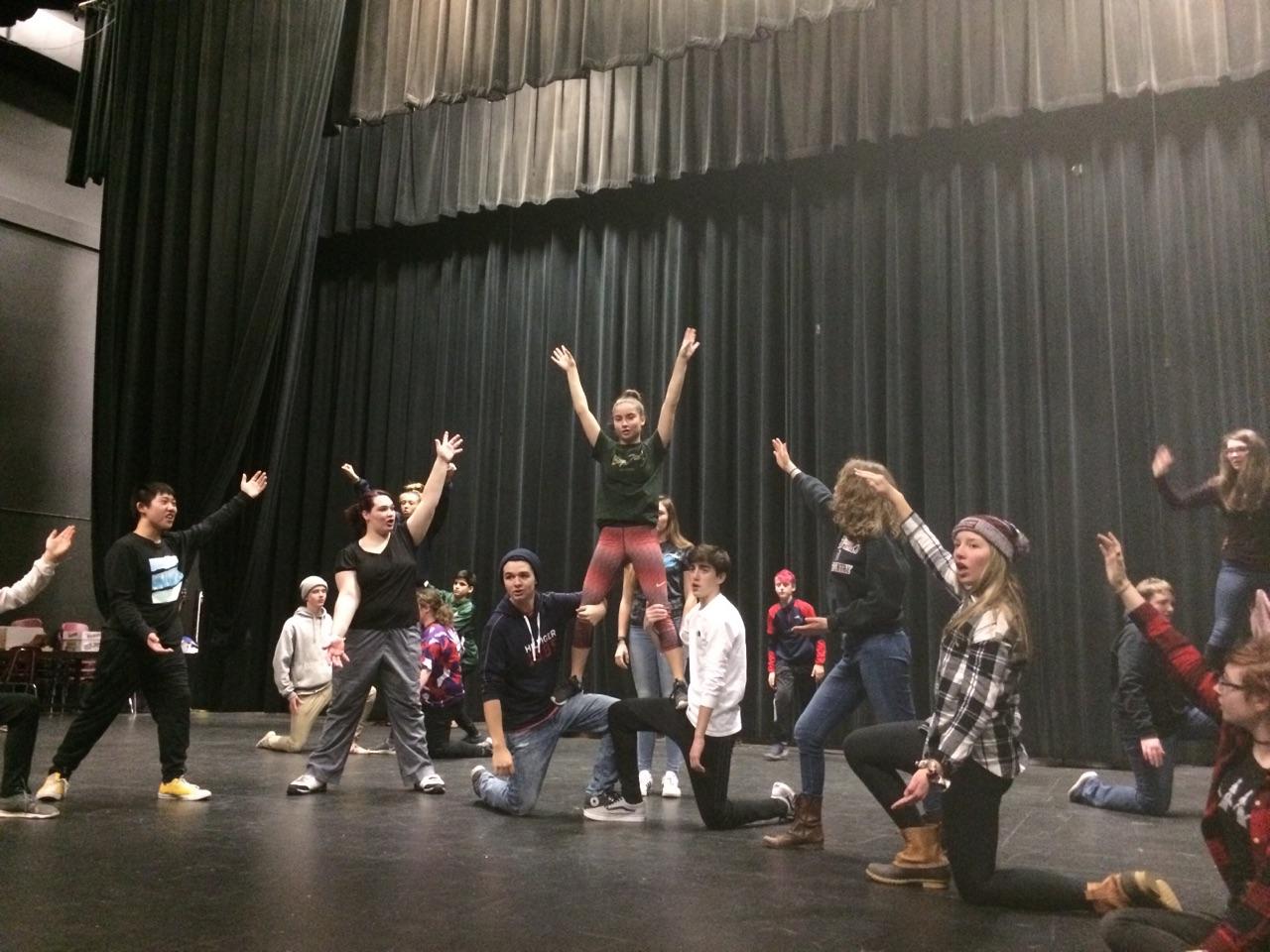
  • Dance was incorporated into the work in a variety of ways. The work began with an introduction to dance movement warm-up and the elements that are common to all dance and movement of any kind as developed and described by Rudolf Laban (Body, Energy, Space, Time or BEST). Students view a demonstration by KQED Art School on Youtube and talked about the Elements. KQED includes a 5th element – Action, which was discussed but did not include further in our work. Students and teachers discussed where dance movement could be included in the scripts or the production to best support or enhance the message. The opening entrance used strong, quick and direct movement introducing each student and getting everyone on stage. In contrast a small cadre of students were the “Chance Butterfly Brigade” in the 3rd section, using quick, light and indirect movement illustrating the notion fleeting chances that one needs to grab. Pathways were explored as well as the notion of repetitive movement in order to create a background of indecision, decision, action, disappointment, success. Viewing another video students learned a specific lift that required trust, timing, strength, and cooperation to make a person “fly”. Several students were particularly successful at embodying the intention of their character by understanding and using the dance elements.

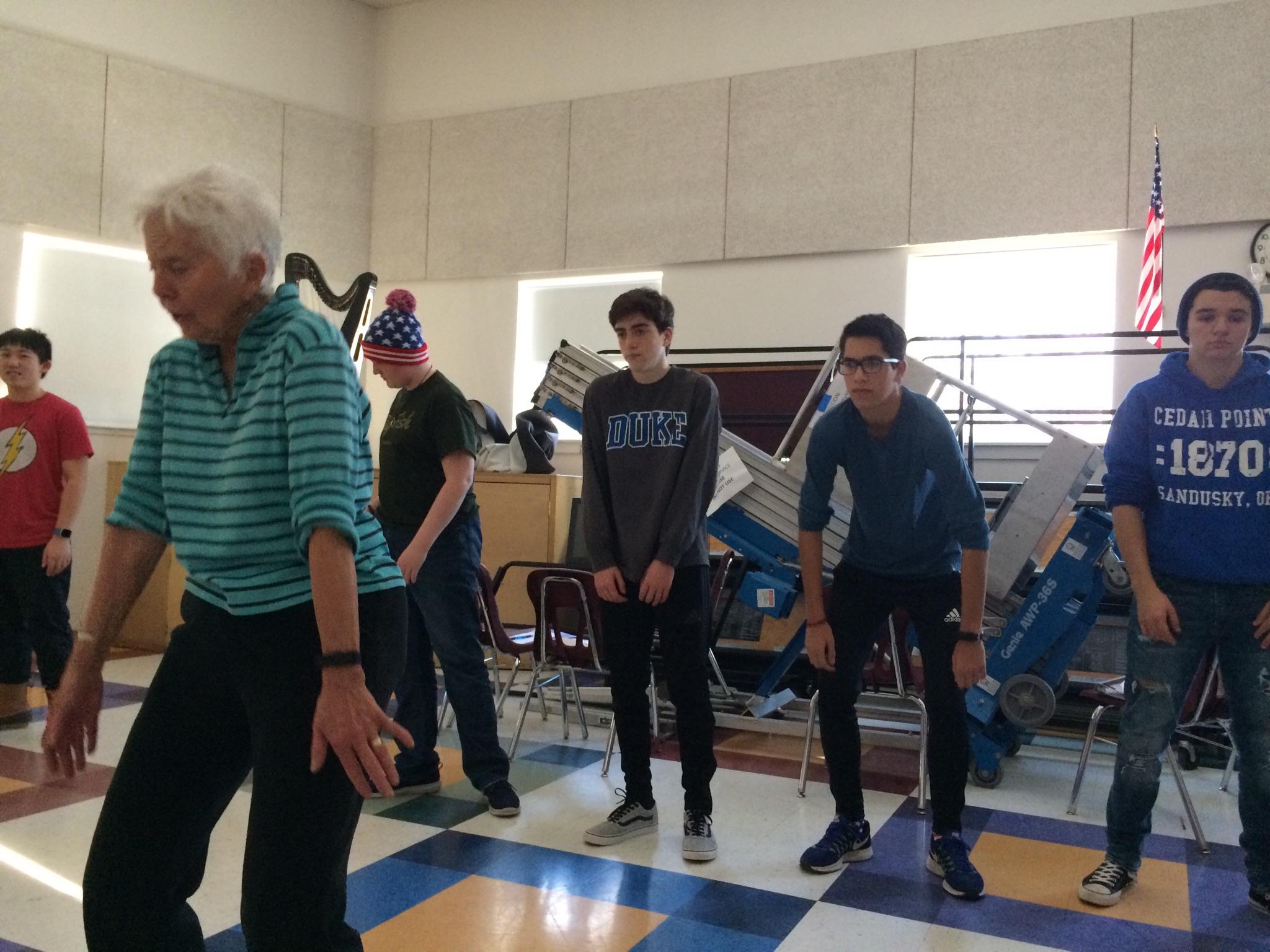
Nancy working with students on movement

LEARNING/OUTCOMES

The students learned…

  • to work as an ensemble, yet individualize the subtext of their characters.
  • to apply and embody vocabulary for dance literacy and devised theatre.
  • a different approach to analyzing a text for performance.
  • about using their bodies to inform the text.
  • that dance is more than memorized steps.
  • to write a story for performance.
  • student voices – benefits, what are they gaining? How might they transfer their learning to real world situations?

QUOTES FROM STUDENT SURVEYS

  • Dance is more than just traditional dancing to movements. It can be more simple and unique.
  • I’m really proud that we accomplished the lift during the last section of the play because the 2nd graders said that they really enjoyed it and loved that section of the play.
  • I am most proud of accomplishing my different facial expressions. I feel that some of my lines in the play make me have to give a lot of emotion and doing that I need a lot of different facial expressions.
  • The synchronization between everyone in the class and how even when we might have made mistakes, we just rolled with it.

WHAT ADMINISTRATORS SAID

  • Thank you so much for sharing this with the second grade. We were very impressed with the way that your students interacted with the younger kids. It made my heart warm watching our students faces in awe of your kids!
  • Thank you SO much for bringing your incredible Kobe Yamada performance to Pownal! The younger kids were in awe by your moves (especially when you made each other fly!), and the older kids were so inspired by how well you depicted the three texts! At a discussion afterwards one of my students said “I want to do what they were doing one day.” Thank you for being such great role models to the kids! We hope you will reach out with any other opportunities for us to see your work again!

LINK TO ONE OF THE PERFORMANCE VIDEOS

LINK TO ONE OF THE WORKSHOPS

To learn more about the MAC Dance Education Grant program Please CLICK HERE

h1

Charlotte’s Web

April 4, 2019

Bowdoinham Community School

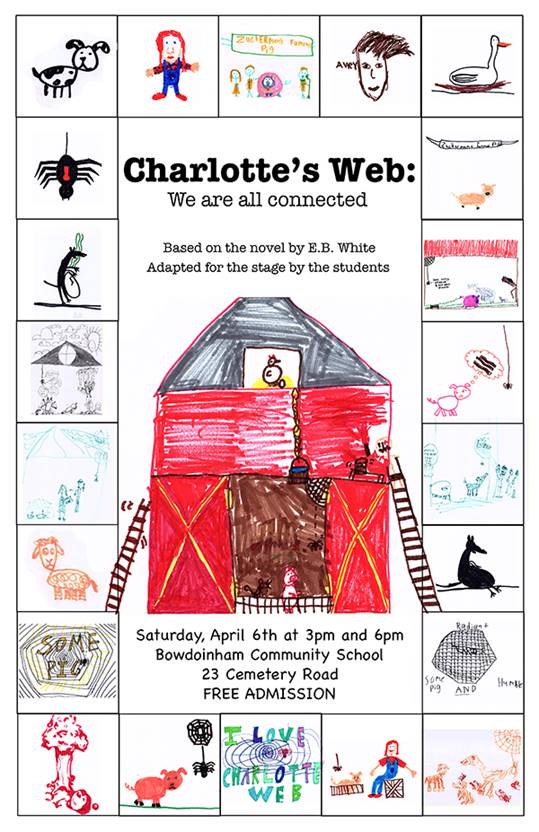
Bowdoinham Community School will present an adaptation of E.B. White’s classic tale Charlotte’s Web on Saturday, April 6 for two public performances at 3 p.m. and 6 p.m.  Charlotte’s Web: We Are All Connected was created by 4th and 5th grade students working from E.B. White’s original text, led by professional teaching artist and theatre program coordinator Dana Legawiec. Students have been meeting after school since January to share their favorite recollections of the story, write and improvise favorite scenes, design sets, props and costumes, and share their perspectives on what this beloved tale of rural life and childhood means to them.  The 4th and 5th grade students created an expansive theatrical world with enough characters and scenes to accommodate a cast of over sixty children from kindergarten through fifth grade.

Two free community performances take place Saturday, April 6 at 3:00 p.m. and 6:00 p.m. Doors will open at 2:30 p.m. for pre-show art-making and community building activities for all ages. Parking and seating are limited, so audiences are advised to carpool and to arrive early. Donations will be accepted to support extracurricular Arts programming at Bowdoinham Community School.  Bowdoinham Community School is located at 23 Cemetery Road in Bowdoinham.

“Friendship,” “Loyalty,” “Sacrifice.” 

“How we all have to take care of each other.”

“Growing up;” “Getting old.” 

“Bacon.” 

This is what the story of Charlotte’s Web means to the children at Bowdoinham Community School.

What does it mean to you?

h1

Theater for Social Change

March 20, 2019

Portland Stage

HIGH SCHOOL INTENSIVE: THEATER FOR SOCIAL CHANGE

Saturday, May 4 | 1PM-4PM
Grades 9-12 | $50
Join Education Director, Hannah Cordes, for a hands-on look at how to use theater tools and techniques to address difficult topics, encourage dialogue, engage communities, and create socially-driven pieces of theater.
Need-based Scholarships Available

h1

Two Teaching Artists’ Journeys

March 19, 2019

Nicole Cardano and Brian Evans Jones

Maine Arts Leadership Initiative Teaching Artists Leaders, summer institute, 2017. Brian is in the back row, third from the left. Nicole is in the front row, first person on the left.

I’m always interested in learning about the needs of teaching artists and how to better support them. I view their role in education as vital. Oftentimes it is the teaching artist who inspires a young person. Providing opportunities for learners in grades PreK through high school that include a teaching artist can be empowering for the learner. I have hope that every young person either becomes an artist or an appreciator of the arts as they continue learning on their life journey.

Those of us who have made arts education a career are so fortunate. We are engaged in the creative process as  individuals and have the chance to help young people develop their artistic ideas as well. When arts educators collaborate with teaching artists it is truly amazing. Both teachers learn but the ones who benefit the most are our students.

Pablo Picasso said: “Every child is born an artist, the problem is how to remain one once we grow up. I think of the artist in each of us as a fragile, beautiful and precious light, a creative spark inside of every person.”

Nicole and Brian at the MALI Summer Institute, 2018

Recently I asked two teaching artists who are leaders in the Maine Arts Leadership Initiative (MALI) to ponder what has contributed to their success as teaching artists. Brian Evans-Jones and Nicole Cardano joined MALI in 2017 during the summer institute.

Brian Evans-Jones is a poetry and creative writing teacher who moved to southern Maine from the UK. He’s been writing poetry since he was 16. Brian has a B.A. in English and Creative Writing from Warwick University.

“Since 2005 I have taught creative writing, which is as important to me as my own writing. I’ve taught all kinds of people, from 4 to 94, in all kinds of venues, and this is the main way I try to spread the appreciation of poetry.”

Nicole Cardano has been teaching Drama and Improvisational Theater in PK-grade 12 schools for eight years. In addition, she teaches adults. Nicole’s studies and practice of improvisational theater connect to the foundational philosophies of Listening, Support, Eye Contact and Respect. The games that she teaches and her directorial mindset work from these foundations. Nicole believes in the process being more valuable than the product. Learning and developing these skills fosters a stronger community, a place of open listening and supportive fun. You can learn more about Nicole’s work on Facebook at Theater Today, Nicole’s non-profit organization.

“This December I worked with elementary and middle school students in preparation for their field trip to see Charles Dickens’ Christmas Carol. The students learned about workhouses and the hard labor and often dangerous jobs that children did in London during the 1840’s. We imagined this world through writing and theater exercises.”

NICOLE, HER TEACHING ARTIST JOURNEY

I started out as a Teaching Artist before I knew that this job title even existed. I was teaching drama and improvisational theater at the Summer Festival of the Arts and re-establishing the drama club program at my alma mater, Pemetic Elementary School. One program would lead to the start of another one. In the last nine years the work has grown. I have formed a non-profit, Theater Today, and have been able to spearhead a larger program in partnering with The Grand Theater, in Ellsworth.

Two years ago I learned that The Grand had a program called Performing Arts for Children showing school-aged performances during the school day, but they were not getting the audiences that they hoped for. The opportunity to partner was clear. Several professionals collaborated to create a Community Arts Curriculum out of which grew my role as the Arts Outreach Educator. This is our second year of this outreach collaboration and we are working with the full student body of four schools, three serving grades K-8, and one 9-12 high school. I have worked with 1,311 students leading theater integration workshops in their classrooms since September of 2017 in just this partnership alone (not including the additional programs I still lead). After meeting with classroom teachers, I design improvisational theater workshops that provide connections between the classroom curriculum and the live theater field trips at The Grand.

I grew up locally on Mount Desert Island in Maine. I got my first taste of theater in school. This made me aware that I wanted to be able to sing better, as I could not really carry a tune. As luck would have it there was an outstanding vocal teacher in our town. Carol Cramer Drummond was an accomplished opera singer and became my performance mother. Carol taught me confidence through song and showed me another world. I struggled to learn in school in the format I was expected. My mother too had her own history of challenges in school. I am now raising my daughter, also as a single parent, and I find myself advocating for her experiential learning needs.

Theater was the only subject I could think to study as I went on to Saint Michael’s College in Vermont. Both of my parents supported this decision. I graduated cum laude with a departmental award of honors and minored in Spanish as an extension of my year abroad in Mexico. My senior year of college one of my theater professors was intrigued with the book “Truth in Comedy; the Manual of Improvisation” from the training and performing center IO (formerly Improv Olympic) in Chicago, IL. IO teaches long form improvisation, where you perform a full show based off of one audience suggestion. Our professor formed an improv troupe and we studied this book. I graduated college in May of 2001 and went home to work a summer job and await a New England Theater festival that I had been selected to compete in. I had plans to go to New York City to follow a job lead. That September our nation experienced 9-11. My understanding of the world as I knew it had changed. The job did not pan out. Going to Chicago to study improv felt like the most sensible and sane endeavour. I competed at the festival in January and flew out to take a level one class at IO. I stayed for the full year and completed the improvisational program. Chicago became my home. Improv was the language that I spoke. I continued to study, perform and work for ten years in this city.

I moved back home to Maine for family reasons. I was raising my three year old daughter and my father had gone through stage four bladder cancer due to his exposure to Agent Orange in Vietnam. Time moved forward and my daughter entered school. She was also displaying learning challenges and was not showing the results that our schools wanted. I served for a full term as the chair member of our local school to support education and to better understand it. I really enjoyed being a part of this team. My term ended and I had to decide where I could make a greater impact. My programs were growing and it is a conflict of interest to be on a school board and working in the schools. I continued to develop the work that I saw a need for and believe in. I formed Theater Today to continue this mission. Theater is a tool that helps to communicate and explore topics of interest. This has been true on my journey through life. The practice of theater is a social, emotional and educational tool for all. I embrace process more so than product.

I design the curriculum for the theater integration workshops as the Arts Outreach Educator with The Grand. In our first outreach workshop I was working with 8th graders. The show that they were scheduled to see was “Frankenstein”. The students were studying gothic romantic writing. I taught them about the significance of Mary Shelley and how she wrote Frankenstein, the first sci-fi novel, based on the real modern science of the early 1800’s. The science teachers invited me to speak on this in their classroom, and so I did. In these workshops we highlighted that we are in the middle of history. Through the use of improvisational theater we “built” Victor Frankenstein’s laboratory and acted out scenes on what could go wrong with today’s modern science….

Next I worked with high school juniors and seniors in preparation for seeing Thornton Wilder’s “Our Town”. With the practice of theater we explored the American Dream and enhanced public speaking skills.

This December I worked with elementary and middle school students in preparation for their field trip to see Charles Dickens’ Christmas Carol. The students learned about workhouses and the hard labor and often dangerous jobs that children did in London during the 1840’s. We imagined this world through writing and theater exercises. We explored Dickens mission of the important role of education in the fight against poverty.

The curriculum areas of integrated study have spanned grades K-12.

In the growth of the outreach program with The Grand I see that there could be more partnerships with other arts organizations in an effort to expand the community of learning. For example, art exhibits could have in-classroom workshops with visual artists in connection to gallery showings. The possibilities are endless. Partnering teaching artists with directors of arts organizations has the potential to create a lot more routine work for arts integration in our schools and blurring the line between classroom and community, thus creating more experiential learning opportunities. Many students, and adults, have not been exposed to all that their town or neighboring towns have to offer. Arts outreach expands the exposure to life that any one person has.

The programs with The Grand and Theater Today are primarily supported by grants and scholarships. We do hope to expand the sponsorship opportunities for this programming.

BRIAN, HIS TEACHING ARTIST JOURNEY

Path 1:

January 2005:  I am in the last year of my undergraduate degree in Creative Writing at Warwick University, UK. Not sure what to do after graduating, I go to see my course director and ask him, “How can I teach creative writing?” He tells me I should go see the professor who runs the university’s creative writing summer school for students aged 11-16. He gives me a job. I work on the summer school for the next 4 years, starting as an assistant for a couple of days, and ending up as a full teacher, staying for two weeks.

April 2006:  I am training as an English teacher in a vocational high school in Manchester, England. I hate it. The school asks for volunteers (unpaid) to run Enrichment workshops. Starved of creative writing teaching, I run one on story writing. 8 students attend.

June 2006:  I am interviewing for a full-time job as English teacher at another high school in England. The principal offers me the post. I say I’ll take it provided I can teach an hour’s creative writing a week, pointing to my experience on the Warwick summer schools and at my previous high school. He says yes.

January 2010:  My creative writing group at the high school has had enrolments of 12 students, 4 students, 18 students, and 23 students. I have organized annual competitions in poetry and fiction, getting the principal and vice principals involved in the judging. I have published chapbooks of the students’ work. In January of 2010, the head of Creative Writing at the local college (Winchester Uni) agrees to judge a fiction competition, teach a lesson to my groups, and give them talk about taking creative writing at college.

December 2010:  I have quit my job at the high school. I contact the head of Creative Writing at Winchester Uni to ask for work, and he asks me to teach an undergraduate course. I teach at Winchester Uni until I leave England in 2014, eventually increasing my teaching to 6 courses per year.

November 2011:  One of my colleagues at Winchester Uni starts an organization called the Hampshire Writers Society. I attend the first meetings to support her initiative. She tells me about a competition to become Hampshire Poet Laureate in 2012 and encourages me to enter. I enter it.

January 2012:  I am named Hampshire Poet Laureate. Over the next year, I am paid to write 4 poems and to run workshops in prisons and homeless hostels. The Poet Laureate also promotes my work as a teaching artist to schools throughout Hampshire. I set up an online project (Writing Hampshire) that encourages people to write poems about their favorite places in the region and submit them for web publication.

2012-13:  Approximately 30 schools contact me to ask me to run poetry workshops. About half of these want me to help students write poems for the Writing Hampshire project. Writers’ groups, arts centers, and community organizations also ask me to work for them. Combining my work as a college professor and teaching artist, I am teaching creative writing full-time.

Path 2:

June 2006:  I am completing my training as a high school English teacher. One of the requirements is to join relevant professional associations. I find an organization I’ve not heard of before called the National Association of Writers in Education. I don’t have much money, but I decide to join it.

July 2008:  All NAWE members receive a letter from the Open University. The OU is expanding its creative writing courses and wants new teachers. NAWE members are encourage to apply. I do, and I am given a course to teach.

June 2010:  After two years teaching my OU course, my manager contacts me. They have a vacancy at short notice, and would like me to take it. The combined income gives me enough money to quit my unhappy high school job and go freelance, albeit with a part-time income, but with more time to write.

December 2010:  I contact my local arts center. Based on my experience teaching for the OU, they hire me to run poetry and fiction workshops. By the time I leave England in 2014, I have run 30 workshops and classes fort them, for children and adults.

April 2013:  The manager of the Jane Austen House in Hampshire, England, attends one of my poetry workshops at the arts center. She hires me to run a poetry workshop at the Jane Austen House.

August 2014: I have moved to Maine with my family. We go to a children’s art event at the Jewett House in South Berwick. I get talking to the manager, and tell her about my work at the Jane Austen House. She hires me to run a writers group at the Jewett House and also some one-off creative writing workshops.

November 2015: With some others, I give a presentation at the New England Museums Association Conference on my work at the Jane Austen House and the Jewett House. Soon after the Conference, I am hired by two other historic buildings to run workshops for them.

May 2015:  I am at the end of my first year in grad school at UNH and looking for ways to fill the summer. I offer some free mentoring to a young writer who has come to my writers’ group at the Jewett House. Her mother is grateful, and invites me to go with them to an event called Big Night run by something called the Telling Room in Portland. I go, and I am hugely impressed by the Telling Room’s work with school students. I ask to train as a Telling Room Teaching Artist.

2016-2018:  I work on multiple residencies for the Telling Room, working with 7 schools and leading several residencies.

Path 3:

April 2016:  I am at the end of time in grad school at UNH and wondering about starting a creative writing nonprofit. I hear about a funding workshop run by the Arts Council of NH. I go to it and meet the woman in charge of Arts funding. We meet again later; she tells me about the NH Teaching Artist roster. I apply to the roster and am accepted.

May 2016:  I look for other rosters to apply to, and discover Maine has one. I apply, am accepted, and am invited to a Teaching Artists Training Day.

Brian conducting Poetry Out Loud workshop at Hermon High School

August 2016: At the Training Day. I meet Argy Nestor, who talks to me about Poetry Out Loud. I have experience of the British equivalent. Argy asks if I could do some workshops for POL in Maine. I say yes! I also meet Kate Smith, music teacher at my local elementary school. She tells me about our local Education Foundation, which funds projects in our district. She encourages me to apply for a grant to work with Central School in South Berwick. The grant is funded.

November 2016 and 2017: Argy sends me hundreds of miles to the parts of Maine that are farthest away from my home in South Berwick, bringing Poetry Out Loud wokshops to rural schools and broadening my knowledge of my adopted home state at the same time.

March 2017: My 2-week poetry residency with second grade at Central School in South Berwick takes place. 80 children all write several poems, redraft one to go in a chapbook, and share their learning with their parents.

Brian and Kris presenting, MALI Mega, March 2018

August 2017: Argy invites me to apply to the Maine Arts Leadership Initiative (MALI). I attend as a Teaching Artist Leader. Kris Bisson, Chorus teacher at Marshwood Middle School, attends my poetry workshop. She asks me to be involved in a composition project with her 7th and 8th grade chorus groups, and writes a grant to the Marshwood Education Foundation.  I also meet Tim Christensen, potter and Teaching Artist extraordinaire; Nicole Cardano, improv artist; and Lindsay Pinchbeck, teacher of the integrated arts school Sweet Tree Arts.

Fall 2017:  I run my part of Kris’s chorus project. I meet the students for 6 sessions and help them write lyrics based on a local landmark bridge that is the focus of a community renewal project.
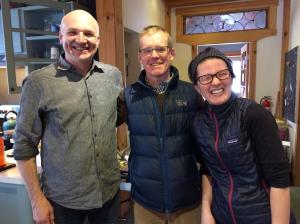
Tim Christensen, Brian, Lindsay Pinchbeck at Sweetland School

January and October 2018: Lindsay Pinchbeck invites me to Sweet Tree Arts to run collaborative residencies, first in partnership with Tim Christensen and later with Nicole Cardano.

2018:  The Arts Council of NH send me to schools throughout the Seacoast region of NH to run Poetry Out Loud workshops.

2018:  Kris Bisson and I present our collaborative project at MALI and at the MAMLE conference.

November 2018:  Argy asks me to make some Poetry Out Loud videos to be hosted on the Maine Arts Commission website. I work with student POL competitors and the MAC’s Ryan Leighton to plan and record the videos.

December 2018:  Kris’s chorus perform their composition piece at the State House in Augusta. I am privileged to attend.

This is not a complete picture of what I have done, but I hope it gives an idea of how my work as a Teaching Artist started, expanded, and changed. What I want to show is that I never planned to do this: every new thing emerged and developed from other things I did before, generally not knowing what they were going to lead to. I don’t claim that this is an ideal path: I still have not gotten back to being a full-time teacher of creative writing as I was in 2014, before I left Britain; and even then my income was barely enough to support a new family. But it has been a fun ride.

If I have advice for new teaching artists, it would be:

·      Find things to do that are the right things to do for you, however small at first.

·      Look for places to meet good people: people on the same wavelength as you.

·      Be as creative about your teaching are you are in your art.

Good luck!