It is not a surprise that the arts are playing a part in helping to heal and supporting Mainers during this time to make sense of the tragedy in Lewiston. As we learn more details we are also learning the ways that the arts are a vehicle for helping us to ease the pain and process the event. Below I’ve included some that have come to me through multiple avenues. I invite you to share some of what you are involved with or are aware of by “leaving a comment” at the bottom of this blog post or by emailing me at meartsed@gmail.com. I have been making cards and sending them to those who I know personally that have been impacted by the event. If you know of someone who could benefit from a handmade card please email me. My heart goes out to the families and loved ones of the victims and to all the educators who are there for students. Please remember that whatever you’re doing is enough and the right thing.
Turner Art Teacher
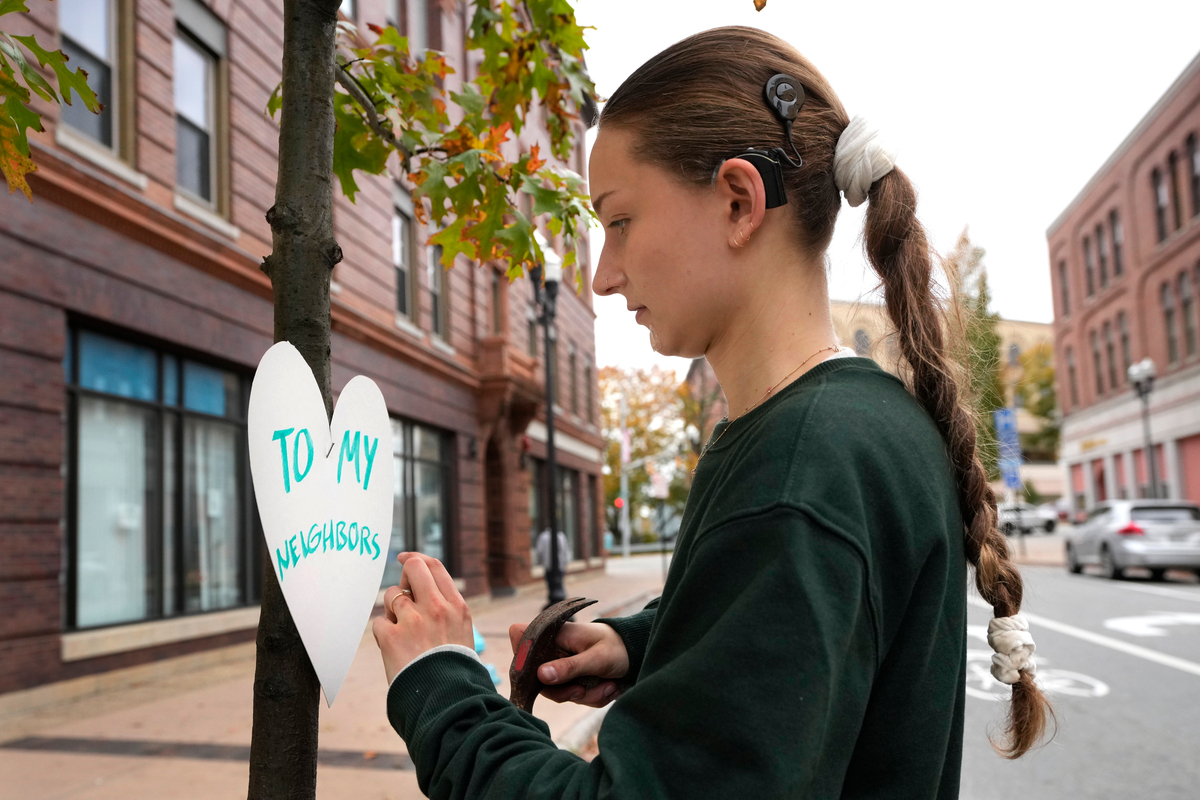
Miia Zellner, an art teacher from Turner, Maine, attaches a heart cut-out with a message of positivity to a tree in downtown Lewiston, Maine, Thursday, Oct. 26, 2023. Zellner wanted to show her love and support for the community in the wake of Wednesday’s mass shootings. (AP Photo/Robert F. Bukaty)
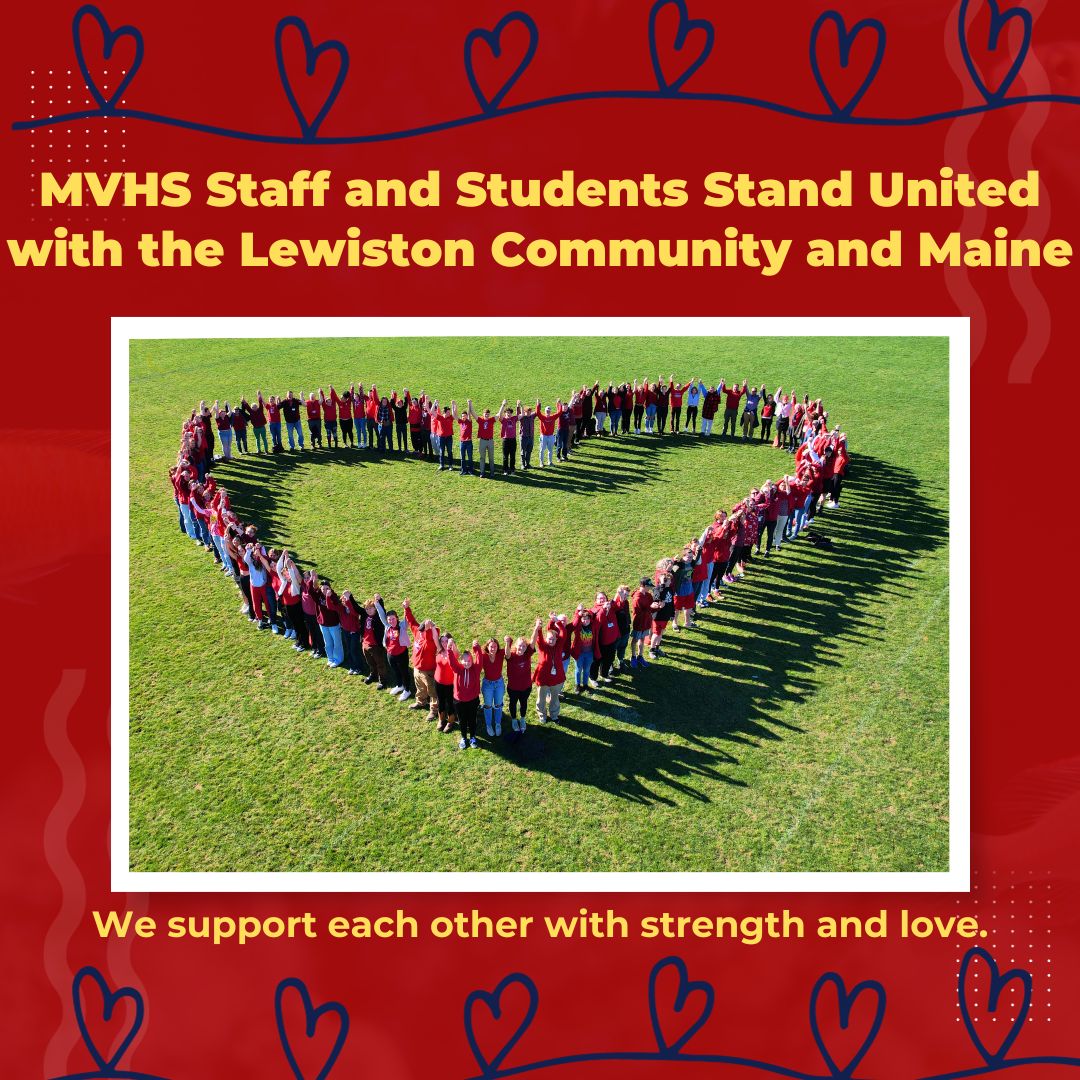
Medomak Valley High School in Waldoboro
James Taylor
Known as the Battle of the Bridge, last weeks football game featured cross-river rivals Lewiston High School and Edward Little High School of Auburn. James Taylor was there to sing an acoustic version of the National Anthem before the kick-off of the game.
L/A Arts – the Arts agency for the cities of Lewiston and Auburn
An open call for artworks to individuals and organizations at the local, state and national level to express your thoughts in the form of a postcard. We call upon all mothers, fathers, and children; teachers and their students at all levels; artists, whether novice or seasoned; wordsmiths; dreamers, thinkers, feelers and doers of all ages and backgrounds. Share your hopes and your fears, your remembrances and your well-wishes.
These postcards can be addressed directly to the victims and/or their families, the immediate community of Lewiston impacted by the tragedy, or more broadly address growing concerns over the horrific frequency of gun violence across the nation.
During a surprise ceremony Thursday, 700 students and staff members learned Waterville Senior High School (WSHS) has received the Performing Arts School of Excellence award given by the National Federation of State High School Associations. The award was introduced in 2016 and only the eighth one presented. WSHS is the smallest school to have received the award.
Principal Brian Laramee said: The award “is truly a testament to the many students and staff of Waterville Senior High School that have worked long and hard to expand and improve their craft.”
WSHS music department visual and performing arts department chair Sue Barre said: The award “was not just representative of the hard work and dedication of current and past department members, but also a celebration of the transformative power of the arts in society.”
Chorus Director Ciara Hargrove, VPA Department Chair Sue Barre, string and Orchestra Director Colin Wheatley, former Drama Director Gayle Pelligrini and current Drama Director Dana Bushee. Rich Abrahamson/Morning Sentinel
Performing as first violinist in the orchestra Thursday, senior Sophie Scheck, 17, said she was surprised and happy about the award, but was not sure everyone realized its magnitude. “This is really big,” Scheck said. “I think we definitely deserve it. The teachers are amazing, and I don’t think we would have gotten it without them.”
Waterville Schools superintendent Peter Hallen emailed: “To me, our performing arts program is an example to all of us in education about how to engage and inspire students. It’s the unique place where students of all ages, interests, backgrounds and abilities come together and learn with, from and about each other. Lots of credit was thrown around today, but make no mistake, those teachers are what drive that program.”
We (arts educators) have first hand knowledge of the work that goes into a dynamic arts education program! I know all of my colleagues reading this blog post join me in offering a huge congratulations to the students, educators, and all those who support arts education in Waterville school district!
Rich Abrahamson/Morning Sentinel
The information for this blog post taken from an article in the Morning Sentinel and written by Amy Calder. Read the entire article at THIS LINK.
They’ve done it again! Today the Union of Maine Visual Arts (UMVA) journal was published and it is jam packed with amazing articles; something for everyone! The fall issue, Materiality has a variety of thought provoking articles written by artists, writers, and educators.
Maine Arts Journal Fall 2023 cover (Rosamond Purcell’s studio, Somerville, MA, with a detail of Wall, mixed-media installation, photo: Veronique Plesch, May 2018).
Introduction by Veronique Plesch
For this issue we invited our contributors to reflect upon the many ways in which their work engages with the notion of materiality, considering the different stages of the creative process, starting with their choice of medium and how tools and materials interact, all the way to the tangible objects they produce. The topic proved inspiring: the responses address the centrality of the choice and handling of the medium. We read about materials’ possibilities and limitations, about how one might attempt to control them or instead submit to them (some materials seem to remain indomitable while others readily—willingly?—cooperate in allowing the artist to reach their goals). Contributors discuss the importance of tools to obtain certain desired effects, while they also marvel at the resulting unexpected and welcome surprises. The process’s dynamic nature is made clear by how often notions such as fluidity, transformation, transmutation, and metamorphosis are mentioned, suggesting that materials have an agency of their own. As we read through the issue, it becomes clear that materials are more than a driving force in the creative process: they are true partners, at once inspiring and motivating, starting point and goal.
This issue includes a piece written for the education column, Insight/Incite by Maryam Emami. Maryam is the 2023 Franklin County Teacher of the Year, has been teaching graphics and social studies at Rangeley Lakes Regional School since 1995. The article includes a variety of images that Maryam’s students have created.
If you’d like to learn more, become a member of UMVA, and support this fabulous organization you may do so at THIS LINK. UMVA hopes that you will subscribe to AND support the journal by becoming a member of the Union of Maine Visual Artists by clicking here. You can subscribe for free by clickinghere.
If you’re interested in writing for the journal please contact me Argy Nestor at meartsed@gmail.com or go to THIS LINK.
Explore archived journals (from the past 10 years) at THIS LINK.
In 2010 Congress passed the House Resolution 275 which designates the week beginning with the second Sunday in September as National Arts in Education Week. This is a week to shed extra light on the power of arts education. Young people and adults come together to tell the story of why the arts are essential for all ages and share the benefits of engagement in the arts.
Suggestions on how to PARTNER with others to celebrate.
Come up with a plan to ADVOCATE with your colleagues.
Create a SOCIAL MEDIA campaign to pass the word on about the value of arts education.
This week is an opportunity for you, your students and your community to recognize the importance of arts education. Celebrate in your classroom, your school, and beyond!
I know what you’re doing is amazing! Take a moment to let others know and THANKSSSS for your great work. YOU ROCK!
Here we are, Labor Day weekend. I know that many of you have returned to school, some with students and some waiting until Tuesday for learners to come rushing in. I’m confident that with the changing of seasons gradually upon us that your school year is going to be spectacular. I love seeing messages on facebook, instagram, texts, and in emails from friends listing the number of years that they’ve taught. It signifies so much pride in teaching. Like hanging your college degree framed on the wall of your classroom, or better yet outside the door of your classroom. The message it sends: I’m proud of my degree in education and proud to teach in this classroom/school. Teaching is the noblest of careers and we all aware that today, it can be challenging.
This weekend, I was together with some friends who are retired teachers. We discussed how easy it is to forget the impact we’ve made on students. Recently they bumped into the parents of former students and they gushed about how fantastic they were and the difference they had made in their child’s lives. I pulled out my portfolio recently and read some letters and cards from former students. My emotions rose and because of the tears streaming down my cheeks I was forced to stop. Rewarding feeling? You betcha! I hope that you are saving the notes that you receive!
My School Year
My time and responsibilities have shifted. I’m grateful to be continuing my involvement with education, in many different ways. I return to substituting, continue to blog, communicate with educators in Maine, the US, and around the world. My connection with HundrED continuously provides ‘food for thought’. Reading educational material and listening to podcasts keeps me updated on research and opinions. One of my favorite podcasts is The Growing Band Director with Kyle Smith who teaches at Westbrook High School. I’m preparing for a keynote that I’m giving at the New England League of Middle School (NELMS) conference in March so I’m thinking about it often. I serve as the editor for two Maine publications, if anyone is interested in writing please let me know. I enjoy visiting classrooms and communicating with teachers. I especially like to connect to learn more so I can write blog posts highlighting the amazing work going on in classrooms. Reach out to me if you’re interested.
My art making has become important to me. In a few days I’ll post about an exciting collaboration that was just published. I’m thrilled to be part of a planning committee in my town for our Sestercentennial – 250 years! We’re helping to bring arts education residencies to Union Elementary School. One with dancer and musician Chrissy Fowler from Belfast Flyer Shoes. She’ll teach the students, K-6 contra dancing and we’ll have a school and community dance. The second with musician and music educator Scott Dyer who is writing my town’s history as a musical. He’ll be working with all the students to learn and perform the history for the school families and greater community. It’s all very exciting.
My commitment to quality arts education for all students become stronger every year! We all know the power of the arts to engage student learning and to appreciate what makes us each human. If you’re a teacher of visual and/or performing arts education you have the power to make a huge difference in a positive way for young people. The arts are an avenue to helping students make sense of the world. They are a necessity not a luxury, not only for the ‘talented’ ones but for all students. They deserve the best from you and everyone with a stake in our children’s success must see arts education as their cause. Access to and opportunities to an excellent arts education is critical and at the heart of excellent education.
Please know as you start (or continue) with your school year that I am excited for you and jumping for joy and wishing you the very best school year. I am grateful that you’ve chosen education for a career! Happpppy New School Year!
As we know the summer is filled with opportunities around the arts. The Farnsworth Art Museum is no exception; they provide exhibits, classes, lectures and other learning situations. Here is some the latest information from the Farnsworth, even a job opportunity.
ARTS@THEINTERSECTION 2023
In its first year, Arts@theIntersection worked with schools in Knox, Lincoln, and Waldo counties, lifting up the voices of midcoast youth. Museum staff start by building trust with students in their own classrooms. They engage with teachers to understand the relationships at play in each class, then build programs and community connections to best meet both teacher and student goals.
“Arts@theIntersection gives students a voice in their education and a choice about how they can engage with it most effectively.” ~Alexis Saba, School Programs Manager at Farnsworth Art Museum.
The Farnsworth’s education staff are all part of the Learning & Engagement Department. They have a job opening for the Academic and Program coordinator.
The Farnsworth Art Museum seeks a creative and collaborative Academic Programs Coordinator to join the Learning & Engagement department. The core responsibilities of this role include supporting arts integration and K-12 programming at the museum, primarily the Farnsworth’s Arts@theIntersection year-long program. The Farnsworth Art Museum is located in Rockland, Maine and the Academic Programs Coordinator role is an on-site position with some travel required throughout the area.
Reporting to the Senior Manager of Academic Programs, the coordinator will provide support for the implementation of our Arts@theIntersection program, a year-long arts integration program working with midcoast Maine area middle and high school students. This position will also work closely with Learning and Engagement staff members to develop core components of K-12 online learning units to align with current education standards and collections-based learning in museum environments. This position supports department program implementation as needed.
The duties, qualifications and application are located at THIS LINK.
PICTURE BOOK: DANIEL MINTER’S BLUE
Join Coretta Scott King and Caldecott Honor winner Daniel Minter for a reading of Nana Ekua Brew-Hammond’s Blue: A History of the Color as Deep as the Sea and as Wide as the Sky, which he illustrated. The book addresses the question, ‘where did the color blue come from-and how did it evolve to be the color we know today?’
Tomorrow, Wednesday, August 23, 10:30-11:30, the Farnsworth Library. For more information CLICK HERE.
I live in a community where some individuals have requested that the school board have certain books removed from our classrooms and library book shelves. The conversation went on for months with both sides taking time to express their opinions. Some advocacy is based on fact and research while others are based on personal beliefs/choices and emotions. These conversations are similar to others going on across our state and the country. We all have opinions and lately I’ve been wondering how individuals can express their options in a way that provides a ‘point of view’, not in a way that comes across as “I am right and if you don’t agree with me, you are wrong”. Most importantly, I wonder how opinions can be expressed without negatively impacting the education of young people? After all, we know they’re watching and listening.
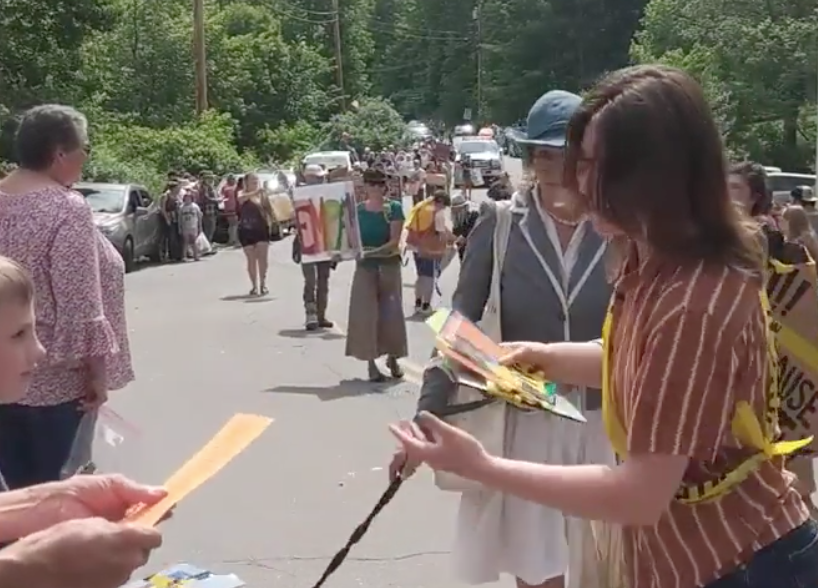
Every year before the July 4th parade in Whitefield, a small town located not a 30 minute drive from Augusta, an artist gathers with other artists and friends to shed light on a ‘challenging topic’ to include in the parade. Artist Natasha Mayers has been doing this for years. Some of you are familiar with the marvelous film that was made to document Natasha’s life story called Natasha Mayers: An Unstill Life. The film chronicles her life as an artist and activist. You can access the trailer and rent the entire film at THIS LINK.
Some of the many participants presenting ‘banned books’ at the Whitefield parade
For this years parade the group focused on books that have been banned and created giant books that are included on a list. They passed out more than 100 children’s books wrapped in caution tape, with bookmarks listing banned books. I’m sure many of you are familiar with some or all of these books, I’ve listed them below.
Its one thing to be aware of banned books but it’s another to express your opinion or to take action. I’ve given some thought about my beliefs and I’m reading, listening and watching. One of my summer goals is to read more of the books on banned book lists. When I participate in a conversation it will be based on my reading and my understanding through my own lens. I attended my town’s candidates forum this spring where the candidates were asked their opinions on banning books from our schools, specifically the book Queer Gender by Maia Kobabe. The two individuals who strongly opposed hadn’t read the book, one had looked at the pictures. I’ve noticed that many people who are opposed to certain books also have strong feelings about the curriculum being taught in our schools. In addition, their rhetoric includes wanting the power to make curriculum decisions. As a teacher I am totally committed to working with parents to educate the child. But I am opposed to parents making decisions for other families. Should parents be making decisions for their own children or all children? Some advocates are attempting to undermine the wisdom of teachers and educational experts who are trained to make curriculum decisions and choices about teaching and learning. I realize that not all educators are ‘experts’ and I’m not suggesting that educators make all the decisions. Policy’s and procedures are in place with curriculum committees that include teachers, administrators, and school board members to guide and make decisions on curriculum.
Handing out books to children
I’m not offering answers, only questions. My baseline question that has always guided me: what is in the best interest of all students? Some folks are saying ‘best interest’ has become murky. Well, no one said that education wasn’t messy business. It feels like we’re at a critical moment so I ask you: will you be part of the problem or part of the solution? How can arts educators use artistry to help at this moment in the history of education?
Banned books for teens and adults
FICTION, FANTASY, ETC.
The Bluest Eyes, Tony Morrison
The Absolutely True Diary of a Part-Time Indian, Sherman Alexie
The Call of the Wild, Jack London
The Hate U Give, Angie Thomas
The Handmaid’s Tale, Margaret Atwood
The Curious Incident of the Dog in the Night-time, Mark Haddon
The DaVinci Code, Dan Brown
Black Boy, Richard Wright
Brave New World, Aldous Huxley
The Alchemist, Paulo Coelho
Running with Scissors, Augusten Burroughs
Looking for Alaska, John Green
The Outsiders, S.E. Hinton
Mrs. Dalloway, Virginia Woolf
The Bell Jar, Sylvia Plath
NONFICTION
A People’s History of the United States, Howard Zinn
Beyond Magenta: Transgender Teens Speak Out, Susan Kuklin
The 1619 Project: A New Origin Story, Nikole Hannah-Jones
The Autobiography of Malcolm X & Alex Haley
Silent Spring, Rachel Carson
You Can’t Read This: Why Books Get Banned, Pamela Jain Dell
COMICS & GRAPHIC NOVELS
Maus, Art Spiegelman
Persepolis, Marjane Satrapi
March (series), John Lewis & Andrew Aydin
Fun Home: A Family Tragicomic, Alison Bechdel
Queer: A Graphic History, Meg-John Barker
Yummy: The Last Days of a Southside Shorty, Gregory Neri & Randi DuBurke
Blankest, Craig Thompson
This One Summer, Mariko Tamaki
Banned booksfor children
PICTURE BOOKS
Donovan’s Big Day, Leslea Newman
It’s a Book, Lane Smith
The Day in June, Gayle Pitman & Kristyna Litten
The Snowy Day, Ezra Jack Keats
In Our Mother’s House, Patricia Polacco
Flabby Cat and Sleepy Dog, Jeanne Willis
Little Red Riding Hood, Trina Schart Hyman
Nappy Hair, Carolina Herron
Goodnight Moon, Margaret Wise Brown
Brown Bear, Brown Bear, What Do You See?, Bill Martin
Nasreen’s Secret School: A True Story From Afghanistan, Jeanette Winter
The Paper Bag Princess, Robert Munsch
The Dumb Bunnies, Dav Pilkey
Strega Nona, Tomie DePaola
The Stupids (series), Harry Allard & James Marshall
CHAPTER BOOKS
The Watsons go to Birmingham, 1963, Christopher Paul Curtis
Julie of the Wolves, Jean Craighead Goerge
The Giver, Lois Lowry
Melissa, Alex Gino
A Wrinkle in Time, Madeleine L’Engle
Go Ask Alice, Anonymous
Charlotte’s Web, E.B. White
The View From Saturday, E.L. Konigsburg
An Indigenous People’s History of the United States, Roxanne Dunbar-Ortiz
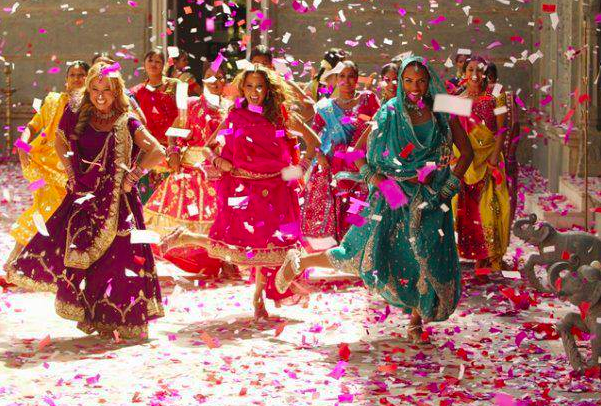
I think the video embedded below was a Coca-Cola commercial for this year’s Super Bowl; yup, back in February 2023. I don’t know exactly how it was created but Artificial Intelligence, AI was part of it. This came out about the same time that I started to see more information and reading about AI. Some people closest to my circle were concerned, and still are, about the negative impact AI might have on education, learning (or the lack of), creativity, and originality. I find it difficult to take a stand, for or against. For me there is too much grey area on the topic. Take this commercial, for example. I’m guessing that we can all agree that it is well done on all levels, creative and inspiring. It includes many known art works. An entire lesson could be formed around or built on the idea. An integrated lesson for music and visual art and actually many subject areas.
One comment from someone in the advertising community said: “that’s the proper way to use ai stuff. not to make the entire content, but to work alongside traditional methods”. I do agree!
I dug a little to learn about it and this is what I found: The new campaign from Coca-Cola features a combination of film, 3D, and Stable Diffusion, which is deep learning, text-to-image AI model. Traditional production methods coupled with artificial intelligence will bring the next level of creativity to the advertising industry.
I suggest that as educators responsible for the arts, use this as an example of how we can utilize AI for the expansion of the creative process. What do you think?
I’ve been working with a committee from my town of Union to plan the Sestercentennial – 250 years since it’s founding in 1774. We’re going to kick off the celebration this July and throughout the year we’ll have events that will culminate during a three day weekend, July 19-21. I’ve never been a big history buff but I love hearing stories from the past. Those of you who know me know that I love to get people together and celebrate so this is a chance for me to give back to the town that’s been so good to me since my husband and I moved here in 1980.
One of the highlights of the Sestercentennial will be digging up a time capsule that was buried 50 years ago during Union’s Bicentennial celebration. We have a list of items contained in the time capsule (blueberry cake included) that reflect life during the 1970’s. I’m guessing that about half of my blog readers weren’t born yet. We know approximately the location of the time capsule but there are lots of unknowns. Our instructions include “dig it up and rebury it” and it is buried “deep in the ground”. As you can imagine some of what we’re reading is left up to interpretation. With a crowd surrounding the location to watch the digging this could be problematic.
We’re fortunate that the members of our town’s historical society is a great collaborator and that there are many answers to questions well documented in 3 books that are available. We’re partnering with Union Elementary School knowing that this is a great opportunity to bring history alive in a hands-on and engaging manner. More on that in a later blog post.
Because of my work on the Sestercentennial (since September 2022), I’ve wondered about what I’m learning from the past and the accuracy of the information. It’s only as good as the documentation and the stories left behind. This has led me to writing this blog post about the bigger picture and accuracy of history. We know that visual art, music, and plays have documented part of our American history. With so much more attention recently on the white washing of history how do I know if what I’m reading, hearing and/or experiencing is accurate? School text books don’t always contain the truth or the whole story. Checking the sources of what’s on the internet is necessary. I read a piece yesterday about the history of Memorial Day.
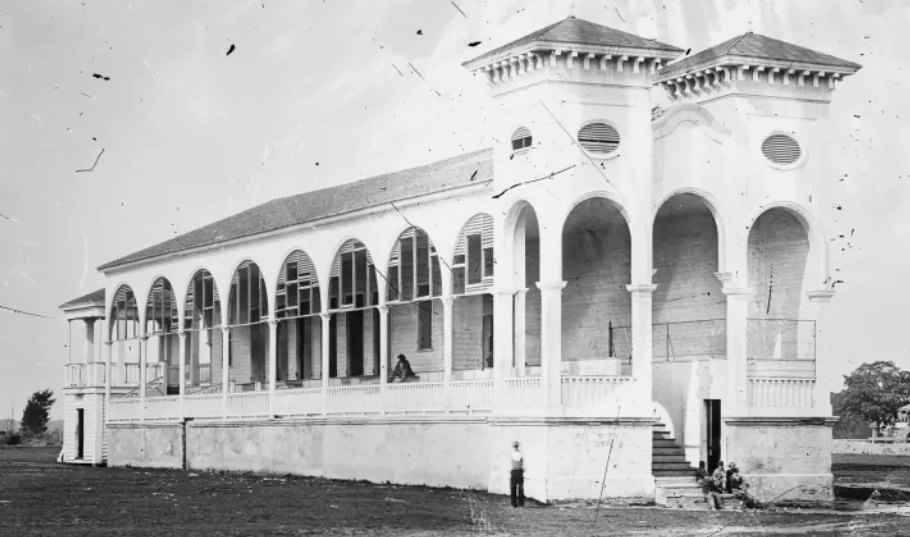
Clubhouse, where Confederates held Union soldiers, held prisoner 1865 | Library of Congress. From Blight’s book: “at least 257 prisoners died, many of disease, and were buried in unmarked graves.”
This is what I learned:
Most Americans will say that May 30th is Memorial Day and they understand we take a day to honor servicemen and women, many of who gave their lives while serving our country.
The first Memorial Day was actually on May 1, 1865 when 10,000 people gathered in Charleston, South Carolina, most of them black and formerly enslaved citizens, to honor slain soldiers from the Civil War. They gathered at an old race track that had been used as a prison to rebury and make a proper cemetery for the U.S. Army soldiers who died. This is according to Pulitzer-Price winning historian David Blight.
The Civil War was April 12, 1861 – April 9, 1865. General Robert E. Lee of the Confederacy surrendered his army to Union General Ulysses S. Grant at Appomattox, Virginia. It was the deadliest war in American history.
I know it can be difficult to find accurate information for students and how necessary it is for students to get the full picture. For this blog post I found information and educational resources at the National Archives, from this story on Medium, a video with Blight speaking about the Civil War and his book Race and Reunion, The Civil War in American Memory at Harvard University Press, and ABC News 7, Charleston. We’re fortunate in Maine to have Americans Who Tell the Truth to use as a resource that has unveiled truths and shared stories about some of our country’s history.
Recently I joined a book group. I’ve never been part of a formal ‘book group’ (secret is out). I’ve never been interested and truth be told its only recently that I’ve been reading books at a very fast rate, now that my schedule allows. I like this book group for several reasons. It’s pretty non-traditional, no one book is read and discussed like in traditional book groups. Actually, its one of the reasons I decided to join the group. We gather over lunch monthly and each participant shares books, films, podcasts and other forms of stories and ideas. The participants are retired educators who have a keen interest in education and other interesting and sometimes challenging topics. At our April gathering we each shared a poem in recognition of National Poetry Month.
At more than one gathering the conversation has included AI – Artificial Intelligence. I’m certain as we learn more that the conversation will continue. I’m reading and learning about what AI is, where it is, and the potential impact on the world. A 60 Minutes episode from a couple of weeks ago provides foundational information that I suggest you take the time to VIEW. It’s very informative and important as educators that we inform ourselves.
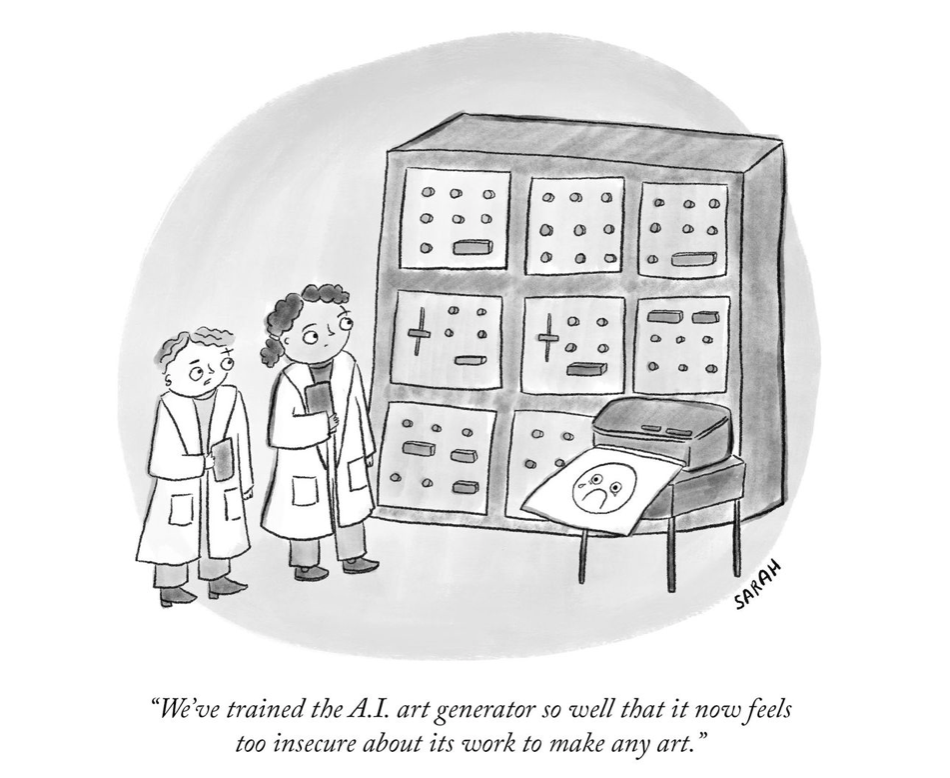
You can google AI and come up with the definition but until you begin to ‘see’ and experiment with the online tools I’m not sure it will provide you with the understanding to consider the impact on education. For example, think about this: The sum of all human knowledge is online. AI is replicating the brain. What are the implications on education? What is the impact on art making? AI can solve problems in very little time compared to the brain. Is humanity diminished because of the enormous capability of AI?
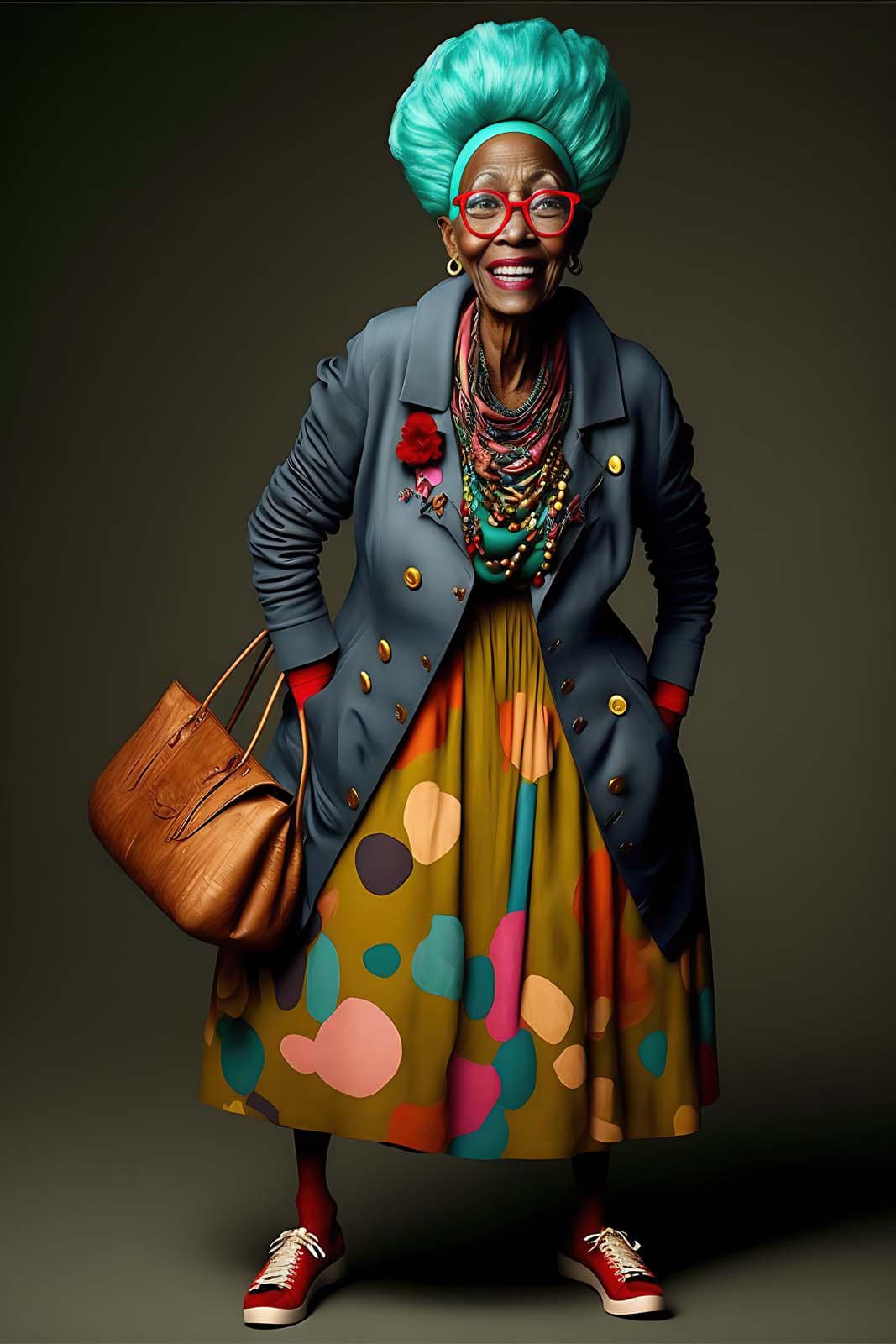
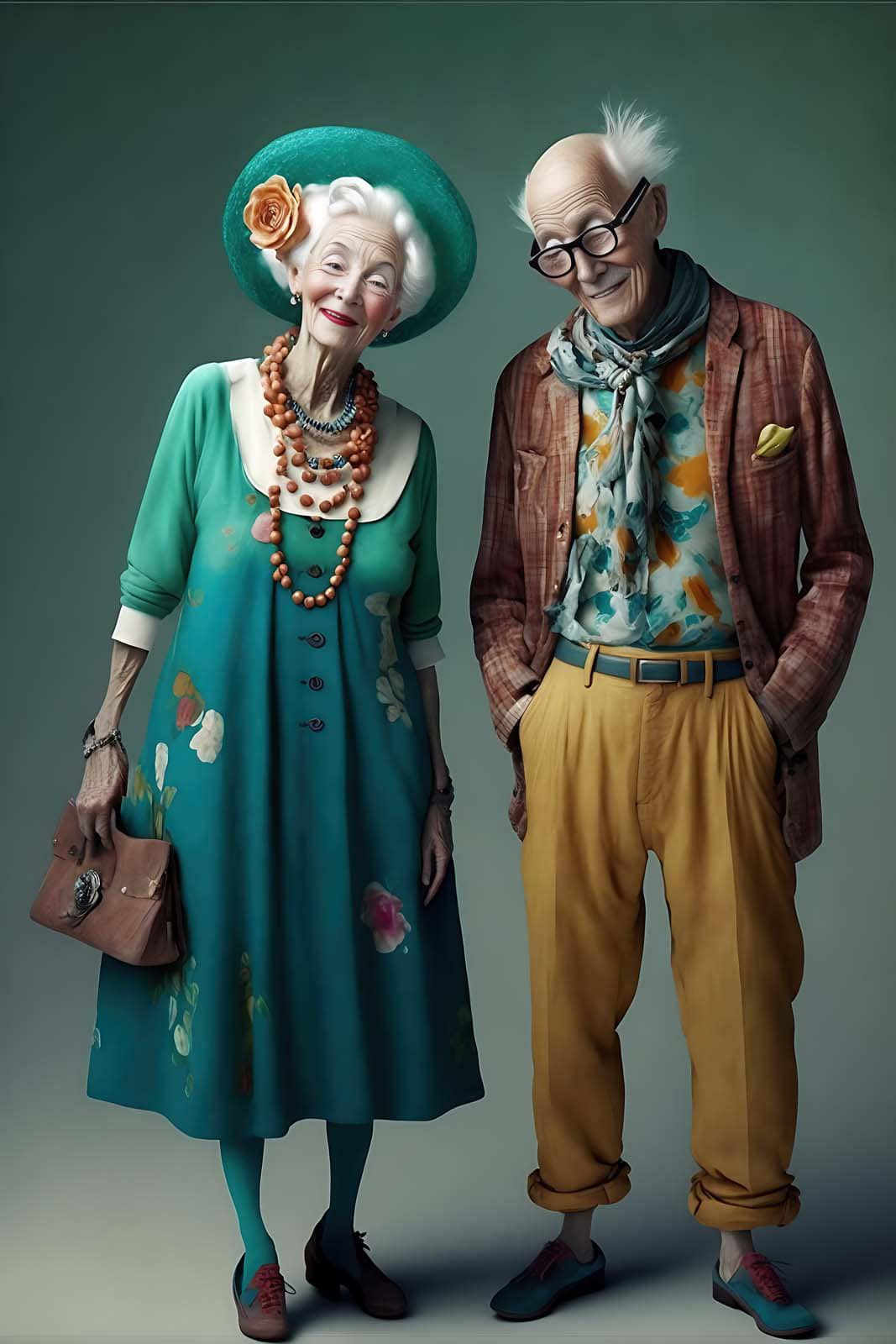
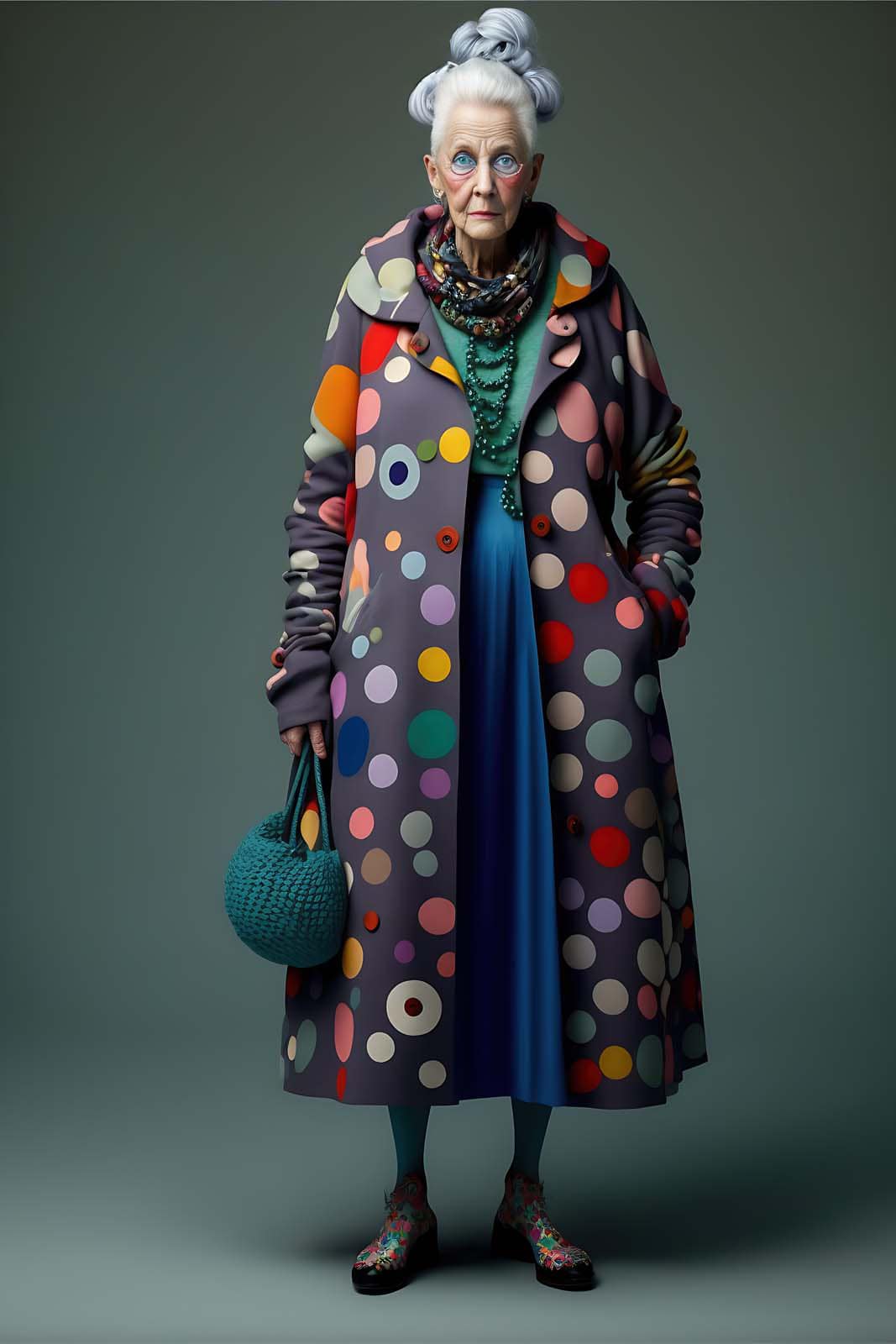
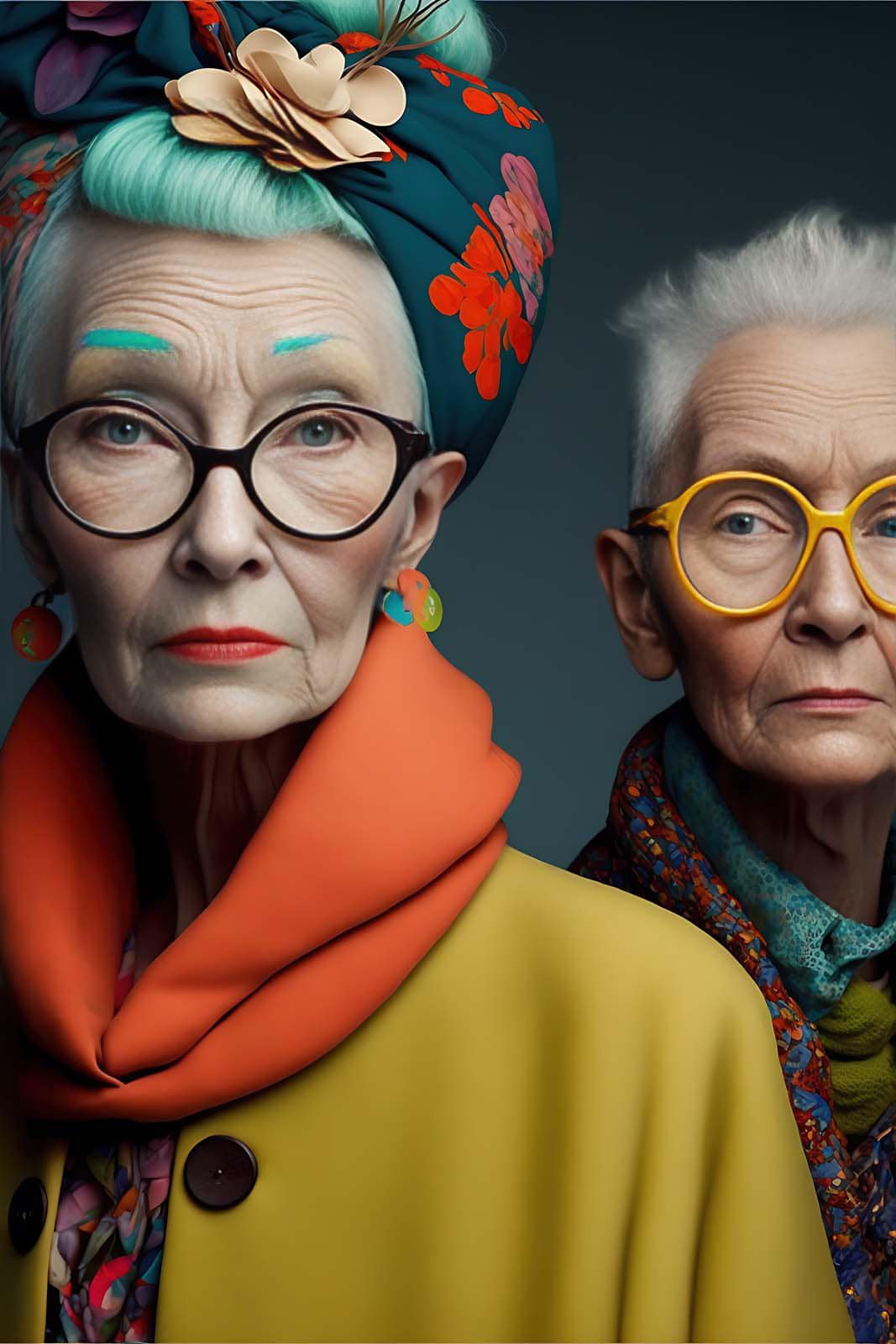
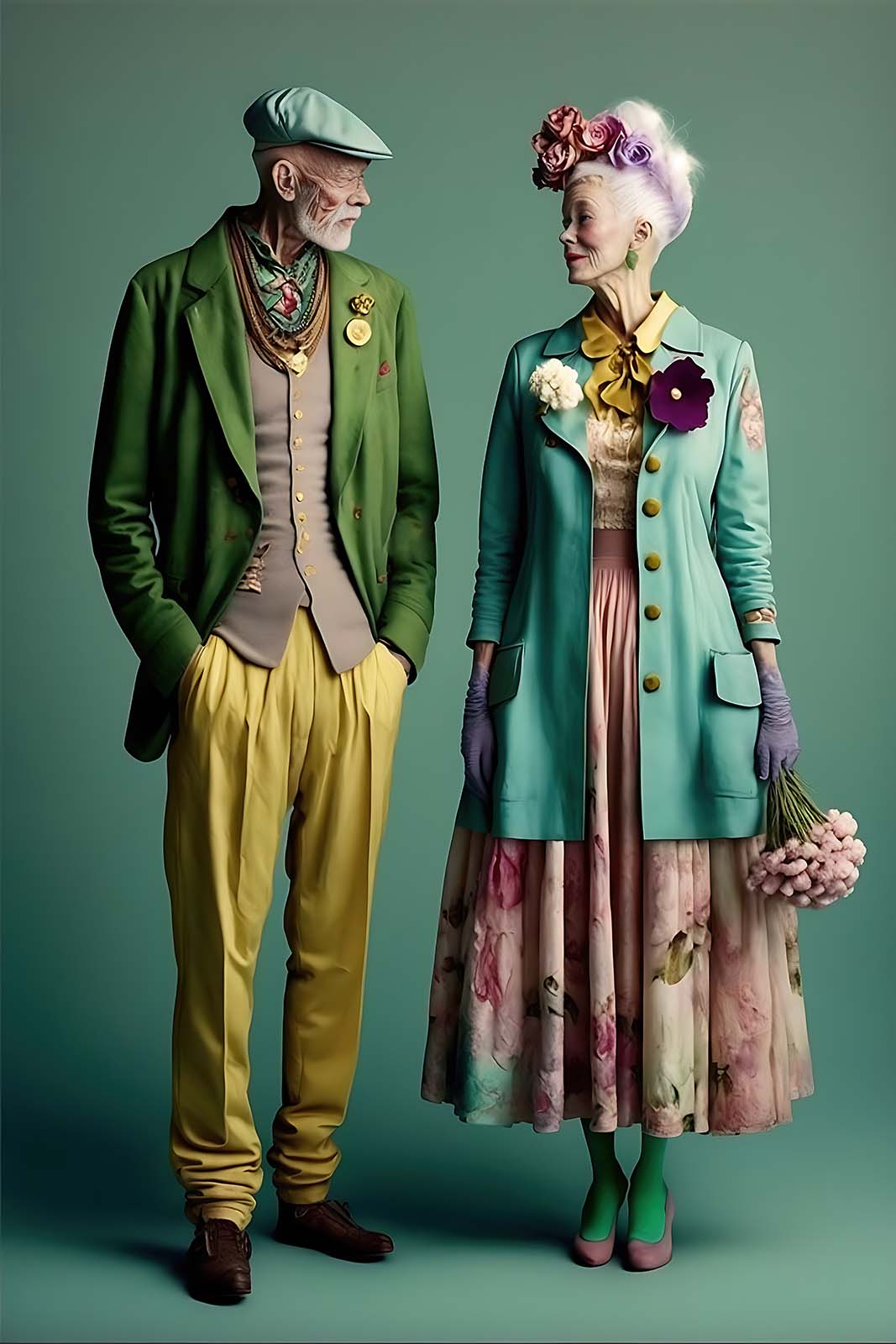
Visual artist Jonas Peterson is creating art work using AI. His collection of art called Youth is wasted on the young is an amazing collection that is his way of celebrating the ‘old’ and a comment on ageism. He used fashion to highlight the personalities of older people. Jonas is a photographer but in this collection he uses AI to create scenes, the people and what they’re wearing. In his own words:
I give specific direction using words only to a program, lenses, angles, camera choice, color theme, colors, styling, backgrounds, attitude and overall look and the AI goes to work, it sends back suggestions and more often than not it’s completely wrong, so I try other ways to describe what I’m after, change wording, move phrases around and try to get the AI to understand the mood. It’s frustrating mostly, the AI is still learning, but getting any collaborator to understand you can be difficult no matter if it’s a human or a machine. After a long stretch of trial and error I get closer to a style and look I want and after that it comes down to curation, picking the renders I believe go well together, I start making it a series. To me the process is similar to that of a film director’s, I direct the AI the same way they would talk to an actor or set designer, it’s a process, we try over and over again until we get it right. Should I get all the credit? God, no, the AI creates with my help and direction, it’s a collaboration between a real brain and an artificial one.
You might be thinking or asking, is this really art? Do I want my students to use this in their art making? Here are some of my thoughts and questions. AI exists in the world. Microsoft introduced ChatGPT, an artificial intelligence chatbot, in November 2022. Bard is a conversational generative artificial intelligence and was released in March 2023. How should educators learn about AI? Should we leave it up to students to teach us? I’m sure that this will be the next wave of education professional development offerings, in person and online.
Jonas Peterson said:
I’m not here to debate the process, I’m a professional photographer, writer and artist myself, I understand the implications, how this will affect many creative fields in the future. I’m simply using a tool available to me to tell stories, the same way I’ve always told stories – to move people. To me that is the point of this, not how I did it. Dissecting something will almost always kill it.
You can learn more about Jonas’s work by googling him and also at this LINK.
I’m sure I’ll circle back to this topic in future blog posts. If you have questions or comments that we can all learn from please don’t hesitate to comment at the bottom of this blog post. Thanks!
Argy Nestor
Arts Educator, Blogger, Artist, Connector meartsed@gmail.com
https://sites.google.com/view/anestor/
Argy’s Blog
The purpose of this blog is to share stories about people and places; and to celebrate the amazing work (and play) that students, educators, and organizations are doing in and for arts education. In addition, the blog has a plethora of resources and innovative ideas. This forum gives blog readers the opportunity to learn from each other. It is essential that we listen, learn, and collaborate in order to build on teaching practices for the benefit of every learner in Maine and beyond.






 me arts ed