Water is Life
Thank you to Krisanne Baker, Ecological Artist and Educator, teaches Visual Arts at Medomak Valley High School in Waldoboro, who provided this blog post. It was previously published in the Union of Maine Visual Artists Journal and again in the Courier-Gazette newspaper. You can see Krisanne’s artwork at HER WEBSITE. Krisanne has continued the work that was started in July 2016, Arts Integration workshops for teachers in Malawi, Africa. If you’re interested in learning more please contact me at argy.nestor@maine.gov.
At this time last year, Medomak Valley High School art teacher Krisanne Baker took her mantra, “Water is Life,” to Malawi, Africa, where she educated teachers at the top of a rainforest about their water systems, and then made art about preservation and conservation.
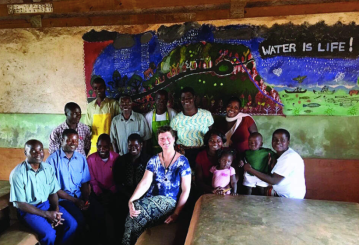 I found myself waking up, in what I thought was a National Geographic magazine spread, at the top of a rainforest mountain in Malawi, Africa. Passion can take you on some funny paths. Ten years ago I could easily have imagined a safari in Africa, but not for the reason that got me there in April 2018 with my teaching colleague, Melissa Barbour, who had invited me to collaborate with her. My reason for embarking was water, the rains of Africa, and the passion to make and empower change.
My day job for the past 25 years has been as a crazy high school art teacher. I get a kick out of working with hormonal teenagers getting ready to jump into life. When people find out that I teach at the local high school, they say, “Oh, thank you!” They can’t imagine why I’d be crazy enough to want to spend all day with their kids, but they are grateful.
 Teaching also funds my main job – I mean the one in my head and my heart – being a painter; and all the expensive art supplies that go along with it. Once my son was old enough, I finally had the opportunity to work on a Master of Fine Arts. I didn’t do it to become a better teacher, although it did make me that, but to get deeper into my own work. You see, I’d always felt like there was something missing.
One of the hardest and yet simplest things to put together as a research thesis in grad school was what I was passionate about. I knew it was water. But where to go from there? Twelve years ago, there were no front page headlines about climate change; Flint, Michigan; Nestlé Corporation or drought. Why water? I’d spent years making paintings of its many moods and atmospheres. But the reveries just weren’t enough. What it came down to is that I CARE about water. And when you look at the myriad ways in which it touches our lives and makes our lives possible, I thought, well, EVERYBODY should care about water!
 My research led me down a road I never thought possible – one that scared the pants off of me – ACTIVISM. “Oh, no, I can’t do that! I don’t know the first thing about it… what would I say? What could I possibly do? Does that mean I have to give a performance or something? Wait, no, I can’t do that, I’M AN INTROVERT!”
All I can say is, introvert or extrovert, if you are passionate about something, you find a way to share it with people. The hardest thing I found was to stay positive and not blame or make people feel bad about all the difficult water situations. I found the most meaningful way to bring about a change is to educate people. With knowledge comes the care and the desire to do positive helpful things. Actions start small and grow bigger, bolder and louder.
First I did my work in true introvert style. I made short videos, using myself as a model, superimposed upon various water situations that need our attention. That way I could perform, but didn’t have to come eye to eye with an audience. But after my short films, I began having to do question and answer talks, or tell stories… or give a gallery talk about series of paintings I made to raise awareness of water quality, chemical infiltration and women’s body burdens.
 Five years ago, I began incorporating my water awareness work into my classroom teaching. I developed the “Gulf of Maine: Endangered Ocean Creatures” curriculum and “Gulf of Maine: Dare to Care.” Students wholeheartedly engaged. When I was presented with the idea of interdisciplinary teaching in Africa to teachers in a remote area, the first thing I looked up was their connection to water. My first thoughts were the Darfur droughts and water wars between Israel and Palestine. The area where I was to go was water rich in comparison. Malawi, if you don’t know where it is – I didn’t – is just inland from the Eastern shores of Africa, and is home to one of the largest bodies of fresh water on the continent, Lake Malawi. It’s just above Mozambique.
My mission was to incorporate art and the local rainforest ecology in a teachable curriculum for the Ntchisi district teachers, in the hopes that they would implement local ecological stewardship through art and action. When we think of rainforests, we usually think “rich in resources,” which they are. Rainforests currently face major deforestation problems, not only due to removal of rare and beautiful woods, but also through exponentially increasing populations – a global problem. I hired a forest ranger to guide 12 teachers and me through the Ntchisi rainforest. We learned about the water system, in concert with the plants and animals, and how everything is connected through water. Back in a classroom, I drew global water systems on a chalkboard. I talked about how much the ocean covers the planet, and how we need to care for all waters, as they continually circulate from oceans to clouds to mountains to rainforests, and beyond. There were looks of amazement, and lightbulbs glowing in the minds of these remote educators. I was amazed that this was new knowledge to them, but in a landlocked very remote area, what else should I expect? I was grateful that they were receptive and completely engaged and passionate.
 We discussed the water sources that humans use, the mountain rainforest, and how people cutting down trees for cooking fuel would eventually collapse the water system. Malawi is the world’s second poorest country. This mountaintop population of about 40 small villages has no running water and no electricity, no fuel other than wood. When I say poor, I mean to write on a piece of paper, a teacher would first divide it into four quarters before handing it out, if they had any. Children walking with me on the road between the school and the Go! Malawi compound would ask for a sweet. If I didn’t have any, they would ask me for a pencil. They are hungry to learn. Books are a rarity. A current fundraising project begun by an 8th grade student in Maine through the Go! Malawi non-profit will build the first mountain library in the Ntchisi region, hopefully in 2020. (Visit go-malawi.org/donate-online/ if interested in making a donation.)
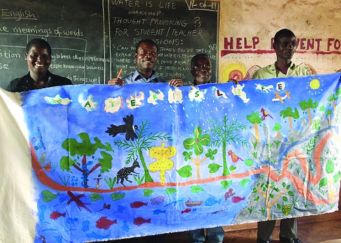
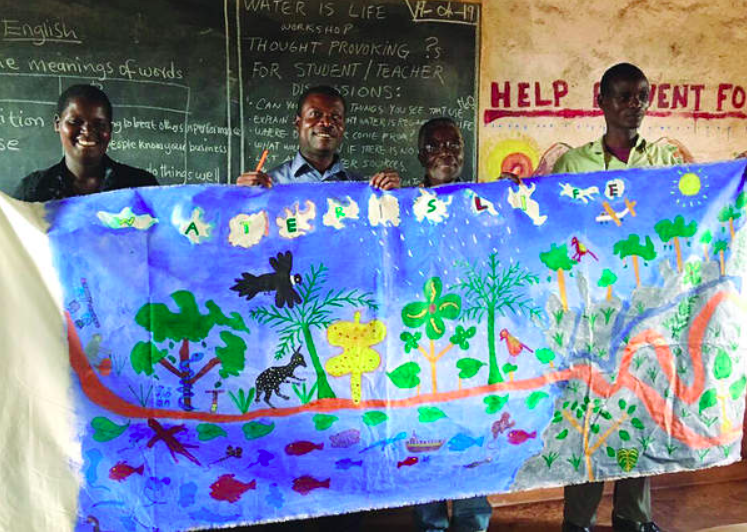
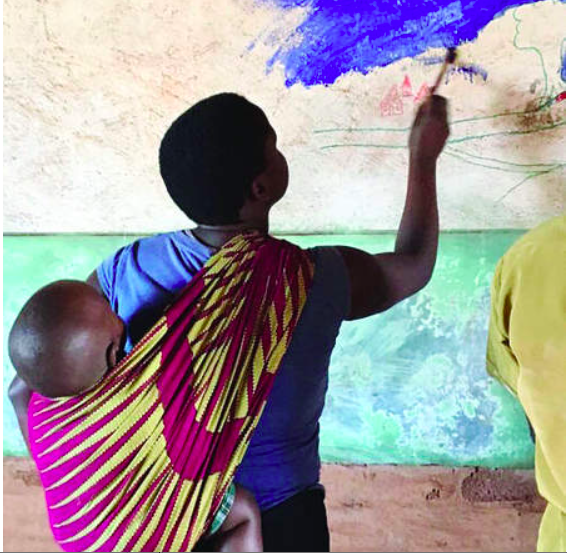
I led the teachers to incorporate their drawings (images from our rainforest walks, talks and microscope viewings) into plans for three large, painted murals. Each mural showed the place, the cycles of water, plants, trees, animals, people, fish, phytoplankton and zooplankton. I brought a digital microscope, which we plugged into a solar inverter at the Go! Malawi compound. Each told a visual story of how we are all connected through water and how we must care for this place to protect the water. Each mural had the simple words: Water is Life / Madzi ndi Moyo.
At the end of two weeks, my teachers had become new water art activists. They had a plan to circulate the murals amongst several schools, with thought-provoking questions to spark discussions with their students. We have future plans through Go! Malawi to underwrite tree planting workshops and do-it-yourself solar cookers. Until my workshop, many of the teachers had not ever been in the rainforest at the top of the mountain. They thanked me for opening up that part of their world to them, along with the concept and practices of stewardship. I thanked them by asking them to engage their students, and left a suitcase of art supplies for them to make more murals in their classrooms as constant reminders of the importance of water to our lives. Someday I hope to meet up with one of those rainforest village children who has become a water activist.
Krisanne Baker is a Waldoboro artist, an art and ecology educator at Medomak Valley High School, a former professor at the University of Maine Farmington and an avid ocean advocate. Her work concerns water quality, availability and rights, both locally and globally. Baker’s multimedia installations and paintings are studies of the patterns of the natural world, arrangements of colors and ocean life in macroscopic and microscopic views of the “heart of the planet.”
Baker exhibits nationally, gives talks internationally and collaborates with others. She was recently a Visiting Artist in Residence at the Bigelow Laboratory for Ocean Sciences in its world-renowned living marine algae lab. This collaboration will result this summer in a large-scale installation of phytoplankton created as phosphorescent glowing glass sculptures.
Baker’s paintings can be seen locally at Caldbeck Gallery, 12 Elm St., Rockland and online at KrisanneBaker.com.









 me arts ed