Archive for the ‘YAHOO’ Category

h1

Certainty

March 8, 2019

A community project

Tuesday, March 12, 6:30-8:00 p.m., Norway Memorial Library will host an evening of discussion and readings from Certainty, a community writing project with contributors from the Oxford Hills area and all over New England. Writers have described how they achieve a sense of certainty, dispel doubts, share wisdom, and reflect on how we maintain a well-informed democracy in a time when truths are so hard to define.
You are invited to participate in discussion, share your writing, or listen to work read aloud. An additional reading will occur in May at the Table Rock Arts Center for Bethel Area residents, but feel free to attend this one too!
This is a really wonderful project created by Georgina Grenier. Congrats Georgina!
Surrounded by darkness
We see light
Spinning endlessly alone
We do so together
Unique among countless orbs
We have Love.
 
Anthony Lilor
h1

Maine High School One-Acts

March 7, 2019

Opportunity in communities across the state

This weekend, March 8 and 9, in nine high schools across Maine students will be putting on their best performances as part of the Maine Drama Festival. It’s a great opportunity to support students in the arts, specifically drama, and a wonderful chance to enrich your lives by viewing several short plays in one location. Not to mention, it’s Maine, it’s winter, it’s March – what a great way to spend a weekend!

Below shows you which schools are performing where and the order of the performances. If you click on the image you’ll be able to see it at a larger scale. In blue are the schools performing on Friday night and in salmon are the schools performing on Saturday.

Students are scored by three judges on all kinds of categories including by not limited to: Ensemble Acting, Set Design, Scenic Art, Set Construction, Lighting Design, Sound Design, Special Effects, Prop Design/Construction, Costume Design/Construction, Make-up, Choreography, Stage Combat, Overall Technical Excellence, Original Music by a Student, Student Direction, Student-Written Script. You can imagine after practicing for several weeks, hundreds of students are ready and excited!

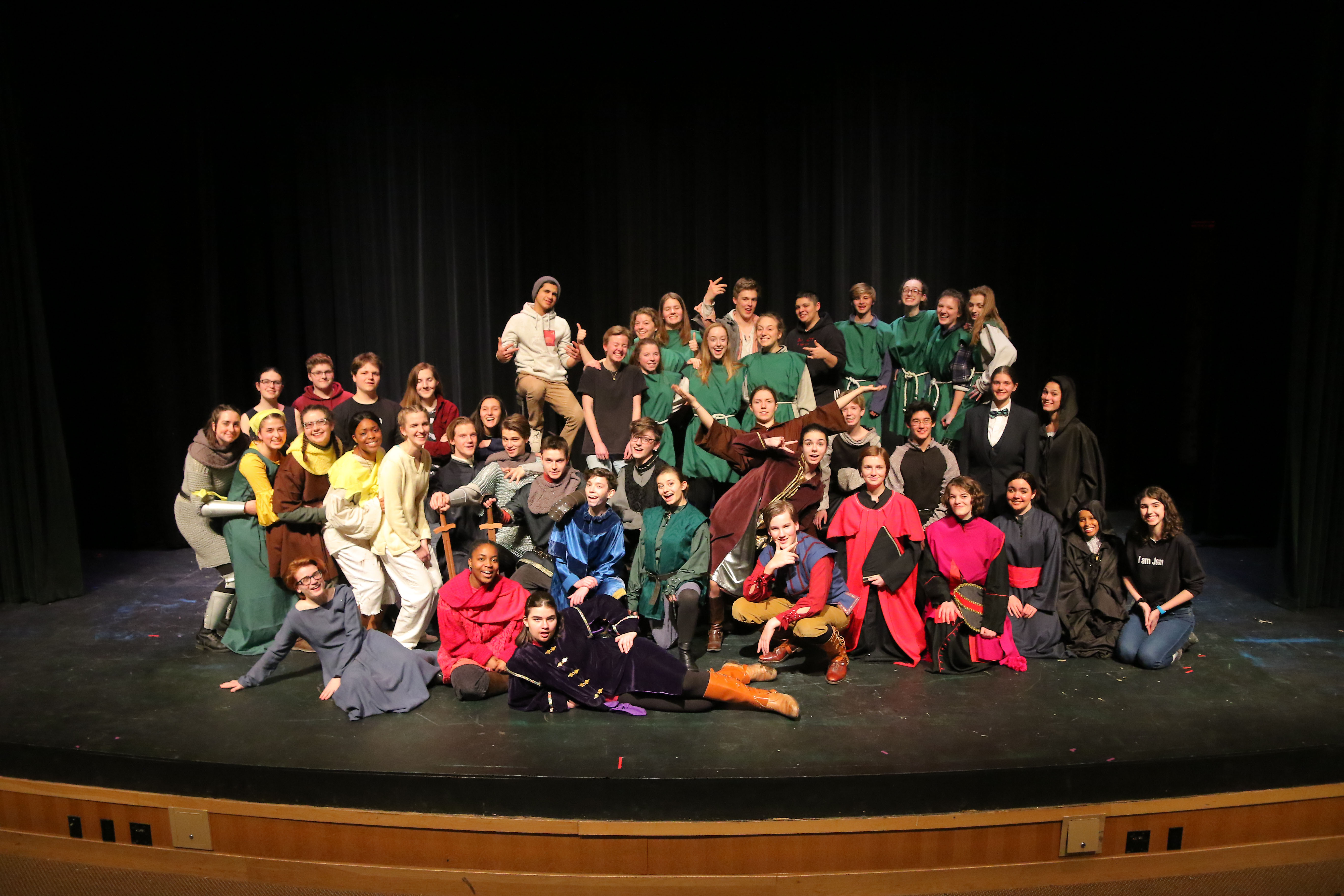
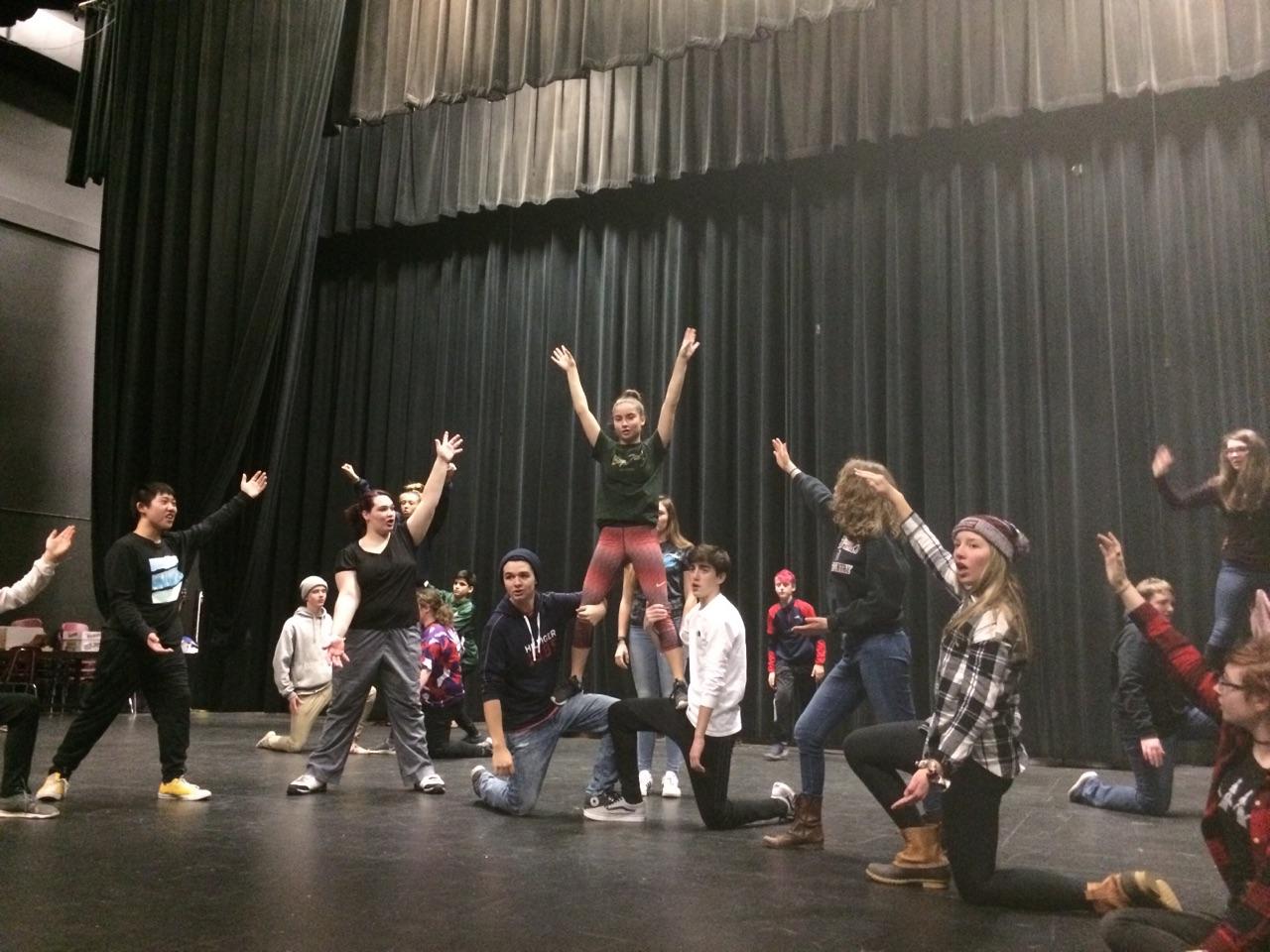
Cast and crew of Waynflete School’s (Portland) production of SAINT JOAN by George Bernard Shaw

Schools who come out on top will advance to the States being held on March 22 and 23.

h1

MALI Winter Retreat

March 6, 2019

Amazing day

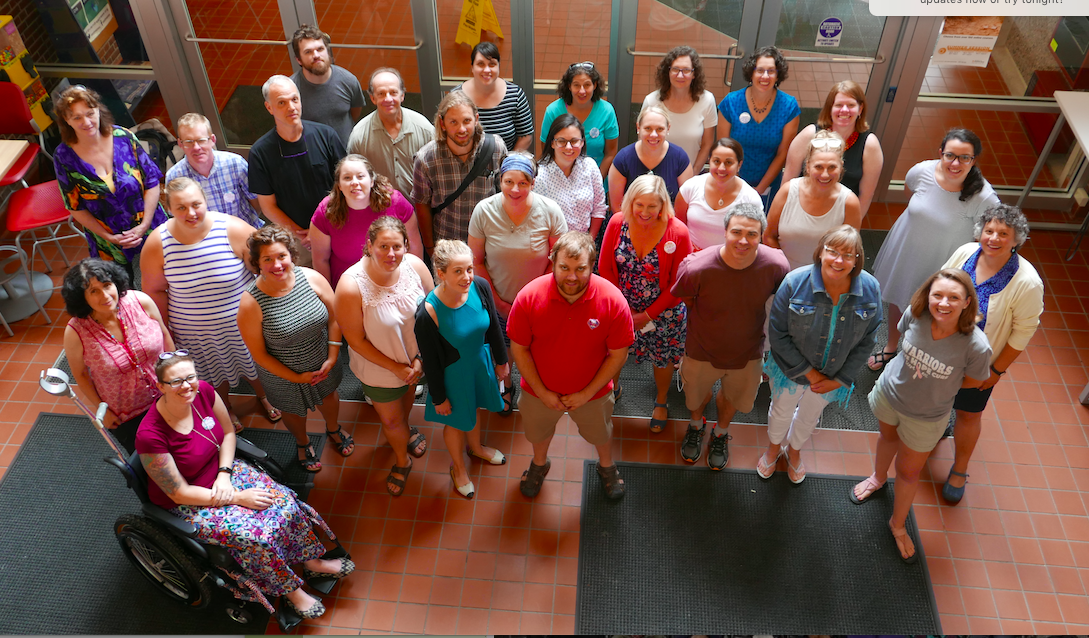
The Maine Arts Leadership Initiative (MALI) held the annual Winter Retreat on Saturday at Waterville Senior High School. Thank you to music educator and teacher leader Sue Barre who provided and arranged for a space for us to meet, exchange and share ideas, and most importantly to learn from each other. This is the foundation of the MALI community.

2019 MALI Winter Retreat

I was curious about words that are related to community. On a recent google search I found the following: amity, benevolence, cordiality, friendliness, friendship, goodwill, kindliness. civility, comity, concord, harmony, rapport, charity, generosity. affinity, compassion, empathy, sympathy. chumminess, familiarity, inseparability, intimacy, nearness. affection, devotion, fondness, love. In Japanese the word is コミュニティ pronounced Komyuniti. In Greek the word is κοινότητα and pronounced koinótita. The Greek community is directly related to the culture and emerged and rose to great heights in 525 BC to 350 BC. The traditions that exist today are built on the original ideas.

When MALI educators come together the opportunity is about connecting with people, their idea, and all of those words in the previous paragraph that I found online. In addition, new learning is offered and depending on individual experiences educators enter the conversation from their own place. Everyone is a learner no matter how much experience they have with teaching, learning and/or living. MALI teacher leaders and teaching artist leaders range in teaching experience from 2 years to 49 years.

On Saturday we revisited the work that teacher leaders and teaching artist leaders have underway in this phase (8) of MALI. During this session we looked at the MALI “This We Believe” statements that are each defined. The titles include Arts Integration, Advocacy, Assessment Literacy, Creativity, Effective Educators: Teaching and Learning, Student-Centered Learning, Teacher Leadership and Social Responsibility. The revised definitions will be posted soon for each topic. I’m sure you’ll all agree that these are critical topics to the success of teaching and learning in arts education.

We were fortunate to have Brittany Ray, Director of TREE (Transforming Rural Experience in Education) speak with us about ACEs (Adverse Childhood Experiences) and how trauma interrupts the brains capacity to learn. Heavy stuff but so worthwhile to learn more. I will write more about this in later blog posts.

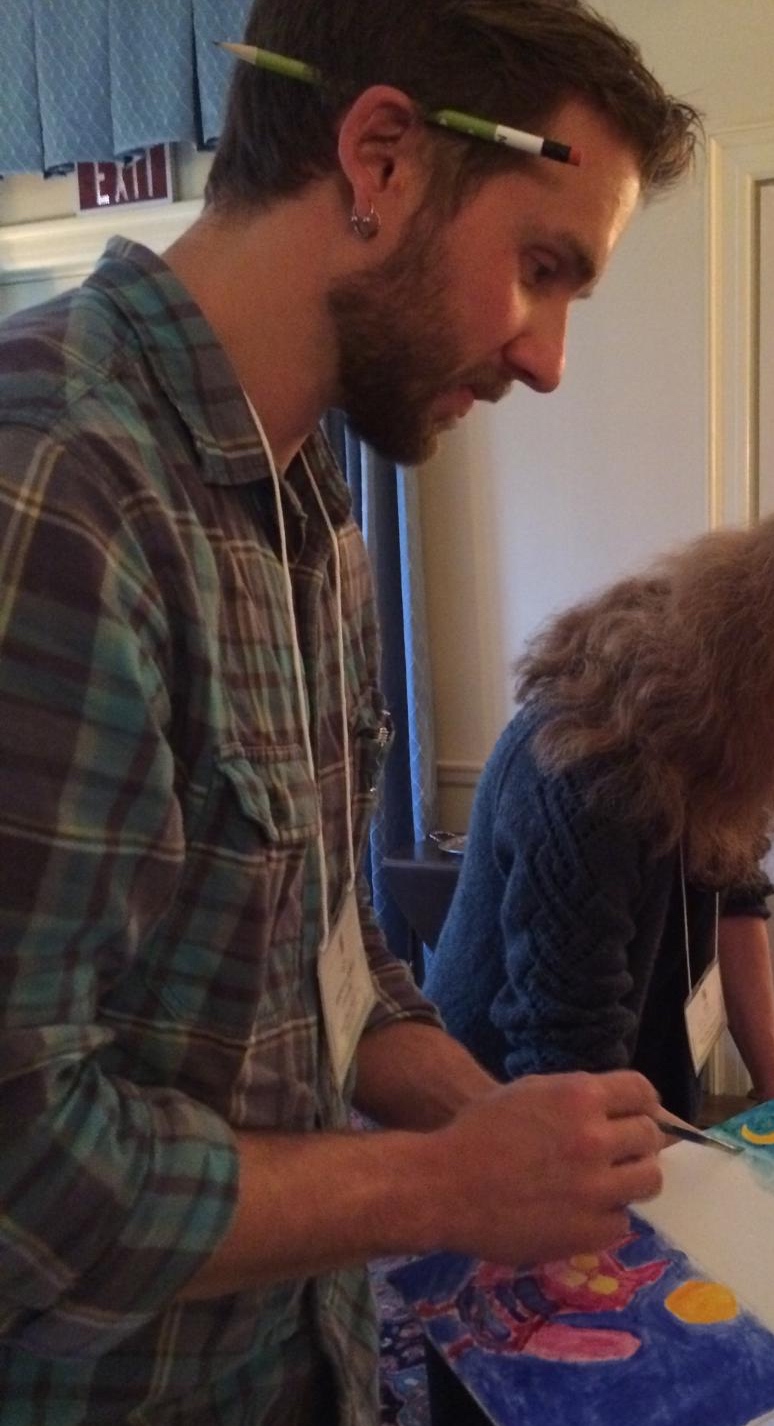
We had a chance to paint using Process Painting as a jumping off place. Listening to music and painting provided an opportunity to think about where we were as educators. And, the day finished out with information on HundrED and the resources and opportunities the organization provides. It’s difficult not to get excited about an organization that believes that the purpose of education is to help every child flourish, no matter what happens in life. HundrED is looking for Youth Ambassadors so if you have students who are interested in leading check out their Youth Ambassadors webpage.

The last of the Phase 8 MALI Teacher Leaders and Teaching Artist Leaders stories will be posted this next Tuesday on the blog. I hope you’ve had a chance to read about their journey’s.

h1

POL State Finals

March 4, 2019

Excitement in the air!

This photo says it all – Maine Arts Commission staff is proud to provide the State Poetry Out Loud (POL) Finals at the Waterville Opera House, March 11, 3:00 p.m.

The doors open at 2:30 and is free to the public. At 2:45 the Messalonskee High Schoo Jazz Band, under the direction of music educator Andrew Forster will perform and again during the afternoon. State Poet Laureate Stuart Kestenbaum will share some of his poems. Emcee for the afternoon will be television personality Bill Green. Ten state finalists from throughout the state will recite some of their favorite poems. At the end of the event, one student will be selected to represent Maine as the 2019 State Champ and move on to the National Poetry Out Loud finals scheduled for April 30 in Washington, D.C.

To learn more about POL CLICK HERE!

Poetry Out Loud is organized nationally by the National Endowment for the Arts and the Poetry Foundation and administered at the state level by the Maine Arts Commission. It begins in Maine’s schools where school champions are selected to compete in two regional finals at which ten students are ultimately selected to recite at the state finals. One student, the state champion, moves on from the state finals to represent Maine at the national finals in Washington D.C., where students from all 50 states, the District of Columbia, the U.S. Virgin Islands, and Puerto Rico will compete for a total of $50,000 in awards and school stipends for the purchase of poetry books.

h1

YAMMING it Up!

March 2, 2019

Tonight at PMA – Celebrating Maine’s Community of Young Artists

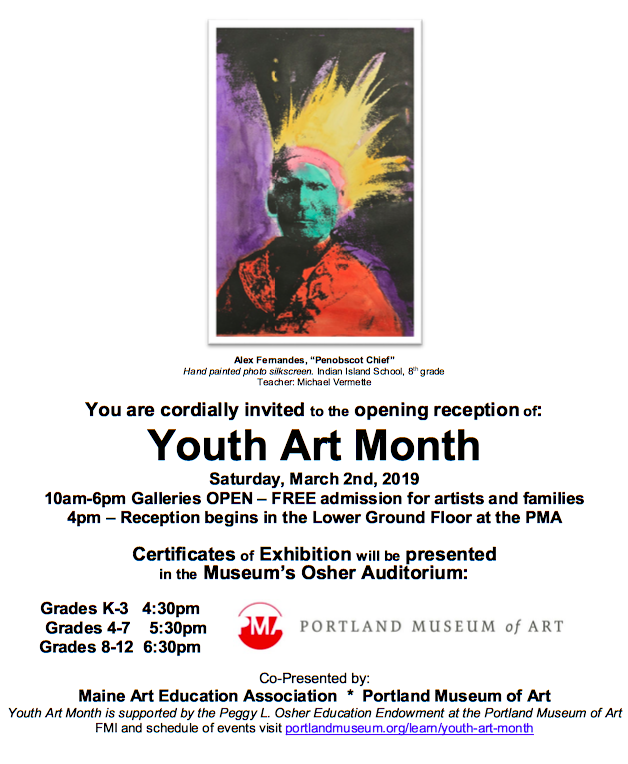
Portland, Maine, March 2019– Creative works from Maine art students will be on display during the month of March at the Portland Museum of Art (PMA). This multi-media exhibition, sponsored by Maine Art Education Association (MAEA), highlights Youth Art Month, a national celebration sponsored by the Council for Art Education. The annual celebration, which typically takes place in March, emphasizes the value of art education for all children and encourages support for quality art programs in Maine schools. This event marks 25 years of collaboration between the Portland Museum of Art and the Maine Art Education Association to celebrate student creativity from pre-kindergarten-12th grade.

Guest speakers for the event include representatives from the Portland Museum of Art and honorees as named by the Maine Art Education Association. This year’s MAEA Award for Excellence in Art Advocacy recognizes Waterfall Arts for long-standing support of arts education and youth creativity. Teacher Holly Houston from Yarmouth High School will be speaking as MAEA’s 2019 Art Educator of the Year.

The exhibition runs from March 1, 2019, through April 1, 2019 on the Lower Ground Floor of the PMA.The celebratory opening reception is Saturday, March 2 from 4:00pm to 7:30pm. Presentation of certificates will start with pre-kindergarten to third grade at 4:30pm, fourth to seventh grade at 5:30pm, and finally, eighth to twelfth grade at 6:30pm.

Please consider scheduling your arrival to allow time to enjoy the exhibition and the museum’s collection. The galleries close at 6 p.m.Admission to the Youth Art Month exhibition is free the day of the opening for Youth Art Month participants, their families, and teachers. Children 14 years and under are always free at the PMA..

For more information on the Youth Art Month exhibition visit www.portlandmuseum.org/learn/youth-art-month


h1

MALI Teacher Leader Story: Anthony Lufkin

February 26, 2019

Art Educator

This is one of six blog posts in 2019 that include stories of the Maine Arts Leadership Initiative (MALI) Phase 8 Teacher Leaders and Teaching Artist Leaders. This series includes a set of questions so you can learn a little bit about each leader. CLICK HERE  for more information on MALI. CLICK HERE  for more information on the 96 Teacher Leaders and 11 Teaching Artist Leaders. CLICK HERE  for Arts education resources. CLICK HERE for the MALI Resource Bank. Search in the “search archives” box on the bottom right side of this post for past teacher leader stories. Thank you Anthony for sharing your story!
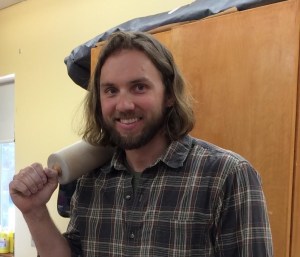
Anthony Lufkin

Anthony Lufkin currently teaches art in RSU #40, at three small schools, including Friendship Village School, Prescott Memorial School, and Union Elementary School. In addition, Anthony teaches a weekly class at Rivers Alternative Middle School which is on the same premises as Union Elementary. This is Anthony’s 12thyear teaching; 4 years at Sedomocha Elementary in Dover-Foxcroft, 4 years at Appleton Village School in Appleton, and the rest in his current position. Presently, he has about 300 students that he sees once a week for about 40 minutes.

What do you like best about being an arts educator?

I like to create, whether for aesthetics or function, it is a gratifying experience for me to use my hands, to think visually, and experiment with ideas. The collaboration of ideas that comes with teaching and learning is as exciting for me as the creation process. Teaching art in my opinion, is visually capturing what already exists in students. It is harnessing the innate characteristics of art that drive creativity, expression, innovation, investigation, and the ability to develop fine motor skills.  It is a powerful tool, and a great opportunity. It is being immersed in the subject, refining skills, pushing creative boundaries, sharing ideas, and celebrating successes. While the logistics of the educational field may have its difficulties, I find the interaction with students, the development of ideas, and the growth in understanding and skill development in both students and myself, very rewarding.

One other thing I appreciate most about art education, is that I can help students respond to ideas through artistic mediums by developing their skills, knowledge, and understanding of the materials and therefore begin to understand the potential for communication. When students are able to make connections, transfer and apply their learning outside of the art room, it is both a fulfilling and motivating experience. Knowing what I am teaching them has application and seeing them utilizing it not only justifies what I do, but inspires me to develop more thought provoking, interconnected, and inspiring teaching practices

What do you believe are three keys to ANY successful visual and performing arts education?

Three important components to a successful VPA program in my opinion, are resources, flexibility, and support.

Having access to quality resources will help define how students perceive art. This does not necessarily mean having the cake made for you, but having the materials and tools to make it.  There is a distinct difference in feeling if you are working in a shared space versus having a designated studio space. The same applies to materials. We don’t need to give oil paints to kindergarteners, but we need to use materials the same way we project high expectations on students if we expect them to value the experience.

One of the nice things about teaching art is that it is more expansive than linear, allowing for more flexibility in curriculum than most subjects. It does not mean just doing whatever, but rather having the ability to experiment, to find new ways to connect with students, and to try new methods and materials. Making progressive and relevant changes is important in education and requires at least some experimentation to implement. This flexibility also allows room for educators to connect more with their students interests, making the information relevant and creating applicable associations for students. I firmly believe there is still a linear progression to art education, however, there are many pathways to getting there. Having the ability to customize it to a specific audience, will create a more relatable and impactful experience.

Similar to resources, perception of the art program is important to student engagement. Having the support of administration, colleagues, parents and community members, not only makes our job easier, it also creates a positive assumption in students that there is value in what we do. When parents and teachers are engaged with what is happening, students naturally develop a stronger sense of importance. What a community values can easily be seen in its children. If we are to have a successful VPA program, we need to build and foster support.

How have you found assessment to be helpful to you in your classroom?

I have found informal assessment to be an invaluable tool in developing student growth both in skills, and conceptual understanding. Being able to respond to students throughout the process allows me to interject when students are struggling, and to provide support to help them understand the components of techniques and expression of ideas. With the limited amount of time I have with students, I have found verbal formative assessments to be the most beneficial and productive to students’ growth. I also include some critiquing components such as visual thinking skills when looking artwork to help students analyze and create meaning. Helping them create meaning is as important as helping them create.

MALI Critical Friend Day, November 2018

What have been the benefits in becoming involved in the Maine Arts Leadership initiative?

I joined MALI this year after talking to several other VPA educators that recommended it. I was aware of its existence but not really sure about its application. Becoming involved with MALI has been motivational, providing a platform for creating improvements. Through the collaborative exercises, the processes of feedback, and the access to resources, it has helped me begin a pathway to creating improvement I would have otherwise thought incapable of happening. There is always room for improvement. Using MALI as a platform has already helped foster more impact on making some of those improvements a reality. There is a lot of work to do within my logic model, but I feel confident through this process that I will be able to influence the necessary stakeholders to move in a positive direction.

What are you most proud of in your career?

As I continue in the teaching profession, there are a few things that really motivate me, and keep invested in my work. Visual culture is such a huge and underrated component of society so creating awareness has always been a driving factor for me. To create awareness, I have sought to create opportunities for students to see how art is integrated throughout life experiences and give them the tools to actively participate in communication through visual literacy. I am proud of the integrated, collaborative, and extracurricular opportunities I have been able to provide students.

As students develop, there is a gradual shift from the creativity and skill development of traditional art mediums to a more social awareness that tends to start a gradual decline in participation and eventually interest in art. I know most students enjoy creating, but it becomes a balance of time, a self-conscious view of abilities and self, and drive towards financial stability that stifles their continued growth.  Creating opportunities that make connections for students, has helped to keep them engaged, and helped them see the relevance and possibilities that art can have on their lifestyle and career. Not everyone will make a career out of art, but everyone can and should appreciate it for what is, as a reflection of humanity.

What gets in the way of being a better teacher or doing a better job as a teacher?

Currently, one of my biggest obstacles is the logistics of my position. Being an itinerant teacher, and only seeing students once a week makes it very difficult to create any continuity. Just working in separate spaces, toting materials between schools, working in a gymnasium for the majority of my classes are a few of the difficulties of the position.

Another difficult component to teaching art in my position are the natural interruptions that cause missed classes. There have been times that I have not seen students over the course of a month due to snow days, field trips, sick days, etc. It is very hard to maintain sequential learning without continuity and to teach transferable concepts, when students don’t have enough time and access to the material.

And, of course time.
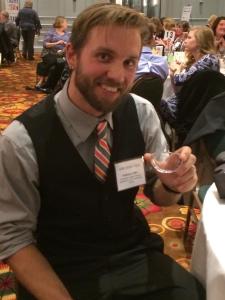
Anthony at the Gala celebrating the Maine Teacher of the Year educators. Anthony is the 2018 Knox County Teacher of the Year.

What have you accomplished through hard work and determination that might otherwise appear at first glance to be due to “luck” or circumstances?

Something I have spent a lot of time on is the development of curriculum and lesson plans that are both relevant and engaging. The more times I teach something, the more connections I can make, and the more clearly I see the effectiveness. My “curriculum” is as it should be, is in constant flux.  There are some tried and true lessons I do not change much, but most are adapted regularly and I am constantly on the lookout for better ways to build skills and convey concepts. I am sure it looks like any other art class to most, but there are many details and research I have put into my process.  Understanding developmental levels, how to have high but reasonable standards, how to structure building blocks of learning both over the course of a year and over several years, are all important aspects that may not be noticed but I believe make a huge difference in how effective and art education can be.

Look into your crystal ball: what advice would you give to teachers?

Teaching is a social service. It is not a lucrative job and success is not based on a financial scale. It is though, one of the most rewarding occupations one can have. You are given the opportunity to influence the future more than anyone else. It is a powerful and humbling experience.

There is the saying that there are two types of people, those that work to live, and those that live to work. There should be a balance though, being self-aware and allowing time to step back, is crucial to the longevity of a successful teaching career. It is also important to work in a field you enjoy. However, to truly appreciate something, you need to be able to see it from other perspectives as well so it is important to take a step back every once in a while. There is the quote by Marc Anthony, “If you do what you love, you’ll never work a day in your life”. True to some degree, though I would argue that all success requires hard work. Being able to see the big picture and being passionate about it, gives a sense of accomplishment and gratitude to the work that is being done. I like the quote by Dr. J a little better: “Being a professional is doing the things you love to do, on the days you don’t feel like doing them”.

Some other advice, be passionate. If you’re not excited about it, neither will your students. Even if it’s not your favorite thing to teach, teach it with enthusiasm. Being passionate is projected and will create interest.

Finally, have a plan, and a back-up plan, and maybe even plan C. There can be many difficulties to teaching whether it is specific students, administration, parents, access to materials or resources, etc. If you are not prepared for these, they can derail you. If you are though, you can take them in stride, and not let them cripple your perspective on teaching. You’ll also look good doing it.
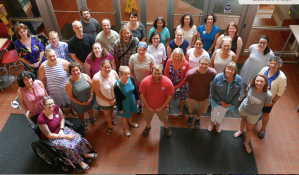
MALI Summer Institute, August 2018, USM

If you were given a $500,000.00 to do with whatever you please, what would it be?

I feel like the most fiscally responsible thing to do with such a large amount of money would be to invest it. Using the interest, I would think I would be able to create a system of sustainable growth contributing to the enhancements of the art programs and facilities in my district and community first, then possibly expand to other areas of the state.

Imagine you are 94 years old. You’re looking back. Do you have any regrets?

I do and would regret opportunities I was not able to take advantage of. We only have one life to live so I think it is important to make the most of it. However, if we are always trying to take advantage of opportunities, it is easy to get burnt out and lose focus on what matters. It is important to see and appreciate the little things that make life so great. One of the benefits of having a job directly focused in art, is that it encourages me to take time to look closely at things, to identify and appreciate the subtleties that make life so interesting.

So, my regrets don’t mean I am disappointed with the direction my life has and will go. The events in my life have shaped who I am. The path I have taken has sculpted the way I think, interact, and of course teach. Therefore, it is the destiny I have put forth. Plus, I teach art for a living. I think that’s hard to beat.

h1

MALI Teaching Artist Leader Story: Kerry Constantino

February 19, 2019

Teaching Artist – Dancer

This is one of six blog posts in 2019 that include stories of the Maine Arts Leadership Initiative (MALI) Phase 8 Teacher Leaders and Teaching Artist Leaders. This series includes a set of questions so you can learn a little bit about each leader. CLICK HERE  for more information on MALI. CLICK HERE  for more information on the 96 Teacher Leaders and 11 Teaching Artist Leaders. CLICK HERE  for Arts education resources. CLICK HERE for the MALI Resource Bank. Search in the “search archives” box on the bottom right side of this post for past teacher leader stories. Thank you Kerry for sharing your story!

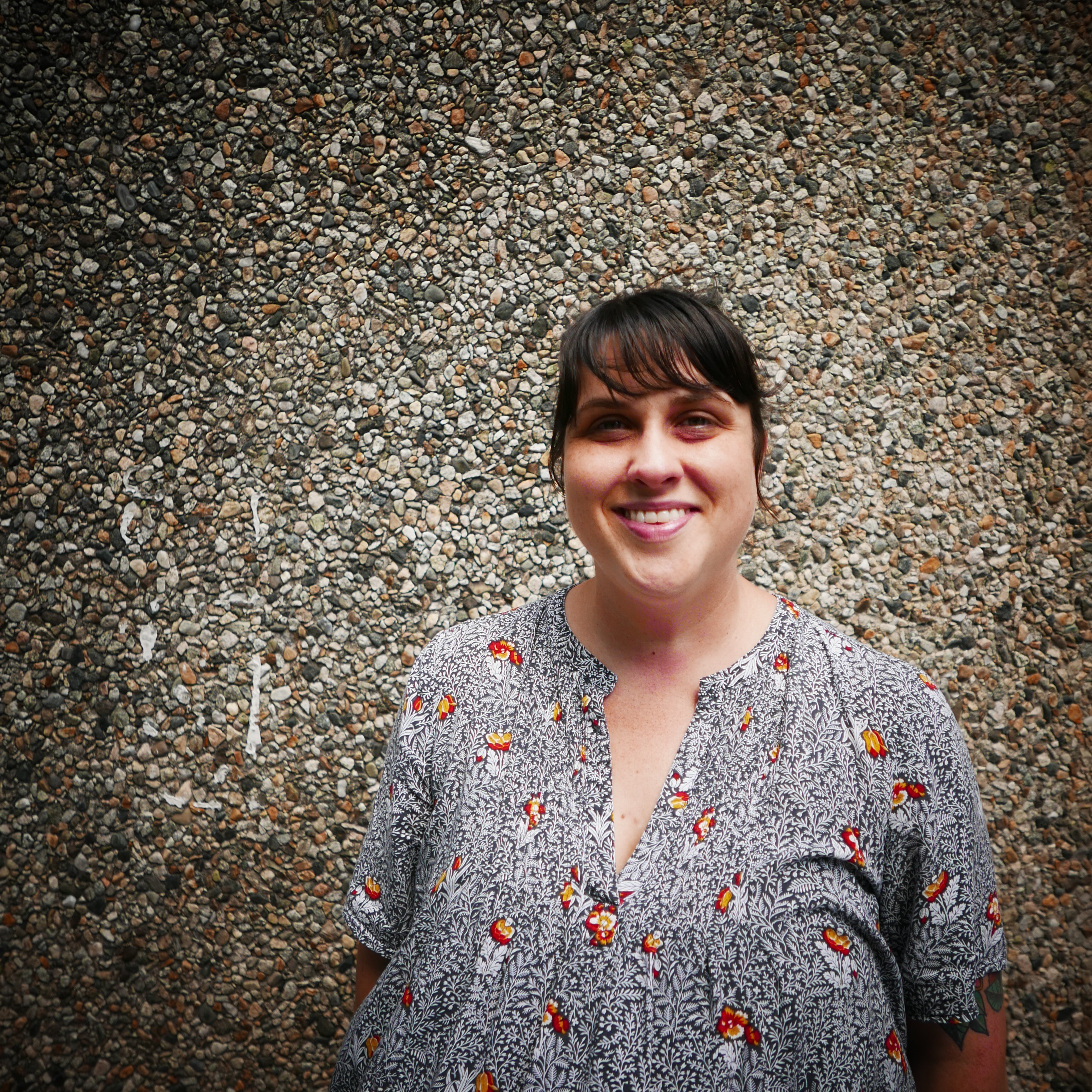
Kerry Constantino

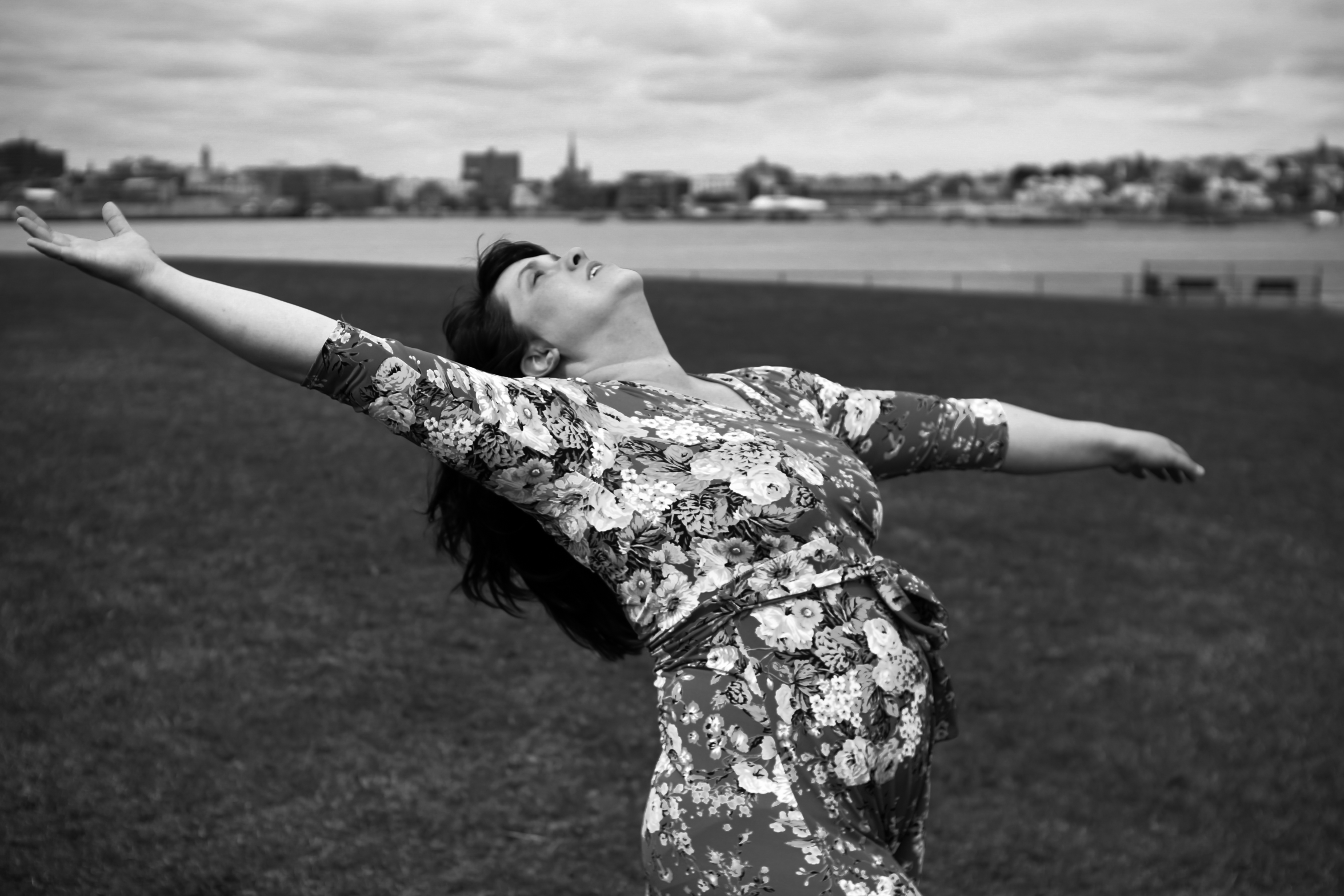
Kerry Constantino began teaching dance to kids right out of college when she graduated college in 2003. Even though she really enjoyed teaching, Kerry felt like she needed more time and experience just creating art. She stepped away from teaching and turned her focus towards developing her technique, studying movement and choreographic theory, and participating in the practice and creation of dance for herself and others. Nearly a decade later, Kerry found herself wanting to teach again, so she applied and was accepted in the San Diego Young Audiences Teaching Artist Training, where she re-learned a lot of things that would prepare her for her role as  a teaching artist. And, she loved it! Kerry really feel at home working with all members of the community. Whether through a school residency or at a private studio, she finds that working with dancers of all ages is so satisfying.

What do you like best about being a teaching artist?

I love being a teaching artist because people, especially young people, are natural dancers.           Giving people permission to move, when so often in a school and work setting, we are told to stay sedentary, is one of my greatest joys.

What do you believe are three keys to ANY successful visual and performing arts education?

I have no idea what would be the key to having a successful arts education, however, I think the thing that stops people from having a successful arts education is a pressure from society that the arts are not valid, or that they are superfluous. The arts give us tools to be creative problem solvers, to think three-dimensionally, and to have the confidence to improvise if we need to. I think all kinds of industries and workplace environments benefit when there are artists at the table.

Have you found assessment to be helpful in your classes, workshops and residencies, and if so, how?

Assessment is part and parcel to being a teaching artist. Whether I’m teaching 3 year olds or 70 year olds, having tools to assess how my students are understanding me is important. When teaching dance, so much is dependent on being a clear communicator, I want my students to dance articulately, safely, and joyfully. Knowing how much of my information is getting across is accomplished through using assessment throughout class.

What have been the benefits in becoming involved in the Maine Arts Leadership Initiative?

I have loved my experiences learning with the other educators in the MALI. It has been inspirational to hear their stories and learn from what they are currently practicing in their classrooms. Learning from other teachers and seeing how they organize and strategize their teaching techniques is invaluable.

What are you most proud of as an artist and/or a teaching artist?

I think what I am most proud of in my art is that I haven’t gotten stuck with just one medium. I began as a dancer, but over the years I have continued to be a voracious learner in many different mediums. I don’t think I will ever be satisfied just practicing and teaching one thing, there is so much more to learn. As I have learned new mediums I’ve incorporated it into my own art and into my teaching as well. Sometimes it feels like I’m a bit of a “Jack of all trades” it’s during those times that I remind myself that if I stop learning new things, then I have stopped growing.

Kerry Constantino

What gets in the way of doing a better job as a teaching artist?

I think that the biggest challenge for me as a teaching artist is navigating the process of finding residencies. I still feel really new to teaching, so I’m hoping this gets easier the more that I do it. I tend to retreat a bit when it comes to pursuing residencies because I feel like there are other people who are doing what I do, but with more experience and better. I talk myself out of things a lot and I think this is all born out of fear.

What have you accomplished through hard work and determination that might otherwise appear at first glance to be due to “luck” or circumstances?

Everything. I have spent years pushing and finding a way to continue as a dancer and movement artist. Sometimes it feels too hard, like if being a dancer and choreographer is this hard, then I just shouldn’t do it, but for some crazy reason I keep going. Every piece of choreography I have shown, every informal performance, every single time I have made dance and shown it there has been a period during my creative process that has felt impossible.

What advice would you give to someone who is thinking about becoming a teaching artist or is just starting out?

Go for it! Practice saying what you want to say to your students before you are actually in front of a class. Write down everything. Get a calendar and use it. Don’t worry if you get flustered on the first day and forget your whole lesson plan, you will be ok!

MALI Summer Institute, August 2018, USM

If you were given a $500,000.00 to do with whatever you please, what would it be?

There is so much I could do with $500,000. I have always hoped to own a home that would have a dance/art/movement studio in it. Dance requires a lot of open space, so I think that would be a big thing for me, to have a proper studio where I could hold classes and have informal performances in my own home. One of my first dance teachers lived in a huge old victorian house and the “ballroom” was her dance studio. It is definitely a dream of mine to do that. Oh, and more travel, I have terrible wanderlust.

Imagine you are 94 years old. You’re looking back. Do you have any regrets?

If I make it to be 94, I hope that I can see that all of my choices were what made my long beautiful life. I can’t say there would be any regrets at this point.

h1

POL Southern Regional Finals

February 13, 2019

Amazing Reciters

The Poetry Out Loud (POL) Southern Maine Regional Finals were held earlier this week at the beautiful Westbrook Performing Arts Center. Students traveled from 17 high schools in the southern part of the state to recite poetry. The Maine Arts Commission held the Poetry Out Loud (POL) Southern Maine Regional Finals in conjunction with the Poetry Foundation and the National Endowment for the Arts. Students have been practicing and reciting poems in schools across the state and country since the fall. For the event each student had prepared three recitations and wowed the audience with their amazing performances.

We’re so proud of the following students who participated (listed in order of their recitations, selected randomly). The names with stars are the five students moving onto the state finals on March 11 at the Waterville Opera House, 3:00 p.m. The event is free and open to the public. The Messalonskee Jazz Band under the direction of music educator Andy Forster will perform at 2:45 and again in between recitations. All are welcome!

  • Jack Lent, North Yarmouth Academy
  • Stephanie Brown, Portland High School
  • Amber Soucy, Lisbon High School
  • Kaitlyn Guay, Greely High School
  • Liam Doyle, South Portland High School
  • Hannah Smith, Westbrook High School
  • Helen Strout, Cape Elizabeth High School
  • Delaney Ziegman, Thornton Academy**
  • Aaliyah Biamby, Gorham High School**
  • Olivia Cox, Mt. Ararat High School
  • Blythe Thompson, Waynflete School
  • Wyatt Bates, Yarmouth High School**
  • Maya Ham, Oak Hill High School
  • Charles Van West, Maine Coast Waldorf School
  • Allison Rickert, Kennebunk High School
  • Allan Monga, Deering High School**
  • Joao Victor, Lewiston High School**

For more information about the Poetry Out Loud program please go the POL pages at the Maine Arts Commission website.

Southern Regional Finalists Wyatt Bates, Delaney Zeigman, Aaliyah Biamby, Allan Monga, and Joao Victor

Poetry Out Loud is organized nationally by the National Endowment for the Arts and the Poetry Foundation and administered at the state level by the Maine Arts Commission. It begins in Maine’s schools where school champions are selected to compete in two regional finals at which ten students are ultimately selected to recite at the state finals. One student, the state champion, moves on from the state finals to represent Maine at the national finals in Washington D.C., where students from all 50 states, the District of Columbia, the U.S. Virgin Islands, and Puerto Rico will compete for a total of $50,000 in awards and school stipends for the purchase of poetry books.

Poetry Out Loud uses a pyramid structure that starts at the classroom level. Winners advance to a school-wide competition, then to a regional and/or state competition, and ultimately to the National Finals.

h1

Celebrating Teachers

February 3, 2019

Proud of arts educators

Today is the last day nominations are being accepted for the 2019 County Teachers of the Year and the 2020 Maine State Teacher of the Year.

Information is located on the Maine Teacher of the Year Website.

The Maine State Teacher of the Year process of selecting and recognizing educators is very extensive. The process starts in January with nominations and during the following several months essays are written and submitted, interviews take place, presentations occur and video tapes created. Many are nominated of which each county has a teacher named. After 9 months the process takes it down to 3 finalists and in the end one teacher is selected. Each year in November a gala celebration happens where all of the county teachers of the year are recognized along with the next years State Teacher of the Year.

Anthony Lufkin

The 2019 gala took place the week before Thanksgiving. It was to see Kaitlin Young, music educator, Maine Arts Leadership Initiative Teacher Leader and the 2018 Maine Teacher of the Year emcee the evenings program. It was a chance to celebrate Kaitlin’s amazing journey and what she has contributed to education. She has been a wonderful representative of all Maine teachers and especially Visual and Performing Arts Educators. In addition, three more arts educators were celebrated. I’m so proud of their work.

  • Christine Del Rossi, Sagadahoc County, Visual Arts grades 9-12 Mt. Ararat High School
  • Anthony Lufkin, Knox Counnty, Visual Arts grades PreK-8 Union Elementary School, Prescott School (Washington), Friendship Village School, Middle School Alternative Education
  • David Coffey, Waldo County, Music grades 6-12 Belfast Area High School

Christine Del Rossi


h1

Dance Education Funding

January 29, 2019

Schools/districts apply by January 31, 2019

AUGUSTA-January 23, 2019—The power of dance is alive in Maine schools thanks to a Dance Education Grant offered by the Maine Arts Commission that is available to PK-12 schools and teaching artists until January 31, 2019. Applicants can apply for awards up to $2,500 to fund a dance residency in their school district.

Teaching Artist Nancy Salmon with students at Freeport High School

Dance education makes a difference in children’s lives and creativity. Yet only five percent of all schools in Maine offer opportunities in this artistic discipline, according to the Arts Education Census study conducted in 2016 by the Maine Arts Commission.

The Dance Education Grant emphasizes high quality learning experiences for students and educators through a series of residencies that are administrated by teaching artists from the Arts Commission’s Teaching Artist Roster. Each residency is designed to teach the art of movement, performance, creative expression, and teamwork.

Freeport High School students rehearsing their dance

During this past school year, the dance education grant funded residencies at Freeport High School and Maranacook Middle School. Nancy Salmon, a teaching artist listed on the Arts Commission’s teaching artist roster, provided the instruction.

“The students know that dance is more than memorized steps,” Salmon said, reflecting on her residency program at Freeport High School that collaborated with the theater program. “They know how dance movement can enhance meaning of words in a script and how all dance and movement have elements in common. I believe all of us, teacher, students and visiting artist, have honed our adaptation, flexibility, and focus skills.”

Freeport High School students rehearsing their dance

Applying what they learned in the dance residency program, the Freeport theater class wrote a play based on three thematic stories, and then performed the piece as an interactive workshop for all second graders in the Freeport school district.

“The dance education grant is intended as seed money to grow a dance program,” said Argy Nestor, Director of Arts Education at the Maine Arts Commission. “This funding provides a unique opportunity, one that I hope all schools without dance ed curriculum in place will take advantage and apply.”

Collaborators – Teaching Artist Nancy Salmon and Freeport High School Theater teacher Natalie Safely

Funding for the grant is made possible through an annual dance performance presented by two schools and ten dance studios in collaboration with Thornton Academy dance educator and Maine Arts Leadership Initiative Teacher Leader Emma Arenstam Campbell.

Dance Education Grant guidelines application criterion is listed at www.MaineArts.com. Applications will be accepted until Thursday, January 31, 2019.The Commission encourages PK-12 educators or teaching artists to review the guidelines prior to applying. The funding cycle for the grant must take place September 1, 2019 through March 30, 2020.

For more information visit the grants and the teaching artist roster webpages at www.MaineArts.com.

For questions regarding the grants or current teaching roster, contact Argy Nestor, Director of Arts Education at 207-287-2713 or email at argy.nestor@maine.gov.