Posts Tagged ‘Americans for the Arts’

h1

Vans and Americans for the Arts

October 1, 2016

Eight schools and funding

screen-shot-2016-09-23-at-7-35-30-pmDeadline: November 2, 2016. Vans and Americans for the Arts are partnering once again to support arts education programs across the country with the Vans Custom Culture grant program. Eight schools will receive grants of $2,500 each in support of their music, visual arts, theater, and/or dance programs, and is supported by funds from sales of the winning shoe design in the Vans Custom Culture Art Competition. All public high schools (including charter schools) are eligible to apply during the application period, which runs September 21 through November 2, 2016.

For more information please CLICK HERE.

h1

National Arts in Education Week

September 4, 2016

What you can do

Screen Shot 2016-08-20 at 6.12.15 AMJoin Americans for the Arts in celebrating National Arts In Education Week from September 11-17, 2016. Take two minutes to issue a Letter to the Editor to your local papers and tell them why the arts matter in education!

Designated by Congress in 2010, House Resolution 275 names the week beginning with the second Sunday in September as National Arts in Education Week. During this week, the field of arts education and its supporters join together in communities across the country to tell the story of the transformative power of the arts in education.

In 2016, it is a particularly important time to celebrate arts education, as we usher in a new chapter of American educational policy with the new Every Student Succeeds Act and its many arts-friendly provisions. In the new law, the arts remain a “well-rounded” subject and are empowered to be central to a child’s education in our public schools.

Our municipal, education, and state leaders need to know about the impact the arts have on young peoples’ lives and that they must support the arts in every district and every school in America. Write a letter to the editor now to tell them how and why the arts matter in education!

After sending in your letter, you can join the movement of thousands of arts education advocates celebrating National Arts in Education Week. Contribute to the visibility campaign on social media during the week of September 11-17, 2016 by using the hashtag, #BecauseOfArtsEd. People from all walks of life can share their story of the transformative power of the arts in their own education and the impact the arts have had on their work and life.
Post on Facebook. Tell the world your #BecauseOfArtsEd story on Facebook. Describe what you are doing now in work and life and how arts education has a positive impact with a photo! Be sure to use #ArtsEdWeek, too.
Send a tweet.  Share your quick #BecauseOfArtsEd story on Twitter. Be sure to include an image or video along with #ArtsEdWeek.
Share a photo. Post your favorite arts education photo on Instagram along with your #BecauseOfArtsEd story about the impact of arts education on your life. Be sure to use #ArtsEdWeek.
Be sure to do your part to advocate to our decision makers and bring attention to the cause of arts education!

h1

National Arts in Education Week

August 21, 2016

Save the dates

Screen Shot 2016-08-20 at 6.12.15 AMCelebrate this year’s National Arts in Education Week! September 11–17, 2016

Designated by Congress in 2010, the third week in September is a national celebration of the transformative power of the arts in education. Over the course of September 11–17, celebrate arts education in events across the country; advocate to federal, state, and local decision-makers; and participate in visibility campaigns on social media using #ArtsEdWeek. Americans for the Arts will also host a series of professional development opportunities on ArtsU. For more information, contact Arts Education Program Manager Jeff Poulin at jpoulin@artsusa.org.

OCTOBER IS NATIONAL ARTS & HUMANITIES MONTH

Screen Shot 2016-08-20 at 6.14.57 AMThe arts are a part of our lives every day, but we take all 31 days in October to commemorate the arts in a big way! National Arts & Humanities Month is the largest annual celebration of the arts and humanities in the United States. October may seem far away, but it’s never too early to start planning the celebration in your community. Our website offers resources and tools to establish a Do-It-Yourself Community Visioning Forum, host a Creative Conversation, or partner with a local arts venue on an open house or a special performance. Follow NAHM on Facebook for the latest updates on the national celebration, including a special social media challenge coming October 1, and to share your ideas and events with our followers.

h1

Americans for the Arts

August 8, 2016

Web resources

Screen Shot 2016-08-08 at 12.15.35 AMAmericans for the Arts has many resources on their website that I recommend. They envision that arts education as an integral part of everyone’s lives. From their web page on arts education…

Americans for the Arts envisions a country where everyone has access to—and takes part in—high quality and lifelong learning experiences in the arts, both in school and in the community. What can we do together to ensure that the next generation receives a well-rounded education that includes the arts?

Below is one chart that they’ve made available. Access American for the Arts education material by CLICKING HERE.

Screen Shot 2016-03-09 at 6.08.46 PM

h1

In Today’s News

March 5, 2016

Americans for the Arts – Economic Impact Study
PrintThe Maine Arts Commission announced today that for the first time in the agency’s history it is facilitating statewide participation in Americans for the Arts’ national study Arts & Economic Prosperity® 5 (AEP5). AEP5 is the largest national study measuring the economic impact of spending by nonprofit arts and culture organizations and their audiences ever conducted. Surveys will be collected throughout calendar year 2016; results will be released in June of 2017. AEP5 is the fifth national study over the past 20 years to measure the impact of arts spending on local jobs, income paid to local residents, and revenue generated to local and state governments. More than 300 U.S. communities, including five study regions plus independent venues throughout Maine, will be part of this newest study.

Regions participating as study partners in Maine are Bangor, Belfast, Portland, Waterville, and the Western Mountain Regions. Only Portland has participated previously. In addition, the Arts Commission is reaching out to organizations in communities ranging from Ogunquit to Eastport and Lewiston to Presque Isle.
“The economic impact of the cultural sector in Maine is larger and more important than most people realize,” said Julie Richard, Executive Director of the Maine Arts Commission. “By collecting this data and making it available to communities and regions we are better able to demonstrate this impact, helping policy makers at all levels make better informed decisions throughout Maine.”

The study’s participating communities represent all 50 states plus the District of Columbia. For Maine’s five study regions, a partner organization representing each community will collect detailed financial information from its local nonprofit arts and culture organizations such as local theater and dance companies, museums and galleries, and arts education organizations. Study partners will also collect audience-intercept surveys from attendees at arts events using a short, anonymous questionnaire that asks how much they spent on items such as meals, parking and transportation, souvenirs and retail shopping, and overnight lodging as a direct result of attending the event. Outside of the five Maine study regions, the Arts Commission will work directly with independent organizations. Additional analyses will gauge the important role that the nonprofit arts industry plays in attracting tourists to communities.
Screen Shot 2016-03-03 at 9.27.46 AM“Our Arts & Economic Prosperity series demonstrates that the arts are an economic and employment powerhouse both locally and across the nation,” said Robert L. Lynch, president and CEO of Americans for the Arts. Americans for the Arts is the nation’s leading nonprofit organization for advancing the arts and arts education. “Leaders who care about community and economic vitality can feel good about choosing to invest in the arts. Nationally as well as locally, the arts mean business.”

According to AEP4, based on FY2010 data, the nonprofit arts industry generated $135.2 billion in economic activity and supported 4.1 million full-time equivalent jobs during 2010, resulting in $22.3 billion in federal, state, and local government revenues. The $135.2 billion total included $61.1 billion in spending by arts and culture organizations and an additional $74.1 billion in event-related spending by their audiences. A statistic that captured the attention of business and government leaders was that the typical attendee to a nonprofit arts event spends $24.60 per person, per event, beyond the cost of admission on meals, transportation, babysitting, and other event-related spending. Additionally, 32 percent of all arts attendees live outside of the county in which the arts event took place—a finding based on a survey sample of 152,000 arts attendees.

Americans for the Arts’ Arts & Economic Prosperity 5 study is supported by The Ruth Lilly Fund of Americans for the Arts. In addition, Americans for the Arts’ local and statewide study partners are contributing both time and a cost-sharing fee to support to the study. Financial information from organizations will be collected in partnership with DataArts™, formerly The Cultural Data Project, using a new online survey interface. For a full list of the communities participating in the Arts & Economic Prosperity 5 study, visit www.AmericansForTheArts.org/AEP5Partners.

For Maine arts organizations who have not yet been contacted by a study partner or the Arts Commission, please contact Linda Nelson, Assistant Director, at linda.l.nelson@maine.gov.

Americans for the Arts is the leading nonprofit organization for advancing the arts and arts education in America. With offices in Washington, D.C. and New York City, it has a record of more than 50 years of service. Americans for the Arts is dedicated to representing and serving local communities and creating opportunities for every American to participate in and appreciate all forms of the arts. Additional information is available at www.AmericansForTheArts.org.

The Maine Arts Commission encourages and stimulates public interest and participation in the cultural heritage and cultural programs of our state; expands the state’s cultural resources; and encourages and assists freedom of artistic expression for the well-being of the arts, to meet the needs and aspirations of persons in all parts of the state. Additional information is available at www.mainearts.com.

h1

National Arts in Education Week

September 13, 2015

Resources

Screen Shot 2015-09-08 at 8.52.00 AMBelow are suggestions, from Americans for the Arts, on how to celebrate National Arts in Education Week and resources to help you do do.

Information on www.NationalArtsInEducationWeek.org Website and Resources
Launched in March 2015, a website containing downloadable resources has been made available for those interested in celebrating, advocating and participating in National Arts In Education Week.  A share domain (www.NationalArtsInEducationWeek.org) and logo have been created to unify the field in celebration. Containing action-oriented materials, the site asks supporters to take three actions:
·         Celebrate: Host or attend an event in your community to celebrate the week (and be sure to include it on ArtsMeet National Event Calendar). Download the logo (above) to be used on any materials, fliers or public awareness campaigns.
·         Advocate: Use the latest tools to bring attention to the cause of arts education in your community or state. Download resolutions for your school, city or state elected officials to voice their own support of arts education.
·         Participate: Get online and use the hashtag #ArtsEdWeek. Show a picture of student artwork or a performance with #EncourageCreativity or tell a story about an arts educator who made a difference with #TeachTheArts. Also, use the new Encourage Creativity. Teach the Arts. video campaign to bring awareness to the cause.

The Arts Education Navigator
The newest tool from Americans for the Arts launching on 9/14/15! Do you believe in the transformative power of arts education? The Arts Education Navigator will help you turn your passion into action.  Follow this six step process to better understand your role in the arts education ecosystem, the policies which affect your state, the current trends in the field and how to best take action. With over 300 contributors and 75 partner organizations, find the tools and tips you need to take action immediately! www.AmericansForTheArts.org/Navigator (Note: this link goes live on 9/14/15)

Blog Salon September 14–18: Reauthorizing ESEA
Read from 20 of the top experts from the field on the impacts of the current reauthorization of the Elementary and Secondary Education Act (ESEA). As the U.S. House of Representatives and U.S. Senate go into Conference Committee, this is your chance to understand the inner workings on this law and its impact on arts education. Learn more on ARTSblog.

“Arts Education: What You Need to Know” Webinar Series
Every year there are new buzzwords which affect our work. Each day during the week of September 14–18, we will gather thought leaders to unpack these terms, where they came from, and their impact on our day to day work in arts education. These daily webinars will be held at 3:00 p.m. (EST) and last approximately 20 minutes. To continue the conversation, join Jeff Poulin (@JeffMPoulin) and special guests for a Twitter chat from 8:00 p.m.–9:00 p.m. (EST) by following the specified hashtag. You can either view them live or throughout the week.

The topics include:

  • Monday, September 14, 3:00pm ET: Arts Integration
    Including presentations from Amy Duma (John F. Kennedy Center for the Performing Arts), Janet Starke, (Richmond Center Stage) and Lauren Hess (Cincinnati Public Schools). Register here. Follow the conversation at #ArtsIntegration
  • Tuesday, September 15, 2015, 3:00pm ET: Creative Youth Development
    Including presentations from Heather Ikemire (National Guild for Community Arts Education), Traci Slater-Rigaud (President’s Committee on the Arts and the Humanities), Erik Holmgren (Massachusetts Cultural Council) and Denise Montgomery (CultureThrive). Register here.  Follow the conversation at #CYD
  • Wednesday, September 16, 2015, 3:00pm ET: STEAM
    Including presentations from Kate McClanahan (Americans for the Arts), Lucinda Presley (The Innovation Collaborative) and Andrew Watson (Alexandria City Public Schools). Register here. Follow the conversation at #STEAM
  • Thursday, September 17, 2015, 3:00pm ET: Arts Education Standards
    Including presentations from Pam Paulson (Perpich Center for Arts Education), David Dik (Young Audiences Arts For Learning) and Jim Palmarini (Educational Theatre Association).  Register here. Follow the conversation at #Standards
  • Friday, September 18, 2015, 3:00pm ET: Creative Aging
    Including presentations from Gay Hanna and Evan Sanderson (National Center for Creative Aging) and Robert Schultz (City of Mesa, AZ Arts and Culture).  Register here. Follow the conversation at #CreativeAging
    Be sure to register for the webinars to receive the direct link, pre-reading materials, and details for the follow up Twitter chat!

Join the National #ArtsEdChat on Twitter
Join Americans for the Arts’ Arts Education Program Coordinator, Jeff M. Poulin (@JeffMPoulin) and special guests for a Twitter chat from 8:00–9:00pm ET by following the specified hashtag. The Schedule is as follows.
Monday, September 14, 8:00-9:00pm ET: Arts Integration (#ArtsIntegration)
Tuesday, September 15, 2015, 8:00-9:00pm ET: Creative Youth Development (#CYD)
Wednesday, September 16, 2015, 8:00-9:00pm ET: STEAM (#STEAM)
Thursday, September 17, 2015, 8:00-9:00pm ET: Arts Education Standards (#Standards)
Follow @Americans4Arts and #ArtsEdWeek for more updates.

h1

WERU – Arts Alive

September 7, 2015

Listen to the archive

showweru

Susan Potters, Jen Nash, Michael Donahue

I mentioned last week that the WERU Arts Alive program invited a group to discuss arts education and advocacy week, September 14-18. The program has been archived so you can access it and listen to your colleague, music educator from Sebasticook Middle School and Maine Arts Leadership Initiative Teacher Leader Jen Nash. Also participating in the program were Susan Potters, Executive Director of the Maine Alliance for Arts Education, Jeff Poulin, Arts Education Program Director from the Americans for the Arts, and me, Argy Nestor. Michael Donahue is the host of WERU, Maine Arts Alive and did a wonderful job.

To access the program on WERU Community Radio, MaineArtsAlive, please go to the site http://archives.weru.org/maine-arts-alive/, click on Public Affairs Archives in the lower right, scroll down to MAINEARTSALIVE and click on title; or

go directly to MaineArtsAlive.org and click on “Program Information” and click on “recent programs” drop down.  This is the direct link: http://archives.weru.org/maine-arts-alive/2015/08/maine-arts-alive-82515/

h1

Arts Education for America’s Students

January 14, 2014

A Shared Endeavor

A Shared Endeavor is a recently released statement which represents a groundbreaking joint endeavor with twelve major arts organizations stemming from the Accord meeting in Washington D.C., May 2013.  A Shared Vision defines what quality arts education looks like at the local level, encourages partnerships, and calls on organizations and individuals to actively support and promote:   

  • Policies and resources for arts education.
  • Access to arts education for all students.
  • Collaboration between school-based arts educators, other subject area teachers, and community-based artists and arts educators.
  • Long-term advocacy partnership between all providers of arts education.  

A Shared Vision can be used in a multiple ways. Please share it with your administrators, colleagues, and community members. Encourage other educators to distribute the statement to education organizations. Be a leader and use Shared Vision to start a conversation at the local level, within your school and community.

The arts(1) are part of a balanced education, providing America’s learners with essential skills and knowledge they need to be productive, college and career ready citizens. A core academic subject of learning,(2) the arts are supported by a rigorous set of voluntary national standards(3) and assessment frameworks(4) designed to improve and support arts learning. In addition, forty‐nine states support sequential arts learning in their public schools with state‐adopted arts standards.(5)

The American public values a quality arts education in our schools.(6) When America’s public schools invest in certified arts educators, students gain the opportunity for a sequential, standards‐based education in the arts. Certified non‐arts educators in schools expand students’ opportunities for arts learning by providing curricular connections among the arts and other subjects.(7) Furthermore, students gain deeper, additional standards‐based arts learning experiences through America’s cultural organizations, community arts organizations, and teaching artists. It is the convergence of the contributions of all partners and opportunities that provides a quality arts education for our students.

Despite the rich body of data(8 )demonstrating how students benefit from quality arts education, many American children lack access to it in their schools. According to the National Center for Education Statistics, students in high poverty schools are more than twice as likely to have no access to the arts.(9) We believe that the inequity of access to quality arts education must be addressed. Too often, arts education is squeezed out of America’s public schools.

An education without the arts is inadequate. Therefore, we call on our public policy leaders to provide a systemic and rigorous arts education for all students in all public schools by leveraging the expertise and experience of the partners involved in arts education. To this end, the signatories of this document will support efforts to:

  • Advance policies and resources that ensure access to arts education for all students— delivered by certified arts educators—and that develop artistic literacy through a sequential, standards‐based arts education.
  • Ensure that all students have access to in‐school and community arts learning opportunities that add value to a standards‐based PK‐12 education in America’s public schools.
  • Encourage certified arts educators, community arts providers and certified non‐ arts educators to provide quality arts education for their students by collaborating together in support of improved instructional and classroom practices.
  • Foster proactive, long‐term advocacy collaborations among certified arts educators, community arts providers, and certified non‐arts educators that engage parents, school leaders, and other key stakeholders to support student access to high‐quality arts education throughout the school and community.

Screen shot 2014-01-13 at 8.24.10 PM Screen shot 2014-01-13 at 8.24.26 PM

Screen shot 2014-01-13 at 8.19.42 PMInterested in endorsing this statement? Email SharedEndeavor@gmail.com

1 The arts are defined here as dance, media arts, music, theatre and visual arts, following the National Coalition for Core Arts Standards, http://nccas.wikispaces.com. Each state defines the arts differently within statute. Reference http://www.aep‐arts.org/
research‐policy/state‐policy‐database/ for further state information.
2 Elementary and Secondary Education Act, Title IX, Section 9101, 11, http://www2.ed.gov/policy/elsec/leg/esea02/pg107.html; http://www.aep‐arts.org/wp‐content/uploads/2012/07/State‐of‐the‐states‐2012‐FINAL.pdf
3 http://artsedge.kennedy‐center.org/educators/standards.aspx                                                     4 http://nces.ed.gov/nationsreportcard/arts/howdevelop.aspx                                                        5 http://www.aep‐arts.org/wp‐content/uploads/2012/07/State‐of‐the‐states‐2012‐FINAL.pdf
6 Americans for the Arts (2005), “New Harris Poll Reveals That 93% of Americans Believe That the Arts Are Vital to Providing a Well Rounded Education,” http://www.americansforthearts.org/sites/default/files/pdf/news/press‐releases/2005/06/New‐Harris%20Poll‐
Reveals‐93‐Percent‐of‐Americans‐Believe‐Arts‐are‐Vital‐to‐Well‐Rounded‐Education.pdf
7 http://nccas.wikispaces.com/file/view/Arts%20and%20Common%20Core%20‐%20final%20report1.pdf/404993792/Arts%20and%20 Common%20Core%20‐%20final%20report1.pdf
8 http://www.americansforthearts.org/by‐program/networks‐and‐councils/arts‐education‐network/tools‐resources/arts‐ed‐navigator/ facts
9 http://www.aep‐arts.org/resources‐2/report‐arts‐education‐in‐public‐elementary‐and‐secondary‐schools/

If you’d like to download this information in document form please go to http://www.seadae.org/Corporatesite/files/6e/6e73488d-bd16-4394-b0f5-78629c1d7aeb.pdf or http://www.seadae.org/ or email me.  

h1

US Department of Education

April 6, 2012

New study: Arts Education in Public Elementary and Secondary Schools

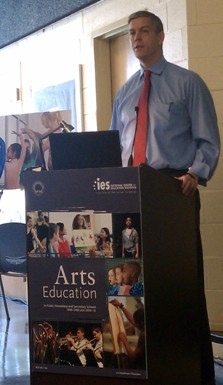
US Department of Education Secretary of Education, Arne Duncan

On April 2, the U.S. Department of Education released a study entitled Arts Education in Public Elementary and Secondary Schools 1999-2000 and 2009-10. This study was previously published in 2002, prior to implementation of the No Child Left Behind Act (NCLB). Arts education advocates are very pleased to finally see an update, even if a full decade later.

The report offers mixed results in support of arts education. According to the report, music and visual art are widely available in schools in some form in schools nationwide; however, dance and theater are far less available. U.S. Education Secretary Arne Duncan stated, “despite the importance of providing equal educational opportunities in the arts, today’s report shows we are falling well short of that goal.”

Despite being designated a “core academic subject” in NCLB and being included in mandated elementary school curriculum in 44 states, this survey demonstrates that access to arts education remains elusive to a tremendous number of students across the nation.

From the Department’s announcement of the study we learned that:

  • 1.3 million of our nation’s public elementary school students receive no specific instruction in music, and nearly 4 million students receive no specific instruction in the visual arts.
  • 800,000 public secondary school students do not receive music, and 11 percent of secondary schools do not provide the visual arts.
  • Only 3 percent of elementary schools offer any specific dance instruction and only 4 percent offer any specific theater instruction. In secondary schools, the numbers improve somewhat as 12 percent offer dance and 45 percent offer theater.

Finally, this report found that the nation’s poorest students, the ones who could benefit the most from arts education, are receiving it the least.  A decade ago, the data showed that 100 percent of high poverty schools offered music instruction, but currently, only 80 percent offer music instruction. The percentage offering visual arts, dance, and theater is even lower.

In his remarks, Secretary Duncan called the disparity between high-poverty and low-poverty schools “deeply disturbing” and “absolutely an equity issue and a civil rights issue.”

For further details on this federal study, read this post on ARTSblog, “Ten Years Later: A Puzzling Picture of Arts Education in America.”

This information was provided by the Americans for the Arts.