Posts Tagged ‘assessment’

h1

Another Arts Teachers’ Story: Alice Sullivan

March 27, 2012

Featuring one teacher’s journey as an arts educator

This is the second in a series of blog posts telling arts teachers’ stories. This series contains a set of questions to provide the opportunity for you to read their stories and to learn from others. This post features Alice Sullivan who has been teaching music for 27 years. Alice is one of the Maine Arts Assessment Initiative’s Teacher Leaders, Phase I, and represents the region of Washington County.
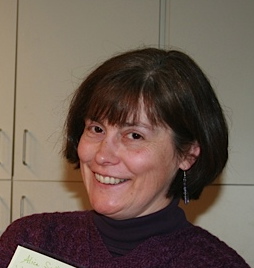
Alice is currently teaching, grades K-12, at Woodland Jr. Sr. High School, Woodland Elementary School and Princeton Elementary School. She has been there for 6 years teaching 200 students, band program grades 4-12, some classroom music K-4 and junior high general music, digital arts class and music theory at the high school, and one small elementary chorus.

What do you like best about being a music/art/drama/dance educator?

I really like the opportunity to use my organizational skills in an environment where I can also be creative. The music room is a great place to find a balance between hard and fast standards and finding numerous ways of meeting those standards. Twenty seven years of concerts with no two being the same, but every year I strive to provide every student with the same well rounded music education.

Tell me what you think are three keys to ANY successful arts ed program?

  •  a commitment to stretching the limits (your own and those around you)
  • a belief that what you do is important
  • enough confidence in your skills to take risks

What specific way(s) do your assessment practices tie into the success of your program?

Developing solid assessment practices sends the message to those around you that you believe your program is valuable and worthy of reflection. This instills a sense of importance in your students and as a result they strive to reach higher goals. I often say to my students – “who wants to belong to the good enough club”? An assessment is a tangible way for my students to prove the level they have attained, to themselves and others.

What have been the benefits in becoming involved in the arts assessment initiative?

There have been so many benefits to being part of the arts assessment initiative. The first that comes to mind is the great opportunity to network with other educators. It has also helped to keep assessment practices foremost in my daily teaching. With so many things to do each week, priorities become a necessity. Having weekly connections through the arts initiative wiki has ensured that assessments make my priority list.

What are you most proud of in your career?

I’ve always believed that music is a gift that all students can and should receive. My classes have always been available to all students. I’m most proud of the moments when the reluctant musicians realized they did have musical talent.

What gets in the way of being a better teacher or doing a better job as a teacher?

SLEEP!

Apple or PC?

Both – depends on the job I want to get done.

What have you accomplished through hard work and determination that might otherwise appear at first glance to be due to “luck” or circumstances?

Exceptional concerts are a reflection of hard work and determination. A good performance is often attributed to talent or “good” students. I believe even very young and inexperienced performers can present quality programs with hard work and determination.

Look into your crystal ball: what advice would you give to teachers?

Enjoy what you do. Focus on the positive forces in your environment and link arms with those who also have a positive outlook.

If you were given a $500,000.00 to do with whatever you please, what would it be?

I would travel. I want to see the world and share those experiences with the people around me.

This is a link to the wiki that Alice created that includes her marvelous resources: https://meaningfulassessments.wikispaces.com/. If you have comments or questions for Alice please put them in the “comment” section below.

Thank you Alice for telling your story!

h1

Another Arts Teacher’s Story: Rob Westerberg

March 20, 2012

Featuring one teacher’s journey as an arts educator

This is the first in a series of blog posts telling arts teachers’ stories. This series contains a set of questions to provide the opportunity for you to read their stories and to learn from others. The first one is featuring Rob Westerberg who is one of the recipients of the first presented Carol Trimble Award for outstanding contributions to arts education. If you have questions please don’t hesitate to contact Rob at rwesterberg@yorkschools.org and/or put your comments at the bottom of the post. Please let me know if this series “Another Arts teachers’ story” will be helpful to you by emailing me at argy.nestor@maine.gov.

All-State conference, UMaine, 2010

All-State conference, UMaine, 2010

Rob Westerberg is a High School Choral & General Music teacher who has taught for 24 years, the last 12 at York High School. He averages between 175 and 250 students per year covering several choirs, Vocal Auditions Class, Music History & Music Theory I and II. He is well respected by colleagues in New England for his enthusiasm and commitment to excellence in arts education! He has been a member of the Leadership Team for the Maine Arts Assesment Initiative and a member of the three person team who created the plan for the initiative.

What do you like best about being a music educator?

Waking up every day and being excited about going to work. Really!

Tell me what you think are three keys to ANY successful arts ed program?

1) getting the school and community to “unlearn the irrelevant” about the arts, 2) establishing the arts as “essential” ACADEMIC instruction, 3) building connections with other arts educators outside of your district to invigorate and reinforce your work.

What specific way(s) do your assessment practices tie into the success of your program?

They show the concrete parallels to assessment in other academic areas (reinforcing and demonstrating our academic status), they focus and enhance student achievement, and they help me to continuously evaluate and revise my curriculum and instructional practices.

What have been the benefits in becoming involved in the arts assessment initiative?

I have grown more in the last two years as a professional than the previous ten combined. Every interaction I’ve had with others as a component of the Initiative has driven me to want to be better at what I do, and has provided a foundation on which to build my assessment practices in ways I always wanted to but could never fully wrap my arms around.

What are you most proud of in your career?

Establishing a graduation requirement specifically for music (performing arts) and specifically for art (visual arts) at two of the three schools I have taught at. 100% of our graduates display genuine proficiency in the fundamental MLR standards of both subject areas through rigorous coursework, truly fulfilling a global vision of arts education for all.

What gets in the way of being a better teacher or doing a better job as a teacher?

“Getting SO wrapped up in working through, over or under the various brick walls that always seem to be standing in front of me (in front of ALL of us!!!) that I easily forget how much I love teaching to begin with… and not drawing from that reservoir of passion and excitement more often.”

Apple or PC?

Apple

What have you accomplished through hard work and determination that might otherwise appear at first glance to be due to “luck” or circumstances?

The music resources that we have access to at YHS can often be perceived as being due to being in a “wealthy” community. 75% of those resources (which does not include a functional auditorium) were not around 12 years ago and had to be fought for tooth and nail. We can empathize with anyone’s battle of having to fight for more resources in the arts.

Look into your crystal ball: what advice would you give to teachers?

Connect with other arts educators CONSTANTLY… in your 1st year or 41st year, all the best ideas for building and developing your program are already out there, and it’s your colleagues who have those ideas ready to share with you! Go get them!!!!

If you were given a $500,000.00 to do with whatever you please, what would it be?

I’d pay off my mortgage and then live off of the rest so I could just spend every single day of every single school year visiting arts educators across northern New England and working with them on curriculum and assessment development for their own programs I’d also buy an awful lot of Terra Cotta Butternut Squash Pasta

York High School music programs webpage: www.yorkschools.org/yhs/music

h1

Harlow Gallery: Hallowell

March 19, 2012

Harlow Gallery working with visual art educators

Nancy Barron, Program Director at the Harlow Gallery in Hallowell has helped to create a connection with local visual art educators to form a group called Art Educators’ Initiative. Recently Nancy answered questions for meartsed readers. Since this is a great model for other communities please share this post with your local galleries so they can think of possibilities for communities throughout Maine.

Mission Statement: “The Harlow Education Committee mission is to promote the arts through educational partnerships with the community.”

Vision Statement: “The goal of the Harlow Education Committee is to foster creativity by supporting programs and activities that encourage public awareness of, participation in, and appreciation of the arts.”

Tell me about the purpose of the Art Educators’ Initiative group.

The purpose of the Art Educators’ Initiative group is to give art educators a network of peers to problem solve, generate ideas, share professional development opportunities-in short, a support system.

Sounds like a PLC (Professional Learning Community) to me. How and when did this idea form?

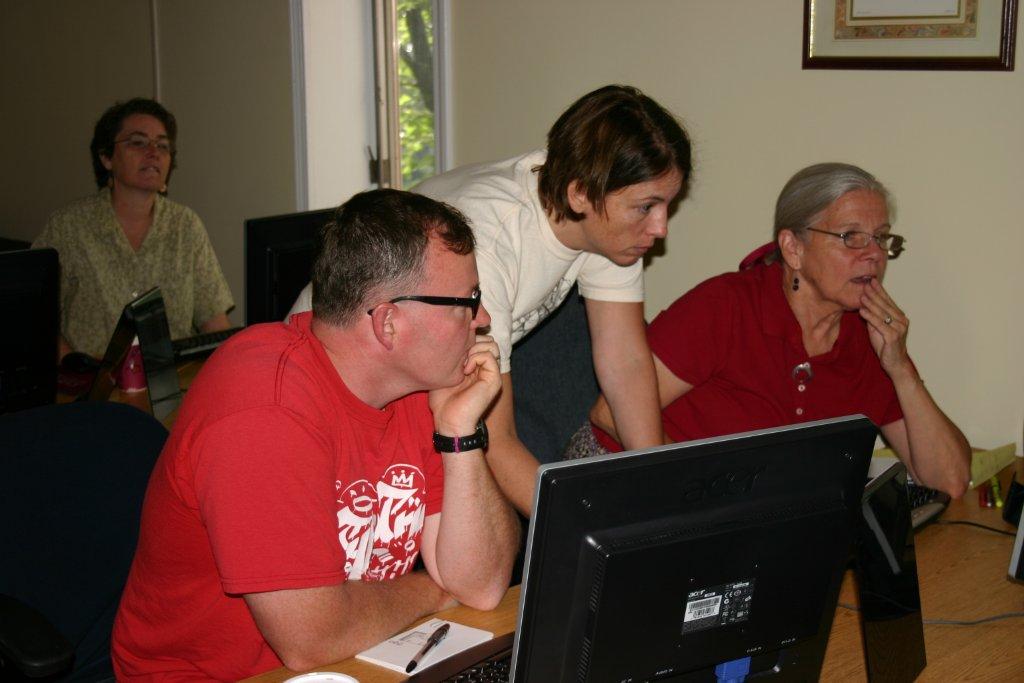
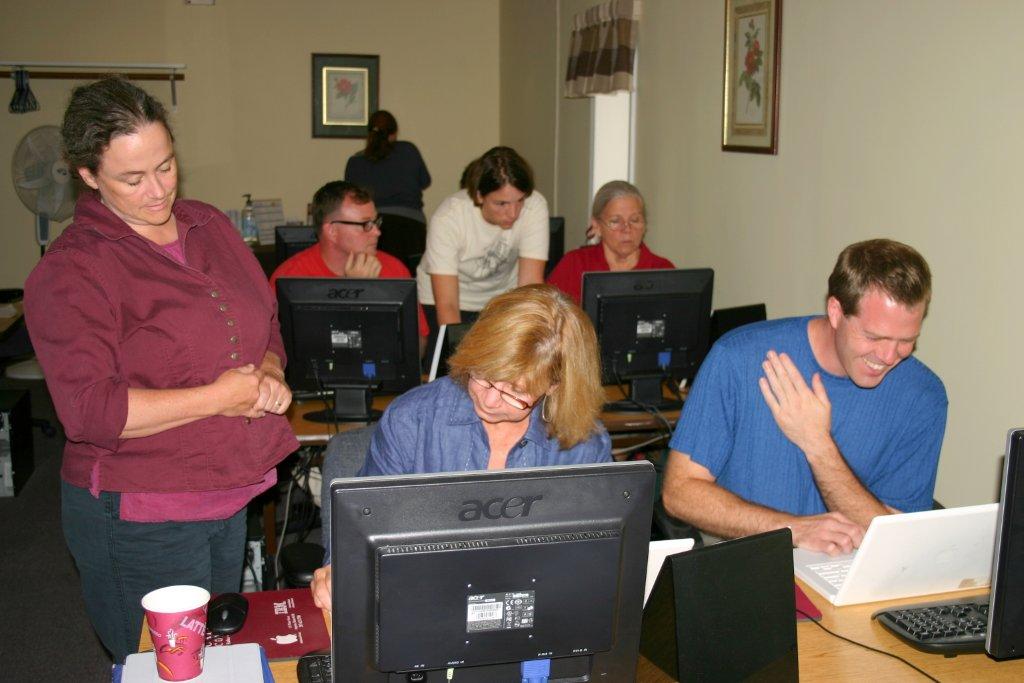
Website for classroom workshop, Shalimar Poulin instructing

The idea was an “ah-ha” moment at the Harlow. We have hosted Higher Forms of Art for several years; a show celebrating some of the area’s high school students art work. It is unique because the students not only display their work, but select the work for the show (curate), hang and promote the show. A hands on experience in a real gallery. We always want to engage this high school demographic and brain stormed about how to do just that. We decided to have a young artists celebratory pizza party. We had a sponsor who provided the pizza and requested that the teachers invite up to 6 students and to attend themselves. (60 students were invited). Disappointedly only 3 students came to the party, however; nearly all of their instructors came. With art from these various schools on the walls, introductions were made and the event instantly morphed into a very upbeat networking session for the instructors. The teachers were inspired by their colleague’s lessons and curious about their techniques. Needless to say, the event, though not for reasons intended, was a complete success. I floated the idea to host an “Art Teachers Retreat” to our relatively new, but very eager Art Education committee. They, (some of whom are retired art educators) loved the idea. In May of 2011 we held a focus group compiled of about 15 area art educators, Art Ed committee members and the Harlow staff. We asked the group:

  • Is there interest in having such a group
  • If so, what they would like to explore
  • How often they would like to meet
  • Would they be interested in a blog to communicate between meetings

They liked the idea, were realistic about what kind of commitment they could make (4 times per year), and they came up with a list of focus items which included: website development, clay workshops, behavior in the classroom, and more.

What does your work include?

So far, nearly a year later, the group has met for a website for classroom workshop taught by Art teacher Shalimar Poulin-10 educators signed up for this workshop in August of 2011. We have had two meetings since in which a good chunk of time was spent talking about assessments. This piece was a real eye opener for me. This one topic is clearly something nearly every teacher seems to struggle with. Teachers were also encouraged to bring examples of “tried and true” lessons.

Tell me about the teachers who are participating. 

Website for classroom workshop

The group varies from meeting to meeting with between 9 and 12 teachers attending. Our list has grown from 20 to over 30 teachers now.  Many of the teachers on our list have participated in our yearly Young at Art month in March. But we are not limiting the group to school aged children. We have an adult ed instructor and two instructors of adults with mental illness. Instructors are finding us through email blasts to statewide groups. The areas represented are:  Bath (adult ed instructor),Wiscassett, Richmond, Gardiner (and all the schools they serve-Randolf, Pittston, Chelsea), Chelsea, Hallowell, Augusta, Manchester, Readfield, Winthrop, Monmouth, Wayne (Kent’s Hill), and Waterville.

What activities, forums, and/or gatherings have you provided for the teachers?

So far, we have done one off site workshop at Capitol Area Computers and three meetings at the Harlow. We provide snacks… a small gesture with a large impact.

What is your philosophy around the idea of connecting the Harlow Gallery with art teachers? Value to the community, teachers, students, and others?

Chantel Wellman, "Blue Rock' Gouche on Paper Cony High School, from this years Higher Forms of Art show at the Harlow Gallery

The philosophy behind the group is: Art teachers are a somewhat under supported group. Every year facing budget cuts-one of our instructors jobs was cut in half last year!  They are very often the only art teacher in their schools-there are not “teams” for them to bounce ideas off from. The Art Educators’ Initiative Group was meant to provide support-for teachers from teachers.

The value to the community will be teachers that, even with the unique challenges they face, will continue to provide the best arts education to students.

The value to teachers will be a support network, for example someone to call during the struggles of trying to understand how to assess a student that doesn’t fit the criteria for a passing grade in art. Professional development: something so important, to keep current with new trends in art education. The importance of this group for students will be art teachers that are fresh and focused.

What do your future plans include for the Art Educators’ Initiative group?

We are currently writing a grant to help support this group both by providing funds for a laptop and LCD for educators to present to one another, and for a series of clay summer workshops. This was one of the original requests from the focus group.

A great big THANK YOU to Nancy for taking the time to answer these questions. If you have others please post them below in the comment section of the blog post or email Nancy Barron directly at kvaa@harlowgallery.org.

h1

Goober Music Teachers

March 7, 2012

What are they saying?

Goober Music Teachers is the name that Waynflete School Choral Director Jarika Olberg and York High School Choral Director Rob Westerberg gave their blog that they started in November 2011. Each of them write posts and sometimes one starts the post and the other responds to what was included. It is a great way to build knowledge, think more deeply about teaching practices, and collaborate on ideas. And what a great way for ongoing professional development!

Recently Rob wrote a post called the dirty word which is all about assessment and the Maine Arts Assessment Initiative. The post starts with this…

Assessment. In the Arts. In Music. Could there be anything worse? I mean, come on… squelching creativity? Interfering with students’ sheer love of the art? How about the time it takes from class time to actually DO assessments? And how in the world do you assess aesthetics?After all, if the group sounds great, isn’t that what really counts? When the Maine Arts Assessment Initiative decided to run a statewide Arts Assessment Conference in the Fall of 2011, some of the discussion centered around what in the world to call it because, it was pointed out, “if we call it an ‘assessment’ conference, no one will want to come!” No doubt about it: assessment is a dirty word.

Or is it?

If you’d like to read more of Rob’s post on this topic you can find it at http://goobermusicteachers.wordpress.com/2012/03/03/the-dirty-word/

If you’d like to read other posts that Rob and Jarika have written you can go to their Goober Music Teachers blog at http://goobermusicteachers.wordpress.com/

h1

Update: Arts Assessment Courses Available

February 14, 2012

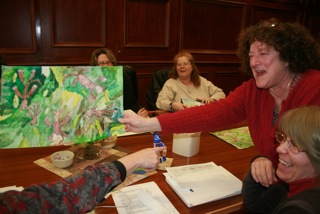
Jackie McTigue, Glenburn and Sue Beaulier, Ashland look at student exemplars

Bangor and Augusta

In January, a group of visual art educators met with faculty instructor, Catherine Ring, to begin a course in Refining Arts Assessment in the Visual Art Classroom in Bangor.  This was a great opportunity to bring together art educators who really do not have a lot of time to collaborate with each other. Looking at student art work, sharing how to assess student work according to standards, and participating in some very lively discussions were the name of the game. Many wonderful resources and ideas were shared. Participants are looking forward to more rich dialogue, and exciting discoveries of things they can do to improve student learning in Visual Art classrooms around Maine!

Katy Helman, Deer Isle-Stoningon and other art teachers in an animated discussion of student work

Does this partially meet, meet, or exceed proficiency?  How do we know our students are learning concepts and skills?  Are we teaching through standards-based instruction?  How do we measure creativity?  How does an art teacher balance the need to teach art skills and techniques and still encourage student ownership and creativity?   These are just some of the questions teachers tackled in the recent class in Bangor.  If you missed that opportunity, another course at Falmouth High School is happening on March 9, 10 and May 4 and 5.  There are still some openings in that class, though they are filling up fast!  Be sure to save a spot by registering for the course: Refining Arts Education in the Visual Art Classroom K-12 at Falmouth High School.

To register for upcoming courses, contact Catherine Ring (207) 367-5807 or visit the New England Institute for Teacher Education at www.newenglandinstitute.org.

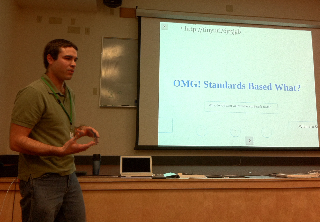
Jake Sturtevant presents on Standards-Based Instruction in the Music Room

On February 10, faculty instructor, Jake Sturtevant, greeted music educators from Deer Isle, Millinocket, Waterville, and Nobleboro in the first session of the course, Refining Assessment in the Music Classroom, at the Arboretum in Augusta. Jake presented on standards-based teaching in the music room, shared many resources (including ways to use technology) and fielded questions from how to give grades in a standards-based classroom to when to use formative and summative assessments. Jake is a Teacher Leader with the Maine Arts Assessment Initiative and has led seminars on music assessment at conferences and regional workshops around Maine.

Sue Barre, Waterville, Eileen York, Deer Isle, and Kris Vigue, Millinocket

These teacher-friendly courses are held in two weekend sessions and are offered for three graduate credits through the New England Institute’s partnership with Endicott College. If you are interested in bringing an arts assessment course to your area, please contact Catherine Ring, Executive Director, New England Institute for Teacher Education, PO Box 460, Stonington, Maine 04681 (207) 367-5807 or visit the website www.newenglandinstitute.org.

Thank you to Catherine Ring, member of the Maine Arts Assessment Initiative Leadership team, for contributing this blog post.

h1

Improving Arts Learning through Standards & Assessment

February 6, 2012

National Endowment for the Arts Research Roundtable

The National Endowment for the Arts (NEA) will host a webcast, “Improving Arts Learning through Standards & Assessment:  A National Endowment for the Arts Research Roundtable,” on Tuesday, February 14, 2012 from 8:30 a.m. to 3:00 p.m. ET at www.arts.gov

No preregistration is necessary. To watch the webcast, go to the NEA website at the scheduled date and time. Also, the webcast will be recorded and archived at arts.gov. It will be available for viewing beginning February 21, 2012, on the Research/Convenings page.

Questions? Contact Victoria Hutter, hutterv@arts.gov, 202-682-5692.

h1

Arts Assessment Graduate Course

November 28, 2011

Learning about arts assessment

The New England Institute for Teacher Education is providing a unique opportunity for arts educators throughout Maine to take a three-credit, graduate level course on on Arts Assessment. Visual art and music educators who are interested in deepening their learning in arts assessment are invited to participate in a cohort of peers to collaborate, and to learn about and apply best assessment practices in their classrooms. Course credit is given through Endicott Collegeʼs Van Loan School of Graduate and Professional Studies.

These courses have been specially-designed as an outgrowth of the Maine Arts Assessment Initiative. Teachers can expect to work at growing their level of understanding and enhancing their schoolʼs practices in an individually-tailored, inquiry- based class. Classes meet on a teacher-friendly schedule, over two weekends, with inter-session and post-session work done online.

Rob, Argy, Catherine on our way to assessment workshop for Aroostook county arts teachers

Rob Westerberg and Catherine Ring are the instructors for the Music and Visual Art courses respectively. Both Rob and Catherine are experienced arts educators and teacher leaders and bring a wealth of knowledge in their disciplines and in assessment practices. Join them for a great opportunity to meet and work with colleagues while improving your teaching and student learning in the arts!

Dates and Locations:

  • January 13, 14 and March 16, 17, 2012, York High School, York (Visual Art and Music)
  • January 27, 28 and April 27, 28, 2012, Bangor    (Visual Art only)
  •  February 10, 11 and May 11, 12, 2012    Augusta (Visual Art only)

Three ways to Register:

  1. Call Catherine Ring at 207-367-5807
  2. Email: newenglandinstitute@gmail.com
  3. Download the Registration Form at www.newenglandinstitute.org/index.php/
    registration-arts-assessment/
    . A flyer with the information can be downloaded from this page.

If you would like the New England Institute to bring a course to your area, please contact:

The New England Institute for Teacher Education                                            P.O. Box 460                                                                                                        Stonington, Maine 04681    207-367-5807                                                           Website: www.newenglandinstitute.org
Email: newenglandinstitute@gmail.com

h1

Maine Arts Ed Institute

August 10, 2011

Soooooo many resources

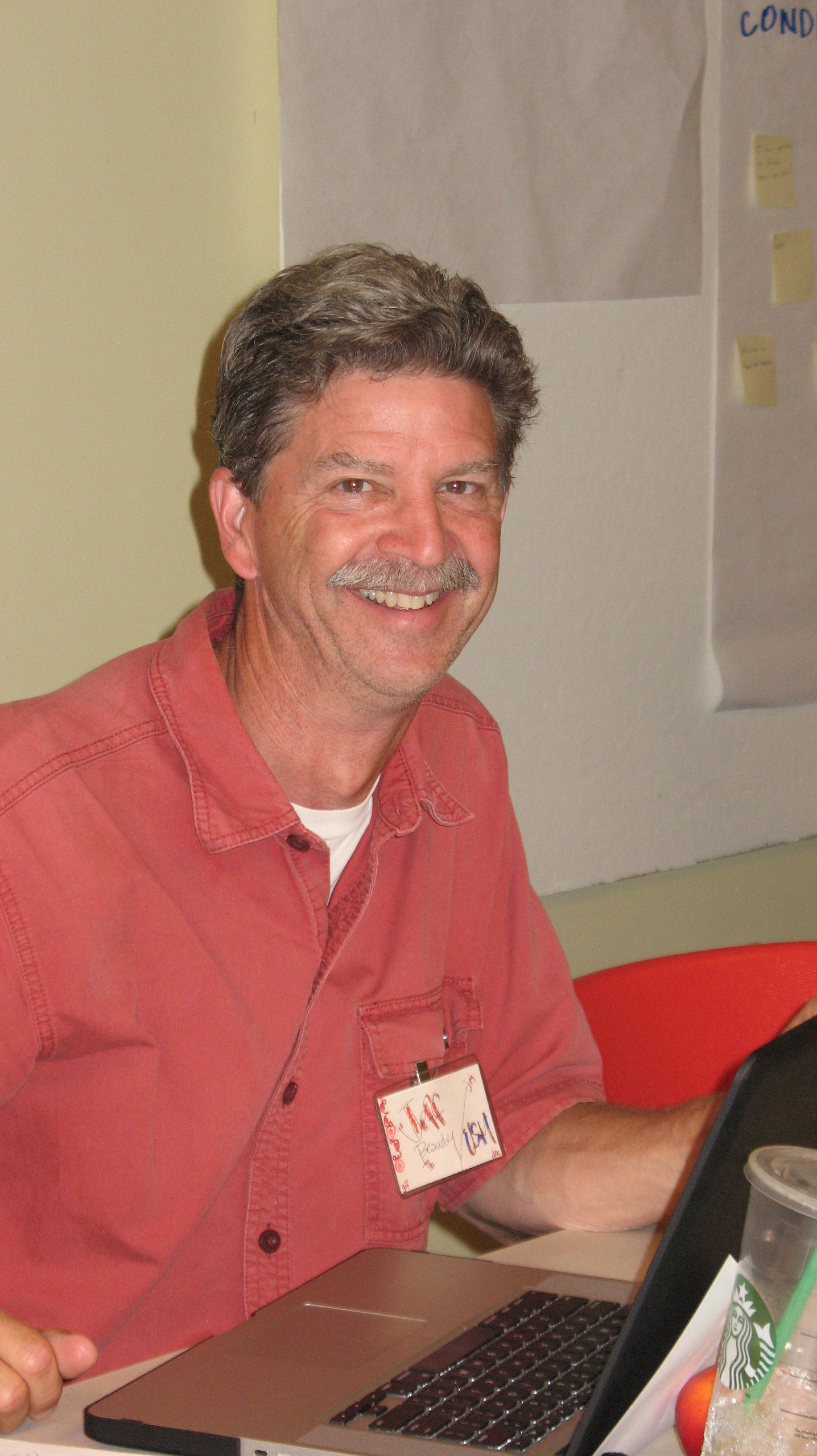
Jeff Beaudry, USM

To prepare for the institute that was held last week at Maine College of Art (MECA) participants prepared by reading articles, viewing videos, communicating on a wiki, and thinking about their role as leaders, teachers, and collaborators.

There were numerous resources provided for them and that they shared. This post is to provide you with some of the information to help you as a teacher in the 21st century classroom.

Assessment: New Hampshire Department of Education Arts Consultant Marcia

McCaffrey has many resources on the NH DOE website. For several years Marcia, and our Vermont colleague Gail Kilkelly, planned the New England Arts Education Assessment Institute. http://www.education.nh.gov/instruction/curriculum/arts/index.htm Maine’s teacher leaders read Guidelines for Arts Assessment and Envisioning Arts Assessment which can both be found at the above link. However, there are many other outstanding reading resources there as well. I suggest you spend a few minutes checking out what Marcia kindly provides there for eduators.

Jeff Beaudry, one of our planning committee members, teaches at USM. He is an

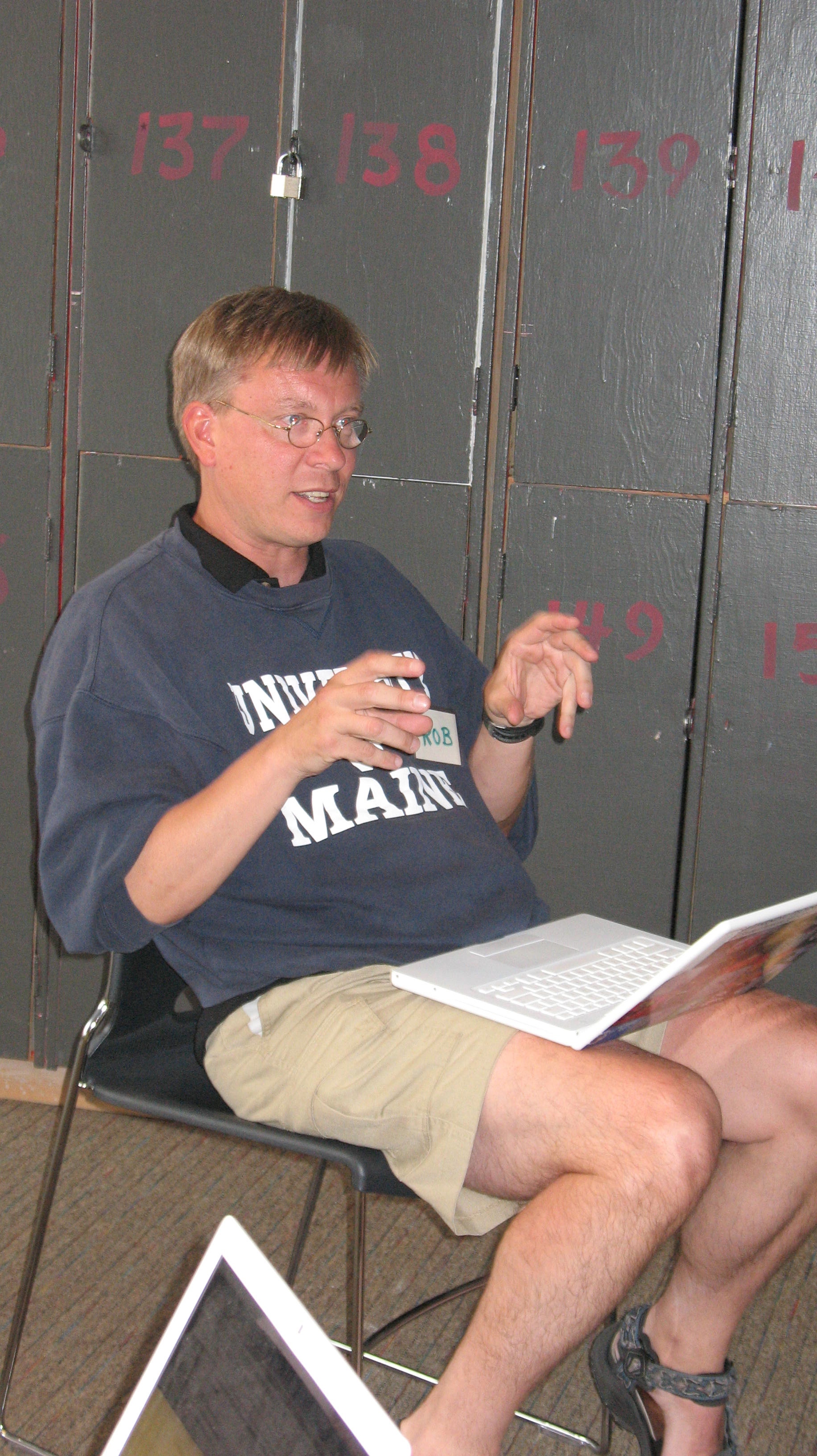
Rob Westerberg, music educator York High School

expert in assessment, data, leadership, is a photographer, and focuses much of his work (and play) on collaborating. In fact he has a really wonderful project that incorporates science and color encouraging participants to carefully observe and document the observations. We know how important observation is in the art and science world. Jeff guided participants readings contributing two chapters from Rick Stiggins assessment book. Chapter 2 is on Assessment for and of Learning and Chapter 4 called Assess How? Designing Assessments to Do What You Want. You can access both of these articles at http://maineartsassessment.pbworks.com/w/page/28367262/Resources#view=edit

Joining Jeff on the assessment portions at the institute were Bronwyn Sale who was an art teacher at Brunswick High School before joining the staff at Bates two years ago. Bronwyn provided a variety of information and led a session on some of the pre-reading assignments using jig-saw. Also at the above link are two assessment articles that participants read called Self Assessment by Heidi Andrade and The View by Maja Wilson.

Technology: To help prepare for the technology segment of the institute participants

Ann Marie Hutton, Apple MLTI

viewed Tony Wagner’s YouTube on the global economy and they read Integrating Technology with Student-Center Learning, a report to the Nellie Mae Education Foundation. We were fortunate to have Ann Marie Hutton join us for the assessment institute and share her knowledge and skills with participants. Ann Marie works for Apple with the MLTI project and was an art teacher before joining the MLTI team. Did you know that you can contact MLTI and request staff to travel to your school for professional development? And, there is absolutely no cost involved!

Leadership: Carol Trimble facilitated the session on leadership modeling her leadership skills. Pre-reading was information written by Linda Lambert from ASCD called Leadership Capacity for Lasting School Improvement. Certainly all arts educators contribute to improving schools, often at the heart of that responsibility. Another article that was written by teacher Scott Hunt is called Teacher Leadership. Both articles are available on the page embedded above.

Catherine Ring, arts consultant New England Institute for Teacher Education

Rounding out our presenters last week were music educator Rob Westerberg and arts consultant with the New England Institute for Teacher Education Catherine Ring.  Both contributed resources and their wisdom and experience to the institute. There are many more resources that will be shared as time passes and you can look forward to getting at the October 7th statewide arts conference being held at USM, Portland. More information coming in the near future on the conference. The 18 teacher leaders will be presenting workshops at the conference and will also be presenting in the regions throughout the state during the school year, 2011-12.

For an update on the arts assessment initiative please go to http://maineartsassessment.pbworks.com/ and please email me if you have questions at argy.nestor@maine.gov

Photographs taken at the institute by Jen Nash have been posted at https://picasaweb.google.com/Jen.Acosta.Nash/DropBox?authuser=0&authkey=Gv1sRgCOqAqMzDvbf1lQE&feat=directlink

h1

Groundswell

June 28, 2011

Assessment in the arts

MENC (National Association for Music Education) has a fairly new section on their website called MENC Advocacy Groundswell. On March 31st the following question was posted:

What do you think about “measuring” music students? I am thinking in terms of accountability.

The question was posted by one of MENC staff members, Nancy Townes. As of today there were 12 comments to the question. You might want to check them out and consider your thoughts on this topic. Even though this was posted on the national music website it could apply to any of the art forms. http://advocacy.menc.org/forum/topics/what-do-you-think-about#comments Of course it would be great to hear what you have to say so please post a comment below in the meartsed blog.